Our top picks
Battery, single-stage
1. Greenworks SN80L410
Best for: A paved drive in light to moderate snow
Gas, two-stage
2. Husqvarna ST 124
Best for: Heavy, wet or deep snow, and gravel
Corded electric
3. WEN 5670
Best for: A short paved drive near an outlet
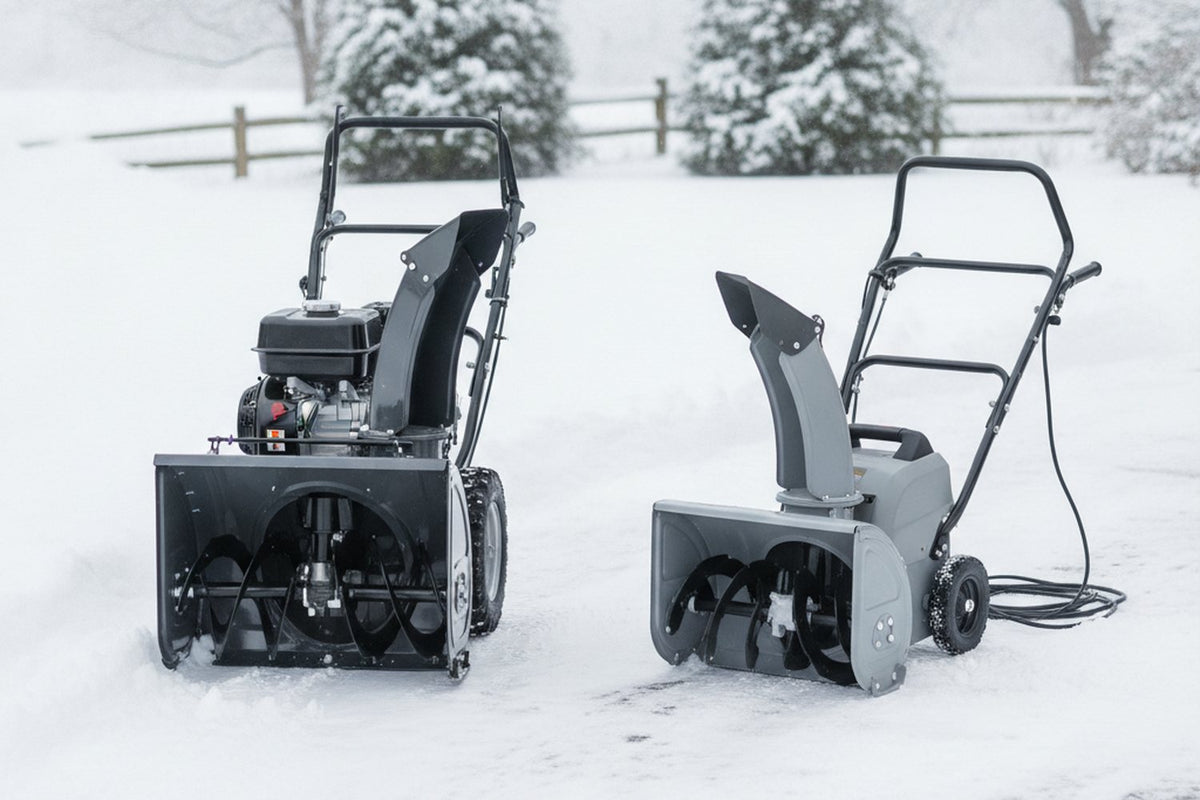
Gas vs electric snow blower, by Toro's snow page: electric snow blowers are efficient solutions for light to moderate snow, while gas models handle heavier, deeper snow. Greenworks adds that electric machines have no problem with snowfalls of less than a foot but may struggle to completely clear wet and deep snow, and that they need no oil changes, spark plug replacements or fuel stabilizers. Electric means battery or corded, and for small driveways Toro calls power shovels or corded snow blowers perfect for tight spaces and quick clears. Our battery pick is the Greenworks SN80L410 battery snow blower; our gas pick is the Husqvarna ST 124; our corded pick is the WEN 5670.
Electric vs gas snow blower: how the three power sources compare
| What the makers say | Corded electric | Battery | Gas |
|---|---|---|---|
| Snow it suits | Light to moderate snow, for electric machines (Toro); a 10 in clearing depth on the WEN 5670 (WEN) | Light to moderate snowfalls, anything less than a foot (Greenworks); snow up to 12 in deep for its electric and battery line (Toro) | Heavier, deeper snow (Toro); heavy, wet snow and larger driveways, and snow up to 12.5 in deep for its gas line (Toro) |
| Kinds sold | Power shovels only, in Toro's range (Toro) | Power shovels, single-stage, two-stage and commercial machines (Toro) | Single-stage, two-stage and commercial machines (Toro) |
| Driveway | Small driveways: power shovels or corded snow blowers for tight spaces and quick clears (Toro) | Up to 18 cars for its electric and battery line (Toro); smaller areas and tight spaces (Husqvarna) | Larger driveways; up to 18 cars for its gas line (Toro) |
| What ends a run | The cord: move only within the range the extension cord can reach (WEN) | The battery: runtimes can be limited, and heavy snowfall may need a second battery (Greenworks) | The tank: 2.2 l of fuel on the ST 124 (Husqvarna) |
| Upkeep | Virtually maintenance free, of its electric Power Shovel and Power Curve (Toro); lubricated for life at the factory (WEN) | No oil changes, spark plug replacements or fuel stabilizers (Greenworks) | An oil check before each start, oil changes by the hour and a yearly spark plug check (Husqvarna, ST 124 manual) |
| Cold mornings | Parts may freeze in extreme cold, and it is not to be run with frozen parts (WEN) | Cold can cut power for a time; store and charge the battery indoors (Greenworks) | A plug-in electric start, as low temperatures are often tough on batteries (Husqvarna) |
| Surface | Smooth surfaces, for its power shovels (Toro) | Not on gravel for its single-stage machines (Greenworks); two-stage machines, gas or battery, for gravel (Toro) | Smooth or gravel surfaces for its two-stage machines (Toro); housing height set to clear gravel (Husqvarna) |
| Weight | 29.3 lb for the WEN 5670 (WEN) | Typically lighter than gas models (Greenworks); 53 lb for the SN80L410 (Greenworks) | 173 lb for the ST 124 (Husqvarna) |
Sources: Toro's snow page and buying guide, Greenworks's electric vs gas guide, its SN80L410 kit page and that machine's manual, Husqvarna's buying guide, ST 124 page and ST 124 manual, and WEN's manual for the 5670.
The makers differ on how far electric goes. Toro says electric suits light to moderate snow and gas handles heavier, deeper snow, yet its own snow page lists its electric and battery line for snow up to 12 inches deep and its gas line for up to 12.5, both for driveways of up to 18 cars. Greenworks calls electric machines ideal for most homeowners, while Husqvarna calls its battery models ideal for smaller areas and tight spaces. And Greenworks says the SN80L410 clears up to a 16 to 20 car driveway without giving a snow depth for that figure.
For battery and corded machines compared by job, with sections on how many batteries a driveway needs, gravel and when to step up to a two-stage battery machine, see our best electric snow blower guide. For two-stage machines, gas and battery, compared by job, with sections on how heavy they are, gravel and what they need each year, see our best 2-stage snow blower guide. For every kind ranked by job, with sections on public tests and on repairing, buying used or buying new, see our best snow blower guide.
Choose by your snow, your drive and your outlet
How much snow, and how wet
Toro's snow page lists its single-stage machines, which it sells in gas and battery, for light to moderate snow up to 18 inches, and its two-stage machines, also gas or battery, for heavy snow up to 21 inches. So a battery machine is not limited to a single-stage: our single stage vs two stage snow blower comparison sets the two stages side by side in the makers' words, and single-stage machines come in gas too, which our best single-stage snow blower guide covers in a section of its own.
Drive length, the cord and the battery
WEN's manual says to start the clearing path near the electrical outlet and work outward, and to move only within the range the extension cord can reach; its table calls for a 14 gauge cord at 25 feet and a 12 gauge cord at 50 feet for its 15A motor, and marks 100 and 150 feet not recommended. A battery has no cord, but Greenworks says runtimes can be limited and a heavy snowfall may need a second battery; it adds that any of its 80V batteries powers more than 75 tools. For how long a battery snow blower runs, see our best cordless snow blower guide.
Gravel and uneven ground
Greenworks does not recommend its single-stage snow throwers or snow shovels on gravel, and says gravel and stones can be picked up and thrown by the machine. Toro says some models, typically two-stage snow blowers, are designed to handle gravel or uneven ground, and to check the owner's manual first. Husqvarna's manual for the ST 124 says to adjust the collector housing height to clear gravel or crushed rock surface and, on rough surfaces, to set the skid plates so the scraper bar is above the top of the ground. WEN's manual, as we read it, says nothing about gravel. Our snow blower for gravel driveways guide covers how to set a snow blower for gravel and what to add for it.
Weight, storage and starting
By the makers' figures, the WEN 5670 weighs 29.3 pounds, the SN80L410 53 pounds and the ST 124 173 pounds, and Greenworks says battery machines are typically lighter and easier to handle than gas models. Husqvarna's manual says to empty the fuel tank before long storage and to keep the machine in a dry and frost free area; WEN's manual says to store its machine with the disconnected extension cord in a locked, dry place; and Greenworks says to store the snow thrower indoors, and its batteries and charger in a dry, room-temperature place. For starting, Husqvarna's page says to plug the ST 124 into an outlet and push the button. For lighter machines, with what the American Heart Association says about clearing snow, see our best lightweight snow blower guide.
The picks, by power source
1. Greenworks SN80L410: battery, single-stage
A 20 in battery single-stage with a 10 in clearing depth, by Greenworks.
| Pick | Power | Width | Depth or intake | Weight | Best for | Our verdict | Where to buy |
|---|---|---|---|---|---|---|---|
| 1. Greenworks SN80L410Battery, single-stage | 80V battery, one 4.0Ah | 20 in | 10 in | 53 lb | A paved drive in light to moderate snow | A 20 in battery single-stage with a 10 in clearing depth and one 80V 4.0Ah battery, by Greenworks. | Check price on Amazon |
| 2. Husqvarna ST 124Gas, two-stage | 212 cc gas, electric start | 24 in | 21 in | 173 lb | Heavy, wet or deep snow, and gravel | A 24 in gas two-stage with a 21 in intake and a plug-in electric start, by Husqvarna. | Check price on Amazon |
| 3. WEN 5670Corded electric | 120V corded, 15A | 20 in | 10 in | 29.3 lb | A short paved drive near an outlet | A 20 in corded machine with a 10 in clearing depth and a 15A motor, by its manual. | Check price on Amazon |
When we checked on November 25, 2026, every snow blower we link was in stock as new and sold by Amazon. How our guides are made sets out what we check.
The Greenworks SN80L410 is a battery machine that Greenworks's page calls a single-stage snow blower. By that kit page: a 20 inch clearing width, a 10 inch clearing depth, a brushless motor, a 180 degree rotating chute that throws snow up to 25 feet, dual LED headlights, folding handles, one 80V 4.0Ah battery and a charger, and a 4 year limited tool and battery warranty; Greenworks says it is designed for paved driveways and walkways and clears up to a 16 to 20 car driveway. Good to know: Greenworks gives that driveway figure without a snow depth, and its own page says coverage depends on snow depth, snow conditions and operating temperature; its manual lists operation from 1.4 to 113 degrees F and battery charging from 39 to 104 degrees F.
2. Husqvarna ST 124: gas, two-stage
Best for: Heavy, wet or deep snow, and gravel
A 24 in gas two-stage with a 21 in intake and a plug-in electric start, by Husqvarna.
The Husqvarna ST 124 is a gas machine that Husqvarna's page calls two-stage. Husqvarna's page gives a 24 inch working width, a 21 inch intake height, a 12.9 cubic inch engine (212 cc in its manual) of 6 hp gross, a 2.2 liter fuel tank, a plug-in electric start, a friction disc transmission with 4 forward and 1 reverse steps, a self-propelled variable speed drive and a weight of 173 pounds. Good to know: Husqvarna's manual for the ST 124 asks for an oil level check before each start, an oil change after the first 20, 50 and 100 hours and then every 100 hours, and a spark plug check each year, and Husqvarna's page lists no headlights.
3. WEN 5670: corded electric
Best for: A short paved drive near an outlet
A 20 in corded machine with a 10 in clearing depth and a 15A motor, by its manual.
The WEN 5670 is a corded machine that WEN's manual calls a 20-inch electric snow thrower. By WEN's manual: a 120V, 15A motor, a 20 inch clearing width, a 10 inch clearing depth, a throw of up to 29.5 feet, a chute that turns through 180 degrees, 7.1 inch wheels, a weight of 29.3 pounds, lubrication for life from the factory and a two year limited warranty for home use. Good to know: its manual's cord table marks every cord over 50 feet not recommended, so every part of the drive has to be within 50 feet of an outdoor outlet.
Size, weight and power, calculated from maker specs
Three figures we computed from the makers' numbers. Cross-section = clearing width x clearing depth or intake height, the size in square inches of the opening each pass takes in. Weight per inch = weight / clearing width, in pounds per inch of path. Battery energy = volts x amp-hours, in watt-hours; power draw = volts x amps, in watts. Each input is the maker's own figure, named in the last column.
| Pick | Cross-section per pass (computed) | Weight per inch of width (computed) | Battery energy or power draw (computed) | Inputs (source) |
|---|---|---|---|---|
| Greenworks SN80L410 (pick 1) | 200 sq in | 2.7 lb per in | 320 Wh battery | 20 in clearing width, 10 in clearing depth, 53 lb, 80V, one 4.0Ah battery (Greenworks page) |
| Husqvarna ST 124 (pick 2) | 504 sq in | 7.2 lb per in | does not apply (gas engine) | 24 in working width, 21 in intake height, 173 lb (Husqvarna page) |
| WEN 5670 (pick 3) | 200 sq in | 1.5 lb per in | 1,800 W draw | 20 in clearing width, 10 in clearing depth, 29.3 lb, 120V, 15A (WEN manual) |
Safety, in the words of the CPSC, OPEI, Husqvarna, Greenworks and WEN
Each line below is the source's own, for the purpose it gives. OPEI (the Outdoor Power Equipment Institute) says to review your owner's manual before getting out a snow thrower, and to know how to correctly operate the controls and quickly shut it off if necessary.
On clogs, the CPSC's snow thrower safety alert says injuries most frequently occur when people try to clear the auger, collector or discharge chute with their hands, and that people have died after becoming caught in the machine; it says to stop the engine and use a long stick to unclog wet snow and debris from the machine, not your hands, and to always keep hands and feet away from all moving parts. OPEI says never to put your hands inside the auger or chute, to use a clean out tool, and to always turn off the snow thrower and wait for all moving parts to come to a complete stop before clearing any clogs. Husqvarna's ST 124 manual says to shut the engine off, wait 10 seconds to be sure the impeller blades have stopped rotating, and always use a clean-out tool, not your hands. The Greenworks manual gives the same three steps for the SN80L410, with the product shut off. WEN's manual says not to use your hands to unclog the chute, and to stop the motor and unplug the unit before removing debris.
On carbon monoxide, the CPSC says others have died from carbon monoxide poisoning after leaving the engine running in an enclosed space, and says never to leave the machine running in an enclosed area. Husqvarna's manual says the exhaust fumes contain carbon monoxide and not to start the engine indoors or in closed spaces; elsewhere it says not to run the engine indoors except when starting it and moving the machine in or out of the building, with the outside doors open. Greenworks says electric snow blowers produce zero emissions.
On fuel, the CPSC says to add fuel to the tank outdoors before starting the machine, not to add gasoline to a running or hot engine, to keep the gasoline can capped, and to store gasoline out of the house and away from ignition sources; OPEI says never to add fuel to a running or hot engine. Husqvarna's manual says to make sure the engine is cool before you refuel, not to add fuel indoors, to move the machine at least 10 feet from where you filled the tank before a start, and not to fill the tank fully.
On cords, the CPSC says, for an electric-powered snow thrower, to be aware of where the power cord is at all times, and OPEI says to use an extension cord designed for outdoor use, avoid tripping and not run over the power cord. WEN's manual says ground fault circuit interrupter (GFCI) protection should be provided on the circuit or outlet used, to use an extension cord suitable for outdoor use, and to use a separate circuit of not less than 12-gauge wire protected with a 15A time-delayed fuse. For the ST 124's plug-in start, Husqvarna's manual says to use extension cords and receptacles as specified by the manufacturer for all units with electric starting motors.
On thrown objects, children and pets, OPEI says snow can hide objects, that doormats, hoses, balls, toys, wires and other debris should be removed because a snow thrower that runs over them may harm the machine or people, and that it is best to keep kids and pets indoors and supervised while a snow thrower runs, not playing in the snow as it is tossed out of the chute. Husqvarna's manual says never to direct the discharge toward people or areas where property damage can occur, to keep children and others away, and to exercise extreme caution when operating on or crossing gravel drives or walks. WEN's manual says to keep children, pets and bystanders away from the area of operation.
On slopes, OPEI says never to attempt to clear steep slopes and to use caution when changing directions on slopes or inclines. Husqvarna's manual says not to use the ST 124 on slopes greater than 15 degrees, and the Greenworks manual says to exercise extreme caution when operating on slopes.
How we made this comparison
We built this comparison from the makers' own pages and manuals (Toro, Greenworks, Husqvarna and WEN), the CPSC and OPEI, and picked one machine for each power source. We also searched the US Consumer Product Safety Commission's recall database on November 24, 2026 for each model we link and found no recall listed for any of these machines; the nearest, a 2023 Husqvarna recall, covers its Residential 300 Series (the ST 324, ST 327 and ST 330), not the ST 124. We make digging spades, not snow blowers, so nothing on this page is ours. How our guides are made sets out the full process.
Also considered
Each was checked on November 24, 2026.
- EGO SNT2424 two-stage snow blower. A battery two-stage, in stock and sold by Amazon; it is already the battery two-stage pick in our single stage vs two stage comparison, so this page does not repeat it.
- Westinghouse WSnow20D corded snow blower. In stock and sold by Amazon; the corded pick here is the WEN 5670, whose manual sets out the cord gauge and length it needs.
- Greenworks SN40L510 40V snow blower. In stock and sold by Amazon; the Greenworks page and manual cited here are for the 80V SN80L410, so that is the one we link.
Frequently asked questions
Gas or electric snow blower: which suits most homes?
Greenworks says it depends on your needs: electric machines offer ease of use and low maintenance and are ideal for most homeowners, while the upper ranges of gas machines can be more powerful and better suited to areas with frequent, heavy snowfall. Toro says electric suits light to moderate snow and gas handles heavier, deeper snow.
Battery vs gas snow blower: which needs less upkeep?
Greenworks says battery machines need no oil changes, spark plug replacements or fuel stabilizers: keep the battery charged and the machine clean. Husqvarna's manual for the gas ST 124 asks for an oil level check before each start, oil changes after the first 20, 50 and 100 hours and every 100 hours after that, a spark plug check each year, and an empty fuel tank before long storage. WEN says its corded 5670 is lubricated for life at the factory.
Which kind starts best on a very cold morning?
Husqvarna says low temperatures are often tough on batteries, and gives the gas ST 124 an electric start you plug into an outlet. The Greenworks manual for the SN80L410 lists operation from 1.4 to 113 degrees F and battery charging from 39 to 104 degrees F, and Greenworks says a cold battery may give less power for a time and to bring it indoors to warm up before charging. WEN's manual says parts of its corded machine may freeze in extreme cold, and not to run it with frozen parts.
Is an electric snow blower quieter than a gas one?
Greenworks says electric snow blowers are significantly quieter than gas models. For the gas ST 124, Husqvarna's own figures differ: its page lists a sound pressure level at the operator's ear of 105 dB(A), and its manual 86 dB(A). Neither WEN's manual nor the Greenworks page and manual for the SN80L410, as we read them, gives a decibel figure, and WEN's manual says the normal noise of a running snow thrower may make it hard to hear people approaching.
Can an electric snow blower clear a foot of snow?
Greenworks says electric snow blowers have no problem with light to moderate snowfalls of less than a foot but may struggle to completely clear wet and deep snow. Toro's snow page lists its electric and battery line for snow up to 12 inches deep, and its two-stage machines, which it sells in gas and battery, for heavy snow up to 21 inches. The two electric picks here each list a 10 inch clearing depth.
As an Amazon Associate we earn from qualifying purchases. Some links are paid. Disclosure
Product prices and availability are accurate as of the date/time indicated and are subject to change. Any price and availability information displayed on Amazon.com at the time of purchase will apply to the purchase of this product.