As an Amazon Associate we earn from qualifying purchases. Some links are paid. Disclosure
Our top picks
Best overall
1. Back to the Roots Organic Indoor Potting Mix
Best for: The base of a chunky mix
Best bark to mix in
2. SuperMoss Orchid Potting Bark
Best for: Opening up a mix with bark
Best perlite to mix in
3. Back to the Roots Organic Perlite
Best for: Drainage and air in any mix
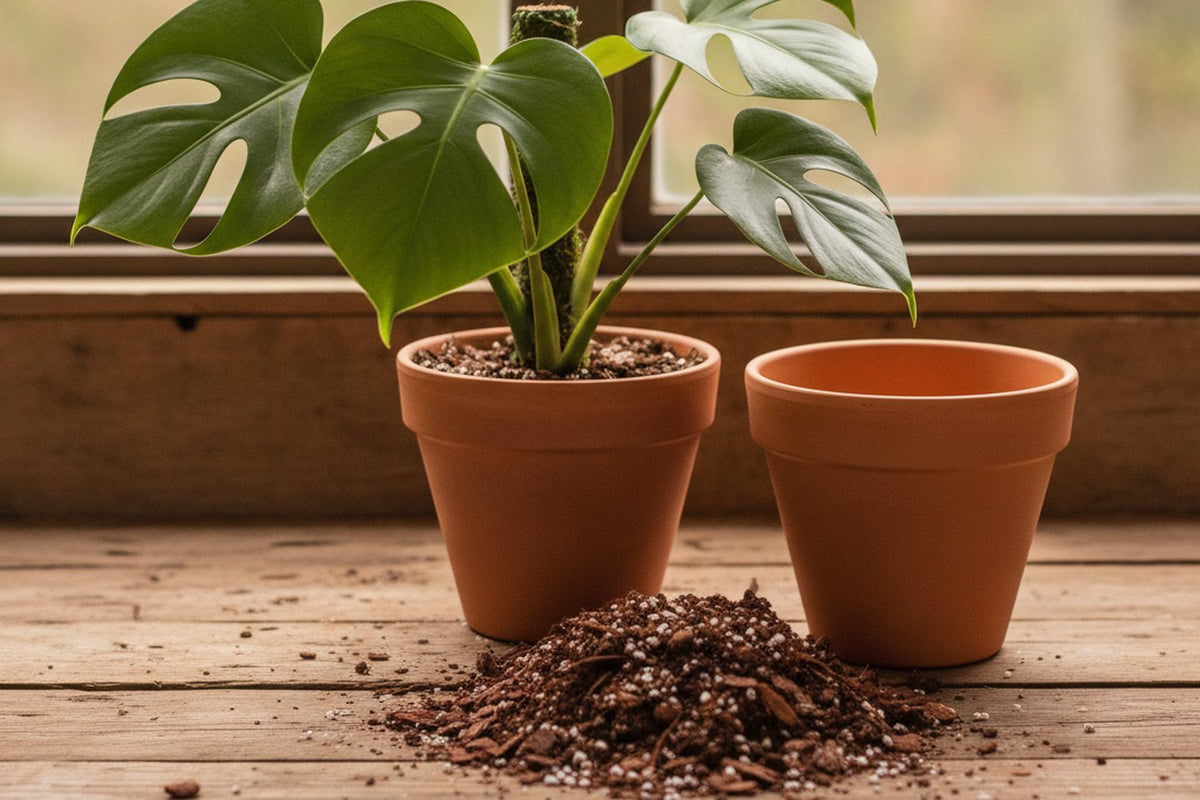
The best soil for monstera for most growers is the Back to the Roots Organic Indoor Potting Mix, a 6-quart peat-free indoor mix, stirred together with equal parts orchid bark and perlite. Picks 2 to 4 are that bark, that perlite and a peat-based indoor mix with plant food in the bag. Good to know: on its own pick 1 is an indoor potting mix, not a chunky one, and Ohio Tropics says many all-purpose mixes do far better for a monstera with chunky material such as perlite, pumice or orchid bark added.
1. Back to the Roots Organic Indoor Potting Mix
A peat-free indoor mix made without bark or compost, the base of the chunky mix.
| Pick | What it is | Bag | Part of the mix | Best for | Our verdict | Where to buy |
|---|---|---|---|---|---|---|
| 1. Back to the Roots Organic Indoor Potting MixBest overall | Coir and perlite mix | 6 qt | The potting mix third | The base of a chunky mix | A peat-free 6-quart indoor mix of coir and perlite, by Back to the Roots. | Check price on Amazon |
| 2. SuperMoss Orchid Potting BarkBest bark to mix in | Douglas fir bark | 4 qt | The bark third | Opening up a mix with bark | A 4-quart bag of natural Douglas fir bark, by SuperMoss. | Check price on Amazon |
| 3. Back to the Roots Organic PerliteBest perlite to mix in | Horticultural perlite | 8 qt | The perlite third | Drainage and air in any mix | An 8-quart bag of horticultural perlite, by Back to the Roots. | Check price on Amazon |
| 4. Miracle-Gro Houseplant Potting MixBest mix with plant food | Peat, coir, perlite, food | 4 qt | A base on its own | A peat mix that feeds | A 4-quart peat, coir and perlite mix with plant food, by Miracle-Gro. | Check price on Amazon |
When we checked on November 25, 2026, every pick we link was in stock as new and sold by Amazon. How our guides are made sets out what we check.
What is the best soil for monstera?
A loose mix that drains well and holds some organic matter. Penn State Extension asks for a well-draining soilless potting mix that is rich with organic matter and has a neutral pH (6.0 to 8.0), and says charcoal, bark or perlite can be added to a purchased mix. Our pick for that purchased mix is the Back to the Roots indoor mix (pick 1): Back to the Roots' page lists organic all-purpose plant food, perlite for aeration and drainage, coconut coir and yucca extract for moisture control and dolomitic limestone to help adjust pH, adds mycorrhizae for root growth, and says that because it is made without bark or compost it is less prone to indoor gnats. It is sold by Amazon. For the chunky mix, stir it with equal parts of orchid bark (pick 2) and perlite (pick 3). Otherwise, for a peat-based mix with plant food in it, the Miracle-Gro Houseplant Potting Mix (pick 4). For other houseplants and outdoor pots, our potting soil guide compares the everyday bags.
Why monstera roots want air as well as water
Because in the wild a monstera climbs. Penn State calls it a tropical understory plant that becomes epiphytic as it climbs into the trees, meaning it grows on the tree but gets its nutrients from rain and air, and says overwatering can result in root rot. Wisconsin Extension says to grow it in a fertile soilless mix, with ample root room to promote larger leaf growth. NC State Extension lists high organic matter and good drainage for it, and the Missouri Botanical Garden says that as a houseplant it needs a peaty soil-based potting mix, where Penn State and Wisconsin say soilless.
Mixing your own: the monstera mixes the sources give
Each one starts from a bag and opens it up. Ohio Tropics' chunky aroid mix is equal parts indoor potting mix, orchid bark and perlite, which it calls probably the freest draining of its blends; its simpler blend is 2 parts potting mix to 1 part #3 perlite, a larger perlite that it says adds far more porosity and drainage than smaller perlite and helps prevent compaction. House Plant Journal's Darryl Cheng gives peat moss or coco coir, perlite and bark chips in a ratio of roughly 2:1:1. Joy Us Garden's Nell Foster uses half potting soil and half coco coir with a few handfuls of coco chips and compost, and lists half potting soil with half orchid bark or coco chips, or three quarters potting soil with a quarter pumice or perlite, as other mixes. Perfect Plants gives a DIY aroid mix as 1 part orchid bark, 1 part perlite or pumice and 1 part peat moss or coco coir.
Which to choose depends on how fast your pot dries. Ohio Tropics says the chunkier the mix, the more quickly it will dry out, especially in great light and warm temperatures. So the equal-parts mix suits a bright, warm room where you water often, and a 2:1 mix or a half-and-half mix suits a pot that dries slowly.
How far one bag goes, by recipe
Further than the bag size suggests, because each bag is only one part of the mix. Miracle-Gro's listing for pick 4 says one 4-quart bag fills one 8-inch container, so the table takes 4 quarts as one 8-inch pot and works out how many such pots each bag supplies its share for: pots = bag quarts / (4 x the part's share of the recipe). In Ohio Tropics' equal-parts mix each part is a third; in its 2:1 mix the potting mix is two thirds and the perlite a third, with no bark. Bag sizes are from each listing. Not stated means neither the maker's page nor the listing details we read say what one bag fills.
| Bag | 8-inch pots, equal parts | 8-inch pots, 2 parts mix to 1 perlite | Bag size (source) | What one bag fills (source) |
|---|---|---|---|---|
| Back to the Roots indoor mix (pick 1) | 4.5 | 2.25 | 6 qt (listing) | not stated |
| SuperMoss orchid bark (pick 2) | 3 | not in this recipe | 4 qt (listing) | not stated |
| Back to the Roots perlite (pick 3) | 6 | 6 | 8 qt (listing) | not stated |
| Miracle-Gro Houseplant mix (pick 4) | 3 | 1.5 | 4 qt (listing) | one 8-inch container (listing) |
The counts are for an empty pot. Miracle-Gro says amounts vary with the size of the root ball, and a root ball takes up room, so with a plant going in, a bag goes further. In an equal-parts batch the 4-quart bark bag runs out first, at three pots, against four and a half from pick 1's 6 quarts and six from pick 3's 8 quarts.
Bark, perlite, pumice or charcoal?
Any of them can open up a bag. Penn State names charcoal, bark and perlite as add-ins for a purchased mix. Ohio Tropics says perlite tends to float to the top over time and that there are some concerns over the fluoride content in perlite, and it uses 1/4-inch pumice in place of perlite if you do not like perlite. Joy Us Garden adds coco chips, which it says add aeration and aid in drainage.
When to repot a monstera, and into what
Every one to two years, in late winter or early spring, by the University of Minnesota Extension, or sooner on one of its signs: roots growing out of the bottom of the pot, potting soil that dries out within 24 hours, a plant that has overgrown its container and tips over easily, a root ball you can lift out whole, or a plant that is dull and seems to have stopped growing. Joy Us Garden gives a longer span, every 2 to 4 years, depending on the conditions the plant grows in and its size. Minnesota says to choose a container about two inches wider than the current one and at least 1 to 2 inches taller. Joy Us Garden says you can go up one pot size, for instance from 6 inches to 8 inches, and that the pot needs plenty of drainage holes so excess water can flow out. House Plant Journal suggests a bigger step for a vigorous plant: a pot roughly the same diameter as its largest leaf.
Set the support when you repot. Penn State says a monstera will need something sturdy to climb, and that moss sticks, trellises, bamboo stakes and boards covered with sphagnum moss will all work; Wisconsin says to water the moss-covered support too, so the aerial roots can take up water and nutrients.
Repotting into the new mix, step by step
These are Joy Us Garden's steps from its own repotting. Lay a piece of paper bag over the drain holes to keep the fresh mix from escaping, with small holes poked in it so the water drains out. Gently massage the roots to loosen them a bit; with a very tight root ball you may have to cut into it a bit. Put enough mix in the pot that the top of the root ball sits about 1/2 inch below the top of the pot, then fill around the root ball and tamp the mix between the root ball and the sides of the pot so the plant stands up straight. If the aerial roots are in the way, you can tie them together; Joy Us Garden leaves most of them on. Afterward it waters the plant well, puts it back in its bright spot out of direct sun, and does not let the soil dry out completely while the plant settles in.
Watering a monstera in a chunky mix
Water by the mix, not the calendar. Penn State says to water thoroughly and let the top 1 to 2 inches of the soil dry out between waterings; Minnesota says mature plants should be watered weekly, or when the top 1 to 2 inches of soil is dry; NC State says to let the top quarter to one-third dry; and House Plant Journal says a better rule is to water whenever the soil is about halfway dry, because a weekly rule does not account for varying light. Ohio Tropics says watering schedules should not be strictly adhered to, since your mix and your room change how quickly a pot dries. Joy Us Garden warns that even though the top of the soil is dry, it could be wet further down where most of the roots are, and suggests a moisture meter; our soil moisture meter guide covers those.
What the leaves say about the mix
Leaves that sweat are the first sign of a mix that stays too wet. Wisconsin says the leaves will sweat if the growing medium is too moist, and to reduce watering when that happens to prevent root rot; it adds that plants kept on the dry side grow slower and that the leaf edges turn brown if humidity is too low. Penn State asks for humidity above 50 percent, says a nearby humidifier may help in a very dry room, and wants bright light but not direct sun, since a monstera gets leggy in lower light; our grow light guide covers lights for darker rooms. For feeding, Penn State says to fertilize every two weeks through the growing season and monthly through the winter with a balanced houseplant fertilizer, and Wisconsin says to fertilize regularly from spring until fall.
What to root a monstera cutting in
Root it first, then pot it in the mix. Minnesota says a rooting medium has to keep moisture, support the cutting and drain well so the cutting does not rot; it calls perlite the most common medium for monstera cuttings, since it gives new plants support, oxygen and moisture, and also lists potting soil and lightweight expanded clay aggregate (LECA). It asks for a container at least 4 inches in diameter and 5 inches deep, or a one-quart nursery pot, with at least one hole about the diameter of a pencil, and for the medium to stay continually moist for the first 1 to 2 weeks. Roots form in about 2 to 4 weeks, by Minnesota; once they have and the cutting is growing, it moves to a larger pot.
The best soil and mix-ins for monstera, by job
2. SuperMoss Orchid Potting Bark: best bark to mix in
Best for: Opening up a mix with bark
A 4-quart bag of natural Douglas fir bark, by SuperMoss.
The SuperMoss orchid bark is the bark third of the chunky mix: the listing calls it natural Douglas fir tree bark that is not heat treated or baked, sold as an orchid potting medium and as a soil cover for indoor and outdoor container plants, in a bag of 4 quarts (231 cubic inches). It is sold by Amazon. Good to know: pick 4's listing says bark is known to shelter fungus gnats, which Penn State lists among the pests to watch for on monstera, and the listing details we read give no piece size.
3. Back to the Roots Organic Perlite: best perlite to mix in
Best for: Drainage and air in any mix
An 8-quart bag of horticultural perlite, by Back to the Roots.
The Back to the Roots perlite is the perlite for either recipe: the listing calls it premium horticultural grade perlite in an 8-quart bag, for root growth, soil aeration and drainage, and Back to the Roots' page says it reduces soil compaction and is 100% USA sourced. It is sold by Amazon. Good to know: neither the listing nor the maker's page gives a grade number or piece size, and Ohio Tropics' 2:1 mix asks for the larger #3 perlite.
4. Miracle-Gro Houseplant Potting Mix: best mix with plant food
Best for: A peat mix that feeds
A 4-quart peat, coir and perlite mix with plant food, by Miracle-Gro.
The Miracle-Gro Houseplant mix is the base with plant food in the bag: the listing gives a blend of perlite, sphagnum peat moss, coir and fertilizer that feeds indoor container plants for up to 6 months, names monstera among the indoor tropical plants it is for, and says it is less prone to fungus gnats because it contains no compost or bark. It is sold by Amazon. Good to know: at 4 quarts it is the smallest bag here (the table shows how far it goes), and it is peat-based, the one ingredient pick 1 leaves out.
How we picked these mixes
We compared each pick's ingredients, bag size and stated use from its maker's page and its Amazon listing, took the mix, repotting and watering advice from the Penn State, Minnesota, Wisconsin and NC State extensions, the Missouri Botanical Garden, Ohio Tropics, House Plant Journal and Joy Us Garden, and worked out how many 8-inch pots each bag supplies in two of Ohio Tropics' recipes. None of the ready-made aroid or monstera mixes we read on Amazon was sold by Amazon, so the picks are a base mix and the two add-ins for the chunky mix, plus a peat-based base with plant food. Every pick we link was in stock as new and sold by Amazon when we checked, and Also considered names the other mixes we read and why each is not linked. We make digging spades, not potting mix, so nothing on this page is ours. How our guides are made sets out the full process.
Also considered
Each was checked on November 24, 2026.
- Perfect Plants Aroid Potting Mix. Its maker lists pine bark, perlite and coconut coir among its ingredients. On Amazon it is sold by a seller under the brand's own name rather than by Amazon, so we do not link it.
- rePotme Monstera Imperial mix. Its maker gives a coir base with small sponge rock, Monterey pine bark and charcoal. On Amazon it is sold by a seller under the brand's own name, not by Amazon.
- Grow Queen, veryplants, Duspro and HydraGarden aroid mixes. Each listing we read was sold by a seller under the brand's own name, not by Amazon.
- GARDENWISE coarse perlite. The listings we read were sold by a seller under the brand's own name, not by Amazon, so the perlite pick is Back to the Roots'.
- Soil Sunrise and Gardenera monstera mixes. The listings we read were sold by third-party sellers.
- Rosy Soil aroid mix. The listing we read had no offer on Amazon.
- Miracle-Gro Tropical Potting Mix. The listing we read was sold by a third party and was in short supply.
- Better-Gro Special Orchid Mix. Sold by Amazon; it is a pick in our Christmas cactus soil guide, so the bark here is a different one.
Frequently asked questions
What is the best soil for monstera?
For most growers, the Back to the Roots Organic Indoor Potting Mix stirred with equal parts orchid bark and perlite, Ohio Tropics' chunky aroid mix. Penn State asks for a well-draining soilless mix rich in organic matter, with charcoal, bark or perlite added to a purchased mix. For a peat-based mix with plant food in it, the Miracle-Gro Houseplant Potting Mix.
Can I use regular potting mix for a monstera?
Yes, but Ohio Tropics says many all-purpose mixes are far better with chunky material added, such as perlite, pumice or orchid bark, for drainage and air flow to the roots.
Can you use cactus soil for monstera?
You can make it work, says Ohio Tropics, but cactus mixes are designed to dry out more quickly, and it recommends adding coarse material such as perlite or pumice.
How often should you repot a monstera?
Every one to two years, in late winter or early spring, by the University of Minnesota Extension, into a pot about two inches wider. Joy Us Garden repots when the roots are showing out the bottom.
Does a monstera need a moss pole?
It needs something sturdy to climb, by Penn State: moss sticks, trellises, bamboo stakes or boards covered with sphagnum moss. Without support, the Missouri Botanical Garden says, plants tend to grow horizontally.
Disclosure: Some links pay us a commission when you click or buy, and on some pages brands pay us through Amazon's creator program on links to their products.
Product prices and availability are accurate as of the date/time indicated and are subject to change. Any price and availability information displayed on Amazon.com at the time of purchase will apply to the purchase of this product.