As an Amazon Associate we earn from qualifying purchases. Some links are paid. Disclosure
Our top picks
Best overall
1. USA Pinestraw Long Needle Pine Straw
Best for: Trees, shrubs and slopes
Best OMRI Listed mulch
2. Back to the Roots Coconut Husk Mulch
Best for: Beds kept to organic inputs
Best for two seasons in a bed
3. PlantBest Coco Mulch Block
Best for: Flower beds and borders
The best mulch for trees, shrubs and sloped beds is long needle pine straw, such as the USA Pinestraw Long Needle Pine Straw, sold on Amazon by USA Pinestraw itself: Clemson's extension service calls a 2- to 3-inch layer of pine needles an excellent mulch for acid-loving trees and shrubs and says the needles interlock and stay in place better than most mulches, especially on a slope. For coconut mulch, which comes as a compressed block you wet before spreading, picks 2 to 4 differ by form and by what their makers state. Good to know: the University of Florida says pine straw breaks down and settles quickly, so you will have to re-mulch often, while Clemson gives pine needles around 2 to 4 years before more is needed.
1. USA Pinestraw Long Needle Pine Straw
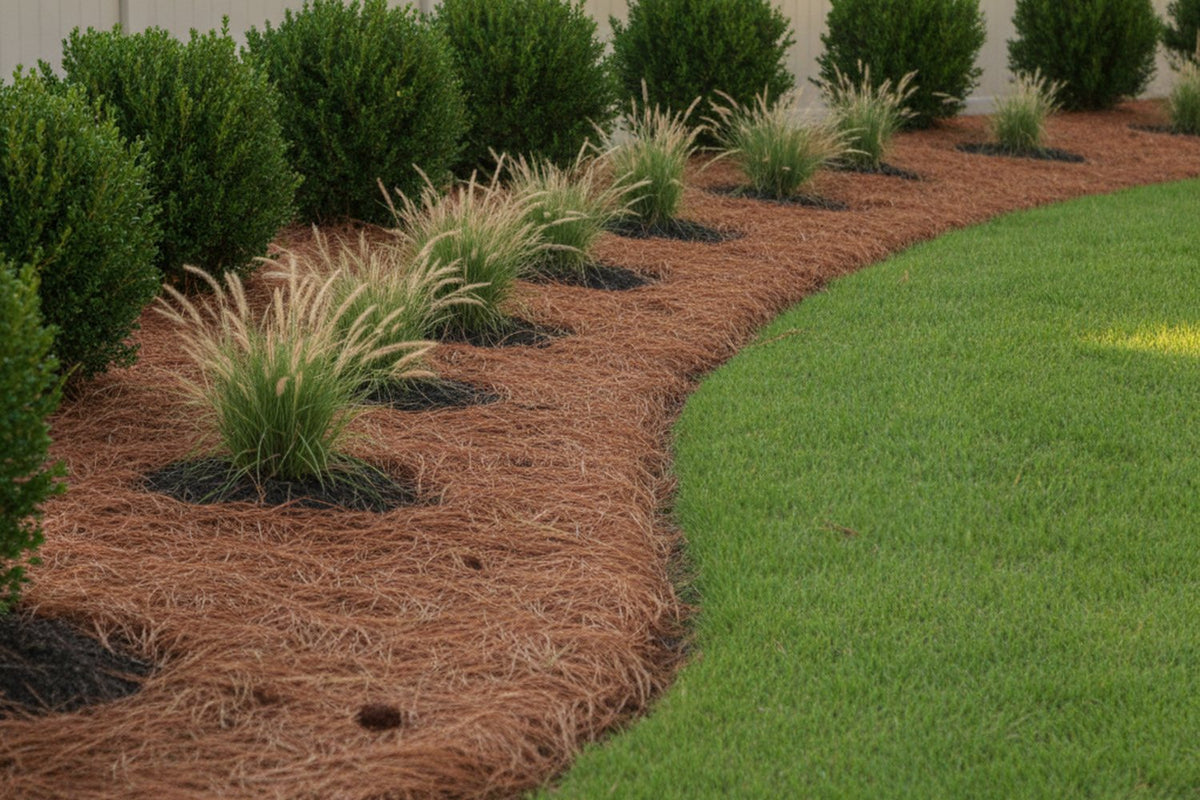
Long needle pine straw; Clemson says pine needles stay in place, even on a slope.
| Pick | Material | Form | Stated coverage | Best for | Our verdict | Where to buy |
|---|---|---|---|---|---|---|
| 1. USA Pinestraw Long Needle Pine StrawBest overall | Long needle pine straw | Loose straw in a box | Up to 240 sq ft | Trees, shrubs and slopes | Long needle pine straw in a box the listing says covers up to 240 sq ft. | Check price on Amazon |
| 2. Back to the Roots Coconut Husk MulchBest OMRI Listed mulch | Coconut husk | 10 lb block, add water | Over 2 cubic feet | Beds kept to organic inputs | A 10 lb coconut husk block that expands to over 2 cubic feet; the listing says OMRI Listed. | Check price on Amazon |
| 3. PlantBest Coco Mulch BlockBest for two seasons in a bed | Coconut fiber and husk chips | 9.1 lb block, add water | 17.5 sq ft at 1.5 in | Flower beds and borders | A 9.1 lb coconut block its maker says lasts up to two seasons. | Check price on Amazon |
| 4. Plantonix Coco ChipsBest coconut husk chips | Coconut husk chips | 10 lb block, hydrate | Not stated | Raised beds and containers | A 10 lb block of coconut husk chips that you hydrate, then spread. | Check price on Amazon |
When we checked on November 21, 2026, every pick we link was in stock as new, each sold by Amazon or by the company that makes it. How our guides are made sets out what we check.
What is the best mulch?
The one that fits the bed. For trees, shrubs and slopes, the USA Pinestraw long needle pine straw (pick 1): the maker's site says its premium long needle straw is up to 14 inches long, from the longleaf pine, and harvested in southern Georgia, and the listing says one box covers up to 240 square feet and that the long needles interlock to stay in place, even on slopes. Otherwise, for beds kept to organic inputs, the Back to the Roots coconut husk mulch (pick 2), whose listing says OMRI Listed; for a coconut mulch its maker says lasts up to two seasons, the PlantBest block (pick 3); for coconut husk chips in raised beds or pots, the Plantonix coco chips (pick 4). Shredded hardwood, wood chips, pine bark, straw and cedar are not on the list because the bags we found were sold by third-party sellers or in short supply; What each kind of mulch is for covers them anyway.
What each kind of mulch is for
Organic mulch, made of something that was once living, breaks down, and that is part of the point. Clemson's Home and Garden Information Center says organic mulches decompose over time and need to be replaced after a few years, and that as the mulch decays and moves down into the soil, the organic material improves the quality of the topsoil. The University of Florida's IFAS Gardening Solutions recommends organic mulches for herbs, vegetables, shrubs, fruit trees and other trees.
- Pine straw (pick 1). Florida says pine straw is not likely to wash away, because the needles knit together.
- Shredded hardwood. Clemson says it is good at suppressing weeds, does not wash away easily and decomposes relatively slowly. Florida says hardwood mulches are often dyed using organic colorants, and cautions that mixed hardwood mulch can be contaminated with chromated copper arsenate (CCA) from pressure-treated lumber: since it is toxic to animals and humans, do not use it around edible gardens and wear gloves when spreading it; to buy mulch free of toxic substances like CCA, look for the Mulch and Soil Council (MSC) certification logo.
- Wood chips. Clemson says a 2- to 3-inch layer of wood chips provides good weed control, and The Morton Arboretum says wood chips can hold water better than bark chips; the nitrogen question below covers small wood chips.
- Pine bark. Clemson says a 2- to 3-inch layer is good for weed control and that large pine bark nuggets float in water and may not stay in place during a heavy rain. Florida says one of its studies found pine bark kept two-thirds of its original depth after two years.
- Straw, for vegetable beds. Clemson says straw is not very ornamental and is best for a vegetable garden or over newly sown lawns, decomposes rapidly so you will have to replenish it, and may carry grain seed heads that sprout. The University of Missouri Extension lists composts, straw, hay or other materials that will be largely decomposed at the end of the season among the best mulches for annual vegetable crops. The two differ on hay: Clemson says never to use hay (coastal Bermudagrass) for mulch, since it contains too many weed seeds.
- Cypress. Florida's Florida-Friendly Landscaping program does not recommend cypress mulch, because it may be sourced from endangered wetlands.
- Rubber. Florida says rubber mulches are generally less effective than organic mulches in suppressing weeds and absorb heat, leading to extremely high temperatures in the ground beneath, and that UF/IFAS does not recommend inorganic mulches such as rubber in garden beds. Clemson says the effectiveness of ground rubber tires as a mulch is still being evaluated.
- Coconut. None of the extension pages we read covers coconut mulch, so what we say about picks 2, 3 and 4 comes from their makers and listings.
- Leaves. Clemson counts leaves among the organic mulches. Our guide on how to mulch leaves covers shredding fall leaves with a mower and spreading them on beds.
The picks below are pine straw and coconut mulch because those are the kinds we could link sold by Amazon or by the company that makes them; Also considered names the rest.
How deep to spread mulch, and how much to buy
Two to three inches for most beds, by the sources, with less around small plants and up to 4 inches for coarse mulch under trees. Clemson says many wood and bark mulches are composed of fine particles and should not be more than 2 to 3 inches deep, that excessive amounts of these fine-textured mulches can suffocate plant roots, and that coarse-textured mulches such as pine bark nuggets can be as deep as 4 inches. Florida recommends mulching to a depth of 3 inches and only a 1-inch depth around seedlings or small vegetables or herbs, and says not to apply more than 3 inches, as excessive mulch can divert rain and irrigation meant for plant root systems. The Morton Arboretum gives 3 to 4 inches of medium- to coarse-textured mulch under trees and shrubs and says perennial beds need only a couple of inches. The sources differ on the top end: Florida stops at 3 inches, while Clemson and Morton allow 4 for coarse mulch.
To work out how much, Clemson's arithmetic: there are 27 cubic feet in a cubic yard, and one cubic yard covers 324 square feet with an inch of mulch, so multiply your bed's square footage by the depth in inches and divide by 324 for cubic yards. The table does the same sum per pick: square feet covered = cubic feet x 12 / depth in inches, and blocks per 100 square feet at 3 inches = 25 / cubic feet. Not stated means the maker and the listing give no volume.
| Mulch | Sq ft covered at 2 in, per block | Sq ft covered at 3 in, per block | Blocks per 100 sq ft at 3 in | Volume (source) | Coverage the listing states |
|---|---|---|---|---|---|
| USA Pinestraw long needle pine straw (pick 1) | not stated | not stated | not stated | not stated | up to 240 sq ft, depth not stated (listing) |
| Back to the Roots coconut husk mulch (pick 2) | at least 12.0 | at least 8.0 | at most 12.5 | over 2 cubic feet (listing) | not stated |
| PlantBest coco mulch block (pick 3) | 12.7 | 8.5 | 11.8 | about 16 gallons (60 L) = 2.12 cubic feet (listing) | up to 17.5 sq ft at a 1.5 in depth (listing) |
| Plantonix coco chips (pick 4) | not stated | not stated | not stated | not stated | not stated |
Pick 2 says over 2 cubic feet, so its rows are a floor on coverage. Pine straw is sold by area, not volume: the listing gives 240 square feet a box with no depth, and Clemson's 2- to 3-inch layer is the depth to aim for.
Keep mulch off trunks, stems and siding
The sources agree that mulch stays off trunks and stems, and differ on how far, by plant size. Clemson's steps: weed the area first, spread a layer over the entire bed, keep mulch 2 to 3 inches away from the stems of woody plants to prevent decay caused by wet mulch and rodent damage during the winter, and keep mulch 6 to 12 inches away from the walls of buildings, so termites cannot use it as a bridge to cross treated soil. Florida calls mulch piled against the base of a tree volcano mulching, says it holds moisture and encourages rot in the trunk and can shelter rodents that chew the bark, and says to place mulch about 1 foot from the base of large plants and trees and leave a couple of inches bare around smaller plants. Morton says to pull mulch away from the bases of tree and shrub trunks, creating a donut-hole around the trunk. Clemson also says that adding several inches of mulch on top of landscape cloth gives better moisture, temperature and weed control; our weed barrier and landscape fabric guide covers putting landscape fabric under mulch.
When to mulch, and when to top it up
Clemson says the best time to mulch new plantings is right after you plant them, and around established plants in early spring, when plants are beginning to grow and before weed seeds start to germinate. Florida says that when the depth falls below two inches, it is time to add another thin layer on top, and that replacing the mulch entirely is not recommended, as you may damage surface-level plant roots; Morton says to check the depth every year and replenish as necessary. Clemson says newly installed mulch should be watered, to prevent a mat of fungus that repels water.
Does mulch take nitrogen from the soil?
Small wood chips can, by Clemson: it says they decompose very rapidly using nitrogen from the soil, which needs to be replaced by nitrogen fertilizer, that wood chips may attract termites, and that they are usually completely decomposed within 2 years. It names no such effect for pine needles.
The best mulches, by job
2. Back to the Roots Coconut Husk Mulch: best OMRI Listed mulch
Best for: Beds kept to organic inputs
A 10 lb coconut husk block that expands to over 2 cubic feet; the listing says OMRI Listed.
The Back to the Roots coconut husk mulch is the one pick whose listing says OMRI Listed, which it says assures organic production, handling and processing. It comes as a 10-pound block of compressed coconut husk that the listing says expands to over 2 cubic feet of mulch, for gardens, raised beds, pet bedding and more, and it is peat free. It is sold by Amazon. Good to know: the listing gives no coverage or depth, so the table works from the 2 cubic feet: at least 8 square feet at 3 inches a block.
3. PlantBest Coco Mulch Block: best for two seasons in a bed
Best for: Flower beds and borders
A 9.1 lb coconut block its maker says lasts up to two seasons.
The PlantBest coco mulch block is the one pick whose maker states how long it lasts: its listing says it lasts for up to 2 seasons, and that one 9.1-pound compressed block expands to approximately 16 gallons (60 L) and covers up to 17.5 square feet at a 1.5-inch depth, for flower beds, garden borders, walkways and around trees, and that its coconut fibers and husk chips interlock to stay in place on slopes. It is sold on Amazon by PlantBest itself. Good to know: 17.5 square feet is at 1.5 inches, thinner than the 2 to 3 inches the sources give for most beds; by the table, one block covers about 8.5 square feet at 3 inches.
4. Plantonix Coco Chips: best coconut husk chips
Best for: Raised beds and containers
A 10 lb block of coconut husk chips that you hydrate, then spread.
The Plantonix coco chips are the chip-only coconut pick: a compressed 10-pound block of coconut husk chips you hydrate and then spread. Plantonix's page calls them ideal for use in potting mixes, garden beds, and as a decorative mulch, and the listing names raised beds, flower gardens, trees, shrubs and container plants and says the chips stay light and airy. It is sold on Amazon by Plantonix itself. Good to know: neither the maker nor the listing gives the volume or coverage once hydrated, so the table cannot size it or say how many blocks a bed takes.
How we picked these mulches
We compared each pick's material, form and stated volume or coverage from its Amazon listing and, for picks 1 and 4, its maker's page, took the buying, depth, placement and timing advice from Clemson University's Home and Garden Information Center, the University of Florida's IFAS Gardening Solutions, the University of Missouri Extension and The Morton Arboretum, checked every pick against its Amazon listing and the CPSC recall database, and worked out each pick's square feet at 2 and 3 inches from its stated volume. Every pick we link was in stock as new when we checked, each sold by Amazon or by the company that makes it, and Also considered names the other mulches we read and why each is not linked. When we checked the CPSC's recall database on November 21, 2026, none of the four picks had a recall listed. We make digging spades, not mulch, so nothing on this page is ours. How our guides are made sets out the full process.
Also considered
Each was checked on November 21, 2026.
- Shredded hardwood. The bag we read was sold by CountryMax Stores, a third-party seller, and another hardwood bark bag was out of stock.
- Wood chips. The wood chip bags we read were sold by a third-party seller, and a pine chip bag was in short supply.
- Garden straw. The HealthiStraw bags we read were sold by Esbenshades Garden Center, a third-party seller.
- Cedar. The bed-size cedar bags we read were sold by third-party sellers.
- Pine bark nuggets and cypress. The GardenWise bags were in short supply, and the other pine bark nuggets we read were sold by a third-party seller.
- Rubber mulch. The loose rubber mulch we read was sold by third-party sellers, and Florida does not recommend rubber in garden beds.
- Cocoa shell mulch. The bags we read were sold by third-party sellers, and The Morton Arboretum says cocoa bean shells, like chocolate, contain theobromine and caffeine, which can make dogs sick.
Frequently asked questions
What is the best mulch?
For trees, shrubs and sloped beds, long needle pine straw such as USA Pinestraw: Clemson calls pine needles an excellent mulch for acid-loving trees and shrubs that stays in place, especially on a slope. Otherwise, for beds kept to organic inputs, Back to the Roots coconut husk mulch; for a coconut mulch its maker says lasts up to two seasons, the PlantBest coco mulch block; for coconut husk chips, Plantonix coco chips.
How deep should mulch be?
Two to three inches for most beds, by the sources. Clemson says fine wood and bark mulches should not be more than 2 to 3 inches deep and coarse ones such as pine bark nuggets can be as deep as 4 inches; the University of Florida recommends 3 inches, 1 inch around seedlings or small vegetables or herbs, and no more than 3 inches; The Morton Arboretum gives 3 to 4 inches under trees and shrubs.
Should mulch touch the tree trunk?
No, by all three sources. Clemson says to keep mulch 2 to 3 inches away from the stems of woody plants, the University of Florida says to place it about 1 foot from the base of large plants and trees and calls mulch piled against the trunk volcano mulching, and The Morton Arboretum says to leave a donut-hole around the trunk.
How much mulch do I need?
Multiply the bed's square footage by the depth in inches and divide by 324 for cubic yards, by Clemson: one cubic yard, 27 cubic feet, covers 324 square feet an inch deep. At 3 inches, 100 square feet takes 25 cubic feet.
Does mulch take nitrogen from the soil?
Small wood chips can: Clemson says they decompose very rapidly using nitrogen from the soil, which needs to be replaced by nitrogen fertilizer.
Disclosure: Some links pay us a commission when you click or buy, and on some pages brands pay us through Amazon's creator program on links to their products.
Product prices and availability are accurate as of the date/time indicated and are subject to change. Any price and availability information displayed on Amazon.com at the time of purchase will apply to the purchase of this product.