As an Amazon Associate we earn from qualifying purchases. Some brands also pay us when you click or buy, so those links are ads. Full disclosure below
Our top picks
Best overall
1. AeroGarden Harvest
Best for: Most kitchens, six herbs at a time
Best for small spaces and the least upkeep
2. Click & Grow Smart Garden 3
Best for: A small counter or shelf, with no pump or plant food to manage
Best for your own seeds
3. LetPot LPH-SE
Best for: Your own seeds, with room for a dozen plants
The best indoor herb garden for most kitchens is the AeroGarden Harvest, a six-pod hydroponic garden with a 20 watt LED grow light on a timer and buttons that light up when it wants water or plant food. Good Housekeeping and Serious Eats both name AeroGarden's Harvest Elite as their favorite, and AeroGarden's own comparison says the Elite adds a stainless finish and a vacation mode. For the least upkeep, the Click & Grow Smart Garden 3 grows three soil pods with no pump and no plant food to mix, and it is CNET's top indoor garden. To plant your own seeds, the 12-site LetPot LPH-SE has Wired's six months of use behind it.
The other two picks cover tomatoes and tall plants, and a silent garden with room for nine. Below, the gardens sit side by side in one table, a second table works out how much electricity each light uses in a month, and the growing advice on light, herbs, hydroponics and care comes from university extension services, each named where it appears.
Jump to: Gardens side by side | Electricity per month | Windowsill or garden? | How much light herbs need | Which herbs grow indoors | Hydroponic or soil pods | Care and harvest | As a gift
Start here: which indoor herb garden for your kitchen
- Most kitchens, six herbs at a time: AeroGarden Harvest (pick 1).
- A small counter or shelf, with no pump or plant food to manage: Click & Grow Smart Garden 3 (pick 2).
- Your own seeds, with room for a dozen plants: LetPot LPH-SE (pick 3).
- Tomatoes, peppers or tall herbs: AeroGarden Bounty (pick 4), with a grow height of up to 24 inches.
- A silent garden with room for nine: Click & Grow Smart Garden 9 (pick 5).
Buying one as a gift? See which garden suits which person, and what to add to the box.
| Pick | How it grows | Plant sites | Light | Best for | Our verdict | Where to buy |
|---|---|---|---|---|---|---|
| 1. AeroGarden HarvestBest overall | Hydroponic, timed pump | 6 | 20 watt LED | Most kitchens, six herbs at a time | The six-pod garden that Good Housekeeping and Serious Eats pick in its Elite version, with a 20 watt light on a timer and lighted reminders. | Check price on Amazon |
| 2. Click & Grow Smart Garden 3Best for small spaces and the least upkeep | Soil pods on wicks, no pump | 3 | 8 watt LED, 16 hours on | A small counter or shelf, with no pump or plant food to manage | CNET's top indoor garden grows three soil pods on wicks, so there is no pump to hear and no plant food to mix. | Check price on Amazon |
| 3. LetPot LPH-SEBest for your own seeds | Hydroponic, pump in 30-minute cycles | 12 | 24 watt LED, schedule set in the app | Your own seeds, with room for a dozen plants | Twelve sites with sponges, baskets and nutrients but no seeds, and about six months of use by Wired. | Check price on Amazon |
| 4. AeroGarden BountyBest for tomatoes, peppers and tall plants | Hydroponic, timed pump | 9 | 40 watt LED, dims to 30 percent | Tomatoes, peppers or tall herbs | Nine pods under a 40 watt light with a grow height of up to 24 inches, from the AeroGarden line Wired names best for beginners. | Check price on Amazon |
| 5. Click & Grow Smart Garden 9Best quiet garden for more plants | Soil pods on wicks, no pump | 9 | 13 watt LED, 16 hours on | A silent garden with room for nine | Nine soil pods on wicks with no pump, which sprouted every pod in Fern & Shelf's six-month side by side, though Wired found it slow. | Check price on Amazon |
The best indoor herb gardens, by job
1. AeroGarden Harvest: best overall
Best overall
Best for: Most kitchens, six herbs at a time
AeroGarden Harvest
- How it grows: Hydroponic, timed pump
- Plant sites: 6
- Light: 20 watt LED
The six-pod garden that Good Housekeeping and Serious Eats pick in its Elite version, with a 20 watt light on a timer and lighted reminders.
The Harvest is AeroGarden's six-pod countertop garden. Plants grow with their roots in water and liquid plant food that a timed pump circulates, under a 20 watt LED hood that switches itself on and off. AeroGarden's page gives its size as 10.5 inches wide, 6 deep and 17.4 tall, and lists an adjustable grow height of up to 12 inches. By the listing, a touch-sensitive control panel lights up when the bowl needs water or a dose of plant food, and the box holds a 6-pod Seed Pod Kit, a 3 ounce bottle of liquid plant food, and the power adapter.
Why it is the pick: AeroGarden's six-pod Harvest is the top pick at Good Housekeeping and Serious Eats, in its Elite version. Good Housekeeping's best overall is the Harvest Elite, and in its home tests the plants grew in the time printed on each pod, the lights kept to their schedule, and setup was simple. Serious Eats names the Harvest Elite its favorite indoor herb garden, writing that it "germinated and grew quickly, and was easy to clean," and The Spruce lists the Harvest Elite as its pick for herbs. AeroGarden's own answer to how the Elite differs from the Harvest: the Elite has a stainless steel finish, and it adds a vacation mode. The Strategist's best overall pick is AeroGarden too, though its top model is the three-pod Sprout; its writer also tested the Harvest 2.0, and preferred the Sprout to a Click & Grow, citing bigger, healthier plants and less trouble with algae and mold.
Good to know: six pods sit close together, so taller plants can shade shorter ones. The Strategist found the deck crowds as plants grow, and suggests grouping plants by height, planting fewer or pruning hard; Good Housekeeping warns that greens left too long can press against the light and burn. The Strategist also notes the light runs 15 hours on and nine off from the moment you plug it in, so time the plug-in for about 15 hours before you want the light off. To grow your own seeds, AeroGarden sells a Grow Anything Seed Pod Kit. AeroGarden announced in late 2024 that it would close, then reversed that decision, as The Strategist reported; Wired reports the brand is back with a refreshed line.
2. Click & Grow Smart Garden 3: best for small spaces and the least upkeep
Best for small spaces and the least upkeep
Best for: A small counter or shelf, with no pump or plant food to manage
Click & Grow Smart Garden 3
- How it grows: Soil pods on wicks, no pump
- Plant sites: 3
- Light: 8 watt LED, 16 hours on
CNET's top indoor garden grows three soil pods on wicks, so there is no pump to hear and no plant food to mix.
Sold on Amazon as the "Click & Grow Indoor Herb Garden Kit with Grow Light," the Smart Garden 3 grows three plants in pods of Click & Grow's own growing medium with the nutrients already inside. Wicks draw water from a tank to each pod, so by the listing it has no pump and makes no sound, and one fill of the tank keeps it going for about 2 to 3 weeks. The LED stays on 16 hours and off 8 by itself, and its arm extends as plants grow. Click & Grow's specifications give a 1.5 liter tank, an 8 watt light and a size of 11.8 by 4.7 by 13.4 inches with one extension. It comes with three basil pods, and Click & Grow sells other herbs as refill pods, plus seedless Grow Anything pods for your own seeds.
Why it is the pick: for someone who wants herbs without a pump or plant food to think about, it is the simplest garden here. CNET calls it its best indoor smart garden for most people and gives it an Editors' Choice award, saying it "couldn't be simpler to operate" and that its tank needs a refill only every two or three weeks. Food & Wine names it its best indoor garden overall. Good Housekeeping found it "extremely easy to use and compact," a fit for small spaces, though it holds only three pods and its testers did not find the app useful.
Good to know: three plants is a small harvest. CNET says it is a little small for vegetables, so stick to herbs and lettuce. By the listing, basil grows to full size within 1 to 2 months, and each pod keeps producing for 2 to 3 months. The Strategist owned a Smart Garden 3 for about a year and now steers readers away from self-watering soil gardens: it says growth stops once a pod runs out of nutrients and room for roots, and that water which never circulates invites mold. Its writer got larger, healthier plants from a small AeroGarden. If the most herbs per week matters more than the least fuss, pick 1 is the better fit.
3. LetPot LPH-SE: best for your own seeds
Best for your own seeds
Best for: Your own seeds, with room for a dozen plants
LetPot LPH-SE
- How it grows: Hydroponic, pump in 30-minute cycles
- Plant sites: 12
- Light: 24 watt LED, schedule set in the app
Twelve sites with sponges, baskets and nutrients but no seeds, and about six months of use by Wired.
LetPot's 12-pod hydroponic garden, which LetPot also calls the Senior, has a stainless steel body, a 24 watt full-spectrum LED with two light modes (one for vegetables and herbs, one for fruits and flowers) and a 5.5 liter tank that LetPot says covers up to 3 weeks of growth. A quiet pump runs in 30-minute cycles. The LetPot app sets the light schedule anywhere from 0 to 24 hours a day and reminds you to add water. By the listing, the box holds 12 planting cups with sponges, baskets and covers, plus A and B nutrients; it holds no seeds, so you bring your own.
Why it is the pick: if you want to grow what you choose rather than what comes in a pod, this is the garden built for it. Wired used it for about six months, growing rainbow chard from a seed packet with "immediate and sustained success," and calls LetPot the best established of the many AeroGarden lookalikes on Amazon. Wired also points out that its plastic inserts and grow plugs are not proprietary, so refills are easy to find.
Good to know: Wired could not get the app's light schedule to work on its test unit and ended up switching the garden off at night by hand; that was the only fault it reports in six months. LetPot's listing says the light rod adjusts up to 30 inches, but Wired puts the top-mounted light at 16 inches and found it too limiting for tomatoes, peppers and other fruiting plants, so keep this one for herbs and greens (pick 4 is the tall-plant garden). Wired's setup: 15 milliliters of each nutrient go into a full tank; they come dry and mix up to about six fills' worth.
4. AeroGarden Bounty: best for tomatoes, peppers and tall plants
Best for tomatoes, peppers and tall plants
Best for: Tomatoes, peppers or tall herbs
AeroGarden Bounty
- How it grows: Hydroponic, timed pump
- Plant sites: 9
- Light: 40 watt LED, dims to 30 percent
Nine pods under a 40 watt light with a grow height of up to 24 inches, from the AeroGarden line Wired names best for beginners.
The Bounty is AeroGarden's nine-pod garden. The version linked here is the one AeroGarden sells as plain "Bounty": by its product page, a 40 watt LED light that dims to 30 percent, a grow height of up to 24 inches, a full-color touchscreen, Wi-Fi control through the AeroGarden app, a vacation mode and AeroGarden's largest water bowl. The listing adds Alexa compatibility and a three-step water level indicator, and the box holds a 9-pod Seed Pod Kit, liquid plant food and a 6 inch trellis. AeroGarden lists its size as 17.25 by 11.25 by 34 inches.
Why it is the pick: its grow height of up to 24 inches is twice the Harvest's, and AeroGarden says the Bounty can take some vegetables such as cherry tomatoes and peppers along with herbs; Wired found the LetPot's 16 inch light too limiting for those fruiting plants. Wired names AeroGarden's relaunched Bounty its best garden for beginners; it tested the Bounty Elite, which has a 50 watt light, and notes that both the Elite and the Basic hold nine plants under a telescoping light, with a removable trellis. In Fern & Shelf's six-month side by side, a Bounty Basic grew the largest plants and the heaviest harvest of three gardens, with basil about 30 percent bigger than the same basil in the other two gardens. The Spruce and BHG name the Bounty Basic their best indoor garden overall.
Good to know: each tester ran a different Bounty: Wired the Elite, Fern & Shelf the Basic. The Bounty linked here has a 40 watt light, between the Basic's 30 and the Elite's 50 in Wired's account, plus the touchscreen and vacation mode. Wired found the pump nearly silent until the water fell to about half, when it started to sound like a pet drinking, and found the app unreliable, though not needed, since the screen and buttons on the front do the job. AeroGarden lists the Bounty at 34 inches tall, so check the room under your cabinets. The University of Minnesota Extension adds a caution for tomatoes and other heat-loving crops indoors: the extra heat and light they need would cost more than most gardeners want to spend, so herbs and greens are the surer crop.
5. Click & Grow Smart Garden 9: best quiet garden for more plants
Best quiet garden for more plants
Best for: A silent garden with room for nine
Click & Grow Smart Garden 9
- How it grows: Soil pods on wicks, no pump
- Plant sites: 9
- Light: 13 watt LED, 16 hours on
Nine soil pods on wicks with no pump, which sprouted every pod in Fern & Shelf's six-month side by side, though Wired found it slow.
The Smart Garden 9 is the nine-pod version of pick 2: the same soil pods, wicks and fixed 16 hours on, 8 off light, with no pump. Click & Grow's specifications give a 4 liter tank, a 13 watt light and a size of 23.6 by 7.5 by 15.8 inches with one extension arm. By the listing, it comes with nine pods (three basil, three lettuce and three mini tomatoes), the tank needs topping up about every 2 to 3 weeks, and Click & Grow replaces any pod that has not sprouted within 21 days.
Why it is the pick: it is the quiet choice for a household that wants more than three plants at once. In Fern & Shelf's six-month side by side it was ready in about eight minutes, every pod it came with sprouted, every plant stayed healthy, and it made no sound because it waters by wick. Good Housekeeping found it easy to set up and fairly compact for nine plants.
Good to know: its harvest runs smaller and slower. Fern & Shelf got less from it than from the AeroGarden in the same test, and Wired, which lists it as an honorable mention, calls it one of the simplest gardens to water but one of the slowest growing, with weeks to a first lettuce leaf and one pod that never sprouted. Good Housekeeping notes that it takes Click & Grow's own pods; for your own seeds, Click & Grow sells seedless pods you plant yourself. The same mold caution from The Strategist under pick 2 applies here.
How we chose these
We compared the countertop indoor gardens in Amazon's catalog by what their makers and listings say: hydroponic or soil pods, number of plant sites, light wattage and grow height, tank size, and whether you can plant your own seeds. Then we read the reviews by testers who grew herbs in them: Wired, CNET, Good Housekeeping, The Strategist and Fern & Shelf's six-month side by side. Serious Eats, Food & Wine, The Spruce and BHG would not load for us, so we used only the top picks their search listings show, and say so where they appear.
Our floor, for the picks and for the notes under Also considered: in stock on Amazon and sold new by Amazon or the seller named on the listing, when we checked on October 25, 2026. Each pick met it. Specs come from the maker pages and listings, named where they appear. Growing advice comes from land-grant extension services at Iowa State, Penn State, Maryland, Illinois, Minnesota and New Hampshire, each named where it appears.
Also considered: gardens that missed the list and why
AeroGarden Harvest Lite and Harvest Elite. Wired calls the six-pod Harvest Lite its most giftable garden, worked with one button, and Good Housekeeping and Serious Eats pick the Harvest Elite. Pick 1 is AeroGarden's standard six-pod Harvest; by AeroGarden's own comparison, the Elite adds a stainless finish and a vacation mode.
AeroGarden Sprout. The three-pod AeroGarden The Strategist names, and Food & Wine's pick for small spaces. Pick 2 covers the small-garden job.
iDOO 12-pod hydroponic garden. Good Housekeeping lists it for its water-level window, adjustable light and built-in fan, though it says it had not yet tested the brand; The Spruce also names an iDoo garden. It met our floor, but pick 3 has six months of hands-on use behind it for a 12-site garden.
Ahopegarden 10-pod and LetPot LPH-Air. Both met our floor. Sher She Grows reviewed a smaller 8-site Ahopegarden and the 10-pod LetPot LPH-Air, but none of the tests we read covered this Ahopegarden model, and pick 3 is the larger LetPot, with Wired's long test and, by the listings, a taller light.
Gardyn and Rise Gardens. Wired's best overall is the Gardyn Home 4.0, a vertical garden for 30 plants with an optional paid app subscription, and The Strategist's upgrade pick is a Rise garden. These are larger systems than this page covers.
Lettuce Grow Counterstand. CNET's pick for growing single herbs: three amber glass planters with an optional light. Wired found its yields tiny for the counter space.
Soil kits and jars. The Spruce tested the Spade To Fork herb kit, which was out of stock on Amazon on October 25, 2026. Wired kept Modern Sprout's mason jar gardens on a windowsill for over a year and found them more for looks than harvests. Fern & Shelf's small-kit roundup calls the Back to the Roots herb kit its best low-commitment soil kit: three cans of soil with no drainage holes and no built-in grow light. For pots on a windowsill, see windowsill or garden below.
The gardens side by side: plants, light, water and noise
The makers describe their gardens in different terms, so here is what each maker page or listing gives, side by side, with the source noted where it is not the maker's own page.
| Pick | How it grows | Plant sites | Light | Grow height | Tank | Size as listed |
|---|---|---|---|---|---|---|
| 1. AeroGarden Harvest | Hydroponic, timed pump | 6 | 20 watt LED | Up to 12 in | Not listed | 10.5 x 6 x 17.4 in |
| 2. Click & Grow Smart Garden 3 | Soil pods on wicks, no pump | 3 | 8 watt LED, 16 hours on | Not listed | 1.5 liters | 11.8 x 4.7 x 13.4 in (one extension) |
| 3. LetPot LPH-SE | Hydroponic, pump in 30-minute cycles | 12 | 24 watt LED, schedule set in the app | Light rod up to 30 in (listing) | 5.5 liters | 16 x 7 x 9.8 in |
| 4. AeroGarden Bounty | Hydroponic, timed pump | 9 | 40 watt LED, dims to 30 percent | Up to 24 in | Largest AeroGarden bowl (no volume given) | 17.25 x 11.25 x 34 in |
| 5. Click & Grow Smart Garden 9 | Soil pods on wicks, no pump | 9 | 13 watt LED, 16 hours on | Not listed | 4 liters | 23.6 x 7.5 x 15.8 in (one extension) |
What it shows: picks 1, 3 and 4 are hydroponic, with a pump that moves water past the roots and plant food you add yourself; picks 2 and 5 are soil pods watered by wicks, with no pump and nothing to add but water. The Bounty is the only pick that lists a grow height of 24 inches, which is why it is the one for tomatoes and peppers. The LetPot has the most plant sites, and only it ships with no seeds. On depth, the Smart Garden 3 is the slimmest at 4.7 inches.
What does an indoor herb garden cost to run? Electricity per month
Every garden here runs a grow light most of the day, so electricity is the running cost to plan for. AeroGarden's own formula multiplies the hours the garden is on by its wattage and the days in a month, then by your utility's rate. The table applies that method to the light wattage each maker lists, at 16 hours a day for 30 days, which matches Click & Grow's 16-hour light schedule and reproduces its published monthly figures (our arithmetic). Multiply the kilowatt-hours by the rate on your electric bill.
| Pick | Light wattage listed | Kilowatt-hours per month (computed) |
|---|---|---|
| 1. AeroGarden Harvest | 20 W | About 9.6 |
| 2. Click & Grow Smart Garden 3 | 8 W | 3.8 (Click & Grow's own figure) |
| 3. LetPot LPH-SE | 24 W | About 11.5 |
| 4. AeroGarden Bounty | 40 W | About 19.2 |
| 5. Click & Grow Smart Garden 9 | 13 W | 6.2 (Click & Grow's own figure) |
What it shows: the two Click & Grow gardens draw the least, and the Bounty the most, about five times the Smart Garden 3. Treat the hydroponic figures as a floor: AeroGarden's own worked example is a Bounty drawing 48 watts, more than its 40 watt light, on for 17 hours a day, which comes to about 25 kilowatt-hours over a 31-day month (our arithmetic). Hours matter as much as watts; AeroGarden recommends running its lights 15 to 17 hours a day, and LetPot's app lets you set any schedule.
Do you need a garden at all? A windowsill vs a grow light
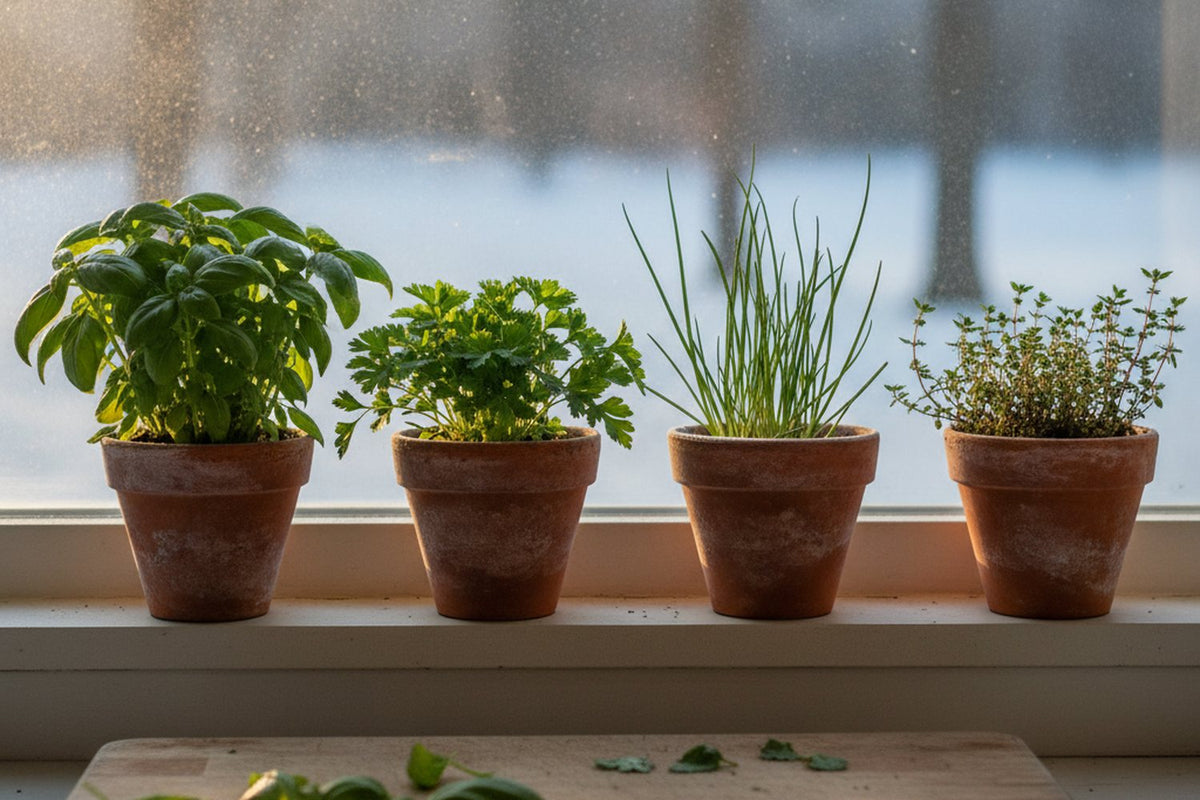
Not always. Herbs grow in pots on a bright windowsill, and extension services describe how. The catch is winter light. Iowa State University Extension calls light the most limiting factor for herbs indoors and says most want around eight hours of direct light a day. The University of New Hampshire Extension says that in a New Hampshire January the sun gives too little light to grow even lettuce well, and that house windows block much of what there is. A countertop garden solves that with its own light; pots on a sill need a sunny window or a grow light over them.
If you go the pot route, the advice is consistent. Use containers with drainage holes and a potting mix that drains well; the University of Illinois Extension says to keep garden soil out of the containers, and the University of Maryland Extension suggests two parts soilless potting mix to one part perlite. Penn State Extension says to keep rooms at 65 to 70 degrees F by day and 55 to 60 at night, and warns that basil cannot survive temperatures below 50 degrees F and should not sit on a windowsill in winter. Turn pots every few days so the plants grow straight rather than leaning to the glass, as the University of Illinois Extension advises. For a light over pots, our grow lights for seedlings guide compares LED strips, shop lights and stands and how far and how long to run them, and our seed starting mix guide compares the bagged mixes for sowing seeds in trays.
How much light do indoor herbs need?
The five extension services in this table agree that herbs want a lot of light indoors and that a grow light has to run for many hours a day. They differ on the numbers, so here they are side by side.
| Extension service | Window light | Under a grow light |
|---|---|---|
| Iowa State | Around 8 hours of direct light; a south window is best, a bright east or west window can work | Light 6 to 12 inches from the leaves, on a timer for 12 to 16 hours |
| Penn State | 6 hours of direct sun, as near a south-facing window | 14 to 16 hours a day, 6 to 12 inches from a pair of 40 watt cool white fluorescents |
| University of Maryland | A south or west window with at least 5 hours of sun | Grow lights 14 to 16 hours a day in winter |
| University of Illinois | 6 to 8 hours of bright light; south windows are best | 12 to 16 hours, about two hours of lamp for every hour of sun it replaces |
| University of Minnesota | South or west exposure; most herbs need at least 6 hours of direct sun | About 12 hours of artificial light a day |
What it shows: plan on six to eight hours of direct sun for a windowsill, and on 12 to 16 hours under a light. The built-in lights on the picks run in that range: 16 hours for Click & Grow, 15 to 17 hours a day for AeroGarden, and whatever you set for the LetPot. Herbs short of light, Penn State says, grow thin and spindly with smaller leaves and less aroma, which is a sign to move a pot or give it more hours of light. AeroGarden adds that its gardens belong in a room-temperature spot out of direct sunlight.
Which herbs grow best indoors?
Iowa State University Extension names seven herbs as the best to start with indoors, because they cope with lower light, dry air and cool rooms: parsley, mint, chives, basil, oregano, cilantro and thyme. It puts rosemary, sage, lemon balm, marjoram, chervil and bay laurel next, since they need more light or attract pests such as spider mites indoors. Penn State Extension sorts several by light and water:
| Herb | Iowa State: indoors | Penn State: light | Penn State: water |
|---|---|---|---|
| Basil | Best to start with | Not listed | Never let the mix dry out completely |
| Chives | Best to start with | Tolerates low light, 2 to 6 hours of direct sun | Not listed |
| Cilantro | Best to start with | Tolerates low light, 2 to 6 hours of direct sun | Not listed |
| Thyme | Best to start with | Does best in direct sun | Let it dry slightly between waterings |
| Oregano | Best to start with | Not listed | Let it dry slightly between waterings |
| Parsley and mint | Best to start with | Not listed | Not listed |
| Rosemary and bay | Try next: more light, more pests | Do best in direct sun | Let them dry slightly between waterings |
| Sage | Try next | Not listed | Let it dry slightly between waterings |
| Lemon balm | Try next | Tolerates low light, 2 to 6 hours of direct sun | Not listed |
What it shows: basil, chives, cilantro, parsley and mint are the easy first crop. Penn State says to skip big-rooted herbs such as horseradish, fennel and lovage, and to give dill, which grows a taproot, a deep pot. In a hydroponic garden, the University of Minnesota Extension says herbs, lettuce and leafy greens do well all year, while heat-loving crops such as tomatoes need extra heat and light indoors. Iowa State adds a fair warning on flavor: herbs grown indoors are often milder than the same herbs grown outside, though basil still tastes like basil.
Hydroponic or soil pods: what the difference means for you
Hydroponic gardens (picks 1, 3 and 4) grow plants in water with the nutrients dissolved in it. The University of Minnesota Extension says hydroponics uses less water than growing in soil and allows faster growth, and that the simplest home systems hang the roots in a tank of water. The trade is upkeep. You add plant food as the water drops, and the University of New Hampshire Extension says to top up with mixed nutrient solution rather than plain water, so the mix in the tank does not get weaker each time. It also says home growers can work with a pH anywhere from 5.5 to 7.0; the University of Illinois Extension suggests changing the water completely every 2 weeks and testing pH weekly, aiming for 5 to 6. AeroGarden says its liquid plant food is pH-buffered, and to rinse and refill the bowl before each new planting.
Hydroponic gardens also need watching for algae and root rot. New Hampshire says algae thrive on the light, water and fertilizer in any hydroponic garden, and suggests keeping light off the water and cleaning the parts between crops; brown, mushy roots point to root rot, and the fix is to empty, clean and disinfect the system and start again.
Soil-pod gardens (picks 2 and 5) skip the plant food and the nutrient solution. Click & Grow puts the nutrients in each pod and waters through a wick, so there is no pump and no plant food to add, and nothing to hear. The trade is that each pod's feed and root room run out, and The Strategist found that still water in a wick system invites mold. Wired, which has grown in both kinds, got anything from a few lettuce leaves out of a Click & Grow to large daily harvests from a big hydroponic system. If you want organic produce, New Hampshire notes that hydroponics and organic growing pull in opposite directions, though a hydroponic garden can be pesticide free.
How to keep an indoor herb garden going
Most herbs come up fast. AeroGarden gives 5 to 15 days for herbs to germinate, 4 to 6 weeks to a first harvest, and about 3 to 4 months of growth, which can stretch to 6 months or more. Click & Grow's listing gives basil 1 to 2 months to reach full size and each pod 2 to 3 months of harvests. After that, the job is harvesting, light height and a little cleaning.
- Harvest often, and from the top. Iowa State says to snip each stem just above a leaf or a pair of leaves, leaving 4 to 6 inches of stem on annual herbs such as basil and parsley, and to take no more than the top third from perennial herbs like chives, mint, oregano and thyme.
- Keep the light close. AeroGarden says to raise the hood as plants grow, keeping it a few inches above them, and to prune so the plants fill out.
- Do not let one plant take over. AeroGarden says basil is quick to sprout and grow and suggests pruning it back so the other pods get the light; The Strategist suggests grouping plants by height.
- Feed lightly, if at all. In pots, Penn State suggests a weak dose of a water-soluble fertilizer every 2 weeks, warning that more can dull the aroma and taste. In a hydroponic garden, follow the plant food reminders; in a Click & Grow, the pod does the feeding.
- Clean between crops. New Hampshire says to replace the nutrient solution now and then and wash the parts between crops, and not to pour the old solution down a drain: water a garden or lawn with it instead.
- Start fresh. Iowa State says to discard annual herbs after several harvests and start new plants from seed.
On food safety, New Hampshire suggests keeping the nutrient solution off the leaves you eat, washing your hands before harvesting, picking herbs dry and washing them just before eating, and washing your scissors with hot soapy water between uses.
Giving one as a gift: which garden for whom
CNET calls indoor gardens a good gift for people who love to cook, and the right one depends on how much the person wants to fuss.
- For someone new to growing, or short on counter space: the Click & Grow Smart Garden 3 (pick 2). It comes with three basil pods, needs only water, and CNET calls it "a perfect starter herb garden for someone with a not-so-green thumb."
- For a cook who uses herbs every day: the AeroGarden Harvest (pick 1), which arrives with a six-pod seed kit and plant food.
- For a gardener who starts their own seeds: the LetPot LPH-SE (pick 3), with a packet of their favorite herb seeds in the box, since it ships with none.
- For a tomato grower with a deep counter: the AeroGarden Bounty (pick 4).
- For a home office or bedroom, where noise matters: a Click & Grow (picks 2 and 5), since neither has a pump. Wired suggests a silent garden such as a Click & Grow where noise matters, and notes that grow lights are bright and run about 16 hours a day, so keep any of these away from a bedroom if that schedule would disturb you.
A spare set of pods makes a good add-on: Click & Grow and AeroGarden both sell refill pods, and Wired says AeroGarden's baskets take the same generic sponges as the LetPot. For more ideas, see our gifts for plant lovers and gifts for gardeners guides.
Related guides
The University of Minnesota Extension says herb seedlings want 14 to 16 hours of light, 4 to 6 inches from the lamp, which our grow lights for seedlings guide covers in detail. To start herbs in trays and pot them up for a windowsill, our best seed starting mix guide compares the bagged mixes. And for gift lists beyond a garden, see gifts for plant lovers.
Frequently asked questions
What is the best indoor herb garden?
For most kitchens, the AeroGarden Harvest: a six-pod hydroponic garden with a 20 watt LED on a timer and lighted reminders for water and plant food. Good Housekeeping and Serious Eats both pick the Harvest Elite, which AeroGarden says adds a stainless finish and vacation mode. For the least upkeep, the Click & Grow Smart Garden 3, CNET's top pick, has no pump and needs only water.
Do indoor herb gardens need sunlight?
No. Countertop gardens carry their own LED light, and AeroGarden recommends a room-temperature spot out of direct sunlight. Herbs in plain pots are different: extension services say they want about 6 to 8 hours of direct sun from a south or west window, or 12 to 16 hours under a grow light, especially in winter.
Is a hydroponic or a soil herb garden easier?
A soil-pod garden such as Click & Grow's is easier day to day: no pump and no plant food to add, only water every 2 to 3 weeks. A hydroponic garden such as an AeroGarden asks for plant food and a cleaning between crops, but testers found it grows bigger plants.
How much electricity does an indoor herb garden use?
Not much. At 16 hours a day for 30 days, the light on the Click & Grow Smart Garden 3 uses 3.8 kilowatt-hours by Click & Grow's figure, the AeroGarden Harvest's about 9.6 and the AeroGarden Bounty's about 19.2 (our arithmetic). AeroGarden's own example Bounty draws more than its light's listed watts, so treat those as a floor and multiply by your utility's rate.
Which herbs grow best in an indoor garden?
Iowa State University Extension names parsley, mint, chives, basil, oregano, cilantro and thyme as the best herbs to start with indoors. Rosemary, sage, lemon balm, marjoram, chervil and bay laurel can work but need more light or draw more pests.
Can I use my own seeds in an AeroGarden or Click & Grow?
Yes. AeroGarden sells a Grow Anything Seed Pod Kit for your own seeds, while Click & Grow offers Grow Anything pods with no seed in them, for seeds you supply. The LetPot LPH-SE is made for it: it comes with sponges, baskets and nutrients but no seeds.
How long do herbs last in an indoor garden?
AeroGarden says herbs usually keep growing for 3 to 4 months, and sometimes 6 months or longer with regular harvesting, and Click & Grow says a basil pod lasts 2 to 3 months. Iowa State suggests replacing annual herbs from seed after several harvests.
Disclosure: Our commissions do not change what we recommend or what you pay. Availability was checked on Amazon on October 25, 2026 and can change.
Product prices and availability are accurate as of the date/time indicated and are subject to change. Any price and availability information displayed on Amazon.com at the time of purchase will apply to the purchase of this product.