As an Amazon Associate we earn from qualifying purchases. Some brands also pay us when you click or buy, so those links are ads. Full disclosure below
Our top picks
Best overall
1. Espoma Organic Seed Starter
Best for: Most cell trays and flats of vegetables, flowers or herbs
Best peat and vermiculite mix
2. Jiffy Natural & Organic Seed Starting Mix
Best for: The plain peat moss and vermiculite recipe, in one big bag
Best peat-free mix
3. Burpee Organic Coconut Coir
Best for: No peat moss at all
The best seed starting mix for most trays is Espoma Organic Seed Starter, which Espoma makes from 80 to 90 percent sphagnum peat moss with perlite, limestone to set the pH and yucca extract, plus its Myco-tone mycorrhizae and no synthetic plant food. It is linked here as two 8 quart bags. Bob Vila names it the best overall seed starting mix, and Gardenary lists it among its favorites. For the plain peat moss and vermiculite recipe that the University of Minnesota Extension describes, in one 16 quart bag, the pick is Jiffy Natural & Organic Seed Starting Mix. For a mix with no peat at all, Burpee Organic Coconut Coir comes as two bricks that swell with water.
The other three picks cover a mix with plant food and no compost, a mix with an organic feed, and a mix made to hold together in soil blocks. Below, the labels sit side by side in one table, a second table works out how many 72-cell trays each purchase sows from the only tray figure any of these makers publishes, and the growing advice on sterile mixes, damping off, bottom watering, feeding and timing comes from university extension services, each named where it appears.
Jump to: Ingredients table | Trays per bag | Seed starting mix vs potting soil | Is it sterile? | Damping off | Watering | Feeding and potting on | When to start
Start here: which seed starting mix for your trays
- Most cell trays and flats of vegetables, flowers or herbs: Espoma Organic Seed Starter (pick 1).
- The plain peat moss and vermiculite recipe, in one big bag: Jiffy Natural & Organic Seed Starting Mix (pick 2).
- No peat moss at all: Burpee Organic Coconut Coir (pick 3), two bricks you expand with water.
- Plant food in the mix, with no compost or bark: Miracle-Gro Indoor Seed Starting Mix (pick 4).
- An organic feed in the mix: Coast of Maine Sprout Island Blend Seed Starter (pick 5).
- Soil blocks instead of cell trays: Purple Cow Seed Starter Mix (pick 6).
Not sure how much to buy? By Miracle-Gro's figure, one 8 quart bag fills about three 72-cell trays; see how many trays a bag fills.
| Pick | Base | Added feed | Volume linked | Best for | Our verdict | Where to buy |
|---|---|---|---|---|---|---|
| 1. Espoma Organic Seed StarterBest overall | Sphagnum peat moss, 80 to 90 percent | None named; no synthetic plant food (listing) | 16 qt (two 8 qt bags) | Most cell trays and flats of vegetables, flowers or herbs | Bob Vila's best overall pick is mostly sphagnum peat moss with perlite and mycorrhizae, and carries no synthetic plant food. | Check price on Amazon |
| 2. Jiffy Natural & Organic Seed Starting MixBest peat and vermiculite mix | Peat moss | No analysis given | 16 qt bag | The plain peat moss and vermiculite recipe, in one big bag | The peat moss, vermiculite and lime recipe that extension services describe, in one 16 quart bag. | Check price on Amazon |
| 3. Burpee Organic Coconut CoirBest peat-free mix | Coconut coir | None named | 16 qt once expanded (two 8 qt bricks) | No peat moss at all | Two coir bricks that swell into 16 quarts of peat-free mix, Bob Vila's pick for coconut coir. | Check price on Amazon |
| 4. Miracle-Gro Indoor Seed Starting MixBest with plant food and no compost | Sphagnum peat moss | Plant food, 0.03-0.03-0.03 | 16 qt (two 8 qt bags) | Plant food in the mix, with no compost or bark | The one maker here that publishes a fill figure, three 72-cell trays per 8 quart bag, with a light feed and no compost. | Check price on Amazon |
| 5. Coast of Maine Sprout Island Blend Seed StarterBest with an organic feed | Sphagnum peat moss and compost | Organic, 0.35-0.10-0.05 | 8 qt bag | An organic feed in the mix | Bob Vila's best organic pick carries a mild 0.35-0.10-0.05 feed from kelp, shell meal and worm castings. | Check price on Amazon |
| 6. Purple Cow Seed Starter MixBest for soil blocks | Compost and sphagnum peat moss | Organic, up to 45 days (maker) | 12 qt bag | Soil blocks instead of cell trays | The only pick with soil blocker directions from its maker, and fertility to last up to 45 days. | Check price on Amazon |
The best seed starting mix, by job
1. Espoma Organic Seed Starter: best overall
Best overall
Best for: Most cell trays and flats of vegetables, flowers or herbs
Espoma Organic Seed Starter
- Base: Sphagnum peat moss, 80 to 90 percent
- Added feed: None named; no synthetic plant food (listing)
- Volume linked: 16 qt (two 8 qt bags)
Bob Vila's best overall pick is mostly sphagnum peat moss with perlite and mycorrhizae, and carries no synthetic plant food.
Espoma's seed starter is a fine, soilless mix. Its ingredient line reads "80-90% sphagnum peat moss, perlite, limestone to adjust pH, and yucca extract," and the listing adds Myco-tone, Espoma's blend of endo and ecto mycorrhizae. Its ingredient list names no fertilizer, and the listing says Espoma uses no synthetic plant food or chemicals in it. Espoma sells it in 8 and 16 quart bags, and the link here is a pair of 8 quart bags, 16 quarts in all. Espoma makes it for starting seeds and for rooting stem and leaf cuttings.
Why it is the pick: Bob Vila names it the best overall seed starting mix, and Gardenary's founder, Nicole Johnsey Burke, lists it among her favorite organic mixes for starting seeds. It is also close to the recipe extension services describe. The University of Minnesota Extension says commercial seed starting mixes are usually peat and vermiculite with no true soil, and Espoma uses perlite in place of the vermiculite; Oklahoma State University Extension ranks perlite among the best growing media at holding oxygen. With no feed in the bag, you choose when the seedlings get their first fertilizer.
Good to know: start feeding once seedlings have several sets of true leaves, as the University of Minnesota advises (see when to feed). Espoma's directions say to keep the mix moist by misting it with a spray bottle, to set the container somewhere warm and bright but out of direct sun, and to move each seedling to a larger container or a prepared bed once it grows its first true leaves. Peat moss repels water when it is bone dry, so wet the mix before you fill the cells (see the tip under trays per bag). On October 24, 2026 this pair of bags was sold and shipped by a third-party seller.
2. Jiffy Natural & Organic Seed Starting Mix: best peat and vermiculite mix
Best peat and vermiculite mix
Best for: The plain peat moss and vermiculite recipe, in one big bag
Jiffy Natural & Organic Seed Starting Mix
- Base: Peat moss
- Added feed: No analysis given
- Volume linked: 16 qt bag
The peat moss, vermiculite and lime recipe that extension services describe, in one 16 quart bag.
Jiffy's listing describes a natural and organic seed starting mix of peat moss, vermiculite and lime, linked here in the 16 quart bag. Ferry-Morse, which sells the Jiffy line on its own site, calls Jiffy Seed Starting Mix lightweight and fine in texture, for seed trays, pots or peat pellets. The listing gives no fertilizer analysis.
Why it is the pick: it is the extension recipe in its plainest form. The University of Minnesota Extension says commercial seed starting mixes are usually peat and vermiculite with no true soil and recommends them for starting seeds, and Rutgers Cooperative Extension calls commercial soilless mixes such as Jiffy-Mix the most convenient choice. Gardenary lists Jiffy's Natural and Organic mix among its favorites; it names the 12 quart bag, which was out of stock on Amazon on October 24, 2026, so the 16 quart bag of the same mix is linked here. Oklahoma State University Extension says vermiculite has excellent water holding capacity, which makes this our pick if your trays tend to dry out between checks under bright lights or on a heat mat.
Good to know: the flip side of water holding is a mix that can stay wet, so let the top of the mix get nearly dry before you water again, as the University of Maryland Extension advises (see watering). With no fertilizer analysis on the listing, plan to start feeding at several sets of true leaves. Vermiculite has a second use at sowing time: the University of Minnesota suggests a thin layer of fine vermiculite over seeds that need light to germinate.
3. Burpee Organic Coconut Coir: best peat-free mix
Best peat-free mix
Best for: No peat moss at all
Burpee Organic Coconut Coir
- Base: Coconut coir
- Added feed: None named
- Volume linked: 16 qt once expanded (two 8 qt bricks)
Two coir bricks that swell into 16 quarts of peat-free mix, Bob Vila's pick for coconut coir.
Sold as "Burpee Organic Coconut Coir Seed Starting Mix": two compressed bricks of coconut coir, the fiber from coconut husks. By Burpee's page and the listing, each brick expands into 8 quarts of mix once you add water, so the pair makes 16 quarts. Burpee says it is certified organic and OMRI listed and gives it a balanced pH, and neither the page nor the listing names a fertilizer or any other ingredient. The dry bricks take little shelf space until you wet them.
Why it is the pick: it is the one pick with no peat moss, for growers who would rather leave peat alone, and Burpee calls coir a renewable alternative to peat. Bob Vila names it its best coconut coir seed starting mix, and Gardenary's founder expanded a Burpee coir brick in her seed starting video. Oklahoma State University Extension says coir holds moisture very well yet still lets roots get air, and that the compressed form has to soak in water before use.
Good to know: give it time to soak. Gardenary describes adding water over a brick in a bucket and letting it swell and break apart fully, and Oklahoma State says coir can grow to as much as six times the size of the brick as it rehydrates. Bob Vila notes that it dries out faster than other mixes, so check the trays more often. With no fertilizer in it, start feeding at several sets of true leaves (University of Minnesota).
4. Miracle-Gro Indoor Seed Starting Mix: best with plant food and no compost
Best with plant food and no compost
Best for: Plant food in the mix, with no compost or bark
Miracle-Gro Indoor Seed Starting Mix
- Base: Sphagnum peat moss
- Added feed: Plant food, 0.03-0.03-0.03
- Volume linked: 16 qt (two 8 qt bags)
The one maker here that publishes a fill figure, three 72-cell trays per 8 quart bag, with a light feed and no compost.
Sold in full as "Miracle-Gro Indoor Potting Mix for Seed Starting": a ready to use mix that Miracle-Gro enriches with plant food, at a light 0.03-0.03-0.03 analysis by its product page, linked here as two 8 quart bags. Miracle-Gro says the mix contains no compost or bark, two ingredients it says shelter fungus gnats, and Bob Vila lists its ingredients as "Sphagnum peat moss, perlite, fertilizer, and a wetting agent." Miracle-Gro makes it for vegetable, flower and herb seeds and for leaf, stem and root cuttings.
Why it is the pick: it is the pick for growers who want a feed in the mix without compost. The University of Maryland Extension notes that soilless mixes often carry a little fertilizer, enough for 6 to 8 weeks of growth after the seeds sprout. Miracle-Gro is also the only one of the six whose page or listing says how many trays a bag fills: three 72-cell trays per 8 quart bag, though it adds that amounts may vary. Bob Vila lists it among its seed starting picks.
Good to know: Miracle-Gro says to keep the mix evenly moist, never soggy, to keep the container out of direct sunlight until the seeds sprout, and to move seedlings to a larger pot once they grow their first true leaves. It recommends gardening gloves while you handle it. Because the feed is already in the bag, go easy on extra fertilizer: the University of Minnesota lists high salts from overfertilizing among the conditions that increase damping off. Bob Vila lists it as not organic; the other five picks are sold as organic or OMRI listed.
5. Coast of Maine Sprout Island Blend Seed Starter: best with an organic feed
Best with an organic feed
Best for: An organic feed in the mix
Coast of Maine Sprout Island Blend Seed Starter
- Base: Sphagnum peat moss and compost
- Added feed: Organic, 0.35-0.10-0.05
- Volume linked: 8 qt bag
Bob Vila's best organic pick carries a mild 0.35-0.10-0.05 feed from kelp, shell meal and worm castings.
An OMRI listed seed starter built on sphagnum peat moss and compost. Coast of Maine's page lists sphagnum peat moss, composted manure, compost or mushroom compost, perlite, fertilizer and mycorrhizae, with the feed coming from kelp meal, earthworm castings and crab and lobster shell meal at a 0.35-0.10-0.05 analysis, its nitrogen all slowly available. The listing also names aged bark and calls the feed a mild organic fertilizer charge. The link is the 8 quart bag, and Coast of Maine makes it for germinating seeds and rooting cuttings.
Why it is the pick: it is the pick for an organic grower who wants a feed in the mix from the first day. Bob Vila names it the best organic seed starting mix, and Gardenary lists it among its favorites. In Suburban Hobby Farmer's side by side of four OMRI listed seed starting mixes, its seeds came up third of the four and one seed never came up, though the author called the plants very vigorous.
Good to know: Coast of Maine says to moisten it thoroughly with warm water before use, to fill the container to within a quarter inch of the top, and to switch to an organic fertilizer once seedlings are transplanted. A compost-based mix comes with a caution, set out under damping off: none of picks 1 to 4 lists compost. On October 24, 2026 this bag was sold by a third-party seller and shipped from Amazon.
6. Purple Cow Seed Starter Mix: best for soil blocks
Best for soil blocks
Best for: Soil blocks instead of cell trays
Purple Cow Seed Starter Mix
- Base: Compost and sphagnum peat moss
- Added feed: Organic, up to 45 days (maker)
- Volume linked: 12 qt bag
The only pick with soil blocker directions from its maker, and fertility to last up to 45 days.
A compost-based seed starter, linked here in the 12 quart bag. Purple Cow lists its own compost, sphagnum peat moss, perlite, vermiculite and rock and sea minerals, says the mix is OMRI listed, and says it carries fertility to last up to 45 days.
Why it is the pick: it is the only pick whose maker gives directions for soil blocks, the pressed cubes of mix that stand on a tray without cells, and its listing says it works in plastic trays or a soil blocker. Suburban Hobby Farmer explains why that matters: with no pot around a soil block, the mix has to stick together. For blocks, Purple Cow says to mix three parts of it with one part warm water until it is about as thick as peanut butter, then press the blocker into a mound of it. Gardenary lists this mix among its favorites.
Good to know: Purple Cow says to mist the surface to keep it evenly moist until the seeds come up, and not to move seedlings into pots larger than 2 inches at this stage. Like pick 5 it is compost based, so read the damping off section before you choose it for trays that have had trouble.
How we chose these
We compared the bagged seed starting mixes in Amazon's catalog by what their makers say is in the bag: the base (peat moss, coconut coir or compost), the other ingredients, any added feed and its analysis, the volume you get, and what the maker says the mix is for. For every pick we read the maker's product page and the Amazon listing; no Jiffy product page for the bag mix turned up, so for pick 2 we read the listing, Ferry-Morse's Jiffy Seed Starting Mix page and a retailer's product page. Then we read the seed starting mix roundups by Bob Vila and Gardenary, and Suburban Hobby Farmer's side by side of four organic mixes, in which the author sowed seeds in each and compared how fast they came up, how vigorous the plants were and whether any damped off.
Our floor, for the picks and for the notes under Also considered: in stock on Amazon and sold new, when we checked on October 24, 2026. Each pick met it. Ingredients, analyses, volumes and directions come from the maker pages and listings, named where they appear. Growing advice comes from land-grant extension services at Minnesota, Maryland, Rutgers, Clemson, Penn State, Purdue and Oklahoma State, each named where it appears.
Also considered: mixes that missed the list and why
Hoffman Seed Starter Potting and Planting Mix. Bob Vila's runner-up, a soilless mix of "Sphagnum peat moss, vermiculite, limestone, and a wetting agent" by Bob Vila's list. It met our floor on October 24, 2026, through a third-party seller that ships it from Amazon. Pick 2 is the same kind of peat and vermiculite mix, with Gardenary's and Rutgers' mentions behind it.
Black Gold Seedling Mix. One of Gardenary's favorites: Sun Gro lists Canadian sphagnum peat moss, perlite, an organic wetting agent and calcium silicate, and says it is OMRI listed. It met our floor on October 24, 2026, from a third-party seller. Pick 1 is the same kind of peat and perlite mix with Bob Vila's and Gardenary's backing, and in Suburban Hobby Farmer's side by side of four mixes this one finished behind the other three.
PRO-MIX Organic Seed Starting Mix. Suburban Hobby Farmer's choice for soil blocks, because its blocks held together. On October 24, 2026 the Amazon listing we found bundled it with test strips and gloves.
Back to the Roots seed starting mix. Another peat-free mix, sold as "Back to the Roots 3-in-1 Seed Starting Mix": by its listing, coconut coir with mycorrhizae, yucca extract, worm castings, dolomitic limestone and plant food, in a 6 quart bag. It met our floor, but none of the reviews we read covered it, and pick 3 has Bob Vila's and Gardenary's coverage behind it for the peat-free role.
What is in each bag? The labels side by side
Each maker describes its mix in its own way, so here is what each maker page or listing names, side by side, with the source noted where the two differ.
| Pick | Base | Other ingredients named | Added feed | Volume linked | Maker says it is for |
|---|---|---|---|---|---|
| 1. Espoma Organic Seed Starter | Sphagnum peat moss, 80 to 90 percent | Perlite, limestone, yucca extract, Myco-tone mycorrhizae | None named; no synthetic plant food (listing) | 16 qt (two 8 qt bags) | Starting seeds; rooting stem and leaf cuttings |
| 2. Jiffy Natural & Organic Seed Starting Mix | Peat moss | Vermiculite, lime (listing) | No analysis given | 16 qt bag | Seed trays, pots or peat pellets (Ferry-Morse) |
| 3. Burpee Organic Coconut Coir | Coconut coir | None named | None named | 16 qt once expanded (two 8 qt bricks) | Seed starting and seedlings |
| 4. Miracle-Gro Indoor Seed Starting Mix | Sphagnum peat moss (Bob Vila's list) | Perlite, a wetting agent (Bob Vila's list); no compost or bark (Miracle-Gro) | Plant food, 0.03-0.03-0.03 | 16 qt (two 8 qt bags) | Vegetable, flower and herb seeds; leaf, stem and root cuttings |
| 5. Coast of Maine Sprout Island Blend Seed Starter | Sphagnum peat moss and compost | Composted manure, perlite, mycorrhizae, kelp meal, earthworm castings, crab and lobster shell meal; the listing adds aged bark | Organic, 0.35-0.10-0.05, nitrogen slowly available | 8 qt bag | Germinating seeds; rooting cuttings |
| 6. Purple Cow Seed Starter Mix | Purple Cow compost and sphagnum peat moss | Perlite, vermiculite, rock and sea minerals | Organic; fertility to last up to 45 days (no analysis on the page) | 12 qt bag | Plastic trays or a soil blocker |
What it shows: five of the six contain peat moss, and pick 3, coconut coir, is the only peat-free pick. Three carry a feed (picks 4, 5 and 6) and three name none (picks 1, 2 and 3), which changes when you start feeding (see when to feed seedlings). Picks 5 and 6 are the two compost-based mixes. None of the product pages or listings we read for the six picks calls the mix sterile; for what that word does and does not cover, see is seed starting mix sterile?
How many seed trays does one bag fill?
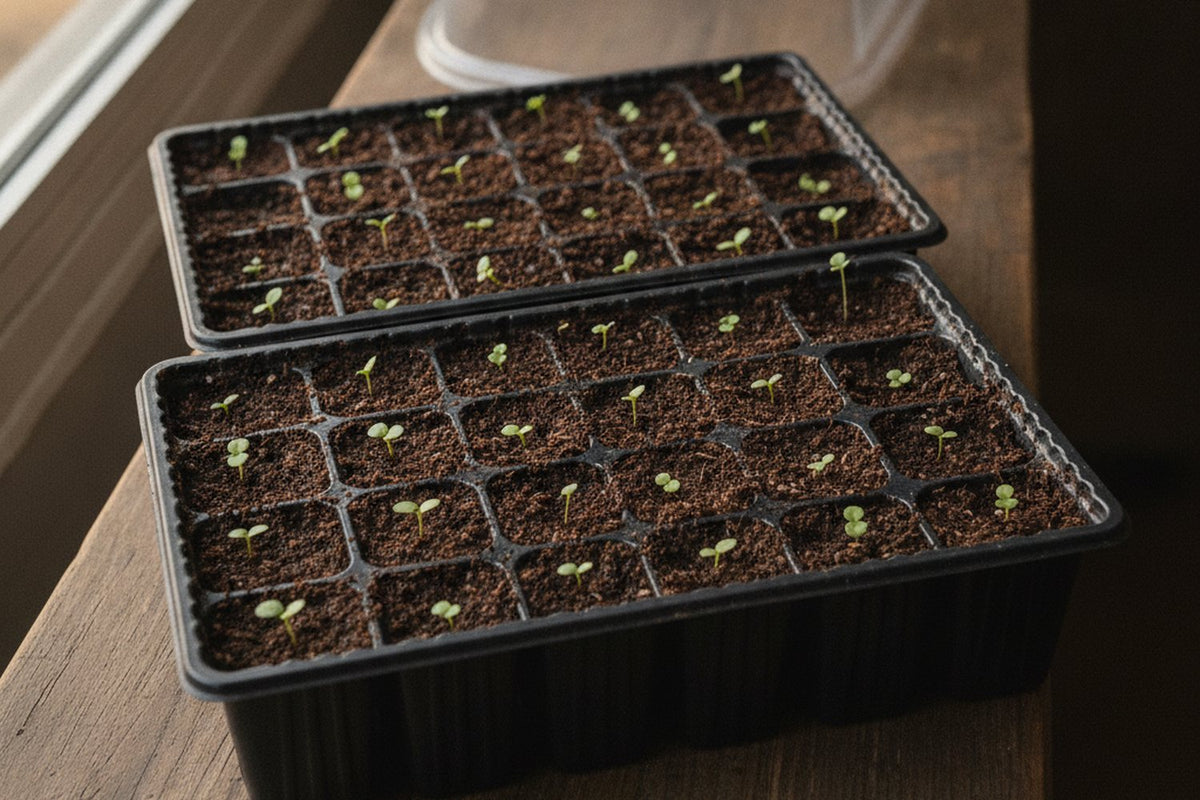
Buy by the tray, not the bag. Only one maker of the six publishes a fill figure: Miracle-Gro says one 8 quart bag fills three 72-cell trays, and adds that amounts may vary. That works out to about 2.7 quarts per 72-cell tray, or about 27 cells per quart (our arithmetic). Gardenary's rule of thumb is close to it: a bag, it says, should fill two or three trays, depending on their size.
The table applies Miracle-Gro's rate to the volume each pick's link buys. Our assumptions, so you can adjust them: your inserts are 72-cell trays like the ones Miracle-Gro's figure is for, and bigger cells take more mix per tray; the volume is the mix as sold, or after soaking for pick 3's bricks; and you top the cells up as the mix settles, since the University of Minnesota says to add more if wet mix sinks more than half an inch below the rim. The figures cover sowing only: potting seedlings on into containers 1 to 2 inches wider, as Minnesota advises, takes more mix again.
| Pick and purchase | Volume linked | 72-cell trays at Miracle-Gro's rate (computed) | Cells (computed) |
|---|---|---|---|
| 1. Espoma, two 8 qt bags | 16 qt | About 6 | About 432 |
| 2. Jiffy, one 16 qt bag | 16 qt | About 6 | About 432 |
| 3. Burpee, two coir bricks | 16 qt once expanded | About 6 | About 432 |
| 4. Miracle-Gro, two 8 qt bags | 16 qt | 6 (Miracle-Gro's own figure, three per bag) | 432 |
| 5. Coast of Maine, one 8 qt bag | 8 qt | About 3 | About 216 |
| 6. Purple Cow, one 12 qt bag | 12 qt | About 4.5 | About 324 |
What it shows: one 16 quart purchase of picks 1 to 4 sows about six 72-cell trays, the 8 quart Coast of Maine bag about three, and Purple Cow's 12 quarts about four and a half. If you are sowing a tray or two, an 8 quart bag is enough; for six trays or more, one of the 16 quart purchases covers it. Treat every figure but Miracle-Gro's own as an estimate.
Seed starting mix vs potting soil
A seed starting mix is a finer, lighter relative of potting mix. The University of Maryland Extension explains that most bagged "potting soil" holds no true soil either, and that seed starter mixes have a finer texture that helps very small seeds germinate, though they are not needed for most vegetable seeds. Clemson's Home and Garden Information Center is firmer: it says to keep bagged topsoil, vegetable garden mixes and potting mixes out of seed trays, and to start seeds in a sterile soilless medium that drains well and lets air in.
Garden soil is the one to leave out. Maryland says soil is too dense in a container, about 75 pounds per cubic foot against roughly 10 for a good soilless mix, and may carry weed seeds, pests or pathogens; the University of Minnesota adds that garden soil often holds small amounts of the organisms that cause damping off. Seedlings do not need a rich soil to sprout, either: Minnesota says they draw the energy to germinate from nutrients stored in the seed.
Is seed starting mix sterile? What it protects against, and what it does not
Extension services describe bagged mixes as clean when fresh. The University of Minnesota calls commercial seed starting mixes sterile and free of weed seeds, and the University of Maryland says fresh soilless mixes are usually free of weeds, insects and disease organisms. None of the product pages or listings we read for the six picks calls the mix sterile, and the protection does not last on its own.
The University of Minnesota lists the ways damping off organisms get into a clean tray: pots, tools and mix reused from earlier seasons, spores carried in by fungus gnats or splashing water, and dirty hands, tools or hose ends. Once in, they spread from plant to plant through the mix or shared water. Oklahoma State University Extension adds that sterilizing peat does not solve the problem for good, because it leaves an empty niche that disease fungi can move into. So a clean bag is a starting point; clean trays, new mix every season and careful watering do the rest.
How to stop damping off before it starts
Damping off is the death of seedlings just before or after they come up. The University of Minnesota names the fungi Rhizoctonia and Fusarium and the water mold Pythium as the usual causes, and says the disease often kills a large section or a whole tray. Seedlings fail to come up, or their stems turn water soaked and thread thin and the seedlings collapse. It thrives in cool, wet conditions, and Minnesota says anything that slows growth makes it worse: low light, overwatering, high salts from overfertilizing and cool soil.
- Start clean. Minnesota says to soak used pots and trays for 30 minutes in a 10 percent household bleach solution, to fill them with new mix, and not to reuse old mix or fill trays with garden soil or compost.
- Keep the mix warm. Minnesota suggests a heating mat to hold the mix at 70 to 75 degrees F indoors.
- Water carefully. Moist, not soggy, in pots with drainage holes, with clean, warm water (see watering), and hoses kept off the floor.
- Give them air and space. Penn State Extension says to avoid overwatering and overseeding and to space plants so air circulates; Purdue suggests good ventilation so seedlings dry off.
- Hold the fertilizer. Minnesota says to feed only after several true leaves, at a quarter strength.
- Act fast. Purdue says to remove any pot or flat with damping off at once. If it strikes, the University of Maryland says to throw out the plants and mix, wash containers and tools, and give them a 1 to 2 minute soak in one part chlorine bleach in ten parts water before a rinse.
On the compost-based picks: Minnesota's list above rules out compost as a tray filler, Miracle-Gro says compost and bark shelter fungus gnats, and Minnesota says fungus gnats can carry Fusarium spores. Coast of Maine and Purple Cow sell their compost blends for seed starting, and each adds an organic feed. If damping off has hit your trays before, picks 1 to 4 name no compost.
How to water seed trays: from the top or the bottom
Both work; the goal is mix that stays evenly moist and never soggy. Bottom watering means setting the tray in a shallow pan of water so the mix soaks it up through the drainage holes. Rutgers Cooperative Extension recommends it right after sowing, leaving it until the top of the mix turns moist, because sprinkling from above can carry small seeds away; Clemson suggests water 1 to 2 inches deep, with the tray left in for 3 to 10 minutes. From the top, use a gentle spray: the University of Minnesota suggests a spray bottle, which will not wash mix out of the cells, and warns how easy it is to mist the surface while the mix below dries out. For top watering with a can, our watering can guide covers the fine rose heads made for seedlings.
- Pour off what is left. Minnesota says to drain water that sits in the tray, to keep roots healthy.
- Water when the top is nearly dry. The University of Maryland says to wait for that, because mix kept too wet starves roots of oxygen and invites root rot and damping off.
- Use clean, warm water. Minnesota suggests 68 to 77 degrees F for young seedlings, since cool water slows growth and raises the risk of infection; Purdue says to skip stored rainwater and pond water in favor of clean water.
- Cover until they sprout, then uncover. A clear dome holds the moisture in, and Maryland says to take it off as soon as sprouts appear.
When to feed seedlings, and when to pot them on
Germination and growing on are two different jobs. A seed carries its own food: the University of Minnesota says seedlings need no fertilizer before they have grown several sets of true leaves, then suggests a weak water-soluble fertilizer at a quarter strength once a week, with plain water the rest of the week. Clemson starts a little sooner, at the first true leaves, with a starter fertilizer at every other watering. How soon you start depends on the bag:
- No feed in the bag (picks 1, 2 and 3): start at true leaves, as above.
- A feed in the bag (picks 4, 5 and 6): wait. The University of Maryland says most potting mixes can feed a seedling for 6 weeks or more, Purple Cow says its mix carries fertility to last up to 45 days, and Coast of Maine says to switch to an organic fertilizer after transplanting. Minnesota notes that many mixes with slow release fertilizer need none at all.
Potting on comes next. Miracle-Gro and Espoma both say to move seedlings to a larger container once they grow their first true leaves, and the University of Minnesota says to move seedlings that outgrow their cells into containers 1 to 2 inches wider, lifting each by its root ball or a leaf, never the stem. The University of Maryland says tomato, pepper and eggplant started one to a cell usually move up 2 to 3 weeks after germination. For that bigger pot, Miracle-Gro points to a general potting mix, and Purple Cow says to keep to pots no larger than 2 inches at this early stage.
When to start seeds indoors: count back from your last frost
Start from your area's average last spring frost date, which your county extension office can give you, and count back by how long each crop takes from sowing to planting out. Rutgers Cooperative Extension works the example for tomatoes: with a May 15 last frost and 6 to 8 weeks between sowing and transplanting, sow indoors between mid-March and April 1. Warm-season crops such as tomatoes and peppers go out only after the last frost, while cool-season crops such as lettuce and broccoli can go out earlier. The University of Maryland warns that sowing too early is a common mistake, one that leaves tall, root-bound plants.
| Crop | Rutgers: weeks to grow | Clemson: seeding to transplanting | University of Maryland: time indoors |
|---|---|---|---|
| Tomato | 6 to 8 weeks | 6 to 8 weeks | 5 to 6 weeks |
| Pepper | 8 to 10 weeks | 8 to 10 weeks | 8 to 10 weeks |
| Eggplant | 8 to 10 weeks | 6 to 8 weeks | 8 to 10 weeks |
| Broccoli and cabbage | 6 to 7 weeks | 5 to 7 weeks | 4 to 6 weeks |
| Lettuce | 5 to 6 weeks | 5 to 7 weeks | Not listed (leafy greens: 2 to 4 weeks) |
| Cucumber and squash | 2 to 3 weeks | 3 to 5 weeks | 3 to 5 weeks |
| Onion | 10 to 12 weeks | Not listed | 8 to 10 weeks |
What it shows: the three agree on peppers, overlap on tomatoes and differ by a few weeks on cucumber and squash and on onions, so read each range as a window rather than a date. The University of Minnesota's own calendar, keyed to Minnesota, puts tomato seed in early April for 5 to 6 weeks indoors.
Related guides
Seedlings in a fine mix need strong light to stay stocky, and the University of Minnesota calls a lack of light the major cause of long, skinny stems; our grow lights for seedlings guide covers the lights and how many trays each one covers. For hardening seedlings off, Minnesota suggests a cold frame, and our mini greenhouse and cold frame guide compares them. Once the seedlings are out, our frost protection guide covers a late cold night, and how to build a raised garden bed covers the bed they go into.
Frequently asked questions
What is the best seed starting mix?
For most trays, Espoma Organic Seed Starter: a fine mix of sphagnum peat moss and perlite with limestone, yucca extract and mycorrhizae and no synthetic plant food, which Bob Vila names its best overall. For no peat, Burpee's coconut coir bricks; for a starter feed with no compost, Miracle-Gro Indoor Seed Starting Mix; for soil blocks, Purple Cow Seed Starter Mix.
Can I use potting soil to start seeds?
You can, but a seed starting mix fits the job better. The University of Maryland says seed starter mixes are finer, which helps very small seeds, though they are not needed for most vegetable seeds, and Clemson says to keep bagged topsoil, garden mixes and potting mixes out of seed trays. Never use garden soil: it is too dense in a container, and the University of Minnesota says it often carries the organisms that cause damping off.
Is seed starting mix sterile?
A fresh bag is clean, but it does not stay that way on its own. The University of Minnesota calls commercial seed starting mixes sterile, and the University of Maryland says fresh soilless mixes are usually free of weeds, insects and disease organisms; none of the product pages or listings we read for the six picks calls the mix sterile. Damping off organisms can come in on reused pots and tools, fungus gnats, splashing water or dirty hands, so clean trays, new mix and careful watering matter as much as the bag.
When should I fertilize seedlings in seed starting mix?
With a mix that has no feed, once seedlings have several sets of true leaves: the University of Minnesota suggests a water-soluble fertilizer at a quarter strength once a week. With a fed mix such as Miracle-Gro's, Coast of Maine's or Purple Cow's, wait: the University of Maryland says most mixes can feed a seedling for 6 weeks or more, and Purple Cow says its mix carries fertility to last up to 45 days.
How much seed starting mix do I need for a 72-cell tray?
About 2.7 quarts, by Miracle-Gro's figure that one 8 quart bag fills three 72-cell trays, which it says may vary. A 16 quart purchase sows about six trays and an 8 quart bag about three.
Should you wet seed starting mix before planting?
Yes. The University of Maryland says to moisten dry mix before you fill the cells, especially mix with peat moss, which repels water when dry, and to work the water in until the mix feels like a wrung-out sponge. The University of Minnesota says to water the filled cells before sowing and to top them up if the mix settles more than half an inch.
Can you reuse seed starting mix?
Not for seedlings. The University of Minnesota says to fill trays with new mix and not to reuse old mix, because mix from earlier seasons can harbor damping off organisms. Bob Vila suggests mixing leftovers into the garden or a potted plant instead.
Disclosure: Our commissions do not change what we recommend or what you pay. Availability was checked on Amazon on October 24, 2026 and can change.
Product prices and availability are accurate as of the date/time indicated and are subject to change. Any price and availability information displayed on Amazon.com at the time of purchase will apply to the purchase of this product.