As an Amazon Associate we earn from qualifying purchases. Some links are paid. Disclosure
Our top picks
Best rooting hormone overall
1. Bonide Bontone II
Best for: Most cuttings, vegetables and fruit
Best two-bottle pack
2. Garden Safe TakeRoot 2 Pack
Best for: A spare bottle for a big season
Best for flowering shrubs
3. GardenTech RootBoost
Best for: Flowering shrubs
The best rooting hormone for most cuttings is the Bonide Bontone II: a 0.1% IBA rooting powder whose label covers ornamentals, vegetables, fruit trees and small fruits. For cuttings you root in a jar of water, the Miracle-Gro Root Starter Gel is made to work in water or soil. Every powder here is 0.1% IBA, the lowest strength in K-State's table of rooting products, so read the strength section before you treat woody cuttings.
1. Bonide Bontone II
A 0.1% IBA powder for most cuttings, vegetables and fruit trees included.
| Pick | Form | IBA | Size | Label covers | Best for | Our verdict | Where to buy |
|---|---|---|---|---|---|---|---|
| 1. Bonide Bontone IIBest rooting hormone overall | Powder | 0.1% | 1.25 oz | Ornamentals, vegetables, fruit | Most cuttings, vegetables and fruit | A 0.1% IBA powder whose label covers ornamentals, vegetables, fruit trees and small fruits. | Check price on Amazon |
| 2. Garden Safe TakeRoot 2 PackBest two-bottle pack | Powder | 0.1% | 2 x 2 oz | Houseplants, woody ornamentals | A spare bottle for a big season | Two 2 ounce bottles of a 0.1% IBA powder for flowers, houseplants and woody ornamentals. | Check price on Amazon |
| 3. GardenTech RootBoostBest for flowering shrubs | Powder | 0.1% | 2 oz | Ornamental cuttings only | Flowering shrubs | A 2 ounce bottle of Hormodin 1, for ornamental cuttings. | Check price on Amazon |
| 4. Miracle-Gro Root Starter GelBest for rooting in water | Gel | Not stated | 4 packets | Houseplants | Houseplant cuttings in water | Single-use gel packets for houseplant cuttings in water or soil. | Check price on Amazon |
When we checked on November 20, 2026, every pick we link was in stock as new and sold by Amazon. How our guides are made sets out what we check.
What is rooting hormone?
Rooting hormone is a root-promoting compound you put on the cut end of a stem before you plant it. NC State Extension's gardener handbook says these compounds increase the percentage of cuttings that form roots, make cuttings root faster and more uniformly, and increase the number and quality of roots per cutting, particularly on difficult-to-root species. Kansas State University's extension guide lists the forms, from powders and gels to liquid concentrates, and names indole-3-butyric acid (IBA) among the auxins they carry; it is the active ingredient in all four picks here. K-State also warns that too much auxin can promote callusing and may hinder rooting, which is why the strength on the label matters.
What is the best rooting hormone?
The Bonide Bontone II (pick 1), for most cuttings. Its EPA label lists woody, herbaceous and flowering ornamentals, vegetables, fruit trees and small fruits, plus bulbs, roots and corms and many houseplants, and says its 1 1/4 ounces should treat approximately 2,800 average cuttings. It is the only pick here whose label names vegetables and fruit trees, and the only powder that gives a number of cuttings. Good to know: the label asks for treated cuttings to stay at 60 degrees F or warmer, and its directions plant them in a rooting medium, so for a jar of water, see pick 4.
Which rooting hormone do you need?
All three powders here carry the same 0.1% IBA, so choose by how you root, what you root and how much you root; the checks below explain each step.
Powder or gel
K-State's guide says powders need no dilution, are easy to store and let you see the application, but some powder is lost as the cutting goes into the medium and the coat is less uniform. Gels give fast, uniform results with less chance of spillage than a liquid, but come in a limited number of concentrations. NC State's answer to the lost powder is a dibble: make the hole first so the powder stays on as the cutting goes in. For a jar of water, the gel here is the one made for it: Miracle-Gro says its gel works in water or soil, while GardenTech's FAQ says water is not recommended as a rooting medium.
Which strength: what 0.1% IBA means
Rooting products are sold by strength. K-State's December 2013 table of EPA-registered products starts at 0.1% IBA, where Hormex No. 1 and Hormodin 1 sit, and its powders run up to a Hormex No. 45 at 4.5%; the gel and the liquid in Also considered are in it too. Hormex's own site now lists four strengths, No. 1 to No. 16, "from soft green stems to woody cuttings," and its No. 16 label warns that too high a concentration can inhibit root formation, so the proper strength for the species must be chosen.
The percentages are easier to compare as parts per million. K-State gives 1% as 10,000 ppm, so the table works out strength in ppm = IBA % x 10,000. It also works out a box of the gel as 5 cuttings per packet x 4 packets, and Bontone II's cuttings per ounce as 2,800 cuttings / 1.25 ounces. Each input is from the maker's label, page or safety data sheet; where a maker gives no figure, the cell says not stated.
| Product | IBA on the label | IBA in ppm | Cuttings per pack |
|---|---|---|---|
| Bonide Bontone II (pick 1) | 0.10% (label) | 1,000 | About 2,800 per 1.25 oz (label), so about 2,240 per ounce |
| Garden Safe TakeRoot (pick 2) | 0.1% (page) | 1,000 | Not stated |
| GardenTech RootBoost (pick 3) | 0.1% (safety data sheet) | 1,000 | Not stated |
| Miracle-Gro Root Starter Gel (pick 4) | Not stated | Not stated | Up to 20 per box (page) |
| Hormex No. 16 (not linked) | 1.60% (label) | 16,000 | Not stated |
So the three linked powders all sit at 1,000 ppm, the bottom of K-State's range. GardenTech's label for its 0.1% powder says success is generally best when taking softwood cuttings, or new wood. K-State's own example, citing Dirr and Heuser, puts butterflybush cuttings taken in June, July or August at a 3,000 ppm IBA solution, and notes that a powder used in place of a solution may need a similar or higher concentration. For woody, hard-to-root cuttings, the stronger products are in Also considered.
Softwood, semi-hardwood or hardwood cuttings
Mississippi State Extension times woody cuttings by season. Softwood cuttings, 3 to 5 inches long, come in June, July and August, and most root in 4 to 6 weeks. Semi-hardwood cuttings, 3 to 6 inches long, come from August through October. Hardwood cuttings, 4 to 8 inches long with four to six buds, come in December, January and February and usually take longer than softwood cuttings to root; its list of plants that root easily from them includes forsythia, hydrangea, rose, spirea and wisteria.
How to use rooting hormone
NC State's handbook sets out the steps, and the Garden Safe and GardenTech directions match them. Put a little powder in a separate container, so the rest of the supply is not contaminated, and throw away what is left when you finish rather than returning it. Moisten the base of the cutting so the powder sticks, dip it, tap off the excess, and use a dibble to make the hole so the powder stays on as the cutting goes in. Mississippi State says to make cuttings with clean pruning shears or a sharp knife and to wipe the tools down with 70 percent or higher isopropyl alcohol between plants; our best pruning shears guide covers the pruners.
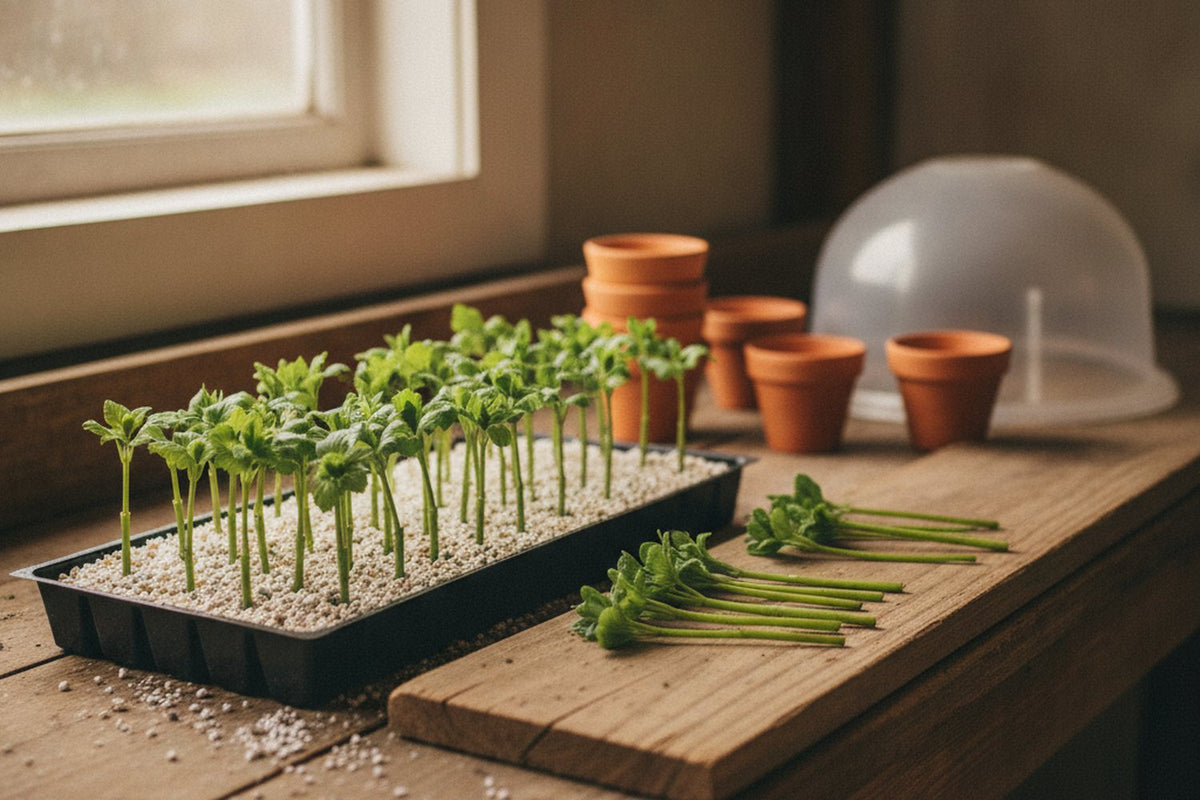
Root them in a medium that is sterile and low in fertility. NC State names coarse sand, pine bark, or one part peat to one or two parts perlite, and the Bonide and Garden Safe labels name potting soil. For a ready-made light mix, our best seed starting mix guide includes one its maker, Espoma, makes for rooting stem and leaf cuttings as well as seeds. Cover the cuttings with plastic, keep them in indirect light and keep the medium moist. Once they root, our best potting soil guide covers what to pot them on into.
The best rooting hormones, by job
2. Garden Safe TakeRoot, 2 Pack: best two-bottle pack
Best for: A spare bottle for a big season
Two 2 ounce bottles of a 0.1% IBA powder for flowers, houseplants and woody ornamentals.
The Garden Safe TakeRoot two-pack is two 2 ounce bottles of a 0.1% IBA powder, so one can stay sealed while you work from the other. Garden Safe's page names African violets, roses, poinsettias, philodendrons, geraniums, coleus and woody ornamentals among the plants it roots. Its label carries EPA Reg. No. 59807-4-39609, and RootBoost's (pick 3) carries 59807-4-71004. Good to know: neither its page nor its label gives a number of cuttings, and neither names vegetables or fruit.
3. GardenTech RootBoost: best for flowering shrubs
Best for: Flowering shrubs
A 2 ounce bottle of Hormodin 1, for ornamental cuttings.
The GardenTech RootBoost comes in a 2 ounce bottle, and GardenTech says it contains Hormodin 1, "same formula used by professionals"; Hormodin Powder 1 sits at 0.1% IBA in K-State's table. Of the four, its label says the most about shrubs: it names semi-hardwood cuttings of azalea, rhododendron, magnolia and photinia and hardwood cuttings such as dogwood and juniper, and says that in New York cuttings of most deciduous shrubs root best when taken in June, July and August. Its FAQ says rooting can take 3 to 5 weeks, depending on the plant species. Good to know: its page says to use it only on ornamental cuttings.
4. Miracle-Gro Root Starter Gel: best for rooting in water
Best for: Houseplant cuttings in water
Single-use gel packets for houseplant cuttings in water or soil.
The Miracle-Gro Root Starter Gel is the pick for cuttings you root in water. Miracle-Gro's page says to dip the cut end in the gel, then set the cutting in a vessel of water or plant it in soil, and not to add the gel to the water itself. A box holds 4 single-use packets, each good for up to 5 cuttings, and the page names pothos, fiddle leaf fig, prayer plant, spider plant and snake plant. Good to know: it names the active ingredient, indole-3-butyric acid, but not its strength, and an opened packet is discarded after its 5 cuttings, so prep every cutting before you tear one open.
When you can skip rooting hormone
Mississippi State says rooting hormones are not necessary for herbaceous cuttings, such as coleus, impatiens and chrysanthemum, but can increase the chances of a more uniform, heavier root system. Miracle-Gro's answer for houseplant cuttings in water is "Not necessarily, but it helps," since many root in plain water. For honey, a University of Hawaii Master Gardener trial at the National Tropical Botanical Garden found that cuttings of three easy-rooting ground covers dipped in diluted honey (2 tablespoons in 2 cups of boiled, cooled water) rooted at a similar or higher rate than untreated or hormone-treated cuttings, while the woody Hibiscus clayii rooted best with hormone powder. Woody stem cuttings are where NC State calls the compounds a common practice.
How we picked these rooting hormones
We compared each product's label, maker page or safety data sheet for its IBA strength, the plants it names and how much it treats, checked each pack against its Amazon listing, checked the advice against the Kansas State, NC State and Mississippi State extension guides and a University of Hawaii Master Gardener trial, and worked out each strength in parts per million from the label percentages. We make digging spades, not rooting hormone, so nothing on this page is ours. How our guides are made sets out the full process.
Also considered
- Hormex Rooting Powder. The numbered powders above No. 1 are all stronger than anything linked here; No. 16 is in the table above. When we checked on November 19, 2026, the Hormex No. 1 and No. 16 listings we read on Amazon were sold by a seller named for the brand, not by Amazon, and we have no proof that seller is the maker, so we do not link it.
- Clonex Rooting Compound Gel. A gel at 0.3% IBA in K-State's table, three times the IBA percentage of the linked powders. When we checked on November 19, 2026, its Amazon listings were sold by other sellers, not Amazon, so we do not link it.
- Dip'N Grow. A liquid concentrate at 1.0% IBA and 0.5% NAA in K-State's table, which K-State says can be diluted to the concentration a plant needs. When we checked on November 19, 2026, its Amazon listings were sold by other sellers, not Amazon, so we do not link it.
Frequently asked questions
What does rooting hormone do?
It helps a cutting grow roots. NC State Extension says root-promoting compounds raise the percentage of cuttings that root, make them root faster and more uniformly, and increase the number and quality of roots, particularly on difficult-to-root species.
Do you need rooting hormone for cuttings?
Not always. Mississippi State says it is not necessary for herbaceous cuttings but can give a more uniform, heavier root system; NC State calls it a common practice for woody stem cuttings.
Powder or gel rooting hormone: which is better?
A powder needs no dilution and stores easily; a gel gives fast, uniform results with less spillage than a liquid, by K-State's guide. For cuttings you root in water, use a gel made for water, such as Miracle-Gro's.
Can you use rooting hormone on vegetables?
Only a product whose label says so. The Bonide Bontone II label lists vegetables, fruit trees and small fruits; GardenTech says to use RootBoost only on ornamental cuttings.
What is the best rooting hormone?
The Bonide Bontone II, a 0.1% IBA powder for most cuttings; the Miracle-Gro Root Starter Gel for cuttings you root in water. For woody, hard-to-root cuttings, match the strength to the plant first.
Disclosure: Some links pay us a commission when you click or buy, and on some pages brands pay us through Amazon's creator program on links to their products.
Product prices and availability are accurate as of the date/time indicated and are subject to change. Any price and availability information displayed on Amazon.com at the time of purchase will apply to the purchase of this product.