As an Amazon Associate we earn from qualifying purchases. Some brands also pay us when you click or buy, so those links are ads. Full disclosure below
The best kindling splitter for most people who burn wood is the Kindling Cracker Original, a single casting of iron with a fixed wedge standing inside a 6.5 inch ring. You set a piece of firewood on the wedge, bring a blunt hammer down on the end of the piece, and the wood splits around the blade while your hands stay outside the ring. Popular Mechanics names it best for kindling in its log splitter roundup.
If your splits are wider than about 5.5 inches, which leaves that ring an inch for bark and lumpy splits, or longer than about 12 inches, the Kindling Cracker King XL widens the ring to 9 inches and stands 17 inches tall, and it is the size Family Handyman bought and ran 49 logs through. If you would rather stand at a wall and pull a lever, with no hammer at all, the Timber Tuff Wall-Mounted Kindling Splitter does that for pine and spruce.
None of these splitters asks you to swing an axe or a hatchet. The ring and open-blade types hold the blade still and let you drive the wood onto it, the reverse of a hatchet; the wall lever brings a hinged wedge down on a stick you have fed under it. Beyond that they differ in how they hold the wood, in how big a piece they accept, and in what you hit them with. For the two ring splitters, the width and the length of your pieces decide fit, so the size table below works out which rounds each ring takes and how long a piece each one holds.
Jump to: Original or King? | Ring, open blade or wall-mounted? | What hammer? | Mounting it | Hardwood and wet wood
Start here: which kindling splitter for you
- You split pieces up to about 5.5 inches across (an inch under its 6.5 inch ring) and 12 inches long: the Kindling Cracker Original (pick 1).
- Your splits run wider or longer than that, up to about 8 inches across whole, or you want to quarter rounds and keep going in one tool: the Kindling Cracker King XL (pick 2).
- You want something you can carry to a fire pit or a campsite: the Hi-Flame open-blade splitter (pick 3).
- You burn softwood and would rather not bend down or swing anything: the Timber Tuff wall-mounted lever (pick 4).
- You own no hammer: the Original (pick 1) plus a 3 lb hand sledge; see what hammer to use.
Best kindling splitters at a glance
| Pick | Opening | Longest piece | Weight | Hammer | Design | Best for | Our verdict | Where to buy |
|---|---|---|---|---|---|---|---|---|
| 1. Kindling Cracker OriginalBest kindling splitter overall | 6.5 in ring (listing) | About 12 in (Popular Mechanics) | 4.8 kg, about 10.6 lb (listing) | Not included | Cast iron ring around a fixed wedge | Splits up to about 5.5 inches across and 12 inches long | The splitter the sources agree on, one casting of iron whose 6.5 inch ring keeps your hands off the blade, though the ring caps what it takes and no hammer comes with it. | Check price on Amazon |
| 2. Kindling Cracker King XLBest for bigger and longer splits | 9 in ring (listing, Northern Tool) | 17 in frame (Northern Tool); Family Handyman split 12 to 19 in | A bit over 20 lb (Family Handyman) | Not included | Cast iron ring around a fixed wedge | Wider or longer splits, up to about 8 inches across whole, or quartering rounds | The one a tester ran a woodpile through, 49 logs quartered in a little over an hour for Family Handyman, though it is heavy, bulky and ships with no hammer. | Check price on Amazon |
| 3. Hi-Flame Wood Kindling SplitterBest for carrying to a fire pit or camp | No ring | No frame; the unit is 9.5 in tall (listing) | 9 lb (listing) | Not included | Open steel blade with baffles on both sides | Carrying to a fire pit or a campsite | The compact, ringless option a source backs, 9 pounds and 9.5 inches tall, though your hand steadies each stick until the first blow and BestReviews alone vouches for it. | Check price on Amazon |
| 4. Timber Tuff Wall-Mounted Kindling SplitterBest for softwood, standing up | 5 steps for different sizes (listing) | Not listed | 8.78 lb (listing); 10 lb (Tractor Supply) | Not needed | Cast iron lever, wall mounted | Softwood, with no bending and no hammer | A wall lever for pine and spruce with no bending and no hammer, though it is sold for softwood, needs a wall that can take the strain, and no tester we found has reviewed it. | Check price on Amazon |
The best kindling splitters, by job
1. Kindling Cracker Original: best kindling splitter overall
Best kindling splitter overall
Best for: Splits up to about 5.5 inches across and 12 inches long
Kindling Cracker Original
- Opening: 6.5 in ring (listing)
- Longest piece: About 12 in (Popular Mechanics)
- Weight: 4.8 kg, about 10.6 lb (listing)
The splitter the sources agree on, one casting of iron whose 6.5 inch ring keeps your hands off the blade, though the ring caps what it takes and no hammer comes with it.
One casting of iron, made at an Australian foundry according to the listing, with no welds, no moving parts and a wedge with no edge to hone. The ring is 6.5 inches across by the listing (the maker gives 170 mm, about 6.7 inches), the whole thing stands about 12 inches tall by BestReviews' measure, and the listing gives the weight as 4.8 kg, which is about 10.6 pounds. The base has bolt holes for a stump or a bench, and it also stands on its own.
Why it is the pick: it is the splitter the sources agree on. Popular Mechanics calls it best for kindling and an easy recommendation, crediting the one-piece cast iron, the lack of upkeep and a ring that keeps your hands off the blade. BestReviews made it its top kindling splitter in 2022. The Wood Burner, a UK firewood site, makes it best overall and credits it with defining the category. Down to Earth's reviewer found it did a very good job turning seasoned, dry wood into kindling and judged it far safer than an axe for the job. The method is the whole appeal. The wedge stays put and the hammer only ever meets the end of the log, so there is no sharp edge moving toward your fingers.
Where it loses: the ring caps what it takes. Popular Mechanics lists the small log capacity as its one con and gives that capacity as 12 by 6.5 inches, length by diameter, and BestReviews says it suits shorter pieces. A Hearth.com member who owns one says pieces a little too big for the ring jam, and that he would reach for it more if he had the bigger model. No hammer comes with it (Family Handyman and The Wood Burner both point this out), and The Wood Burner says the Original hops around on hard blows unless you bolt it down. If you already split with a powered machine, weigh one reaction: Down to Earth's reviewer took both sizes to a friend who splits his firewood with a tractor-driven machine, and the friend found them well made but would not buy one, while granting they are an excellent kindling tool for anyone without a tractor. If your splits run fat or long, buy pick 2.
2. Kindling Cracker King XL: best for bigger and longer splits
Best for bigger and longer splits
Best for: Wider or longer splits, up to about 8 inches across whole, or quartering rounds
Kindling Cracker King XL
- Opening: 9 in ring (listing, Northern Tool)
- Longest piece: 17 in frame (Northern Tool); Family Handyman split 12 to 19 in
- Weight: A bit over 20 lb (Family Handyman)
The one a tester ran a woodpile through, 49 logs quartered in a little over an hour for Family Handyman, though it is heavy, bulky and ships with no hammer.
The same one-piece cast iron design, scaled up. Northern Tool's page gives a 9 inch inside diameter for the ring, a 17 inch tall frame for longer pieces, an H-shaped base 10.5 inches wide with bolt holes, and a 5-year limited warranty; the Amazon listing gives the same ring and frame and says the bigger ring takes logs nearly 40 percent larger than the Original's. Family Handyman puts the weight at a bit over 20 pounds, and The Wood Burner lists it at 9.5 kg. The Amazon listing's weight row says 16 ounces, which disagrees with both, so plan on 20 pounds.
Why it is the pick: it is the splitter a tester actually ran a woodpile through. Family Handyman fed it 49 logs of aspen, birch, oak and boxelder, 3 to 9 inches across and 12 to 19 inches in length, quartered all of them in a little over an hour, and found that a knotted or odd-grained piece took only an extra hammer swing or two. Its verdict was that the king size is the one to get. The Wood Burner makes it the pick for bigger logs because you can split a fat piece into quarters and then keep tapping the quarters down to kindling in the same tool. The size table shows what the extra 2.5 inches of ring buys: whole splits up to about 8 inches across and quarters of rounds up to about 11.3 inches, against about 5.5 and 7.8 for the Original.
Where it loses: weight and bulk. Family Handyman calls it heavy and bulky and says it is not portable, and The Wood Burner puts it at nearly twice the Original's size, so it takes more room by the woodpile. Like the Original, it ships with no hammer. If your stove takes short, narrow splits, the Original does the same work in a smaller casting.
3. Hi-Flame Wood Kindling Splitter: best for carrying to a fire pit or camp
Best for carrying to a fire pit or camp
Best for: Carrying to a fire pit or a campsite
Hi-Flame Wood Kindling Splitter
- Opening: No ring
- Longest piece: No frame; the unit is 9.5 in tall (listing)
- Weight: 9 lb (listing)
The compact, ringless option a source backs, 9 pounds and 9.5 inches tall, though your hand steadies each stick until the first blow and BestReviews alone vouches for it.
A powder-coated steel splitter, 9.5 inches tall and 9 pounds by the listing, with four bolt holes for a block of wood or another flat surface (screws not included). There is no ring: the blade stands open, with baffles on both sides that the listing says push the two halves in different directions, and the listing says it twists the wood apart into pieces from about 1 inch down to a quarter inch. It comes in bright orange.
Why it is the pick: it is the compact, ringless option a source backs. At 9 pounds and 9.5 inches tall it is a little lighter and shorter than the Original (about 10.6 pounds and 12 inches), and BestReviews picked it in 2022 as a no-frills splitter, said it is compact enough to take camping, and liked the bright orange because it is easy to spot underfoot. Without one, nothing caps the width of a piece you set on it.
Where it loses: without a ring, your hand holds the stick upright on the blade until the first blow lands. The Wood Burner says the same of the ringless Forest Master base it covers: with nothing holding the log up, you steady it by hand, and that asks for a little more care and aim. BestReviews also warns of a short break-in period before it splits at its best. It is the one pick here that BestReviews alone vouches for, so treat it as the portable choice, not the safest one; for a splitter that keeps your hands out of the way, use pick 1 or 2.
4. Timber Tuff Wall-Mounted Kindling Splitter: best for softwood, standing up
Best for softwood, standing up
Best for: Softwood, with no bending and no hammer
Timber Tuff Wall-Mounted Kindling Splitter
- Opening: 5 steps for different sizes (listing)
- Weight: 8.78 lb (listing); 10 lb (Tractor Supply)
- Hammer: Not needed
A wall lever for pine and spruce with no bending and no hammer, though it is sold for softwood, needs a wall that can take the strain, and no tester we found has reviewed it.
A cast iron lever on a 24 inch handle, mounted to a wall through four holes, with five steps cut for different sizes of wood and no edge to keep honed, finished in powder coat. Tractor Supply sells the same model (TMW-87) and lists it at 27.6 inches long, 11.85 inches high and 9.45 inches wide, 10 pounds, with a 12-month limited parts warranty; the Amazon listing gives 8.78 pounds. Both say it is for softwood: pine and spruce on both pages, and birch on Amazon too.
Why it is the pick: the wall lever is a different way of working, and some readers want exactly that. The Wood Burner describes the design (its example is the Stikkan, in Also considered) as a wedge on a lever fixed at standing height, with no bending and no hammer. We found no tester who has reviewed this Timber Tuff model; it is on the list because the wall lever is a design the ring and open-blade picks do not cover, and it is the wall lever we found that a farm-store chain also sells, with a spec sheet of its own.
Where it loses: it is sold for softwood (its listing names pine, spruce and softwood), so oak and other dense hardwood offcuts are not its job; The Wood Burner treats the lever design as a tool for making kindling, not for splitting in general. It also needs a wall that can take the strain. One Hearth.com member who looked into these decided his stick-framed house was the wrong support and would mount one on a 6x6 rather than on a doubled 2x4 stud beside a door, and another said a friend tried one for a while and went back to an axe. Plan the mounting before you buy (see mounting).
How we chose these
We did not test these splitters ourselves. Three pages we read did put a splitter to wood: Family Handyman bought a Kindling Cracker King and quartered a pile of logs with it, the UK garden blog Down to Earth tried both Kindling Cracker sizes (its UK distributor sent them free, which the blog says), and HomeFixated tested the Logosol drop-hammer splitter in Also considered. We also used the roundups that name kindling splitters: Popular Mechanics, two 2022 BestReviews kindling splitter articles, one republished by KSN (our source for the Kindling Cracker, Hi-Flame and KABIN lines, and for the mounting, drying and safety-gear advice) and one on BestReviews' own site (our source for SPEED FORCE and the Fiskars X7), and the UK site The Wood Burner, plus a Hearth.com owners' thread. We read every Amazon listing on this page on October 5, 2026, and maker or retailer spec pages where they exist (Kindling Cracker and Northern Tool, Tractor Supply for Timber Tuff, Menards for KABIN, Logosol, Stikkan). Specs are the listing's unless we name another source.
The evidence thins after pick 2: the Hi-Flame has only the KSN BestReviews article behind it, and no tester we found has reviewed the Timber Tuff; it is here to cover a design the tested picks do not, and its pick says so. Three of the five products on BestReviews' own list (Marvoware, SnugNiture and Blue Home) are currently unavailable on Amazon, so they are not here.
Also considered: splitters that missed the list and why
BAYQISI Cast Iron Kindling Splitter with 3 lb Hammer. A one-piece cast iron blade on a base, open with nothing around it, 7.5 pounds and 9.8 inches tall by the listing, with screw holes in the base and a rubber sleeve that fits over the blade; four screws and a 3 pound hammer come in the box. It is the one splitter we link with a hammer in the box, and 3 pounds is the weight Kindling Cracker's maker suggests. It missed because no tester we found has reviewed it, the listing says dry logs only, and the Original plus a 3 lb hand sledge (see the hammer section) does the same job with the evidence behind it. Its dimensions row reads 1 by 1 by 1 inches, so go by the height in its description.
KABIN Kindle Quick Log Splitter (XL). 12 pounds of cast steel with an all-weather black coating, angled alternating teeth meant to stop jams, carry handles, and an X-shaped base with bolt holes that doubles as a crate for hauling the kindling, per the listing. BestReviews flagged it in 2022 as worth a look for that base and for an edge deliberately left dull so it splits rather than cuts. It missed because its own size figures disagree: the Amazon description says it takes logs up to 6 inches across and stands 15.5 inches tall, while Menards lists the same model (KKQR1) at up to 8 inches across and 16.5 inches tall. Until the seller settles which, we cannot tell you what it fits.
SPEED FORCE Firewood Kindling Splitter (3 inch). A small blade of nodular cast iron, 3 by 2.5 by 7 inches and 3.3 pounds, that screws to a stump with the four screws supplied and has a safety cover, per the listing. BestReviews listed a SPEED FORCE splitter in 2022 and liked that it comes with mounting screws. It missed because its only frame is your hand: BestReviews' own drawback is that keeping the wood level while the hammer comes down can be hard, and the open picks above are larger and taller.
Logosol Smart Splitter. A different machine: a weighted sleeve slides down a rail and drives a wedge, so you never swing a hammer at all. Logosol gives a 3.5 kg striking weight, 9.5 kg in total, and wood up to 55 cm long. HomeFixated tested it and liked the small kindling blade, whose recess holds thin pieces so they do not spring away, but found its force well short of a full swing with an 8 pound maul, needing six or more strikes on tough pieces, and still found kindling easier to make with a sharp hatchet. It missed because it is a firewood splitter first, and because the only Amazon listing we found is titled "Swedish Log Splitter" and its brand and spec fields do not match Logosol's, so we do not link it. Logosol's site lists its dealers.
Stikkan. The original wall-mounted kindling maker, which Stikkan dates to a Norwegian craftsman in 1982 and makes in Sweden: electroplated cast iron, 4.7 kg, 590 mm long, secured between uses, with a 10-year warranty, per Stikkan. The Wood Burner rates it as pleasant to use standing up but softwood only. We do not link it; Stikkan's US site lists where to buy it.
Fiskars X7 Hatchet. BestReviews' own 2022 kindling list includes this hatchet. It missed because it is a different tool: you swing an edge at wood you are holding, which is the thing every splitter here is built to avoid.
Kindling Cracker Original or King XL: which size takes your splits?
A ring splitter takes a piece that fits through its ring and in the room below its wedge, so check both the width and the length of your pieces. Two pieces of geometry help with width. A half round is as wide across its flat face as the whole round was, so splitting a round in half does not make it fit a smaller ring. A quarter round does shrink: it fits through an opening about 0.71 times the round's diameter. Every width on this page keeps the one-inch margin from the top of the page, so the computed column takes an inch off each ring's width and multiplies by about 1.41.
| Splitter | Opening | Quarters of rounds up to (computed, inch to spare) | Longest piece |
|---|---|---|---|
| 1. Original | 6.5 in | About 7.8 in | About 12 in (Popular Mechanics) |
| 2. King XL | 9 in | About 11.3 in | 17 in frame; Family Handyman split up to 19 in |
| KABIN (Also considered) | 6 or 8 in (sources disagree) | About 7.1 to 9.9 in | 15.5 or 16.5 in tall unit |
The open blades (pick 3, and the BAYQISI and SPEED FORCE in Also considered) have no ring, so your hand sets the limit, and the wall lever (pick 4) has five steps but gives no sizes.
How to read it: check both numbers. If your splits are about 5.5 inches across or less and no longer than about 12 inches, the Original takes them whole with that inch to spare. Longer or fatter pieces are what the King is for: Northern Tool says its taller frame leaves room below the wedge for longer pieces, and its ring takes whole splits up to about 8 inches across and quarters of rounds up to about 11.3 inches. The Wood Burner, writing for UK log burners, also sends mixed loads to the King. Our log splitter guide covers the machines for the rounds neither ring takes.
Ring, open blade or wall-mounted: which kindling splitter design?
Ring around a fixed wedge (picks 1 and 2). You stand the wood upright inside the ring and drive it onto the blade with blows from a blunt hammer. The ring keeps the piece upright and your hands away from the edge, and it is the design every tested pick on this page uses. The Wood Burner lists the costs: you work down low, so it wants a stump or a bench under it, you need your own hammer, and the ring sets the largest piece it will take.
Open blade (pick 3, and the BAYQISI and SPEED FORCE in Also considered). The same fixed blade with no ring, so nothing limits the width and the unit is lighter to move. The trade is that your hand steadies the piece until the first blow, which The Wood Burner says takes more care, and BestReviews lists holding the wood level as the drawback of a small open blade.
Wall-mounted lever (pick 4, and Stikkan). A wedge on a hinged arm at standing height: you feed a stick under it and pull down. No bending and no hammer. Both the Timber Tuff and the Stikkan are sold for softwood, the Stikkan for softwood only by The Wood Burner's account, and that site treats the design as a kindling maker, not a splitter for anything thick.
Drop hammer (Logosol, in Also considered). A weight slides down a rail onto a wedge. The Wood Burner suggests the design for anyone whose wrists, elbows or shoulders object to swinging a hammer, but HomeFixated found the stroke still takes a vigorous downward throw and less force than a maul.
What hammer should you use with a kindling splitter?
A blunt hammer of 3 to 4 pounds, and you will probably have to supply it: Family Handyman notes the Kindling Cracker comes with no mallet, and The Wood Burner says no bare Kindling Cracker includes one and that this catches most people out at the checkout. Kindling Cracker's maker says to strike with a 3 to 4 pound mallet or another piece of wood, and suggests a long-handled 3 pound club hammer. Family Handyman tried several on its King: a handheld 4 pound club hammer beat the others outright, a long-handled framing hammer was not stout enough, and a 10 pound sledgehammer did fine on green logs but was more than the rest needed. Swinging another log, as the packaging shows, worked but was awkward. The Wood Burner lands in the same place, 3 pounds for occasional use and 4 for volume, and says a rubber mallet lacks the weight for anything beyond thin softwood, and that you should not strike with an axe or a claw hammer.
If you need one, the Estwing Sure Strike MRF3LB 3 lb hand sledge has a forged steel head and a fiberglass handle with a non-slip grip. Its 11 inch handle makes it a handheld hammer like the one Family Handyman preferred, not the long-handled kind Kindling Cracker's maker suggests. One check before you order: the listing's first bullet mentions a 2 pound head, but the size selected at that link and the item weight both read 3 pounds, so confirm the size swatch says 3 lbs.
How to mount a kindling splitter
Ring and open-blade splitters: bolt them to a heavy round of wood. Every pick except the wall lever has holes in its base for that. The Wood Burner passes on the usual advice from UK firewood forums: coach bolts or large screws, driven through the holes in the base into a log round about knee high, which brings the ring up to a height that is easy to hit and keeps the splitter from creeping across the ground under repeated blows. It adds that the heavy King mostly stays put on its own, while the lighter Original skips around on hard strikes. Down to Earth found the log it was sent to stand the splitter on a little wobbly and noted that large screws through the base would fix that. Keep it off a patio: BestReviews warns that hammering on bricks will crack them, and suggests a big, level stump instead.
Wall levers: the wall carries every pull. The Timber Tuff mounts through four holes, and Stikkan's manual shows its lever about 120 cm (47 inches) off the floor. Look at what is behind the wall first: the Hearth.com member quoted above concluded a stick-built wall was the wrong support and would use a 6x6 post rather than a doubled 2x4 stud.
Will a kindling splitter handle hardwood, knots or wet wood?
Ring splitters handle hardwood: Family Handyman's pile included oak and birch. Straight grain splits easiest, and that tester found a knot or a twisted grain needed only an extra swing or two. The Wood Burner says dry, seasoned wood pops apart in a tap or two, while wet wood still splits but needs firmer, repeated blows and comes apart stringy; it suggests knocking down very gnarled or oversized pieces with an axe or maul first, or buying the larger ring. The exceptions are on the labels: the Timber Tuff and the Stikkan are sold for softwood, and the BAYQISI listing says dry logs only.
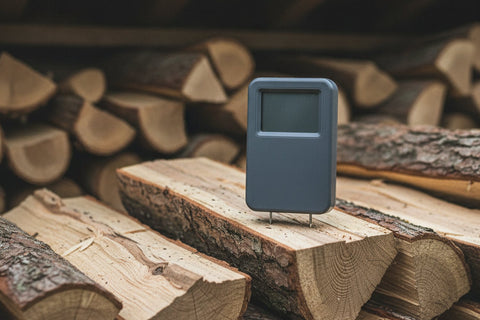
Moisture also decides whether the kindling lights, as The Wood Burner puts it. BestReviews adds the other side of the trade: splitting wood while it is still wet shortens how long it takes to dry. Our firewood moisture meter guide covers how to check a split before it goes in the stove.
Are kindling splitters safe? How to use one
The sources here pitch these tools as a safer way to make kindling than a hatchet, but each design still has a rule. On a ring splitter, keep your hands outside the ring: the maker's point is that you only ever strike the wood with a blunt object, never a blade. On an open blade, your hand steadies the piece until the first blow, which The Wood Burner says asks for more care. On a wall lever, the wall carries every pull, so check what is behind it first (see mounting). For gear, BestReviews suggests heavy work gloves, safety glasses against flying chips, long pants and steel-toe boots. On children, The Wood Burner says older kids able to manage a hammer can split kindling with a ring splitter while an adult supervises, and that it remains a bladed tool.
Related guides
For the rounds too big for any ring, our log splitter guide compares the machines. Our firewood rack guide covers keeping the splits dry once they are cut, and our fire starter guide covers what goes under the kindling.
A word from the people who wrote this
We are Spear Head Spade. We make digging spades, not kindling splitters, so nothing on this list is ours. When the ground thaws in spring, our spade finder matches a spade to your soil.
Frequently asked questions
What is the best kindling splitter?
For most people, the Kindling Cracker Original: one piece of cast iron with a 6.5 inch ring around a fixed wedge, which Popular Mechanics names best for kindling. If your splits are wider than about 5.5 inches or longer than about 12 inches, the Kindling Cracker King XL, with its 9 inch ring and 17 inch frame, is the one Family Handyman tested.
Are kindling splitters worth it over a hatchet?
On safety, the sources here say yes. Popular Mechanics counts a ring that keeps hands off the blade among its pros and tells readers to put the hatchet down for one, The Wood Burner's reason is the fixed blade: there is no swinging edge for your fingers to be near, and Down to Earth's reviewer judged the Kindling Cracker very much safer than an axe for kindling. Not everyone switches: Down to Earth's friend with a tractor-driven splitter would not buy one, a Hearth.com member felt a wall-mounted splitter loses a hatchet's speed and momentum, and HomeFixated's reviewer still found kindling easier with a sharp hatchet than with the Logosol.
What size kindling splitter do I need?
Measure the widest and the longest pieces you plan to split. A ring takes whole pieces and halves up to about an inch under its own width, and quarters of rounds up to about 1.41 times that: about 5.5 and 7.8 inches for the Original's 6.5 inch ring, and about 8 and 11.3 inches for the King's 9 inch ring. For length, Popular Mechanics gives the Original's capacity as 12 by 6.5 inches, and the King's 17 inch frame is built for longer pieces.
What hammer do you use with a kindling splitter?
A blunt hammer of 3 to 4 pounds. Kindling Cracker's maker suggests a 3 pound club hammer, Family Handyman found a 4 pound club hammer worked best, and The Wood Burner says rubber mallets lack the weight for most wood and warns against striking with an axe.
Do you need to bolt a kindling splitter down?
For regular use, yes. The Wood Burner suggests coach bolts or large screws, driven through the holes in the base into a log round about knee high, and says the lighter Kindling Cracker Original skips around on hard strikes if it is not fixed. Do not use one on a brick patio; BestReviews warns the hammering cracks bricks.
Will a kindling splitter split hardwood or wet wood?
Ring splitters do: Family Handyman split oak and birch in a Kindling Cracker King, with knots taking an extra swing or two. The Wood Burner says wet wood splits but needs firmer blows. Wall levers such as the Timber Tuff and Stikkan are made for softwood, and the BAYQISI listing says dry logs only.
Does a kindling splitter need sharpening?
The Kindling Crackers, the Timber Tuff and the KABIN are sold as needing none: both Kindling Cracker listings say there is no blade to sharpen, the Timber Tuff listing says no blade sharpening is required, and the KABIN description says its blade never needs it. The SPEED FORCE is the exception on BestReviews' own list, which says it came with a blade sharpener, and the Hi-Flame and BAYQISI listings do not say either way.
Do wall-mounted kindling splitters work?
For softwood, at standing height, they can: The Wood Burner describes the design as kindling without bending or a hammer. They need a solid mount, and one Hearth.com member would use a 6x6 post rather than a stud wall; another said a friend tried one and went back to an axe. Hardwood is not their job.
Can kids use a kindling splitter?
The Wood Burner says older kids able to manage a hammer can split kindling with a ring splitter while an adult supervises, and that it remains a bladed tool.
Disclosure: Our commissions do not change what we recommend or what you pay. We do not print prices because they move; every "Check price" link shows today's.