As an Amazon Associate we earn from qualifying purchases. Some brands also pay us when you click or buy, so those links are ads. Full disclosure below
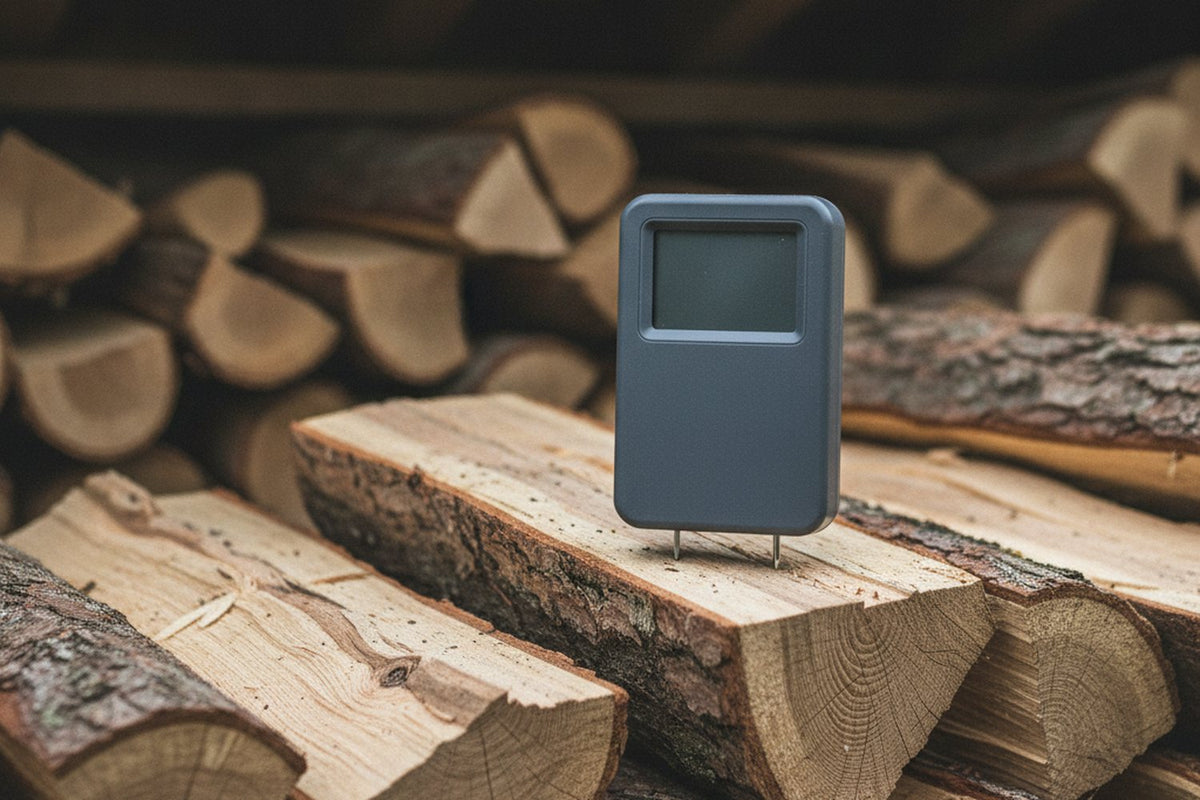
The best firewood moisture meter for most people who burn wood is the Tavool Digital Pin Moisture Meter, a pin-type meter with 8 wood calibration scales whose listing tells you to set red and white oak to Mode A. It reads wood from 6% to 60%, far enough past 30% to tell wood that is nearly ready from wood that is still green, and Bob Vila tested it and named it best for wood. On a tight budget, the Proster Wood Moisture Meter, which Bob Vila tested, called the best bang for the buck and liked for showing everything on the front of the meter. If you want the simplest meter, the Lignomat Mini-Ligno E/D, which has no power button and just two wood settings, was the easiest to use in the same test.
What you are checking for is simple. The US EPA's Burn Wise program says a moisture meter lets you stop guessing whether your wood is dry and seasoned enough to burn, which it defines as below 20% moisture content. Any meter on this page can tell you that, as long as you test the right surface: EPA's method is to split a piece and test the newly split side, not the weathered outside of the log. The how-to section below covers that and the cold-weather catch that makes a pin meter read low.
Jump to: Will it read your firewood? | What moisture content should firewood be? | How to test firewood | Pin or pinless? | Do they work?
Start here: which firewood moisture meter for you
- You burn mixed hardwoods, oak included, and want the reading corrected for species: the Tavool (pick 1).
- You want a working meter for the least money: the Proster (pick 2).
- You want no settings at all, and a cap check that reads right at the burn line: the General Tools MMD4E (pick 3).
- You want the meter a tester found easiest to use, with a warranty that covers the display for life: the Lignomat Mini-Ligno E/D (pick 4).
- You want a meter sold for firewood alone, from a chimney and hearth tools maker: the AW Perkins Hearth Country (pick 5).
- You want a meter that clips in your shirt pocket like a pen, and you test splits indoors: the Klein Tools ET150 (pick 6).
- You want to skip pins and can spend far more: the Wagner Orion 910 pinless meter, in Also considered.
Best firewood moisture meters at a glance
| Product | Best for | Type | Wood reading range | Species settings | Pins | Who recommends it | Where to buy |
|---|---|---|---|---|---|---|---|
| 1. Tavool Digital Pin Moisture Meter (sold as VINHMOR on Amazon) | Best overall for firewood | Pin | 6% to 60% (listing) | 8 scales; oak on Mode A (listing) | Stainless steel (listing) | Bob Vila, tested; Popular Mechanics, from research | Check price on Amazon |
| 2. Proster Wood Moisture Meter | Lowest cost of the six | Pin | 0% to 99.9% (listing) | 4 groups; oak not named (listing) | Integrated, 10 mm (listing) | Bob Vila, tested; Popular Mechanics, from research | Check price on Amazon |
| 3. General Tools MMD4E | No settings; cap check reads 18.3% | Pin | 5% to 50% (General Tools) | None; one wood mode | Replaceable, spares in the box (listing) | Popular Mechanics, from research; Hearth.com owners | Check price on Amazon |
| 4. Lignomat Mini-Ligno E/D | Easiest to use (Bob Vila, tested) | Pin | 6% to 45% (Lignomat) | 2: softwood, hardwood | Two lengths (Bob Vila) | Bob Vila, tested | Check price on Amazon |
| 5. AW Perkins Hearth Country | Firewood only, from a chimney and hearth tools maker | Pin | 5% to 40% (listing) | None named in the listing | Not stated | No tester | Check price on Amazon |
| 6. Klein Tools ET150 | A clip-on pocket meter | Pin | Hardwood 0% to 33%; softwood 0% to 55% (Klein) | 2: hardwood, softwood | Replaceable, two spares in the box (Klein) | No tester | Check price on Amazon |
How we chose these
We did not hands-on test these meters. We compared each meter's Amazon listing, and the maker's product page or manual where we could find one, against what independent reviewers reported. Bob Vila tested moisture meters hands-on, and three of our six picks are among the meters it tested: the Tavool, the Proster and the Lignomat. It also tested two meters in our Also considered section, the General Tools MMH800 and the Klein Tools ET140, and the Klein failed. Bob Vila's separate wood moisture meter guide names the Lignomat its favorite. Popular Mechanics says it did not hands-on test its picks, and chose the MMD4E, the Proster and the Tavool from specs and user reviews. Those tester pages cover leak finding and woodworking too, so we judged every meter on what firewood needs: a scale that reaches past 30%, so it can tell nearly ready wood from green wood; how it behaves in cold weather; and whether it corrects for species. A species setting helps most with dense hardwoods like oak; two picks skip it for simplicity, and each says so.
Our rules: every numbered pick was in stock on Amazon on September 29, 2026, and every pick without a tester says so. For the 20% target and the testing method we used the EPA's Burn Wise flyer and Cornell Cooperative Extension; for cold readings, Delmhorst, a moisture meter maker. Bob Vila's overall winner, the General Tools MMH800, is in Also considered: it is a leak-finding meter, and a firewood buyer pays for a pinless pad and humidity and temperature sensors a woodpile does not use, when its pins read the same 5% to 50% wood range as the MMD4E (pick 3), which cost less on September 29.
The best firewood moisture meters, by job
1. Tavool Digital Pin Moisture Meter: best overall for firewood
Check price. A pin-type meter with 8 calibration scales for wood, a wood range of 6% to 60% and a building material mode, per the listing. The screen is backlit, a Hold key freezes the reading, and the listing adds a memory function, max and min readings, a temperature display in F or C, and auto power-off after 10 minutes. On Amazon it is sold under the VINHMOR name, with Tavool listed as the maker, and the listing text calls it the Tavool moisture meter.
Why it is the pick: it is the meter on this page that deals with oak most directly. The listing notes that the botanical name for red oak and white oak in the manual is "Quercus spp" and says to switch to Mode A when testing oak. With 8 scales it has more species settings than any other numbered pick, and its 6% to 60% range runs well past 30%, so it separates nearly ready wood (20% to 30%) from green wood. Truly fresh-cut wood can read above 60% (Cornell says freshly cut wood can hold 100% or more), and then any meter just shows its top or no number: read that as green. Bob Vila tested it and called it one of the biggest surprises of its test: it liked the screen, which it called the best digital screen in the test, and the pins, long and thin enough to go deep into wood while staying durable. Popular Mechanics picked it as best for woodworkers from research, and a 2021 Backyard Boss firewood roundup includes it too. Bob Vila describes seven wood scales and Popular Mechanics gives both seven and eight; the current listing and the MT270 manual say eight.
Where it loses: both Bob Vila and Popular Mechanics complain that its species guide lists trees by their scientific names; Bob Vila says its testers had to look many of them up. Tavool's manual for its MT270, whose specifications match this listing, answers that: any hardwood it does not list goes on Mode A and any softwood on Mode H, so for most firewood you need only those two. Its listing puts "High" at 17% to 60%, so a high reading is not by itself a reason to wait. Its temperature reading is a display, not a correction the listing says it applies, and the MT270 manual rates it for use from 32F and says it is calibrated for wood at 68F, so the cold-weather advice in the how-to section still applies.
2. Proster Wood Moisture Meter: best budget pick
Check price. A pin meter with integrated 10 mm (0.4 inch) pins, 4 wood modes covering approximately 28 species, a large LCD with Data Hold, auto power-off and a 9V battery, per the listing, which names firewood and logs among its uses. On Amazon on September 29 it cost less than any other pick here.
Bob Vila tested it and named it the best bang for the buck: it liked that everything you need to know shows on the face of the meter, with no long manual to read. Popular Mechanics chose it as best budget from research, noting the species reference printed on the housing, and Backyard Boss lists it for firewood too. For a woodpile, where you want a yes or no on 20%, that is the right amount of meter.
Where it loses: it measures wood and wood products only, which Bob Vila and Popular Mechanics both list as its drawback, though that costs a firewood buyer nothing. The species group table on the listing and in Proster's manual names teak, walnut, beech, cedar, ash, elm, fir, maple, basswood, larch, pine and birch, among others, but not oak, though Popular Mechanics says oak is among its 28 species on the guide printed on the housing; check that guide, or use the Tavool (pick 1), whose listing names the oak setting outright. The listing calls its pins integrated and lists no replacements. Proster's manual rates it for use from 32F to 104F. Its scale runs to 99.9%, and Bob Vila suspects anything above about 70% would feel dripping wet, so treat very high readings as simply "wet".
3. General Tools MMD4E: best simple meter with a calibration check
Check price. A pin meter with one wood mode, 5% to 50%, and a building material mode, 1.5% to 33%, with a stated accuracy of plus or minus 2%, per the General Tools manual. It has a backlit LCD, a Hold button, low, medium and high tones, and a protective cap with a built-in calibration check; the listing says spare 8 mm pins and a 9V battery come in the box.
Why it is here: there is nothing to set. You turn it on, pick wood mode and push the pins in. The cap check is the useful extra. The manual says that with the pins in the cap's calibration holes, a meter in good order reads 18.3% plus or minus 1% in wood mode, which sits right under the 20% line you care about. It is Popular Mechanics' best overall, from research, and it has a long record on the Hearth.com forum: one member recommends it to a member who did not know which species he burns and wanted no species settings, and another who has used one for a couple of years says his reads correctly on the cap's calibration check every time.
Where it loses: with no species correction, a forum member on the same thread cautions that its number is an indication of moisture content, more so when the meter does not adjust for species or temperature. Another member says he called General Tools and was told the meter was not good for hard woods, especially firewood, because the pins cannot go in deep; test a freshly split face and push the pins in fully. Popular Mechanics says its pins are not durable. The manual rates it for use from 32F, and its red "high" indicator in wood mode starts at 16%, so do not read red as "too wet to burn". Moisture Meter Experts lists General among brands it does not recommend, for poor accuracy or for not reading the low moisture levels that woodworking needs. If you burn mostly oak or other dense hardwood, the Tavool (pick 1), which cost less on September 29 and names an oak setting, is the safer buy.
4. Lignomat Mini-Ligno E/D: easiest to use
Check price. A pin meter reading 6% to 45% with two wood group settings, softwood and hardwood, per Lignomat, which lists firewood among its uses. Bob Vila says it comes with two sets of pins, 3/16 inch and 7/16 inch deep. Lignomat says it runs a calibration check before each measurement, says the LED display is warranted for life and the meter for 2 years, and that it fits in a shirt pocket.
Bob Vila's wood moisture meter guide names it best overall, and in Bob Vila's hands-on moisture meter test it was the Best Ease of Use pick, the simplest of the meters tested there by a wide margin: there is no power button, because a switch between the pins turns it on when you push them into wood, and you only choose between two wood groups. Backyard Boss picked it for firewood too.
Where it loses: Bob Vila's only complaints are that it has no pinless option and an old-fashioned, 1980s look. It is the most expensive numbered pick, and its 45% top is lower than the Tavool's 60%, though still well past the 30% line between nearly ready and green wood.
5. AW Perkins Hearth Country Firewood Moisture Meter Kit: best firewood-only meter
Check price. A digital meter that reads 5% to 40% at 1% resolution with a stated accuracy of plus or minus 1%, with a large LCD and a carry case, per the listing. US Fireplace Store's page for the meter says it uses a 4-prong test and runs on a 9V battery. It is the one pick sold only for firewood, from AW Perkins, which makes chimney sweeping and stove and fireplace repair products. US Fireplace Store's description says 3% to 40%, though its own spec list gives 5% to 40%, as the listing does.
It suits the buyer who wants a tool made for the woodpile, not a leak finder with a wood mode added. Its 5% to 40% scale covers the firewood range with 20 points of room above the 20% line.
Where it loses: no tester has reviewed it, and the listing names no species setting or operating temperature. Without a species setting, treat its number on oak as a trend, not an exact figure. Its 1% resolution is coarser than the 0.1% of the Proster, though for a burn-or-wait call on 20% that makes no difference.
6. Klein Tools ET150 Pin Moisture Meter: best clip-on pocket meter
Check price. A slim, pocket-sized pin meter with a pen clip, hardwood and softwood modes, a cap whose top checks calibration, and a backlight that turns green, orange or red for low, medium and high moisture, per the listing. Klein says the pins go up to 8 mm (about 0.3 inch) into the wood, and gives a range of 0% to 33% in hardwood and 0% to 55% in softwood, wood accuracy of plus or minus 2%, and an operating range of 50F to 104F; it comes with two AAA batteries, a lanyard and two replacement pins.
Owners on the Firewood Hoarders Club forum and Hearth.com say they like a meter small enough to keep in a pocket. This is the one numbered pick with a pen clip, and it still has hardwood and softwood modes.
Where it loses: no tester has reviewed it. Its hardwood scale stops at 33%, so a green oak split may just read at the top of the scale, and Klein's 50F floor means you read splits indoors, which the how-to section recommends anyway. Klein describes its readings as relative moisture content for leak and flood work, with plus or minus 2% on wood.
Also considered: meters that missed the list and why
Wagner Meters Orion 910. Moisture Meter Experts' pick for firewood and its highest scorer overall. On its damp-surface test, the four Wagner Orion models scored far better than every other meter it lists, which matters when a split is still wet from rain. The listing says it measures at a 3/4 inch depth and is virtually unaffected by the wood's surface temperature, and it comes with an on-demand calibrator. It missed the list because Amazon showed limited stock on September 29, 2026, and it costs several times more than any numbered pick. Moisture Meter Experts says it may be paid when you buy through its links, and its top four meters are all Wagners.
General Tools MMH800. Bob Vila's best overall after testing, with pin and pinless sensors plus humidity and temperature readouts; Popular Mechanics names it best combination. It is a leak-finding tool first: a firewood buyer pays for a pinless pad and humidity and temperature sensors a woodpile does not use, when its pins read the same 5% to 50% wood range as the MMD4E (pick 3), which cost less on September 29.
Lignomat mini-Ligno DX/C. The Mini-Ligno with 46 settings across wood species and building materials (bamboo, OSB, subfloors, plaster, concrete), and a 5% to 65% range, per the listing, which names firewood in its title. It missed because Amazon showed limited stock on September 29, 2026 and no tester has reviewed it; the E/D (pick 4) does the firewood job with two groups.
Klein Tools ET140. Bob Vila tested it hands-on and it did not pass: during repeated testing it consistently read 4% moisture and could not be recalibrated. It is a pinless meter that reads up to 3/4 inch deep with hardwood and softwood modes; Klein describes its readings as relative moisture content and gives an accuracy of plus or minus 4%. We do not link it. The ET150 (pick 6) is the Klein with pins.
Calculated Industries 7440 AccuMASTER XT. A pin meter whose listing has a line titled "ensure firewood is ready to burn", with icons, audio alerts and built-in calibration test pins. Calculated Industries gives it the same 5% to 50% wood range as the MMD4E, and its listing puts "High" at 16% to 50%. It missed because the MMD4E covers the same ground with a Popular Mechanics pick and a long forum record behind it.
Stihl Wood Digital Moisture Meter. A name chainsaw owners know, and Backyard Boss's 2021 firewood roundup picked it, giving a 6% to 42% wood range. It missed because Amazon showed limited stock on September 29, 2026 and the listing carries no specifications to confirm that figure.
Delmhorst J-Lite. A pin meter from Delmhorst, whose temperature guidance we cite below, but its scale runs 6% to 30%, per the listing title, so it cannot separate half-seasoned wood from green wood. Amazon listed it for later delivery on September 29, 2026, so we do not link it.
AMTAST Wood Moisture Meter. Amazon returned no offer for it when we checked on September 29, 2026, so we do not link it.
RDINSCOS Replaceable Pins Moisture Meter. A pin meter whose listing has a line titled "check firewood before you burn" and whose pins are replaceable, per its title. It missed because no tester has reviewed it and the listing gives no wood range or species setting; the Proster (pick 2) covers the low-cost slot with a tester behind it.
Harbor Freight's moisture meter. Not on Amazon, but the meter several Hearth.com members use. One says it fits in a pocket and works fine; another owns both it and an MMD4E and says they read fairly close to each other, but dislikes that it takes coin batteries.
Will it read your firewood?
Three things decide whether a meter suits a woodpile: whether its scale reaches past 30%, whether it corrects for species, and how cold it can be used. The reading chart in the next section puts 20% to 30% at nearly ready and over 30% at still green, so a meter that tops out near 30% shows the same number for wood that needs another few weeks and wood that was cut last week. Cornell Cooperative Extension says freshly cut wood can hold 100% moisture content or more, so on every meter, a reading stuck at the top of the scale means green.
| Meter | Top of wood range | Tells nearly ready (20% to 30%) from green (over 30%)? | Species settings | Lowest stated operating temperature |
|---|---|---|---|---|
| 1. Tavool | 60% (listing) | Yes | 8 scales | 32F in a matching manual; not in the listing |
| 2. Proster | 99.9% (listing) | Yes | 4 groups | 32F (Proster manual) |
| 3. General Tools MMD4E | 50% (manual) | Yes | None | 32F (manual) |
| 4. Lignomat Mini-Ligno E/D | 45% (Lignomat) | Yes | 2 groups | Not on Lignomat's page |
| 5. AW Perkins Hearth Country | 40% (listing) | Yes | None named | Not in the listing |
| 6. Klein Tools ET150 | 33% hardwood, 55% softwood (Klein) | Softwood yes; hardwood only to 33% | 2 modes | 50F (Klein) |
| Lignomat mini-Ligno DX/C | 65% (listing) | Yes | 46 settings, wood and other materials | Not in the listing |
| General Tools MMH800 | 50% (Bob Vila) | Yes | None | Not in our sources |
| Calculated Industries 7440 | 50% (Calculated Industries) | Yes | None named | Not on the maker's page |
| Delmhorst J-Lite | 30% (listing) | No, stops at 30% | Not in our sources | Not in our sources |
What the table says: every numbered pick except the Klein on hardwood reaches past 30%, and the Tavool pairs that with the most species settings of the six picks. The Klein's hardwood scale and the Delmhorst J-Lite top out at 30% to 33%. On any meter, treat a reading at the top of the scale as "not ready", not as a measurement. Four of the six picks have a stated cold limit: 32F on the Tavool (in the matching manual), Proster and MMD4E, and 50F on the Klein. A winter woodshed can be colder, which is one more reason to read splits indoors.
Firewood moisture content: what should firewood read?
Below 20%. The EPA's Burn Wise flyer calls wood below 20% moisture content dry, seasoned and ready to burn, and Cornell Cooperative Extension says it is important to burn only wood below 20%. Popular Mechanics puts the ideal for wood stove fuel at 15% to 20%. Not every source draws the line in the same place: the UNH Cooperative Extension puts air-dried, seasoned wood at about 30%, and calls split, seasoned wood between 20% and 30% the best fuel for any woodstove. It also says newer stoves, especially those with catalytic combustors, need dry wood and to follow the stove maker's recommendation. Most buyers will be safest aiming for the EPA's under 20%.
Why it matters, per the EPA: dry wood is easier to start and burns hotter, uses less wood for the same heat, and reduces creosote build-up and chimney fires; wet wood gives off less heat and makes more smoke and creosote. Cornell adds that boiling the water out uses up energy, so you get less heat.
Here is a firewood moisture content chart built from those same sources:
| Meter reading | What it means | What to do |
|---|---|---|
| Under 20% | Dry, seasoned and ready to burn (EPA) | Burn it, and keep it under cover |
| 20% to 30% | Partly seasoned. Cornell says freshly cut wood gets down to 25% to 30% fairly easily, but the last, bound water takes much longer to leave | Give it more time; test again in a few weeks |
| Over 30% | Still green or wet. Cornell says freshly cut wood can hold 100% or more, and UNH puts green wood between 50% and more than 100% | Split, stack and cover it, as the EPA advises, and wait |
How long that takes: the EPA says to split, stack, cover and store wood for at least 6 to 12 months, and that split wood dries much faster than whole logs. Cornell says getting green wood below 20% takes at least six months and can take much longer in a shady spot or near water, and it suggests buying firewood a year or more ahead of when you plan to burn it. Our firewood rack guide covers stacking it so the air can do that work.
A note on numbers over 50%: Cornell explains that at 100% moisture content, water makes up half of what the wood weighs, so readings above 50% are possible on green wood.
How to use a moisture meter on firewood
- Take a few big splits, not one. A Hearth.com member tests a few big splits from each year's batch, and a Firewood Hoarders Club member splits a few pieces and averages the readings.
- Let them warm up indoors. Delmhorst, a meter maker, says very low temperatures lower a pin meter's reading and that below freezing a pin meter will read the wood as drier than it is. Its own pin meters are calibrated at 70F, and it says temperatures between 50F and 90F should not change their readings much. A Firewood Hoarders Club member advises bringing wood inside for a bit before testing in the middle of winter, and Moisture Meter Experts says to let the wood warm to room temperature before testing when you can. Tavool's MT270 manual also says to give the meter itself 10 minutes or more to adjust after you move it somewhere new.
- Split each piece again, and test the new face. This is the EPA's method: split the wood and test the newly split side. A Firewood Hoarders Club member explains why: the inside of a log holds more moisture than the outside, even when it has been seasoned. Cornell adds that most meters' probes reach only about a quarter inch deep, so testing the outside only tells you about that outer layer.
- Use the species setting if your meter has one. Pick the group or scale for the wood you are burning, or at least hardwood or softwood. On a meter without one, such as the MMD4E, compare readings on the same species over time instead of trusting the exact figure.
- Push the pins in fully. The EPA says to insert the probes into the wood grain and to follow your meter's instructions. One Hearth.com member says the pins need to go as deep as possible to avoid an artificially high resistance, which is tough in oak; another found that a harder push raised the reading. Push to the same full depth every time. The MMD4E's manual says the pins should go in at least a quarter of the thickness of the material for an average reading.
- Take two or three readings and trust the trend. Bob Vila's quick accuracy check is to test one spot two or three times and see whether the numbers agree. When readings on a few splits all come in under 20%, that batch meets the EPA's line for ready to burn.
One thing the meter cannot fix: a Firewood Hoarders Club member notes that meters are preset for a certain temperature, and a Hearth.com member notes that readings vary with the wood's temperature, species and how deep the probes go. Keep those three the same from test to test and the meter will show you the wood drying out, even if the exact figure is not lab-accurate.
Pin or pinless for firewood?
Pin, for most people who burn wood. A pin meter pushes two pins into the wood and reads the electrical resistance between them; a pinless meter presses a sensor pad against the wood and reads it with electromagnetic signals, Popular Mechanics explains. Pinless meters read faster and over a broader area, Popular Mechanics says, and they leave no pin holes, but firewood gives them two problems.
- Firewood is not flat. A Hearth.com member warns that a pinless meter needs firm contact, that any air between it and the wood affects the reading, and that since firewood is never flat, the reading will almost always be off. Another member on the same thread questioned why the asker wanted a pinless meter at all and recommended the pin-type MMD4E (pick 3). Whichever you use, a fresh, flat split face is what the meter needs.
- Wet surfaces. Delmhorst says surface moisture from condensation is the main obstacle for pinless meters on cold wood, and on Moisture Meter Experts' damp-surface test, every meter it lists except the four Wagner Orions got the lowest score.
In the pinless meters' favor, Delmhorst says pinless meters are better suited to cold wood than pin meters, since temperature has little effect on them unless the wood is frozen solid. If you test outside in winter and can spend far more, the Wagner Orion 910 in Also considered is the pinless meter a tester recommends for firewood. For everyone else, a pin meter on a split brought indoors does the job.
Do firewood moisture meters work, and how accurate are they?
They work well enough for firewood, and cheap ones are fine. Bob Vila says a wood stove owner can get by with a cheap meter, since firewood does not call for high accuracy, and saves the case for spending more for construction lumber and furniture making. Popular Mechanics says a lower-priced meter usually reads within 4% of the true figure, and Moisture Meter Experts says a cheap meter will get you a reading to within about 5%. The question you are asking, "is this wood under 20%?", does not need better than that, as long as you test the way the how-to section describes.
Owners agree. On Hearth.com, one member reads his MMD4E and a Harbor Freight meter fairly close to each other, and another says he bought his meter for a friend who kept claiming his oak was seasoned. A Firewood Hoarders Club member found dead standing lodgepole pine, which he had heard was dry enough to burn right away, read well over 30% after cutting and splitting. A Hearth.com member's advice is that a meter is most useful in your first year or two of burning, until you are far enough ahead on your wood supply, and he adds that within about five years you will be able to tell dry from wet by a split's weight and the sound two splits make when you knock them together. Cornell describes the same signs: checks up to a quarter inch wide in the end grain, and a crisp sound instead of a dull one.
Related guides
If the meter says the wood needs more time, our firewood rack guide covers stacking it off the ground so it dries. If you are still putting up this winter's wood, our chainsaw guide and log splitter guide cover cutting it and splitting it smaller so it dries faster. When it is dry, our fire starter guide covers lighting it, and once it is burning, our wood stove fan guide helps move the heat into the room. If you are still choosing the stove itself, our wood stove guide compares small EPA-certified stoves and what installing one takes.
A word from the people who wrote this
We are Spear Head Spade, and we make digging spades, not moisture meters, so nothing on this list is ours. When spring comes around, our spade finder matches a spade to your soil.
Frequently asked questions
What is the best moisture meter for firewood?
For most people who burn wood, the Tavool Digital Pin Moisture Meter: it has 8 wood calibration scales, its listing tells you which scale to use for oak, and it reads from 6% to 60%. Bob Vila tested it and named it best for wood. The Proster is the lower-cost choice Bob Vila also tested, and the Lignomat Mini-Ligno E/D was the easiest to use in the same test. You may also see these sold as moisture testers.
What moisture percentage should firewood be?
Below 20%. The EPA's Burn Wise program calls wood below 20% moisture content dry, seasoned and ready to burn, and Cornell Cooperative Extension says to burn only wood below 20%. UNH Cooperative Extension sets its line higher, at 20% to 30%, so if your stove maker gives a figure, follow it.
How do you test firewood with a moisture meter?
Bring a few big splits indoors to warm up, split each one again, and push the meter's pins into the freshly split face, which is the EPA's method. If your meter has a species setting, set it first. The inside of a split holds more moisture than the outside, and Delmhorst says a pin meter reads very cold wood as drier than it is.
Are cheap firewood moisture meters accurate?
Accurate enough for firewood. Bob Vila says a cheap meter is fine for heating with a wood stove, since firewood does not call for high accuracy, and Popular Mechanics says a lower-priced meter usually reads within 4% of the true figure. For a yes or no on 20%, that is enough, as long as you test a fresh split face on wood at room temperature.
Should I buy a pin or pinless meter for firewood?
A pin meter, for most people. Pinless meters need firm contact with a flat surface, and a Hearth.com member warns that since firewood is never flat, the reading will almost always be off. Delmhorst says pinless meters cope better with cold wood, so they make most sense if you test outdoors in winter and can pay for a meter such as the Wagner Orion 910.
How long does firewood take to dry to 20%?
At least six months, and often longer. The EPA says to split, stack, cover and store wood for at least 6 to 12 months, and that split wood dries much faster than whole logs. Cornell Cooperative Extension says getting green wood below 20% takes at least six months and can take much longer in a shady spot or near water, so a meter reading is the way to know.
Can firewood be too dry?
The EPA sets only an upper line, below 20%. Popular Mechanics puts the ideal for wood stove fuel at 15% to 20%, and US Fireplace Store, a hearth retailer, says wood below 15% burns too quickly. If your stove maker gives a figure, follow it.
Why does my moisture meter give a different reading on the same log?
Readings change with where you test, how deep the pins go, the wood's temperature and the species setting. The outside of a log dries first, so its surface reads lower than a freshly split face. A Hearth.com member says a harder push on the pins can raise the reading, and Delmhorst says cold wood reads drier on a pin meter. Test the same way every time and compare the trend.
Disclosure: Our commissions do not change what we recommend or what you pay. Availability was checked on Amazon on September 29, 2026 and can change; we do not print prices because they move, so every "Check price" link shows today's.
Product prices and availability are accurate as of the date/time indicated and are subject to change. Any price and availability information displayed on Amazon.com at the time of purchase will apply to the purchase of this product.