As an Amazon Associate we earn from qualifying purchases. Some brands also pay us when you click or buy, so those links are ads. Full disclosure below
The best weed barrier for most yards is a woven landscape fabric like the Dewitt Pro-5, laid under rocks, gravel paths, patios and driveways where nothing is supposed to grow. A gravel driveway wants a heavy-duty woven fabric, and around plants under decorative rock, a non-woven mat is easier to cut and fit. Under bark mulch in a planting bed, fabric is a two to three year fix at best, and plain cardboard does that job better.
Landscape fabric earned half of its bad reputation honestly. Rolled out in a flower bed under shredded bark, it holds for two or three years. Then the mulch breaks down into a thin layer of compost, weeds root in that layer, and pulling them tears the fabric. The fabric is not defective. It was put in the wrong place.
Best weed barriers at a glance
| Weed barrier | Best for | Why it wins | Where to buy |
|---|---|---|---|
| Dewitt Pro-5 5 oz woven, 4 ft. x 250 ft. (best overall) | Paths, gravel, and permanent ground cover | Woven 5 ounce fabric sold for commercial installations, and it passes air and water | Check price on Amazon |
| DWALE 5 oz woven driveway fabric, 13 ft. x 115 ft. | Gravel driveways, parking pads, patio bases | Woven fabric with a listed 800 pound tensile strength, wide enough to skip the seam on a single car drive | Check price on Amazon |
| Dewitt Natural Paper Mulch, 4 ft. x 300 ft. | Vegetable rows and annual beds | Breaks down at the end of the season and tills straight into the soil | Check price on Amazon |
| ECOgardener 5 oz landscape fabric, 3 ft. x 50 ft. | One bed or one short path | A 5 ounce roll sized for a single project instead of a contractor pallet | Check price on Amazon |
| Grenebo non-woven weed barrier, 4 ft. x 100 ft. | Blocking light under decorative rock and stone | Non-woven mat that cuts cleanly without fraying, so it fits around what is already planted | Check price on Amazon |
| HongWay 6 in. landscape staples, 240 pack | Holding any of it down | Enough 6 inch, 11 gauge galvanized pins for a real project, not half of one | Check price on Amazon |
What is the best weed barrier?
The best all round weed barrier is the Dewitt Pro-5, a 5 ounce woven fabric that blocks light while letting air and water reach the soil. Put it under gravel, stepping stones, and paths. In vegetable and perennial beds, paper mulch or plain cardboard is the better barrier, because it breaks down instead of trapping roots.
Weight is the spec that decides everything and the one nobody explains. Fabric is graded in ounces per square yard, and every fabric in this guide is 5 ounces or heavier, the range meant for paths and stone rather than one season under mulch.
What is the best weed barrier to use under rocks?
For rock that will stay where you put it, a woven landscape fabric of 5 ounces or more, such as the Dewitt Pro-5 (pick 1). River rock beds, dry creek beds and the strip of stone along a foundation all fit that description. Where the rock goes in around plants that are already growing, a non-woven mat such as the Grenebo (pick 5) is easier to cut and fit, and it still blocks light under the stone.
Rock is where fabric earns its place. UC IPM's Pest Notes on weed management in landscapes suggest considering a fabric under rock mulch, for two reasons: it keeps the stones from sinking into the soil, and it keeps soil from working up between them, where it carries weed seed up to the surface and gives windblown seed somewhere to sprout. The same guide warns that pulling weeds out of a rock bed by hand or with a hoe is very difficult, so the layer underneath is worth getting right the first time.
Four habits keep a rock bed clean:
- Clear the perennial weeds first. Fabric cuts down on weeds sprouting from seed in the soil below, but an established perennial weed can come up through it, so dig those out before you lay anything.
- Close every gap. Weeds come up through any opening, so overlap the pieces and pin them down tight, as in the gravel section below.
- Cover all of it. Sunlight is what breaks fabric down, so leave no edge or patch showing between the stones.
- Keep the top clean. Fallen leaves and blown-in soil that settle between the stones turn into a seedbed on top of the fabric. Blow or rake the bed clear each fall.
Mind the rock color around plants, too. UC IPM points out that white rock reflects enough light to damage sensitive plants, and that dark rock holds heat that can stress them.
Best landscape fabric under gravel
The best landscape fabric under gravel is a heavy woven fabric of 5 ounces or more, such as the DWALE 5 ounce driveway fabric. Under stone the fabric does two jobs at once. It blocks weeds, and it separates the gravel from the soil below, which is what keeps a crisp path from turning muddy.
This is the use where fabric is not a compromise. Nothing grows there, nothing decomposes on top of it, and the stone shields the fabric from the sunlight that makes it go brittle. Lay it over graded soil, overlap seams by about 6 inches, pin the edges, and cover it with 2 to 3 inches of stone. The same logic applies under stepping stones, under a shed, and along a fence line.
What are the downsides of weed barrier fabric?
The real ones mostly come from putting fabric where the ground is meant to change. In her Washington State University fact sheet The Myth of Landscape Fabric, extension horticulturist Linda Chalker-Scott lists the documented drawbacks, and UC IPM's Pest Notes on weed management in landscapes cover the same ground:
- Sunlight breaks it down. Chalker-Scott writes that fabric left unprotected from the sun can degrade in as little as a year, which is why UC IPM says to keep it fully covered.
- What lands on top becomes a seedbed. Soil, compost or decayed mulch on the fabric lets weeds take root above it and then grow into it. This is the bark mulch problem described at the top of this guide.
- Plant roots grow into it. Tree and shrub roots can work their way into the fabric, and they are damaged when it is pulled up. UC IPM flags this as a concern once fabric has been down for more than 5 years.
- It does not suit ground that gets replanted. UC IPM advises against fabric in annual flower beds, and anywhere ground covers need to root and spread.
- Some weeds get through anyway. Yellow nutsedge comes up through most fabrics, though UC IPM notes that thicker fabric holds it back better than thin, and any weed will find an unpinned seam or a cut left open.
That is not the whole story, and UC IPM is kinder to fabric than Chalker-Scott. Its guide finds that fabric under mulch controls more weeds than mulch alone, as long as the mulch on top stays shallow, about an inch, and is kept weeded, and it sees fabric mainly as a long term tool around trees and shrubs, for plantings meant to stay put 4 years or more. Under rock and gravel, where nothing decays on top and the stone shades the fabric, most of these downsides fall away. In beds you plan to change, the options in the next section usually do the job better.
Natural weed barriers, and when to skip fabric entirely
In vegetable beds and perennial borders the better barrier is one that disappears. Plain corrugated cardboard, overlapped six to eight inches at every seam, soaked through, and covered with four to six inches of mulch or compost, kills ordinary lawn grass in two to four months and then feeds the soil as it rots. Pull off tape, labels, and staples first, and skip anything glossy. A paper mulch roll like the Dewitt Natural Paper Mulch does the same thing in a tidier, straighter form for row crops.

Sheet mulching is also the least strenuous way to turn lawn into bed, and it is the method we walk through in our guide to removing sod. The trade off is time. Cardboard needs two to four months, while fabric works the afternoon you install it. If you can start in fall and plant in spring, cardboard wins on cost and on soil life.
How to choose a weed barrier
Four decisions cover nearly every project.
- Match the fabric to the job, not to the bed. Under gravel, paths, patios, and sheds, use a heavy woven fabric. Under bark mulch in a planting bed, use cardboard or nothing. Around annual vegetables, use paper mulch you can till in. The biggest mistake here is putting permanent fabric where the ground is meant to change.
- Weight tells you the lifespan. Heavier grades survive both foot traffic and the punctures that installation itself causes. Five ounces and up is path, gravel, and driveway territory. Lighter fabric is a few season material anywhere something is decomposing on top of it.
- Woven or non-woven. Woven fabric is interlaced polypropylene tape, the stronger and more permeable of the two and the class to use under gravel and traffic, though it frays at every cut edge. Non-woven fabric is bonded fibers, sold mainly to block light under decorative rock, and it cuts cleanly, which makes it easier to fit around established plants.
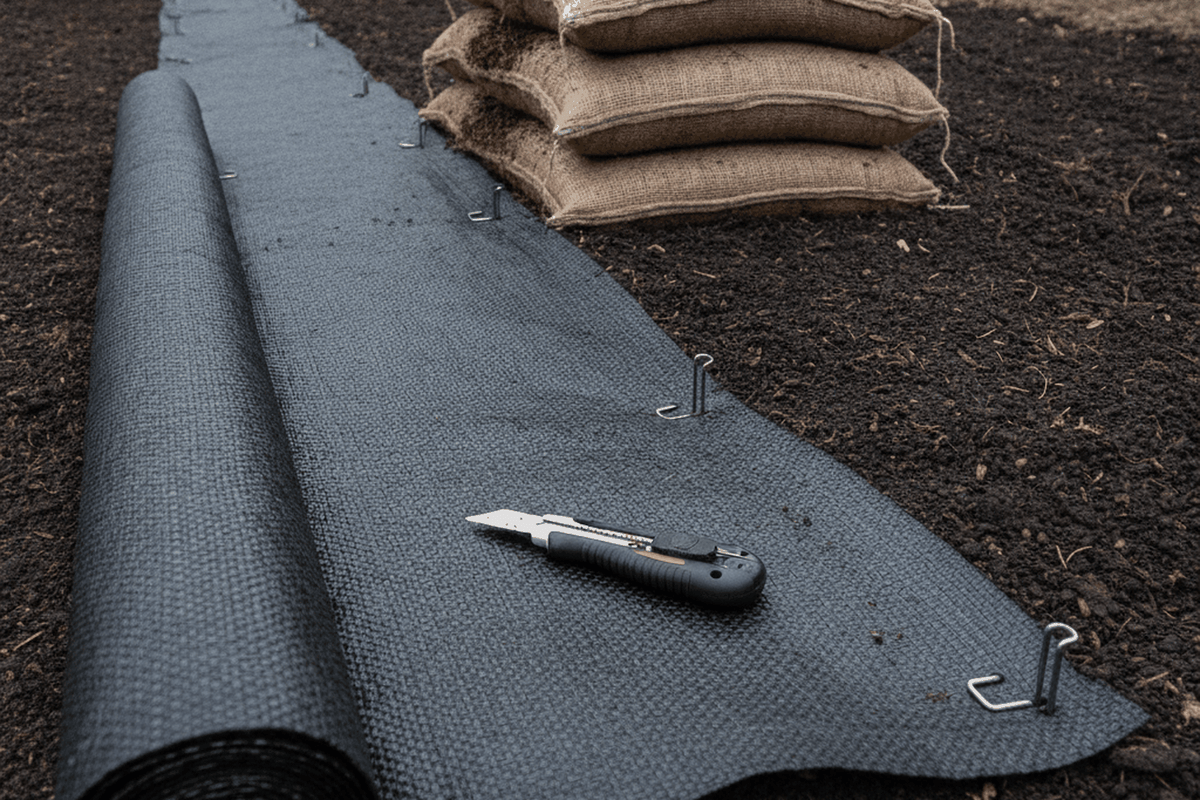
- Buy the pins with the fabric. Fabric that lifts at an edge has failed. Plan on a pin about every 3 feet along seams and edges, closer on slopes, and bury the perimeter in a shallow trench rather than leaving a cut edge in the sun.
That trench is the step people skip, and the one that makes an installation look deliberate instead of temporary. Cut a narrow vertical slot along the bed line, tuck the fabric edge down into it, and backfill. We cut ours with the D-handle garden spade, and our guide to cutting a clean bed edge covers the technique in full.
The best weed barriers and landscape fabrics, by job
1. Dewitt Pro-5 5 oz woven, 4 ft. x 250 ft.: best weed barrier overall
The Dewitt Pro-5 is a 5 ounce woven fabric the listing describes as commercial grade, built for landscaping installations where the ground cover has to keep working. It blocks weed growth while letting air, water, and nutrients into the soil, and the listing rates it to resist tears and punctures during installation. Gold alignment stripes every 12 inches are a nursery feature that is useful at home too, because they give you straight rows when you cut planting holes.
Where it loses: it is sold in contractor rolls, so the smallest quantity you can buy is far more fabric than one bed needs.
2. DWALE 5 oz woven driveway fabric: best heavy-duty weed barrier for gravel
Gravel drives and hard used paths ask more of a fabric than any bed ever will. The DWALE driveway fabric is built for that: a 5 ounce woven geotextile with a listed 800 pound tensile strength, in a 13 foot by 115 foot roll, about 1,495 square feet.
The width is the point. A 13 foot roll covers a single car drive in one pass with no seam down the middle, and a seam is where gravel starts working its way into the subsoil.
Where it loses: the roll is heavy and awkward for one person, and far more material than a small yard needs.
3. Dewitt Natural Paper Mulch: weed barrier for vegetable gardens
The Dewitt Natural Paper Mulch is the answer for anyone who wants weed suppression in a vegetable garden without leaving plastic in the soil. It lets air, water, and nutrients through, and at the end of the season it breaks down and can be tilled straight in.
In practice it does what black plastic does for a season, minus the disposal problem. Roll it down the row, cut an X for each transplant, weight the edges with soil, and the ground between plants stays clean through harvest.
Where it loses: it is a one season material by design, and wet paper tears, so a windy install before the plants fill in can leave you re-anchoring edges.
4. ECOgardener 5 oz landscape fabric, 3 ft. x 50 ft.: for one bed or one short path
Most people are covering one bed or one short path, and the ECOgardener roll is the sane way to buy fabric at that scale: 5 ounces, 3 feet by 50 feet. That is 150 square feet, which is close to what a real project actually needs.
Where it loses: the listing describes a "two-layered needle punch design", a different build from the woven rolls above, so use one of those under gravel or anywhere it will take traffic. The roll is also only 3 feet wide, so wider runs mean seams, and seams are where weeds come through.
5. Grenebo non-woven weed barrier: best non-woven fabric for rock and stone
For ground going under decorative rock, a non-woven mat is the easy one to work with, and the Grenebo barrier is a reasonable example, in a 4 foot by 100 foot roll. It cuts cleanly without unraveling, which matters when you fit it around a dozen established plants, and the roll ships with 30 staples, which is nowhere near enough for 100 feet.
The listing describes a high density non-woven fabric that blocks sunlight and claims better air and water permeability than woven polypropylene. Blocking light is the part that matters here. Treat the permeability comparison as the seller's claim rather than a settled fact.
Where it loses: the listing gives no fabric weight in ounces, and this is not a traffic fabric. Under bark mulch it is still a two to three year answer, because the problem there is the mulch, not the fabric.
6. HongWay 6 in. landscape staples, 240 pack: best fabric staples
Fabric fails at its edges, and the fix is cheap. The HongWay 240 pack gives you 6 inch, 11 gauge galvanized U pins about 1.2 inches across the top, the standard size for holding fabric, sod, and irrigation tubing in normal garden soil.
A 240 pack covers a real project, unlike the 20 or 30 pins bundled with a small roll.
Where it loses: 6 inches is short for loose sandy soil and hard to drive through stony ground. Longer 8 inch pins hold better in both.
What makes a weed barrier heavy duty and long lasting?
Three specs decide it, and you can read two of them off the listing. The first is weight, in ounces per square yard: heavier fabric is built for foot traffic and for the punctures that installation causes. The second is construction. Woven fabric is the class to use under gravel and traffic, and UC IPM's Pest Notes add that thin, lightweight or open mesh fabrics let more weeds through than closely woven or non-woven ones. The third is placement, and it matters more than either. Fabric kept covered by stone goes on working for years, while the same roll left bare in the sun goes brittle, as the downsides section above explains.
Here is what the listings for the four fabric picks state. The paper mulch (pick 3) is a one season material by design, and pick 6 is the staples, so both are left out.
| Pick | Construction (per listing) | Weight or density (per listing) | Roll size | Also listed |
|---|---|---|---|---|
| 1. Dewitt Pro-5 | Woven | 5 oz | 4 ft. x 250 ft. | Commercial grade; gold alignment stripes every 12 inches |
| 2. DWALE driveway fabric | Woven geotextile | 5 oz | 13 ft. x 115 ft. | 800 pound tensile strength |
| 4. ECOgardener landscape fabric | Two-layered needle punch | 5 oz | 3 ft. x 50 ft. | Designed to conserve soil moisture |
| 5. Grenebo non-woven weed barrier | Non-woven | High-density non-woven | 4 ft. x 100 ft. | Cuts without fraying; 30 staples included |
Read the table as a fit guide, not a ranking. The two woven 5 ounce rolls, picks 1 and 2, are the fabrics for traffic and stone, with the DWALE's 13 foot width suited to a single car drive. The ECOgardener is sized for one bed or one short path, and the Grenebo is the light blocking mat for planted rock beds. Whichever you choose, keeping it covered does more for its life than any line on a listing.
Frequently asked questions
Does landscape fabric really stop weeds?
Yes, for a few years, and only against weeds coming up from below. It does nothing about seed that lands on top, which is how most weeds arrive. Under gravel it keeps working as long as the stone stays over it. Under bark mulch it fails in two to three years, once the mulch turns into a rooting layer.
What is the difference between woven and non-woven landscape fabric?
Woven fabric is made from interlaced polypropylene tapes. It is the stronger and more permeable of the two, which is why it is specified under gravel, and it frays wherever you cut it. Non-woven fabric is bonded fibers, sold mainly to block light under decorative rock. It cuts cleanly and fits around plants more easily.
Can you put landscape fabric under mulch?
You can, but it is the weakest use of it. Bark mulch breaks down into a soil layer on top of the fabric, weeds root in that layer, and pulling them shreds the fabric. Expect two to three good years. Cardboard under the same mulch costs nothing and improves the soil.
How long does landscape fabric last?
Buried under 2 to 3 inches of gravel, a 5 ounce woven fabric goes on working for years, because nothing decomposes on top of it and no sunlight reaches it. Under bark mulch, plan on two to three years before weeds root above it. Left exposed to sun, any fabric goes brittle within a season or two.
How do you install landscape fabric on a slope?
Run the fabric across the slope rather than down it, so the pins sit across the fall line and the seams do not channel water. Overlap seams at least 6 inches with the uphill piece on top, add pins along every seam, and bury both the top and bottom edges in a shallow trench.
What is the difference between landscape fabric and weed barrier fabric?
Mostly the name. Weed barrier is the wider term for anything laid down to keep weeds from coming up, including black plastic, paper mulch and cardboard. Landscape fabric is the woven or non-woven synthetic kind, also called a geotextile, that lets air and water through. Many rolls, including three of the four fabrics in this guide, are sold under both names, so judge one by its construction and weight, not by which name is on the label.
Is landscape fabric waterproof?
No, and it is not meant to be. Landscape fabric is porous so that air and water reach the soil, which UC IPM's Pest Notes describe as its advantage over the black plastic it was developed to replace. Solid plastic sheeting is the waterproof option, and UC IPM does not favor it for beds over the long term, because it restricts air and water and tends to break apart fairly quickly.
How many landscape staples do you need?
Count the edges and seams, then plan on a pin about every 3 feet along each one, closer on slopes. A single 4 foot by 50 foot strip has about 108 feet of edge, which works out to roughly 36 pins before any seams, and each seam adds its own length divided by three. UC IPM's guide calls for long U-shaped staples and fabric tacked down tightly, because weeds come up through any gap.
The bottom line
Buy the Dewitt Pro-5 for ground that will live under gravel or stone, the DWALE roll if that ground is a driveway, and the ECOgardener roll if it is one path beside one bed. In vegetable beds, use paper mulch or cardboard and skip the plastic. Whatever you lay down, buy the pins and bury the edges. Fabric only stops the weeds coming from below, and for the ones that arrive anyway, our guide to the best weeding tools covers what gets them out. If you are starting the bed from scratch, begin with how to build a raised garden bed.
Disclosure: some links in this guide are affiliate links to Amazon. This is at no extra cost to you, and it never changes our honest recommendations.