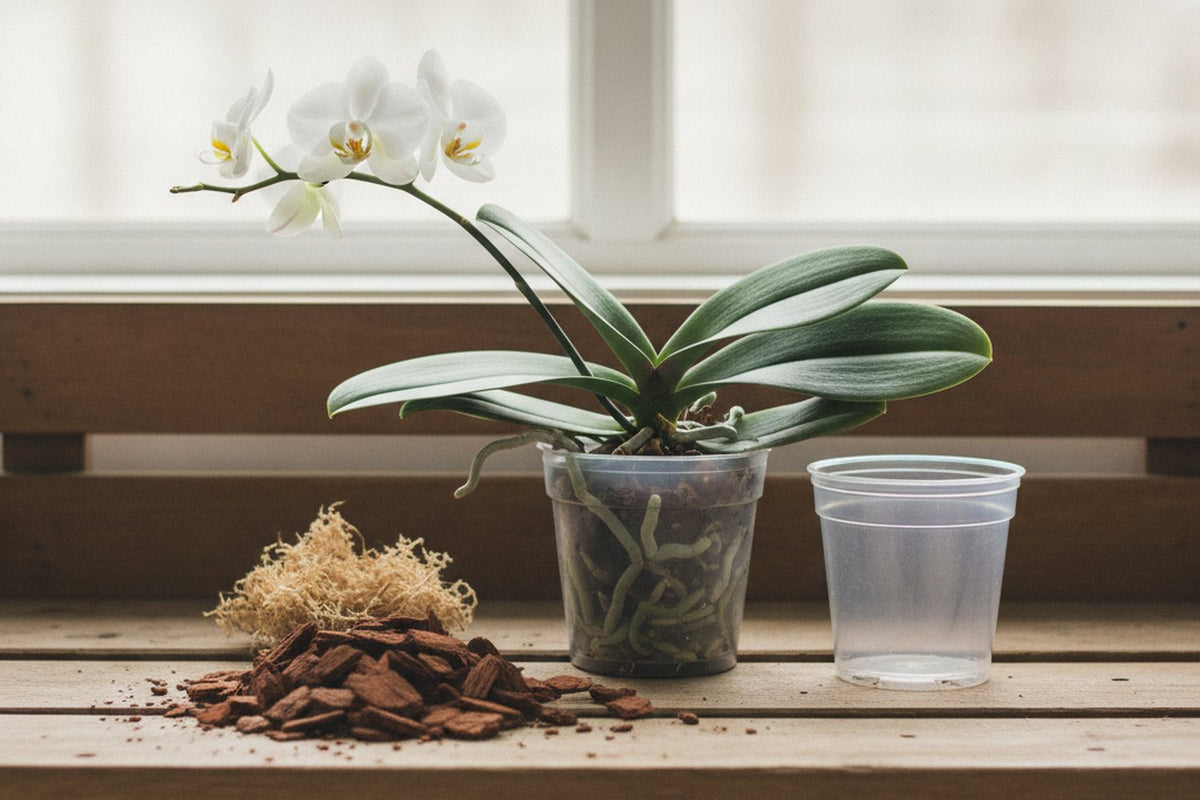
Our top picks
Best fir bark for most orchids
1. Better-Gro Orchid Bark
Best for: Most epiphytic orchids
Best for seedlings and thin roots
3. SuperMoss White Fir Bark
Best for: Seedlings and thin roots
Best for Dendrobiums
4. Better-Gro Dendrobium Potting Mix
Best for: Dendrobium orchids
The best soil for orchids for most growers is Better-Gro Orchid Bark, 4 dry quarts of western fir bark a bag. Most orchids are epiphytes that grow on tree branches, not in soil, and Clemson Extension says it is best to use a bark mix when you repot; an American Orchid Society article calls fir bark the reigning king of potting materials for the past 40 years and medium fir bark a quite standard potting material all by itself, particularly in a plastic pot. Good to know: this listing does not state the bark's particle size, which the same article ties to the thickness of the roots; pick 3 is the one bark here sold in a stated size.
1. Better-Gro Orchid Bark
Western fir bark, 4 dry quarts a bag, to pot in on its own or to build a mix on.
| Pick | Type | Particle size | Volume | Best for | Our verdict | Where to buy |
|---|---|---|---|---|---|---|
| 1. Better-Gro Orchid BarkBest fir bark for most orchids | Western fir bark | Not stated | 4 dry qt | Most epiphytic orchids | Western fir bark in a 4 dry quart bag, on its own or as the base of your own mix. | Check price on Amazon |
| 2. Miracle-Gro Indoor Potting Mix for OrchidsGood ready mix for several pots | Coarse orchid mix | Coarse blend | 2 bags of 8 qt | Potting several orchids | A ready to use coarse orchid mix with plant food, two 8 quart bags that each fill five 6-inch pots. | No in-stock new offer from Amazon on November 26, 2026 |
| 3. SuperMoss White Fir BarkBest for seedlings and thin roots | White fir bark | 1/4 in | 231 cu in | Seedlings and thin roots | White fir bark in the quarter-inch seedling size, 231 cubic inches a bag, sold as 4 quarts. | Check price on Amazon |
| 4. Better-Gro Dendrobium Potting MixBest for Dendrobiums | Bark, lava rock, charcoal | Not stated | 8 qt | Dendrobium orchids | Lava rock, western fir bark, hardwood charcoal and coarse perlite, ready to use, 8 quarts. | Check price on Amazon |
When we checked on November 26, 2026, every pick we link was in stock as new, sold by Amazon. How our guides are made sets out what we check.
What is the best soil for orchids?
A bark-based medium that does two jobs: the AOS article says a potting material must let plenty of air reach the roots and let water run past them freely, rather than stand around them, while still holding enough moisture for the plant. Fir bark on its own does both for most epiphytic orchids, and the Better-Gro orchid bark (pick 1) is that bark: its listing calls it grower's grade choice western fir bark for orchids, bromeliads, ferns and tropical plants, for potting on its own or as the base of your own mix, in a resealable bag. Good to know: the same listing also mentions pine bark components next to the fir bark. For the other jobs: for seedlings, thin-rooted orchids and moth orchids grown indoors, the SuperMoss white fir bark (pick 3); for Dendrobiums, the Better-Gro dendrobium mix (pick 4). Bagged potting soil is not on this list: the University of Wisconsin-Madison Division of Extension says orchids should only be planted in a specialized orchid medium of small bark pieces that drains well.
Bark, charcoal, perlite or moss: what each does in an orchid pot
The AOS article's list of potting materials gives each one's job, and most orchid mixes are built from a few of them.
- Fir bark (picks 1, 3 and 4). The most widely used potting material, by that list: it holds four fifths of its weight in water, drains freely, and should be soaked overnight before use. As it breaks down, a wood-eating fungus takes up nitrogen, which is why the article suggests a 30-10-10 fertilizer for orchids in bark; the AOS Phalaenopsis culture sheet feeds 30-10-10 twice a month where bark-based media are used, and a balanced fertilizer otherwise.
- Charcoal (pick 4). It holds water on its surface rather than absorbing it, and soaks up impurities and fertilizer residues, the list says, though it can hold salts too, which flushing with plain water helps. The AOS repotting page adds that it never hurts to add charcoal if you have hard water.
- Perlite and lava rock (pick 4). Inorganic parts usually do not break down or release anything of nutritional value, the article says. Perlite holds some water but not much and keeps the mix open as the bark decays, and chunkier sizes suit orchids best.
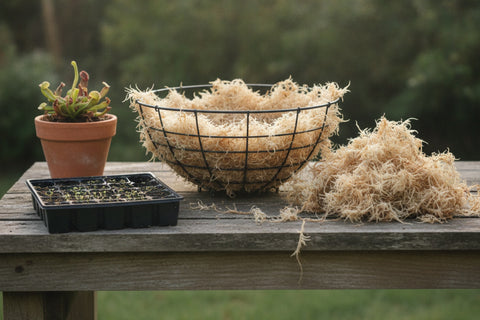
- Sphagnum moss (not a pick here). Clemson says growers pot in moss so plants do not dry out in shipping and on store shelves, but that it is not a preferred medium for long-term growth because it holds moisture around the roots and can lead to root rot; NC State Extension says pure sphagnum can be difficult to rewet and that it is better to repot into a bark-based medium. The AOS repotting page differs: it says all indoor orchids should have some sphagnum in their medium, and to add more sphagnum or tree fern fiber to a bark mix when growing indoors.
Regular potting soil is not on that list. Our potting soil guide compares bagged mixes for houseplants and pots, and none of its picks is an orchid mix.
Which bark size for which orchid
Size follows the roots. The AOS article gives the Eric Young Orchid Foundation's rule: 1/4 inch seedling grade for seedlings and for orchids whose roots stay thin, such as Miltoniopsis; 1/2 inch medium grade for medium-sized plants, the vast majority; and 3/4 inch coarse grade for large orchids such as mature cattleyas. The Phalaenopsis sheet repots seedlings yearly in a fine-grade medium and mature plants in a medium-grade bark mix, but adds that indoors, moth orchids do best in a fine bark mix regardless of size, in a net or mesh pot slipped into a larger plastic or ceramic pot. Care habits move the grade too: the AOS repotting page says a heavier waterer or a greenhouse grower should choose a coarser medium, and a forgetful waterer or an indoor grower one that retains more water.
How many pots a bag of orchid bark fills
Miracle-Gro gives the one fill rate among these bags: each 8 quart bag of pick 2 fills five 6-inch containers, though the amount may vary by root ball size. That is 1.6 quarts a pot. The table runs every pick through that rate from the quarts on its bag, and converts to cubic inches and liters where the listing says which quart it means: a US dry quart is 67.2 cubic inches, a US liquid quart 57.75.
| Bark or mix | Cubic inches | Liters | 6-inch pots a bag, at 1.6 quarts a pot | Volume as stated (source) |
|---|---|---|---|---|
| Better-Gro orchid bark (pick 1) | 268.8 | 4.4 | 2.5 | 4 dry quarts (4.4 liters) (listing) |
| Miracle-Gro orchid mix (pick 2) | not stated | not stated | 5.0 a bag, 10.0 a pack | 8 quarts a bag, 2 bags (listing) |
| SuperMoss white fir bark (pick 3) | 231.0 | 3.8 | 2.5 | 231 cubic inches, sold as 4 quarts (listing) |
| Better-Gro dendrobium mix (pick 4) | not stated | not stated | 5.0 | 8 quarts (listing) |
Two notes on the table. Pick 3's 231 cubic inches are exactly 4 liquid quarts, about 3.4 dry quarts, so the same 4 quarts on the label holds about 14 percent less bark than pick 1's 4 dry quarts, 268.8 cubic inches. And the pot counts take each bag's quarts as stated: the listings for picks 2 and 4 give quarts without saying dry or liquid, so every bag is read in the same unit as Miracle-Gro's fill rate.
How to repot an orchid into bark
When: the AOS repotting page says to repot when you first get a plant, within two weeks of bringing it home unless it is in bloom, then every year or two as the medium decays. Clemson replaces bark about every two years, or when tiny fragments of the media wash out of the pot as you water, and says the best time is late winter or early spring, once new root growth is visible. NC State gives approximately every two years, after the blooms fade or as new leaves appear; Wisconsin waits until the roots are almost bursting out of the pot, typically every two or more years. The Chicago Botanic Garden repots shortly after purchase, because store orchids are often packed in sphagnum moss, which provides too much moisture.
How: soak new bark overnight before you use it, the AOS article says, since processed bark can be so dry that it pulls water from the roots, and stir a premixed medium first, since its parts settle. Clemson trims dead roots with a sterile pair of snips (healthy roots are white with green tips), premoistens the mix, fills the bottom quarter of the pot with the largest bark pieces, keeps the crown lifted as it adds the mix, presses it down with the thumbs, and then waters copiously. The Phalaenopsis sheet spreads the roots over a handful of medium in the bottom of the new pot and sets the junction of the roots and the stem at the top of the medium.
Pots: the AOS repotting page says always to choose a pot with drainage holes; plastic dries slowest and is recommended for most orchids, especially indoors, and clear plastic lets the roots photosynthesize; terracotta dries fastest; and metal pots never. Clemson says the pot should be just large enough to contain the root system, and the Chicago Botanic Garden says never to let the plant sit in a saucer of water.
The best orchid bark and mixes, by job
2. Miracle-Gro Indoor Potting Mix for Orchids: good ready mix for several pots
Good for: Potting several orchids
A ready to use coarse orchid mix with plant food, two 8 quart bags that each fill five 6-inch pots.
No in-stock new offer from Amazon on November 26, 2026
When we checked on November 26, 2026, the Miracle-Gro orchid mix (pick 2) had no main offer on Amazon showing it in stock as new and sold by Amazon, so we do not link it for now.
The Miracle-Gro orchid mix is the ready-to-use mix with plant food in it, sold as two 8 quart bags: its listing calls it a coarse blend that gives quick drainage for epiphytic orchids, names Phalaenopsis (moth orchids), Cattleya, Epidendrum and Dendrobium, says it goes straight into the pot without mixing or amending, and says each 8 quart bag fills five 6-inch containers. Good to know: the listing names no ingredients and no particle size beyond coarse; its title says it feeds for up to 6 months, so count that plant food in your feeding plan.
3. SuperMoss White Fir Bark: best for seedlings and thin roots
Best for: Seedlings and thin roots
White fir bark in the quarter-inch seedling size, 231 cubic inches a bag, sold as 4 quarts.
The SuperMoss white fir bark is the one pick sold in a stated particle size, 1/4 inch, the seedling grade the AOS article gives for seedlings and for orchids whose roots stay thin, and the fine bark the Phalaenopsis sheet puts indoor moth orchids in. Its listing calls it natural white fir tree bark with a pH that makes it an ideal potting medium for orchids, and says it is not heat treated or baked. It is sold by Amazon. Good to know: by the same AOS rule, a large orchid with thick roots, such as a mature cattleya, wants a coarser bark than this one; the bag's size is in the table above.
4. Better-Gro Dendrobium Potting Mix: best for Dendrobiums
Best for: Dendrobium orchids
Lava rock, western fir bark, hardwood charcoal and coarse perlite, ready to use, 8 quarts.
The Better-Gro dendrobium mix is the one pick made for a single kind of orchid: its listing names porous lava rock, western fir bark, hardwood charcoal and coarse perlite, says the blend gives Dendrobiums quick drainage and good airflow, and says to use it when repotting every 12 to 18 months. It comes ready to use in an 8 quart package. It is sold by Amazon. Good to know: that 12 to 18 month schedule is sooner than the about two years Clemson gives for replacing bark.
How we picked these orchid mixes
We compared each pick's type, particle size and stated volume from its Amazon listing, took the potting, sizing and repotting advice from the American Orchid Society, Clemson Extension, NC State Extension, the University of Wisconsin-Madison Division of Extension and the Chicago Botanic Garden, checked every pick against its Amazon listing and the CPSC recall database, and worked out each bag's cubic inches and how many 6-inch pots it fills from its stated volume. Every pick we link was in stock as new when we checked, each sold by Amazon, and Also considered names the other orchid media we read and why each is not linked. When we checked the CPSC's recall database on November 24, 2026, none of the four picks had a recall listed. We make digging spades, not potting media, so nothing on this page is ours. How our guides are made sets out the full process.
Also considered
Each was checked on November 24, 2026.
- Perfect Plants orchid mix. Sold on Amazon by Perfect Plants, not by Amazon, so it is not linked here.
- Orchiata bark. The Orchiata listings we read were each sold by a third-party seller.
- E.B. Stone Organics fine fir bark. Sold by a third-party seller.
- Hoffman orchid mix. Sold by a third-party seller.
- Better-Gro Special Orchid Mix. Western fir bark with charcoal, sponge rock and perlite, sold by Amazon. It is the bark mix our Christmas cactus soil guide links, so this page links the same maker's plain bark and its dendrobium mix instead.
- Other orchid barks. The Legigo, CJGQ, DUSPRO, Riare and Soil Sunrise barks and mixes we read were each sold by a third-party seller.
Frequently asked questions
What is the best soil for orchids?
Fir bark or a bark-based orchid mix, not soil: Clemson Extension says it is best to use a bark mix when you repot, and an American Orchid Society article calls medium fir bark a quite standard potting material all by itself. For most orchids, Better-Gro Orchid Bark. By job: for seedlings and thin roots, the SuperMoss quarter-inch white fir bark; for Dendrobiums, the Better-Gro dendrobium mix.
Can you use regular potting soil for orchids?
Not for most orchids. Clemson Extension notes that most orchids are epiphytes that grow on the branches of trees, and the University of Wisconsin-Madison Division of Extension says orchids should only be planted in a specialized orchid medium of small bark pieces, since good drainage prevents root rot.
Is bark or sphagnum moss better for orchids?
The sources differ. Clemson Extension, NC State Extension and the Chicago Botanic Garden repot out of moss into bark: Clemson says moss holds moisture around the roots and can lead to root rot, and NC State that pure moss can be difficult to rewet. The American Orchid Society's repotting page says all indoor orchids should have some sphagnum in their medium.
How often should you repot an orchid?
Every one to two years for most. The American Orchid Society says every year or two as the medium decays, Clemson Extension and NC State Extension about every two years, and the AOS Phalaenopsis sheet every 1 to 3 years, with seedlings yearly. Repot a new plant within two weeks of bringing it home, the AOS says, unless it is in bloom.
Should you soak orchid bark before potting?
Yes. The American Orchid Society article says to soak new bark overnight in a bucket of warm water, which also helps debris rise to the surface, because dry bark can pull water from the roots. Clemson Extension premoistens the mix to remove tiny fragments.
As an Amazon Associate we earn from qualifying purchases. Some links are paid. Disclosure
Product prices and availability are accurate as of the date/time indicated and are subject to change. Any price and availability information displayed on Amazon.com at the time of purchase will apply to the purchase of this product.