Our top picks
Best for most hydrangeas
1. Miracle-Gro Flowering Trees and Shrubs Plant Food
Best for: Most hydrangeas, blue ones too
Best water-soluble feed
2. Miracle-Gro Water Soluble Azalea, Camellia, Rhododendron
Best for: Feeding from a watering can
Best for turning flowers blue
3. Hoffman Aluminum Sulfate
Best for: Pink bigleaf hydrangeas you want blue
The best fertilizer for hydrangeas for most gardeners is Miracle-Gro Shake 'N Feed Flowering Trees and Shrubs Plant Food, an 18-6-12 that its maker says feeds for up to 3 months. It is made for flowering shrubs and other acid-loving plants, and its numbers are in the same 3 to 1 to 2 proportion as the 12-4-8 that UMass Extension gives as its example of a fertilizer low in phosphorus, the kind it advises for blue hydrangeas. Good to know: hydrangeas need less than you might think. Georgia's and Mississippi State's extension services both feed them in March, May and July, and both list too much nitrogen among the reasons a hydrangea fails to flower.
1. Miracle-Gro Flowering Trees and Shrubs Plant Food
An 18-6-12 for flowering shrubs that feeds for up to 3 months.
| Pick | Analysis | Size | How often | Best for | Our verdict | Where to buy |
|---|---|---|---|---|---|---|
| 1. Miracle-Gro Flowering Trees and Shrubs Plant FoodBest for most hydrangeas | 18-6-12 | 8 lb bag | Every 3 months | Most hydrangeas, blue ones too | An 18-6-12 for flowering shrubs and acid-loving plants that feeds for up to 3 months. | Check price on Amazon |
| 2. Miracle-Gro Water Soluble Azalea, Camellia, RhododendronBest water-soluble feed | 30-10-10 | 5 lb | Every 7 to 14 days | Feeding from a watering can | A 30-10-10 you mix in a watering can; its maker names hydrangeas among the plants it feeds. | Check price on Amazon |
| 3. Hoffman Aluminum SulfateBest for turning flowers blue | Aluminum sulfate | 4 lb bag | Extension: March to May | Pink bigleaf hydrangeas you want blue | Aluminum sulfate, the product the extension services name for turning pink flowers blue. | Check price on Amazon |
When we checked on November 26, 2026, every pick we link was in stock as new and sold by Amazon. How our guides are made sets out what we check.
What is the best fertilizer for hydrangeas?
A light, slow feed that is low in phosphorus; the flower color comes from the soil more than the food. Pick 1 is that feed: Miracle-Gro's page gives it as an 18-6-12 for flowering trees, shrubs and other acid-loving plants, in the ground or in containers, with kelp, earthworm castings, bone meal and feather meal among its ingredients. Spread it dry on the soil within the spread of the branches, keeping it off the trunk and the leaves, then water it in. The amount goes by the width of the drip line: 2 1/2 teaspoons for 2 ft, 3 tablespoons for 4 ft, 7 tablespoons for 6 ft and 3/4 cup for 8 ft and up. Its maker says to feed in early spring as new leaves appear and again in late summer, every 3 months in the growing season, and that feeding too late can push out growth that frost may damage. It is linked here in the 8 lb bag, item 3002410.
Good to know: the New York Botanical Garden says to avoid bone meal when you want blue flowers. Bone meal is one of pick 1's ingredients, though phosphate is still the smallest of its three numbers, and its maker gives each dose by volume, not weight, so we could not work out the nitrogen a dose puts down.
Which hydrangeas can change color
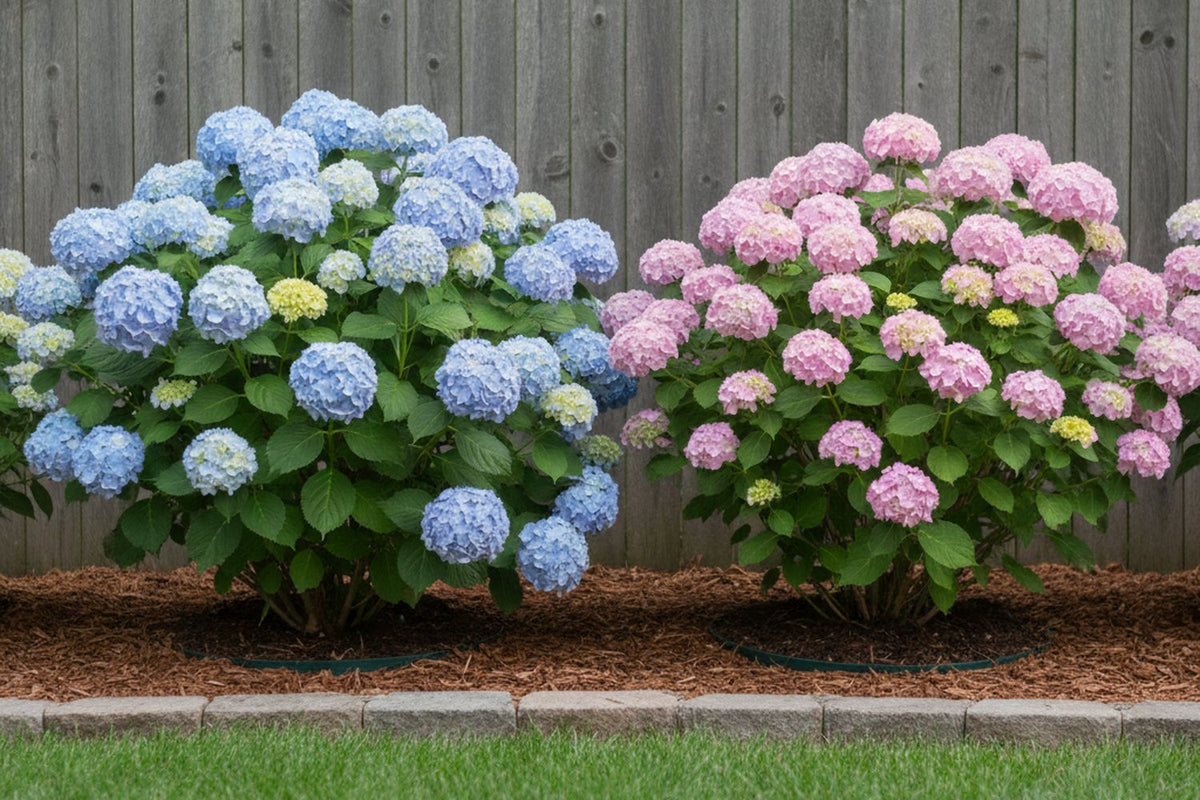
Only two kinds. UMass Extension says only the flowers of bigleaf and mountain hydrangeas turn blue, and Mississippi State says only those two give gardeners a choice of color. Here is UMass Extension's table, in short:
| Hydrangea | Examples | Flower color |
|---|---|---|
| Bigleaf (mophead and lacecap), H. macrophylla | 'Endless Summer', 'Nikko Blue' | Blue below pH 5.5, mauve from 5.5 to 6.5, pink above 6.5; some cultivars are white |
| Mountain, H. macrophylla var. serrata | 'Bluebird' | Same as bigleaf |
| Smooth, H. arborescens | 'Annabelle', 'White Dome' | White to pale green |
| Panicle, H. paniculata | 'Limelight', 'Tardiva' | White to pink or light green |
| Oakleaf, H. quercifolia | 'Alice' | Creamy white to rose |
| Climbing, H. anomala ssp. petiolaris | 'Skylands Giant' | White |
What it shows: the smooth, panicle, oakleaf and climbing hydrangeas are not candidates for pick 3, and UF/IFAS Extension adds that panicle hydrangea color does not respond to soil pH. Some bigleaf cultivars resist too: UMass notes that some tend to be blue and others pink regardless of pH. Not sure which you have? UF/IFAS describes bigleaf flowers as round, dense mop heads or lace caps, and Mississippi State says panicle blooms come in cone-shaped clusters rather than balls or lace caps; it adds that panicle blooms that open white slowly turn pink in fall, and oakleaf flowers turn pinkish as they age, so a pink cone is not a candidate for pick 3. Mississippi State's pH bands differ slightly from UMass's (blue at 5 to 5.5, pink at 6 to 6.5, rose to purple between 5 and 6), but both put blue in acid soil.
Before you buy anything for color, find out your soil's pH. Washington State University Extension puts it first, "Test your soil pH before selecting hydrangeas", and says blue cultivars are at their most vibrant in strongly acid soil, while "pink and white hydrangeas perform best in weakly acid to weakly alkaline conditions." UMass Extension adds that how much lime or aluminum sulfate it takes to change the color depends on your soil's current pH and its type. Our soil test kit guide compares home and mail-in tests.
How much and when to fertilize hydrangeas
Lightly, in spring and early summer. Here is what each source and each feed says. A 10-10-10 is 10 percent nitrogen, so 1 lb of it carries 0.1 lb of nitrogen, and Georgia counts 2 cups of it to the pound.
| Source or label | Fertilizer and amount | When | Nitrogen per feeding |
|---|---|---|---|
| Georgia (bigleaf hydrangea) | An 8-8-8 or a 10-10-10, 1 lb (2 cups) per 100 sq ft | March, May and July | 0.08 to 0.1 lb per 100 sq ft |
| Mississippi State | 8-8-8, 10-10-10 and 13-13-13 are its examples: about 1/4 cup for a small plant, 1 to 2 cups for a very large shrub; or a slow-release 12-4-6 or an 8-8-8 in the mulch | March, May and July | As 10-10-10: about 0.0125 lb for a small plant, 0.05 to 0.1 lb for a very large shrub |
| UMass Extension (blue bigleaf and mountain) | A low-phosphorus formula for acid-loving plants, such as 12-4-8 | Once, in spring | Not given by weight |
| UMass Extension (Growing Hydrangeas) | About 4 oz of a balanced fertilizer | Early spring and once more after the flowers | As 10-10-10: 0.025 lb |
| 1. Shake 'N Feed (maker) | 2 1/2 teaspoons (2 ft drip line) to 3/4 cup (8 ft and up) | Early spring and late summer, every 3 months in the growing season | Not worked out (no weight given) |
| 2. Water Soluble Azalea, Camellia, Rhododendron (maker) | 1 1/2 tablespoons in 1 1/2 gallons of water, soaked into the soil at the base of the plant | Every 7 to 14 days while plants are growing | Not worked out (no weight given) |
What the two feeds' numbers mean for a hydrangea: the table below divides each N-P-K by its phosphate number, gives phosphate as a share of the three numbers (P divided by N plus P plus K), and counts the feedings each schedule gives from March 1 to July 31, at the maker's interval for the two picks and as the extension services give them for their examples.
| Feed | N-P-K | Each number divided by the phosphate number | Phosphate share of N + P + K | How often | Feedings from March 1 to July 31 | Source |
|---|---|---|---|---|---|---|
| Shake 'N Feed (pick 1) | 18-6-12 | 3 : 1 : 2 | 17 percent | Every 3 months | 2 | Miracle-Gro product page |
| Water Soluble Azalea, Camellia, Rhododendron (pick 2) | 30-10-10 | 3 : 1 : 1 | 20 percent | Every 7 to 14 days | 11 to 22 | Miracle-Gro product pages |
| UMass example for blue flowers | 12-4-8 | 3 : 1 : 2 | 17 percent | Once, in spring | 1 | UMass Extension |
| Georgia and Mississippi State example | 10-10-10 | 1 : 1 : 1 | 33 percent | March, May and July | 3 | Georgia; Mississippi State |
Pick 1 is in the same 3 to 1 to 2 proportion as UMass's 12-4-8, and both put phosphate at 17 percent of the three numbers, half the 33 percent of a 10-10-10. Pick 2 is low in phosphate too, at 20 percent, but its maker's interval gives 11 to 22 feedings between March and July against the three Georgia and Mississippi State give, and Mississippi State says too much nitrogen fertilizer can decrease flower production. Georgia adds that bigleaf hydrangeas form next year's flower buds in late summer, and Mississippi State that the buds begin forming in August; our hydrangea pruning guide covers when to cut each type so you keep them. Georgia also says you do not need to pull back the mulch to fertilize, but should water soon after to dissolve the fertilizer into the soil.
Blue or pink: how to change the flower color
Change the soil's pH, then wait. Georgia's circular says, "Soil pH indirectly affects flower color by affecting the availability of aluminum in the soil," and that roots get at aluminum more easily in acid soil, at pH 5.5 or below. UMass Extension adds that most soils hold enough aluminum, but the plant cannot get at it when the pH is high. Here are the methods the sources give:
| Method | For blue | For pink | Source |
|---|---|---|---|
| Quick: a soil drench | 1 tablespoon of aluminum sulfate to a gallon of water, in March, April and May | 1 tablespoon of hydrated lime to a gallon of water, in March, April and May | Georgia; Mississippi State |
| Slow: broadcast and water in | 1/2 cup of wettable sulfur for every 10 sq ft | 1 cup of dolomitic lime for every 10 sq ft | Georgia |
| Long-term: a fall application | 1/2 cup of sulfur per 10 sq ft | 1 cup of dolomitic lime per 10 sq ft | Mississippi State |
| Through the season | 1/2 oz of aluminum sulfate to each gallon of water, for plants at least 2 to 3 years old | Not covered | New York Botanical Garden |
What it shows: the extension services' doses are small and repeated, and Mississippi State's warning not to increase the amounts applies to the drenches. The fertilizer matters too: for blue, Mississippi State, UMass and the New York Botanical Garden all say to keep phosphorus low, and the botanical garden suggests a fertilizer high in potassium as well. For pink, UMass Extension says to add limestone according to the directions on the bag, and that too much lime can turn new growth yellow from a lack of iron; our lime guide compares dolomitic and calcitic limes, with a 5 lb dolomite for beds. Washington State University Extension notes that excess aluminum can harm other plants, herbivores and soil organisms, so it suggests growing blue hydrangeas in large containers if your garden soil lacks aluminum.
Feeding a new hydrangea
Hold off. Georgia's circular says, "Don't fertilize until the plant is established (4 to 8 weeks after transplanting)." Before planting, it works compost into a wide area: 50 pounds of composted organic matter per 10 sq ft, worked 8 to 12 inches deep. For a planted or moved hydrangea in fall, our guide to transplanting shrubs and perennials in fall covers the timing by hydrangea type.
Hydrangeas in pots
Georgia says bigleaf hydrangeas grow easily in containers and make an excellent patio plant; for holding a blue color the New York Botanical Garden suggests containers because conditions are easier to control there, and Washington State suggests them when your garden soil lacks aluminum. Pick 1's maker gives container doses by drip line, 1 1/4 teaspoons for 10 inches, 1 1/2 tablespoons for 12 inches and 2 tablespoons for 14 inches, worked lightly into the soil and watered in. Pick 2's maker names planters among the places it feeds, mixed in a watering can.
The best fertilizers for hydrangeas, by job
2. Miracle-Gro Water Soluble Azalea, Camellia, Rhododendron: best water-soluble feed
Best for: Feeding from a watering can
A 30-10-10 you mix in a watering can; its maker names hydrangeas among the plants it feeds.
The Miracle-Gro Water Soluble Azalea, Camellia, Rhododendron Plant Food, in the 5 lb size, is the one you water in: Miracle-Gro's page names hydrangeas among the acid-loving plants it feeds, and the analysis printed on its 5 lb label is 30-10-10. Outdoors, mix 1 1/2 tablespoons, the large end of the scoop in the box, in 1 1/2 gallons of water and soak the soil at the base of the plant. Miracle-Gro says it feeds instantly, will not harm other plants or burn foliage when used as directed, and that 5 lb feeds about 2,000 sq ft of garden. It is sold by Amazon. Good to know: its maker's interval, every 7 to 14 days while plants are growing, is many more feedings than Georgia and Mississippi State give a hydrangea, as the calculated table above shows, so on a hydrangea in the ground we would use it on their March, May and July schedule.
3. Hoffman Aluminum Sulfate: best for turning flowers blue
Best for: Pink bigleaf hydrangeas you want blue
Aluminum sulfate, the product the extension services name for turning pink flowers blue.
The Hoffman Aluminum Sulfate, item 66505, is aluminum sulfate in a 4 lb bag by its listing, which calls it an acidifying soil conditioner for acid-loving plants that makes hydrangeas blue. It is the product the extension services name for blue: UF/IFAS Extension says, "To turn pink flowers to blue, use aluminum sulfate." Georgia and Mississippi State give the same quick method, 1 tablespoon of aluminum sulfate dissolved in a gallon of water and poured on the soil around the plant in March, April and May, and the New York Botanical Garden explains why it works: blue needs aluminum in the soil plus a low pH to make it available, and aluminum sulfate adds the aluminum and lowers the pH somewhat. It is sold by Amazon. Good to know: we could not find a Hoffman page with its rates, so use the extension drench and never more than the label on the bag. More is not better: Mississippi State says, "Do not increase the amounts of the color change additives," and "Aluminum in high doses will harm hydrangea plants," and UMass Extension says, "too much aluminum sulfate will injure plants." Keep it off the leaves, which Georgia warns the drench can damage, and do not expect it to work on white flowers: the New York Botanical Garden and Mississippi State both say white-flowered hydrangeas do not change color with the soil.
How we picked these
We compared each pick's analysis, ingredients, directions and feeding interval from its maker's product pages, or for pick 3 its Amazon listing, against what five extension services and the New York Botanical Garden say about feeding hydrangeas and changing their color, and worked out each feed's phosphate share and how many feedings its schedule gives from March to July. Every pick we link was in stock as new and sold by Amazon when we checked, and Also considered names the other hydrangea products we read and why each is not linked. When we checked the CPSC's recall database on November 24, 2026, none of the three picks had a recall listed. We make digging spades, not fertilizer, so nothing on this page is ours. How our guides are made sets out the full process.
For the hydrangea advice we read the University of Georgia Cooperative Extension's Circular 973, Growing Bigleaf Hydrangea, by Sheri Dorn (published August 7, 2017), Mississippi State University Extension's Publication 2574, "Hydrangeas for Mississippi Gardens", written by Wayne C. Porter, UMass Extension's fact sheets Growing Tips: Hydrangeas, Color and Fertilizing and Growing Hydrangeas, UF/IFAS Extension's Gardening Solutions page on hydrangeas, Washington State University Extension's fact sheet FS309E, "How Are Hydrangea Flower Colors Determined?", by Linda Chalker-Scott, and the New York Botanical Garden's Plant Information Service's answer to "How do I get my hydrangea flowers to turn blue?" The rates on this page are theirs or the makers', named where they appear; never go above the label on the bag you buy.
Also considered
Each was checked on November 24, 2026. A pick here has to be sold by Amazon, and none of these was when we checked.
- Espoma Holly-tone 4-3-4. An organic food for acid-loving plants whose fact sheet lists hydrangea among the plants it is for, with elemental sulfur to help acidify the soil. Every Holly-tone listing we read was sold by a third-party seller.
- Hi-Yield Aluminum Sulfate. Aluminum sulfate like pick 3, with a label that gives its own rates. Sold by a third-party seller.
- Espoma Organic Soil Acidifier. Elemental sulfur and gypsum, 30 percent sulfur, by Espoma's fact sheet, which gives hydrangea rates and calls it safer than aluminum sulfate: the slower route to blue, without adding aluminum. Sold by a third-party seller.
- Jack's Classic Hydrangea Blue. A water-soluble 7-3-3 that J.R. Peters' sell sheet says contains aluminum sulfate; the sheet gives no rates. Sold by a third-party seller.
Frequently asked questions
What is the best fertilizer for hydrangeas?
For most hydrangeas, a slow shrub food low in phosphorus, such as Miracle-Gro Shake 'N Feed Flowering Trees and Shrubs Plant Food, an 18-6-12 that its maker says feeds for up to 3 months. Georgia and Mississippi State also feed hydrangeas a general-purpose 8-8-8 or 10-10-10 in March, May and July. To change the flower color, add aluminum sulfate for blue or dolomitic lime for pink.
When should you fertilize hydrangeas?
In spring and early summer. Georgia and Mississippi State feed in March, May and July, and UMass Extension feeds in early spring and once more after the flowers, or once in spring for blue hydrangeas. Georgia says bigleaf hydrangeas form next year's flower buds in late summer.
How do you make hydrangeas blue?
Lower the soil pH and make aluminum available. Georgia and Mississippi State mix 1 tablespoon of aluminum sulfate into a gallon of water and pour it around the plant, on the soil, in March, April and May, keeping it off the leaves. Use a fertilizer low in phosphorus as well. Only bigleaf and mountain hydrangeas turn blue.
How do you make hydrangeas pink?
Raise the soil pH with lime. Georgia broadcasts 1 cup of dolomitic lime per 10 sq ft and waters it in, and Mississippi State calls a fall application of that rate the more practical long-term method. Georgia says the change may take a year.
Is 10-10-10 good for hydrangeas?
Yes. Georgia suggests an 8-8-8 or a 10-10-10 at 1 lb (2 cups) per 100 sq ft in March, May and July, and Mississippi State lists 10-10-10 among its general-purpose choices. For blue flowers, Mississippi State and UMass prefer a fertilizer lower in phosphorus, such as a 12-4-6 or 12-4-8.
Why is my hydrangea not blooming?
Fertilizer is only one possible cause. Georgia lists winter injury to the flower buds, too much shade, excess nitrogen fertilizer and pruning at the wrong time, and Mississippi State adds drought in late fall or winter. More feeding can make it worse.
Do white hydrangeas need a different fertilizer?
A general-purpose one is enough. UMass Extension says to feed hydrangeas other than blue bigleaf and mountain types with a general-purpose fertilizer at the package rate. Aluminum sulfate will not turn white flowers blue: Mississippi State says the color of white-flowered cultivars does not respond to soil pH, and UF/IFAS says soil pH does not affect panicle hydrangea color.
As an Amazon Associate we earn from qualifying purchases. Some links are paid. Disclosure
Product prices and availability are accurate as of the date/time indicated and are subject to change. Any price and availability information displayed on Amazon.com at the time of purchase will apply to the purchase of this product.