As an Amazon Associate we earn from qualifying purchases. Some links are paid. Disclosure
Our top picks
Best overall
1. Bonsai Jack Succulent and Cactus Soil
Best for: Desert cacti and succulents in pots, and anyone who tends to overwater; the gritty mix here
Best for jungle cacti and light watering
2. Espoma Organic Cactus Mix
Best for: Jungle cacti such as a Christmas cactus, and long gaps between waterings; a cactus mix with peat moss
Best grit to add
3. Cz Garden Horticultural Pumice
Best for: Cutting any bagged mix for small pots
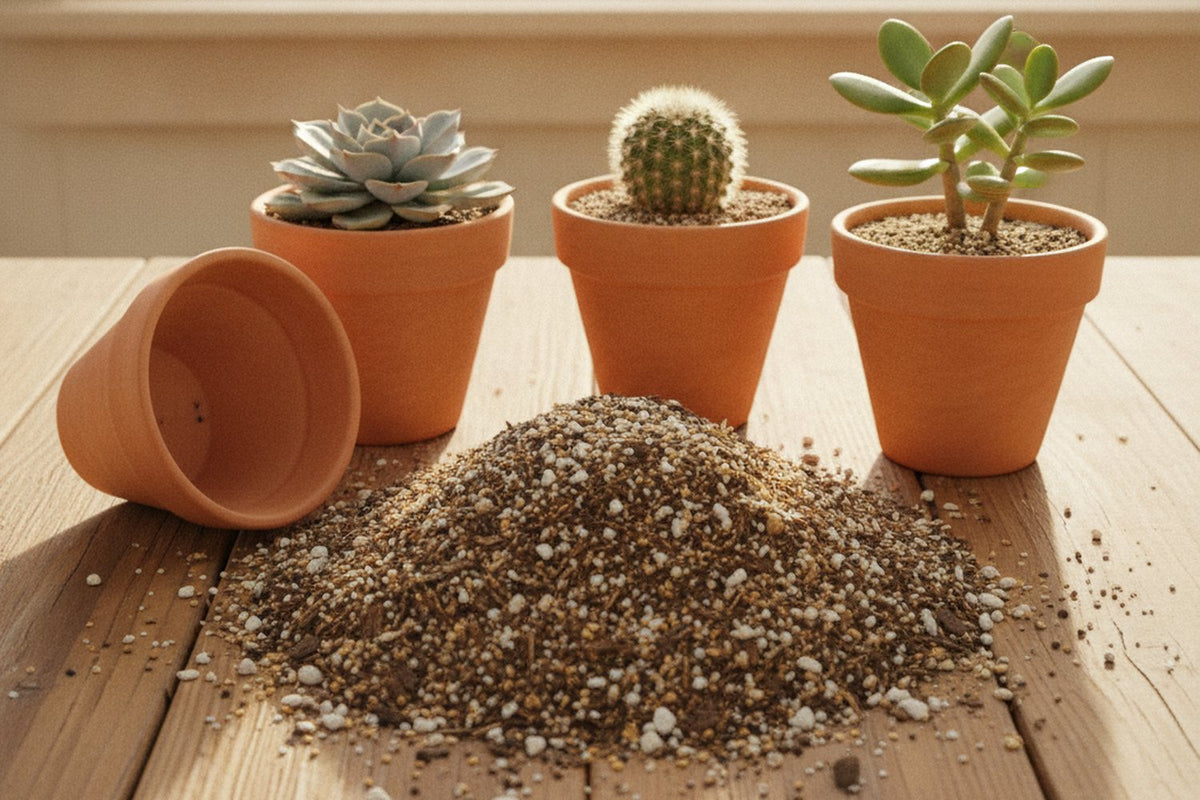
The best soil for succulents drains in moments and carries a lot of grit: most of the recipes that extension services publish make half the pot or more out of sand, pumice or perlite. The bag whose maker describes it that way is Bonsai Jack Succulent and Cactus Soil, a gritty blend of calcined clay, Monto Clay and pine coir that Bonsai Jack's description, as Succulent Plant Care quoted it in 2020, says has no peat moss, linked here in the 2 quart bag. Bob Vila's guide picks it for succulents grown outdoors, and a grower at Succulent Plant Care who compared four bagged mixes called it "super fast draining." For jungle cacti that like a little more moisture, and for plants that go a long time between waterings, the pick is Espoma Organic Cactus Mix, which a Bob Vila tester relies on for her indoor succulents. To add grit to a bag yourself, as three University of California Master Gardener programs advise, use horticultural pumice.
The other two picks cover a big repotting day and a mix with no peat moss. Below the picks, one table sets out nine succulent soil recipes by whose word and how much grit each one puts in the pot, a second puts the labels side by side, and a third works out how much grit to add to a bag. The advice on sand, perlite and pumice, gravel in the pot, pots, watering and feeding comes from university extension services and the New York Botanical Garden, each named where it appears.
Jump to: Recipes by whose word | Labels table | How much grit to add | Sand, perlite or pumice | Gravel in the pot | Pots | Watering and feeding
Start here: which soil for your succulents
- Most succulents and cacti in pots, and anyone who tends to overwater: Bonsai Jack Succulent and Cactus Soil (pick 1).
- Jungle cacti such as a Christmas cactus, or a long gap between waterings: Espoma Organic Cactus Mix (pick 2).
- Mixing your own, or opening up a bag that stays wet: Cz Garden horticultural pumice (pick 3).
- Repotting a whole collection: Miracle-Gro Cactus and Succulent Mix, two 8 quart bags (pick 4), cut with perlite or pumice.
- No peat moss: Back to the Roots Succulent and Cacti Mix (pick 5).
Whatever the bag, the pot needs a drainage hole, as UC Master Gardeners in San Luis Obispo and Sacramento counties and the University of Minnesota all say (see pots).
| Pick | Grit in it | Peat moss | Linked size | Best for | Our verdict | Where to buy |
|---|---|---|---|---|---|---|
| 1. Bonsai Jack Succulent and Cactus SoilBest overall | Calcined clay, Monto Clay | None, by the maker's description | 2 qt | Desert cacti and succulents in pots, and anyone who tends to overwater; the gritty mix here | A ready to use gritty mix, by its maker's description (as Succulent Plant Care quoted it), about two thirds clay granules and one third pine fines with no peat moss; Bob Vila's pick for succulents outdoors. | Check price on Amazon |
| 2. Espoma Organic Cactus MixBest for jungle cacti and light watering | Perlite | Yes | 4 qt | Jungle cacti such as a Christmas cactus, and long gaps between waterings; a cactus mix with peat moss | Forest products, peat moss and perlite with Myco-tone and no synthetic plant food by its listing; a Bob Vila tester's choice for her indoor succulents. | Check price on Amazon |
| 3. Cz Garden Horticultural PumiceBest grit to add | All pumice | None | 2 liters | Cutting any bagged mix for small pots | Fine pumice, 1/32 to 1/8 inch, the grit UC Master Gardeners in Sacramento County mix half and half with a cactus mix. | Check price on Amazon |
| 4. Miracle-Gro Cactus and Succulent MixBest for repotting a collection | Sand, perlite | Yes | 2 x 8 qt | Repotting many pots at once, cut with perlite or pumice | Sand and perlite in a base of forest products and peat moss, with plant food, in two 8 quart bags; one long-time grower's everyday base, cut with perlite. | Check price on Amazon |
| 5. Back to the Roots Succulent and Cacti MixBest peat-free mix | Perlite, horticultural sand | None | 6 qt | Succulents indoors or out, with no peat moss | Aged bark with perlite and horticultural sand, from a maker that makes its mixes peat-free; Bob Vila's pick for succulents indoors. | Check price on Amazon |
The best soil for succulents, by job
1. Bonsai Jack Succulent and Cactus Soil: best overall
Best overall
Best for: Desert cacti and succulents in pots, and anyone who tends to overwater; the gritty mix here
Bonsai Jack Succulent and Cactus Soil
- Grit in it: Calcined clay, Monto Clay
- Peat moss: None, by the maker's description
- Linked size: 2 qt
A ready to use gritty mix, by its maker's description (as Succulent Plant Care quoted it), about two thirds clay granules and one third pine fines with no peat moss; Bob Vila's pick for succulents outdoors.
Sold as "Bonsai Jack Succulent and Cactus Soil - Jacks Gritty Mix #111" and linked here in the 2 quart bag; the same mix comes in 1 and 2 gallon bags too. By its listing it is a blend of three things: pine coir, which the listing also calls pine fines, plus Bonsai Block and Monto Clay. In 2020 Succulent Plant Care quoted Bonsai Jack's own description, which gives the recipe as one third each of pine coir, quarter inch calcined clay (the Bonsai Block) and quarter inch Monto Clay, with no peat or sphagnum moss and a pH of 5.5. The listing calls it ready to use for most cacti and succulents, as it comes or mixed with your own potting soil, and names echeveria, haworthia, crassula, lithops, jade and aloe.
Why it is the pick: it is the one bag on this list whose maker's description shows a grit share like the recipes' (the other makers print none). By that 2020 recipe, two of its three parts are clay granules, about two thirds grit: a little more than the New York Botanical Garden's three parts grit or sand in five, and inside the Delaware extension answer's range of 50 to 70 percent mineral (see the recipes table). Bob Vila named it its best soil for succulents outdoors, and its tester Debbie Wolfe calls it "an ideal potting mix for desert cacti and succulents requiring excellent drainage and root rot protection." The grower behind Succulent Plant Care, who set it beside three other bagged mixes, said the product is "top notch" and that "they used top-quality ingredients," and wrote that it would suit people who keep overwatering or who live somewhere very humid.
Good to know: it may be too fast for you. The same grower found it drained too quickly for her dry climate and light hand with water, and wrote that she would mix it about half and half with the succulent mix she already had, to keep a little moisture for the roots to draw on. Bob Vila's tester says it may not suit jungle cacti, which prefer wetter soil (pick 2 is the mix for those). A 2 quart bag fills only about two or three 4 inch pots (see how much grit to add), so for a bigger job the 1 and 2 gallon bags are the same mix.
2. Espoma Organic Cactus Mix: best for jungle cacti and light watering
Best for jungle cacti and light watering
Best for: Jungle cacti such as a Christmas cactus, and long gaps between waterings; a cactus mix with peat moss
Espoma Organic Cactus Mix
- Grit in it: Perlite
- Peat moss: Yes
- Linked size: 4 qt
Forest products, peat moss and perlite with Myco-tone and no synthetic plant food by its listing; a Bob Vila tester's choice for her indoor succulents.
Espoma's cactus and succulent potting mix, linked here in the 4 quart bag; Espoma also sells an 8 quart bag. Its ingredient line reads "60-70% processed forest products, sphagnum peat moss, perlite, humus, limestone to adjust pH, and yucca extract," and Espoma adds Myco-tone, its own blend of mycorrhizal fungi meant to help roots grow. The listing says no synthetic plant foods or chemicals go into it, and Espoma's page calls it "100% Natural & Organic Approved." It is made for cacti, succulents, palms and citrus in containers; the listing names jade, burro's tail, aloe vera, barrel cactus and Christmas cactus.
Why it is the pick: it is the bagged cactus mix that a named grower vouches for from her own use in a published guide. Bob Vila's guide, which its writers say draws on product research across more than 20 soils, puts it among its six picks, and its tester Debbie Wolfe writes, "I always trust the Espoma organic cactus mix for my indoor succulents." She describes it as light and quick to drain and a fit for desert cacti, citrus, hoyas and jungle cacti alike, and she keeps it for her most prized succulents. It holds more water than a gritty mix like pick 1, which is what Bob Vila's tester says jungle cacti prefer, and what Succulent Plant Care wanted for her own lightly watered plants.
Good to know: its ingredient list names no sand, and the University of Maryland Extension says a bought mix for cacti and succulents should have a high share of sand, so if it stays wet in your home, cut it with pick 3 (see how much grit to add). Espoma's directions say to set the plant at the same depth it grew before and to wait one or two weeks before the first thorough watering (more under watering). On November 6, 2026 it was sold on Amazon by a third-party seller.
3. Cz Garden Horticultural Pumice: best grit to add
Best grit to add
Best for: Cutting any bagged mix for small pots
Cz Garden Horticultural Pumice
- Grit in it: All pumice
- Peat moss: None
- Linked size: 2 liters
Fine pumice, 1/32 to 1/8 inch, the grit UC Master Gardeners in Sacramento County mix half and half with a cactus mix.
Sold as "Pumice Stone Grow Media" by Cz Garden and linked here in its 2 liter resealable pouch, which works out to about 1.8 dry quarts. The listing gives the average particle size as 1/32 to 1/8 inch and recommends this size for small pots under 4 inches, as well as for succulents, cuttings and seedlings. It calls the pumice inert and pH neutral, and says it is OMRI Listed for organic growing.
Why it is the pick: pumice is the grit all three University of California programs name. UC Master Gardeners in Sacramento County suggest a cactus or succulent mix cut half and half with pumice and give the reason: pumice does not break down easily or float to the top the way perlite does. The San Luis Obispo County program lists horticultural pumice first among the porous materials for half the pot, and El Dorado County says coarse perlite or pumice added to an ordinary potting mix will generally make a good succulent mix, with more of it for cacti. Its fine grade suits small pots, by the listing's own advice.
Good to know: at 1.8 dry quarts, one pouch cuts about 1.8 quarts of mix at Sacramento's half and half, or about 3.6 quarts at the lighter two parts mix to one part grit that Succulent Plant Care uses (see the table). Sacramento notes that pumice comes in different sizes and suggests experimenting; the listing keeps this fine grade to pots under 4 inches, and pick 1's clay granules, for comparison, are about a quarter inch in the 2020 recipe Succulent Plant Care quoted. On November 6, 2026 it was sold on Amazon by Cz Garden.
4. Miracle-Gro Cactus and Succulent Mix: best for repotting a collection
Best for repotting a collection
Best for: Repotting many pots at once, cut with perlite or pumice
Miracle-Gro Cactus and Succulent Mix
- Grit in it: Sand, perlite
- Peat moss: Yes
- Linked size: 2 x 8 qt
Sand and perlite in a base of forest products and peat moss, with plant food, in two 8 quart bags; one long-time grower's everyday base, cut with perlite.
Sold as "Miracle-Gro Indoor Potting Mix for Cactus & Succulent" and linked here as two 8 quart bags, the most mix of any pick. By its listing it holds "forest products, sphagnum peat moss, sand, and perlite" for fast drainage, with Miracle-Gro plant food in it, and the listing says it is meant for cacti, citrus trees and succulents in indoor containers. Each 8 quart bag fills five 6 inch containers, by the listing, though the root ball changes that. Miracle-Gro's page says the food in it lasts up to 6 months, and answers a common question: this is the mix it used to sell as Cactus, Palm and Citrus Potting Mix, renamed with new packaging and the same contents. Its directions are to fill a pot with a drain hole about a third full, set the plant in, top it off, press the mix lightly, then water and let the pot drain.
Why it is the pick: it is the base that one long-time grower uses for her own collection. Succulent Plant Care compared it under its old name and wrote that after years of using it she had not had problems with it, while some other brands she tried ended up in the trash because of mold or other trouble. Her method is to mix it with perlite, two parts mix to one part perlite, or half and half for plants that tend to stay too wet, and she named that blend, with some of pick 1 added, as her top choice of the four she compared. Unlike pick 2, its ingredient list includes sand, which is what the University of Maryland Extension looks for in a bought cactus mix.
Good to know: the same grower says her perlite blend has most likely worked for her because she lives in a dry climate and waters little. Plan to cut it with perlite, as she does, or with pumice; both bags cut two to one take about 8 quarts of grit (see how much grit to add). It has plant food in it; Miracle-Gro suggests starting a regular feeding program 30 days after planting and letting the top 2 inches of mix dry out between waterings, while several extension sources say succulents need very little feeding (see watering and feeding).
5. Back to the Roots Succulent and Cacti Mix: best peat-free mix
Best peat-free mix
Best for: Succulents indoors or out, with no peat moss
Back to the Roots Succulent and Cacti Mix
- Grit in it: Perlite, horticultural sand
- Peat moss: None
- Linked size: 6 qt
Aged bark with perlite and horticultural sand, from a maker that makes its mixes peat-free; Bob Vila's pick for succulents indoors.
Sold as "Back to the Roots 100% Organic Succulent & Cacti Mix" and linked here in the 6 quart bag. By its listing it holds aged bark for structure and perlite and horticultural sand for fast drainage, and Bob Vila adds dolomitic limestone and organic plant food to the list. Back to the Roots' page for the mix says it works indoors and out, explains why the company makes its mixes peat-free, and gives the nutrient analysis as 0.08-0.03-0.03.
Why it is the pick: it is the mix for anyone who would rather not use peat moss, and it still carries sand and perlite rather than leaning on bark alone. Bob Vila named it its best soil for succulents indoors. No tester we read grew plants in it side by side with other mixes, so this pick rests on the maker's ingredient list and Bob Vila's research.
Good to know: Back to the Roots advises feeding with an organic fertilizer roughly a month after you transplant. Its bag is also sold in a 12 quart size.
How we chose these
We compared the cactus and succulent mixes in Amazon's catalog by what their makers say is in the bag: the organic part (peat moss, forest products, bark or coir), the grit (sand, perlite, pumice or clay granules), any feed, any organic listing, and the size you get. For each pick we read the maker's product page, where one turned up, and the Amazon listing; Bonsai Jack's own site served only a menu when we read it, so for pick 1 we used the listing and the recipe that Succulent Plant Care quotes from the maker. Then we read the two hands-on sources we found for these bags: Succulent Plant Care's comparison of four succulent mixes, bought in 2020 and used for some months afterward, and Bob Vila's guide to soils for succulents (updated 2023), which rests on research plus notes from its tester. We found no published side by side growing trial of bagged succulent soils of the kind that exists for potting mix.
Our floor, for the picks and for the notes under Also considered: in stock on Amazon and sold new, when we checked on November 6, 2026. Each pick met it. Ingredients, sizes and directions come from the maker pages and listings, named where they appear. Growing advice comes from the University of California Master Gardener programs in San Luis Obispo, Sacramento and El Dorado counties, the University of Minnesota and University of Maryland extension services, a University of Delaware extension expert answering on Ask Extension, the New York Botanical Garden and Washington State University's Linda Chalker-Scott, each named where it appears.
Also considered: mixes that missed the list and why
Hoffman Cactus and Succulent Soil Mix. Bob Vila's runner-up, and the cactus pick in our potting soil guide. Bob Vila lists sand, perlite, limestone, compost and two kinds of peat (sphagnum and reed sedge), and says that much peat may hold too much water for some succulents. Succulent Plant Care used it for a few months, called it an OK product, and found it stays wet unless you add perlite, about a quarter by her measure. It was in stock on Amazon on November 6, 2026; picks 2 and 4 are the peat-based mixes here, and pick 1 drains faster by both hands-on accounts we read.
The Valley Garden Organic Succulent Soil. Bob Vila's best overall, for its pH of 5.5 and mild fertilizer. It was out of stock on Amazon on November 6, 2026.
Perfect Plants Succulent and Cactus Soil. Bob Vila's best organic pick. Perfect Plants' own page lists coarse sand, perlite and lime with organic peat moss and composted pine bark, while its Amazon listing's title and bullets disagree on whether the base is peat moss or coir. It met our floor on November 6, 2026, but no hands-on source we read covered it, and pick 5 has Bob Vila's vote for indoor use with no peat moss in it.
Black Gold Cactus Mix. Sun Gro's cactus mix with pumice or perlite, forest products, bark, compost and worm castings, by Succulent Plant Care's reading of the bag. The grower first named it her favorite of the four, then found after a few months that it stayed wetter than she liked and needed perlite added. It was in stock on Amazon on November 6, 2026.
Nine succulent soil recipes, by whose word
Every source below agrees on the goal: a mix that drains quickly and lets the roots dry between waterings. They disagree on how to get there. To compare them, the last column works out how much of the pot each recipe gives to grit or sand (pumice, perlite, decomposed granite, lava rock or coarse sand), counting parts as equal volumes. Of the eight recipes that give numbers, seven put grit or sand at half the pot or more.
| Whose recipe | What goes in | Grit or sand share |
|---|---|---|
| UC Master Gardeners, San Luis Obispo County | Half organic (a commercial planter mix, coir, or composted fir or redwood), half porous material (decomposed granite, perlite or horticultural pumice) | 50% |
| UC Master Gardeners, Sacramento County | A cactus or succulent mix and pumice, half and half | 50%, plus any grit already in the bag |
| UC Master Gardener, El Dorado County | An ordinary potting mix plus coarse perlite or pumice, more of it for cacti | No ratio given |
| University of Minnesota Extension | One part potting soil, one part coarse sand | 50% |
| New York Botanical Garden | Three parts grit or sand, one part potting soil, one part shredded bark, coir or peat | 60% |
| Ask Extension (a University of Delaware expert) | 30 to 40% pumice or perlite, 20 to 30% coarse sand, granite grit or lava rock, 30 to 40% cactus mix, potting soil, coir or pine bark fines | 50 to 70% |
| Epic Gardening (Madison Moulton) | Potting soil and coarse sand, two parts each, plus one part perlite | 60% |
| Bob Vila | Coarse sand and sphagnum peat moss, two parts each, plus one part perlite | 60% |
| Succulent Plant Care | A bagged cactus mix (pick 4) and perlite, two to one, or one to one for plants that stay too wet | 33 to 50% added, on top of the bag's own sand and perlite |
What it shows: the eighth recipe with numbers, Succulent Plant Care's, adds a third to a half of perlite to a bag that already holds sand and perlite. The University of Maryland Extension gives no ratio but points the same way: a bought cactus mix needs less humus and a high share of sand. None of the makers of picks 2, 4 and 5 says what share of the bag is grit, and the New York Botanical Garden warns that many commercial cactus and potting mixes "rely too heavily on peat." That is why this page leads with a gritty mix and a bag of pumice, and why picks 2 and 4 come with a note on cutting them.
The recipes also show where the sources split. Most use some ordinary potting soil or bark for the organic part, and Epic Gardening says potting soil should not be the only ingredient, because on its own it is too dense and stays too wet for succulents in pots. Any all-purpose bagged mix will do for that share; our potting soil guide compares them. Epic also adjusts its own recipe by plant: a few handfuls of gravel for succulents that rot easily, and three parts potting soil instead of two for those that like more moisture, such as string of pearls. The Delaware expert moves furthest from the bagged mixes and calls for a mix that is "mostly mineral," warning against garden soil, fine sand or play sand, moisture-control potting soils, compost-heavy mixes and mixes with a lot of vermiculite.
Two quick checks for any mix
- The squeeze test (University of Minnesota): wet the mix, squeeze a handful, and open your hand. It should fall apart.
- The drain test (New York Botanical Garden): "A proper cactus soil should drain in less than a minute after watering."
What is in each bag: the labels side by side
Taken from each maker's page and Amazon listing (pick 1's recipe as Succulent Plant Care quotes it from Bonsai Jack).
| Pick | Organic part | Grit in the bag | Peat moss | Feed | Linked size |
|---|---|---|---|---|---|
| 1. Bonsai Jack | Pine coir (pine fines), one third | Calcined clay and Monto Clay, two thirds | No | Not listed | 2 qt |
| 2. Espoma Organic Cactus | Forest products (60 to 70%), peat moss, humus | Perlite | Yes | No synthetic plant food, by its listing; Myco-tone | 4 qt |
| 3. Cz Garden pumice | None | All pumice, 1/32 to 1/8 inch | No | None | 2 liters (about 1.8 dry qt) |
| 4. Miracle-Gro Cactus and Succulent | Forest products, peat moss | Sand, perlite | Yes | Miracle-Gro plant food | 2 x 8 qt |
| 5. Back to the Roots | Aged bark | Perlite, horticultural sand | No (peat-free, by the maker) | 0.08-0.03-0.03, by the maker | 6 qt |
Two things stand out. Of the four mixes, only pick 1's recipe holds the organic part to a third (Espoma's line puts forest products alone at 60 to 70 percent), and only picks 4 and 5 list sand. And none of the four mix makers prints what share of its bag is grit, apart from Bonsai Jack's recipe as Succulent Plant Care quotes it, which is why the recipes above tell you more than a fast-draining label does.
How much grit to add to a bag
Here is what the two most common ways to cut a bagged mix work out to: Sacramento's half and half (one part mix to one part pumice) and Succulent Plant Care's lighter two parts mix to one part perlite. The grit columns are what you add; the total is the mix you end up with.
| Bag | Half and half: grit to add | Half and half: total | Two to one: grit to add | Two to one: total |
|---|---|---|---|---|
| 4 qt (pick 2) | 4 qt | 8 qt | 2 qt | 6 qt |
| 6 qt (pick 5) | 6 qt | 12 qt | 3 qt | 9 qt |
| 8 qt (one bag of pick 4) | 8 qt | 16 qt | 4 qt | 12 qt |
| 2 x 8 qt (all of pick 4) | 16 qt | 32 qt | 8 qt | 24 qt |
- One pouch of pick 3 (2 liters, about 1.8 dry quarts at 1.101 liters to the dry quart) cuts about 1.8 quarts of mix half and half, or about 3.6 quarts two to one.
- How much a small pot holds: a straight-sided pot as deep as it is wide holds about 0.75 quart at 4 inches and about 2.5 quarts at 6 inches; real pots taper, so they take less. Miracle-Gro's own figure is five 6 inch containers per 8 quart bag, about 1.6 quarts each. So pick 1's 2 quart bag fills about two or three 4 inch pots, and pick 4's two bags, cut two to one, fill about 15 six inch pots.
Sand, perlite or pumice: what the sources say
- Sand has to be coarse. Epic Gardening says to use horticultural or building sand, not the finer beach or play sand, and the Delaware extension expert lists fine sand and play sand among the things to keep out of an indoor cactus mix. Minnesota's recipe calls for coarse sand too.
- Pumice over perlite, where you can get it. Sacramento's Master Gardeners prefer pumice: "Pumice doesn't decompose easily or float to the top like perlite." San Luis Obispo, El Dorado, the Delaware expert and Succulent Plant Care all accept perlite as well, and Succulent Plant Care uses it because it is easier to find in stores.
- Other grit. San Luis Obispo lists decomposed granite, and the Delaware expert lists granite grit and lava rock.
- What to leave out. Epic Gardening skips worm castings for succulents, since they hold a great deal of water, and says to keep garden soil out of pots because it can carry pests, diseases and weed seeds. Minnesota says both the pot and the growing mix should be sterile.
Gravel in the bottom of the pot: skip it
Bob Vila's guide suggests adding rocks or gravel to the bottom of succulent pots for extra drainage. Washington State University's Linda Chalker-Scott calls it "one of those myths that refuses to die": soil scientists showed nearly 100 years ago that water held in a fine layer is slow to pass down into a coarser one beneath it, so a gravel layer keeps the soil above it wetter, the very thing it is meant to prevent. Her bottom line is that containers need drainage holes and that drainage material only hinders water movement. Minnesota allows clay shards or coarse gravel in a shallow dish garden with no drain hole, and then warns that the extra water is drawn back into the soil and can keep the roots wet too long. Put the grit in the mix, not under it.
Pots: drainage holes, clay and size
- Holes: San Luis Obispo's Master Gardeners say succulent pots need plenty of drainage holes, or a single large one, and no saucer that leaves the pot standing in water. Sacramento calls one or more holes a must, and Minnesota warns that water trapped in the soil leads to rot in a very short time.
- Clay or plastic: San Luis Obispo recommends unglazed terra cotta for beginners and says plastic and glazed pots need a little more attention to watering. Sacramento agrees that terra cotta helps soak up extra water, and adds that it is heavy and breaks easily.
- Size: San Luis Obispo suggests the smallest pot that suits the plant, about 1 to 2 inches wider than the plant. The New York Botanical Garden says to move a cactus up only one pot size in early spring, since a pot that is too big holds more water than the plant can use, and suggests a folded length of newspaper to keep your hands off the spines while you do it.
Watering and feeding after you repot
On watering, the sources agree on the pattern: soak the pot until water runs out of the bottom, then let the mix dry out before the next watering. San Luis Obispo suggests a moisture meter or a bamboo skewer to make sure the mix has dried at least two thirds of the way down, and water less while the plant rests, usually in winter. Minnesota says to let the soil dry out completely between waterings, to pour off the extra water after a few minutes, and to water in winter only enough to keep the plants from shriveling. El Dorado County suggests watering early in the day.
The first watering after repotting is where the sources split. Espoma's directions for pick 2 say to wait one or two weeks and then water thoroughly; Miracle-Gro's directions for pick 4 say to water and let it drain right away. If you are unsure, follow the bag in your hand.
Feeding is the other split. Sacramento's Master Gardeners say most experts consider fertilizer unnecessary, and that a newly transplanted plant should never be fed; if a plant looks hungry, they suggest a low nitrogen feed at half strength during its growing season. Minnesota feeds cacti once or twice a year in late spring or summer with a houseplant food higher in phosphorus than nitrogen, at half the label rate. El Dorado County says once or twice a year at half strength, and warns that too much nitrogen makes the plants soft and more prone to rot. San Luis Obispo prefers a very weak feed, a quarter of the label rate, with each watering. The makers lean toward feeding: Back to the Roots says to add organic fertilizer about a month after transplanting, and Miracle-Gro suggests a feeding program starting 30 days after planting.
Light matters as much as soil. Minnesota says to give succulents a bright, sunny window, and that artificial light can make up for a dim one if the lamps hang 6 to 12 inches over the plants for 14 to 16 hours a day; our grow lights guide compares strip lights for a shelf and clip-on lights for a windowsill.
Related guides
For pots of everything else, from houseplants to tomatoes, see our potting soil guide. For a small long-spout can that reaches indoor pots on a crowded shelf, see our watering can guide.
Frequently asked questions
What is the best soil for succulents?
A fast-draining mix with a lot of grit in it. Most published recipes make half the pot or more out of sand, pumice or perlite. For a bag whose maker describes it that way, Bonsai Jack Succulent and Cactus Soil; for jungle cacti and long gaps between waterings, Espoma Organic Cactus Mix; and to add grit to any bag, horticultural pumice.
Can I use regular potting soil for succulents?
Not on its own. Epic Gardening says potting soil alone is too dense and stays too wet for succulents in pots, but it works as the organic part of a mix: the University of Minnesota Extension suggests one part potting soil to one part coarse sand, and UC Master Gardeners in El Dorado County say coarse perlite or pumice added to a potting mix will generally make a good succulent mix.
Is cactus soil the same as succulent soil?
For buying purposes, yes. Makers sell one bag for both, and the University of Maryland Extension puts cacti and succulents in the same group, needing less humus and a high share of sand. Jungle cacti such as a Christmas cactus are the exception the sources point to: Bob Vila's tester says a very gritty mix may be too dry for them.
Is perlite or pumice better for succulents?
Either works, and most extension recipes accept both. UC Master Gardeners in Sacramento County prefer pumice because it does not break down easily or float to the top of the pot the way perlite does. Perlite is easier to find in stores, which is why Succulent Plant Care uses it.
Do succulents need rocks or gravel in the bottom of the pot?
No. Washington State University's Linda Chalker-Scott explains that water held in fine soil is slow to pass down into a coarser layer beneath it, so a gravel layer keeps the soil above it wetter. Use a pot with a drainage hole and put the grit in the mix instead.
Should you water succulents right after repotting?
The makers disagree. Espoma's directions say to wait one or two weeks before the first thorough watering, while Miracle-Gro's say to water and let the pot drain right away. Follow the directions on the bag you use, then let the mix dry out between waterings.
What kind of sand should I use for succulents?
Coarse sand. Epic Gardening recommends horticultural or building sand rather than beach or play sand, and a University of Delaware extension expert warns against fine sand and play sand in an indoor cactus mix because they hold too much moisture.
Disclosure: Some links pay us a commission when you click or buy, and on some pages brands pay us through Amazon's creator program on links to their products. Availability was checked on Amazon on November 6, 2026 and can change.
Product prices and availability are accurate as of the date/time indicated and are subject to change. Any price and availability information displayed on Amazon.com at the time of purchase will apply to the purchase of this product.