
As an Amazon Associate we earn from qualifying purchases. Some links are paid. Disclosure
Our top picks
Snap traps
1. Victor Wide Pedal Mouse Traps
Best for: Trapping along walls
Filler for small holes
2. Xcluder Fill Fabric Kit
Best for: Stuffing small holes and gaps
Seal for door bottoms
3. M-D Door Sweep with Kick Plate
Best for: The gap under an exterior door
Here is how to get rid of mice in house kitchens, walls and attics, from the University of California's IPM program (UC IPM), the New York State Department of Health, the CDC and university extension guides: look for the signs, take away food and shelter, seal the gaps mice use, then trap along the walls and clean up without stirring up the droppings. UC IPM calls exclusion the most successful and permanent form of house mouse control, and trapping the preferred method in homes where only a few house mice are present; for traps, our pick is the Victor Wide Pedal Mouse Traps, 12 pack. Good to know: Victor's page places its traps at 2 to 3 foot intervals, New York's health department sets traps in pairs about 6 to 10 feet apart, and UC IPM spaces them no more than about 10 feet apart (the table below works out each).
Skip to the steps for getting rid of mice in the house
The tools for the job
1. Victor Wide Pedal Mouse Traps, 12 pack
Twelve wooden snap traps, wide trigger pedal.
| Pick | What it is | Size | Step | Best for | Our verdict | Where to buy |
|---|---|---|---|---|---|---|
| 1. Victor Wide Pedal Mouse TrapsSnap traps | Wooden snap trap | 12 traps | Step 4, trapping | Trapping along walls | Twelve wooden snap traps with a wide plastic trigger pedal, by Victor. | Check price on Amazon |
| 2. Xcluder Fill Fabric KitFiller for small holes | Steel wool fill fabric | 4 in by 5 ft roll | Step 3, sealing | Stuffing small holes and gaps | A 4 inch by 5 foot roll of steel wool fill fabric with shears and gloves, by its listing. | Check price on Amazon |
| 3. M-D Door Sweep with Kick PlateSeal for door bottoms | Aluminum sweep, vinyl insert | 36 in long | Step 3, sealing | The gap under an exterior door | A 36 inch aluminum door sweep and kick plate with a replaceable vinyl insert, by its listing. | Check price on Amazon |
| 4. ForPro Vinyl GlovesGloves for cleanup | Disposable vinyl gloves | 100 gloves, medium | Step 5, cleanup | Handling traps and dead mice | A box of 100 single use vinyl gloves, by its listing. | Check price on Amazon |
When we checked on November 21, 2026, every tool we link was in stock as new and sold by Amazon. How our guides are made sets out what we check.
The Victor Wide Pedal Mouse Traps are the traps for Step 4: by Victor's page, the original wooden snap trap design with a larger plastic trip pedal and two settings, Firm and Sensitive, here 12 to a pack. UC IPM says mouse traps with a wide trigger plate have higher catch rates, and New York's health department says wood based snap traps work well and names the expanded trigger model of trap, and says the newer, easy to set, plastic mouse traps work well too. Good to know: most of the buyer reviews shown on Victor's page say the trap is hard to set, with the bar slipping off the plastic pedal so the trap snaps shut, in two of them on a finger. Victor's reply to one says it will not pretend this is an isolated case, that the plastic pedal on this design is prone to slipping out from under the trigger bar before it locks, and that it has no metal pedal version to point to, since that design was discontinued; Victor's replies say to lift the pedal only slightly, use the Firm setting, keep fingers to the sides of the pedal, set the trap on a flat, stable surface, and stop using a trap whose staple or any part comes loose rather than reset it. Victor's product description instead recommends setting the trap somewhere between the two settings. Penn State Extension says the safest traps for catching mice in the home are snap traps set by latching or squeezing the back of the trap, which avoids snapping fingers while setting and releasing; Victor's instruction sheet sets this one by pulling the kill bar back, holding it with your thumb and latching the end of the arm bar under the pedal (Step 4). By that sheet, this trap latches at the pedal rather than at the back of the trap, so it is not the kind Penn State calls safest.
2. Xcluder fill fabric kit: filler for small holes
Best for: Stuffing small holes and gaps
A 4 inch by 5 foot roll of steel wool fill fabric with shears and gloves, by its listing.
The Xcluder fill fabric kit is a 4 inch by 5 foot roll of fill fabric that its listing describes as coarse stainless steel wool interwoven with poly fibers, packed with shears and work gloves, for filling gaps, holes and openings, and says it will not rust. Coarse steel wool is a material UC IPM names for sealing small cracks and openings in Step 3, where UC IPM also says steel wool scouring pads make good temporary plugs but may rust over time. Good to know: the listing gives the roll's size but not the size of the fabric's openings, so the table shows that as not stated.
3. M-D door sweep with kick plate: seal for door bottoms
Best for: The gap under an exterior door
A 36 inch aluminum door sweep and kick plate with a replaceable vinyl insert, by its listing.
The M-D door sweep with kick plate is a 36 inch U shaped aluminum sweep with an integrated kick plate and a replaceable vinyl insert, by its listing, which says it wraps around wood and fiberglass doors, fits standard 1 3/4 inch thick exterior doors and screws on with the included hardware. New York's health department says to keep a tight fitting door sweep on all exterior doors, Penn State Extension says to install door sweeps under doors, and UC IPM says it may be necessary to cover the edges of doors with metal to prevent gnawing. Good to know: the seal itself is the vinyl insert, and UC IPM lists rubber and vinyl among the gnawable materials that are ineffective for plugging holes used by house mice; the listing sells the sweep against drafts, dust and insects, does not mention mice and does not state the gap the insert seals.
4. ForPro vinyl gloves: gloves for cleanup
Best for: Handling traps and dead mice
A box of 100 single use vinyl gloves, by its listing.
The ForPro vinyl gloves come 100 to a box, single use, powder free and latex free, by their listing. New York's health department says to wear rubber gloves when cleaning up dead rodents or their droppings, Penn State Extension says to wear rubber, latex or vinyl gloves to dispose of dead mice and when cleaning urine and droppings, and Step 5 gives the CDC's glove steps. Good to know: this listing is size medium, with a 2.75 mil palm and 3.9 mil finger thickness.
How to get rid of mice in the house, step by step
UC IPM says there is no simple and easy fix for controlling house mice: when dealing with an infestation, some form of population reduction is almost always necessary, and traps and other tools must be combined with sanitation, to remove sources of food, water and shelter, and exclusion, to prevent entry into and movement within a structure. New York's health department gives the same three basic steps: proper sanitation, mouse proofing and removing mice. The EPA says identifying and preventing rodent infestations is always a good idea to try first.
Step 1: Look for the signs
UC IPM says to look for droppings, fresh gnaw marks and tracks, which show where mice are active; to search behind boxes, in drawers and around woodpiles for nests made of finely shredded paper or other fibrous material; that a musky odor commonly goes with mice; and that mice are most active at night, though you might see them during the day. New York's health department says you can probably hear them after dark, that pets may paw at walls and cabinets where mice are hiding, and that dusting a suspected area with a light coating of unscented talcum powder or mason's chalk dust, then shining a flashlight across it a day later, shows any small tracks. The EPA's signs list adds rodent droppings around food packages, in drawers or cupboards and under the sink, chewing on food packaging, holes chewed through walls and floors, and stale smells coming from hidden areas, and says you may never see a mouse unless an infestation is severe. The University of Georgia's IPM program says rats and mice usually hide during the day and come out at night, and that if you see one, you can be sure there are many more you have not seen.
Penn State Extension says mouse droppings are pointed, about the size of a grain of rice, and rat droppings blunt, about the size of a small raisin, and that house mice are typically 5 to 8 inches long, including a long, hairless tail. If the droppings and size point to rats, our how to get rid of rats guide covers rats step by step. If the mice are in your garage, our how to get rid of mice in a garage guide covers that room step by step; this page stays on the rooms of the house.
Step 2: Take away food, water and shelter
New York's health department says a clean, uncluttered home makes it hard for mice to find hiding places and food, since mice can live on crumbs; to keep food and garbage in mouse proof containers, metal or heavy duty plastic with tight fitting lids, or in mouse proof cabinets, including the refrigerator; and to eliminate all sources of water such as condensation or leaks from faucets, pipes and radiators. The CDC's seal up page says to keep food sealed in thick plastic, metal or glass containers with tight lids, to clean up spilled food right away, to wash dishes and cooking utensils soon after use, to put pet food away after use and not leave food or water bowls out overnight, and to keep inside garbage in thick plastic or metal containers with tight lids. UC IPM adds feeding pets only the amount of food they will eat at a single feeding, and says good sanitation will seldom completely control house mice, though poor sanitation can attract them and let them thrive in greater numbers.
Step 3: Find and seal the way in
The sources size a mouse's opening a little differently. UC IPM says house mice can squeeze under gaps 1/4 inch tall and through openings 3/8 inch wide, and to eliminate all gaps and openings larger than 1/4 inch; the CDC says mice can fit through a hole the width of a pencil, 1/4 inch; Penn State says a hole about the size of a dime or a pencil, and the University of Georgia's IPM program (UGA) openings as small as a dime; New York's health department says crevices as small as 1/4 inch wide. Penn State says to look at the walls, ceilings, floors and around pipes and wires on the inside of the house, and that these openings may have a dirty or oily marking around them. Inside, the CDC's seal up page says to look inside, under and behind kitchen cabinets; at the floor of closets, especially the corners; around the fireplace, windows and doors; behind appliances; around the pipes under sinks and washing machines and the pipes to water heaters and furnaces; around floor air and dryer vents and floor drains; around all electrical, water, gas and sewer lines; in the attic, basement or crawl space; and between the floor and wall juncture.
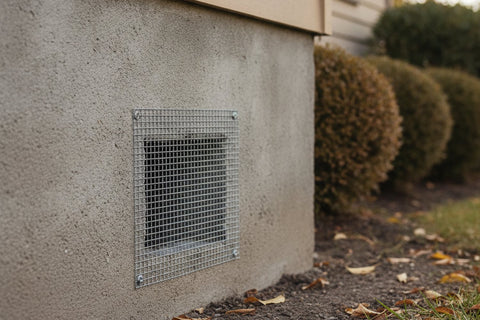
For what to seal with, UC IPM's quick tips name wire screen or coarse steel wool that mice cannot chew through, and its pest note says to seal cracks in foundations and around openings for water pipes, vents and utility cables with metal or concrete, that steel wool scouring pads make good temporary plugs but may rust over time, and that plastic screening, rubber, vinyl, insulating (expanding) foam, wood and other gnawable materials are ineffective for plugging holes used by house mice. New York's health department says to seal all openings, like cracks and spaces around vents, wires and pipes, with sheet metal, concrete or a knitted copper wire mesh, to screen necessary openings such as fans and chimneys with 1/4 inch wire mesh, to screen doors and windows with tight fitting metal screens, and to keep a tight fitting door sweep on all exterior doors, since mice can jump 12 inches high, run up the sides of buildings and cross cables and wires. Penn State names copper mesh, hardware cloth and silicone sealant for outdoor holes, and door sweeps under doors. On foam, the sources differ: the CDC says to fill small holes with steel wool and put caulk around the steel wool to keep it in place or use spray foam, while UC IPM lists insulating (expanding) foam among the materials that are ineffective for plugging holes used by house mice. UGA says to seal the openings under doors, to seal small holes and cracks by stuffing them with steel wool, then caulk over them, and to cover clothes dryer vents, being careful to allow adequate airflow, and clean them regularly to remove lint build up that could be a fire hazard.
Step 4: Set snap traps along the walls
The CDC's trap up page recommends traditional snap traps to reduce rodent populations around the home, and says to carefully read the instructions on the box before setting a trap, to put a small amount of bait such as chunky peanut butter on the bait pan, and to place the trap on the floor against the wall with the baited end next to the wall, so it forms a T with the wall. The CDC places traps where you have seen mice, nesting materials, urine and droppings, nibbled food or gnaw marks, and in closed areas such as behind the stove and refrigerator and in the back of cabinets and drawers. UC IPM sets traps behind objects, in dark corners and close to walls so mice pass directly over the trigger, says mice seldom venture more than 30 feet from their nest and food, so to space traps no more than about 10 feet apart where mice are active, and says pairs of traps set 1 to 2 inches apart can increase capture success for mice that jump over obstacles. New York's health department puts a sheet of newspaper under each trap, sets traps in pairs at right angles to the wall with the trigger end touching it, about 6 to 10 feet apart along the routes mice travel, and moves the traps to a new spot if nothing happens in a couple of days; UGA says not to expect a mouse to travel more than 5 or 10 feet to find a trap.
For bait, UC IPM says the best bait is often the food the mice are already eating, that a ball of cotton wool or dental floss can be an effective bait because reproductive females are highly motivated to build nests, and to use a small amount on the trigger plate, since with too much a mouse may remove it without triggering the trap; UC IPM also says peanut butter can pose allergy risks to people in some situations. For the pick 1 traps, Victor's instruction sheet (the Easy Set Mouse Trap sheet that the trap's product page links as its manual) says to apply a small amount of peanut butter or another high protein bait to the yellow pedal, using a Q-tip, toothpick or another tool so your scent is not transferred onto the trap; to pull the kill bar back and hold it with your thumb; to latch the end of the arm bar under the yellow pedal, lifting the pedal slightly, on the Firm side (easier to set, but does not trip as easily) or the Sensitive side (more difficult to set, and trips very easily); and to place the trap with the baited pedal end flush against the wall. On bait, Victor differs from itself: an answer to a buyer on its product page says to place a small amount of bait inside the bait cup only and to avoid placing bait on the pedal. For electric, covered, bucket and live catch mouse traps, our best mouse traps guide compares those kinds.
On children and pets, the CDC says always to keep traps and bait out of reach of children and pets, and the EPA says always to place traps and baits where children and pets cannot reach them. Penn State says to keep traps well hidden and out of reach of children, and that since mice are typically awake at night, traps can be put away during the day to prevent accidents to children or pets; it also says the safest traps for catching mice in the home are snap traps set by latching or squeezing the back of the trap, which avoids snapping fingers while setting and releasing. The CDC says to check traps daily, dispose of any dead rodents immediately, reset traps until rodent activity has stopped, and that if no rodents are caught for a week and there are no new signs, they are gone.
Step 5: Clean up droppings, urine and nests
The CDC's clean up page says diseases are mainly spread to people from rodents when they breathe in contaminated air, and not to vacuum or sweep rodent urine, droppings or nesting materials, since that can put tiny droplets containing viruses into the air. For homes, the CDC says to open all doors and windows for 30 minutes before cleaning and to leave the area during that time. The CDC's steps for urine and droppings: put on rubber or plastic gloves; spray the urine and droppings with a bleach solution of 1.5 cups of household bleach in 1 gallon of water (1 part bleach to 9 parts water), made fresh, or an EPA registered disinfectant until very wet, and let it soak for 5 minutes or as the disinfectant label says; wipe them up with paper towels and throw the towels in a covered garbage can that is regularly emptied; mop or sponge the area with a disinfectant, cleaning all hard surfaces including floors, countertops, cabinets and drawers; wash the gloved hands with soap and water or a disinfectant before removing the gloves; then wash hands with soap and warm water, or use an alcohol based hand rub when soap is not available and hands are not visibly soiled.
For a dead mouse or a nest, the CDC suggests considering an insect repellent on clothing, shoes and hands, since fleas are common on rodents; its steps are to wear rubber or plastic gloves, spray the dead rodent, nest and surrounding area with a disinfectant and let it soak for 5 minutes or as the label says, place it in a plastic bag along with any used traps, tie the bag shut, place that bag in a second plastic bag tied shut and throw it in a covered garbage can that is regularly emptied, then wash the gloved hands before removing the gloves, and wash hands after. To reuse a snap trap instead, the CDC soaks the trap with the rodent in disinfectant for 5 minutes while wearing rubber gloves, drops the rodent into a plastic bag, rinses the trap well with water and lets it dry completely, then double bags the rodent, throws the bag away and washes gloves and hands the same way. UC IPM's quick tips differ on disposal: they say to dispose of dead rodents by burying them or placing them in plastic bags in the garbage, not to touch mice with your bare hands, and to wash hands thoroughly after handling traps.
On the bleach rate, the sources differ slightly: the New York State Department of Health mixes detergent plus 1 1/2 cups of bleach for each gallon of water, the CDC's figure, while Penn State recommends one part bleach to ten parts water. New York's health department sprays dead rodents, traps, droppings and the areas where they were found from a spray bottle, says not to sweep or vacuum mouse droppings until the area is wet with detergent, bleach and water, and double bags the sprayed rodent or droppings. UC IPM says house mice carry diseases such as leptospirosis, salmonella and lymphocytic choriomeningitis (LCM), a viral disease contracted from exposure to fresh urine, droppings, saliva or nesting materials from infected house mice, and that house mouse urine is a major source of allergens; UGA names hantavirus among the diseases rats and mice transmit, and says always to use a dust mask and rubber or disposable gloves when handling mice, rats, traps or poison. For heavy infestations, the CDC lists coveralls, rubber boots or disposable shoe covers, rubber, latex or vinyl gloves, protective goggles and a half mask air purifying respirator with a HEPA filter, and says to follow local and state requirements on pulmonary function and fit testing before using a respirator. The CDC says to talk to a healthcare provider if you think a recent illness may be due to a rodent borne disease, and to tell them about any exposure to rodents.
Step 6: Know when to call a professional
The CDC says to contact your local or state health department if you are concerned about a rodent infestation, that you can contact a pest control specialist if rodents have gotten into areas that cannot be reached to clean, and to contact a professional rodent exterminating service when there is evidence rodents have reached the heating and cooling ventilation systems; its trap up page says that if trapping does not resolve the infestation, you could consider using a poison bait station or seek professional help. The EPA says to choose a pest control company carefully, to ask to see the company's license, and to call your state pesticide regulatory agency if you have concerns. New York's health department says that outside New York City you can call your local health department.
How to keep mice out of the house
New York's health department says the best way to control mice is to keep them out in the first place: check your home yearly to make sure it is still mouse proof, keep the home and property uncluttered, and do not expect a cat or dog to keep mice away. UC IPM says house mice frequently enter homes in autumn when nighttime temperatures become colder, and that while some dogs and cats will catch and kill mice, there are few situations in which they will sufficiently control them. UGA says mice really like to move into warm houses for the winter, so fall is when many houses get infested, and that once the mice are gone, to save your traps, keep looking for holes and openings, keep the property in good repair and always keep doors closed.
How far does one pack go?
UC IPM says to use enough traps to make the trapping period short and decisive. The table works out what one pack or roll of each pick gives. Set in pairs at New York's spacing, one 12 pack makes 12 / 2 = 6 pairs, and the wall it spans = (pairs - 1) x the spacing between pairs: 5 x 6 to 10 feet = 30 to 50 feet. Set singly, the wall it spans = (12 traps - 1) x the spacing between traps: 11 x up to about 10 feet = up to about 110 feet at UC IPM's spacing, and 11 x 2 to 3 feet = 22 to 33 feet at Victor's. Area of the roll = width x length: 4 inches x 60 inches = 240 square inches, about 1.7 square feet. One sweep covers one door bottom. Pairs of gloves = 100 gloves / 2 = 50.
| Pick | One pack or roll gives (computed) | Inputs (source) |
|---|---|---|
| Victor Wide Pedal Mouse Traps (pick 1) | 30 to 50 ft of wall as 6 pairs at New York's spacing; up to about 110 ft as single traps at UC IPM's; 22 to 33 ft at Victor's | 12 traps (listing); pairs about 6 to 10 ft apart (New York); no more than about 10 ft apart (UC IPM); 2 to 3 ft intervals (maker) |
| Xcluder fill fabric kit (pick 2) | 240 sq in, about 1.7 sq ft | 4 in by 5 ft roll (listing); opening size not stated |
| M-D door sweep with kick plate (pick 3) | 1 door bottom, 36 in | 1 sweep, 36 in (listing); gap it seals not stated |
| ForPro vinyl gloves (pick 4) | 50 pairs | 100 gloves (listing) |
Poison baits and bait stations
This guide links no rodent poison or bait product. The EPA says the rodenticide products sold at consumer outlets are ready to use bait stations, and that rat and mouse poison products, if misused, can potentially harm you, your children or your pets. The EPA says always to read the product label and follow all directions, to store pesticides away from the reach of children and pets, such as in a locked utility cabinet or garden shed, and never next to food, including pet food, and, to prevent accidental poisoning of wildlife and pets that might eat a dead animal, to promptly remove and dispose of the carcasses of dead rodents. The EPA's options page says to protect children, pets and wildlife by only using tamper resistant bait stations, and to follow all label directions and precautions; its restrictions page says second generation anticoagulant rodenticides are no longer registered for use in products geared toward consumers, that the consumer products are ready to use bait stations with the bait in block or paste form, and that pelleted baits are no longer permitted in rodenticide products for consumer markets.
On poison inside the home, the sources differ: the CDC's trap up page says to use poison or bait stations only for mouse and rat infestations that persist, and recommends EPA registered products. UGA says to use traps, not poison baits, inside houses, because poisons are more dangerous to children and pets and poisoned rodents usually crawl into an inaccessible space in a wall or behind appliances, die and then smell awful; Penn State says to avoid using rodenticides inside homes, because besides increased risks to children and pets, rodents die inside walls and smell bad, attracting insect pests. UC IPM says that because house mice tend to stay within 30 feet of their nest, a rodenticide will often leave mice dying inside the structure, so if that is a problem trapping may be the best approach; that because all rodenticides are toxic to people, pets and wildlife, to take special precautions to prevent access to baits by children and nontarget animals and always follow the product label; and that there is evidence bromethalin can pass through the food chain to predators that eat poisoned mice.
New York's health department, in a page revised in July 2012, says trapping is effective and generally safer than using poison, and that poisoned mice often die in hard to reach places, causing a very unpleasant odor; its poison section names baits containing anticoagulants such as warfarin, pival and chlorophacinone as the most effective, least toxic mouse poisons for home use, and says to read all label instructions completely and follow them carefully, to watch out for children and pets, and to place clearly marked baits in a secluded and secure area. That 2012 page and the EPA's consumer rules above differ in form: the EPA says consumer rodenticides are ready to use bait stations, and that only tamper resistant bait stations should be used. Penn State says that if you suspect a child has been accidentally exposed to chemicals, to call the Poison Control Center immediately at 1-800-222-1222.
Glue boards, live traps and repellers
On glue boards, the sources split: the CDC says not to use glue traps and live traps, because these traps can scare the rodents, causing them to urinate, which can increase your chance of getting sick. Penn State says glue boards are not recommended for rodent control and should be used with caution, since they do not kill the mouse, you may be bitten, and the mouse can suffer while on the trap. UC IPM says adult rodents can often detect and avoid the glue, that rodents caught on glue boards will need to be euthanized, and not to use glue boards where children, pets or desirable wildlife can contact them. New York's health department says that if you have many mice you might have to use a multi catch mouse trap or a glue board, and to check traps every day; UGA says sticky traps are as good as snap traps for mice, not to place them where other wildlife may be caught, and to check them at least once a day, since you will need to kill the trapped rodent to prevent suffering.
On live traps, UC IPM says live house mice need to be removed from the trap frequently and humanely euthanized, that in California it is illegal to relocate them away from the property where they were captured without a special permit, and that house mice moved as much as a half mile from their home ranges can navigate back to their nest site. On repellers, UC IPM says high frequency electronic devices are not effective, and that there is little evidence that sound, magnetic or vibrational devices of any kind will drive established house mice from buildings; UGA says ultrasound devices are almost completely useless against rodent pests. Our best mouse repellent guide scores the evidence on mouse repellents.
How we picked these tools
We built the tool list from the house mouse and rodent pages of UC IPM, the New York State Department of Health, the CDC, the EPA, Penn State Extension and the University of Georgia's IPM program, and linked a product only where a step names one: snap traps with a wide trigger, steel wool, a door sweep and disposable gloves. We also searched the US Consumer Product Safety Commission's recall database on November 21, 2026 for each brand and model we link and found no recall listed for any of these products. We make digging spades, not mouse traps, so nothing on this page is ours. How our guides are made sets out the full process.
Also considered
Each was checked on November 21, 2026.
- Homax extra coarse steel wool pads. In stock and sold by Amazon; UC IPM says steel wool scouring pads make good temporary plugs but may rust over time, so we link the stainless steel fill fabric instead.
- Victor Quick-Kill Mouse Traps, 6 pack. A plastic snap trap that its listing says sets with just one click, in stock and sold by Amazon; its listing also says these traps can be used around children and pets, while the CDC and the EPA say to keep traps where children and pets cannot reach them, so we link the wooden wide pedal traps instead.
- Knitted copper mesh. New York's health department names a knitted copper wire mesh for sealing; the copper mesh rolls in our searches were not sold by Amazon, so we do not link one.
Frequently asked questions
How do you get rid of mice in the house for good?
New York's health department gives three basic steps, proper sanitation, mouse proofing and removing mice, and says the best way to control mice is to keep them out in the first place. UC IPM calls exclusion, eliminating all gaps and openings larger than 1/4 inch, the most successful and permanent form of house mouse control.
How do you keep mice out of the house?
UC IPM says to eliminate all gaps and openings larger than 1/4 inch and to seal cracks and openings for pipes, vents and cables with metal or concrete. New York's health department says to keep a tight fitting door sweep on all exterior doors and to check your home yearly to make sure it is still mouse proof. The CDC says to keep food sealed in thick plastic, metal or glass containers with tight lids.
What are the signs of mice in the house?
UC IPM lists droppings, fresh gnaw marks and tracks, nests of finely shredded paper or other fibrous material, and a musky odor. New York's health department says you can probably hear them after dark. Penn State says mouse droppings are pointed, about the size of a grain of rice.
How long does it take to get rid of mice in the house?
The CDC says to continue trapping until there are no more rodents, that a week with no rodents captured and no new signs means they are gone, and to check the bait every week and refill or move it as needed for at least 15 days. UGA says to leave the traps in place for a few weeks.
Where do you put mouse traps in the house?
The CDC places them on the floor against the wall where you have seen mice, nesting materials, urine and droppings, nibbled food or gnaw marks, and in closed areas such as behind the stove and refrigerator and in the back of cabinets and drawers. UC IPM sets them close to walls, behind objects and in dark corners.
Disclosure: Some links pay us a commission when you click or buy, and on some pages brands pay us through Amazon's creator program on links to their products.
Product prices and availability are accurate as of the date/time indicated and are subject to change. Any price and availability information displayed on Amazon.com at the time of purchase will apply to the purchase of this product.