As an Amazon Associate we earn from qualifying purchases. Some links are paid. Disclosure
Our top picks
Snap traps
1. Victor Wide Pedal Rat Trap
Best for: Trapping along walls
Mesh for openings
2. VEVOR Hardware Cloth
Best for: Openings, at 1/4 inch mesh
Filler for small holes
3. Xcluder Fill Fabric Kit
Best for: Stuffing small holes and gaps
Here is how to get rid of rats, from the University of California's IPM program (UC IPM), the US EPA and university extension guides: look for the signs, take away food and shelter, seal the way in, then trap, and know when to call a professional. UC IPM says all holes larger than 1/4 inch should be sealed to exclude both rats and mice, and to use traps to remove rats; for traps, our pick is the Victor Wide Pedal Rat Trap, 12 pack. Good to know: Victor's page sets its rat traps along walls at 2 to 3 foot intervals, while UC IPM places rat traps about 10 to 20 feet apart (the table below shows both).
Skip to the steps for getting rid of rats
The tools for the job
1. Victor Wide Pedal Rat Trap, 12 pack
Twelve wooden snap traps, wide trigger pedal.
| Pick | What it is | Size | Step | Best for | Our verdict | Where to buy |
|---|---|---|---|---|---|---|
| 1. Victor Wide Pedal Rat TrapSnap traps | Wooden snap trap | 12 traps | Step 4, trapping | Trapping along walls | Twelve wooden snap traps with a wide plastic trigger pedal, by Victor. | Check price on Amazon |
| 2. VEVOR Hardware ClothMesh for openings | Galvanized steel mesh | 36 in by 100 ft, 1/4 in mesh | Step 3, sealing | Openings, at 1/4 inch mesh | A 36 inch by 100 foot roll of galvanized 1/4 inch mesh, by its listing. | Check price on Amazon |
| 3. Xcluder Fill Fabric KitFiller for small holes | Steel wool fill fabric | 4 in by 5 ft roll | Step 3, sealing | Stuffing small holes and gaps | A 4 inch by 5 foot roll of steel wool fill fabric with shears and gloves, by its listing. | Check price on Amazon |
| 4. ForPro Vinyl GlovesGloves for cleanup | Disposable vinyl gloves | 100 gloves, medium | Step 5, cleanup | Handling traps and dead rats | A box of 100 single use vinyl gloves, by its listing. | Check price on Amazon |
When we checked on November 21, 2026, every tool we link was in stock as new and sold by Amazon. How our guides are made sets out what we check.
The Victor Wide Pedal Rat Trap is the trap for Step 4: by Victor's page, a wooden snap trap with a wide plastic trigger pedal and Firm and Sensitive settings, here 12 to a pack. King County's health department says that once rodents have entered a home, shed, garage or vehicle, the best trap is the simple wooden snap trap, and that snap traps for rats and mice are different sizes.
2. VEVOR hardware cloth: mesh for openings
Best for: Openings, at 1/4 inch mesh
A 36 inch by 100 foot roll of galvanized 1/4 inch mesh, by its listing.
The VEVOR hardware cloth is a 36 inch by 100 foot roll of 1/4 inch mesh, welded from low carbon steel wire and hot dipped galvanized, by its listing, which says it cuts with scissors or wire cutters, and to beware of sharp edges after cutting and always wear gloves when handling it. Its 1/4 inch squares are the mesh size the University of Georgia names in Step 3. Good to know: for vent covers and windows that open near the ground, UC IPM's spec in Step 3 is 1/2 inch galvanized mesh at 16 to 19 gauge, and this listing gives the mesh size but not the wire gauge.
3. Xcluder fill fabric kit: filler for small holes
Best for: Stuffing small holes and gaps
A 4 inch by 5 foot roll of steel wool fill fabric with shears and gloves, by its listing.
The Xcluder fill fabric kit is a 4 inch by 5 foot roll of fill fabric that its listing describes as coarse stainless steel wool interwoven with poly fibers, packed with shears and work gloves, for filling gaps, holes and openings. Steel wool is among the materials the EPA, UC IPM and the University of Georgia name for sealing holes in Step 3, and our best mouse repellent guide picks this same kit for sealing out mice. Good to know: the listing gives the roll's size but not the size of the fabric's openings, so the table shows that as not stated.
4. ForPro vinyl gloves: gloves for cleanup
Best for: Handling traps and dead rats
A box of 100 single use vinyl gloves, by its listing.
The ForPro vinyl gloves come 100 to a box, single use, powder free and latex free, by their listing. Step 5 gives the glove steps of UC IPM, the University of Georgia and the CDC for handling traps, dead rats and droppings. Good to know: this listing is size medium, with a 2.75 mil palm and 3.9 mil finger thickness.
How to get rid of rats, step by step
UC IPM says successful rat control typically includes three elements: sanitation, structural exclusion (rodent proofing) and population control, and that control takes less time and effort, and fewer traps, when it starts early, while numbers are low. The EPA says identifying and preventing an infestation is always a good idea to try first.
Step 1: Look for the signs
UC IPM lists rat droppings near food, storage areas or pet food containers; gnaw marks on fruit or nuts; nests behind boxes, in cluttered garages and in woodpiles; burrows beneath garbage cans and compost piles or among garden plants; rats traveling along utility lines or fence tops at dusk; noises from the attic or drop ceilings; and smudge marks where rats rub their fur against beams, rafters, pipes and walls. The University of Georgia's IPM program (UGA) says rat droppings are about the size of raisins and mouse droppings about the size of rice grains, and that a little flour or talcum powder scattered along a wall, with a cracker or bread with peanut butter in the middle, shows tracks the next day; Penn State Extension describes rat droppings as blunt and mouse droppings as pointed. UC IPM says it is important to know whether you have rats or mice, since mice and small young rats often will not trigger a rat snap trap. For mice, our best mouse traps guide covers traps sized for them, and our how to get rid of mice in a garage guide covers that job step by step.
UC IPM tells the two common rats apart. The stocky Norway rat builds burrows along building foundations, beneath trash piles and in woodpiles, and indoors tends to stay in basements or on the ground floor. The roof rat, a great climber with a tail longer than its head and body, usually nests above ground in shrubs, trees and dense vegetation, and indoors favors attics, walls, false ceilings and cabinets. Where the rats live sets where the traps go in Step 4.
UC IPM's list of signs also includes something digging under a garden tool shed or doghouse. If the digger turns out to be a raccoon, groundhog or squirrel, our best live animal trap guide covers cage traps sized for those animals.
Step 2: Take away food and shelter
UC IPM calls sanitation fundamental to rat control and says it must be ongoing, or rats will quickly return. UC IPM's steps: outdoors, feed pets only the amount they will eat at a single feeding, or bring the food inside at night; clean up garden debris and fallen fruit; store indoor and outdoor food, garbage included, in containers with tight fitting lids; keep compost in rigid plastic or metal containers with tight fitting lids, keeping in mind that rats can gnaw through plastic; and remove climbing plants from buildings. The EPA says to remove leaf piles and deep mulch, turn compost piles to cover newly added food scraps, and stop feeding outdoor birds while you are controlling an infestation, or feed only huskless items that leave less residue. King County's health department says bird feeders should be on poles, with seed in trays that rats cannot reach.
On distances, the sources differ. UC IPM's quick tips say to leave at least a 2 foot space between shrubs and between shrubs and buildings, and to prune tree limbs that are within 3 feet of a roof, while its full pest note says overhanging tree limbs within 6 feet of roofs should be removed, to keep both rats and tree squirrels off the roof and out of attics and soffit vents. King County keeps bushes at least 3 feet from the house and bushes, vines and tree branches cut back at least 3 feet. For firewood, King County stacks it 18 inches off the ground and away from all buildings, and UGA stores it at least a foot off the ground and does not pile wood against the house.
Step 3: Seal the way in
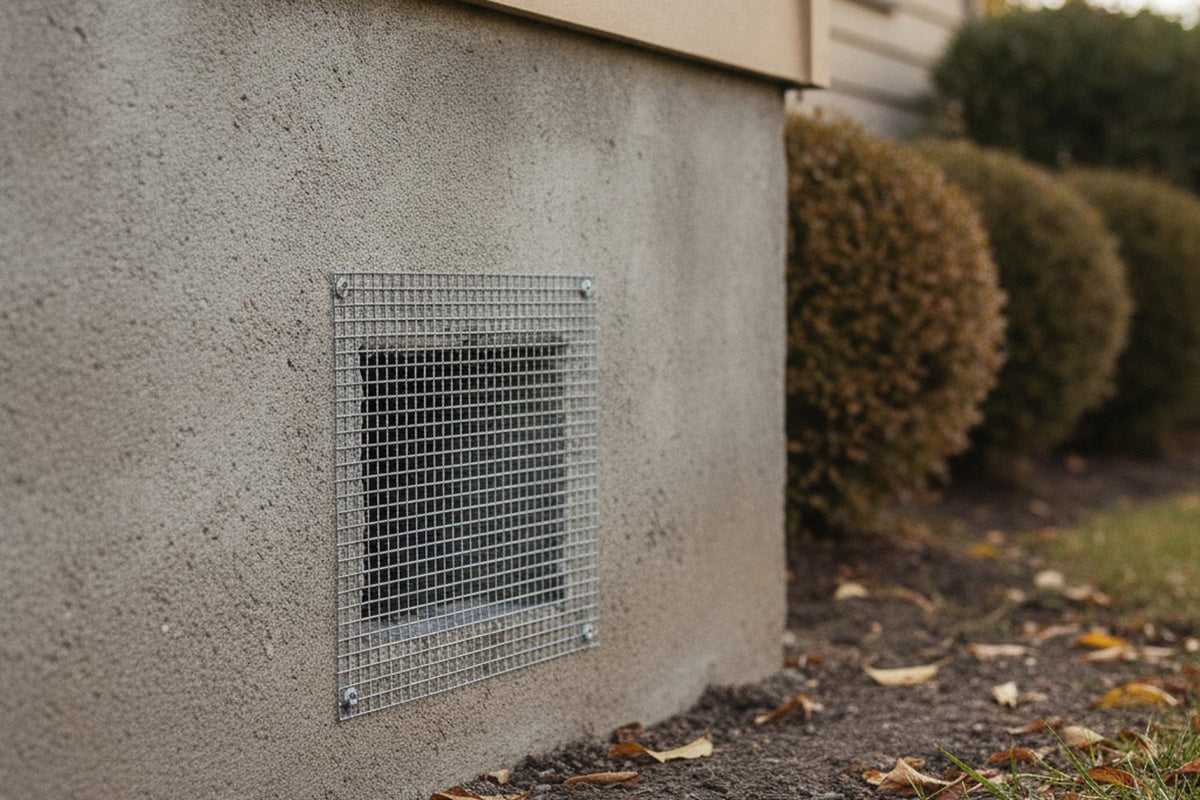
UC IPM calls exclusion the most successful and longest lasting strategy for rat control around buildings. It says to seal cracks and openings larger than 1/4 inch with steel wool, wire screen or sheet metal, since rats can chew through plastic, foam, wood and caulk; to make sure doors, windows and screens fit tightly, with door sweeps or weather stripping, though its rodent proofing list adds that typical weatherproofing materials may not be sufficient to exclude rats and mice, and to cover their edges with sheet metal if gnawing is a problem; and, because roof rats are excellent climbers, to plug openings above ground level too. Its spec for vent covers is 18 gauge, 1/2 inch mesh galvanized expanded metal or 16 gauge, 1/2 inch mesh galvanized wire cloth; for windows that open near the ground, 19 gauge, 1/2 inch mesh galvanized wire cloth; and never lightweight chicken wire, since rats can easily pass through its openings.
The sources size a rat's opening differently. UC IPM says young rats can squeeze beneath a door with only a 1/2 inch gap; Penn State says a rat can fit through a hole about the size of a quarter, and a mouse through one about the size of a dime; UGA says mice and rats can enter through openings as small as a dime. UGA's steps: seal the openings under doors, use mesh hardware wire with 1/4 inch squares, cement or caulk around pipes and wires, and stuff small holes and cracks with steel wool, then caulk over them. The EPA says sealing may be as simple as plugging small holes with steel wool, or patching holes in inside or outside walls.
Step 4: Set snap traps
UC IPM says finding the best places to set traps may be more important than the type of trap: secluded areas where rats travel and shelter, where droppings, gnaw marks and damage show, especially between their shelter and food. For Norway rats it sets traps close to walls, behind objects and in dark corners, at right angles to the wall with the trigger end nearly touching it, and sets any traps that run parallel to the wall in pairs, to catch rats from either direction; for roof rats, on the ground and above it, on ledges, shelves, branches, fences, pipes or overhead beams, secured to the surface where possible. UGA likewise sets the bait treadle across the rat's path at a right angle to the wall, and says two traps back to back, one facing each way along the wall, also work. Victor's page sets its trap in four steps: remove the staple and hang the arm bar over the back of the trap; bait the plastic pedal with a high protein bait such as peanut butter or hazelnut spread; pull back the kill bar, hold it with your thumb and secure the arm bar under the pedal, on the Firm side (easier to set, but does not trip as easily) or the Sensitive side (harder to set, but trips very easily); and place the trap perpendicular to the wall with the yellow trigger plate flush against the baseboard. Victor's page also carries buyer comments about the wide pedal snapping shut while being set, including on fingers, or tripping without a catch; Victor's replies point to the Firm and Sensitive settings and a pea sized amount of bait, and, for setting it safely, to holding the kill bar back with the thumb first, then hooking the arm bar under the pedal from the side rather than lifting the pedal itself, which Victor says keeps fingers out of the kill bar's path.
For bait, UC IPM names nuts, dried fruit, bacon, a piece of dry pet food or soft baits such as peanut butter, in just a pea sized amount, and says to set traps so that the trigger is sensitive and will spring easily; UGA names peanut butter, bacon or cooked chicken. UC IPM says rats avoid new objects for the first several days, and maybe weeks, and that a rat that sets off a trap without being caught is very hard to trap again; its answer is to leave traps baited but unset until the bait has been taken several times, to double the number of baited traps whenever bait is taken from all of them, until some traps keep their bait, and then to bait and set all traps. UGA says to leave the traps in place for a few weeks.
On children and pets, the EPA says always to place traps and baits where children and pets cannot reach them. UC IPM says that where children, pets, birds and other nontarget animals might come across traps, to set them within boxes or stations or use a barrier, and that trapping during the night can reduce interactions with birds; UGA places rat traps where children and pets are not likely to trigger them by accident. Victor's page differs: it lists this trap as one that can be used around children and pets. For covered, electric and outdoor tunnel rat traps, our best rat traps guide compares those kinds.
Step 5: Remove dead rats and clean up
UC IPM says never to touch rodents with your bare hands and to wash thoroughly after handling traps, to use disposable gloves to handle dead rodents, and to dispose of dead rats by burying them or by placing them in a sealed plastic bag and putting them in the trash. UGA uses a dust mask and rubber or disposable gloves when handling mice, rats, traps or poison, and puts dead carcasses and used gloves in the trash or buries them. UC IPM lists typhus, leptospirosis, food borne illnesses and rat bite fever as the most common diseases rats transmit.
For urine, droppings, nests and dead rodents, the CDC's cleanup page starts with the space: for homes and outbuildings such as cabins, sheds and barns, the CDC says to open all doors and windows for 30 minutes before cleaning and to leave the area during that time. The CDC says not to vacuum or sweep rodent urine, droppings or nesting materials, since that can put tiny droplets containing viruses into the air. The CDC's steps for urine and droppings: put on rubber or plastic gloves; spray the urine and droppings with a bleach solution of 1 part bleach to 9 parts water, made fresh, or an EPA registered disinfectant until very wet, and let it soak for 5 minutes or as the disinfectant label says; wipe them up with paper towels and throw the towels in a covered garbage can that is regularly emptied; mop or sponge the area with a disinfectant, cleaning all hard surfaces including floors, countertops, cabinets and drawers; wash the gloved hands with soap and water or a disinfectant before removing the gloves; then wash hands with soap and warm water, or use an alcohol based hand rub when soap is not available and hands are not visibly soiled. For other surfaces, the CDC launders bedding, clothing and stuffed animals with hot water and detergent, then machine dries them on a high setting or hangs them to air dry in the sun, and shampoos rugs and upholstered furniture with a commercial disinfectant or a commercial grade steam cleaner or shampoo.
For a dead rodent or nest, the CDC's steps go further than UC IPM's single sealed bag. Since fleas are common on rodents, the CDC suggests considering an insect repellent on clothing, shoes and hands; it sprays the dead rodent, nest and surrounding area with a disinfectant and lets it soak for 5 minutes or as the label says; places it in a plastic bag along with any used traps, ties the bag shut, places that bag in a second plastic bag tied shut and throws it in a covered garbage can that is regularly emptied; then washes gloved hands before removing the gloves, and washes hands after. To reuse a snap trap instead, the CDC soaks the trap with the rodent in disinfectant for 5 minutes while wearing rubber gloves, drops the rodent into a plastic bag, rinses the trap well with water and lets it dry completely, then double bags the rodent, throws the bag away and washes gloves and hands the same way.
For heavy infestations, the CDC lists coveralls, rubber boots or disposable shoe covers, rubber, latex or vinyl gloves, protective goggles and a half mask air purifying respirator with a HEPA filter, and says to follow local and state requirements on pulmonary function and fit testing before using a respirator, and to decontaminate the protective equipment when it comes off at the end of the day.
Step 6: Know when to call a professional
King County's health department says some rodent problems, such as heavy infestations with piles of feces, numerous nests or dead rodents, may be too extensive to control on your own, and recommends a professional pest control company; it says to ask about integrated pest management (IPM) services, to interview companies and ask for references, to be clear about what you want done and check their performance, and to ask to see their license. The EPA says to choose a pest control company carefully, to ask to see the company's license, and to call your state pesticide regulatory agency if you have concerns. UC IPM says that if roof rats are traveling on overhead utility wires, to contact a pest professional or the utility company.
How many traps, and how much mesh?
UC IPM says to use as many traps as is practical, so that trapping is short and effective, and that a dozen or more traps for a heavily infested home might be necessary; UGA says that for rats, about a dozen per house should do. The table works out what each pick gives. Wall run of one 12 pack = (12 traps - 1) x the spacing between traps: 11 x 10 to 20 feet = 110 to 220 feet at UC IPM's spacing, and 11 x 2 to 3 feet = 22 to 33 feet at Victor's. Area of a roll = width x length: 3 feet x 100 feet = 300 square feet, and 4 inches x 60 inches = 240 square inches, about 1.7 square feet. Mesh against the gap = mesh opening / the 1/2 inch gap UC IPM says young rats squeeze under: 1/4 / 1/2 = 0.5. Pairs of gloves = 100 gloves / 2 = 50.
| Pick | One pack or roll gives (computed) | Opening against a 1/2 inch gap (computed) | Inputs (source) |
|---|---|---|---|
| Victor Wide Pedal Rat Trap (pick 1) | 110 to 220 ft of wall at UC IPM's spacing; 22 to 33 ft at Victor's | Does not apply | 12 traps (listing); about 10 to 20 ft apart (UC IPM); 2 to 3 ft intervals (maker) |
| VEVOR hardware cloth (pick 2) | 300 sq ft | 0.5 of the gap | 36 in by 100 ft, 1/4 in mesh (listing); 1/2 in gap (UC IPM) |
| Xcluder fill fabric kit (pick 3) | 240 sq in, about 1.7 sq ft | Not stated | 4 in by 5 ft roll (listing); opening not stated |
| ForPro vinyl gloves (pick 4) | 50 pairs | Does not apply | 100 gloves (listing) |
At UGA's count of about a dozen traps per house for rats, one 12 pack covers a house; under UC IPM's prebaiting step, a dozen traps that all lose their bait double to 2 x 12 = 24 traps, two packs. The listed 1/4 inch mesh is the size UGA names and is not larger than UC IPM's 1/4 inch limit for holes.
Poison baits and bait stations
This guide links no rodent poison or bait product. The EPA says the rodenticide products sold at consumer outlets are ready to use bait stations, with the bait, a block or a paste, secured within the station; that rat and mouse poison products, if misused, can potentially harm you, your children or your pets; to always read the product label and follow all directions; to store pesticides away from the reach of children and pets, such as in a locked utility cabinet or garden shed, and never next to food, including pet food; and, to prevent accidental poisoning of wildlife and pets that might eat a dead animal, to promptly remove and dispose of the carcasses of dead rodents. The EPA's options page says to protect children, pets and wildlife by only using tamper resistant bait stations, and to follow all label directions and precautions.
UC IPM says all rodenticides are toxic to nontarget species, pets and humans, to read and follow the label carefully and keep them away from children and pets, and to minimize entry points to buildings before baiting outside, to prevent poisoned rats from coming inside to die. UC IPM adds that with anticoagulants, dead rats can contain several lethal doses, so secondary poisoning of pets and wildlife is possible if they eat rat carcasses, and that the best precaution against accidental poisonings is to keep pets away from rodenticide baits and dead or dying rodents, then to dispose of dead rodents as in Step 5. UGA says to use traps, not poison baits, inside houses, because poisons are more dangerous to children and pets and poisoned rodents usually crawl into an inaccessible space, die and then smell awful. Here the sources split: UGA's guide says to use modern, second generation poison baits, while the EPA says second generation anticoagulant rodenticides are no longer registered for use in products geared toward consumers, and are registered only for the commercial and structural pest control markets.
Glue boards, live traps and repellers
UC IPM says glue boards are difficult to use and not generally recommended for nonprofessional use, that they should never be used outdoors because nontarget wildlife can become stuck, and that indoors, cats and dogs may also be endangered unless the traps are placed within boxes or stations or in spaces they cannot reach; UGA says sticky traps probably will not hold a large rat. UC IPM does not recommend live trapping of rats for nonprofessionals, because legally, trapped rats must be humanely euthanized or released immediately where they were trapped, and it does not recommend releasing them; the EPA says rodents released outside may find their way back into the house unless the entry points are sealed. On repellers, UC IPM says high frequency and ultrasonic sounds are ineffective for controlling rats in homes and gardens and that no repellents have been found to solve a rat problem for more than a very short time, and UGA calls ultrasound devices almost completely useless against rodent pests.
How we picked these tools
We built the tool list from the rodent control pages of UC IPM, the University of Georgia's IPM program, the EPA and King County's health department, and linked a product only where a step names one: snap traps, 1/4 inch mesh, steel wool and disposable gloves. We also searched the US Consumer Product Safety Commission's recall database on November 21, 2026 for each brand and model we link and found no recall listed for any of these products. We make digging spades, not rat traps, so nothing on this page is ours. How our guides are made sets out the full process.
Also considered
Each was checked on November 21, 2026.
- Other wooden rat snap traps. The Tomcat and JT Eaton rat snap traps we read were in stock and sold by Amazon; this page links one trap pack.
- Zevemomo 1/4 inch hardware cloth, 24 inch by 100 foot. The same mesh size in a narrower roll, in stock and sold by Amazon; we link the wider roll.
- Amerimax galvanized flashing. UC IPM names sheet metal for door and window edges where gnawing is a problem; the Amerimax rolls we read are listed for roof and gutter repair, so we do not link them. In stock and sold by Amazon.
Frequently asked questions
How do you get rid of rats in the house?
By UC IPM's three elements: sanitation, structural exclusion (rodent proofing) and population control. Inside, UGA uses traps, not poison baits, and King County's health department says to bait snap traps with food and place them near the droppings.
How long does it take to get rid of rats?
UC IPM says rats often avoid traps and baits for the first several days, and maybe weeks, after they are placed, and that control takes less time and effort when it starts early, while numbers are low. UGA says to leave the traps in place for a few weeks.
What attracts rats to a house?
King County's health department lists birdseed, pet food, fruits and berries on the ground, bread crumbs, food waste, grease such as from an outdoor grill, and garbage, and says that if you feed them, they will stay. UC IPM says rats are highly attracted to vegetation that is dense or close to the ground, and that climbing hedges such as ivy on fences or buildings are conducive to roof rat foraging and should be thinned or removed if possible.
How do you know the rats are gone?
UGA says it is hard to say, and to leave the traps in place for a few weeks; after the rats are gone, it closes their burrows with rocks and dirt, and if a burrow is reopened, rats are still there. UC IPM says to check periodically for signs, since rats are active throughout the year.
Can you get rid of rats without poison?
UC IPM calls snap traps the safest and most effective way to trap rats, and says that while the most permanent form of control is to limit food, water, shelter and access to buildings, direct population control often is necessary. The EPA lists lethal traps such as snap traps among the options, alongside poison baits in tamper resistant bait stations.
Disclosure: Some links pay us a commission when you click or buy, and on some pages brands pay us through Amazon's creator program on links to their products.
Product prices and availability are accurate as of the date/time indicated and are subject to change. Any price and availability information displayed on Amazon.com at the time of purchase will apply to the purchase of this product.