As an Amazon Associate we earn from qualifying purchases. Some brands also pay us when you click or buy, so those links are ads. Full disclosure below
The best heated chicken waterer for most backyard flocks is the Farm Innovators HB-60P, a 2 gallon drinker with three side-mounted nipples that Camryn Rabideau ran through two New England winters on her own flock without the nipples freezing. Its 60 watt heater is thermostatically controlled, Farm Innovators rates it for use to -10F and for up to 15 chickens, though both researched guides we cite size it for about four to eight. If you already own a double-wall metal fount, set it on the Farm Innovators HP-125 heated base instead; for ducks, which need water deep enough to dunk their heads, Rabideau uses the Farm Innovators heated bucket. Whichever you buy, the University of Minnesota Extension says to keep every wire away from the birds, the water and the bedding, and not to power a coop with an extension cord.
We make digging spades, not poultry gear, so nothing on this list is ours. Every pick is judged on the maker's freeze rating and wattage, how it holds and serves water, how many birds it serves, and what the one keeper who tested these on her own flock, and the guides that researched them, found.
Jump to: How long one fill lasts | Every model compared | Heated base or heated waterer? | Keeping water from freezing | Do nipples freeze? | Are heated waterers safe?
The best heated chicken waterers at a glance
| Waterer | Best for | How birds drink | Maker's freeze rating | Heater | Who recommends it | Where to buy |
|---|---|---|---|---|---|---|
| 1. Farm Innovators HB-60P Heated Poultry Drinker | Best overall: flocks of up to about eight | 3 nipples, up to 15 chickens | -10F (instruction sheet) | 60 watts | Camryn Rabideau (tested, this listing); FlockGuide, Chicken Geek (researched) | Check price on Amazon |
| 2. API Heated Deluxe Hen Hydrator | More water between fills, on nipples | 4 nipples, each for up to 4 birds | -10F | 65 watts | No tester; see How we chose | Check price on Amazon |
| 3. API 3 Gallon Heated Poultry Waterer | Birds that only know an open trough | Open trough | -5F | 100 watts | FlockGuide, Chicken Geek (researched) | Check price on Amazon |
| 4. K&H Thermo-Poultry Waterer | A trough that sits on the coop floor | Open trough with a filter ring | not stated | 60 watts | FlockGuide (researched) | Check price on Amazon |
| 5. Farm Innovators HP-125 Heated Base | A double-wall metal fount you already own | Your fount | 10F | 125 watts | FlockGuide, Chicken Geek (researched) | Check price on Amazon |
| 6. My Favorite Chicken Heated Poultry Waterer Base | A plastic or metal drinker you already own, in a sheltered spot | Your drinker | -13F (the listing says -20F) | 28 watts, 24V | None found: maker and listing only | Check price on Amazon |
| 7. Farm Innovators HB-60 Heated Bucket | Ducks and mixed flocks | Open bucket, 2 gallon (the maker says it holds 9 quarts) | -10F (instruction sheet) | 60 watts | Camryn Rabideau (tested, this listing) | Check price on Amazon |
How we chose
We did not test these waterers on a flock of our own. We compared each pick's Amazon listing with the maker's own product page and, where the maker publishes one, its instruction sheet: Farm Innovators for picks 1, 5 and 7, Miller Manufacturing (which makes API) for picks 2 and 3, K&H for pick 4, and My Favorite Chicken for pick 6. Pick 6 changed on September 29, 2026, when the base that held it went out of stock on Amazon with no other listing, and no tester or guide we read covers its replacement. We then checked the makers' claims against the one hands-on test we could find, Camryn Rabideau's (a shopping writer who keeps chickens, ducks and geese in New England and tested these on her flock), two researched 2026 guides, FlockGuide's (which says it is researched from extension, USDA and veterinary sources and describes no hands-on testing) and Chicken Geek's (which says its picks are research based, not hands-on), and what the writer of Meyer Hatchery's winter waterer post uses at home (Meyer sells what it names). We found few hands-on tests of heated waterers, so every pick says whose word it rests on.
Our rules: a full pick had to be in stock on Amazon on September 28, 2026 (pick 6 on September 29, 2026), with a freeze rating, wattage or bird count we could trace to the maker or the listing. The Premier 1 All-Season Heated Poultry Waterer, FlockGuide's best overall, showed only limited stock on Amazon that day, so it is the first model in Also considered rather than a pick. Two picks have no tester or guide behind them. The API Heated Deluxe Hen Hydrator is an in-stock 3 gallon nipple waterer we chose in the Premier's place, on its maker's -10F rating and bird count, and the My Favorite Chicken base (pick 6) rests on its maker's spec sheet and its listing. Water needs come from the University of Kentucky, and every fire and cord rule comes from a maker, a university extension service or a fire official, named where it appears; where we add a retailer's view, we name it as that.
The best heated chicken waterers, by job
1. Farm Innovators HB-60P Heated Poultry Drinker: best overall
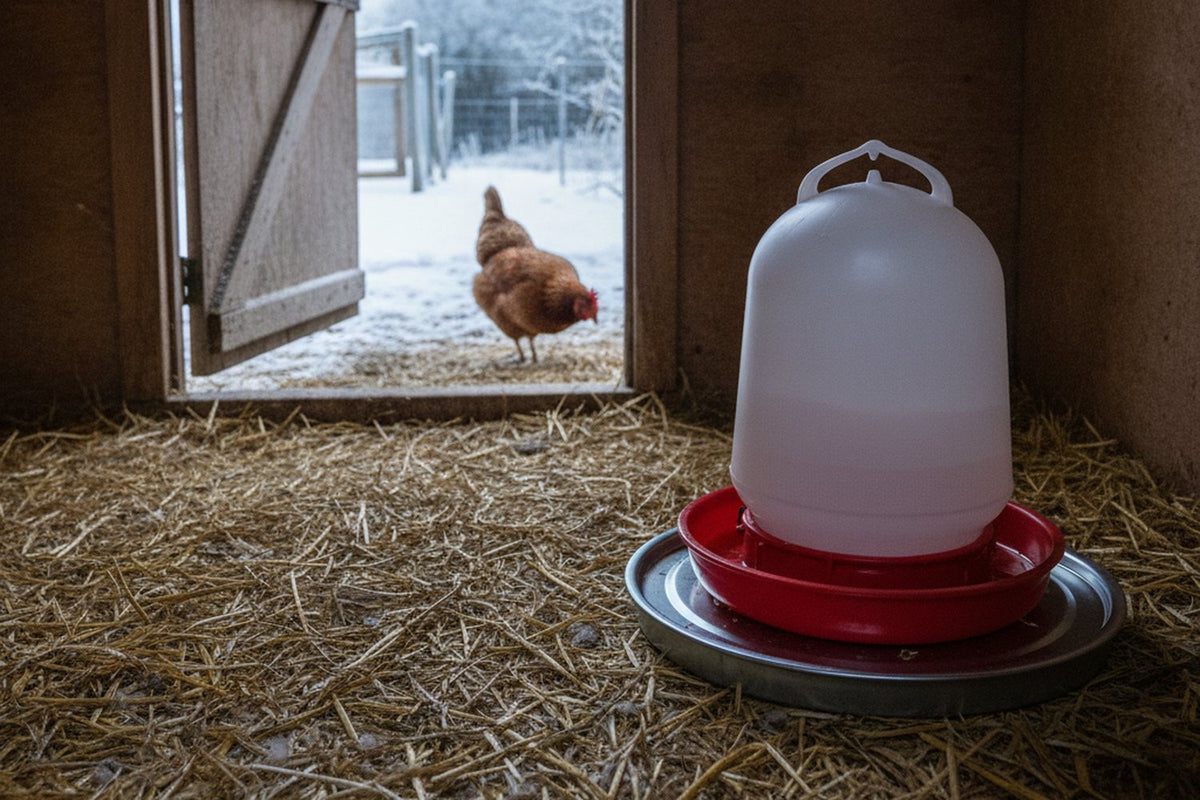
Check price. This is the drinker Camryn Rabideau recommends as the best heated waterer for chickens, and the exact listing she links: "We've used this exact model for two years now, and I've never had any issues with the nipples freezing, even on the coldest winter days here in New England." FlockGuide's researched guide calls it the best value and Chicken Geek's the best overall. It holds 2 gallons, and a 60 watt heater in the base is thermostatically controlled; the instruction sheet says it runs only below 35F and is recommended for use to -10F.
Birds drink from three side-mounted nipples that Farm Innovators calls drip-free and freeze-free, and the instruction sheet allows up to 5 hens per nipple, which is where the listing's "up to 15 chickens" comes from. Nipples keep the water clean, Rabideau points out, because the birds cannot step or poop in it. The metal handle lets you hang it, which she says keeps it from freezing to the ground, and the top lifts off for filling. Farm Innovators gives it a one-year limited warranty.
Where it loses: capacity and training. Two gallons is the smallest tank among our picks: at the University of Kentucky's water figure one fill lasts eight hens about four and a half days (see the table below), and FlockGuide, planning on more water per hen, says every two or three days. Rabideau lists a learning curve for birds that have never used nipples, and chickens can perch on top. FlockGuide notes the plastic lid has no insulation and the cord does not detach. Chicken Geek calls two gallons thin for more than six or seven birds and notes that the cord exits at the base; the University of Minnesota Extension says to keep all wires away from flammable litter. Farm Innovators' own sheet warns that the red outer plastic reservoir is not heated, so a little ice can build up there, and says to protect the drinker from wind.
2. API Heated Deluxe Hen Hydrator: a bigger nipple tank
Check price. No tester or guide we read has reviewed this one; it is here because the 3 gallon nipple waterer FlockGuide picks, the Premier 1, was on limited stock, and this is an in-stock 3 gallon nipple waterer whose maker publishes a freeze rating. Miller Manufacturing, which makes API, says it keeps water ice-free to -10F on 65 watts, with thermostatically controlled, UL listed electrical components. Four side-mounted nipples each serve up to four birds, which puts it at up to 16 birds by Miller's numbers, and Miller recommends it for adult birds only. If the Premier 1 All-Season shows in stock when you click, it is the better-documented 3 gallon nipple waterer on this page: a colder rating, room for more birds, a longer detachable cord, and the best overall pick of FlockGuide, which Chicken Geek also picks for larger flocks, mixed flocks with ducks and severe winters. This is the one to buy when it is not.
The translucent bucket is designed, Miller says, to provide UV protection against algae growth while letting you see the water level. The twist-locking lid is sloped so birds cannot roost on it, the handle is made for hanging (Miller says to hang it with the nipples at the birds' eye level), and the cord, 6 feet long, stows in a compartment for summer.
Where it loses: nobody independent has vouched for it, and Miller does not publish the temperatures its thermostat switches at. Like every nipple waterer, it needs a few days of training for birds raised on a trough (see Do nipples freeze?).
3. API 3 Gallon Heated Poultry Waterer: best open trough for deep cold
Check price. If your birds have only ever drunk from an open fount, this is the heated version of what they know. FlockGuide names it the best for deep cold. Miller rates it to keep water ice-free down to -5F, the only trough among our picks with a published rating; the heater is a 100 watt pad heating the 3 gallon jug, per the listing and Miller. Chicken Geek also picks it. The listing adds overheating protection, a thermostat that turns it on and off as needed, a rounded top that stops chickens from roosting on it, a galvanized steel handle and a funnel design for filling.
Where it loses: the cord is only 4 feet long, so the outlet has to be close. FlockGuide notes it is trough style, and a trough needs scrubbing every few days where nipples stay clean.
4. K&H Thermo-Poultry Waterer: best trough for the coop floor
Check price. FlockGuide's best no-roost design, for a waterer that sits rather than hangs. K&H shapes the top of the 2.5 gallon tank so chickens cannot roost on it and drop manure into the water, and a removable filter ring in the tray lets you lift out shavings and debris without draining it. The spill-proof cap lets you carry the full tank without spilling, K&H says. It uses 60 watts, it is thermostatically controlled, and K&H says the heated version is MET listed for safety and carries a 2-year limited warranty, the longest any of our picks states. Against pick 3, it adds the filter ring and the carry-full cap and draws 60 watts to pick 3's 100; pick 3 has a published -5F rating where K&H publishes none.
Where it loses: K&H does not publish a temperature rating, so we cannot tell you how cold it copes with. It is a trough, not nipples, which FlockGuide lists as its drawback, and the University of Minnesota Extension suggests setting the water source on a stand so birds do not scratch manure and bedding into it.
5. Farm Innovators HP-125 Heated Base: best for a metal fount
Check price. A heated base, often sold as a chicken water heater, is a flat heated plate you set your own fount on. This one is made for double-wall metal founts, draws 125 watts, switches on below 35F and, Farm Innovators says, prevents freezing to 10F. A bottom cover keeps dirt away from the heating element. FlockGuide lists it among its heated bases, Chicken Geek names it the best base for metal founts, and Farm Innovators gives it a one-year limited warranty.
Where it loses: it is metal only. The instruction sheet says to set a metal pan or metal fount on it, warns that the top gets extremely hot to the touch, and says not to use extension cords. Farm Innovators' product page says it is for outdoor use in a dry, covered area, while the instruction sheet calls it an indoor product to be placed in a sheltered area, so keep it under cover. Its 10F is the warmest rating among our picks that state one; the Meyer Hatchery writer, whose own heated base is rated to 10 degrees, says a base like that is not the best solution where it gets colder. The base at pick 6 carries a rating below zero, though only on its maker's word.
6. My Favorite Chicken Heated Poultry Waterer Base: a low-watt base for metal or plastic
Check price. The base for a plastic or metal drinker you already own, and the only base here rated below zero. My Favorite Chicken's product page describes a 30 cm base with 15 mm of polyurethane insulation under a 28 watt heater on a low voltage 24V DC connection, and three movable clamps that hold a round plastic or metal drinker up to 12.6 inches across. It rates the base to help prevent freezing to about -13F under suitable sheltered conditions. The Amazon listing gives the same 28 watts and 24V but claims freeze-proof to -20F and a fit up to 11.8 inches, so plan on the maker's -13F and measure your drinker against the smaller figure. At 28 watts it draws under a quarter of the HP-125's power, and the listing says the 24V supply keeps household line voltage away from the waterer. Chicken Geek says to skip a heated base under a thin plastic fount, and the Meyer Hatchery writer, by contrast, wrote in 2019 of a fourth winter with a plastic waterer on a heated base (Meyer's own) and said the base does not get warm enough to melt the plastic. With a thin plastic fount, a heated waterer (picks 1 to 4) avoids the question.
Where it loses: no tester or researched guide we read covers it, so everything here comes from its maker and its listing, and those two disagree on the freeze rating. Neither states a thermostat, so assume it draws its 28 watts whenever it is plugged in, which is still at most 0.67 kWh a day. The maker says the base is not waterproof and belongs on an elevated, flat, firm surface in a covered, dry, wind-sheltered spot, with the power adapter and every connection kept dry and out of the birds' reach. It is not universal-fit either: the maker says to measure the bottom of your drinker and check its shape before you order.
7. Farm Innovators HB-60 Heated Bucket: best for ducks and mixed flocks
Check price. For ducks a nipple waterer simply will not do, and Rabideau explains why: they need several inches of water to submerge their heads and clean their nares and eyes. After trying a few open-top setups, her answer for ducks and geese is this bucket, and this is the listing she links. The University of Maryland Extension makes the same point: waterfowl need liquid water deep enough to dunk and wash their heads. Farm Innovators rates the bucket for use to -10F; it is sold as a 2 gallon bucket (the maker says it holds 9 quarts), runs a 60 watt element only below 35F, and has an anti-chew cord protector (Rabideau says the spring-wrapped cord is hard for geese to chew) and a heavy-duty bail. Rabideau likes that it hangs by the handle, which keeps it from freezing to the ground; Farm Innovators' sheet says to set it on a hard flat surface. Farm Innovators gives it a one-year limited warranty.
Where it loses: Rabideau tops it off daily, because ducks cannot reach the water once the level drops, and she lists its lack of a flat back as a drawback. Its instruction sheet asks for a GFCI outlet and says not to use extension cords or power strips.
Also considered: models that missed the list and why
Premier 1 All-Season Heated Poultry Waterer, 3 Gallon. FlockGuide's best overall: a 100 watt heater that turns on below 40F and off at 60F, three recessed nipples, an insulated lid with a hinged quick-fill cap for a hose or watering can, a 16 foot cord that detaches for summer, and up to 35 adult chickens per the listing. Premier's own page says it keeps water flowing to -20F. It missed only because Amazon showed limited stock on September 28, 2026. Chicken Geek picks it for larger flocks, mixed flocks with ducks and severe winters. Premier requires a GFCI-protected circuit. If it shows in stock when you click, buy it over pick 2; if not, pick 2 is the 3 gallon nipple waterer to buy.
Farm Innovators HPF-100 Heated 3 Gallon Poultry Fountain (2 pack). Farm Innovators' heated 3 gallon fount is FlockGuide's best open trough, and the Meyer Hatchery writer calls it another fantastic option, rated to 0F. The single fountain was out of stock on Amazon, and this listing is a pair. On Meyer's post, one commenter reports theirs freezing above the heating element when overfilled and spilling constantly, and another never had it freeze but found the bottom hard to seat back on; pick 3 does the same job, rated to -5F.
Farm Innovators C-50P Chicken Waterer De-Icer. A Teflon-coated heater for nipple drinker buckets; Farm Innovators suggests it for anyone keeping their current waterer, and FlockGuide lists it for a nipple bucket you built yourself. The listing gives 150W in its title and a 200-watt warmer in its description, so we could not tell you which it is.
Farm Innovators Heated Pet Water Bowl, 1.5 Gallon. Meyer Hatchery says many of its customers use heated pet bowls, which are thermostatically controlled and easy to clean. Rabideau tried Farm Innovators' 1.5 gallon heated bowl with a valve cover in the middle for her ducks: the water never froze and the cord held up, but her geese flipped the cover out and the ducks climbed in and splashed it empty. For waterfowl, the bucket (pick 7) is what she settled on.
K&H Thermal-Bowl, 25W. A 96 ounce heated pet bowl with a wrapped cord, safety listed, that K&H recommends placing in a sheltered spot. At 96 ounces it is the smallest vessel on this page, and like any open bowl it fouls (see the heated bowl answer below).
Omlet Insulated Chicken Waterer, 3 Gallon. Insulated, not heated: Omlet says the insulation helps prevent freezing in winter and keeps water cool in summer, and it comes with both cups and nipples and legs or a hanging option. It has no heater and no freeze rating, so it suits a mild winter, not a hard freeze.
Eggluuz Heated Chicken Waterer, 5 Gallon. The biggest tank here, with eight horizontal nipples, folding legs and a thermostat that turns on below 35F; FlockGuide mentions it for bigger flocks on nipples. It is rated only to 10F, no tester has reviewed it, and the listing does not state its wattage.
YOTNUS 11 Inch Chicken Water Heater Base. A 125 watt galvanized steel base with a 6 foot cord and a sealed bottom that the listing says works under metal or plastic waterers, turning on around 35F. No tester or guide we read mentions it, and it states no freeze rating, where the My Favorite Chicken base (pick 6) does the same job with one, at under a quarter of the wattage.
How long does one fill last?
The University of Kentucky's poultry extension puts laying hens at about 5.55 gallons per 100 birds per day at 68F, roughly 7 fluid ounces per hen, and says chickens drink about twice as much water as feed by weight. It also says the exact requirement is impossible to state and can quadruple in extreme heat; the University of Maryland Extension notes that water use typically declines in winter. So treat the days below as a planning figure, not a promise. Our arithmetic: hen-days per fill = gallons x 100 / 5.55, then divided by the number of hens.
| Waterer | Holds (maker) | 4 hens (computed) | 8 hens (computed) | 12 hens (computed) | At the maker's bird limit (computed) |
|---|---|---|---|---|---|
| 1. Farm Innovators HB-60P | 2 gal | 9 days | 4.5 days | 3 days | 15 chickens: 2.4 days |
| 2. API Heated Deluxe Hen Hydrator | 3 gal | 13.5 days | 6.8 days | 4.5 days | 16 birds (4 nipples x 4, Miller's per-nipple figure): 3.4 days |
| 3. API 3 Gallon Heated Poultry Waterer | 3 gal | 13.5 days | 6.8 days | 4.5 days | no limit stated |
| 4. K&H Thermo-Poultry | 2.5 gal | 11.3 days | 5.6 days | 3.8 days | no limit stated |
| 5. and 6. Heated bases | your fount | A 3 gallon fount reads like the 3 gallon rows; a 2 gallon one like the HB-60P row | depends on the fount | ||
| 7. Farm Innovators HB-60 bucket | 9 quarts (2.25 gal) | 10.1 days | 5.1 days | 3.4 days | not for hens: see below |
What the table says: at eight hens, every waterer in the table lasts at least four days between fills, and the 3 gallon tanks roughly a week. The maker bird limits are about drinking positions, not days: a 2 gallon drinker at its full 15 chickens needs filling every two or three days. The bucket row is for comparison only; the Kentucky figure is for laying hens, and ducks empty an open bucket faster, which is why Rabideau tops hers off daily. Water that has frozen over is no use to the birds, and the University of Maryland Extension says they cannot break through the ice, so check the waterer daily whatever the table says.
Real flocks may drink more than Kentucky's figure: FlockGuide plans on about a pint per hen a day, which cuts these days by more than half (the HB-60P at eight hens drops to about two days), and Rabideau says her 2 gallon drinker holds enough for a few days. If you can only fill on weekends, size up. More than 16 birds: the Premier 1 (up to 35 by its listing) if it is in stock, the Eggluuz 5 gallon (rated only to 10F, untested), or two waterers, which the University of Minnesota Extension recommends having anyway in case one freezes.
Every model compared: freeze rating, watts, thermostat and cord
All figures are the maker's or the listing's. The "Most energy in a day" column is our arithmetic: the most energy the heater could use in a day if its thermostat never switched it off (watts x 24 / 1,000). A thermostat that clicks off on milder days uses less; multiply by your own electric rate to see the worst case.
| Pick | Type | Holds | Freeze rating | Thermostat | Watts | Most energy in a day (computed) | Cord |
|---|---|---|---|---|---|---|---|
| 1. Farm Innovators HB-60P | Nipple drinker | 2 gal | -10F | on below 35F | 60 | 1.44 kWh | length not stated; does not detach (FlockGuide) |
| 2. API Heated Deluxe Hen Hydrator | Nipple drinker | 3 gal | -10F | yes, points not stated | 65 | 1.56 kWh | 6 ft, stows for summer |
| 3. API 3 Gallon Heated Poultry Waterer | Open trough | 3 gal | -5F | yes, points not stated | 100 | 2.4 kWh | 4 ft |
| 4. K&H Thermo-Poultry | Open trough | 2.5 gal | not stated | yes, points not stated | 60 | 1.44 kWh | not stated |
| 5. Farm Innovators HP-125 | Base, metal founts | your fount | 10F | on below 35F | 125 | 3.0 kWh | not stated |
| 6. My Favorite Chicken base | Base, metal or plastic | your drinker | -13F (maker); -20F (listing) | not stated | 28 | 0.67 kWh | not stated |
| 7. Farm Innovators HB-60 bucket | Open bucket | 9 qt | -10F | on below 35F | 60 | 1.44 kWh | length not stated; anti-chew protector |
What the table says: among the picks, the three rated to -10F (picks 1, 2 and 7) and the API trough at -5F are the ones for a climate that goes below zero, and the My Favorite Chicken base joins them only on its maker's word: -13F in a covered, wind-sheltered spot, a rating no tester or guide we read has checked. The HP-125 base stops at 10F. The 28 watt base has the lowest worst case, under half of any 60 watt pick, and the 60 watt picks in turn use less than half of what the 125 watt base could. Only two picks state a cord length, and the API trough's 4 feet is the shortest, so measure from your outlet before you buy.
The also-considered models, for comparison:
| Model | Type | Freeze rating | Watts |
|---|---|---|---|
| Premier 1 All-Season | Nipple drinker, 3 gal; 16 ft detachable cord | -20F (Premier's page) | 100 |
| Farm Innovators HPF-100 | Open trough, 3 gal | 0F | not stated |
| Farm Innovators C-50P de-icer | Drop-in heater | not stated | 150 or 200 (listing disagrees) |
| Farm Innovators heated pet bowl | Open bowl, 1.5 gal | not stated | 60 |
| K&H Thermal-Bowl | Open bowl, 96 oz; 5.5 ft wrapped cord | not stated | 25 |
| Omlet Insulated | Cups or nipples, 3 gal | none (no heater) | none |
| Eggluuz 5 Gallon | Nipple drinker, 5 gal | 10F | not stated |
| YOTNUS 11 inch base | Base, metal or plastic; 6 ft cord | not stated | 125 |
Chicken water heater or heated waterer: which do you need?
It depends on what you already own. There are three kinds of product on this page:
- A heated waterer (picks 1 to 4) has the heater built in. FlockGuide calls it the simplest option, and the nipple versions keep the water clean.
- A heated base (picks 5 and 6), often sold as a chicken water heater, is a heated plate for a fount you already have. Match it to the fount: Farm Innovators says the HP-125 is for double-wall metal founts only, while My Favorite Chicken says its base takes plastic or metal drinkers, though Chicken Geek says to skip a base under thin plastic. The University of Maryland Extension says to be sure the base you choose will not melt or damage your waterer, or start a fire if it touches the litter.
- A de-icer is a heater that goes inside a bucket, for a homemade nipple bucket or livestock water. The Meyer Hatchery writer uses a Farm Innovators poultry de-icer in rubber bowls and buckets once winter drops into negative digits.
For ducks, skip the nipple drinkers: they need open water deep enough to dunk their heads, so use a heated bucket (pick 7) or, as FlockGuide suggests, a de-icer in a bucket.
Do nipple waterers freeze in winter?
Side-mounted nipples freeze less, but can. Farm Innovators says the HB-60P's nipples are designed to be drip-free and freeze-free, with the shaft, spring and seal staying unfrozen, and Rabideau never had them freeze over two New England winters. Replying to a reader whose nipples froze in the teens, Meyer Hatchery's staff wrote that vertical nipples and watering cups freeze because they hold a little water, that horizontal nipples are less likely to, and that in the teens any nipple system can freeze.
Wind is the usual culprit. Premier says that if the nipples freeze while the water in the bucket does not, the cause is typically wind or a draft, and recommends putting the waterer in the coop, protected from wind on all sides; Farm Innovators' sheet puts it in three words: "Protect from wind!" Premier also says to hang nipples just above the birds' heads, so they stretch up slightly to drink, while Miller says eye level for the Hen Hydrator; follow your waterer's maker.
Birds raised on an open trough need teaching, and FlockGuide advises doing it before the cold. Both makers give the same first step: remove every other water source. Then tap or flick a nipple so the birds see water come out; Premier says you only have to train a few birds, because the rest follow.
How much water does a chicken drink per day?
About 7 fluid ounces for a laying hen at 68F, from the University of Kentucky's figure of 5.55 gallons per 100 hens per day, or roughly a gallon a day for 18 hens. In hot weather (89.6F) Kentucky's figure for laying hens nearly doubles to 10.57 gallons per 100, and the University of Maryland Extension says consumption typically declines in winter. Water matters even when the birds drink less: the University of Minnesota Extension says that without water, chickens stop eating, and UMaine Extension's rule of thumb is that water is a necessity for sustained egg production, "and snow doesn't count."
How long can chickens go without water?
Not long enough to skip a frozen morning. The University of Illinois Extension says chickens need access to water at least every 10 hours, day and night, and the University of Minnesota Extension says to check and refresh water routinely and keep a second waterer on hand in case one freezes or stops working. Rabideau locks her birds in overnight without water for eight hours or more in winter with no trouble, which fits inside Illinois' window; a waterer that froze solid overnight and stays frozen until evening does not.
How do you keep chicken water from freezing?
With power at the coop, use heat: a heated waterer, a heated base under the fount you own, or a de-icer in a bucket (see which you need). Keep it out of the wind, which Premier names as the usual cause of frozen nipples, and off the bedding, on a stand as the University of Minnesota Extension suggests. If the water has to reach the coop by hose, our heated water hose guide covers hoses that keep it from freezing on the way.
Without electricity, you can slow it, not stop it. The ideas the saved sources offer:
- Swap waterers. Take out a fresh one in the morning and thaw the frozen one indoors, as some of Meyer Hatchery's customers do; the University of Minnesota Extension suggests a garage or porch for thawing.
- Use a low rubber pan or bucket you can turn over to knock the ice out, as the University of New Hampshire Extension suggests.
- Put the sun to work. Meyer's customers set waterers where the sun hits them or build a tent of old windows around them; Rabideau describes three-sided enclosures of polycarbonate panels.
- Keep the water moving. The University of Maryland Extension lists floating ping pong balls and a soda bottle filled with salt water placed in the water bowl.
Rabideau's verdict on all of these: they work best where the temperature only dips below freezing now and then, and where cold or sub-zero weather lasts, you will be tending waterers several times a day. Maryland likewise says to check or replace the water several times a day.
Does a heated water bowl work for chickens?
It keeps the water liquid, but chickens foul it. Rabideau retired a small heated pet bowl from her coop because the chickens stood on the edge and pooped in it, and FlockGuide warns that an open bowl on the floor "collects shavings and droppings within hours." Meyer Hatchery's customers like heated pet bowls for small poultry and for ducks and geese, and they are easy to clean. For a flock of hens, a nipple waterer (pick 1 or 2) stays cleaner; for ducks, Rabideau prefers the deeper bucket (pick 7).
Are heated chicken waterers safe?
A heated waterer is an electrical appliance in a space full of dry bedding, dust and damp, so the cord and the outlet matter as much as the heater. What the named sources say:
- Coop fires. Greg Day, fire inspection supervisor with the Office of the Maine Fire Marshal, told the Bangor Daily News that the four top things that can cause a fire in a coop are heat lamps, extension cords, bedding and water heaters, and that heat lamps can be the most dangerous.
- Extension cords. The University of Minnesota Extension says to use extension cords only short term, not to run power to a coop, and to work with a professional electrician when installing electricity in a coop. Farm Innovators' instructions for the HP-125 base and the HB-60 bucket both say not to use extension cords. Where a maker allows one, follow that maker: if you must use one with its waterer, Premier says a heavy-duty outdoor cord rated for at least 1 amp. Where the maker says no extension cords, the waterer's own cord has to reach the outlet, so check the Cord column in the comparison table against the distance to yours; Farm Innovators' sheet for the HP-125 also says to route the cord so livestock cannot damage it. If the coop has no outlet, Minnesota's advice is a professional electrician.
- Outlets. Premier says to connect its waterer only to a circuit protected by a ground-fault circuit-interrupter (GFCI) and to call a qualified electrician if you cannot verify that; Farm Innovators' bucket instructions also call for a GFCI outlet.
- Cords and bedding. Minnesota says to keep all wires away from poultry, water and flammable litter, and to set the waterer on a stand so the heating element stays away from the bedding. The University of Illinois Extension says to keep cords and connections off the floor and out of the chickens' reach. Farm Innovators says not to use a unit with a damaged cord and not to let it run without water.
- Heat lamps over the water: of the four top coop-fire causes, the Maine Fire Marshal's inspection supervisor says heat lamps can be the most dangerous. UMaine Extension, noting that many flock owners hang them over the waterer, says many barns and animals have been lost to fires from heat lamps and names heated water buckets among the less risky ways to keep water available. A retailer's view agrees: the Meyer Hatchery writer calls heat lamps over waterers "not the safest solution". We link no heat lamp here.
- Homemade heaters: the ranking DIY build breaks its cable maker's guidelines. The DIY heated waterer that ranks on the first page for this search is a heat cable coiled inside a cinder block, and its author notes that the build goes against the cable maker's installation guidelines; the same writer does not recommend an earlier light bulb in a cookie tin, because moisture meant replacing bulbs monthly, if not weekly. Minnesota's advice is to work with a professional electrician when installing electricity in a coop. Buy a waterer or base made for the job, and follow its instructions.
Six of our seven picks state a thermostat, so they heat only when it is cold; the My Favorite Chicken base states none, so treat it as on whenever it is plugged in. K&H says the Thermo-Poultry is MET listed, and Miller says the Hen Hydrator's electrical components are UL listed. None of that replaces the maker's instructions for your model.
A word from the people who wrote this
We are Spear Head Spade, and we make a double patented digging spade, not poultry gear. If your flock shares the property with your garden, winter chores run together: refilling waterers on a cold morning is exactly the job our best heated gloves guide is for, and a heated waterer makes a practical present for anyone on our gifts for homesteaders list. When the ground thaws and digging is the job again, our spade finder matches a spade to your soil.
Frequently asked questions
Do heated chicken waterers work?
Yes. Rabideau calls them arguably the most effective way to keep a flock's water from freezing, and the nipples on her heated drinker never froze in two New England winters. She adds a caveat for negative temperatures: plastic can crack and a layer of ice can form on top, so check on the birds a few times a day in that weather. Premier names wind as the usual cause of frozen nipples, and Farm Innovators' sheet says to protect the drinker from wind.
What is the best heated chicken waterer?
For most backyard flocks, the Farm Innovators HB-60P: 2 gallons, three freeze-free nipples for up to 15 chickens, 60 watts, rated for use to -10F, and the drinker Camryn Rabideau has used for two winters. For a bigger tank on nipples, the Premier 1 All-Season if it shows in stock when you click (FlockGuide's best overall, rated to -20F by Premier), otherwise the 3 gallon API Heated Deluxe Hen Hydrator, with four nipples, each for up to four birds by Miller's figure. For more than about eight birds, both researched guides we cite point past a 2 gallon drinker: Chicken Geek says flocks above eight should look at a 3 gallon unit.
What is the best heated waterer for ducks?
An open heated bucket, not a nipple drinker. Ducks need water deep enough to dunk their heads, as the University of Maryland Extension and Rabideau both say, and Rabideau uses the Farm Innovators HB-60 heated bucket for her ducks and geese, topping it off daily.
Where should a heated waterer go in the coop?
Off the bedding and out of the wind. The University of Minnesota Extension says to put it on a stand so the heating element stays away from the bedding, Rabideau points out that hanging the HB-60P by its handle keeps it from freezing to the ground, and Premier recommends placing its waterer in the coop, protected from wind. Premier also suggests a rubber pan under a hanging waterer to catch drips.
Can you use an extension cord for a heated chicken waterer?
Only short term, says the University of Minnesota Extension, which advises against running power to a coop by extension cord and recommends a professional electrician. Some makers' instruction sheets say not to use one, Farm Innovators' for its HP-125 base and HB-60 bucket among them, so read the sheet for your model first.
Do chickens need heated water in winter?
They need water that is not frozen, heated or not. The University of Minnesota Extension says that without water, chickens stop eating, and the University of Illinois Extension says they need access to water at least every 10 hours, day and night. Where it freezes, the alternative to a heated waterer or base is checking or replacing the water several times a day, as the University of Maryland Extension describes.
How many watts does a heated chicken waterer use?
The picks here run 28 to 125 watts per their makers: 28 for the My Favorite Chicken base, 60 for the HB-60P, the K&H and the HB-60 bucket, 65 for the Hen Hydrator, 100 for the API trough and 125 for the HP-125 base. Six of the seven state a thermostat that switches the heater off when it is not needed, so a 60 watt waterer uses at most 1.44 kWh in a day, and less on milder days; the 28 watt base states none, so count on its full 0.67 kWh.
Disclosure: Our commissions do not change what we recommend or what you pay. Availability was checked on Amazon on September 28, 2026 (pick 6 on September 29, 2026) and can change; we do not print prices because they move, so every "Check price" link shows today's.