As an Amazon Associate we earn from qualifying purchases. Some links are paid. Disclosure
Our top picks
For straight-grained rounds
1. Fiskars X27 Super Splitting Axe, 36 in
Best for: Straight-grained rounds that are not too big, struck near the edge
For knotty rounds and driving a wedge
2. Fiskars Pro IsoCore Splitting Maul, 6 lb, 36 in
Best for: Big, knotty or twisted rounds, and driving a steel wedge
For the round that will not open
3. Estwing Sure Split Wedge, 5 lb
Best for: Rounds that stop the maul, or an axe stuck in a round
To split firewood by hand, cut the wood into rounds 12 to 24 inches long, stand a round on end on a chopping block, and swing a splitting axe or maul straight down onto its edge, through any crack already showing in the end grain, rather than into the middle. Take big or knotty rounds apart from the outside in, slabbing off the sides, and when a round will not open, drive a steel wedge into it with a maul. Wear safety glasses and stout boots, keep everyone clear of your swing, and split the wood soon after it is cut: the US EPA says split wood dries much faster.
For straight-grained rounds, our pick is the Fiskars X27 Super Splitting Axe, which Fiskars makes 36 inches long for taller users and 28 inches long as the Fiskars X25. For knotty rounds and wedge work, the Fiskars Pro IsoCore splitting maul, a 6 lb maul, has what its listing calls a driving face for striking wedges, and the Estwing Sure Split Wedge is a 5 lb steel wedge to drive with it. For kindling, the Kindling Cracker splits small pieces inside a cast iron ring when you strike the wood with a mallet or hammer, with no axe swing. Below: the method step by step, a computed table of what a round weighs, how green, seasoned and frozen wood split, knots and forks, the safety rules, and when a log splitter makes sense.
Jump to: Step by step | Round weights | Green, seasoned or frozen | Knots and forks | Safety | Log splitters | What to use
Start here: the right tool for the round in front of you
Take the first line that fits (the chart below asks the same questions in the same order):
- Small, straight pieces you want as kindling: a kindling splitter such as the Kindling Cracker (pick 4), which keeps your hands above its ring and needs no axe swing.
- A round that has stopped the maul, or one with an axe stuck in it: a steel wedge (pick 3), driven with the maul.
- Straight-grained rounds that are not too big, with few knots and no fork: a splitting axe (pick 1), struck near the edge of the round, through any crack.
- Big rounds, twisted grain or lots of knots: a splitting maul (pick 2), which the US Forest Service pairs with a steel wedge as the easiest and safest option for this wood.
Every line starts the same way: glasses on, boots on, nobody within reach of the swing, and the round standing steady on a block or on level ground.
| Pick | Tool | Size | Build | Wedge work | Best for | Our verdict | Where to buy |
|---|---|---|---|---|---|---|---|
| 1. Fiskars X27 Super Splitting Axe, 36 inFor straight-grained rounds | Splitting axe | 36 in long; the X25 is 28 in | Forged steel head insert-molded into a shock-absorbing handle | None listed; drive wedges with the maul | Straight-grained rounds that are not too big, struck near the edge | A 36 inch splitting axe with a forged steel head insert-molded into a shock-absorbing handle, for straight-grained rounds struck near the edge. | Check price on Amazon |
| 2. Fiskars Pro IsoCore Splitting Maul, 6 lb, 36 inFor knotty rounds and driving a wedge | Splitting maul | 6 lb head, 36 in handle | Forged, heat-treated steel head riveted to an IsoCore handle | Driving face for striking wedges, by its listing | Big, knotty or twisted rounds, and driving a steel wedge | A 6 lb maul whose listing names a driving face for wedges, so one tool takes the knotty rounds and drives the wedge the Forest Service pairs with it. | Check price on Amazon |
| 3. Estwing Sure Split Wedge, 5 lbFor the round that will not open | Steel splitting wedge | 5 lb | Solid steel, a fin on each side, hand-sharpened edge | It is the wedge: drive it with a maul or hand sledge | Rounds that stop the maul, or an axe stuck in a round | A 5 lb solid steel wedge with a fin on each side, driven with a maul or hand sledge into the rounds an axe alone will not open. | Check price on Amazon |
| 4. Kindling Cracker OriginalFor kindling without swinging an axe | Kindling splitter | 6.5 in ring; the King XL is 9 in | One piece of cast iron with a fixed blade | None: strike the wood with a mallet or hammer | Kindling from small, straight pieces | A one-piece cast iron splitter that turns small pieces into kindling inside a 6.5 inch safety ring, struck with a mallet or hammer instead of an axe. | Check price on Amazon |
How to split firewood, step by step
The steps follow two US Forest Service ax manuals, An Ax to Grind (1999) and One Moving Part (2019), the BC Forest Safety Council's (BCFSC) Crew Talk on chopping wood, and Splitting Firewood by Hand, a 2021 note from Ireland's COFORD.
Step 1: Cut the logs to stove length, then split them soon
An Ax to Grind puts stove lengths anywhere from 12 to 24 inches; cut yours to fit your stove or fireplace. Cut the ends square: a round cut straight with a saw stands on end, while one with uneven ends needs a fork in a fallen log to stand it up, An Ax to Grind says. Then split soon. COFORD calls it good practice to split right after cross-cutting, because splitting opens more of the wood to wind and sun, and in a Yukon University trial, green wood split and stacked at the start of summer averaged around 16% moisture by early October while unsplit rounds were still above 20%.
Step 2: Set up a chopping block
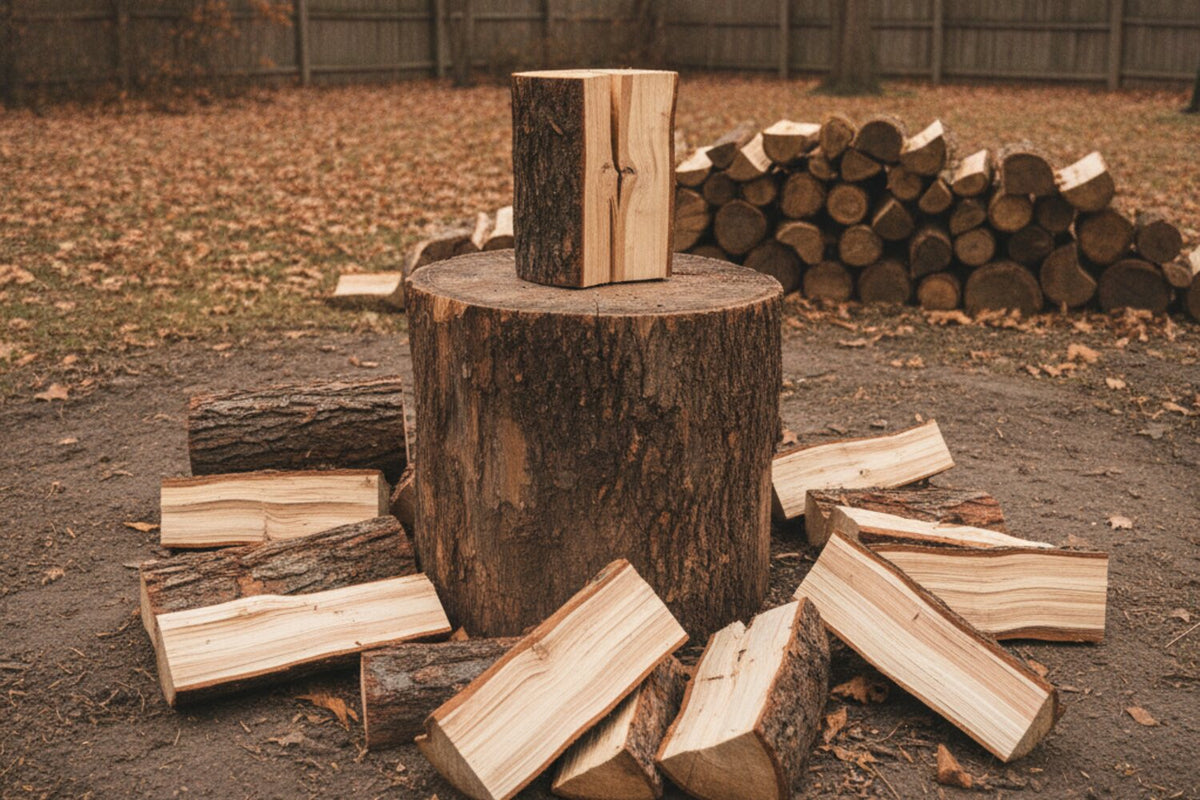
BCFSC calls a chopping block a fundamental safety tool: splitting on an elevated block placed on a level surface keeps the axe farther from your feet and makes it less likely the axe hits the ground. Its checklist for a good block: broad and solid, heavy, with both ends cut flat, sitting on level ground. COFORD adds that the block takes the force of the maul, keeps the edge out of soil and stones, and raises the wood to a better working height. A thick sheet of plywood does the first two jobs, and an old car tire set on top of the block holds the pieces together as they split, at almost no cost. A round with flat ends can also stand on level ground or on another round, One Moving Part says.
Step 3: Gear up and clear your swing
An Ax to Grind says to always wear leather boots with tops at least 8 inches high, plus safety glasses or goggles, and calls gloves sensible for splitting firewood, since you handle so many splintered pieces. COFORD asks for shoes or boots with a hard toecap, against an axe glancing off the log and pieces of wood falling on your feet, and for heavy-duty work gloves; BCFSC's list adds a hard hat. One Moving Part differs: it calls gloves optional, and warns that in rain or other wet conditions they can turn slick enough that you could lose control of the axe. Then clear the space. The manual says to clear everything in the arc of your swing, backswing included, since even a twig can knock a blow off line; to keep other people out of the work area; and advises against chopping alone. BCFSC says children should be kept well away from the work.
Step 4: Read the round before you swing
Look at the end grain. Both Forest Service manuals say to use the cracks, or checks, already in the wood, and An Ax to Grind notes that the first split is usually the hardest, so let a crack direct it. Avoid knots where you can, and if the knots sit closer to one end, put that end down so the split starts in clear wood, says Brett McLeod, a forestry professor writing in Northern Woodlands. If one end of the round is uneven, BCFSC says to turn it upside down. If neither end is flat, One Moving Part says to set the round in a fork of a downed log and split it from the side, striking near the top of the round, so the wood splits away from you, not toward you; a badly placed strike from the side risks a glancing or scooping blow, it warns. One Moving Part's check: "If you can stabilize the round with your foot, you are chopping in the wrong direction."
Step 5: Stand back, swing straight down, and hit the edge
Strike near the edge, not the center. McLeod says a split is easier to begin at the edge, and that many people stand too near the wood, so the blow lands in the center or, worse, the handle hits the log. One Moving Part adds that an ax binds more readily when it strikes the middle of a round, and that striking the edge both lowers that risk and splits the round more easily. For the swing itself, BCFSC says to stand with your legs well apart and your knees slightly bent, lift the axe over your shoulder or behind your head, keep your arms extended, let the hand near the head slide down the handle as you swing, and never bring it around the side of your body. An Ax to Grind says to bring it straight down onto the top of the block, with your body weight behind it, and to give the handle a slight twist as the bit hits, which throws the pieces apart and keeps the bit from sticking. One Moving Part warns that the twist puts sideways strain on the handle that can snap it, and a handle that is already damaged is most at risk. Start gently: accuracy is more important than power, the manual says.
Step 6: Take big or knotty rounds apart from the outside in
On a knotty, gnarly block, An Ax to Grind says to begin at the outer edges and take slabs off the sides, and McLeod calls the same idea the corner-slabbing method for large or stubborn logs. COFORD notes that the first split in a larger hardwood log is often the hard one, and that once the log is in two, further splits come far more easily. So halve a big round as soon as it will go, then split the halves. If a round opens but the pieces are still joined by a few fibers, COFORD says a well-sharpened small chopping axe cuts through them easily.
Step 7: Drive a wedge when a round will not open
A maul has a heavier, more wedge-like head than an axe, and for big rounds, twisted grain or lots of knots, One Moving Part calls a splitting maul and steel wedge the easiest and safest option. Check that the maul's poll, the flat back of its head, is hardened or tempered steel, and wear safety glasses every time. Place the wedge a quarter to a third of the way in from the edge of the round's top face, nearer the edge than the middle, in a natural crack if there is one and away from knots. Tap it lightly so it bites, as COFORD suggests, then drive it about three quarters of its length. If the round splits partway, drive a second wedge into the opposite side; if it does not split, knock the wedge free with the maul and start again. Never pound a steel wedge with the back of an ordinary axe: An Ax to Grind says a single-bit ax's poll is not tempered for pounding and will deform or shed chips of steel, and Gransfors Bruk says its splitting maul is the only one of its splitting tools meant for striking a wedge.
Step 8: Free a stuck axe the gentle way
An axe will stick sooner or later. Do not yank it: One Moving Part says too much continuous force can break the handle, and to bump or push the handle down, then up, and repeat until the head starts to move. An Ax to Grind's way is to strike the end of the handle down hard with your open palm, letting go of the handle as you do. If it still will not come free, split the round with a maul and wedge, or another axe, to release it.
Step 9: Split to stove size, and save the small stuff for kindling
EPA says to split to several sizes that suit your stove, with no piece bigger than a 6 inch wedge, and to split small pieces for kindling. COFORD's guide size is 7 to 9 cm across, about 3 to 3.5 inches. Kindling comes easiest from straight, knot-free pieces, especially of ash, pine or spruce, COFORD says, and it calls kindling splitters much safer than holding a piece in a gloved hand and chopping it with a hatchet.
Step 10: Stack it to dry
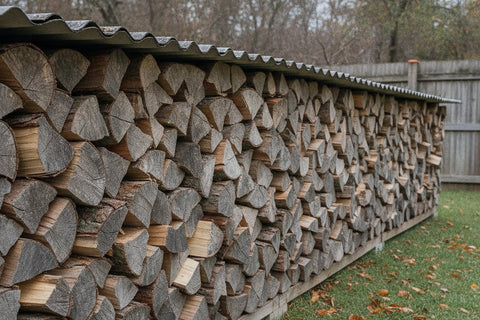
EPA's Wet Wood Is a Waste brochure says to stack it in one row, split faces down, on rails to keep it off the ground, away from buildings, so air can circulate. Its Burn Wise pages say the only wood to burn is dry, split and well seasoned, and UNH Extension calls splitting critical to speeding the drying if you buy unsplit wood. Our firewood rack guide covers racks that hold a stack off the ground, and how to tell if firewood is seasoned covers checking it before you burn it.
What a round weighs green, and why you split big ones where they fall (computed)
A round's weight is the reason to split wide rounds where they lie. The table works it out from Penn State Extension's average green weight per cubic foot for each species, multiplied by the volume of a round 16 inches long, a length inside An Ax to Grind's 12 to 24 inches. Penn State's figures come from each species' density and typical green moisture, so bark and the water in your own wood will move every number; treat each one as a rough guide.
| Species | Green weight, lb per cubic foot | 12 in across | 16 in across | 20 in across | 24 in across |
|---|---|---|---|---|---|
| White oak | 64 | 67 lb | 119 lb | 186 lb | 268 lb |
| Mockernut hickory | 64 | 67 lb | 119 lb | 186 lb | 268 lb |
| Northern red oak | 61 | 64 lb | 114 lb | 177 lb | 256 lb |
| Sugar maple | 59 | 62 lb | 110 lb | 172 lb | 247 lb |
| American beech | 57 | 60 lb | 106 lb | 166 lb | 239 lb |
| American elm | 56 | 59 lb | 104 lb | 163 lb | 235 lb |
| Eastern white pine | 55 | 58 lb | 102 lb | 160 lb | 230 lb |
| Paper birch | 54 | 57 lb | 101 lb | 157 lb | 226 lb |
| White ash | 50 | 52 lb | 93 lb | 145 lb | 209 lb |
| Douglas-fir, coast | 49 | 51 lb | 91 lb | 143 lb | 205 lb |
Read across: a white oak round 20 inches across and 16 inches long weighs about 186 lb green, and a 24 inch one about 268 lb, a heavy lift onto any block. BCFSC lists heavy lifting among the risks of chopping wood. A round that wide can be split standing on end on the ground, as An Ax to Grind allows, or on a sheet of plywood, as COFORD suggests, and quartered, the same 20 inch oak round is four pieces of about 47 lb each. Eastern white pine weighs nearly as much green as sugar maple here because, by Penn State's figures, its sapwood holds more than twice its dry weight in water. The math: a round's volume is 3.1416 times its radius squared times its 16 inch length, divided by 1,728 cubic inches per cubic foot, and that volume times the species weight gives the figure in the table.
Green, seasoned or frozen: when to split
Split green, as a rule. COFORD calls it good practice to split right after cross-cutting so the wood dries faster, and the Yukon University trial shows why. Its green wood started at 40% to 60% moisture; split and stacked, it averaged around 16% by early October, while the unsplit rounds and bigger logs had not dropped below 20%, and even smaller 4 inch rounds averaged around 20%. The researcher, Stephen Biggin-Pound, split most of the wood by hand and says green wood is not much harder to work with.
There are two exceptions, both from COFORD. Freshly cut hardwood can make a splitting axe bounce back. And freshly felled, fast-grown softwood can trap the axe, because the water-filled wood absorbs the blow; for that wood, COFORD says waiting a few weeks after cutting helps, since small cracks open on the cut ends, and striking those cracks, or tapping a wedge into one, makes splitting a lot easier.
Frozen wood is a risk to the tool. One Moving Part says cold steel turns brittle and can chip or break, so keep a cold axe off knots and frozen wood. Warm the head first, tucked under your arm inside your coat, or chop slowly for a few minutes so friction warms the metal.
Knots, forks and twisted grain
Grain decides most of the work. One Moving Part says straight-grained wood is easy to split and curly or twisting grain is difficult. COFORD names ash, beech and birch as hardwoods with straight grain that are easy to split, says the American white and red oaks are easy to split, and puts horse chestnut, with its gnarled wood, among the most difficult hardwoods. Spruce, pine, Douglas fir and other softwoods split fairly easily, it says, as long as the branch whorls are more than about 30 cm (about 12 inches) apart; split a softwood round from the end farthest from a whorl.
For knots, COFORD points out that branch knots do not reach the core of the stem, so splitting a log through the middle can avoid them, and that a log with a whorl of branches at each end will be hard to split. Split a fork straight through the middle, starting from the bottom side, never across the crotch: COFORD calls splitting through the fork's armpit almost impossible. McLeod calls the wedge indispensable for crotches and knotty whorls, and adds that the wood around the knots is the densest, most heat-rich part of the log, so it is worth splitting.
A chainsaw can start the hardest rounds. COFORD's method is to cut into the edge of the round at about 45 degrees to the cut end and drive a wedge into that cut; a steeper cut throws long slivers that can clog the saw's sprocket. Never cut into the center of the round to start a split: COFORD calls that a very dangerous practice, because the saw is very prone to kickback, flying upward toward your face and upper body. Wear chainsaw gear for that cut: COFORD lists safety pants, steel-capped boots, hearing protection and gloves, and BCFSC lists bucking pants and a face shield. Our chainsaw guide covers choosing a saw.
Splitting safely: what the safety sources say
BCFSC lists lacerations, amputated fingers, and shoulder, arm and wrist strains among the risks of chopping wood. Most of the rules come down to keeping your body, and everyone else, away from where the blade lands:
- Check the tool first. BCFSC says to inspect your equipment before you use it, One Moving Part says to make sure the ax is in good condition before chopping, and COFORD warns that a handle can dry out and shrink so the head works loose: check that the head, and the small wedges that hold it, are tight before you start.
- Eyes and feet first. Safety glasses or goggles every time (An Ax to Grind, One Moving Part), and leather boots with tops at least 8 inches high (both Forest Service manuals) with a hard or steel toecap (COFORD, BCFSC).
- Space. Clear the arc of your swing, keep people and children out of the work area, and do not split alone if you can help it (One Moving Part, BCFSC).
- Distance from the round. Stand far enough back that the bit, not the handle, lands on the round. COFORD calls hitting the log with the handle one of the main risks with a splitting axe, and Gransfors Bruk says the handle is under high strain close to the head because it can easily strike the log.
- Direction. Strike the edge of a standing round, and split a round lying in a fork so it opens away from you.
- The right striker for a wedge. Drive steel wedges with a maul made for it or a sledge, never with the back of an ordinary axe (both Forest Service manuals, Gransfors Bruk).
- Keep wedge heads dressed. COFORD says wedge heads flatten in use and form burrs that, if they extend too far, can fly off when struck, so grind the burrs off now and then, wearing gloves and goggles. One Moving Part goes further: a wedge that is broken or damaged, above all one whose back edge has mushroomed, should not be used at all, since bits of the mushroomed steel can break away and hurt you; it says the same of a mushroomed axe poll. Grind burrs early, and retire a wedge that is broken, damaged or mushroomed.
- The edge. Sources differ on how sharp a splitting edge should be: One Moving Part says the cutting edge should be sharp with thicker sides, COFORD says a splitting axe need not be sharp as long as the blade is thick and wide, and McLeod says a blunt, thick edge resists chipping. They agree on the shape, thick behind the edge, and An Ax to Grind warns that a dull ax glances off a surface more easily.
- Cold steel. Warm the head before you split frozen wood (One Moving Part).
- Stop when you are tired. BCFSC: know when to quit, because that is when injuries occur.
When a log splitter makes sense
A powered log splitter takes the swinging out of the job, not the risk. A 2017 study by Hammig and Jones in the "Journal of Agricultural Safety and Health", using US emergency department data, estimated 37,000 emergency department visits for injuries related to log splitters from 2011 to 2014, most of them to the hand, with lacerations, fractures and avulsions, and amputations the most common. BCFSC's rules for a powered splitter: read its manual first, hold the wood by its sides, never its ends, when you load it, never shove the wood in or steady it with any part of your body, split one log at a time with its squarest side against the blade, and keep children out of the area.
If you put up more wood than you want to swing through, or most of your rounds are big and knotty, our log splitter guide compares gas, electric, manual hydraulic and kinetic splitters and how many tons each job needs. COFORD also describes smaller tools, impact rods and foot-operated splitters, but says that for very gnarled wood, or wood with knots or forks, a splitting axe and wedges still do better. It warns about one more: a spiral splitter cone on a drill can jam in the wood and spin the log, or wrench the hand holding the drill.
What to use, by job
Four tools cover splitting by hand, one for each line of the start-here list above. Our splitting axe guide compares more axes and mauls.
1. Fiskars X27 Super Splitting Axe, 36 in: for straight-grained rounds
For straight-grained rounds
Best for: Straight-grained rounds that are not too big, struck near the edge
Fiskars X27 Super Splitting Axe, 36 in
- Tool: Splitting axe
- Size: 36 in long; the X25 is 28 in
- Build: Forged steel head insert-molded into a shock-absorbing handle
A 36 inch splitting axe with a forged steel head insert-molded into a shock-absorbing handle, for straight-grained rounds struck near the edge.
The X27 is a splitting axe with a forged steel head insert-molded into a shock-absorbing handle. Its listing says the 36 inch handle suits taller users and the axe suits medium to large logs, and that it comes with a protective sheath. Fiskars says its convex bevel splits well and pulls out of the wood more easily.
Why it is the pick: a splitting axe is the tool for straight-grained rounds, and COFORD says to split with a splitting axe or maul, not a felling axe. McLeod's Northern Woodlands piece names the X27 among the most popular of the modern hybrid splitting axes, with a narrow bit that cuts resistance and a raised cheek that helps pop the wood apart. The ideal splitting ax, in One Moving Part, has a long handle, which lets you build more speed in the swing.
Good to know: if you are not tall, Fiskars makes the same kind of axe 28 inches long as the X25, which its listing pitches at medium to large logs. Both listings say the handle helps prevent overstrike damage; still, stand back far enough that the bit lands on the round, not the handle.
Where it loses: its listing names no striking face, so drive wedges with the maul (pick 2) instead; One Moving Part warns that most axes lack a hardened poll. Big rounds, and knotty ones, are maul and wedge work, by the same manual.
2. Fiskars Pro IsoCore Splitting Maul, 6 lb, 36 in: for knotty rounds and driving a wedge
For knotty rounds and driving a wedge
Best for: Big, knotty or twisted rounds, and driving a steel wedge
Fiskars Pro IsoCore Splitting Maul, 6 lb, 36 in
- Tool: Splitting maul
- Size: 6 lb head, 36 in handle
- Build: Forged, heat-treated steel head riveted to an IsoCore handle
A 6 lb maul whose listing names a driving face for wedges, so one tool takes the knotty rounds and drives the wedge the Forest Service pairs with it.
A 6 lb splitting maul on a 36 inch IsoCore handle. Its listing describes a forged steel head, heat-treated, with a rust-resistant finish and a splitting face, an integrated driving face that lets the maul strike wedges and stakes, a riveted head that will not loosen, and a steel-reinforced sleeve against overstrike damage. Fiskars says the handle "transfers 2X less shock and vibration than wood-handled mauls."
Why it is the pick: One Moving Part calls a splitting maul with a steel wedge the easiest and safest option for large rounds, twisted grain and many knots, as long as the maul's poll is tempered or hardened steel. This maul's listing names its driving face for wedge work, so one tool takes the swing at a knotty round and drives the wedge when the round stops it. McLeod puts mauls at 6 to 16 lb, and 6 lb is the light end of that range; the Forest Service puts accuracy ahead of power.
Good to know: Gransfors Bruk says larger, thicker or knottier wood often needs a heavier tool.
Where it loses: weight. McLeod writes that splitting mauls "would be great if you didn't have to lift them" and keeps his for gnarly, knotted pieces; on straight rounds, the splitting axe (pick 1) does the job.
3. Estwing Sure Split Wedge, 5 lb: for the round that will not open
For the round that will not open
Best for: Rounds that stop the maul, or an axe stuck in a round
Estwing Sure Split Wedge, 5 lb
- Tool: Steel splitting wedge
- Size: 5 lb
- Build: Solid steel, a fin on each side, hand-sharpened edge
A 5 lb solid steel wedge with a fin on each side, driven with a maul or hand sledge into the rounds an axe alone will not open.
A 5 lb solid steel splitting wedge with a fin on each side, which Estwing says creates extra outward force as the wedge is driven in, and a hand-sharpened edge made to sit in an established groove and drive true. Estwing's listing pairs it with a hand sledge or maul, for logs an axe alone has trouble splitting.
Why it is the pick: the Forest Service method for big and knotty rounds is a maul and a steel wedge, and McLeod calls the wedge indispensable for crotches and knotty whorls. A wedge is also how One Moving Part frees an axe stuck in a round. This one brings 5 lb of solid steel, with side fins built to push the halves apart as it goes in.
Good to know: drive it with the maul (pick 2) or a hand sledge such as Estwing's 3 lb hand sledge, whose listing names driving wedges among its jobs. Set it a quarter to a third of the way across the round, tap it so it bites, then drive it about three quarters of its length (step 7). One Moving Part's method uses a second wedge on the opposite side of a round that only cracks, so it helps to keep two. As the striking head wears, grind off any burr, as COFORD advises.
4. Kindling Cracker Original: for kindling without swinging an axe
For kindling without swinging an axe
Best for: Kindling from small, straight pieces
Kindling Cracker Original
- Tool: Kindling splitter
- Size: 6.5 in ring; the King XL is 9 in
- Build: One piece of cast iron with a fixed blade
A one-piece cast iron splitter that turns small pieces into kindling inside a 6.5 inch safety ring, struck with a mallet or hammer instead of an axe.
A one-piece cast iron kindling splitter: a fixed blade inside a 6.5 inch safety ring. You stand a piece of wood in the ring, give it a tap so it sits on the blade unsupported, take your hand away and strike the wood with a mallet, a hammer, or a spare chunk of wood. Its listing says Ayla Hutchinson of New Zealand designed it at 13, after her mother hurt her hand splitting with an axe, and that it has built-in bolt holes for mounting on a stump or workbench as well as a stable base for freestanding use.
Why it is the pick: COFORD calls kindling splitters much safer than holding a piece in a gloved hand and chopping it with a hatchet, and by the maker's manual, your hands always stay above the safety ring. It does the last splitting job on the list above, small pieces for kindling (EPA), with no axe swing at all.
Good to know: the maker's manual says to set it on a chopping block, fixed with two screws and washers for the Original, on solid, level ground; to split one piece at a time and nothing overly wide or tall, which makes it unstable; not to hit the blade with the hammer; to wear gloves and protective glasses; and not to let children play with or around it. The blade needs no razor edge, the manual says, and a metal file brings it back in a few strokes. For wider pieces, the Kindling Cracker King XL has a 9 inch ring. Our kindling splitter guide compares other designs and the hammers to use with them.
How we chose these
We started from what the safety and forestry sources say about splitting by hand: the US Forest Service's An Ax to Grind (1999) and One Moving Part (2019), BCFSC's Crew Talk on chopping wood and COFORD's note on splitting firewood by hand, with McLeod's Northern Woodlands piece and Gransfors Bruk's axe guide for technique, and EPA, UNH Extension, Yukon University and Penn State Extension for drying and weights. Then we matched each job on the page to a tool sold on Amazon. What we say about each pick comes from its Amazon listing and, for the Kindling Cracker, the maker's user manual, named where it appears.
Our floor, for the picks, the other tools linked on this page and the notes under Also considered: in stock on Amazon and sold new by Amazon or the seller named on the listing, when we checked on November 11, 2026. Each met it.
Also considered: what missed the list and why
Fiskars Helix Splitting Wedge. An 8.5 inch, 4.8 lb forged wedge with a helical profile that its listing says drives in and forces the wood apart from inside, for large and knotty rounds, with a rounded head meant to reduce fragmentation when struck with a sledgehammer. A good second wedge; we picked the Estwing because its listing names both a hand sledge and a maul to drive it.
Felling axes and hatchets. Not for splitting rounds. COFORD says a delimbing axe's narrow, sharp blade slices the fibers and tends to get stuck, and An Ax to Grind says to have a designated splitting ax with a much steeper blade angle than a felling ax. A hatchet has a place at the kindling stage, though COFORD calls a kindling splitter the safer tool there.
Related guides
Our splitting axe guide compares more splitting axes and mauls, and our log splitter guide covers gas, electric and manual machines for when splitting by hand stops making sense. Our kindling splitter guide compares the Kindling Cracker with other designs. Once the wood is split, our firewood rack guide covers stacking it off the ground, our firewood moisture meter guide covers testing it, and how to tell if firewood is seasoned walks through the checks. If you cut your own rounds, see our chainsaw guide.
A word from the people who wrote this
We are Spear Head Spade, and we make digging spades, not axes, mauls or splitters, so nothing on this page is ours. When the ground thaws, our spade finder matches a spade to your soil.
Frequently asked questions
What is the easiest way to split firewood by hand?
Split it soon after cutting, with each round standing on a chopping block, and strike near the edge, through any crack in the end, with a splitting axe. Take big or knotty rounds apart from the outside in, and drive a steel wedge with a maul into any round that will not open. The US Forest Service calls the maul and wedge the easiest and safest option for large rounds and twisted or knotty grain.
Where should you hit a log when splitting it?
Near the edge, not the center. Northern Woodlands' McLeod says a split is easier to begin at the edge, and the Forest Service says striking the edge makes the axe less likely to bind and splits the round more easily. Aim for a crack already in the end grain if there is one.
Is it better to split wood when it is wet or dry?
Split it green, soon after cutting, so it dries faster: in Yukon University's trial, green wood split and stacked for one summer averaged around 16% moisture, while unsplit rounds stayed above 20%. COFORD notes two exceptions: fresh hardwood can make the axe bounce back, and fresh, fast-grown softwood can trap it, which waiting a few weeks for cracks to open helps.
What is the best thing to split wood on?
A chopping block: broad and solid, heavy, with both ends cut flat, sitting on level ground, by BCFSC's checklist. It keeps the axe away from your feet and out of the dirt. A thick sheet of plywood also works (COFORD), and a round with flat ends can stand on level ground.
Can you split wood with a regular axe?
You can split wood with an ordinary axe, the Forest Service says, but large rounds or knotty wood call for a maul and wedge, and COFORD says a thin delimbing axe tends to get stuck. Never pound a steel wedge with the back of an ordinary axe: its poll is not hardened for it.
How do you split wood without a log splitter?
By hand, with three tools: a splitting axe for straight-grained rounds, a splitting maul for big or knotty ones, and a steel wedge driven with the maul for any round that will not open. A kindling splitter handles the small pieces. Keeping the pieces on the block can cost almost nothing: COFORD says a used car tire on the chopping block, or on a thick sheet of plywood, holds the logs while you split, and that a used tire works just as well as the costlier gear sold for the job.
How do you use a splitting wedge?
Place it a quarter to a third of the way in from the edge of the round's top face, nearer the edge than the middle and in a crack if there is one, tap it so it bites, then drive it with a maul about three quarters of its length. If the round only cracks, drive a second wedge into the opposite side. That is the Forest Service's method, with COFORD's light tap to start; wear safety glasses for it.
What is the hardest firewood to split?
Wood with curly or twisted grain is hard to split, One Moving Part says, and so is a log with a whorl of branches at each end, COFORD says. Species matter too: of the species COFORD covers, horse chestnut is among the most difficult hardwoods to split because its wood is so gnarled, while ash, beech, birch and the American white and red oaks are easy to split.
How big should you split firewood?
To several sizes that suit your stove, with no piece bigger than a 6 inch wedge, by EPA's Wet Wood Is a Waste brochure; COFORD's guide is 7 to 9 cm across, about 3 to 3.5 inches. Split some small pieces for kindling, too.
Disclosure: Some links pay us a commission when you click or buy, and on some pages brands pay us through Amazon's creator program on links to their products. Availability was checked on Amazon on November 11, 2026 and can change.
Product prices and availability are accurate as of the date/time indicated and are subject to change. Any price and availability information displayed on Amazon.com at the time of purchase will apply to the purchase of this product.