As an Amazon Associate we earn from qualifying purchases. Some brands also pay us when you click or buy, so those links are ads. Full disclosure below
The best ice melt for concrete is a coated blend used sparingly, such as Snow Joe Premium Enviro Blend, whose green tint shows where it landed so you stop over applying. For deep cold, Qik Joe calcium chloride is listed to minus 25 degrees F. For dog paths, chloride free Safe Paw is the pick.
Ice melt does not scrape ice. It dissolves into the film of water already on the surface and makes brine, and brine freezes lower than water does, so a wet layer forms underneath and breaks the ice free of the pavement. This page is one stop on our fall yard cleanup tools checklist, which puts every fall job in order.
Two numbers decide almost every purchase. The first is the lowest pavement temperature at which the chemistry still makes brine fast enough to matter: rock salt slows badly below about 20 degrees F, while calcium chloride keeps working into the twenties below zero. The second is how much chloride you leave behind, because chloride burns turf, corrodes railings and rebar, and ends up in the storm drain. The bags that melt hardest carry the most chloride, and the chloride free bags melt in a narrower window, so this list splits by job.
One thing before the list: we make digging tools, not ice melt, so nothing here is ours. Every pick is judged on chemistry, application rate, and what the maker's own label claims.
Best ice melts at a glance
| Ice melt | Chemistry | Listed low temp | Best for | Where to buy |
|---|---|---|---|---|
| Snow Joe Premium Enviro Blend (best overall) | Coated blend with CMA | Minus 10 F | Everyday driveways and walks | Check price on Amazon50 lb |
| Qik Joe Calcium Chloride Ice Melt | Calcium chloride pellets | Minus 25 F | Deep cold, lowest application rate | Check price on Amazon18 lb |
| Peladow Calcium Chloride Pellets | Calcium chloride pellets | Minus 25 F | Long driveways, buying by the season | Check price on Amazon50 lb |
| Safe Paw Pet Safe Ice Melt | Chloride free | Minus 2 F | Dog paths, decks, bed edges | Check price on Amazon8 lb |
| Pestell Paw Thaw Pet Friendly Ice Melter | CMA and fertilizer blend | Not listed | Decks and small walks | Check price on Amazon12 lb |
| Redmond Ice Slicer | Mineral salt, trace minerals | Not listed | Traction on packed snow | Check price on Amazon160 oz |
What is the best ice melt for concrete?
Snow Joe Premium Enviro Blend, for a reason that has little to do with the bag. Deicers do not dissolve cured concrete. What breaks a driveway is freeze and thaw: the melt you create soaks into the pores, refreezes that night, and pushes the surface apart from the inside. More meltwater through more cycles means more damage, so the safest ice melt is the one you apply in the smallest amount and sweep up.
A coated blend buys exactly that, because seeing your own coverage is the difference between one pass and three. Two exceptions are worth memorizing. Concrete in its first winter has not finished curing and should get sand for traction rather than any deicer. And ammonium sulfate or ammonium nitrate, sometimes borrowed from the fertilizer shelf, chemically attacks cement paste. Never put either on a slab you care about.
Calcium chloride vs rock salt, and the rest of the shelf
Six chemistries make up almost everything sold in the United States, usually blended under a name that tells you nothing.
| Chemistry | Practical low temp | Chloride | What you should know |
|---|---|---|---|
| Sodium chloride, rock salt | 15 to 20 F | High | Cheapest per pound, hardest on turf, soil, and metal |
| Calcium chloride | Minus 25 F | High | Gives off heat as it dissolves, needs the least material |
| Magnesium chloride | 0 to 5 F | Moderate | Easier on plants than rock salt, can leave surfaces damp |
| Potassium chloride | About 12 F | Moderate | Rarely sold alone, hard on plants despite the potassium |
| Calcium magnesium acetate, CMA | About 20 F | None | Low corrosion, works slowly, almost always a blend component |
| Urea | 15 to 20 F | None | Weak melter that adds nitrogen to runoff, better used as fertilizer |
The practical reading is short. Rock salt is for mild forecasts and tight budgets. Calcium chloride is for genuinely cold pavement, and because it works at a lower rate, the gap per storm is smaller than the gap per bag. Chloride free products trade melting power for a lighter footprint, and are right only where that footprint matters.
Will ice melt kill grass and plants?
It can, and the mechanism decides where you spread rather than whether you spread. Chloride is taken up by roots and builds in leaf tissue until the margins brown, which is why grass along a salted walk goes first. Sodium does separate damage underground, displacing calcium on soil particles so clay swells shut, water stops soaking in, and roots sit in compacted ground come spring.
Three habits cut most of it. Keep the spread on the pavement rather than throwing it wide, since the strip within about two feet of the edge takes the worst of the runoff. Sweep dry surfaces after a storm so leftover granules never reach the beds. Then flush those edges with water at spring thaw to push accumulated salt below the root zone. The University of Minnesota Extension page on the effects of deicing salts on landscapes is the clearest plain language source. Our guide to winterizing the garden covers the rest of the fall shutdown, and protecting plants from frost covers the evergreens most likely to show salt burn in March.
What pet safe actually means on an ice melt bag
Pet safe is a marketing term, not a regulated one, and no agency certifies it. What the honest products are telling you is that they contain no chloride salts, the ingredients that sting a cut paw pad, dry the skin between toes, and cause stomach upset when a dog licks them off. That is a real difference, and it is why the exact wording repays reading: Safe Paw's label says salt and chloride free, while some pet marketed jugs say only calcium chloride free, which is a narrower promise.
It is not the same as harmless. Chloride free formulas are usually urea or glycol based, and both can make a dog sick if it eats granules off the ground. Keep every product here bagged in the garage and rinse paws after walks. For the garage itself, our best garage heaters guide prices electric, propane and gas heat per 1,000 BTU so you can work out there in January.
How much ice melt to use, and when
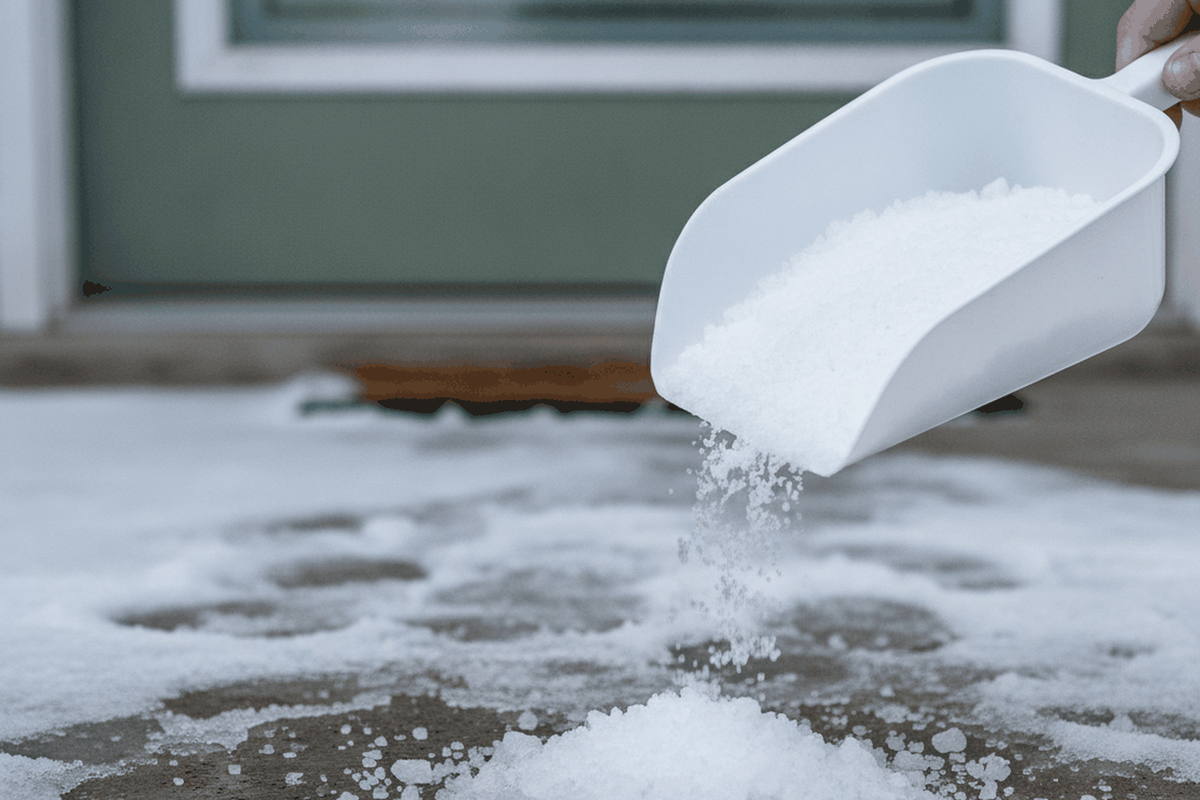
Almost everyone uses far too much. The University of Minnesota Extension guidance is a coffee mug of salt, about 12 ounces, for roughly 1,000 square feet, about a 20 foot driveway or 10 sidewalk squares, spread so grains land three inches apart. If the pavement looks white, you have thrown away product and bought yourself runoff.
Timing matters as much as quantity. A light application before the storm keeps the first layer from bonding to the pavement, and that bond is what makes shoveling miserable. Once snow is down, shovel first and treat only the glaze you cannot lift, because ice melt is for the last stubborn layer, not for six inches of snow. A good snow shovel or a cordless snow shovel removes the volume no deicer will, and a cheap handheld spreader pays for itself in a season by making a light, even rate possible.
The best ice melts, by job
These six cover the everyday driveway, the deep cold night, the season bulk buy, the household with dogs, a non corrosive blend for decks and small walks, and traction on packed snow.
1. Snow Joe Premium Enviro Blend: best ice melt overall
Snow Joe Premium Enviro Blend is a 50 pound bag of green coated crystals blended with calcium magnesium acetate, and Snow Joe lists the blend as melting down to minus 10 degrees F. The coating is why it wins: you can see where the spread landed, the easiest way to stop over applying. Snow Joe says the CMA reduces corrosion on concrete, metal, and nearby vegetation compared with rock salt, and that the crystals will not track onto floors. Where it loses: it still contains chloride salts, so it is not the bag for the path your dog uses daily, and a real cold snap wants calcium chloride, and 50 pounds is a real lift. We link the 50 pound bag because the 25 pound bag was out of stock on Amazon when we checked on October 13, 2026.
2. Qik Joe Calcium Chloride Ice Melt: best for deep cold
Qik Joe is an 18 pound bag of pellets the listing describes as 100 percent calcium chloride, working down to minus 25 degrees F. Calcium chloride is the only common deicer that gives off heat as it dissolves, so the pellets bore down through a glaze instead of sitting on it, and they pull moisture from the air to keep going. That buys a genuinely lower application rate, which is what buyers miss when they compare bag prices. The bag costs more per pound than rock salt, and the lower application rate is what has to earn that back over a season. Where it loses: high chloride, so keep it off turf edges and paws, and tracked in pellets leave a slick film on tile.
3. Peladow Calcium Chloride Pellets: best bulk buy for long driveways
Peladow is the 50 pound contractor bag of the same chemistry, listed as effective down to minus 25 degrees F with the fast acting, moisture attracting behavior calcium chloride is known for. Buy it if you treat a long driveway, a shared walk, or a rental: 50 pounds ends midwinter hardware store runs. The pellets spread evenly through a spreader without the dust a flake product makes. Where it loses: 50 pounds is a real lift, and it must be stored sealed and off a concrete floor, because calcium chloride pulls water from the air and sets into a solid block in a humid garage.
4. Safe Paw Pet Safe Ice Melt: best chloride free choice
Safe Paw is the chloride free jug most dog owners end up with. The maker describes it as salt free and chloride free, non corrosive, and formulated for cured concrete, pavers, brick, metal, and wood decks. Safe Paw states it works to minus 2 degrees F, prevents ice forming for up to 72 hours when used as directed, and needs about half the amount of rock salt. Worth knowing: minus 2 degrees F is a mild cold rating, so keep something stronger for the nights that go below it. Where it loses: it has the highest price per pound here, though the same formula in a 35 pound pail costs less per pound.
5. Pestell Paw Thaw Pet Friendly Ice Melter: a non corrosive blend, not the pick for pets
Pestell Paw Thaw is a 12 pound shaker jug, and the Family Handyman roundup that covers it lists the formula as fertilizer, calcium magnesium acetate and pH stabilizers. The listing calls it non corrosive, biodegradable, water soluble and odorless, and says it will not harm carpets or floors or damage footwear. It is sold as pet friendly, but it is not our pick for a home with dogs or cats: that same roundup quotes Petco chief veterinarian Dr. Whitney Miller listing calcium magnesium acetate among the calcium salts that "can be especially toxic to pets", and its FAQ puts melts made with calcium magnesium acetate on its not safe list. With pets in the house, buy Safe Paw instead. Where it loses: the Amazon listing states no working temperature, that roundup rates it effective only to 0 degrees F, and our chemistry table puts CMA on its own nearer 20 F, so keep something stronger for colder nights. The maker also says not to use it on precast or concrete less than a year old, and twelve pounds is a walkway jug, not a driveway supply.
Also considered: Natural Rapport Pet Friendly Ice Melt, currently unavailable on Amazon; its label promised only calcium chloride free, a narrower claim than chloride free.
6. Redmond Ice Slicer: best for traction on packed snow
Redmond Ice Slicer is a mined mineral salt, 160 ounces, with trace minerals that give it a reddish color. Redmond says it is dye free, urea free, and polymer free, that it is more concentrated than white salt so you use less, and that one bag treats up to 400 square feet. The color is the practical feature: on packed snow you can see where you have been, and the coarse granules bite into a glazed surface for traction while they work. Where it loses: it is still a chloride salt, so the plant and metal cautions apply in full, and Redmond warns that over applying leaves a reddish residue on concrete.
How to choose an ice melt
- Start with your coldest pavement, not your coldest air. Slabs run colder than the thermometer on a clear night. Where single digits are normal, meaning the Upper Midwest, the northern Plains, and interior New England, make calcium chloride the default. Across the Mid Atlantic, the Ohio Valley, and the Pacific Northwest, a blend handles almost every storm and one bag of calcium chloride covers the annual cold snap.
- Match the product to the surface. Concrete in its first winter gets sand only. Cured concrete and asphalt take anything here at a light rate. Wood decks and pavers are where chloride free earns its price.
- Count pounds per storm, not dollars per bag. A product that works at half the rate is half the price it looks.
- Buy the spreader. It is the cheapest way to cut usage, and usage sets both your cost and your damage.
Frequently asked questions
What is the best ice melt for concrete?
A coated blend used at a light rate, such as Snow Joe Premium Enviro Blend. Deicers do not dissolve cured concrete. The damage comes from meltwater soaking into the slab and refreezing, so the safest product is the one you can apply sparingly and sweep up. Never use ammonium sulfate or ammonium nitrate, and give concrete in its first winter sand instead.
Will ice melt kill my grass?
Chloride based products can brown the turf within about two feet of a salted walk, and the sodium in rock salt also compacts the soil by displacing calcium. Keep the spread on the pavement, sweep up loose granules on dry days, and flush those edges with water at spring thaw. Chloride free products along planted edges avoid most of the problem.
Is pet safe ice melt actually safe for dogs?
Pet safe is a marketing term with no agency behind it. The honest products are chloride free, which removes the ingredient that stings cut paw pads and dries out skin, and that is a genuine difference. Read the label rather than the badge, because calcium chloride free is a narrower promise than chloride free. It still does not mean the granules are harmless if eaten. Store the bag out of reach and rinse paws after walks whatever you use.
Is calcium chloride better than rock salt?
For melting, yes. Calcium chloride keeps working down to about minus 25 degrees F where rock salt does very little below 15, and it gives off heat as it dissolves, so it needs less material per square foot. Rock salt is cheaper per pound. Once you account for the lower rate, calcium chloride often costs less per storm.
Should you put ice melt down before it snows?
Yes, a light application before the storm is the most useful thing you can do. It keeps the first layer of snow from bonding to the pavement, which is what makes shoveling hard and leaves a glaze behind. After the storm, shovel first and treat only the ice you could not lift.
The bottom line
Buy one blend and one specialist. Snow Joe Premium Enviro Blend handles most storms and lets you see your own spread, and a bag of Qik Joe calcium chloride covers the nights it cannot. Add Safe Paw for the dog path and the walk beside your beds, use a coffee mug per thousand square feet, and sweep up what is left. The rest of the winter kit, from shovels to roof rakes, is in our snow removal tools guide. More garden guides are here when the ground thaws.
A word on who wrote this: we are Spear Head Spade, a family business in New Jersey. We sell double-patented spades and one long-handled hoe, with over 600,000 sold. Neither melts ice, but the ground does thaw, and our spade finder matches a spade to the soil you will be opening in spring.
Disclosure: Our commissions do not change what we recommend or what you pay.
Product prices and availability are accurate as of the date/time indicated and are subject to change. Any price and availability information displayed on Amazon.com at the time of purchase will apply to the purchase of this product.