As an Amazon Associate we earn from qualifying purchases. Some brands also pay us when you click or buy, so those links are ads. Full disclosure below
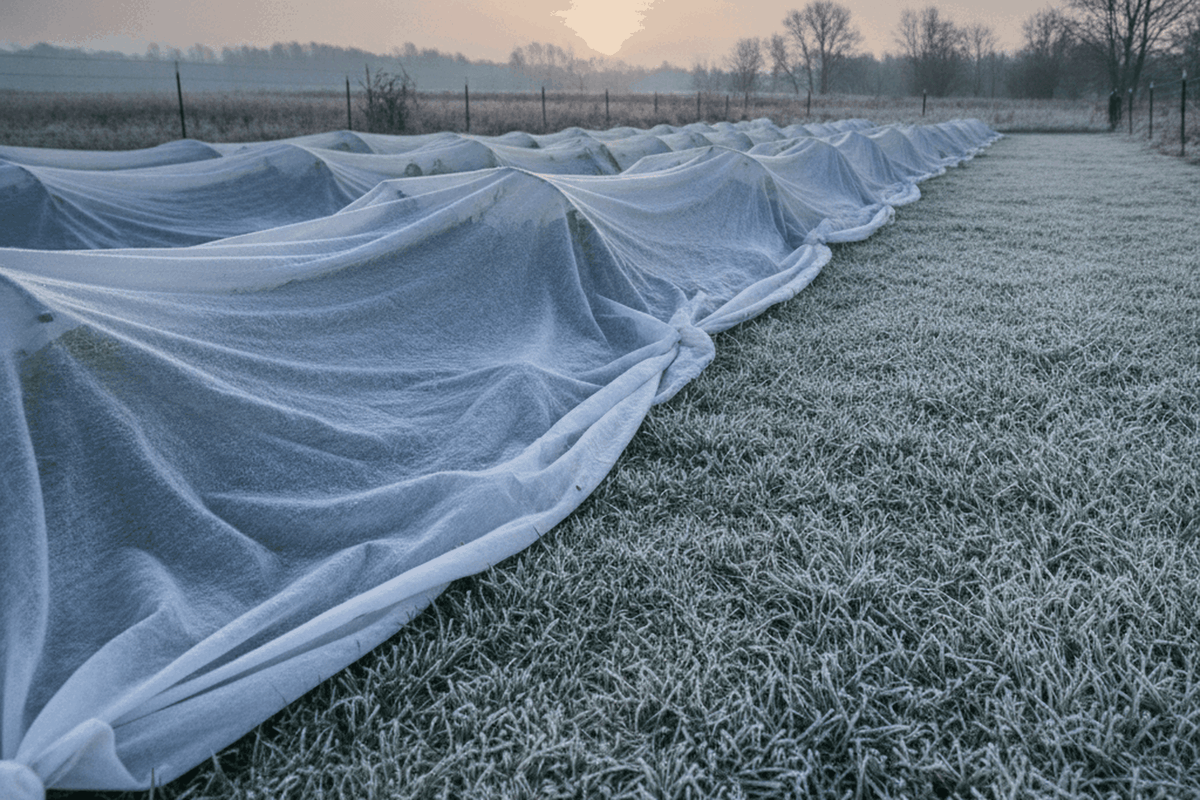
To protect plants from frost, water the soil in the afternoon, then cover tender plants before dusk with fabric that reaches the ground, held off the leaves by hoops or stakes. Uncover once the morning air is above freezing. The cover traps heat the soil radiates overnight, keeping leaves a few degrees warmer.
That routine handles the light frosts that end most gardens weeks before they need to end. Below: frost versus freeze in real numbers, which plants need covering, how to read a forecast, the steps in detail, and the covers worth owning. This page is one stop on our fall yard cleanup tools checklist, which puts every fall job in order.
Frost, freeze and hard freeze in plain numbers
The forecast low is measured about five feet off the ground at the nearest weather station. Your plants are lower, in a yard that may sit colder, and on a clear, calm night the ground surface can run four or five degrees below the reported air temperature. That is why frost shows up when the forecast said 36.
| Event | Air temperature | What it does |
|---|---|---|
| Frost | 33 to 36 F | Ice forms on leaf surfaces on clear, calm nights. Kills tender annuals and blackens tomato, basil, squash and dahlia foliage. |
| Light freeze | 29 to 32 F | The air itself is below freezing. Tender plants die, half-hardy plants are damaged, cool-season crops and hardy perennials are fine. |
| Moderate freeze | 25 to 28 F | Widely destructive to anything not fully hardy. Lettuce and chard are damaged, and unprotected containers freeze through. |
| Severe freeze | 24 F and below | Ends the season for everything except hardy crops and dormant plants. Fabric covers stop helping much below the high 20s. |
Duration matters as much as the number: an hour at 30 before dawn does far less damage than six hours at 30. The National Weather Service issues a frost advisory for 33 to 36 degrees, a freeze warning at 32 and below, and a hard freeze warning in most regions at 28 and below. Those three alerts are the signals to act on.
Which plants need covering and which do not
Cover these:
- Warm-season vegetables and herbs: tomatoes, peppers, eggplant, squash, cucumbers, beans and basil.
- Tender annuals: impatiens, coleus, begonias, zinnias and marigolds, for a few more weeks of color.
- Tender perennials still in bloom: dahlias, cannas, salvias, geraniums and fuchsias. Dahlias only need covering until you lift them; our guide on how to store dahlia tubers covers the lift.
- Anything in a container, where the roots have no soil mass to buffer the cold.
- New transplants and seedlings, including hardy ones, for their first few weeks.
Do not bother covering these:
- Established trees, shrubs and hardy perennials. They are built for it, and frost triggers the dormancy they need.
- Cool-season crops: kale, collards, Brussels sprouts, cabbage, leeks, carrots, parsnips and spinach take a frost, and most taste better after one. Cover them only for a hard freeze if you want to keep harvesting.
- Hardy bulbs and fall plantings such as tulips and garlic, which want the cold. Mulch is the right protection there, not fabric; our guides to planting garlic and transplanting in fall cover the depth, and shredded leaves make that mulch for nothing.
- Lawns. Just stay off frosted grass until it thaws, since footprints on frozen blades leave brown tracks.
Citrus, tender succulents and tropicals come indoors for good once nights drop into the 40s. Pansies, snapdragons and ornamental kale sit in between: fine through a light freeze, worth a cover only for a hard one.
How to read a frost forecast
Three numbers on the evening forecast tell you more than the low itself.
Dew point. On a clear night the air cools until it reaches the dew point, then slows, because condensation releases heat. An evening dew point in the low 30s means the temperature will bottom out near there and frost is likely. A dew point of 25 with a forecast low of 36 means the air is dry enough to keep falling, so treat the night as a freeze. A dew point in the 40s means frost is unlikely.
Wind. Frost is mostly a calm-night event. Still air lets the ground radiate its heat into the sky while the coldest air pools at leaf level, and wind above about ten miles an hour keeps the air mixed enough to prevent frost even at 34 or 35. The exception is a windy freeze, when a cold air mass arrives already below 32; covers help less then, and windbreaks matter more.
Sky. Clouds act as a blanket and bounce radiated heat back down. A clear sky with a low in the mid 30s is a frost night; the same low under overcast usually is not. Check the sky cover for the hours after midnight, not just the evening.
Then apply your own yard. Cold air flows downhill and pools in low spots, behind fences and hedges, and in open beds, while beds against a south or west wall or beside pavement stay several degrees warmer. A thermometer with its sensor at plant height in the coldest corner will teach you your garden's real offset from the forecast in one season.
How to cover plants for frost, step by step
1. Water the soil in the afternoon
Moist soil absorbs more heat during the day and releases it more slowly at night than dry soil, and it conducts that heat up toward the plants. Water the beds you plan to cover in the early afternoon so the surface is damp but not soggy by dusk, and keep the water off the foliage. For that afternoon watering, our garden hose guide covers which hose fits your yard and how far it has to reach.
2. Cover before dusk, all the way to the ground
The heat you are trapping is in the soil, and it starts radiating away as soon as the sun drops, so get the covers on about an hour before sunset, not at ten at night when the news mentions frost. Drape the fabric to the ground on every side and weight the edges with bricks, boards or a shovelful of soil. A cover that stops halfway down the plant, or hangs open on one side, lets the warm air out the bottom and protects almost nothing. You will be on your knees for most of this, pinning edges in cold wet grass, and a garden kneeler makes a long row of covers a lot less punishing.
3. Keep the fabric off the foliage
Wherever a cover touches a leaf, cold conducts straight through the fabric and frost forms on that leaf anyway. Hold the fabric up with hoops, stakes, tomato cages, lawn chairs or anything else that keeps an air gap between cloth and plant. Hoops over a bed make a tunnel you can throw a cover over in one motion; a single stake taller than the plant does the same job for one shrub.
4. Uncover in the morning
Once the air is back above freezing, usually by mid-morning, take the covers off. Plants need light, and heavy or dark covers heat up fast in sun and can cook what they protected overnight. The exception is lightweight floating row cover, which passes most of the light and all of the rain and can stay on through a run of cold nights or for weeks over fall greens. A cover is not animal protection, and deer work the same beds hardest once frost has taken everything else in the neighborhood, so our deer repellent picks cover what keeps them off the greens you are nursing through October. When a cloche is not enough, a small kit greenhouse is the next step up, and our best greenhouses guide compares them by snow rating and cost per square foot. To keep a greenhouse frost-free through a cold snap, our guide to the best greenhouse heater covers how much greenhouse one heater can hold. A step up from a cloche is a cold frame or shelf greenhouse, and our best mini greenhouses and cold frames guide compares them by what a seed tray actually costs to house.
If the season is clearly over, use the moment to start the bigger job. Our 10-step guide to winterizing your garden covers everything from lifting dahlias to draining the rain barrel.
Container plants
Pots freeze faster than the ground and from every side. On a frost night, move pots against a south-facing wall, under an eave, or into an unheated garage, and cluster them so they shelter each other. What cannot move gets wrapped: burlap or bubble wrap around the pot for the roots, a cover over the top for the leaves.
What not to use
Plastic touching the leaves. Sheeting, trash bags and drop cloths conduct cold straight through to any leaf they touch, sweat condensation onto the foliage, and turn into an oven when the sun hits them. If plastic is all you have, hold it off the plants on a frame, seal it to the ground, and pull it off at sunrise.
Anything that stops short of the ground. A cover wrapped around the top of a shrub like a scarf protects the top of the shrub. The heat comes from the soil, so the cover has to reach it.
Wet fabric on a windy night. A soaked sheet conducts cold and crushes what it lies on. Keep fabric dry, hold it up, and on a windy freeze add a windbreak.
Sprinklers. Commercial growers run water over crops through a freeze because water releases heat as it turns to ice, but the sprinklers have to run until the ice melts the next morning, and stopping early does more damage than no water at all.
Tools for this job
What actually goes over the plants on a frost night, plus the kneeler for pinning a long row of covers.
Agribon AG-30 frost protection row cover
The heavier row cover growers use; heavy enough for a real freeze and light enough to stay over a bed of lettuce for a month.
Check price on AmazonDECOHS pop-up shrub cover, 30 x 28 x 28 inches, 2 pack
Springs open over a rose, shrub or container plant on its own frame, so the fabric never touches the leaves, and cinches shut at the base.
Check price on AmazonFuBegi 8 foot garden hoops, 60 pieces
Fiberglass rods arch into a two foot tunnel over a bed in seconds and hold the row cover clear of the foliage.
Check price on AmazonMorTime garden cloches, 6 pack
Clear vented bell domes for single seedlings and small plants, staked down so a breeze does not send them across the yard.
Check price on AmazonTempPro wireless indoor outdoor thermometer
A wireless sensor set at plant height in the coldest bed tells you how far below the forecast your garden really runs.
Check price on Amazon
Spear Head Spade Garden Kneeler
Pinning cover edges to the ground means a long stretch on your knees in cold wet grass; a cushioned kneeler makes a row of covers a lot less punishing.
Common questions
At what temperature should you cover plants?
Cover tender plants whenever the forecast low is 36 degrees or below on a clear, calm night, because leaf level runs several degrees colder than the reported air temperature. Cover half-hardy plants at 32 and below. Hardy vegetables and perennials need a cover only for a hard freeze, 28 degrees or below.
Can you use a bedsheet to protect plants from frost?
Yes, for a light frost. A cotton sheet held off the leaves and weighted to the ground buys two to four degrees on a calm night, which is usually enough at 33 to 36. It is not enough for a freeze, it gets heavy when wet, and it has to come off in the morning.
How long can plants stay covered?
Sheets, blankets, tarps and plastic come off every morning once the air is above freezing, so the plants get light and do not overheat. Lightweight floating row cover is the exception: it passes most of the light and all of the rain, so it can stay on through a cold spell or for weeks over fall greens.
Does mulch protect plants from frost?
Mulch protects roots and crowns, not leaves. Two to four inches of shredded leaves or straw keeps soil temperature steady and stops frost heave, which is what hardy perennials, garlic and strawberries need. It does nothing for the foliage of a tomato or a dahlia. Those still need a fabric cover on frost nights.
The bottom line
Frost protection is mostly timing. Watch the dew point, the wind and the sky, not just the low. Water in the afternoon, cover before dusk to the ground, keep the fabric off the leaves, and uncover by mid-morning. One roll of row cover and a handful of hoops handle nearly every frost night a home garden sees and pay for themselves in the first extra week of tomatoes. When the cold finally wins, our winterizing checklist takes it from there. And once the frost turns to snow, our battery snow shovel guide covers clearing the steps and the deck.
Disclosure: some links in this guide are affiliate links to Amazon. This is at no extra cost to you, and it never changes our honest, use-based recommendations.