As an Amazon Associate we earn from qualifying purchases. Some links are paid. Disclosure
Our top picks
Best overall
1. Crescent Nicholson 10-Inch Flat Bastard File
Best for: Most home mowers, by hand
Best for nicked and dented blades
2. DEWALT DW758 8-Inch Bench Grinder
Best for: Nicks, dents and a rolled edge
Best dedicated blade grinder
3. Oregon 88-025 Blade Grinder
Best for: A grinder for mower blades only
The best lawn mower blade sharpener for most home mowers is the Crescent Nicholson 10-Inch Flat Bastard File, a 10-inch flat double-cut file. Bob Vila's testers named the 12-inch length of the same Crescent Nicholson file their best overall after trying eight sharpeners on 16 dull blades, and a file follows whatever bevel your blade already has. Picks 2 to 4 cover nicked and dented blades, a grinder made only for mower blades and the balance check every sharpened blade needs. Good to know: Crescent Nicholson sells this file without a handle, and its filing guide says a file should never be used without a tight fitting handle.
1. Crescent Nicholson 10-Inch Flat Bastard File
The same cut as Bob Vila's best overall file, in a 10-inch length.
| Pick | Type | Motor | Wheel | Best for | Our verdict | Where to buy |
|---|---|---|---|---|---|---|
| 1. Crescent Nicholson 10-Inch Flat Bastard FileBest overall | Double-cut flat file | None, by hand | None, a 10 in file | Most home mowers, by hand | A 10-inch flat double-cut file that follows any bevel, by Crescent Nicholson. | Check price on Amazon |
| 2. DEWALT DW758 8-Inch Bench GrinderBest for nicked and dented blades | Bench grinder | 3/4 HP, 3,600 rpm | Two 8 in, 36 and 60 grit | Nicks, dents and a rolled edge | An 8-inch bench grinder at 3,600 rpm with 36 and 60 grit wheels, by DeWalt. | Check price on Amazon |
| 3. Oregon 88-025 Blade GrinderBest dedicated blade grinder | Mower blade grinder | 1/3 HP, 1,750 rpm | One 8 in stone | A grinder for mower blades only | A 1/3 HP mower blade grinder at 1,750 rpm on an 8-inch stone, by Oregon. | Check price on Amazon |
| 4. Oregon 42-047 Precision Blade BalancerBest for checking the balance | Cone balancer | None | None | Every blade, after sharpening | A metal cone balancer on a magnetic wall mount, by Oregon. | Check price on Amazon |
When we checked on November 25, 2026, every pick we link was in stock as new and sold by Amazon. How our guides are made sets out what we check.
What is the best lawn mower blade sharpener?
A file for most home mowers, a grinder for damage, and a balancer after either. The Crescent Nicholson 10-inch file (pick 1) is double-cut on its sides for rough filing and single-cut on its edges for a smooth finish, and Crescent Nicholson's page lists it at 10 inches long with a 1-year warranty, for anyone who needs rapid removal of metal. With the 12-inch length of this file, Bob Vila's testers sharpened a blade dull from a full season in 10 strokes on each end, and one with a few deep gouges in about twice as many. It is sold by Amazon. Otherwise, for nicks and dents, the DEWALT DW758 bench grinder (pick 2); for a grinder made only for mower blades, the Oregon 88-025 (pick 3); to check the balance after any of them, the Oregon 42-047 (pick 4).
What angle to sharpen a lawn mower blade
The angle the blade already has: Bob Vila's testers followed the established blade angle with long file strokes. The figures makers and advisers give differ, so match the bevel on your blade rather than a number.
| Source | Angle it gives | For which blades |
|---|---|---|
| Oregon (sharpening guide) | 30 degrees | All Oregon blades |
| Cub Cadet (blade service article) | About 45 degrees | Cub Cadet mowers |
| Purdue turfgrass program | About 45 degrees | Home mower blades |
| Bob Vila (sharpener guide) | 35 to 45 degrees | Mower blades in general |
Do not chase a razor edge. Oregon's guide recommends an edge of 0.030 to 0.045 inch and says a razor-sharp edge tends to roll over, nick and chip, and dulls faster; Cub Cadet says a simple clean edge is enough. Take the same off both ends: Purdue passes the file the same number of times on each side with equal pressure to keep the blade in balance, and Cub Cadet adds that the tips do most of the cutting, so most of the wear, and the work, is out there.
Files: the slow, sure way
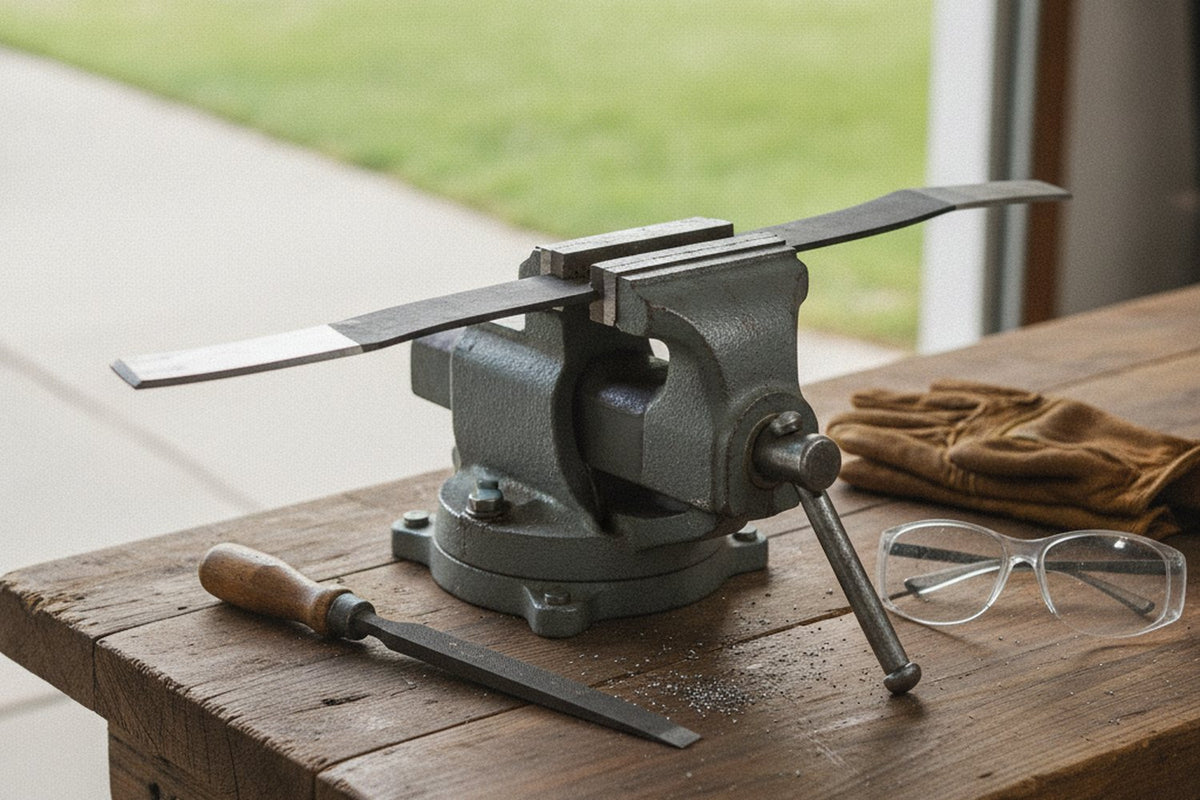
A file needs no power and follows any bevel: Bob Vila's testers could work with any blade angle. Clamp the blade in a vise, as Purdue and Bob Vila's testers did, hold the file at the angle already on the edge and push it along; Crescent Nicholson's filing guide says to lift the file clear of the work on the reverse stroke. The cut sets the speed: the same guide says a double-cut file is used with heavier pressure and removes material faster, a single-cut file is used with light pressure for a smooth finish or a keen edge, and the small ridges a double-cut file leaves are smoothed with a single-cut mill file. Bob Vila found the same: the Crescent Nicholson 14-inch single-cut file, its best file, took 18 strokes on a mildly worn blade and 39 on a nicked one, nearly twice the double-cut file's count, and left an extra smooth edge with few visible tool marks. For pruners, loppers and hoes, our guide to cleaning, sharpening and storing garden tools covers the file work on each, and our chainsaw sharpener guide covers saw chain.
Drill-bit sharpeners: fast, but set to one angle
A drill-bit sharpener is a grinding stone on a shaft that goes in a drill chuck, with a guide that sets the angle. The kit Bob Vila's testers tried, Ankda's double-layer corundum sharpener, has three sets of stones, each with a preset 40-degree guide, and a blade balance; they found it difficult to hold the drill at the precise angle all the way through the stroke, and Bob Vila notes the preset angles are only useful for lawn mowers. Bob Vila's link for it goes to Walmart, not Amazon, so it is not linked here. A stone set to one angle suits a blade whose own bevel is close to it, and the figures in the angle table run from 30 to about 45 degrees.
Grinders: for nicks and dents
Grinders are the fast way: Bob Vila says sharpeners that attach to grinders typically work quickly. In its test, WEN's 8-inch variable-speed bench grinder made it extremely easy to remove the nicks and dents from a badly worn blade and sharpened a moderately dull one in less than 5 minutes. A handheld angle grinder with DeWalt's flap disc took six passes on moderately worn edges and 13 on deeply pitted ones, though Bob Vila calls it imprecise without a jig, and the All American Sharpener 5005, a jig that guides an angle grinder across a clamped blade, gave the most consistent, repeatable results of the products in that guide. A belt sander left an evenly flat edge, where the bench grinder and angle grinders left a slightly concave one that is thinner and less durable.
How fast does each grinder's wheel move?
About twice as fast on the DW758 as on Oregon's blade grinder: 7,540 against 3,665 feet a minute at the rim, both on an 8-inch wheel. The table works it from each maker's figures: rim speed in feet per minute = 3.1416 x wheel diameter in inches / 12 x rpm, and motor watts = horsepower x 745.7. Speed matters because of heat: Bob Vila says grinders that spin too quickly can create excessive heat in the blade, causing it to become brittle, so keep the blade moving. The figures use the rpm each maker states; DeWalt's manual notes the wheel's diameter decreases with use, which lowers the rim speed at the same rpm, and says a replacement wheel must have a maximum operating speed at least as high as the no-load rpm marked on the grinder.
| Sharpener | Rim speed, feet per minute | Motor, watts | Inputs (source) |
|---|---|---|---|
| Crescent Nicholson 10-inch file (pick 1) | not powered | not powered | a 10 in file, used by hand (Crescent Nicholson) |
| DEWALT DW758 (pick 2) | 7,540 | 559 | 8 in wheels, 3,600 rpm, 3/4 HP (DeWalt) |
| Oregon 88-025 (pick 3) | 3,665 | 249 | 8 in stone, 1,750 rpm, 1/3 HP (Oregon) |
| Oregon 42-047 (pick 4) | not powered | not powered | a cone on a magnetic mount, no motor (listing) |
Before you take the blade off: power, gloves and eyes
Your mower's manual comes first. Cub Cadet writes its blade steps for trained technicians and sends anyone unsure to an authorized service center, and Illinois Extension notes that many lawn service businesses will sharpen blades.
- Disable the mower. Purdue says to remove the spark plug wire first, because the mower starting while you file could cause serious injury, and Cub Cadet says to disconnect and ground it. EGO's blade instructions say to remove the battery pack when servicing a battery mower, and Illinois Extension says the same for electric mowers.
- Protect your hands. EGO asks for heavy gloves, or the cutting edges wrapped; Cub Cadet asks for heavy leather gloves.
- Protect your eyes. Bob Vila asks for gloves and eye protection whenever you sharpen, because small metal shavings can become airborne and embed themselves, and OSHA's guide to hand and power tools says to always use eye or face protection with a powered grinder.
- Tip it the right way. Cub Cadet says to tilt a walk-behind mower onto the side opposite the carburetor and air filter and never to turn the whole mower upside down; Colorado State Extension also keeps the air-filter side up.
- Hold the blade still. Cub Cadet puts a block of wood inside the deck as a chock; Illinois Extension braces the blade with a board, a brick or a metal pipe.
- Put it back the right way up. Cub Cadet says its original blades are stamped "Bottom" on the side that faces the ground, with the air fin pointing up toward the deck, and Illinois Extension says to tighten the bolt with a torque wrench to the figure in your manual.
Balance the blade after sharpening
Check it every time. Cub Cadet says an unbalanced blade can cause vibrations that may weaken or loosen parts of the mower, and Illinois Extension says the wobble strains the mower and may leave an uneven cut. Colorado State Extension hangs the blade by its center hole on a nail in the wall; a cone balancer like pick 4 does the same job. Take the extra metal off the heavy end: Oregon says from the sharpened edge only, never the ends or the back of the blade, and Cub Cadet, Purdue and Colorado State all take it from the heavier side. Check again until the blade hangs level, and where your mower's manual says otherwise, follow it.
When to sharpen, and when to replace the blade
Look at the grass. Purdue says dull blades rip the grass rather than cutting it cleanly, leaving ragged tips that give the lawn a whitish cast from a distance and let disease in, and Colorado State Extension reads shredded or brown tips the same way. How often depends on how much you mow: Oregon says a mower used only at home probably needs it once a year, Purdue says at least twice a year and as much as four to six times in a year of frequent mowing, and Bob Vila suggests every 20 to 25 hours of mowing. Purdue's tip is two sets of blades, both sharpened each winter, so a sharp one goes on while the dull one waits.
Some blades are past sharpening. Oregon says to replace a damaged blade immediately and any blade once 1 inch of its original width is gone, a limit Bob Vila repeats, and Cub Cadet says a significantly worn blade or one with large dents should be replaced. Our mulching blade guide covers matching a new blade to your mower, and our lawn mower guide covers the mower itself.
The best lawn mower blade sharpeners, by job
2. DEWALT DW758 8-Inch Bench Grinder: best for nicked and dented blades
Best for: Nicks, dents and a rolled edge
An 8-inch bench grinder at 3,600 rpm with 36 and 60 grit wheels, by DeWalt.
The DEWALT DW758 is the bench grinder for nicked and dented blades: DeWalt's page gives it a 3/4 HP induction motor at 3,600 rpm, a cast iron base and motor housing, aluminum tool rests, 12-1/2 inches between the wheels and one 36 grit and one 60 grit wheel, the coarse wheel for the damage and the finer one for the edge. Bob Vila's bench grinder test, by Glenda Taylor, named it the best overall grinder and found it stable, with the motor casing barely warm after 25 minutes of running. It is sold by Amazon. Good to know: Bob Vila lists no auto-braking when it is switched off, and DeWalt's manual says to use it only firmly bolted to a workbench or a rigid frame, to keep the tool rest within 1/8 inch of the wheel, to put on safety glasses before turning it on (its eye shields do not replace them) and never to start it with a person in line with the wheel, the operator included.
3. Oregon 88-025 Blade Grinder: best dedicated blade grinder
Best for: A grinder for mower blades only
A 1/3 HP mower blade grinder at 1,750 rpm on an 8-inch stone, by Oregon.
The Oregon 88-025 is the grinder made only for mower blades: Oregon's page gives it a 1/3 HP, 1,750 rpm single-direction motor that does not reverse, a safety switch and easy height adjustment, says it will sharpen any length of cutting edge and notes it does not include a light; it runs an 8-inch Oregon grinding stone, which the listing says comes with it. Oregon's sharpening guide calls a dedicated blade grinder the best way to sharpen a mower blade because it can maintain consistent sharpening angles, and it sets the grinder up with the top tongue guard no more than 1/4 inch from the stone and the bottom guard no more than 1/8 inch, with you standing at the front of the grinder, never at the sides. It is sold by Amazon. Good to know: Oregon's guide says a blade whose cutting edge sits on the left, a left-handed blade, cannot be sharpened on the 88-025, and it grinds mower blades only, where Bob Vila says a bench grinder could become one of the most versatile tools in the shop.
4. Oregon 42-047 Precision Blade Balancer: best for checking the balance
Best for: Every blade, after sharpening
A metal cone balancer on a magnetic wall mount, by Oregon.
The Oregon 42-047 is a metal cone balancer on a magnetic wall mount, the one Oregon's guide uses after grinding: push the magnetic unit back, center the blade on the cone, pull the magnetic hold into position, then hold the blade level and release it; if one end drops, that end needs more metal off. Its listing says it verifies unbalanced and bent blades after sharpening and fits almost any mower, riding or push, and a variety of rotary blades. It is sold by Amazon. Good to know: it checks the balance; it does not fix it, so the file or the grinder still does that work.
How we picked these sharpeners
We compared each pick's cut, motor and wheel from its maker's page and its Amazon listing, took the angle, safety and balancing steps from Oregon, Cub Cadet, EGO, DeWalt, Crescent Nicholson, Purdue, Illinois Extension, Colorado State Extension and OSHA, used Bob Vila's mower blade sharpener guide and its bench grinder test for how these tools did on real blades, and worked out each grinder's rim speed from its maker's figures. Every pick we link was in stock as new and sold by Amazon when we checked, and Also considered names the other sharpeners we read and why each is not linked. We make digging spades, not sharpeners, so nothing on this page is ours. How our guides are made sets out the full process.
Also considered
Each was checked on November 24, 2026.
- Crescent Nicholson 14-inch single-cut file. Bob Vila's best file (see the files section); the two Amazon listings we read for it were sold by a third-party seller, not by Amazon.
- Smith's 50603 handheld sharpener. Bob Vila's best for the money: a preset carbide blade and a large finger guard, so there is no angle to hold, and a dozen strokes on each end reset a mildly worn blade. On a deeply nicked blade it rounded over the nicks and left the blade out of balance, and Bob Vila says it suits only standard mower blades. The listing we read was in short supply.
- WEN BG4280 8-inch variable-speed bench grinder. The bench grinder in Bob Vila's mower blade guide, sold by Amazon, with a 2,000 to 3,400 rpm motor by its listing. We link DeWalt's DW758 instead, the best overall in Bob Vila's separate bench grinder test.
- DeWalt flap disc and the All American Sharpener 5005. The listings we read for the angle grinder disc and the jig in Bob Vila's guide were out of stock.
Frequently asked questions
What is the best lawn mower blade sharpener?
For most home mowers, a file: the Crescent Nicholson 10-inch flat double-cut file, the same cut as the 12-inch file Bob Vila's testers named best overall. Otherwise, for nicks and dents, the DEWALT DW758 bench grinder; for a grinder made only for mower blades, the Oregon 88-025; to check the balance afterward, the Oregon 42-047.
What angle should a lawn mower blade be sharpened at?
The angle it already has. Figures differ by blade: Oregon grinds its own blades at 30 degrees, Cub Cadet and Purdue give about 45 degrees, and Bob Vila suggests 35 to 45 degrees for a durable edge.
How often should you sharpen lawn mower blades?
Oregon says once a year for a mower used only at home, Purdue says at least twice a year, and Bob Vila suggests every 20 to 25 hours of mowing. Ragged, whitish or brown grass tips are the sign a blade is dull.
Do I have to take the blade off to sharpen it?
To sharpen and balance it, yes: Cub Cadet says the blade must first be removed from the mower. Bob Vila says some sharpeners can put a serviceable edge on a blade in place, with the mower on its side, the carburetor up and the spark plug wire off.
When should a mower blade be replaced instead of sharpened?
When it is damaged or worn down: Oregon says to replace a damaged blade immediately and any blade once 1 inch of its original width is gone, and Cub Cadet says to replace a significantly worn blade or one with large dents.
Disclosure: Some links pay us a commission when you click or buy, and on some pages brands pay us through Amazon's creator program on links to their products.
Product prices and availability are accurate as of the date/time indicated and are subject to change. Any price and availability information displayed on Amazon.com at the time of purchase will apply to the purchase of this product.