As an Amazon Associate we earn from qualifying purchases. Some links are paid. Disclosure
Our top picks
Best overall
1. Scotts Green Max Lawn Food
Best for: Most lawns, any grass type
Best for one feeding a season
2. Pennington Full Season 32-0-5
Best for: One spring feeding
Best natural lawn food
3. O.M. Scott Natural Grass Food
Best for: A natural feed
The best lawn fertilizer for most lawns is the Scotts Green Max Lawn Food, a 27-0-2 granular with 5% iron that Bob Vila names its best overall and that Scotts says goes on any grass type, any season. Test the soil first: Clemson's extension service bases phosphorus and potassium on a soil sample, and nitrogen on the grass you grow. Good to know: Bob Vila says results may vary by grass type and region and that fast greening may not be necessary for every lawn, and the listing says it is not sold in Florida.
1. Scotts Green Max Lawn Food
27-0-2 with 5% iron; Bob Vila names it best overall.
| Pick | Type | N-P-K | How often | Covers | Best for | Our verdict | Where to buy |
|---|---|---|---|---|---|---|---|
| 1. Scotts Green Max Lawn FoodBest overall | Granular with iron | 27-0-2 | Every 6 to 8 weeks | 5,000 sq ft a bag | Most lawns, any grass type | A 27-0-2 granular with 5% iron that Scotts says greens a lawn in 3 days, on any grass type. | Check price on Amazon |
| 2. Pennington Full Season 32-0-5Best for one feeding a season | Slow-release granular | 32-0-5 | One spring feeding | 4,000 sq ft a bag | One spring feeding | A 32-0-5 granular whose polymer coated urea Pennington says feeds for up to 4 months. | Check price on Amazon |
| 3. O.M. Scott Natural Grass FoodBest natural lawn food | Natural granular | 11-0-0 | Every 8 to 10 weeks | 2,000 sq ft a bag | A natural feed | An 11-0-0 natural granular that its maker says feeds for up to 10 weeks. | Check price on Amazon |
| 4. Scotts Southern Lawn FoodBest for Southern grasses | Southern granular | 32-0-10 | Up to 4 times a year | 5,000 sq ft a bag | St. Augustine, centipede, zoysia | A 32-0-10 granular that Scotts formulates for Southern lawns, centipede and zoysia among them. | Check price on Amazon |
| 5. Spectracide Lawn Fertilizer 30-0-0Best for light feeds by hose | Hose-end liquid | 30-0-0 | As needed, 7+ days apart | 5,000 sq ft a bottle | Light feeds by hose | A 30-0-0 liquid on a hose-end sprayer; its label lists 18% as slowly available nitrogen. | Check price on Amazon |
| 6. Scotts Starter Food for New GrassBest for new seed or sod | Starter granular | 24-25-4 | At planting | 5,000 sq ft a bag | New seed, sod or plugs | A 24-25-4 starter for new seed, sod, sprigs or plugs, put down at planting. | Check price on Amazon |
When we checked on November 21, 2026, every pick we link was in stock as new and sold by Amazon. How our guides are made sets out what we check.
What is the best lawn fertilizer?
The one that fits your grass, your soil test and the time of year. For most lawns, the Scotts Green Max (pick 1). In Bob Vila's test of seven lawn fertilizers on a St. Augustine lawn in Florida, it was the only product that produced an immediate, noticeable color change, with the grass a richer green within the first week. Scotts' page says its 5% iron enhances the greening process and that one 16.67-pound bag covers 5,000 square feet; it gives two broadcast spreader settings, 3 3/4 for the recommended rate and 3 1/4 for the regular rate, says to apply it to a wet or dry lawn on a calm day and to feed every 6 to 8 weeks, and says to lightly water it in for fast results. Otherwise, for new seed or sod, the Scotts Starter Food (pick 6); for St. Augustine, centipede, zoysia or carpetgrass, the Scotts Southern Lawn Food (pick 4); for one feeding a season, the Pennington Full Season (pick 2); for a natural feed, the O.M. Scott natural grass food (pick 3); for light feeds by hose, the Spectracide 30-0-0 (pick 5).
Test the soil before you buy lawn fertilizer
Every source here starts with it. The University of Minnesota Extension says phosphorus is present in high levels in many Midwestern soils and adding it is usually not needed, to only apply phosphorus if a soil test indicates a need, and to use a soil test to determine when to add potassium, which coarse-textured, sandy soils often need. Clemson's Home and Garden Information Center says the best yearly program for lawns is based on soil analysis results, with the phosphorus and potassium rate based on the analysis of a soil sample and nitrogen on the desired growth rate and type of turfgrass. The University of Wisconsin-Extension calls soil testing the best tool for assessing a lawn's fertilizer needs and recommends re-testing every 2 to 3 years, and Bob Vila says to avoid any temptation to apply more than the test results recommend. Minnesota puts the pH most commonly grown turfgrasses do best at in the 6.0 to 6.5 range.
Our best soil test kit guide covers what each type of soil test measures and how to take a soil sample, and our best lime for lawns guide covers whether a lawn needs lime and how much to put down.
When to fertilize the lawn in spring and summer, by grass type
Cool-season grasses, such as tall fescue and Kentucky bluegrass, start when the soil warms. Bob Vila says to fertilize them when the soil reaches 55 degrees Fahrenheit or when the grass has begun active growth. Minnesota's nitrogen schedule for established lawns puts a May-June feeding in every program but the lowest-maintenance one, which feeds once, in September, and adds August, September and early October feedings as watering and clipping removal go up. The University of Wisconsin-Extension says mulch-mowed lawns do best fed in late May (Memorial Day), early July (Independence Day) and early September (Labor Day), and that an organic-based fertilizer, or one with a high percentage of slow-release nitrogen, is a good choice for July, when conditions can be too hot or too dry for a primarily soluble fertilizer.
Warm-season grasses, such as Bermuda grass, zoysia and centipede, wait for green-up. Bob Vila says to fertilize them when the grass has turned at least 50 percent green after the winter months, and Clemson says the first nitrogen of the year should go down once the grass has greened up and is growing in the spring. Clemson's schedules, written for South Carolina, give centipede 1/2 to 1 pound of nitrogen per 1,000 square feet in May and August in the Piedmont and Mountain areas, mark St. Augustine's summer feedings with a note to use a slow-release nitrogen source during the summer to reduce chinch bug problems, and say dates may be 1 to 2 weeks later in spring in cooler parts of each zone and 1 to 2 weeks earlier in warmer ones. Clemson notes its recommendations are for South Carolina conditions and may not apply to other areas.
For the late-season feedings, our best fall lawn fertilizer guide covers what N-P-K to look for in a fall fertilizer, when to apply it by region and what a winterizer is.
How much lawn fertilizer to put down
Work it out from the nitrogen. Clemson says the pounds of fertilizer that supply 1 pound of actual nitrogen per 1,000 square feet = 100 / the nitrogen percentage on the label, so 6.25 pounds of a 16-4-8 supplies 1 pound. Minnesota's nitrogen table assumes each application does not exceed 1 pound of nitrogen per 1,000 square feet, and Clemson's schedules give 1.0 pound a feeding for high-maintenance lawns and 1/2 pound for low-maintenance ones. Clemson also says never to exceed the recommended rate, or the lawn may be damaged.
The table runs the same arithmetic from each label's own rate. Pounds of nitrogen per 1,000 square feet each feeding = the bag's weight / the square feet it covers x 1,000 x the nitrogen percentage: for Scotts Green Max, 16.67 / 5,000 x 1,000 = 3.33 pounds of product, x 27% = 0.90. A year's nitrogen = that figure x the most feedings a year the maker gives. Spectracide's label states its own figure, 0.160 pounds of nitrogen per 1,000 square feet a bottle, and the table takes it as printed. The slow-release share = the nitrogen the label lists as slowly available / its total nitrogen. Wisconsin's guide says the law requires the bag to list the percentages of the two forms of nitrogen; of these picks, only Spectracide's page prints that split, so for the rest check the bag. A figure the maker does not give is not stated.
| Fertilizer | Lb of nitrogen per 1,000 sq ft, each feeding | Lb of nitrogen per 1,000 sq ft a year, at the maker's most feedings | Slow-release share of the nitrogen | N-P-K (source) | Bag, coverage and feedings (source) |
|---|---|---|---|---|---|
| Scotts Green Max (pick 1) | 0.90 | Not stated | Not stated | 27-0-2 (maker) | 16.67 lb covers 5,000 sq ft; every 6 to 8 weeks (maker) |
| Pennington Full Season (pick 2) | 0.90 | 0.90 for the season (one feeding) | Not stated | 32-0-5 (maker) | 11.2 lb covers 4,000 sq ft; one feeding a season (maker) |
| O.M. Scott natural grass food (pick 3) | 0.70 | 2.80 | Not stated | 11-0-0 (maker) | 12.72 lb covers 2,000 sq ft; 4 a year, 8 to 10 weeks apart (maker) |
| Scotts Southern Lawn Food (pick 4) | 0.90 | 3.60 | Not stated | 32-0-10 (maker) | 14.06 lb (listing) covers 5,000 sq ft; up to 4 a year (maker) |
| Spectracide 30-0-0 (pick 5) | 0.16 | Not stated | 60%: 18% of its 30% | 30-0-0 (label) | 1 qt per 5,000 sq ft a 32 fl oz bottle; as needed, at least 7 to 14 days apart (label) |
| Scotts Starter Food (pick 6) | 0.72 | Not stated | Not stated | 24-25-4 (maker) | 15 lb covers 5,000 sq ft; at planting (maker) |
For scale, against the yearly totals the sources give: Minnesota's table runs from 1/2 pound to 4 pounds of nitrogen per 1,000 square feet a year, by maintenance level and soil organic matter; Wisconsin's three feedings come to approximately 3 pounds; and Clemson gives 3 to 5 pounds a year for Bermuda and zoysia in South Carolina and says fertilizing centipede in excess of 2 pounds a year is not normally recommended, as it often results in centipedegrass decline. Bob Vila says overfertilization is a far greater risk to the lawn itself and to the environment than not fertilizing.
Slow-release or quick-release lawn fertilizer?
Most bags carry some of each, and the share sets how fast it greens and how long it lasts. Wisconsin's guide says water-soluble nitrogen, such as urea, gives a quick greening of turf and a spurt of growth that lasts 3 to 4 weeks, while slow-release nitrogen takes longer to green up grass but gives a more uniform growth rate, with a response that can be seen for 8 weeks or more. It says to look for a fertilizer in which about 1/4 to 1/2 of the nitrogen is water insoluble, and to avoid turf fertilizers containing only water-soluble nitrogen, which it says cause excessive and relatively short-term growth and can leach nitrate from coarse soils in heavy rains. Minnesota says fast-release fertilizers are applied more frequently, at low rates, and that natural organic fertilizers are typically slow-release. Bob Vila says fast-release lawn food can be beneficial during early spring and when planting a new lawn, and that slow-release lawn food is best for long-term maintenance.
Among the picks, Pennington says its Full Season's polymer coated urea slowly releases nitrogen up to 4 months; O.M. Scott & Sons says its Natural Grass Food keeps feeding for up to 10 weeks; and Spectracide's label lists its 30% nitrogen as 12% urea nitrogen and 18% other water-soluble nitrogen, the 18% slowly available, from urea-triazone. Scotts' pages for Green Max and Southern Lawn Food give no split.
Natural or synthetic lawn fertilizer?
The grass cannot tell, by Clemson: it says the type of fertilizer makes no difference to the grass, which absorbs nitrogen only as nitrate or ammoniacal nitrogen, and that the advantages and disadvantages relate to the consumer, not the lawn grass. Its table lists organic nitrogen as slow release, less subject to leaching and a small danger of grass burn, but not released readily in cold weather and slow to respond, and inorganic nitrogen as readily available and easily controlled, but leaching readily, with a danger of fertilizer burn, and applied frequently at low rates. Minnesota says natural organic fertilizers usually have a lower concentration of nutrients, so more organic fertilizer is needed to supply the same amount, and Bob Vila says natural products offer benefits such as increasing soil organic matter and boosting beneficial soil microbes. The table shows the difference in bag terms: 6.36 pounds of pick 3's 11-0-0 per 1,000 square feet puts down 0.70 pounds of nitrogen, where 2.80 pounds of pick 2's 32-0-5 puts down 0.90.
Does iron in lawn fertilizer help?
For color, for a few weeks. Clemson says adding iron to grasses such as centipede, bahia, zoysia and St. Augustine gives the desirable dark green color without the excessive growth that follows nitrogen, especially in an alkaline soil, that the effect is only temporary, about 2 to 4 weeks, and, for those supplemental iron applications, usually iron sulfate at 2 ounces per 3 to 5 gallons of water per 1,000 square feet or a chelated iron source, not to apply iron when air temperatures are greater than 80 degrees F or onto wet grass, and to water it in immediately to minimize turf burn. Wisconsin's guide says there have been no confirmed instances of iron or micronutrient deficiencies in Wisconsin lawns, and that iron should not be the deciding factor in the kind of fertilizer purchased. Picks 1 and 2 carry 5% iron, by their makers; Clemson's caution is written for those iron applications, and Scotts' directions for Green Max say to apply it to a wet or dry lawn.
Granular or liquid lawn fertilizer?
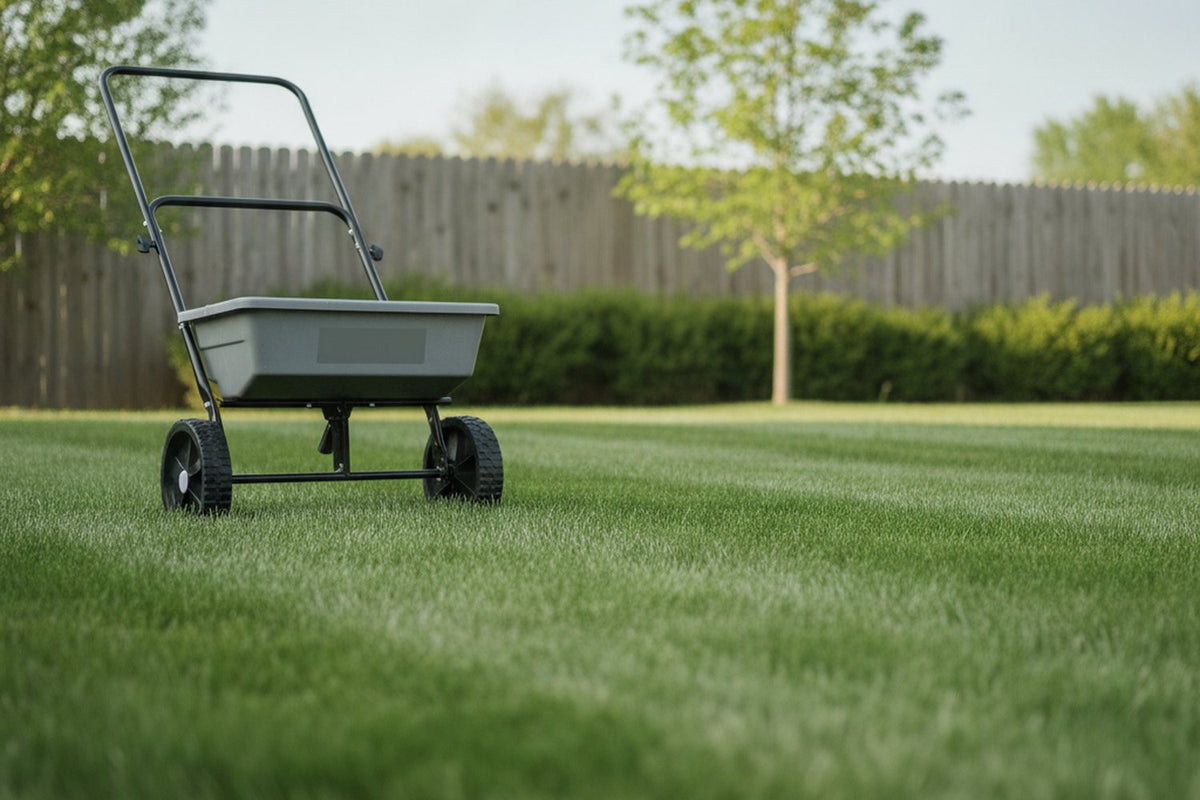
Granular goes through a spreader; liquid goes on through a sprayer on the hose. Bob Vila says liquid fertilizer tends to require more frequent application than granular and is an effective way to see quick results, so it is only recommended when truly rapid results are needed, while granular tends to work in a slow-release fashion, taking up to a month or longer to deliver results but requiring less frequent follow-up. For granulars, it says to apply with a fertilizer spreader calibrated at half the recommended rate, in parallel lines one way and then again in lines running perpendicular to the first, to avoid broadcasting onto pavement or landscape beds, and to blow or sweep fertilizer off pavement immediately. Minnesota says not to leave fertilizer on sidewalks, driveways and gutters, since it contributes to nutrient runoff into lakes and streams. Our best fertilizer spreader guide covers broadcast vs drop spreaders and how to set and calibrate a spreader.
Starter fertilizer, phosphorus and state rules
Phosphorus is for new lawns and soil tests that ask for it. Minnesota says established lawns show little response to added phosphorus, but that because phosphorus does not easily move in the soil, additional amounts are often beneficial when establishing new turf. Wisconsin's guide says to apply a starter fertilizer for new lawns or lawns with low phosphorus; for a new lawn, it says to apply it according to the instructions on your soil test report and rake it into the top 1/2 inch of soil before seeding or sodding, and that sodded lawns should go on a regular maintenance program within 3 to 4 weeks after the sod is laid. Scotts says its Starter Food (pick 6) can be applied immediately before or after planting.
Some states and towns restrict it. Wisconsin's 2011 guide says Wisconsin law prohibits applying phosphorus to your lawn unless your soil test indicates a need for phosphorus or you are establishing a new lawn, and that local ordinances may not permit any phosphorus. Spectracide's page names two date rules, no nitrogen in north Florida in winter and no fertilizer on lawns and non-agricultural turf from Dec. 1 to April 1 in New York State, and tells buyers to refer to their state and local fertilizer ordinances. Rules differ by state and town and change, so check your own state's and town's rule before you put down phosphorus or feed outside the growing season.
Weed and feed or plain lawn fertilizer?
Minnesota keeps them apart where it can: it says spot treating weeds may be more effective than using a weed-and-feed product over the entire lawn, that the time to kill a specific weed may not be the ideal time to fertilize, and that environmentally, applying fertilizers separately from weed killers is the best approach. It notes the watering clash too: fertilizers are watered in after application, while many herbicides need to remain on the plant leaves. Our best weed and feed guide covers which weed and feed can go on which grass, when to apply it and when one bag is the right tool over a spot spray.
The best lawn fertilizers, by job
2. Pennington Full Season Lawn Fertilizer 32-0-5: best for one feeding a season
Best for: One spring feeding
A 32-0-5 granular whose polymer coated urea Pennington says feeds for up to 4 months.
The Pennington Full Season is the one pick its maker calls one application and done for a season. Pennington's page says its polymer coated urea slowly releases nitrogen up to 4 months, that it carries 5% iron and natural beneficial microorganisms, and that the 11.2-pound bag covers up to 4,000 square feet with a lawn spreader. It gives spring as when to use it and says it works best on actively growing turf. Its steps: mow the lawn and water it well 1 to 2 days before, check the product label for its suggested spreader settings, spread around the perimeter and then back and forth inside it with an overlap, then sweep any excess granules off hard surfaces onto the lawn and water the product in; it says not to apply if heavy rain is expected. Good to know: by the table, that one feeding is 0.90 pounds of nitrogen per 1,000 square feet for the season, against the approximately 3 pounds Wisconsin's three feedings add up to, and Pennington says it is not available in Hawaii and South Dakota.
3. O.M. Scott & Sons Natural Grass Food: best natural lawn food
Best for: A natural feed
An 11-0-0 natural granular that its maker says feeds for up to 10 weeks.
The O.M. Scott natural grass food is the natural pick, an 11-0-0 that its maker's page says is made with premium nutrient sources found in nature, contains no added artificial ingredients or pesticides, gets to work right away and keeps feeding for up to 10 weeks. It says it goes on any grass type, anytime, any season: mow a day or two before if the lawn is shaggy, set a Scotts broadcast spreader to 8 and allow a little overlap on your passes, give the lawn a quick, light watering right after, and knock any granules on the driveway or sidewalk back onto the lawn; feed it 4 times a year, about 8 to 10 weeks apart. It says family and pets can be on the lawn right after it is applied, used as directed, and that it is a good idea to wash your hands after. One 12.72-pound bag covers 2,000 square feet. Good to know: it is the lowest-analysis pick, so by the table it takes 6.36 pounds per 1,000 square feet to put down 0.70 pounds of nitrogen, and the scotts.com address for Scotts Natural Lawn Food, Bob Vila's natural pick, now opens this product's page.
4. Scotts Turf Builder Southern Lawn Food: best for Southern grasses
Best for: St. Augustine, centipede, zoysia
A 32-0-10 granular that Scotts formulates for Southern lawns, centipede and zoysia among them.
The Scotts Southern Lawn Food is the one pick made for Southern grasses. Scotts' page says it is formulated for Southern lawns, including St. Augustine, centipede, zoysia and carpetgrass, is 32-0-10, and goes on anytime during the growing season, up to four times a year; it suggests early spring, late spring, summer and early fall. Its directions: keep it on the lawn and avoid applying to driveways, sidewalks and patios, sweep any stray granules back onto the lawn, and, while you don't have to water it in, a light watering after you apply helps; it says family and pets can get back on the lawn right after it is applied, and to wash your hands with soap and water after. The listing gives a 14.06-pound bag for 5,000 square feet. Good to know: its 10% potassium is the most of the six, and Bob Vila says centipede and St. Augustine need roughly equal amounts of nitrogen and potassium, pointing to 15-0-15 or a similar summer fertilizer; at 0.90 pounds of nitrogen a feeding by the table, Clemson's 2-pound yearly ceiling for centipede is two feedings.
5. Spectracide Lawn Fertilizer 30-0-0: best for light feeds by hose
Best for: Light feeds by hose
A 30-0-0 liquid on a hose-end sprayer; its label lists 18% as slowly available nitrogen.
The Spectracide 30-0-0 is the one liquid pick and the lightest feeding of the six: its label says to apply 1 quart per 5,000 square feet and that the bottle applies 0.160 pounds of nitrogen per 1,000 square feet, and to reapply as needed, allowing at least 7 to 14 days between applications, except in Florida, for which it refers to a separate table. Spectracide says it treats all grass types, including Bahia, Bermuda, centipede, St. Augustine and zoysia, should only be applied to actively growing turf, and goes on through the QuickFlip hose-end sprayer with no mixing; this listing is three 32-ounce bottles with one nozzle. The label's directions: keep people and pets out of the treated area during application and do not let them enter until sprays have dried; do not apply near water, storm drains or drainage ditches, or if heavy rain is expected; sweep any product that lands on the driveway, sidewalk or street back onto your lawn; do not apply when grass is excessively stressed for moisture or during periods of high temperatures; keep out of reach of children; and store it in the original container in an area inaccessible to children and pets. Good to know: its label lists all 30% of its nitrogen as water soluble, with the 18% slowly available, and Wisconsin's guide says to avoid turf fertilizers containing only water-soluble nitrogen.
6. Scotts Turf Builder Starter Food for New Grass: best for new seed or sod
Best for: New seed, sod or plugs
A 24-25-4 starter for new seed, sod, sprigs or plugs, put down at planting.
The Scotts Starter Food is the starter, a 24-25-4 that Scotts' page says is for planting new grass, whether starting a new lawn, reseeding an existing one, or installing sod, sprigs or grass plugs, goes on any grass type and can be applied immediately before or after planting; one 15-pound bag covers 5,000 square feet. It says not to apply near water or storm drains or draining ditches or if heavy rain is expected, to sweep or blow stray particles back onto the lawn, that it does not require watering in but to keep the soil consistently moist until seedlings reach 2 inches high, and that while there are no restrictions on reentering the lawn, Scotts recommends watering it in and waiting until it is dried before going back on. Good to know: by the table it puts down 0.75 pounds of phosphate per 1,000 square feet a feeding, the nutrient Minnesota and Wisconsin keep for new lawns and soil tests that call for it, so check your state's rule first.
How we picked these lawn fertilizers
We compared each pick's N-P-K, label rate, coverage and feeding schedule from its maker's page and its Amazon listing, took the buying, timing and feeding advice from the extension services of the University of Minnesota, Clemson University and the University of Wisconsin and from Bob Vila's test of seven lawn fertilizers, checked every pick against its Amazon listing and the CPSC recall database, and worked out each pick's nitrogen per 1,000 square feet a feeding and a year from those label figures. Every pick we link was in stock and sold by Amazon itself when we checked, and Also considered names the other fertilizers we read and why each is not linked. When we checked the CPSC's recall database on November 21, 2026, none of the six picks had a recall listed. We make digging spades, not fertilizer, so nothing on this page is ours. How our guides are made sets out the full process.
Also considered
Each was checked on November 21, 2026.
- Scotts Turf Builder Lawn Food. A 32-0-4 for any grass type, in stock and sold by Amazon. Scotts' page gives 5,000 square feet a bag, fed every 6 to 8 weeks up to 4 times a year. Green Max is the Scotts all-grass pick here, the one Bob Vila tested.
- Scotts Natural Lawn Food. Bob Vila's natural pick, in stock and sold by Amazon. The scotts.com address for it now opens the O.M. Scott & Sons Natural Grass Food page, so we link that product, pick 3, whose maker page we could read.
- Scotts Turf Builder liquid lawn food, 29-0-3. A hose-end liquid in stock and sold by Amazon; its listing says the sprayer is reusable with refill bottles sold separately. Its maker page did not load when we checked, so we could not read its label rate; pick 5's label states its rate and its nitrogen per 1,000 square feet.
- Milorganite. Bob Vila's slow-release organic pick, which it says provides steady nitrogen over 8 to 10 weeks. The Milorganite listings we read were sold by third-party sellers, apart from one sold by Amazon whose listing gives its brand as EasyGo Product rather than Milorganite, so we do not link it.
- Espoma lawn foods. Bob Vila names Espoma's organic spring lawn booster. The Espoma listings we read were sold by third-party sellers, and some were in short supply.
- Simple Lawn Solutions. Bob Vila's liquid pick, a 16-4-8 with a hose-end sprayer. The listings we read were sold by Custom Liquid Solutions, not by Amazon.
- Down to Earth, The Andersons, Jonathan Green, Eco Solutions and Purely Organic. The listings we read were sold by third-party sellers, not by Amazon.
Frequently asked questions
What is the best lawn fertilizer?
For most lawns, Scotts Green Max Lawn Food, a 27-0-2 granular with 5% iron that Bob Vila names its best overall; test the soil first. Otherwise, for new seed or sod, Scotts Turf Builder Starter Food for New Grass; for St. Augustine, centipede, zoysia or carpetgrass, Scotts Turf Builder Southern Lawn Food; for one feeding a season, Pennington Full Season Lawn Fertilizer 32-0-5; for a natural feed, O.M. Scott & Sons Natural Grass Food.
When should you fertilize your lawn in spring?
It depends on the grass. Bob Vila says to feed cool-season grasses, such as tall fescue and Kentucky bluegrass, when the soil reaches 55 degrees Fahrenheit or the grass has begun active growth, and warm-season grasses, such as Bermuda grass, zoysia and centipede, when they have turned at least 50 percent green after winter. The University of Minnesota Extension puts the spring feeding in May-June, and the University of Wisconsin-Extension in late May.
How often should you fertilize your lawn?
As often as its label and your grass call for, and no more. Scotts says to feed Green Max every 6 to 8 weeks, O.M. Scott & Sons says every 8 to 10 weeks for its Natural Grass Food, and Pennington calls Full Season one application for a season. The University of Wisconsin-Extension feeds mulch-mowed lawns in late May, early July and early September, and Bob Vila says overfertilization is a far greater risk to the lawn itself and to the environment than not fertilizing.
Is slow-release lawn fertilizer better?
For steady feeding, by the University of Wisconsin-Extension: it says water-soluble nitrogen gives a quick greening and a spurt of growth that lasts 3 to 4 weeks, while slow-release nitrogen takes longer to green up grass but gives more uniform growth, seen for 8 weeks or more, and to look for a fertilizer in which about 1/4 to 1/2 of the nitrogen is water insoluble. Bob Vila says fast-release lawn food can be beneficial during early spring and when planting a new lawn.
Should you water in lawn fertilizer?
Usually. The University of Minnesota Extension says that to prevent burning, always water after applying any fertilizer, unless the label recommends otherwise, and Bob Vila says some slow-release fertilizers don't require immediate watering, so always check the label. Scotts says a light watering after Southern Lawn Food helps but is not required, and Pennington says to water Full Season in.
Disclosure: Some links pay us a commission when you click or buy, and on some pages brands pay us through Amazon's creator program on links to their products.
Product prices and availability are accurate as of the date/time indicated and are subject to change. Any price and availability information displayed on Amazon.com at the time of purchase will apply to the purchase of this product.