As an Amazon Associate we earn from qualifying purchases. Some links are paid. Disclosure
Our top picks
Best for raccoons, groundhogs, opossums and big tomcats
1. Havahart 1079 Large 1-Door Trap
Best for: Raccoons, groundhogs and opossums, and cats too big for a cat-size trap
Best for cats and rabbits
2. Tru Catch 30LTD
Best for: Stray and community cats, rabbits and skunks, never raccoons
Best for tree squirrels
3. Rugged Ranch Squirrelinator with Waste Basin
Best for: Tree squirrels, several at a time, where your state allows it
For raccoons, groundhogs and opossums, our pick is the Havahart 1079 Large 1-Door Trap: Havahart gives it as 32 by 10 by 12 inches, the cage size the Internet Center for Wildlife Damage Management (ICWDM) gives for all three.
For cats, rabbits and skunks, the Tru Catch 30LTD is a lighter cage with a rear door that slides up, the feature cat rescue groups look for; Tru Catch says it is not meant for raccoons. For tree squirrels, the Rugged Ranch Squirrelinator with Waste Basin is a multi-catch cage, the best squirrel trap the writer of the Practical Self Reliance homestead blog had tried. Before you set any of them, check your state wildlife agency's rules for your animal and decide what happens after the door shuts: Virginia's Department of Wildlife Resources says it is illegal there to trap an animal and relocate it to another area, MassWildlife says Massachusetts law prohibits moving wildlife off your property, and ICWDM says many states forbid moving raccoons and other rabies vectors (see the rules on moving animals).
Jump to: Trap size by animal | The rules on moving animals | Humane handling | Letting an animal go | Rats, mice and chipmunks
Start here: which trap for which animal
- Raccoons, groundhogs, opossums, or a tomcat too big for a cat-size trap: Havahart 1079 Large 1-Door Trap (pick 1).
- A stray or community cat, a rabbit or a skunk: Tru Catch 30LTD (pick 2). For a skunk, cover at least half of the cage before you set it.
- Tree squirrels, one or several: Rugged Ranch Squirrelinator with Waste Basin (pick 3).
- Chipmunks: none of the three. ICWDM calls for a smaller cage with 1/4 inch mesh (see chipmunks).
- Rats and mice: not a live trap. On trapping rats and mice in and around the home, the CDC says not to use live traps; see our rat trap guide and mouse trap guide.
Two checks before you buy. First, the rules: whether you may move the animal, let it go where you caught it, or need a permit to trap it at all depends on your state and the species (see the rules on moving animals). Second, the cause: a trap takes one animal away, but MassWildlife says that moving an animal does not fix the problem, because other members of its species will move in, and it suggests removing what drew the first one, garbage or a bird feeder for example, and closing off crawl spaces.
| Pick | Size | Doors | Made of | Best for | Our verdict | Where to buy |
|---|---|---|---|---|---|---|
| 1. Havahart 1079 Large 1-Door TrapBest for raccoons, groundhogs, opossums and big tomcats | 32 x 10 x 12 in (Havahart) | 1, spring-loaded solid metal door (Havahart) | Galvanized one-piece wire mesh (Havahart) | Raccoons, groundhogs and opossums, and cats too big for a cat-size trap | The 32 by 10 by 12 inch cage ICWDM sizes for raccoons, groundhogs and opossums, with one spring-loaded solid door. | Check price on Amazon |
| 2. Tru Catch 30LTDBest for cats and rabbits | 30 x 9 x 11 in (Tru Catch) | Entry door plus a slide-up rear door (Tru Catch) | 3/16 in steel wire frame, 14 gauge mesh (Tru Catch) | Stray and community cats, rabbits and skunks, never raccoons | A light-duty cat-size cage with the slide-up rear door cat rescue groups look for, which Tru Catch says is not for raccoons. | Check price on Amazon |
| 3. Rugged Ranch Squirrelinator with Waste BasinBest for tree squirrels | Flat square cage, holds up to 25 squirrels (listing) | 2 entry doors, top lid to let them out (listing) | Metal wire, with a waste pan (listing) | Tree squirrels, several at a time, where your state allows it | A multi-catch squirrel cage with no trip plate to set, the best squirrel trap Practical Self Reliance had tried. | Check price on Amazon |
The best live animal traps, by animal size
1. Havahart 1079 Large 1-Door Trap: best for raccoons, groundhogs, opossums and big tomcats
Best for raccoons, groundhogs, opossums and big tomcats
Best for: Raccoons, groundhogs and opossums, and cats too big for a cat-size trap
Havahart 1079 Large 1-Door Trap
- Size: 32 x 10 x 12 in (Havahart)
- Doors: 1, spring-loaded solid metal door (Havahart)
- Made of: Galvanized one-piece wire mesh (Havahart)
The 32 by 10 by 12 inch cage ICWDM sizes for raccoons, groundhogs and opossums, with one spring-loaded solid door.
Havahart's model 1079 is a galvanized wire cage 32 inches long by 10 wide and 12 high, with one spring-loaded solid metal door, by Havahart's product page. Havahart lists raccoons, groundhogs, opossums, cats, skunks and armadillos among the animals it is made for, and says its trip mechanism is tuned for heavier animals such as cats and raccoons, to cut down on false triggers. The trigger rod sits outside the cage, where a caught animal cannot damage it, and a solid door and handle guard keep your hand away from the animal while you carry the trap, Havahart says.
Why it is the pick: its size is the one ICWDM gives for raccoons, groundhogs and opossums. ICWDM says a raccoon cage trap needs to be well built and no smaller than 10 by 12 by 32 inches, and gives 10 by 12 by 32 inches for a single-door groundhog or opossum trap. BestReviews, in a research roundup last updated in July 2023, names this trap its Best of the Best, for raccoons, cats, bobcats, groundhogs, opossums and animals of a similar size. For cats, Alley Cat Allies says that bigger cats, like tomcats, may need the larger raccoon-size trap rather than a standard cat trap.
Good to know: set it with care for a raccoon. ICWDM says to heap the bait behind the treadle and drop a few small bits at the entrance, to keep the ground within about 12 inches of the trap clear because a caught raccoon will pull in whatever it can reach, and to secure the trap, since a caught raccoon may shift or overturn one that is loose. Havahart says the carrying handle lets you hold the cage away from your body. Havahart also lists skunks; for one, cover at least half the cage first (see humane handling). Alley Cat Allies says a cat trap should also have a back door, which is why pick 2 is the cat answer; pick 1 is for the cat that is too big for a cat-size trap.
2. Tru Catch 30LTD: best for cats and rabbits
Best for cats and rabbits
Best for: Stray and community cats, rabbits and skunks, never raccoons
Tru Catch 30LTD
- Size: 30 x 9 x 11 in (Tru Catch)
- Doors: Entry door plus a slide-up rear door (Tru Catch)
- Made of: 3/16 in steel wire frame, 14 gauge mesh (Tru Catch)
A light-duty cat-size cage with the slide-up rear door cat rescue groups look for, which Tru Catch says is not for raccoons.
The 30LTD is a light-duty cage 30 inches long, 9 inches wide and 11 inches high, by Tru Catch's product page and its listing. Tru Catch names cats, skunks and rabbits among the small animals it suits, and lists a slide-up rear door, a self-locking door and a frame of 3/16 inch steel wire with 14 gauge wire mesh. Its door also releases on its own when the trap is turned upside down, Tru Catch says. And Tru Catch is plain about its limit: it calls this a light-duty trap and says it does not recommend it for wildlife such as raccoons.
Why it is the pick: it is built the way cat rescue groups ask for. Alley Cat Allies says a box trap for cats should have a back door that shuts vertically in addition to the entry door, lists a back door that slides open, so your hands stay out of the trap, among the useful features, and names Tru Catch and Tomahawk as the traps it uses most often (while noting that the list is not an endorsement). The team behind Trap and Return, a site whose writers say they have tried every kind of trap while trapping community cats, calls the 30LTD its favorite Tru Catch trap and the most versatile. For rabbits, its 9 inch width, 11 inch height and 30 inch length meet the 9 by 10 by 24 inch trap ICWDM gives for rabbits.
Good to know: it is for cats, rabbits and skunks; for a raccoon or a big tomcat, use pick 1. Trap and Return calls Tru Catch traps gravity lock traps, and Tru Catch says the door releases when the trap is turned upside down. For community cats, the Central New York Cat Coalition says to get permission before you trap on someone else's property, to watch a set trap from somewhere safe, such as a car or a window, never to leave one out overnight unchecked, and to cover every side of the trap with a sheet or towels as soon as a cat is caught. Alley Cat Allies adds that local rescue groups and shelters may lend traps, and to learn a shelter's policy on community cats before you borrow one.
3. Rugged Ranch Squirrelinator with Waste Basin: best for tree squirrels
Best for tree squirrels
Best for: Tree squirrels, several at a time, where your state allows it
Rugged Ranch Squirrelinator with Waste Basin
- Size: Flat square cage, holds up to 25 squirrels (listing)
- Doors: 2 entry doors, top lid to let them out (listing)
- Made of: Metal wire, with a waste pan (listing)
A multi-catch squirrel cage with no trip plate to set, the best squirrel trap Practical Self Reliance had tried.
The Squirrelinator is a flat, square wire cage with two entry doors, a lid on top for letting animals out and a waste pan underneath, by its listing, which says it holds up to 25 squirrels. There is no trip plate to set; Practical Self Reliance describes a one-way door that squirrels push through and are then shut in behind.
Why it is the pick: of the squirrel traps we looked at, it is the one with a first-hand article recommending it. Ashley Adamant of Practical Self Reliance, after squirrels kept taking the bait from two small cage traps without setting them off, calls the Squirrelinator the best squirrel trap she has tried (her article does not say whether hers had the waste basin): set on the woodland floor some 50 feet from her house, with peanuts scattered in and around it, it caught at least one squirrel a day. Bob Vila's research roundup of squirrel traps names this model, with the basin, its best multi-catch trap. And ICWDM says that, if legal in your state, "multiple catch traps are extremely effective on flying squirrels, and can be used on other squirrels as well."
Good to know: its listing names chipmunks too, but it is not our pick for them. Practical Self Reliance watched a young squirrel squeeze out through the side wire and says it "won't catch the smallest juvenile red squirrels," and ICWDM calls for 1/4 inch mesh for chipmunks. Check it often: Bob Vila notes that a caught squirrel soon becomes anxious and dehydrated. And check the law before you set it. ICWDM says fox and gray squirrels are game species in most states, so you may need a trapping permit, and that tree squirrels should not be moved, because of the stress on them and the squirrels already living where they are let go and the risk of spreading disease; many states do not allow it. In California, UC IPM says "Releasing any tree squirrel elsewhere is also illegal unless a proper permit is issued by CDFW," the state's Department of Fish and Wildlife. UC IPM adds that "the issuance of such a permit is unlikely in most situations," and that in California a squirrel caught in a live cage trap must be euthanized, which it calls a problem for some people.
How we chose these
We started from the live cage traps that came up in our Amazon searches and kept those whose size we could find from the maker, the listing or an outside source, so each could be held against ICWDM's advice for the animal it is sold for. Then we looked for an account from outside the seller. We found no publication that compared live animal traps head to head across the animals on this page, so each pick rests on the sources named in its section: a homesteader's first-hand account and Bob Vila's research roundup for the Squirrelinator, a cat rescue team's account and Alley Cat Allies for the Tru Catch, and BestReviews' research roundup for the Havahart. Where a source only researched a trap rather than used it, we say so.
For what to do before and after a catch, we read ICWDM's pages on raccoons, groundhogs, opossums, skunks, rabbits, chipmunks and tree squirrels, Montana State University Extension on groundhogs, University of California IPM's Tree Squirrels Pest Note, MassWildlife's page on moving wildlife, Virginia DWR's page on human-wildlife conflicts, the CDC on rats and mice in the home, and Alley Cat Allies and the Central New York Cat Coalition on trapping cats.
Our rules: each pick was in stock on Amazon on November 11, 2026, with a new offer in the buy box. Every size, feature and limit of a trap on this page is its maker's or its listing's, and every statement about trapping law, release and handling is a wildlife agency's, an extension service's or a rescue group's, named where it appears. Nothing here is legal advice: the rules differ by state and by species, so check yours.
Also considered: other traps we looked at
Havahart Easy-Set Small Trap (1083). Bob Vila's research roundup names it the best easy-set squirrel trap, and Havahart says it sets and releases with one hand and has a screw to adjust how easily it trips. We left it out on size: Havahart gives it as 17 by 7 by 7 inches, an inch shorter than the 18 inch length ICWDM gives for tree squirrel traps and well short of its 24 inch rabbit trap, and Bob Vila's roundup lists among its drawbacks that it may not work for larger squirrels.
Rugged Ranch Chipmunkinator. A smaller multi-catch cage from the maker of pick 3, sold for chipmunks. Its listing says the mesh is tight but gives no mesh size, so we could not hold it against the 1/4 inch mesh ICWDM calls for.
Spray-proof skunk tube traps. Metal tubes sold to catch a skunk without a spray. ICWDM's advice for skunks is a cage trap covered over at least half its length, or a box trap made for skunks, and we found no account of the tubes from outside their sellers, so we left them out.
Low-cost folding cage traps. Many folding cages are sold under brand names we could not trace to a maker's specification page or to an outside account, so none of them made the list.
What size live trap for each animal
ICWDM says "it takes a sturdy trap to hold a raccoon for long," and the wrong mesh lets a small animal slip out, as Practical Self Reliance found with a young squirrel. These are the cage sizes and baits ICWDM gives for each animal (Alley Cat Allies for cats, the CDC for rats and mice), with ICWDM's numbers in the order it writes them, and the pick that fits.
| Animal | Cage size (ICWDM) | Baits ICWDM names | Our pick |
|---|---|---|---|
| Raccoon | 10 x 12 x 32 in or larger, sturdily built | Fish-flavored cat food, sardines, fish, chicken | Pick 1 |
| Groundhog (woodchuck) | 10 x 12 x 32 in with one door; 9 x 9 x 32 in for a two-door trap set in a path | Apple slices, carrots or lettuce, fresh each day | Pick 1 |
| Opossum | 10 x 12 x 32 in with one door; 7 x 7 x 24 in with two | Fruit or other sweet baits, which draw fewer cats and dogs than fatty ones | Pick 1 |
| Skunk | Any cage covered over at least half its length, or a box trap made for skunks | Peanut butter, sardines, fish-flavored cat food; sweet baits where cats are around | Pick 2 (pick 1 also lists skunks) |
| Rabbit | 9 x 10 x 24 in; 7 x 7 x 30 in with two doors | Dry ears of corn, apples, carrots, cabbage, alfalfa, clover, green vegetables | Pick 2 |
| Tree squirrel | 5 x 5 x 18 in or larger; multi-catch traps where legal | Orange or apple slices, shelled walnuts or pecans, peanut butter | Pick 3 |
| Chipmunk | 3 x 3 x 10 in or larger, with 1/4 inch mesh | Peanut butter, nut meats, sunflower seeds | None of our picks |
| Cat | Cat size; raccoon size for bigger cats (Alley Cat Allies) | Not an ICWDM species | Pick 2; pick 1 for a big tomcat |
| Rat or mouse | No live trap (the CDC, for rats and mice at home) | Not a live trap job | See our rat and mouse trap guides |
Two things stand out. Pick 1's 32 by 10 by 12 inches matches the size ICWDM gives for raccoons and groundhogs and for a single-door opossum trap, so one trap covers all three. And pick 2 is at least as big as ICWDM's rabbit trap in every direction, while Tru Catch, calling it a light-duty trap, does not recommend it for raccoons.
Before you trap: the rules on moving animals
Decide what will happen to the animal before you set the trap, because in some places, Virginia and Massachusetts among them, the obvious answer, driving it somewhere else, is against the law. Virginia's Department of Wildlife Resources says "It is illegal in the State of Virginia to trap and relocate an animal to another area." MassWildlife says "Massachusetts law prohibits the capture and relocation of wildlife off your property," a law it says dates back many years. ICWDM says many states forbid moving raccoons and other rabies vectors, does not advise moving skunks "because they are a rabies vector species," and says many states do not allow tree squirrels to be moved; it adds that fox and gray squirrels count as game species in most states, which can mean a trapping permit. In California, UC IPM says a tree squirrel may not be released elsewhere without a permit from the state's Department of Fish and Wildlife, that "the issuance of such a permit is unlikely in most situations," and that a squirrel caught in a live cage trap there must be euthanized, which it calls a problem for some people. The rules differ by state and by species, so check your state wildlife agency's rules for the animal you mean to catch before you set a trap.
Even where moving an animal is legal, MassWildlife and ICWDM's pages for raccoons, tree squirrels and groundhogs advise against it. MassWildlife says a moved animal will struggle to find food, water and shelter, that a diseased one may spread its disease to other animals, and that moving it does not address the cause, since others of its species move in. ICWDM says moved raccoons have low survival rates and may travel up to 25 miles from where they are let go, that tree squirrels should not be moved because of the stress and the risk of disease, and that groundhogs should not be moved unless they are being rescued.
So deal with the cause first. ICWDM calls exclusion usually the best way to cope with raccoon damage, and says not to finish sealing a building until every raccoon has left or been removed. Virginia DWR's list starts with stopping any feeding of wildlife, keeping trash in an animal-proof can or indoors until pickup, keeping pet food indoors, and closing the openings under and into buildings where animals den. For groundhogs at a garden, ICWDM says a fence of heavy poultry wire, or of woven wire with 2 inch mesh, standing at least 3 feet high with an overhang, can keep them out, with its bottom edge buried 2 inches deep and bent outward in an L so they cannot dig under it.
Mind the young. ICWDM says anyone removing raccoons in spring and summer should be aware that young may be present, that young tree squirrels may be in the nest from February through August, with care needed not to abandon them, and that groundhog complaints rise in July as the young leave to find their own ground.
If you cannot let the animal go where you caught it, the agencies point to licensed help: MassWildlife to a Problem Animal Control agent, and Virginia DWR to a licensed trapper or a wildlife control specialist through its Trapper Finder tool.
Humane handling: checking, covering and carrying
- Check it often. Montana State University Extension says to check traps twice a day, morning and evening, so a caught animal can be removed quickly. ICWDM says to check rabbit traps daily and chipmunk traps every 24 hours or sooner, ideally at dusk, and to check groundhog traps as the law requires. Bob Vila notes that a caught squirrel soon becomes anxious and dehydrated. For a cat, the Central New York Cat Coalition says to watch the trap from somewhere safe, such as a car or a window, and Trap and Return says never to leave a trap unattended.
- Cover part of the cage. ICWDM says to cover cage traps at least half their length, especially for skunks, to cover rabbit traps with canvas or another dark material, and to cover half of a chipmunk trap for shelter, each time without letting the cover interfere with how the trap works. For a cat, the Central New York Cat Coalition says to cover every side of the trap with a sheet or towels as soon as it is caught, to calm it.
- Set it where the wrong animal is less likely to walk in. For raccoons and opossums, ICWDM suggests a wooden platform fixed to a fence with the trap 18 inches or more above the ground, so a skunk is less likely to get in. For opossums it suggests fruit or sweet baits rather than fatty ones, so fewer cats and dogs get caught, though it notes skunks and raccoons like sweet baits too.
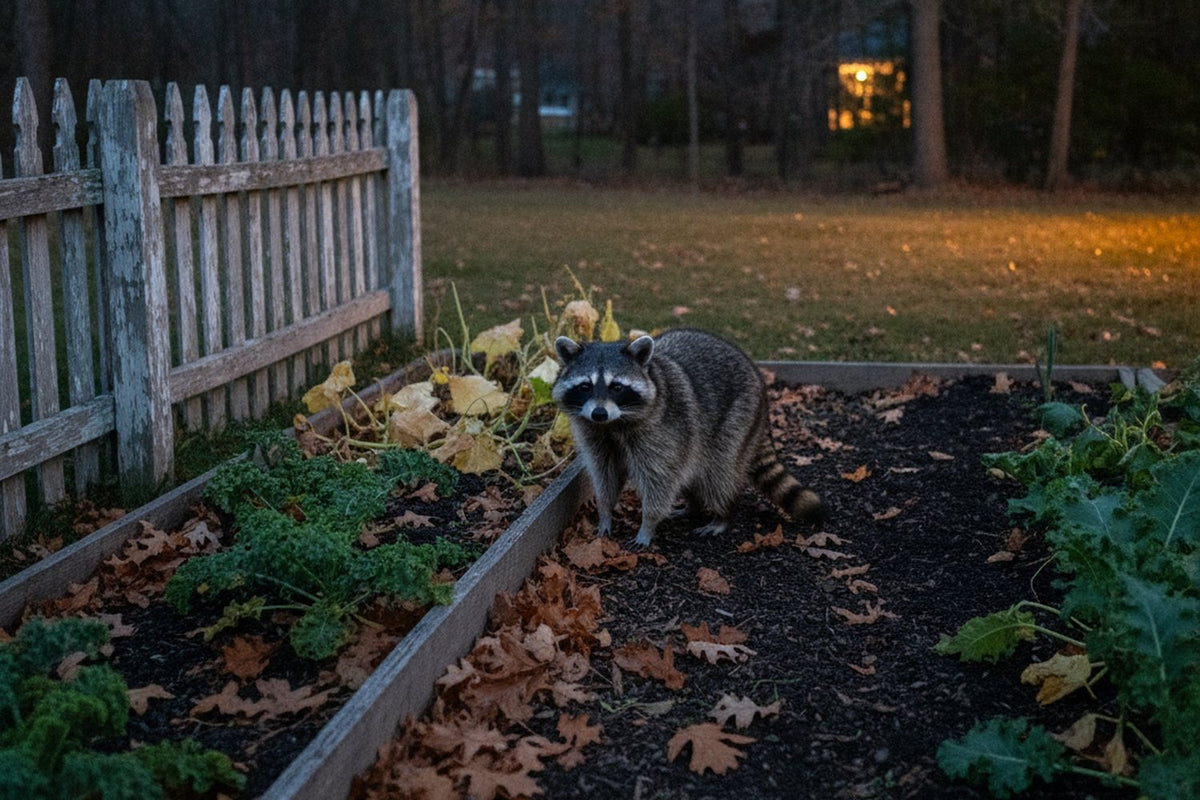
- Give a raccoon nothing to grab. ICWDM says a caught raccoon reaches for anything within about 12 inches and pulls it in, from shingles to a garden hose, and may move or flip a trap that is not secured.
- Wear gloves and keep the cage away from you. Thick gloves are on Alley Cat Allies' trapping kit list, and Havahart says its carrying handle "allows you to hold the trap away from your body" and that its solid door and handle guard shield you from contact with the animal.
Letting an animal go
ICWDM's handling pages for raccoons, skunks and squirrels lean toward letting an animal go where it was caught instead of moving it, and the advice differs by animal. It says raccoons can be let go on site if that is legal in your state, somewhere they will not meet traffic, with children and pets kept away, and warns that they may come back into the home or a nearby one. For a skunk rescued from a window well or garage, it prefers release on site, in an out-of-the-way spot with ground cover, close to nightfall if possible. For squirrels taken from a chimney or basement, it recommends letting them go on site once the way back in has been secured. The last two are rescue situations, so ask your state wildlife agency whether you may release an animal you trapped yourself.
A skunk takes care. ICWDM's first advice is to try not to catch one: shut the trap before sunset and set it again each morning, which it notes will not work when the animal you are after comes out at night. If a skunk is caught anyway, ICWDM says to approach slowly and quietly with a small tarp or blanket held in front of you, to stop if the skunk looks agitated, and to drape the tarp gently over the trap, and that a cover lowers the chance of a spray but does not remove it. With a gravity-door trap, stand back and use a long painter's pole to push the trap over onto its roof so the door opens. With a spring-loaded door, keep a cloth over the half of the trap away from the door whenever it is set, so you can come up to a caught skunk without being seen, then prop the door open at least 5 inches. Then keep people and pets away and let the skunk leave when things quiet down.
Rats, mice and chipmunks
For rats and mice, the answer is not a live trap. On trapping rats and mice in and around the home, the CDC says not to use live traps or glue traps, because they can scare the animal into urinating, which can raise your chance of getting sick. Our rat trap guide and mouse trap guide cover the traps that do the job and where to set them.
For chipmunks, ICWDM calls for a cage at least 3 by 3 by 10 inches with fine 1/4 inch mesh, half covered, baited with peanut butter and checked at least every 24 hours. None of our three picks lists 1/4 inch mesh, so none is our pick for chipmunks. For a bed of bulbs, ICWDM's other answer is to cover the seeds and bulbs with 1/4 inch hardware cloth.
Related guides
For rats and mice, see our rat trap guide and mouse trap guide. For rabbits and deer eating the same plants, our deer repellent guide compares the repellents that keep them off, and for squirrels at a bird feeder, start with the squirrel-proof bird feeder guide.
Frequently asked questions
What is the best live animal trap?
For raccoons, groundhogs and opossums, the Havahart 1079 Large 1-Door Trap, 32 by 10 by 12 inches, the cage size ICWDM gives for those animals; Alley Cat Allies says a big tomcat may need a raccoon-size trap like it. For cats, rabbits and skunks, the lighter Tru Catch 30LTD, with a rear door that slides up; Tru Catch says it is not for raccoons. For tree squirrels, the Rugged Ranch Squirrelinator, a multi-catch cage. Whichever you buy, check your state's rules on moving wildlife first.
What size live trap do I need for a raccoon?
No smaller than 10 by 12 by 32 inches, and sturdy: ICWDM says "it takes a sturdy trap to hold a raccoon for long." It names sardines, fish, chicken or fish-flavored cat food as raccoon baits, and says to keep the area within about 12 inches of the trap clear, since a caught raccoon pulls in whatever it can reach.
What is the best bait for a live animal trap?
It depends on the animal. ICWDM names sardines, fish, chicken or fish-flavored cat food for raccoons; apple slices, carrots or lettuce, changed daily, for groundhogs; fruit or other sweet baits for opossums, which are less likely than fatty baits to draw cats and dogs; dry ears of corn, apples, carrots and green vegetables for rabbits; and orange or apple slices, shelled walnuts or pecans, and peanut butter for tree squirrels.
Is it legal to relocate a trapped animal?
It depends on your state and the animal, and in some places it is not allowed. Virginia's Department of Wildlife Resources says it is illegal there to trap an animal and relocate it to another area, MassWildlife says Massachusetts law prohibits moving wildlife off your property, and ICWDM says many states forbid moving raccoons and other rabies vectors and many do not allow moving tree squirrels. In California, UC IPM says releasing a tree squirrel elsewhere is illegal without a permit, that "the issuance of such a permit is unlikely in most situations," and that a squirrel caught in a live cage trap there must be euthanized. The rules differ by state and species, so check with your state wildlife agency before you set a trap.
How often should you check a live trap?
It depends on the animal: the sources we read range from keeping watch over a cat trap to checking a rabbit trap once a day. Montana State University Extension says to check traps twice daily, morning and evening, and ICWDM says to check rabbit traps daily and chipmunk traps at least every 24 hours, and to check groundhog traps as the law requires. For cats, the Central New York Cat Coalition says to watch the trap from somewhere safe, such as a car or a window, or if you cannot, to come back and check it regularly, and never to leave a set trap out overnight unchecked. Your state may set its own interval, so check its rules.
How do I avoid catching a skunk or a cat by mistake?
For raccoons and opossums, ICWDM suggests setting the trap on a secure platform 18 inches or more above the ground, which makes a skunk less likely, and for opossums, fruit or sweet baits rather than fatty ones, which make a cat or dog less likely to walk in, though skunks and raccoons like sweet baits too. If a skunk does walk in, ICWDM says to approach slowly and quietly with a small tarp or blanket held in front of you, to stop if it seems agitated, and to drape the tarp over the trap, and that a cover lowers the chance of a spray but does not remove it. Then, where your state allows it, let the skunk go where it was caught; ICWDM's steps for that are in this guide's section on letting an animal go.
Can you use a live trap for squirrels?
Yes, where your state allows it. ICWDM says cage traps of 5 by 5 by 18 inches or larger work for tree squirrels and multi-catch traps can be used, but that fox and gray squirrels are game species in most states, so you may need a permit, and that many states do not allow squirrels to be moved. Take care not to strand young, which ICWDM says may be in the nest from February through August. Our pick is the Rugged Ranch Squirrelinator.
Should I use a live trap for rats or mice?
No. On trapping rats and mice in and around the home, the CDC says not to use live traps or glue traps, because they can scare the animal into urinating, which can raise your chance of getting sick. Our rat trap and mouse trap guides cover the traps that do the job.
Disclosure: Some links pay us a commission when you click or buy, and on some pages brands pay us through Amazon's creator program on links to their products. Availability was checked on Amazon on November 11, 2026 and can change.
Product prices and availability are accurate as of the date/time indicated and are subject to change. Any price and availability information displayed on Amazon.com at the time of purchase will apply to the purchase of this product.