As an Amazon Associate we earn from qualifying purchases. Some brands also pay us when you click or buy, so those links are ads. Full disclosure below
To cut through roots when digging, clear the soil to expose the root, then match your tool to its size. Slice roots under one inch with a sharp spade, use loppers or a pruning saw for one to three inches, and a reciprocating or root saw for anything thicker. Undercut, cut clean, lever it out.
The field rule: match the tool to the root, and never lever a blade against a root that is pinned by a rock. Small and fibrous, slice it as you dig. Woody and finger-thick or bigger, switch to a saw. Always undercut first, so the root has somewhere to go and cuts in one clean pass. For the saw itself, our pruning saw picks cover folding, fixed and root saws.
Why do roots stop your dig, and what have you actually hit?
You are three inches into a planting hole and the shovel stops dead. Before you throw your weight at it, figure out what is down there, because it changes both the tool and the risk. Tree and shrub roots come in two broad kinds, and telling them apart is most of the job.

Feeder roots: the ones you can cut
Feeder roots are the thin, fibrous, spreading roots that pull in water and nutrients. They run mostly in the top foot of soil and fan out well past the branch tips. Most roots you meet when digging a bed, a trench, or a small planting hole are feeder roots, usually pencil-thin to about an inch. These slice cleanly and a healthy tree replaces them without much fuss.
- Thin, flexible, often reddish or pale, in loose clusters.
- Run horizontally, near the surface, far from the trunk.
- Safe to cut in reasonable amounts (more on limits below).
Structural or anchor roots: the ones to respect
Structural roots are the thick, woody, load-bearing roots close to the trunk that hold the tree upright. They are stiff, often several inches across, and they do not flex when you press on them. If you have hit something as thick as your wrist or bigger within a few feet of a trunk, stop and reassess. Cutting a major anchor root can weaken the tree and, over time, make it more likely to lean or fall.

What is the best tool to cut through tree roots when digging?
There is no single best tool, there is a best tool for the root in front of you. Root diameter is the deciding factor. Here is the simple matching table to keep in your head.
| Root diameter | Best tool | Why |
|---|---|---|
| Under 1 inch (finger-thick or less) | Sharp spade or garden knife | A sharpened blade slices these on the downstroke while you keep digging, no tool change |
| 1 to 3 inches | Loppers or a pruning saw | Too thick to slice cleanly, thin enough for a hand tool and a clean cut |
| 3 inches and up | Reciprocating saw or dedicated root saw | Needs a real cutting stroke; a spade will chip, bounce, or wedge |
| Large structural or anchor roots | Mattock or axe, or an arborist | Cutting these can destabilize the tree, so proceed carefully or get advice |
Where a sharpened spade earns its keep
For the everyday case, roots under an inch mixed through the soil you are digging, the right tool is a genuinely sharp spade, because it cuts the root as part of the same motion that moves the dirt. That is exactly what the 40 inch D-Handle Spear Head Spade is built to do. Its blade is a spearhead shape that enters the soil at a single point and slices outward as it sinks, and it is sharpened from tip to tail in tempered carbon-manganese steel. Instead of chopping at a root with the flat front edge of a common shovel, you are drawing a sharp edge through it. That is a large part of why digging with it takes up to 80% less effort than a standard shovel, and why it handles hard, clay, and rocky ground where a flat blade just skates.
Prefer to stand tall and let leverage do the work? The 58 inch Long Handle spade gives you a longer lever for slicing roots without stooping. Working in a tight bed, a raised planter, or around established plantings? The 30 inch Mini spade gets a sharp edge into spots a full-size blade cannot reach. All of them are double-patented, and Better Homes and Gardens named the Spear Head Best Shovel/Spade in 2025.
Honest limit: a spade is not a saw. Once a root is thicker than about an inch and woody, stop levering against it and switch to loppers or a saw, both for a cleaner cut and to protect your blade. If you are weighing a spade against a dedicated root saw or a Root Slayer-style tool, we lay out the real tradeoffs in our Spear Head Spade vs Root Slayer comparison. You can also see the full lineup on our all products page.
How do you cut through roots when digging, step by step?
This is the workflow that keeps cuts clean, keeps you safe, and keeps the hole moving.
- Expose the root first. Scrape and pull soil away from the root with the tip of your spade until you can see how thick it is and which way it runs. Cutting blind is how you chip a blade or hit a rock.
- Identify it. Finger-thick feeder root, or wrist-thick structural root? This tells you whether to slice, saw, or stop. If it is big and close to a trunk, read the tree-safety section below before you cut.
- Undercut the root. Dig the soil out from underneath so the root has open space below it. A supported root just flexes and absorbs your force; a root with air beneath it cuts in one clean pass.
- Sever it with a clean cut. For small roots, place the sharp edge of the spade squarely across the root and drive straight down with your body weight, not a sideways hack. For thicker roots, make two cuts a few inches apart with a saw and lift the section out. Clean cuts heal; ragged, crushed cuts invite rot.
- Lever the piece out. Once the root is cut on both sides of your hole, work the spade under it and lever the section free, then keep digging. If this was a planting hole, backfill with native soil and water in to settle any air pockets.
How to dig up roots: step by step
The best way to dig up roots is to work along the root run, not at one stubborn spot. Expose the run, cut it free at both ends with the tool that matches its thickness, lever the loose section out, then backfill. Here is how to dig out roots in six steps.
1. Expose the root run
Trace the root, do not just uncover one spot. Run a garden knife or a trowel along the soil above it and peel the dirt back until the whole length you plan to remove is in the open. Digging up a root you cannot see is how you cut the wrong one, or find a rock with your blade.
2. Cut the small roots with the spade on the downstroke
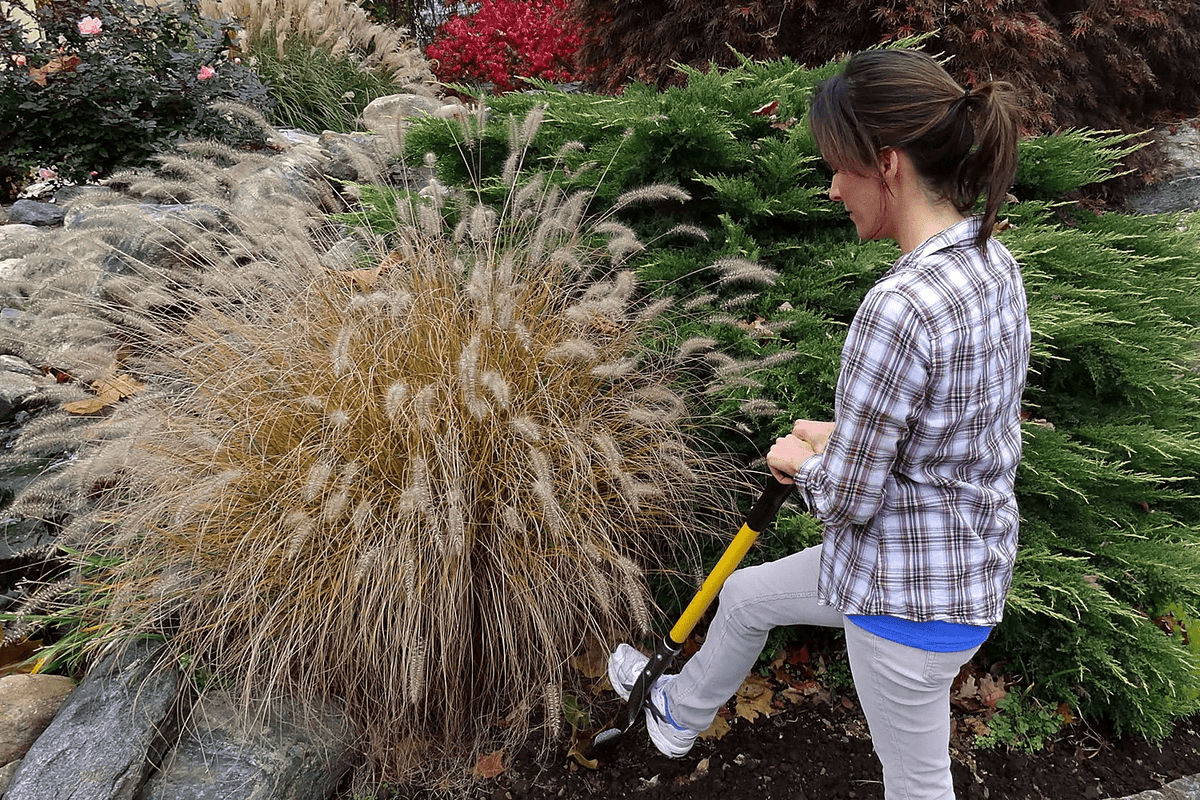
Anything finger-thick or less comes out as you work. Set the sharp edge of the 40 inch D-Handle Spear Head Spade squarely across the root, step onto the foot rest, and let your body weight carry the cut. These slice on the same downstroke that moves the soil, so the fine stuff clears without a tool change.
3. Sever the woody roots with loppers
Once a root is past about an inch and clearly woody, stop leaning on the spade. Loppers close on a one to three inch root in a single squeeze, and the cut stays clean, which is what lets the stub seal instead of rotting. Cut both ends of the section you want out, not just the near side.
4. Saw anything over about three inches with a root saw
Past three inches a spade will chip or bounce and loppers will not close. Undercut first so the root has open air beneath it, then make two cuts a few inches apart with a dedicated root saw or a reciprocating saw. A long run comes out faster in short lengths than in one heroic pull.
5. Lever the section out with the spade
With both ends cut, work the blade under the middle of the section and lever up, moving your feet instead of twisting your back. Roots hold soil, so the piece comes up heavier than it looks. If it will not lift, you have missed a cut, so go find it rather than force it. If the root leads back to a stump, that is a bigger job, and our guide on how to remove a tree stump covers it.
6. Backfill and settle the ground
Every root you pull leaves a channel, and a channel becomes a low spot after the first heavy rain. Refill it in layers, firming each layer with your boot or the back of the blade, then water it in so the soil collapses into the gaps. Check it again in a week and top it off.
Can you dig up tree roots without killing the tree?
Usually yes, if you keep the work outside the drip line, the circle of ground under the outermost branch tips, and remove no more than about a quarter of the root system in a season. Cut clean, leave the thick woody roots near the trunk in place, and spread a big job over two years.
How do I cut through roots without wrecking my back?
Root work is where gardeners hurt themselves, because the instinct is to twist, jerk, and pry with the lower back. The fix is technique and leverage, not brute force.

- Use your legs and body weight, not your back. Step onto the foot rest with your boot and let your weight drive the cut. On a spearhead blade the load funnels to the tip, so a single planted step often does what three angry stabs cannot.
- Get leverage with a longer handle. A longer shaft is a longer lever, so you move more root with less pull. The 58 inch Long Handle spade lets taller gardeners keep the back straighter and pry from a stronger position.
- Do not twist under load. Reposition your feet to face the cut instead of rotating your spine against a stuck root. Twisting plus force is the classic way to tweak a back.
- Let the tool rest between cuts. Undercut, breathe, then cut. Fighting a root nonstop is how you lose form.
- Save your knees too. For close-in root work at ground level, a garden kneeler keeps you off cold, hard soil and out of a permanent stoop.
If back, knee, and wrist strain is a regular concern, our full guide to ergonomic gardening goes deeper on tool choice and body mechanics.
Can a shovel cut through roots without damaging it?
Yes, if it is sharp and you use it correctly. A dull, flat shovel used as a chopping wedge is what ends up bent or chipped. Protect your blade with a few habits.
- Cut down, do not pry sideways against rock. Sideways prying against a root that is pinned by a rock is what bends necks and cracks blades. Undercut so the root has somewhere to go.
- Keep the edge sharp. A sharp edge slices with less force, which means less abuse on the tool and on you. A blade sharpened tip to tail, like the Spear Head, cuts small roots almost incidentally as you dig.
- Know when to switch. If the blade is bouncing off a woody root or you find yourself hammering it, that root is a saw job. Forcing it risks the tool.
- Choose hardened steel for root-heavy soil. Softer stamped shovels deform under this work; tempered carbon-manganese steel holds its edge and shape through repeated root cuts.
No sharpening needed
A common hardware-store shovel dulls fast in rocky ground, and a few passes with a mill file each season is the usual advice. The Spear Head is a different animal, and this is worth knowing before you ever reach for a file: the blade is tempered carbon-manganese steel, 33 percent thicker and 25 percent harder than standard shovel stock, tough enough that a regular file or grinder will not touch it. It does not need one. Each blade is pre-sharpened at the factory to a 35 degree bevel along the entire edge, tip to tail, then powder coated. The coating is designed to wear away gradually as you dig, continually exposing that factory edge. The more you use it, the sharper it gets. No sharpening needed. The rest of the shed is a different story, and our guide to cleaning, sharpening and storing garden tools covers the end-of-season routine for everything else you dug with.
Will cutting tree roots kill the tree?
Usually not, if you keep the cuts small, clean, and away from the trunk. Trees lose and regrow feeder roots all the time. The danger is cutting too many roots, or the wrong roots, too close to the trunk. A little judgment goes a long way here.
When it is generally fine
- You are cutting thin feeder roots out toward the branch tips, well away from the trunk.
- You are removing a modest share of the root system, not trenching a full ring around the tree.
- The cuts are clean, so they seal instead of rotting.
When it gets risky
- Close to the trunk. A common arborist rule of thumb is to stay outside a distance of roughly three to five times the trunk's diameter, measured out from the trunk, before cutting anything significant. Inside that zone you are into structural roots.
- Too much at once. Removing more than about a fifth to a quarter of a tree's roots in a single season stresses the tree and can lead to dieback. Spread big projects over more than one season.
- Big woody roots. Severing a major anchor root, especially on one side, can make a tree unstable even if it looks fine for a year or two.
If you are unsure whether a root is structural, or the tree is large, valuable, or near a structure, that is a good moment to call a certified arborist before you cut.
When should you stop and call a pro or rent power gear?
Most root work is a job for hand tools and an afternoon. A few situations are not, and knowing them keeps you safe.

- Anything near buried utilities. Before any real digging, call 811 (in the US) and have lines marked. A root wrapped around a gas, power, or water line is not a dig-it-out situation.
- Roots against a foundation, driveway, or hardscape. Cutting these can shift what they were bracing, or damage the structure. Get a professional opinion.
- Very large structural roots on a mature tree. This is arborist territory, both for the tree's health and your safety.
- A field of thick roots across a long trench. A reciprocating saw with a pruning blade, or a rented cutter, saves your back and hours of grief. Match the machine to the job, then finish the fine work by hand.
The right spade turns root-choked ground into a good afternoon
Most roots that stop a dig are small enough to slice, and a sharp, well-shaped blade turns that from a fight into a rhythm. The 40 inch D-Handle Spear Head Spade is the tool we reach for first when the ground fights back: a double-patented spearhead blade, sharpened tip to tail, that cuts roots as it digs and takes up to 80% less effort than a standard shovel. It carries a 4.9 average from more than 500 reviews, with over 600,000 sold, and it is the flagship of our family business of about fifteen years, based in New Jersey. It was designed by a Connecticut gardener, Daniel Mathieu, working with his son Julien, an engineer, a gardener-and-engineer pairing that shows in the way the blade cuts instead of chops. See the D-Handle spade and put roots behind you.
Tools for this job
Match the tool to the root in front of you: a sharp spade for the small ones, a cutter for the rest.

Spear Head Spade 40 inch D-Handle
Roots under an inch get sliced on the same downstroke that moves the dirt, with up to 80% less effort than a standard shovel.
Fiskars 32 inch PowerGear2 Bypass Loppers
Loppers handle the finger-thick to two inch roots that are too woody to slice cleanly with a spade, and the geared handles multiply your squeeze.
Check price on AmazonA dedicated root saw makes the clean cut on roots past three inches that a spade will only chip or bounce off.
Check price on AmazonThe cutter blade chops the large structural roots the table sends to a mattock, and the wide end pries them loose once cut.
Check price on AmazonA garden knife scrapes soil off a root so you can see its size and direction before you cut, and slices the fine ones as you go.
Check price on AmazonFrequently asked questions
How thick a root can you cut with a spade versus a saw?
As a rule, a sharp spade handles roots up to about an inch thick, cutting them as you dig. From one to three inches, move to loppers or a pruning saw. Beyond three inches, use a reciprocating saw or a dedicated root saw for a clean cut without straining your tool or yourself.
Can you cut tree roots that are above ground?
You can cut small exposed surface roots, but be cautious. Roots close to the trunk are more likely to be structural, and cutting large ones can hurt the tree's stability. Trim thin surface roots if needed, leave the big woody ones, and if a large surface root is a real problem, ask an arborist.
How close to a tree can you safely cut roots?
Stay well away from the trunk. A common guideline is to avoid significant cuts within roughly three to five times the trunk's diameter from the trunk, and to remove no more than about a fifth to a quarter of the root system at once. The farther out toward the branch tips you work, the safer the cut.
What can I cut tree roots with if I do not have a saw?
A sharp spade will slice small roots on the downstroke, and loppers handle roots up to a couple of inches. In a pinch, a sharpened hatchet or an old wood chisel and mallet will cut a woody root, as long as you undercut it first so it is not just flexing. Whatever you use, make sure it is sharp, a dull edge crushes rather than cuts.
Does cutting through roots damage the shovel?
Not if the blade is sharp and you cut straight down rather than prying sideways against a pinned root. Hardened steel with a real edge cuts small roots cleanly for years. When a root is too thick to slice and you find yourself hammering the blade, switch to a saw.
Where this comes up most
Planting a tree is where roots and digging technique meet most often, and where getting it wrong is expensive. Our guide to planting a tree covers finding the root flare, why you dig wide rather than deep, and the backfill choice that decides how well it establishes.
Disclosure: some links in this guide are affiliate links to Amazon. This is at no extra cost to you, and it never changes our honest, use-based recommendations.
Product prices and availability are accurate as of the date/time indicated and are subject to change. Any price and availability information displayed on Amazon.com at the time of purchase will apply to the purchase of this product.