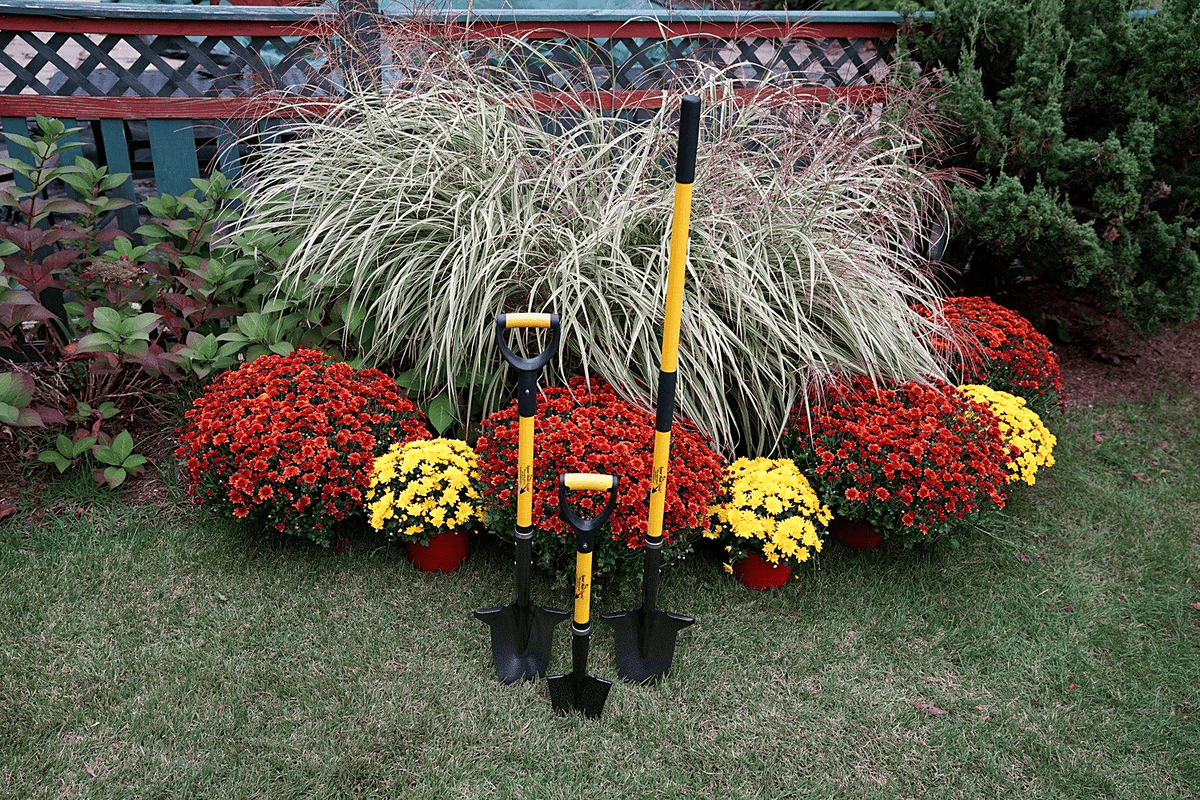
A spade is a digging tool with a narrow, sharp-edged blade set roughly in line with the handle, made for cutting soil, edging beds, and digging clean-sided holes. A shovel has a wider, dished blade angled away from the shaft, made for scooping and moving loose material like soil, gravel, and mulch.
Disclosure: some links in this guide are affiliate links to Amazon. As an Amazon Associate, Spear Head Spade earns from qualifying purchases. This is at no extra cost to you, and it never changes our honest, use-based recommendations.
People use the two words interchangeably, and that is fine at the hardware store. But once you have a bed to edge or a shrub to move, the difference is the difference between fighting your tool and letting it do the work.
What is the difference between a spade and a shovel?
The difference is blade geometry. A spade is a cutting tool: a narrow blade with a straight sharp edge, in line with the shaft so your body weight drives it down. A shovel is a moving tool: a wide dished blade angled away from the shaft, so it scoops and lifts instead.

Handle length, tip shape, and weight all follow from those two purposes. Here is the whole comparison at a glance.
| Feature | Spade | Shovel |
|---|---|---|
| Blade shape | Narrow, straight-sided or pointed | Wide, dished, concave |
| Edge | Sharpened, for cutting | Usually blunt, for scooping |
| Blade angle to shaft | Nearly in line with the shaft | Angled away, so it lifts |
| Tip | Square, or a spearhead point | Rounded or square |
| Handle | Shorter, D-grip or T-grip | Often longer and straight |
| Best jobs | Edging, sod, roots, planting holes, transplanting | Moving soil, gravel, compost, mulch, snow |
| Wrong for | Carrying a big load | Cutting a clean line or a root |
| What to buy | One sharpened spade covers most garden work | Add a round point shovel for moving piles |
What is a spade tool?
A spade is a garden tool with a narrow blade set in line with the handle and a sharpened edge along the bottom. You drive it straight down with your foot rather than scooping with it. That is what it is for: cutting sod, edging beds, slicing roots, and digging clean-sided holes.
The word is used more strictly in the UK than in the US, where almost any digging tool gets called a shovel. That is where most of the confusion comes from, and it is why two people can argue about a spade versus a shovel while holding the same tool.
If the listings all blur together, judge the blade before the price. Steel, edge, and how the handle joins the blade decide whether a spade lasts a season or twenty years. Our 40 inch D-Handle spade is where most gardeners start.
What is a spade shovel?
A spade shovel is the everyday name for a tool asked to do both jobs: cut like a spade and carry like a shovel. Most tools pick a side, so what gets sold under that name is usually a round point shovel with a sharper tip, or a spade with a slight dish to the blade.
The Spear Head Spade is the first hybrid spade and shovel, built for that exact request: the blade is curved so it can carry material and drawn to a sharpened point so it cuts. The section below on blade shape covers how it does both.
What is a spade used for?
A spade is used for cutting and precision digging: edging beds, slicing sod, severing roots, digging clean-sided planting holes, and lifting plants for transplanting. The blade is narrow and the edge is sharp, so it slices into the ground rather than pushing dirt around, and your foot does most of the work.

- Digging clean-sided planting holes. A straight edge gives square walls and a flat bottom, which is what a root ball wants.
- Edging beds and lawns. Press the edge down along a bed line and you get a crisp border in one pass.
- Cutting sod and roots. A sharp spade slices turf into liftable strips and severs surface roots instead of bouncing off.
- Dividing and transplanting. Drive it down around a clump, then lever the plant out with its roots intact.
- Breaking hard, compacted, or clay soil. A pointed spade concentrates your weight on a small area, so the blade penetrates instead of skating.
The classic mistake is trying to scoop with a spade. Cut with it, then switch tools to move the loose material.
What is a garden shovel used for?
A garden shovel is used for moving loose material: soil, gravel, sand, compost, and mulch. It earns its keep once the ground is already broken. The dished blade holds a load, and the forward angle at the neck lets you scoop off the ground without stooping all the way over.
- Moving loose soil, gravel, sand, and compost. The curve cradles the load so it does not spill off the sides.
- Spreading mulch and topdressing. Scoop, carry, and fling in one motion.
- Digging already-loosened ground. A round point shovel bites into soft soil fine. It just will not cut a clean edge.
- Mixing and filling. Loading a wheelbarrow, backfilling a hole, blending amendments.
Ask a shovel to cut a bed edge or split a dense root ball and the rounded blade wanders while the blunt edge tears.
How does a traditional spade differ from round and square shovels?
A traditional spade has a narrow, straight-edged blade in line with the shaft, sharpened to cut. A round point shovel has a wide dished blade with a rounded point, angled away from the shaft, for digging loose ground and scooping. A square shovel has a flat front edge and no point, so it cannot penetrate soil at all.

The handles follow the same logic. A spade runs short with a D-grip for close control, a shovel runs long and straight for reach and swing. Put simply, the spade cuts, the round point digs and scoops, and the square shovel only scoops, lifting loose material cleanly off a hard surface. That is why a square shovel is wrong for a planting hole and right for clearing a gravel driveway.
Is a spade the same as a trowel?
No. A trowel is a small hand tool with a scooped blade, used one handed for bulbs, seedlings, and close weeding. A spade is a full-size two handed tool you stand on. The jobs barely overlap: a trowel cannot open a hole for a shrub, and a spade cannot work between established plants.
Most gardens need both, and a good garden trowel costs a fraction of what a spade does.
Why is a spade blade sharp and a shovel blade dished?
It comes down to physics. A narrow blade with a sharp edge turns your downward force into a cut, because nothing deflects the pressure sideways. A dished blade trades that cutting action for capacity: the concave shape holds material, and the forward angle at the neck lets you scoop and swing a load without bending double.
- Edge sharpness. A good spade is sharpened, a shovel usually is not. That single fact is why a spade cuts roots and sod so much more easily.
- Shaft and handle. A short shaft with a D-grip gives close control and two-handed leverage. A long straight shaft gives reach and swing. A long-handled spade gets you spade cutting without kneeling, which is why our 58 inch Long Handle spade exists.
- Weight and balance. A spade concentrates weight over the blade so you can stomp it home. A shovel spreads weight for a lighter carry.
- Leverage. With a spade, your weight on the foot rest sinks the blade and the handle levers material free. With a shovel, your arms and back do the lifting.
Blade design is also what separates a good digging tool from a frustrating one, and the Spear Head Spade splits the difference on purpose. We have always called it the first hybrid spade and shovel: the blade is gently curved like a shovel so it can carry, but drawn to a sharpened point like a spade, with a cutting edge in tempered carbon-manganese steel running tip to tail. It enters the soil at one point and slices outward as it sinks, taking the path of least resistance around a rock rather than stopping at it, which is why it takes up to 80% less effort than a standard shovel in hard, clay, or rocky ground. It holds about 30% less material than a standard round-head shovel, a trade worth making on almost every dig, with one honest exception: in pure sand with no rocks or roots, a standard round-head shovel is the better scoop.

Which do you need for the job in front of you?
Match the tool to the motion. If the job is a cut, reach for a spade. If it is a lift, reach for a shovel.
| Job | Reach for | Why |
|---|---|---|
| Cutting through roots | Sharp spade | A sharpened edge severs a root on the way down. A blunt one bounces off. |
| Digging in heavy clay | Pointed spade | A point concentrates your weight so the blade penetrates. |
| Edging a bed or path | Spade, every time | Only a straight sharp edge leaves a clean line in one pass. |
| Transplanting a shrub | Spade | Cut a circle around the root ball, then lever the plant out intact. |
| Digging a planting hole | Spade to open, shovel to backfill | The spade shapes clean walls, the shovel refills faster. |
| Cutting and lifting sod | Spade | Slice the turf into strips, then lift them on the blade. |
| Moving mulch, gravel, or compost | Round point shovel | The dish holds the load and the angle saves your back. |
| Clearing loose material off a hard surface | Square shovel | A flat front edge gets under the pile. |
If you fight roots often, our guide on cutting through roots when digging has the technique. If the soil is the problem rather than the tool, start with how to improve clay soil.
Do I need a spade or a shovel?
Most gardeners need a spade first. Be honest about what you do most: if you dig, edge, plant, and divide, a spade handles the large majority of your work. If you spend more time moving piles of loose material than breaking ground, a shovel matters more. Many sheds end up with both.
If you can only own one, buy the spade. A sharp one can dig, edge, cut, transplant, and even move a modest amount of loose soil in a pinch. A shovel cannot cut an edge or slice a root to save its life, so the spade is the smarter single purchase.
For that role, the 40 inch D-Handle spade is our flagship. For tight raised beds and containers, or a lighter tool for a younger or shorter gardener, the 30 inch Mini spade covers close-quarters work. See the full lineup on our tools page, or compare the field in our roundup of the best shovels for digging.
What are the different types of spades and shovels?
Once you know the two families, the named variants make sense. Each is a blade shape tuned to a narrower job.
| Tool | Blade shape | Typical handle | Best at | Wrong for |
|---|---|---|---|---|
| Garden spade | Narrow, straight edged, in line with the shaft | Short, D-grip | Edging, sod, roots, planting holes | Carrying loose material |
| Border spade | Smaller and lighter | Short, D-grip | Working among established plants | Heavy breaking ground |
| Transplanting spade | Long, narrow, tapered | Short or long | Deep holes around root balls | Wide holes, general digging |
| Round point shovel | Wide, dished, rounded point | Long, straight | Digging loose ground, scooping | Cutting a clean edge |
| Square shovel | Wide, dished, flat front edge | Long or D-grip | Lifting gravel and mulch off hard surfaces | Breaking ground |
| Trenching shovel | Narrow, V shaped | Long, straight | Narrow trenches for irrigation and borders | Anything wide |
| Post hole digger | Twin hinged blades | Two long handles | Pulling a plug of soil out of a deep, narrow hole | Anything but a post hole |
| Snow shovel | Wide, light, deeply dished | Long, often bent | Pushing snow off a hard surface | Digging anything |
| Trowel | Small scooped hand blade | One hand | Bulbs, seedlings, close weeding | Anything needing a boot |
What about hoes and garden forks?
A hoe is a bladed head on a long handle that you pull or push just under the surface to sever weeds at the root line. A well-made hoe like our 60 inch Garden Hoe has flow-through windows that let soil pass, so it glides instead of dragging. Our guide to hoe types has the breakdown.
A garden fork, or spading fork, swaps the blade for tines. It loosens soil, turns compost, and lifts root crops without slicing them, which is the one job a spade is genuinely bad at. An edger is a half-moon blade dedicated to lawn edges, and a sharp spade does the same job, which is why many gardeners never buy one.
How do I choose a good quality garden spade?
Judge a spade on four things: blade steel, edge sharpness, how the handle joins the blade, and the foot rest. A cheap spade bends, dulls, and loosens at the handle within a season, while a well-made one becomes the tool you reach for without thinking for twenty years.

- Blade steel. Hardened carbon or manganese steel holds an edge and resists bending when you lever against a root or a rock. Softer stamped steel folds.
- Blade shape and sharpness. A sharpened edge does far more work for far less effort, and a point that concentrates force helps enormously in hard soil.
- Handle and construction. Hardwood and fiberglass both work. The joint matters more: a solid socket or one-piece construction is much harder to snap than a riveted tang.
- Foot rest. A flat rolled foot rest saves your boot and lets you put real weight into the cut.
To be honest about our own tool: the Spear Head Spade was invented by Daniel Mathieu, at 85, in his garden in Windsor, CT, with his son Julien, an engineer named on both patents. It is double patented, with a spearhead blade in tempered carbon-manganese steel 33 percent thicker and 25 percent harder than standard shovel stock, which is why it cuts hard ground with up to 80% less effort than a standard shovel. Better Homes and Gardens named it a "Best Shovel/Spade" in 2025, it carries a 4.9 average from more than 470 reviews and over 600,000 sold, and it comes with a limited lifetime warranty, a one-time replacement if your tool ever breaks. It is a family business in New Jersey, 15 years on from that first shovel.
If you kneel a lot to plant and weed, pair your spade with a simple Garden Kneeler pad, and read our notes on ergonomic gardening techniques.
How do you care for a spade or shovel?
Clean the blade after every use, keep the edge sharp, wipe the metal with a light oil before storage, and hang the tool up somewhere dry. Good tools last decades on that much effort and no more. Rust and a rotted handle are the only two things that really kill them.
- Clean it after every use. Knock the soil off and hose it down. Wet dirt on the blade starts rust.
- Keep the edge sharp. On an ordinary spade, a few passes with a flat file along the bevel restores the edge. Ours is the exception: the Spear Head blade is pre-sharpened at the factory to a 35 degree bevel tip to tail, and the powder coat wears away gradually to keep exposing it. A regular file will not touch the steel, and it should never need one.
- Oil it. Wipe the blade with a light oil before storage, and rub linseed oil into a wooden handle once a season to stop it drying and cracking. Fiberglass handles like ours need none of that.
- Store it dry and off the ground. A tool standing blade-down in a damp corner rusts and rots.
The bottom line: a spade cuts and digs, a shovel scoops and moves, and most gardeners get more done with a sharp, well-built spade in hand. If you want the one tool that handles the bulk of your digging, start with the 40 inch D-Handle Spear Head Spade.
Tools for this job
One tool to cut and dig, and the right shovel shape for whatever you are moving.

Spear Head Spade 40 inch D-Handle
The first hybrid spade and shovel: curved enough to carry, pointed and sharpened tip to tail so it cuts hard ground with up to 80% less effort than a standard shovel.

Bully Tools 14-Gauge Round Point Shovel
A round point shovel bites into already loosened soil and scoops it out in the same stroke, and in pure sand it is the better scoop.
amazon
Ames True Temper Square Point Shovel
A flat square blade lifts gravel, mulch, and compost cleanly off a hard surface, which is moving work, not digging work.
amazon
Bully Tools 14-Gauge Trenching Shovel
A narrow V blade cuts a clean slot for irrigation lines and bed borders without opening a wide hole.
amazonFrequently asked questions
What is the difference between a spade and a shovel?
A spade has a narrow, sharp blade in line with the handle, for cutting, edging, and digging clean-sided holes. A shovel has a wider, dished blade angled away from the shaft, for scooping and moving loose material like soil, gravel, and mulch.
Is a spade the same as a shovel?
No, though the words are used interchangeably in everyday speech. A spade is built to cut and dig, a shovel to scoop and lift. The giveaway is the blade: narrow and sharp on a spade, wide and dished on a shovel.
Can a shovel be called a spade?
In everyday use, yes, and nobody will correct you at the hardware store. In tool terms they are two different things, and the distinction matters when you buy: a shovel will not cut a bed edge, and a spade will not move a pile of gravel efficiently.
What are the three types of shovels?
The three you will see most are the round point shovel for digging and scooping, the square shovel for lifting loose material off hard surfaces, and the trenching shovel for narrow slots. Snow shovels are a fourth family, built to push rather than dig.
What is the difference between a spade, a shovel, and a trowel?
A spade cuts and digs, a shovel scoops and moves, and a trowel is a small hand tool for planting and close work in containers. Think of it as the one-hand tool for jobs too small for a full-size blade.
How do I choose a good quality garden spade?
Look for hardened carbon or manganese steel that holds an edge, a sharpened blade, solid socket or one-piece construction where the handle meets the blade, and a comfortable foot rest. Those four separate a spade that lasts decades from one that bends in a season.
Where the difference shows up most
Edging is the job that separates the two tools clearly, because it asks a blade to slice a clean line rather than scoop. Our guide to cutting and keeping a clean bed edge covers the technique step by step, and compares the main landscape edging materials.