As an Amazon Associate we earn from qualifying purchases. Some links are paid. Disclosure
Our top picks
A pin meter for most woodpiles
1. Proster PST050 Pin Moisture Meter
Best for: Most woodpiles, read on a fresh split at room temperature
Pinless option for dense splits
2. Proster PST199-P Pinless Moisture Meter
Best for: Dense oak and locust splits, if you would rather not drive pins
Firewood is seasoned when it has dried to below 20% moisture content, the line set in the US EPA's Burn Wise guidance, and the one check that proves it is to split a piece and test the new face with a moisture meter. Without a meter, a seasoned split usually shows cracks running across its ends, feels lighter than a green split of the same wood, and gives a crisp, hollow knock against another split instead of a dull thud. Its bark is often loose and its color faded. No single sign settles it: gray color and cracked ends are easy to see, and neither proves the inside is dry (Farm and Dairy warns that some cracked logs can still be too green to burn).
If you buy one tool for this, make it a pin moisture meter: the Proster PST050 is a pin meter whose listing names firewood and logs among its uses, and our firewood moisture meter guide compares it with other meters. If you burn mostly dense oak or locust and would rather not drive pins, the Proster PST199-P is a pinless option you press flat on a fresh split; it is a general wood and building meter, and its listing does not mention firewood. Below: what seasoned really means, the eight checks ranked by how far to trust them, a species table that works out how much lighter a split gets as it dries, and how long drying takes.
Jump to: What seasoned means | The eight checks | Weight by species | How long it takes | Pin or pinless | Testing with a meter | Signs in the stove
Start here: the two-minute check
Test the pieces most likely to be wet. Farm and Dairy notes that logs and unsplit pieces near the center of a pile, or touching the ground, dry out very little, so pull three splits from the middle and bottom of the stack rather than the sunny top. Then:
- Split each one again and test the new face with a moisture meter. Under 20% is seasoned by EPA's line. EPA's own method is to split the wood and test the newly split side. On a cold day, warm the splits indoors before you test them, since very cold wood can affect a reading (see testing with a meter).
- No meter? Feel the new face, then read the outside. Farm and Dairy says dry wood is dry to the touch on the inside. Then look for cracks across the ends, heft the split, and knock two splits together.
- A reading of 20 to 30% means close, not done. Over roughly 30%, the wood still holds free water in its cells and needs months more (see how long it takes).
If you are buying a meter for this, the two we link are side by side here. The pin meter is the one most people should get; the pinless one is an option for dense splits, with the limits the meter section explains.
| Pick | Type | Wood range | Wood settings | Reads | Power | Best for | Our verdict | Where to buy |
|---|---|---|---|---|---|---|---|---|
| 1. Proster PST050 Pin Moisture MeterA pin meter for most woodpiles | Pin | 0% to 99.9% | Four modes, about 28 species | Where its 10 mm pins go in | 9V battery, included | Most woodpiles, read on a fresh split at room temperature | A pin meter with 10 mm pins and four wood modes covering about 28 species, whose listing names firewood and logs among its uses. | Check price on Amazon |
| 2. Proster PST199-P Pinless Moisture MeterPinless option for dense splits | Pinless | 5% to 75% | Soft wood and hard wood modes | Up to 3/4 inch below the surface | 9V battery, included | Dense oak and locust splits, if you would rather not drive pins | A pinless meter that reads up to 3/4 inch below the surface with soft wood and hard wood modes, pressed flat on a fresh split face. | Check price on Amazon |
What seasoned firewood means
Seasoned firewood is wood that has been cut, split and stacked long enough to air-dry below 20% moisture content. EPA's Burn Wise pages and Cornell Cooperative Extension both use 20% as the line, and EPA's Wet Wood Is a Waste brochure says properly dried wood should read 20% or less. Green wood, cut from a living tree, starts far above that: UNH Extension puts it between 50% and more than 100%, and Cornell says most firewood sold green could be at 100% or more.
Those percentages confuse people because they can pass 100. The Forest Products Laboratory's Wood Handbook defines moisture content as the weight of the water divided by the weight of the oven-dry wood, so 100% means a split holds as much water as wood. Cornell puts it the same way: half the weight is water. A split at 20% holds one fifth of its dry weight in water. A 10 lb split at 20%, for example, is about 8.3 lb of wood and 1.7 lb of water (our arithmetic).
The last stretch is the slow one. The Wood Handbook puts the fiber saturation point of wood at about 30% on average: above it, water sits free in the cell cavities; below it, the water left is bound inside the cell walls. Cornell describes the same thing from the woodpile: the free water leaves fairly easily and gets wood down to 25 to 30%, while the bound water takes much longer. That is why so much wood stalls just short of ready, and why UNH Extension describes air-dried wood as generally around 30%. A load sold as seasoned is worth testing.
Why it matters: wet wood burns poorly and dirtily. Cornell says wood above 20% makes more smoke and creosote and gives less heat, because the fire spends energy boiling off the water, and Kentucky's forestry extension says unseasoned wood makes a fire smolder and builds creosote in the chimney.
The eight checks, ranked by how far to trust them
Each check below comes from extension and EPA advice, Farm and Dairy's checklist, and members of Hearth.com; the ranking is ours. The top two test the inside of the wood. The rest read the outside, which dries first, so treat them as reasons to test, not as proof.
| Check | Seasoned wood | Still green | What can fool it | How far to trust it |
|---|---|---|---|---|
| 1. Meter on a fresh split | Under 20% (EPA) | 50% to more than 100% (UNH Extension) | Testing the weathered outside; testing wood that is very cold (Delmhorst) | Decides it |
| 2. Feel of a fresh split | Dry to the touch inside (Farm and Dairy) | Damp inside | Only tells you about the face you split | High |
| 3. Weight | Weighs less (EPA) | Heavy for its size | Species: ash starts drier than oak, so it lightens less (see the weight table) | Good on oak, elm and birch; weak on ash |
| 4. Sound | Crisp and solid (Cornell) or hollow (EPA) when two splits knock together | Dull and muffled (Cornell) | It can take years of burning to learn the difference (about five, one Hearth.com member says) | Good, once you have heard both |
| 5. Cracks in the ends | Checks up to a quarter inch wide (Cornell), running out from the center (Farm and Dairy) | Few or none | Some dry logs never crack, and some cracked ones are still too green (Farm and Dairy) | Medium, never alone |
| 6. Color | Faded and less vibrant (Farm and Dairy); a gray tone on wood that has dried a long time (Kentucky) | Brighter, fresher color | The outside weathers while the inside can still be wet | Low on its own |
| 7. Bark | Loose, easy to pull off, bare spots (Farm and Dairy) | Tight to the wood | Splits with no bark left give you nothing to read | Low |
| 8. Smell | A light woody smell (Farm and Dairy) | A stronger, sappy smell that varies by tree | Species smell different to begin with | Low |
What it shows: only the first two checks look inside the wood, which is where water hides the longest. Cornell notes that most meters' probes go in about a quarter inch and read only that depth, and that the wood could be wetter deeper in, which is why it suggests splitting a few pieces and testing the inside. EPA says the same with its split-and-test method. A gray, cracked outside says nothing certain about the inside, which Cornell notes can be wetter.
The fresh split and the meter
This is the check that settles it. Split a piece through the middle, push the meter's pins into the new face as far as they will go, and read the number. A Hearth.com member who explains how pin meters work points out that the pins need to go in as deep as possible for a true reading. Under 20% is ready by EPA's line. The how-to section below covers the steps, including what to do on a cold day.
Weight and sound
EPA's brochure says wood that has dried properly weighs less and gives a hollow sound when you knock it against another piece. Cornell describes the knock as crisp and solid for seasoned wood and duller and muffled for green wood. Both checks work best when you compare splits of the same species, which is where the weight table below comes in. A Hearth.com member's advice is that after about five years of burning you can tell dry from wet by a split's weight and the sound two splits make knocked together; a meter covers you until then.
The ends, the color and the bark
As wood dries, its ends usually open up in cracks, called checks, that Cornell says can reach a quarter inch wide, and Farm and Dairy says they run from the center toward the edges. Farm and Dairy also warns not to rely on cracks alone: some dry logs never crack and some cracked ones are still too green to burn. Color fades as wood dries, and Kentucky's forestry extension says a gray tone shows wood that has been drying a long time; EPA's own description is that properly seasoned wood is darker. Either way, color is weathering on the outside. Loose bark that pulls away easily is another sign Farm and Dairy lists, as is a fading smell: green wood has a stronger, sappy aroma that depends on the tree.
The weight check, by species: what a split loses on the way to 20%
How much lighter a split gets depends on how wet that species is when it is cut. The Wood Handbook's Table 4-1 gives the average green moisture content of each species, separately for heartwood and sapwood. From those averages, a split's weight at 20% is its green weight times 1.2 divided by (1 plus its green moisture content). The table shows what a 10 lb green split weighs once it reaches 20% (our arithmetic, rounded to a tenth of a pound).
| Species | Green heartwood moisture, % (Wood Handbook) | 10 lb green heartwood split at 20% | Green sapwood moisture, % (Wood Handbook) | 10 lb green sapwood split at 20% |
|---|---|---|---|---|
| White ash | 46 | 8.2 lb | 44 | 8.3 lb |
| Sugar maple | 65 | 7.3 lb | 72 | 7.0 lb |
| Silver maple | 58 | 7.6 lb | 97 | 6.1 lb |
| Northern red oak | 80 | 6.7 lb | 69 | 7.1 lb |
| White oak | 64 | 7.3 lb | 78 | 6.7 lb |
| Mockernut hickory | 70 | 7.1 lb | 52 | 7.9 lb |
| American beech | 55 | 7.7 lb | 72 | 7.0 lb |
| Black cherry | 58 | 7.6 lb | Not listed | Not listed |
| Paper birch | 89 | 6.3 lb | 72 | 7.0 lb |
| American elm | 95 | 6.2 lb | 92 | 6.3 lb |
| Douglas-fir (coast) | 37 | 8.8 lb | 115 | 5.6 lb |
| Lodgepole pine | 41 | 8.5 lb | 120 | 5.5 lb |
What it shows: white ash goes into the pile at under 50% and loses less than a fifth of its weight on the way to 20%, so a dry ash split rarely feels much lighter than a green one. Red oak heartwood, paper birch heartwood and elm lose a third or more, so on those woods the heft test is a strong sign. In the two softwoods the sapwood is far wetter than the heartwood, as the Wood Handbook says is usual for softwoods, and it loses more than 40% of its weight. These are averages: the Wood Handbook notes that green moisture varies a good deal within and between trees, so compare splits from the same tree or the same load, not a split against a number.
How long firewood takes to season
The sources agree on a floor of about six months once the wood is cut, split and stacked, and on longer for dense hardwoods and shady spots:
| Source | What it says |
|---|---|
| EPA, Wet Wood Is a Waste | Softwoods take about 6 months, hardwoods about 12 months |
| EPA, best wood-burning practices | At least six months of seasoning |
| EPA, moisture meter flyer | Split, stack, cover and store it for at least 6 to 12 months |
| Cornell Cooperative Extension | At least six months to get green wood under 20%; much longer where the pile sits in shade or close to a stream or lake; some hardwoods take longer; buy wood a year ahead |
| University of Kentucky forestry extension | Six months at minimum once it is cut, split and stacked |
| Farm and Dairy | Six months to two years |
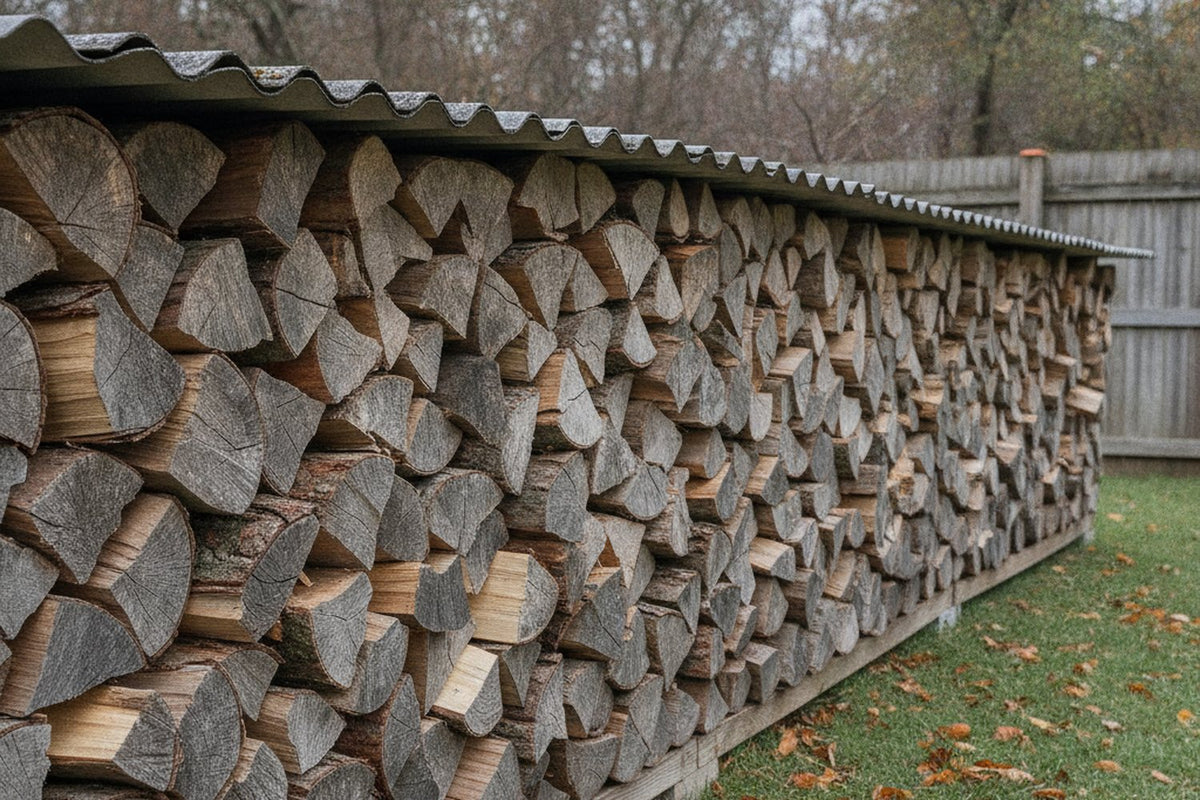
Splitting is the biggest lever. EPA's brochure says split wood dries much faster than whole rounds and recommends splitting no larger than 6 inch wedges, and UNH Extension calls splitting bought rounds critical to speeding the drying. Our log splitter guide and splitting axe guide cover the tools for it. Then stack for air: EPA says off the ground on rails, in a single row, away from buildings, with the top covered and the sides open; UNH Extension says an open, sunny spot with air on all sides is best. Our firewood rack guide covers racks that hold a stack off the ground. A calendar only tells you when to start testing.
Which meter for the split test: pin or pinless
A pin meter drives two pins into the wood and reads the electrical resistance between them; a pinless meter presses a sensor pad on the surface and reads the wood under it with an electromagnetic field. Lignomat, which makes both kinds, says a pin meter shows the highest moisture in the small area between its pins, while a pinless meter shows the average of the wood under its pad. For firewood, a pin meter is the one most people should get, and our firewood moisture meter guide explains why; the pinless meter here is for anyone with dense wood who would rather not drive pins.
1. Proster PST050 Pin Moisture Meter: a pin meter for most woodpiles
A pin meter for most woodpiles
Best for: Most woodpiles, read on a fresh split at room temperature
Proster PST050 Pin Moisture Meter
- Type: Pin
- Wood range: 0% to 99.9%
- Wood settings: Four modes, about 28 species
A pin meter with 10 mm pins and four wood modes covering about 28 species, whose listing names firewood and logs among its uses.
Proster's PST050 is a pin meter with two built-in 10 mm (0.4 inch) pins. Its listing gives a wood range of 0% to 99.9%, read in steps of 0.1%, an accuracy of plus or minus 0.5%, and four wood modes covering about 28 species. It also has a large LCD, a Data Hold function, auto power-off and a low-battery display, and its manual says a 9V battery and a protective case come with it.
Why it is the pick: a pin meter is the kind our firewood moisture meter guide prefers for most people who burn wood, and this one's listing names firewood and logs among its uses. Its wood range reaches well past 30%, so it can tell wood that has nearly made it from wood that is still green. Because a pin meter reports the wettest spot between its pins, a reading under 20% on a fresh face at room temperature is a reading you can act on.
Good to know: match the mode to your wood before you read the number. The MODE button steps through four species groups, and the listing's table puts beech in group B; ash, elm and maple in group C; and birch and pine in group D. For other woods, Popular Mechanics says the modes cover 28 species in all, oak among them, and that a guide on the front of the housing matches each one to a mode. The manual gives an operating temperature of 32 to 104 degrees F.
2. Proster PST199-P Pinless Moisture Meter: a pinless option for dense splits
Pinless option for dense splits
Best for: Dense oak and locust splits, if you would rather not drive pins
Proster PST199-P Pinless Moisture Meter
- Type: Pinless
- Wood range: 5% to 75%
- Wood settings: Soft wood and hard wood modes
A pinless meter that reads up to 3/4 inch below the surface with soft wood and hard wood modes, pressed flat on a fresh split face.
Proster's PST199-P is a pinless meter: you press its pad flat on the wood instead of driving pins, and its listing says it reads up to 3/4 inch (19 mm) below the surface. It has soft wood and hard wood modes that read 5% to 75%, a wall and masonry mode, a three-color LED bar with sound alerts, a backlit screen, a HOLD button and auto power-off, and its listing says a 9V battery and a storage bag come with it. Its listing pitches it for hardwood, softwood, drywall and masonry, for carpentry and leak repair, and does not mention firewood.
Why it is here: some people would rather not drive pins into dense wood. A Hearth.com member who compared a pin meter and a pinless meter on oak pieces fresh off their splitter found the two read close, some higher and some lower, and said that because oak and locust are so common where they live, they find the pinless meter easy to use. Delmhorst, a meter maker, says a pinless meter is barely affected by the temperature of the wood unless it is frozen solid, and Lignomat also says wood temperature does not affect its pinless readings.
Where it loses: firewood is not flat. Another Hearth.com member warns that a pinless meter needs firm pressure on the wood, that any air between the pad and the wood will affect the reading, and that because firewood is never flat, the reading will almost always be off. Lignomat, which makes pinless meters, lists "a smooth surface and a flat measuring area" as requirements, says its pinless meters report an average and, unless they read at two depths, cannot tell surface moisture from core moisture, and offers corrections for different wood species; this meter's listing offers only soft wood and hard wood modes. The member who compared the two says the split has to be more than an inch thick. Delmhorst adds that on very cold wood, surface moisture from condensation is the real obstacle. So press it flat on a fresh, flat split face, and if it reads near 20%, give the wood more time or check it with a pin meter. For those reasons our firewood moisture meter guide prefers a pin meter for most people.
How we chose these two: both were in stock on Amazon and sold new when we checked on November 5, 2026. Proster is one of the brands that pay us through Amazon's creator program. That is why both meters on this page are Prosters. The PST050 is the pin meter, and its listing names firewood. Some other Proster listings that name firewood, including the PST252-US and one PST276-US, were not showing as in stock on Amazon when we checked; of the Proster meters in stock that are pinless only, the PST199-P is the only one whose listing gives a wood percent range, so it is the pinless pick, for the job above. For more meters, pin and pinless, see our firewood moisture meter guide.
The meter test, step by step
- Pick your worst pieces. Take three splits from the middle and bottom of the stack, the spots most likely to stay wet (Farm and Dairy says logs and unsplit pieces there dry out very little).
- Warm them up. Bring them indoors to room temperature first, since very cold wood can affect a reading (Delmhorst).
- Split each one again. EPA's method is to split the wood and test the newly split side, not the weathered outside.
- Set the meter for the wood. On the Proster PST050, press MODE until the screen shows your species' group, from the table in the listing or the guide on the front of the housing.
- Test the middle of the new face. Push the pins in as deep as they will go, or press a pinless pad flat with no air under it.
- Read it against 20%. Under 20% is ready by EPA's line. From 20 to 30%, give the stack more time; over roughly 30%, the wood still holds free water.
Signs in the stove that the wood is still wet
If the wood is already burning, the fire tells you too. EPA's brochure lists a smoldering fire, dirty glass doors and smoke from the chimney as signs that either the fire is short of air or the wood is too wet. Farm and Dairy adds that green wood is hard to light and smolders with a lot of smoke, and suggests burning a test piece outside before you bring a load in. Wet wood is more than a nuisance: Cornell and EPA both tie it to creosote, which EPA calls a chimney hazard, and Kentucky's forestry extension says creosote build-up can, over time, lead to a chimney fire.
Keep it seasoned once it is dry
Dry wood does not stay dry on its own. Kentucky's forestry extension says seasoned wood can take water back up, so keep the stack where air can circulate and cover only the top. EPA says covering the sides traps moisture, and its brochure says to leave space between the cover and the wood rather than letting the cover rest on the stack. Cornell suggests pallets as a first layer, a stack no more than two layers deep, and in the Northeast a cover over the top against rain and snow.
Related guides
If the meter says the wood needs more time, our firewood rack guide covers keeping a stack off the ground while it dries. If you are still putting up next winter's wood, our log splitter guide and splitting axe guide cover splitting it small enough to dry quickly. For a full comparison of meters, pin and pinless, see our firewood moisture meter guide.
A word from the people who wrote this
We are Spear Head Spade, and we make digging spades, not moisture meters or firewood tools, so nothing on this page is ours. When spring comes around, our spade finder matches a spade to your soil.
Frequently asked questions
How can you tell if firewood is seasoned without a moisture meter?
Split a piece and feel the new face: seasoned wood is dry to the touch inside. Then look for cracks across the ends, heft the split against a green one of the same wood, and knock two splits together. Cornell describes a crisp, solid sound for seasoned wood and a duller, muffled one for green wood. No one sign proves it, and Farm and Dairy warns that cracked ends alone can mislead.
What moisture content should seasoned firewood be?
Below 20%, read on a freshly split face. EPA's Burn Wise pages and Cornell Cooperative Extension both use 20% as the line. UNH Extension describes air-dried wood as generally around 30% and calls 20 to 30% the best stove fuel, so sources differ; your stove maker's manual has the final say, and EPA's 20% is the stricter target.
How long does it take to season firewood?
At least six months once it is cut, split and stacked, by EPA, Cornell and Kentucky's forestry extension. EPA's Wet Wood Is a Waste brochure puts softwoods at about 6 months and hardwoods at about 12, Cornell says a shady spot or one near water can take much longer, and Farm and Dairy gives a range of six months to two years. Test the wood rather than counting months.
Does seasoned firewood always have cracks in the ends?
Usually, but not always. Cornell says drying wood usually opens checks in its ends up to a quarter inch wide, and Farm and Dairy warns that some dry logs never crack while some cracked ones are still too green to burn. Treat end cracks as one sign among several.
Is gray firewood seasoned?
Gray usually means the wood has been out a long time, as Kentucky's forestry extension notes. Because color only shows the outside, split a piece and test the new face, as EPA and Cornell advise.
What is the difference between seasoned and kiln-dried firewood?
Seasoned wood is air-dried in a stack; kiln-dried wood is dried with heat. UNH Extension says air-dried wood is generally around 30% moisture and kiln-dried firewood generally under 20%, so a load sold as seasoned is worth testing before you burn it.
Can seasoned firewood get wet again?
Yes. Kentucky's forestry extension says dried wood can take water back up, so keep it stacked where air moves, with only the top covered. EPA says covering the sides traps moisture.
Is a moisture meter worth it for firewood?
For your first few seasons, yes. Cornell suggests a basic meter for anyone unsure of their wood, and a Hearth.com member's view is that a meter matters most in your first year or two, until your splitting and storage get far enough ahead, and that after about five years of burning you can tell dry from wet by a split's weight and the sound of two splits knocked together.
Disclosure: Some links pay us a commission when you click or buy, and on some pages brands pay us through Amazon's creator program on links to their products. Availability was checked on Amazon on November 5, 2026 and can change.
Product prices and availability are accurate as of the date/time indicated and are subject to change. Any price and availability information displayed on Amazon.com at the time of purchase will apply to the purchase of this product.