As an Amazon Associate we earn from qualifying purchases. Some brands also pay us when you click or buy, so those links are ads. Full disclosure below
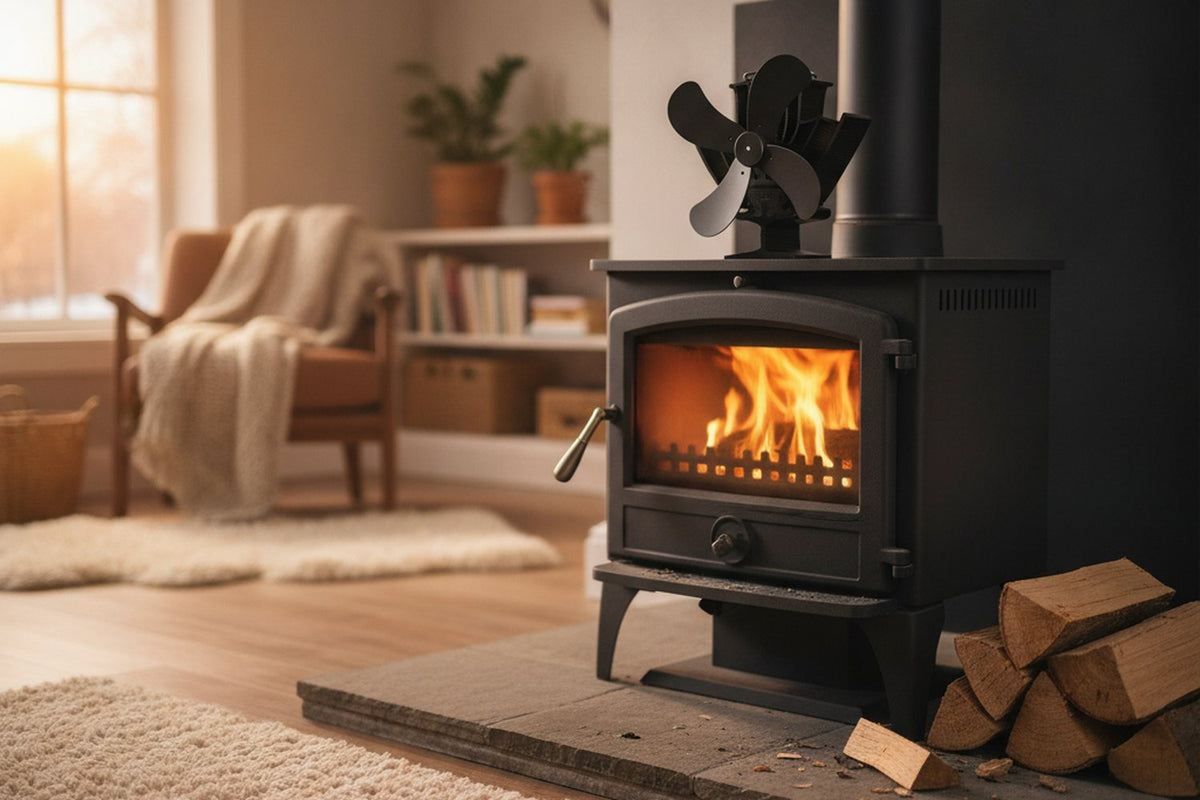
The best wood stove fan for most wood stoves is the Ecofan AirMax 812, a heat-powered stove fan that Caframo rates at 175 CFM for rooms over 240 square feet, with a stated range of 185F to 650F. That range covers the whole 400F to 650F band that Condar, a stove thermometer maker, gives as the ideal stove-top temperature for most wood stoves, so it keeps working when the stove runs hot. For a soapstone stove or a wood stove you often run low, the Ecofan AirDeco I is rated from 149F. For a small stove with little room above it, the Galafire N429 is 7.48 inches tall and comes with a thermometer.
Are they worth it? Yes, if you want the stove's heat spread a little further into the room, and not if you expect a blower. Be clear on what any wood burning stove fan does: it moves warm air off the stove top and out into the room. One owner on the Hearth.com forum who runs two Ecofans says he feels the air movement only within about 15 feet of the stove, and that his upper floor runs 2F to 3F warmer with them going. Caframo says its own fans circulate warm air rather than blow it, and Bob Vila could not feel the Ecofan it tested unless it stood right in front of it. The best fan for a wood stove is the one rated for how hot yours runs, and the temperature table below shows which fan suits your stove.
Jump to: Will it run on your stove? | Where to put it | Do they really work? | Stove thermometers | Safety
Start here: which stove fan for you
- A steel or cast iron wood stove that runs hot, in a big room: the Ecofan AirMax (pick 1).
- The same stove in a medium room, 120 to 240 square feet: the Ecofan UltrAir (pick 2).
- A soapstone stove, or a wood stove you often run low: the Ecofan AirDeco I (pick 3), the earliest-rated Ecofan that still takes 650F.
- A gas or pellet stove whose top stays under about 390F: Caframo makes the BelAir 806 for that (see Also considered); the AirDeco I also covers it and survives a hotter stove.
- A shelf, mantel or alcove close above the stove: the Galafire N429 (pick 4), and measure first.
- The lowest cost of the six picks, with a thermometer in the box: the Tomersun 8-Blade (pick 5).
- A room that needs more than one fan: the Tovisel two-head fan (pick 6), or two single fans.
- The fan a tester liked best: Bob Vila's Voda 4-Blade, in Also considered (limited stock on September 28, and the listing we link says its base lifts at about 482F).
Whichever you buy, put a stove top thermometer beside it. Caframo and Tomersun both warn that running a fan past its top temperature can damage it.
Best wood stove fans at a glance
| Product | Best for | Stated range (low end / top) | Airflow (stated) | Height | Who recommends it | Where to buy |
|---|---|---|---|---|---|---|
| 1. Ecofan AirMax 812 | Best overall: hot-running wood stoves, rooms over 240 sq ft | 185F to 650F (Caframo range) | 175 CFM (Caframo) | 10.0 in (Caframo) | No tester; Hearth.com forum owners (one names the 812) | Check price on Amazon |
| 2. Ecofan UltrAir 810 | A medium room, 120 to 240 sq ft | 212F to 650F (Caframo range) | 125 CFM (Caframo) | 9.0 in (Caframo) | Bob Vila tested it and felt less airflow than from four and five blade fans | Check price on Amazon |
| 3. Ecofan AirDeco I | A stove that runs cool, such as soapstone | 149F to 650F (Caframo range) | 160 CFM (Caframo) | 8.8 in (Caframo) | No tester | Check price on Amazon |
| 4. Galafire N429 | Tight space above the stove | First spin at 122F; no top in the listing | Not in the listing | 7.48 in (listing) | Bob Vila's best compact, from user reviews | Check price on Amazon |
| 5. Tomersun 8-Blade | Lowest cost of the six picks, thermometer included | Best at 392F to 482F; limit 653F (listing) | Not in the listing | Not in the listing | Homebuilding's runner-up, from research | Check price on Amazon |
| 6. Tovisel 12-Blade Dual Motor | Two fan heads in one footprint | First spin at 130F; 570F maximum (listing) | Not in the listing | 9 in wide; height not in the listing | No tester | Check price on Amazon |
How we chose these
We did not hands-on test these fans. We compared each fan's Amazon listing, and the maker's product page and manual where one exists, against what independent reviewers reported. Independent testing of stove fans is thin. Bob Vila ran fans on a wood stove for three weeks and reports results for three: a Voda, a Tomersun and the Ecofan UltrAir. It lists two more, the Galafire and a Hanaoyo, from user reviews. Homebuilding & Renovating, a UK magazine, tested one fan and chose the rest from research. No model is recommended by two testers, so maker data carries more weight here than on most of our guides.
Caframo, which makes the Ecofan, publishes an operating range, airflow, room size and height for most of its models, so its fans are the easiest to check. For stove temperatures we used Condar's published stove-top bands. Our rules: every numbered pick was in stock on Amazon on September 28, 2026, and every pick without a tester says so. Bob Vila's two tested winners, the Voda 4-Blade and the Tomersun 3-Blade, are in the second tier for stock: on September 28 Amazon showed the Voda in limited stock and the Tomersun out of stock. In the Voda's case there is a second reason, the 482F lift point its listing gives.
The best wood stove fans, by stove and room
1. Ecofan AirMax 812: best overall for most wood stoves
Check price. The AirMax is the largest Ecofan in Caframo's Classic style. Caframo lists 175 CFM, an operating range of 185F to 650F, a 9 inch blade, a height of 10.0 inches with the handle up, and a 2-year limited warranty, and rates it for a room of over 240 square feet. Its 185F low end is the stove-top temperature at which, Caframo's manual says, it moves 50 CFM, not the point where the blade first turns. It is made in Canada, and Caframo sells a replacement motor for it.
Why it is the pick: Condar puts the ideal stove-top temperature for most wood stoves at 400F to 650F, and the AirMax is rated through all of it, where three other fans on this page top out or lift their base partway through (see the temperature table). Its 175 CFM is the highest maker figure among the numbered picks, against 160 for the AirDeco I and 125 for the UltrAir; among Ecofans, only the AirDeco II in Also considered is rated higher, at 190 CFM, and the Freedom Stoves and Rutland listings claim more with no test basis given. Caframo says its airflow figures are tested and verified to ANSI/AMCA standards; none of the other listings here gives a test basis for its airflow figure. Owners on the Hearth.com forum are split. One who runs two 812s says they create a slow convection, and another, describing what he calls the big Ecofan, says it has run 24/7 for 14 months and is almost silent. A moderator on the forum found the opposite with an older model: his original Ecofan did not seem to move much air, and the VonHaus fan that replaced it moved much more.
Where it loses: no tester has run the AirMax, and the one Ecofan a tester did run disappointed. Bob Vila found the two-blade UltrAir (pick 2) produced noticeably less circulation than fans with four or five blades, and could not feel it unless it stood directly in front. The AirMax uses the same two-blade design. Caframo's own explanation is that its fans do not blow air forward, and that you notice most movement at the sides of the blade. At 10.0 inches it is the tallest Ecofan here, and Caframo says its motors typically last 3 to 5 burning seasons before a motor kit is needed.
2. Ecofan UltrAir 810: best for a medium room
Check price. The mid-size Classic Ecofan: 125 CFM, an operating range of 212F to 650F, an 8 inch blade and 9.0 inches tall, with a 2-year limited warranty. Caframo rates it for a room of 120 to 240 square feet and sells a replacement motor for it. On Amazon on September 28 it cost less than the AirMax.
It is the one Ecofan an independent reviewer has tested, and the result is the reason it sits below the AirMax. Bob Vila liked its looks, but found its two-blade design moved noticeably less air than the four and five blade fans. Caframo argues the opposite case in its FAQ: two blades need less power to start, put less stress on the motor and run smoother. Pick it if you want Caframo's published specs and 650F ceiling for a living room of ordinary size, and step up to the AirMax for a bigger or open-plan space.
Where it loses: Bob Vila's airflow finding above. Its rated range begins at 212F, higher than the AirMax's 185F or the AirDeco I's 149F, and Caframo's room rating tops out at 240 square feet.
3. Ecofan AirDeco I: best for a stove that runs cool
Check price. Caframo lists 160 CFM, an operating range of 149F to 650F, a 9 inch blade, 8.8 inches tall, and a room size of over 240 square feet. Caframo's spec table and FAQ give the AirDeco models a 4-year limited warranty, where the other Ecofans carry 2; a banner on the same product page reads 15 years, so confirm the term when you buy. The Amazon listing, where Caframo is the manufacturer, calls it ideal for wood, gas, pellet and soapstone stoves, and Caframo's own comparison chart lists the AirDeco models for wood, pellet, gas and soapstone stoves. Caframo's FAQ counts the AirDeco among its wood stove models and makes the BelAir specifically for gas and pellet stoves.
Why it is here: Condar says soapstone stoves are built to run cooler than steel or cast iron, puts their efficient zone at 200F to 500F, and warns that sustained temperatures over 600F can crack the stones. On paper five of the six picks cover all of that soapstone band (the Galafire on Bob Vila's figure), and the UltrAir, whose rated range begins at 212F, covers 96% of it. The AirDeco I's edge is that its rated range begins lowest of the Ecofans, at 149F, the lowest figure Caframo gives for any of its wood stove models, so it gets going sooner as a cool-running stove warms up, and it still takes 650F if you burn hot.
Where it loses: no tester has run it, and it shares the two-blade design Bob Vila found weak on the UltrAir. It moves less air than the AirMax by Caframo's figures, 160 CFM against 175.
4. Galafire N429: best compact fan
Check price. A four-blade anodized aluminum fan that the listing puts at 19 cm, or 7.48 inches, tall, with a magnetic stove thermometer in the box and a 2-year warranty. Galafire says it starts at 122F, runs best at around 482F, and is not recommended for a stove top that stays below 212F.
It is here for the stove with a shelf, a mantel or an alcove close above it: it is shorter than any Ecofan pick. Bob Vila lists it as its best compact fan, for smaller stoves, with a low start temperature; that is a pick from user reviews, not one of its tests. Bob Vila's chart adds a 662F top and 126 CFM, which the listing does not print.
Where it loses: Bob Vila's own caveat is that it may not deliver adequate airflow. Galafire publishes no top temperature on the listing and no spec page on its site, so use the thermometer that comes with it and keep the stove top under the 650F that Condar treats as the top of a wood stove's ideal band.
5. Tomersun 8-Blade: lowest-cost pick with a stated heat limit
Check price. Eight blades and a magnetic stove thermometer, for wood and pellet stoves. The listing gives both the band it works best in, 392F to 482F, and the limit, telling you to avoid overheating above 653F. On Amazon on September 28 it cost less than any other pick here.
Several fans in our second tier print no temperatures at all; this one prints both. Homebuilding & Renovating made a Tomersun 8 Blade its runner-up, from research rather than a test, and its Amazon link for that fan is the listing we link. Homebuilding, which also links UK listings for the fan, describes it as quiet and says it kicks in when the stove reaches 80C (176F). The US listing we link says a magnetic thermometer comes in the box.
Where it loses: no one has tested it. Homebuilding says some reviewers report its performance declined over time. Its comparison table also prints an airflow of 4,860 CFM for it, a figure Tomersun's listing does not make; Bob Vila warns that stove fan CFM ratings are not always accurate. Treat its airflow as unknown.
6. Tovisel 12-Blade Dual Motor: best two-head fan
Check price. Two fan heads, two motors and 12 blades on one body the listing calls 9 inches wide, with a magnetic thermometer, overheat protection that lifts the base, and a 12-month warranty. The listing says it starts spinning at 130F, performs best between 350F and 530F, and should be kept under a 570F maximum.
It answers a question both reviewers raise: Bob Vila says two stove fans are better than one, one on each side of the stove, and Homebuilding suggests two fans at opposite sides or a double stove fan for a large room. This is the double version in one footprint.
Where it loses: no tester has run it, and the listing is its only source. Its 570F maximum is lower than the Ecofans' 650F, so on a stove that runs in the 600s it will be past its limit; Condar's band for most wood stoves goes to 650F. On September 28, two single Ecofans cost more than one Tovisel, but they carry Caframo's published specs.
Also considered: fans that missed the list and why
Voda 4-Blade Wood Stove Fan. Bob Vila's best overall after testing: its blades came on when the stove top reached the low 100s F, sped up as the stove heated, and moved enough air to feel from a few feet away, though Bob Vila says it is best for a small room and does not deliver enough airflow for large spaces. A Hearth.com moderator also suggests Voda fans, and two owners in the thread report running one for their second and third seasons. It missed the numbered list because Amazon showed limited stock on September 28, 2026, and it was on backorder on October 12, 2026, so we do not link it. Check its limits too: the listing Bob Vila links says it starts at around 176F and that its base lifts the front of the fan at around 482F to protect the motor, while Bob Vila's chart lists 185F to 660F. Another Voda listing, sold as an upgrade version with a thermometer, gives 185F to 660F, the range on Bob Vila's chart, but it states no blade count, so the one to look for is the one Bob Vila links.
Tomersun 3-Blade Heat Powered Stove Fan. Bob Vila's best value after testing: quiet, and its blades began to spin at a little over 100F, but it produces limited airflow, so it suits a small space. Its listing says a safety device lifts the front of the fan at around 300C (572F). It was out of stock on Amazon on September 28, 2026, so we do not link it. The Tomersun 8-Blade (pick 5) is the in-stock Tomersun.
Hanaoyo 6-Blade Wood Stove Fan. Bob Vila's honorable mention from user reviews, with six blades, a magnetic thermometer and a base that lifts as it nears its top temperature. Bob Vila's chart lists 131F to 653F, but the Amazon listing prints no temperatures, and Bob Vila notes some users say it is not powerful enough for large spaces. It missed because the Tomersun 8-Blade states its limits.
Ecofan BelAir 806. Caframo's fan for gas, pellet and contemporary stoves with lower surface temperatures: 140 CFM, 167F to 392F, for 120 to 240 square feet. Caframo says it may suit a soapstone stove that runs cooler. Caframo designs it for gas and pellet stoves only, and its 392F top would be exceeded on most wood stoves (Condar's band for them starts at 400F), so it is not a numbered pick on a wood stove page. If your gas or pellet stove top stays under 392F, it is the Ecofan built for that.
Ecofan Original Mini 815. The smallest Ecofan: 85 CFM, a rated range of 185F to 650F and 6.5 inches tall by Caframo, which says it was designed for smaller spaces and stoves. Homebuilding names it best for tight spaces, from research, and says it is unsuitable for large rooms. It missed because Amazon showed limited stock on September 28, 2026 and it moves the least air of any Ecofan here; the Galafire (pick 4) fills the compact role.
Ecofan AirDeco II. The largest AirDeco: Caframo lists 190 CFM, the highest figure of any Ecofan, a rated range of 158F to 650F, 9.4 inches tall, a room size of over 240 square feet and, in its spec chart and FAQ, a 4-year limited warranty. It missed because Amazon showed limited stock on September 28, 2026; the AirMax (pick 1) and AirDeco I (pick 3) cover its roles and were in stock.
Ecofan Original 800. The classic Ecofan: 100 CFM, a rated range of 230F to 650F, 8.5 inches tall and a room size of 120 square feet, per Caframo. It missed because its range begins highest of the Ecofans and its room rating is the smallest of the full-size models; the UltrAir (pick 2) does the same job for a larger room.
Freedom Stoves Heat Powered Stove Fan, 348 CFM. A large Pellethead-branded four-blade fan made by Freedom Stoves, for medium to large rooms, with the highest airflow figure of any listing on this page. It missed because the listing contradicts itself on size (13 inches in the title, a 14-inch design in the features), prints no temperatures, and no tester has checked its 348 CFM.
Rutland Oscillating Gas and Wood Stove Fan. A five-blade fan from Rutland that swings side to side, works on wood and gas stoves, lists 220 CFM and includes a burn indicator. It missed because the listing states no operating temperatures and Amazon showed limited stock on September 28, 2026.
JossaColar Wood Stove Fan. A curved-blade aluminum fan, 7.7 inches high by its listing, with a magnetic thermometer and a 1-year replacement warranty. It missed because the listing prints no start or top temperature and no tester has reviewed it.
Will a heat-powered fan run on your stove?
A stove fan has two numbers that matter: the low end of its stated range, and the top temperature it can take. The stove has a range too. Condar, which makes stove thermometers, says ideal operating efficiency for most wood stoves is between 400F and 650F, that below 400F the fire is smoky and builds creosote, and that above 650F you waste wood and may damage the stove. For soapstone stoves, Condar's StoneGard thermometer marks 200F to 500F as efficient and above 500F as overheating. We set each fan's stated range against those two bands and computed how much of each band it covers.
| Fan | Low end of stated range | Stated top | Source | Share of the 400F to 650F wood stove band covered (computed) | Share of the 200F to 500F soapstone band covered (computed) |
|---|---|---|---|---|---|
| 1. Ecofan AirMax 812 | 185F (50 CFM point) | 650F | Caframo range and manual | 100% | 100% |
| 2. Ecofan UltrAir 810 | 212F (50 CFM point) | 650F | Caframo range and manual | 100% | 96% |
| 3. Ecofan AirDeco I | 149F (range bottom) | 650F | Caframo range | 100% | 100% |
| 4. Galafire N429 | 122F (first spin) | Not in the listing; 662F on Bob Vila's chart | Listing; Bob Vila | 100% on Bob Vila's figure | 100% on Bob Vila's figure |
| 5. Tomersun 8-Blade | 176F (80C, first spin, per Homebuilding) | 653F | Listing; Homebuilding | 100% | 100% |
| 6. Tovisel 12-Blade Dual Motor | 130F (first spin) | 570F | Listing | 68% | 100% |
| Also considered | |||||
| Voda 4-Blade | 176F (first spin) | 482F, where the base lifts | Listing | 33% | 94% |
| Tomersun 3-Blade | 176F (chart low end) | 572F (300C), where the base lifts | Listing; Bob Vila | 69% | 100% |
| Hanaoyo 6-Blade | 131F (chart low end) | 653F | Bob Vila's chart (not in the listing) | 100% | 100% |
| Ecofan AirDeco II | 158F (range bottom) | 650F | Caframo range | 100% | 100% |
| Ecofan Original 800 | 230F (50 CFM point) | 650F | Caframo range and manual | 100% | 90% |
| Ecofan BelAir 806 | 167F (range bottom) | 392F | Caframo range | 0%: tops out below the band | 64% |
| Ecofan Original Mini 815 | 185F (range bottom) | 650F | Caframo comparison chart | 100% | 100% |
| Freedom Stoves 348 CFM | Not stated | Not stated | Listing | Cannot compute | Cannot compute |
| Rutland Oscillating | Not stated | Not stated | Listing | Cannot compute | Cannot compute |
| JossaColar | Not stated | Not stated | Listing | Cannot compute | Cannot compute |
How to read it: the share is the part of the band that falls between the low end of the fan's stated range and its stated top. The three Ecofan picks, the Tomersun 8-Blade and, on Bob Vila's figure, the Galafire cover all of Condar's wood stove band. The Tovisel stops at 570F, about two thirds of the way through it, and the Voda we link says its base lifts at around 482F, a third of the way in. If your stove top sits in the 400s, every numbered pick will run. If it climbs toward 600F with the air open, choose one rated to 650F, or move a lower-rated fan to a cooler spot as Caframo tells Ecofan owners to do. The BelAir is the reverse case: it suits a cool gas or pellet stove and would be over its limit on a typical hot wood stove.
Two cautions. First, the low-end column mixes two kinds of figure, as its labels show: Caframo's figures are the bottom of a rated range (for the UltrAir, AirMax and Original, the stove-top temperature for 50 CFM, per its manual), while the other sellers give a first-spin temperature. An Ecofan may turn below its low end, so the soapstone shares for the Ecofans are, if anything, conservative; the wood stove shares do not change, because every low end sits below 400F. On the same column, Bob Vila saw the Voda and the Tomersun 3-Blade begin spinning at a stove-top temperature in the low 100s F, below what their charts say, so treat the column as a guide. Second, the Wood Heat Organization, a non-profit wood heating site, argues there is no single correct operating temperature, because a stove runs hotter in cold weather and its temperature rises and falls with each load. For a fan, the number that matters is the fan's own limit, which is why Caframo tells Ecofan owners to use a stove thermometer.
Where to put a fan on a wood stove
A heat-powered fan runs on the difference between its hot base and its cool top, so where you put it decides how fast it spins. Caframo's UK manual says to place the fan at a back corner of the stove top so cooler room air is drawn over its fins, and if the gap between the fan and the wall behind is less than 6 inches (150 mm), to move it forward along the side and turn it in slightly. Caframo says not to use it directly in front of the stove pipe or at the front of the stove, and not in the center of the stove top. Condar gives the same rule: on top of the stove, away from the flue pipe.
One source disagrees. Homebuilding & Renovating says the back of the stove next to the flue is the best spot. The makers say away from it, and Caframo says a fan in front of the chimney pipe will overheat and could damage the motor, so follow your fan's own manual.
Height matters when there is a shelf, mantel or alcove close above the stove top. Caframo gives these heights with the handle up: AirMax 10.0 inches, UltrAir 9.0 inches, AirDeco I 8.8 inches, BelAir 9.5 inches and the Original Mini 6.5 inches. The Galafire listing gives 7.48 inches and the JossaColar listing 7.7 inches. The Tomersun 8-Blade and Tovisel listings give no height, so measure before you buy either. Once it is placed, Caframo recommends leaving the fan in position year-round rather than moving it, and storing it where it cannot be knocked over or dropped if you do take it off.
Do wood stove fans really work?
Yes, within limits. A heat-powered fan moves warm air off the stove top and out into the room, which one owner on the Hearth.com forum feels only within about 15 feet of the stove, but it circulates air rather than blowing it, and Bob Vila says these small fans do not provide much airflow.
How does a heat-powered stove fan work?
A heat-powered stove fan makes its own electricity from the difference between its hot base and its cooler top, the Seebeck effect in a thermoelectric module, so it needs no battery or cord. The hotter the stove, the faster it spins.
Caframo adds that the fan has to draw cooler air from behind, which is why placement matters.
What they do. Warm air rises off a stove and collects near the ceiling. Bob Vila says a fan on top of the stove can push that rising heat across the room before it gets there. Owners on the Hearth.com forum describe the effect as modest but real: one owner of two Ecofan 812s says you only feel the air movement within 15 feet or so of the stove, and that the upper floor of the house gets 2F to 3F warmer when the fans run. They are quiet: Bob Vila puts a typical stove fan at 25 to 30 decibels, about a whisper, and says poorly made fans may rattle or click.
What they do not do. A heat-powered fan is not a blower. Caframo says its Ecofan does not blow air the way a typical fan does, but circulates warm air out into the room, and that you will notice movement mostly at the sides of the blade rather than in front. Bob Vila says these fans are small and do not provide much airflow, and that they work best on freestanding wood stoves. Because they need a minimum level of heat to start, Bob Vila says, they will not run on an electric fireplace heater or a standard built-in fireplace. One Hearth.com member put it plainly: he does not think any heat-powered stove fan moves enough air to even out the temperature of a whole house.
What about wood savings? Caframo says that, in its own testing, a wood stove with an Ecofan could burn 14 to 18% less fuel and still keep the same comfort at a set distance from the stove, and that representatives of the University of Waterloo engineering faculty tested its fans. That is the maker's claim about its own product. We found no independent test that measured wood use, and the Voda listing prints a savings figure with no test cited. Whatever the fan does, the next load still has to be stored off the ground, and our firewood rack guide covers that.
Why every stove fan needs a wood stove thermometer
Heat is the thing to watch. Caframo says overheating will reduce an Ecofan's effectiveness, may damage the thermoelectric module and void the warranty, and that you should remove the fan from the stove if the surface passes 650F. Caframo's manual calls a stove thermometer good wood stove safety practice, and its FAQ says the module is not sold as a replacement part: an overheated module means a new fan. Several of the other fans here protect themselves differently: the Voda, Tomersun 3-Blade, Hanaoyo and Tovisel listings describe a device that lifts the fan's base off the stove top as it nears its limit.
Condar sells a wood stove thermometer made for stove fans and prints these zones on it: below 150F, too cool for a fan to run; 150F to 300F, the best zone for low speed fans; 300F to 600F, the best zone for high speed fans; above 600F, overheating and excessive blade speed. Condar places that thermometer on the stove top near the base of the fan. The Galafire, Tomersun 8-Blade and Tovisel come with a magnetic thermometer. For the Ecofans, a surface thermometer such as the Condar Inferno stove top thermometer is the matching tool; Condar says its stove top thermometers attach magnetically to the top, front or side of the stove, and that the magnet holds to steel at temperatures up to 800F.
Using a stove fan safely
- Move it only by the handle. Caframo says the base of the fan is very hot in use and not to touch it; lift the handle upright before placing the fan, reposition it only by the handle, and move or remove it if the stove top passes its limit.
- Keep combustibles back. The US Fire Administration says to keep anything that can burn at least 3 feet from a fireplace or wood stove, and to keep the stove's doors closed unless you are loading or stoking the fire.
Related guides
If you are still putting up this winter's wood, our log splitter guide covers splitting it and our chainsaw sharpener guide keeps the saw cutting. For the saw itself, see our best chainsaw guide. Before the first fire, our firewood moisture meter guide shows how to check the wood is dry enough to burn, and our fire starter guide covers lighting the stove. When the stove needs cleaning out, our ash vacuum guide covers the warm-ash limit of each vacuum. If you have not bought the stove yet, our small wood stove guide compares EPA-certified stoves you can order and what installing one takes.
A word from the people who wrote this
We are Spear Head Spade, and we make digging spades, not stove fans, so nothing on this list is ours. When spring comes around, our spade finder matches a spade to your soil.
Frequently asked questions
Do you need a fan for a wood burning stove?
No. A stove heats a room without one. A heat-powered fan helps move warm air off the stove top and out into the room instead of letting it collect near the ceiling, which Bob Vila says makes the stove better at heating the room. The effect is modest: one owner on the Hearth.com forum says he feels it only within about 15 feet of the stove.
Is an Ecofan worth it, or will a cheaper stove fan do?
It depends on how hot your stove runs. In Bob Vila's test, a four-blade Voda, which cost less on Amazon on September 28, moved more air than the two-blade Ecofan UltrAir. A Hearth.com moderator who ran the original Ecofan for several years says the VonHaus fan that replaced it moves much more air. What the Ecofan gives you is a published range to 650F, airflow Caframo says is verified to ANSI/AMCA standards, a 2-year warranty (4 years on the AirDeco models, per Caframo's spec table and FAQ), and a replacement motor you can buy. Some of the other fans here lift their base or stop at lower stove-top temperatures, such as around 482F on the Voda listing we link.
Are two stove fans better than one?
For a large room, yes. Bob Vila says two fans move more air than one and suggests one on each side of the stove top. Homebuilding & Renovating says one fan is enough for most households, and two at opposite sides of the stove help in a large room. A dual-head fan such as the Tovisel does the same in one footprint.
What is the difference between a stove fan and a wood stove blower?
A stove fan sits on the stove top and powers itself from the stove's heat. A blower is an electric fan mounted on the stove, which needs power; one blower listing on Amazon describes a 100 CFM unit that circulates air around the firebox and comes with mounting hardware. Bob Vila says heat-powered stove fans make very little noise, unlike fireplace insert blowers, and one owner on the Hearth.com forum writes that his household can't stand the sound of their stove's blower fan for very long.
Will a stove fan work on a pellet stove, gas stove or fireplace insert?
Often, if the surface gets hot enough and the fan is made for it. Caframo makes the BelAir for gas and pellet stoves with lower surface temperatures, and its comparison chart and the Amazon listings name wood, pellet, gas and soapstone stoves for the AirDeco models. For a fireplace insert, Caframo says an Ecofan may work if you angle it or set it at one end so it can draw room air from behind. Bob Vila says these fans work best on freestanding wood stoves and will not run on electric fireplace heaters or standard built-in fireplaces.
Why has my wood stove fan stopped working?
Usually the motor or overheating. Caframo says an Ecofan motor typically lasts 3 to 5 burning seasons and the thermoelectric module about 10 years or more; if the blade needs a nudge to start or spins much slower, a new motor kit should fix it, unless the fan was dropped or overheated. Caframo also says that if you can see the individual blades while it spins, it is not working properly. Check placement too: a fan in front of the stove pipe or with no cool air behind it will run poorly.
Disclosure: Our commissions do not change what we recommend or what you pay. Availability was checked on Amazon on September 28, 2026 and can change; we do not print prices because they move, so every "Check price" link shows today's.