As an Amazon Associate we earn from qualifying purchases. Some brands also pay us when you click or buy, so those links are ads. Full disclosure below
The best portable power station for most homes is the Anker SOLIX C1000 Gen 2, with 1,024Wh of storage, 2,000W rated output, 3,000W of peak headroom for a motor that surges on startup, and a listed 49 minute recharge. We checked every pick on Amazon on 2026-09-19.
Two numbers decide whether a station does your job. Watt hours say how long it runs; watts say what it can run at all. A large battery with a modest rating still stops dead at a tool that draws more. The runtime table further down is that sentence made concrete.
One thing first: we make digging spades, not batteries, so nothing here is ours. Every pick is judged on capacity, output, recharge time, cycle rating and chemistry, against Amazon listing text, manufacturer pages and what independent testers reported, all pulled on 2026-09-19.
Best portable power stations at a glance
| Station | Best for | Price | Capacity / rated output | Battery | Tested by |
|---|---|---|---|---|---|
| Anker SOLIX C1000 Gen 2 (best overall) | A day of house essentials | Check price | 1,024Wh / 2,000W | LiFePO4 | OutdoorGearLab (the station; Outdoor Life: award only) |
| EcoFlow RIVER 3 Max | A weekend outdoors, or the far end of the yard | Check price | 572Wh / 600W | LiFePO4 | Not tested |
| Goal Zero Yeti 700 | Rough handling and wet weather | Check price | 677Wh / 600W | LiFePO4 | OutdoorGearLab, Outdoor Life |
| Anker SOLIX S2000 with car charging cable | A fridge through a long outage | Check price | 2kWh / 1,500W | LFP | Consumer Reports |
| BLUETTI Elite 200 V2 | Corded tools away from an outlet | Check price | 2,073.6Wh / 2,600W | LiFePO4 | Not tested |
| BLUETTI Elite 400 | An outage that runs past a day | Out of stock on Amazon on October 12, 2026 | 3,840Wh / 2,600W | LiFePO4 | Not tested |
| Jackery Generator 1000 v2 with 200W panel | Refilling when the grid is gone | Check price | 1,070Wh / 1,500W | LFP | OutdoorGearLab, Outdoor Life (the station) |
How we chose these
We did not hands-on test these. We read every Amazon listing bullet by bullet, checked each against the maker's own product page where we could read one, then against three independent roundups that did put units on a bench: OutdoorGearLab, Outdoor Life and Consumer Reports. For four of the seven picks the maker's page would not render its specifications at all, so those figures rest on the Amazon listing alone.
Where a tester bench-ran the bare station and our pick is the same station in a bundle, we say so in that pick rather than implying the bundle itself was tested. Testers converge on the Anker SOLIX C1000 Gen 2, which OutdoorGearLab made its value award and Outdoor Life its solar generator pick, so it leads here too. If you want the panel in the box and a real answer on how many hours of sun refill it, our best solar generators guide treats station and panel as one system.
Four of the testers' favorites could not be slotted. Outdoor Life's best overall, the EcoFlow Delta 2, was down to scarce stock when we checked on 2026-09-19, and OutdoorGearLab's small pick, the Jackery Explorer 300, showed only one left. OutdoorGearLab's camping and home backup winners, the Jackery Explorer 2000 v2 and the EcoFlow DELTA Pro 3, were on backorder, and the DELTA Pro 3 is over our price band besides. The Delta 2 and the Explorer 2000 v2 are in the second tier below.
One caveat on the tables. Stated capacity is not delivered capacity: OutdoorGearLab measured usable output for fourteen models and found no product matching its own claim, from 60% to 93% of it. Where that measurement covers a model here, the cost table carries it as its own column.
What is the best portable power station?
The best portable power station overall is the Anker SOLIX C1000 Gen 2: 1,024Wh, 2,000W rated with a 3,000W peak, and 4,000 cycles with at least 80% capacity left. OutdoorGearLab measured 890Wh of usable output and a 49 minute recharge in app mode, and made it its value award.
The best portable power stations, by job
1. Anker SOLIX C1000 Gen 2: best portable power station overall
The Anker SOLIX C1000 Gen 2 (ASIN B0HML4PH6Y) is the one we would buy first, and the one both OutdoorGearLab and Outdoor Life landed on. The bare station's listing was out of stock on Amazon on October 14, 2026, so the listing we link is the same C1000 Gen 2 sold with Anker's car charging cable, which ships separately. The testers covered the bare station, not this bundle. The listing and Anker's own product page agree: 2,000W output with a 3,000W peak, 1,024Wh, 10 ports, and at least 80% capacity after 4,000 cycles. They also give a full recharge at 1,600W in 49 minutes in the Anker app and 600W of solar input for a 1.8 hour recharge, and Anker's page gives under 10 ms of UPS switchover. OutdoorGearLab, which ran it on the bench, measured 63 minutes for a full charge and 49 minutes with the app mode on, independently confirming Anker's listed 49, plus 890Wh of usable capacity from the 1,024Wh claimed and 25.2 lb on the scale. Two thousand watts is headroom for a corded tool, and 1,024Wh is 17.1 hours of the 60W CPAP draw in the runtime table below. Where it loses: OutdoorGearLab found the fan loud enough that it would not use this unit overnight or at a workstation, which matters more than any spec if the station sleeps in your bedroom. The listing also names no weight.
2. EcoFlow RIVER 3 Max: the smallest sensible spend
The EcoFlow RIVER 3 Max (ASIN B0F4XRNTWX) is the cheapest way onto this page. It gives 572Wh and 600W. The Anker SOLIX C300, which OutdoorGearLab did test and measured at 230Wh usable of 288Wh claimed, costs a little more for half the capacity and half the watts. The bullets give 10.4 lb, 30 dB at 1.6 ft, a full AC charge in one hour, IP54 protection, 3,000 cycles to 80% capacity, and a 5 year service. Two batteries is a feature outdoors: one sits on the panel while you carry the other. Where it loses, and read this before you buy: the title says 572Wh and 990W, while every feature bullet describes a RIVER 3 Plus rated 600W steady with a 1,200W X-Boost surge, and the box contents bullet lists a 286Wh station plus a 286Wh EB300 extra battery. So the 572Wh is two units, and 990W appears nowhere but the title. Own the 600W. No tester roundup we read mentions this model at all.
3. Goal Zero Yeti 700: built to be knocked about
The Goal Zero Yeti 700 (ASIN B0CRCVKNHR) is the one Outdoor Life called most reliable, and the only pick here that states a tested safety standard. Features cite 677Wh of LiFePO4 rated at 4,000+ cycles, 600W of AC output with a 1,000W surge, a full charge in about two hours in high speed mode, UL2743 testing and an IPX4 water resistance rating. Outdoor Life measured it delivering 70% of its stated watt hours at a steady 34W draw, running that grow light for over 13 hours, and 83% at a heavier 380W draw; OutdoorGearLab measured 560Wh usable, 83% of the claim. Buy it if the station is going to live in a truck bed, a boat or a job site: UL2743 testing, an IPX4 water rating and a dustproof title are a different kind of claim from a spec sheet number. No pick here states a formal drop standard, though the RIVER 3 Max listing claims a 3 ft fall in the same bullets that describe a RIVER 3 Plus. Where it loses: 600W rules out the 1,500W kettle and space heater in the table below.
4. Anker SOLIX S2000 with car charging cable: the cheapest route to 2kWh
The Anker SOLIX S2000 with car charging cable (ASIN B0HJDBKJWL) is the same station Anker sells bare, and Consumer Reports tested that station paired with a bifacial panel. Features on both listings cite 2kWh, LFP cells rated for 10,000 cycles and a 15 year lifespan, 1,500W rated with a 3,000W peak, and 35 hours of fridge backup. The bare listing, ASIN B0GY4TQ2P8, holds the rest: 2,010Wh, 35.7 lb, a 6W idle draw, up to 400W of solar, and eight outlets with no 12V DC port. That 10,000 cycle rating is the highest here, more than double the 4,000 both 1kWh picks state, and 2,010Wh is about ten hours of a cycling fridge by the runtime table below, and the caption there explains the gap to Anker's 35 hours: that claim implies a fridge averaging nearer 57W, not the 200W this table assumes. Where it loses: read the first bullet before ordering, because the cable ships separately, and no 12V DC port is a real gap if you run car fridges.
5. BLUETTI Elite 200 V2: the cheapest 2,600W here
The BLUETTI Elite 200 V2 (ASIN B0DCJV9LTB) exists for one reader: the person whose problem is watts, not hours. Features list 2,600W of continuous AC power and 3,900W in power lifting mode, on 2,073.6Wh of automotive grade LiFePO4 rated at over 6,000 cycles, plus a 10W standby draw and a 50 minute recharge to 80% charge. Those 2,600W tie the Elite 400 for the highest continuous rating here, and this is the cheaper of the two, which makes it the one to buy for watts alone. With the Elite 400 and the C1000 Gen 2 it is one of only three picks that clears an 1,800W induction burner, a draw above the top column of the table below. Where it loses: none of the three tested roundups picked it or bench-ran it, and the listing states no UPS switchover time where three other picks do and no weight.
6. BLUETTI Elite 400: for the outage that runs past a day
The BLUETTI Elite 400 (ASIN B0G8Y8DCC1) stores the most energy here by a wide margin. The listing and BLUETTI's own product page both give 3,840Wh and 2,600W, surging to 3,900W across 9 ports, plus an easy roll trolley, a full charge in 2.5 hours from a standard 1,800W outlet, and a 15 ms switchover. By the runtime table that is 19 hours of a cycling fridge, or 64 hours of a CPAP. The trolley is how the thing reaches the basement. Where it loses: no tested roundup we read picked it, and the listing states no cycle count at all, the number that decides what a battery is worth in year eight. The Anker SOLIX F3000 is effectively the same money with 6,000W and 240V output, if watts matter more than the extra 768Wh here.
The Elite 400 was out of stock on Amazon when we checked on October 12, 2026, so we do not link it for now. Until it is back, picks 4 and 5, at about 2kWh each, are the largest of the other picks.
7. Jackery Generator 1000 v2 with 200W panel: best solar generator
The Jackery Generator 1000 v2 with 200W panel (ASIN B0D2L1G66J) is a power station and a panel on one listing. The Explorer 1000 v2 station inside it is the unit both OutdoorGearLab and Outdoor Life bench-ran, not this bundle; OutdoorGearLab measured 910Wh usable of the 1,070Wh claimed. Features cite 1,500W of AC output with a 3,000W surge, 1,070Wh, 23.8 lb with a foldable handle, an LFP battery holding over 70% capacity after 4,000 cycles, and a full charge in one hour in the app emergency mode, with the same bullet giving 1.7 hours as the default that protects the battery. Where it loses: Jackery states that the Explorer 1000 v2 charges only from Jackery panels.
Also considered: models that missed the list and why
Eight more worth knowing about, including two of the four tester favorites we could not slot. None is in the ranked list above, and every spec here comes from the same Amazon pull on 2026-09-19.
- Jackery Explorer 2000 v2. OutdoorGearLab's Editors' Choice for off-grid camping, 2,042Wh and 2,200W, and measured by that tester at 1,710Wh usable. It was on backorder rather than orderable when we checked on 2026-09-19, which is the only thing keeping it off the list.
- EcoFlow Delta 2. Outdoor Life's best overall pick, at 1,024Wh and 1,800W. It has 200W less rated output than the C1000 Gen 2, and it was down to scarce stock when we checked on 2026-09-19.
- OUPES Mega 1. Outdoor Life's best value pick, and our own numbers agree it is cheap per watt. We left it out because that same review measured it delivering 60 percent of its stated watt hours at a 34W draw.
- EcoFlow DELTA 3 Classic. Consumer Reports tested this one with a 220W panel. It lists 1,024Wh, 1,800W and an 80% charge in 45 minutes, but its rated output is 200W less than our top pick's.
- Jackery Explorer 1500 Ultra. Consumer Reports tested it with a 200W panel. At 1,536Wh and 1,800W it sits between our 1kWh and 2kWh rungs and costs more than either, and far more per watt hour than the S2000.
- Goal Zero Yeti 1500. Tested by both OutdoorGearLab and Consumer Reports, with a 2,000W inverter, a 3,600W surge, 4,000 cycles and an IPX4 rating. Its Amazon listing states no capacity at all; OutdoorGearLab puts it at 1,505Wh claimed and 1,320Wh measured, which puts it among the priciest per stored watt hour here.
- Anker SOLIX C2000 Gen 2. 2,048Wh and 2,400W, a 9W standby draw, a listed 58 minute full recharge, 4kWh of expandability and a 4,000W peak against the Elite 200 V2's 3,900W. Next to the Elite 200 V2 it gives up 200W of continuous output and 25.6Wh, so it is a genuine coin flip rather than a rejection on merit.
- BLUETTI Elite 100 V2. In OutdoorGearLab's test set, measured at 890Wh usable, and priced just under our top pick with 1,024Wh, 1,800W, a stated 25 lb, a 30 dB silent mode, 10 ms UPS and up to 1,000W of solar input. It loses the slot on rated output alone, and that quiet mode makes it the better bedroom option.
What does a portable power station cost per watt hour?
It varies widely across the fifteen models below, so work it out from the listing price on the day you buy. There are three ways to divide: price by the capacity the maker states, price by rated continuous output, and price by the capacity OutdoorGearLab actually measured where it measured one. The table gives you all three divisors.
Use them in that order. Cost per rated watt is a pass or fail gate, not a value metric: rule out anything whose rated output is under your biggest load, because buying more watts than you need only rewards a small battery with a big inverter. Then use cost per watt hour to choose among what survives, and prefer the measured column where it exists, because that is the energy you actually get.
| Station | Tier | Stated capacity | Rated output | Measured usable Wh (OutdoorGearLab) |
|---|---|---|---|---|
| Anker SOLIX S2000 | Pick | 2,010Wh | 1,500W | Not measured |
| BLUETTI Elite 400 | Pick | 3,840Wh | 2,600W | Not measured |
| BLUETTI Elite 200 V2 | Pick | 2,073.6Wh | 2,600W | Not measured |
| Anker SOLIX C1000 Gen 2 | Pick | 1,024Wh | 2,000W | 890Wh |
| EcoFlow RIVER 3 Max | Pick | 572Wh | 600W | Not measured |
| Jackery 1000 v2 with panel | Pick | 1,070Wh | 1,500W | 910Wh |
| Goal Zero Yeti 700 | Pick | 677Wh | 600W | 560Wh |
| Anker SOLIX C2000 Gen 2 | Considered | 2,048Wh | 2,400W | Not measured |
| BLUETTI Elite 100 V2 | Considered | 1,024Wh | 1,800W | 890Wh |
| Jackery Explorer 2000 v2 | Considered | 2,042Wh | 2,200W | 1,710Wh |
| OUPES Mega 1 | Considered | 1,024Wh | 2,000W | Not measured |
| EcoFlow DELTA 3 Classic | Considered | 1,024Wh | 1,800W | Not measured |
| EcoFlow Delta 2 | Considered | 1,024Wh | 1,800W | Not measured |
| Jackery Explorer 1500 Ultra | Considered | 1,536Wh | 1,800W | Not measured |
| Goal Zero Yeti 1500 | Considered | 1,505Wh (OutdoorGearLab) | 2,000W | 1,320Wh |
Two footnotes the numbers need. The S2000 row takes the bare listing's 2,010Wh, because the bundle listing states only "2kWh"; the Yeti 1500 row takes its capacity from OutdoorGearLab for the same reason, since its listing states none.
Three things fall out. Capacity gets cheaper as you go bigger, up to about 2kWh, and then it stops: the 3,840Wh Elite 400 costs more per watt hour than the 2,010Wh S2000. One 2kWh unit still beats two 1kWh units, since two C1000s would cost more per watt hour than the S2000. And measuring changes the ranking: the Yeti 700 and the Jackery bundle both get worse once you use delivered watt hours instead of the box.
What size portable power station do I need?
Match watts first, then hours. The device wattages below are OutdoorGearLab's, from its own runtime testing, and the hours are ours: stated capacity divided by the draw. Real runtime comes in under these figures, by the 7 to 40 percent that tester measured as conversion loss. A fridge is the one exception, because its compressor cycles rather than running flat out, so the column divides by the roughly 200W average OutdoorGearLab uses rather than the 600W on the plate. That duty cycle is also why makers quote backup figures many times longer than plain arithmetic: Anker's 35 hour claim for the S2000 implies a fridge averaging nearer 57W.
| Station (stated capacity) | Rated output | Four LED lights, 20W | CPAP, 60W | Home refrigerator, 600W compressor averaged to 200W | Space heater or kettle, 1,500W |
|---|---|---|---|---|---|
| EcoFlow RIVER 3 Max, 572Wh | 600W | 28.6 hr | 9.5 hr | 2.9 hr | Will not run |
| Goal Zero Yeti 700, 677Wh | 600W | 33.9 hr | 11.3 hr | 3.4 hr | Will not run |
| Anker SOLIX C1000 Gen 2, 1,024Wh | 2,000W | 51.2 hr | 17.1 hr | 5.1 hr | 0.7 hr |
| Jackery Generator 1000 v2, 1,070Wh | 1,500W | 53.5 hr | 17.8 hr | 5.4 hr | 0.7 hr |
| Anker SOLIX S2000, 2,010Wh | 1,500W | 100.5 hr | 33.5 hr | 10.1 hr | 1.3 hr |
| BLUETTI Elite 200 V2, 2,073.6Wh | 2,600W | 103.7 hr | 34.6 hr | 10.4 hr | 1.4 hr |
| BLUETTI Elite 400, 3,840Wh | 2,600W | 192 hr | 64 hr | 19.2 hr | 2.6 hr |
The "will not run" cells are the whole lesson. The Yeti 700 holds more energy than the RIVER 3 Max and still cannot start a kettle, because 600W of rated output is a ceiling no amount of stored capacity lifts. Four cells sit right on that ceiling and deserve the same caution as a corded saw: the 600W column on the two 600W picks, and the 1,500W column on the two 1,500W picks, leave nothing spare for a startup surge. Read the wattage off your own appliance nameplate and divide, and if the plate gives amps instead, multiply by 120 first.
Can a portable power station run corded yard tools?
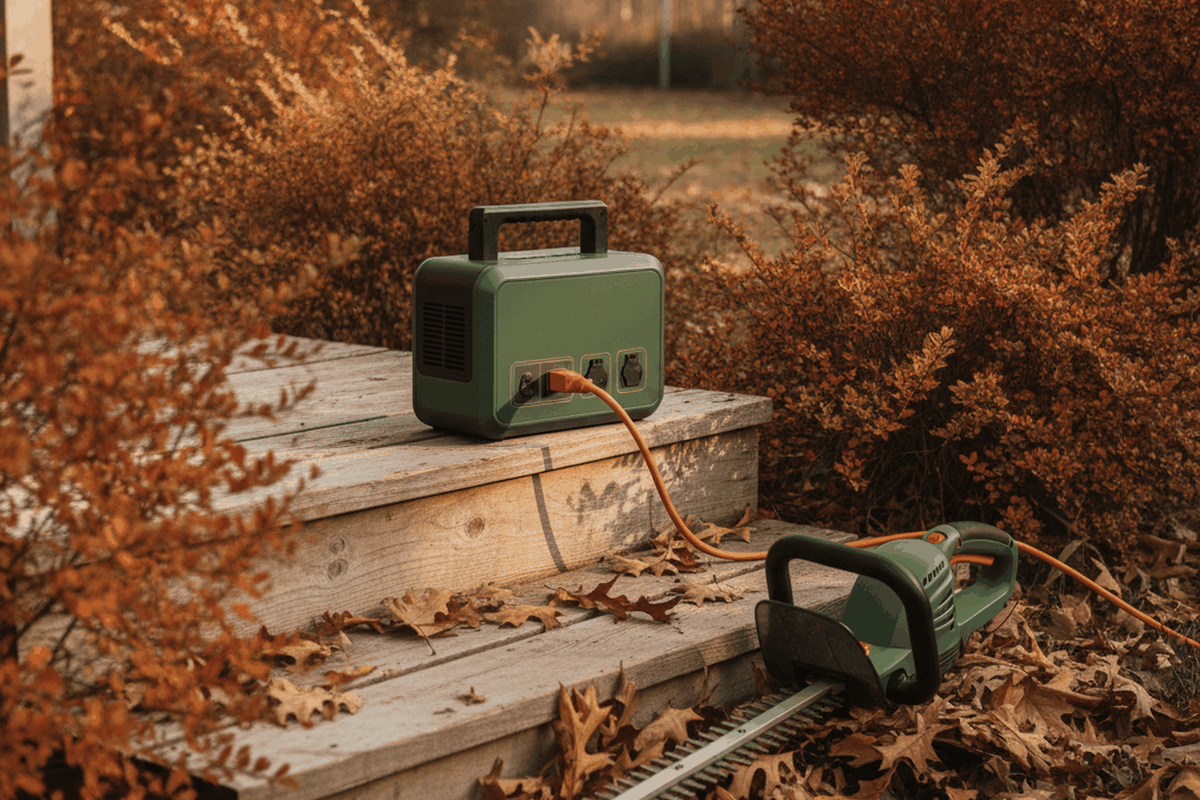
Yes, if you match watts first. Corded tools are labelled in amps, not watts, so multiply the amps on the plate by 120 to get the watts the station has to clear. A 4A hedge trimmer is about 480W, a 12A circular saw about 1,440W, and startup spikes above that.
That arithmetic settles it. A 480W trimmer runs on any pick here, including the RIVER 3 Max, for a bit over an hour. A 1,440W saw rules out both 600W units no matter how long you are willing to wait, and leaves everything else here, though the 1,500W S2000 and Jackery clear it with almost nothing spare for the startup spike. Buy the watts for your biggest tool, then the hours for your longest job.
The cheaper answer is often to skip the cord, since a battery tool carries its own power and charges off any of these overnight. That is why our best cordless leaf blowers and best chainsaws guides matter more here than the station.
What is the best solar generator?
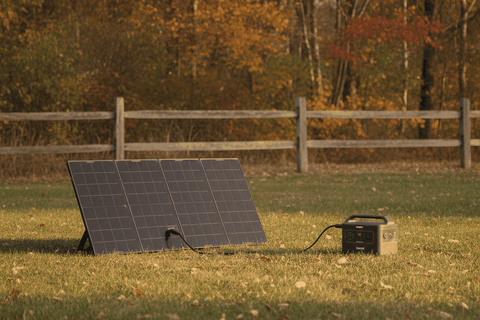
The best solar generator is the Jackery Generator 1000 v2 with a 200W panel. A solar generator is only a power station with panels in the box, and this bundle carries 1,070Wh and 1,500W.
Every pick above charges from solar; the bundles just include the panel. What that buys is a battery which refills with no grid at all, and what it costs is speed. A 200W panel returns closer to 160 watt hours an hour once you allow the 80 percent charging efficiency OutdoorGearLab plans with, so our 1,070Wh pick needs about seven hours of good sun from empty, the 2,010Wh S2000 about twelve and a half, and the 3,840Wh Elite 400 about twenty four. OutdoorGearLab also plans on only four to six peak sun hours a day, so the big one is a multi-day job. That is the real reason panel wattage, not station capacity, decides whether a bundle is serious.
- Jackery Solar Generator 300 with a 40W panel. Its listing offers an 80% charge in about 2.8 hours with a 100W panel, and 7.5 hours on the 40W panel that is actually in the box. That is the trap in cheap solar bundles, in the seller's words.
- Jackery Generator 1000 v2 with a 200W panel. Our pick: 1,070Wh, 1,500W.
- Jackery Solar Generator 1500 Ultra with two 200W panels. 1,536Wh and 1,800W, the shape Consumer Reports tested.
- Jackery HomePower 3600 Plus with two 200W panels. 3,584Wh and 3,600W, the top of what we would call portable.
Is a portable power station better than a generator?
For a house, a portable power station wins on everything except fuel. A battery has no engine and no exhaust, starts silently, needs no oil and stores for months. A fuel generator runs as long as you keep pouring, which a battery cannot do once the charge is gone.
So the split is duration. A 2kWh or 3kWh battery covers a fridge, a router, lights and phones through a day or two. Past that a battery is a finite tank where a generator is refillable, which is why the panel bundles exist. For an outage that runs longer than that, our portable generator guide compares fuel generators for home backup, from how many watts your house needs to running one outdoors, at least 20 feet from the house. For heat with no power at all, our kerosene heater guide covers the wick heaters that light from batteries, and the ventilation rules that come with them.
How long does a portable power station last?
On one charge, capacity divided by draw, as the runtime table above shows. On the calendar, cycles, and those vary more than price does: the Anker S2000 claims 10,000, the Elite 200 V2 over 6,000, the Yeti 700 and both 1kWh picks 4,000, the RIVER 3 Max 3,000. The Elite 400 states none.
Read the retention figure beside the cycle count, because it moves: Anker says at least 80% capacity after 4,000 cycles, Jackery over 70%, EcoFlow 80% capacity after 3,000. Charged weekly, none of these reaches its number inside a decade.
How do you choose a portable power station?
Work from the load, not the brochure. Find the highest wattage you will ever plug in, buy rated output above it, then buy the capacity that covers your longest realistic outage: 600W runs lights and a charger, 2,000W runs a corded tool, and 2kWh carries a cycling fridge overnight. A pellet stove is one load to plan for: our pellet stove guide works out each stove's starting and running draw, and the watt-hours for 8 hours of running, from the makers' manuals.
- Rated watts before watt hours. A 3,840Wh battery still refuses a tool above its rating.
- Do the cost per watt hour yourself. It varies widely here on stated capacity, and more once you use measured.
- Read the cycle rating and its retention together. "4,000 cycles" means nothing until you see whether it ends at 80% capacity or 70%.
- Compare the bundle listing to the bare one. On the S2000 here, only the bare listing states the outlet count and solar input.
- Check the box contents. Picks 1 and 4 ship their included car charging cable separately.
Where a battery stops and a shovel starts
A power station is a storm tool, and a storm leaves more than a dark house. Once the power is back the work outside is cutting, clearing and digging.
Our best chainsaws guide covers the limbs a storm drops, our best snow blowers guide the winter version of the same outage, and our how to winterize your garden guide the jobs worth finishing first. Our fall yard cleanup tools checklist puts the season in order. When the ground itself is the job, that is where we live: Spear Head Spade makes one double patented digging spade, and the spade finder says which size fits your soil.
Frequently asked questions
Do portable power stations work for a CPAP machine?
On watts, yes: OutdoorGearLab puts a CPAP at 60W, so every pick here clears it easily. The constraint is fan noise. OutdoorGearLab tested our top pick and would not recommend that unit for nighttime medical equipment because its fan is loud. If the station sleeps beside you, the BLUETTI Elite 100 V2 states a 30 dB silent mode.
Can you run a portable power station indoors?
Yes, and no exhaust is the real advantage over a fuel generator, which is why a battery can sit in a hallway during an outage. Fan noise is the variable, not fumes: the EcoFlow RIVER 3 Max listing rates it at 30 dB from 1.6 ft, while OutdoorGearLab found our top pick's fan loud enough to rule it out overnight.
Can you charge a portable power station while using it?
Usually yes, and it is called pass through charging, but only one of the fifteen models here states it plainly. The Anker SOLIX F3000 names 3,600W of pass through charging, so it can recharge from a generator and run appliances at the same time. If the feature matters to you, look for it by name on the listing.
Can you leave a portable power station in a cold shed over winter?
Better not. Lithium batteries give up usable capacity in the cold, so a station left in an unheated shed can read low on the morning you need it. None of our seven listings states a storage temperature range, so follow the manual that came with yours. Keep it indoors, charged, and check it with your winter prep.
What is the difference between a portable power station and a solar generator?
The panel, and nothing else. A solar generator is a portable power station sold with one or more solar panels in the box, which is why the same Jackery station appears both bare and with a 200W panel. Any station on this page charges from solar if you buy panels separately.
Do you need a special outlet to charge a portable power station?
No, a normal household outlet is fine. The BLUETTI Elite 400 charges fully in 2.5 hours from a standard 1,800W outlet, and 1,800W at 120V works out to fifteen amps, which is most of an ordinary circuit. Give a big station a circuit it does not share, and follow the manual and your local code.
The bottom line
Buy the Anker SOLIX C1000 Gen 2 if you want one battery for most of what a house and a yard ask of it, which is where the testers landed. Buy the Anker SOLIX S2000 with the car charging cable if your problem is a fridge through a long outage and you want the cheapest stored watt hour here. Buy the BLUETTI Elite 200 V2 only if you need the watts. Starting small, the EcoFlow RIVER 3 Max is the cheapest way onto this page. Do not buy capacity for an outage you have never had.
Disclosure: Our commissions do not change what we recommend or what you pay. Prices and availability were checked on 2026-09-19 and can change.