As an Amazon Associate we earn from qualifying purchases. Some brands also pay us when you click or buy, so those links are ads. Full disclosure below
The best lime for your lawn is the one your soil test asks for, at the amount it asks for. If the report calls for lime and your magnesium is low or not reported, buy a pelletized dolomitic lime such as The Andersons NutraLime OP Hi-Mag, whose label lists 12 percent magnesium and a calcium carbonate equivalent (CCE) of 97 percent. If magnesium is already adequate or high, buy a pelletized calcitic lime such as Solu-Cal Enhanced Calcitic Lime, the one pick with a lab test behind it. Why bother: Penn State says strongly acid soil (pH 5.5 or lower) can leave turf short of calcium, magnesium or phosphorus. The extension sources we read agree on the first step: a soil test tells you whether your lawn needs lime and how much. For a lime amount, choose a lab test that reports a lime requirement or buffer pH (our soil test kit guide compares kits).
Read the CCE, not the promise on the front of the bag. CCE is how much acid a lime neutralizes compared with pure calcium carbonate. Penn State writes its soil test rates for pure calcium carbonate; North Carolina's lab writes its rates for standard lime at a 90 percent CCE, so check which one your report assumes. The two "fast-acting" bags here that claim to do the work of several bags and publish a CCE, Espoma and Solu-Cal, both print 91 percent, which is no stronger per pound than regular lime. The box below turns a report into bags.
Best lime for lawns at a glance
| Product | Best for | Type | Calcium / magnesium (label) | CCE (label) | Multiply a pure calcium carbonate soil test number by (computed) | Bag | Where to buy |
|---|---|---|---|---|---|---|---|
| The Andersons NutraLime OP Hi-Mag (listed as DG) | Best overall: soil test calls for lime, magnesium low or not reported | Pelletized dolomitic, OMRI listed (maker) | 20% / 12% | 97% | 1.03 | 40 lb | Check price on Amazon |
| Solu-Cal Enhanced Calcitic Lime | Best calcitic: magnesium adequate or high | Pelletized calcitic | 38% / 0.4% | 91% | 1.10 | 50 lb | Check price on Amazon |
| Espoma Organic Lightning Lime | Best fast-acting organic calcitic: magnesium adequate or high | Pelletized calcitic, finely ground | 38% / 0.4% | 91% | 1.10 | 30 lb | Check price on Amazon |
| Down To Earth Prilled Dolomite Lime | Best for beds, bare patches and small areas | Prilled dolomitic, OMRI listed | 23.5% / 9.5% | 98.2% | 1.02 | 5 lb | Check price on Amazon |
Tested by: only Solu-Cal has a product test, The Grass Factor's 2021 lab titration against Soil Doctor lime; we found none for the other three.
Which lime for your soil test?
The target depends on the grass and the source. Ohio State puts lawns at 6.0 to 7.0; Penn State's cool-season range starts at 6.0, while UMass calls 5.5 to 7.0 the most satisfactory range for most species, so a reading of 5.8 is below target on Penn State's range and inside UMass's. A lab's lime requirement settles it: Penn State's test gives the amount needed to reach the optimum level for your turf.
| Your soil test shows | Buy | Why |
|---|---|---|
| No lime requirement, or pH at or above the target for your grass | No lime | Penn State: apply limestone only if your test shows a need. Ohio State strongly discourages yearly lime without a test, because the soil can turn alkaline. |
| Lime needed, magnesium low | Dolomitic: pick 1, or pick 4 for beds and patches | Penn State, Virginia Tech, Michigan State and Rutgers all point a low-magnesium test to dolomitic lime. |
| Lime needed, magnesium adequate | Either kind: pick 1 or pick 2 | Virginia Tech says either may be used; Michigan State says either, and finds no evidence dolomitic does harm. |
| Lime needed, magnesium high | Calcitic: pick 2, or pick 3 if you garden organically | Virginia Tech still says either works, and the Fairfax County Master Gardeners say to follow the lab. Kelly's, a lime maker, and a Lawn Forum member choose calcitic when magnesium is already high, so we point you there. |
| A centipedegrass lawn | Lime only if the test says so | NC State: centipede grows best near pH 5.5. UGA: do not lime centipede unless the soil test calls for it. |
From your soil test to bags
- Get a lime requirement from a lab. Penn State says home kits give a fairly good indication of pH but cannot give meaningful liming recommendations, and Ohio State says the same of store kits and pH probes. Penn State runs a lime requirement test on every turf sample; other labs report a buffer pH, which UMass says is used to work out the lime requirement.
- Put it in pounds per 1,000 square feet. Tons per acre x 2,000 / 43.56; pounds per acre / 43.56 (an acre is 43,560 square feet).
- Adjust for your bag. If the report is written for pure calcium carbonate, as Penn State's is, multiply by 100 / CCE: the multiplier column above. If it is written for standard lime, as North Carolina's is (90 percent CCE), use the bag's "pounds equal one ton of standard lime" line instead: The Andersons' label says 1,886 pounds equals one ton of standard agricultural lime in North Carolina, a multiplier of about 0.94 (1,886 / 2,000), and Solu-Cal and Espoma each print 1,980 pounds, about 0.99 (computed). For the same bag the two answers differ by about a tenth, so check which one your report uses, or ask the lab.
- Split big amounts. Most of our sources cap one application on an established lawn at 50 pounds per 1,000 square feet; Penn State and Purdue allow 100. Scotts, citing the University of Arkansas: under 50, one application; 50 to 100, half in spring and half in fall; over 100, 50 in spring and 50 in fall, then retest.
- Count bags. Pounds per 1,000 square feet x your lawn's area in thousands of square feet, divided by the bag weight.
- An example, not your rate. Penn State's published example: a report calls for 75 pounds of limestone per 1,000 square feet, and the bag's CCE is 80, so (75 / 80) x 100 = 94 pounds of that product per 1,000 square feet. Under a 50 pound cap that is two applications of 47 pounds (Penn State itself allows 100 in one); on a 5,000 square foot lawn it is about 470 pounds in all, about twelve 40 pound bags, six per pass (computed).
How we chose these
We did not hands-on test these limes, and our searches turned up no tested roundup of lawn lime: the pages that rank are brand guides, an extension Q and A, lawn-service blogs and shop pages. The one product-level test we found is The Grass Factor's 2021 lab video, which dissolved Solu-Cal and Soil Doctor pelletized lime in acid and titrated them. They came out equal.
So we chose by type first, the way extension services do, then by label. The type rules come from Penn State, Virginia Tech, Michigan State, Ohio State, UMass and Rutgers, plus six more extension services. For each pick we read the Amazon listing, including its main photo, and the maker's label or fact sheet. Our rule: a full pick had to be in stock on Amazon on September 22, 2026, carry a maker-published CCE, and be sold for homeowners. Four passed; Old Castle, a dolomitic lime that failed the last two tests, is under "Also considered". We also read owner reports on The Lawn Forum.
The best lime for lawns, by soil test result
1. The Andersons NutraLime OP Hi-Mag (listed as NutraLime DG), 40 lb: best overall
Check price. Amazon's title says NutraLime DG, but the bag in the listing's main photo reads "NutraLime OP Hi-Mag Lime", and the listing's bullets match The Andersons' own page for NutraLime OP Hi-Mag word for word. That page calls it OMRI listed. Its current label lists 20 percent calcium, 12 percent magnesium and a 97 percent CCE, derived from dolomite, with at least 70 percent passing a 100 mesh screen before pelletizing. Check that the bag you receive says Hi-Mag.
Pelletized dolomitic lime fits the most soil test results on Virginia Tech's rule: it adds magnesium when a test shows magnesium is low, and either kind may be used in all other situations. It costs the least per pound of the four picks.
Where it loses: Virginia Tech finds pelletized lime less effective at raising very acid soils than at holding pH. The label gives rates to use without a test, which our sources advise against. We found no test of it.
2. Solu-Cal Enhanced Calcitic Lime, 50 lb: best calcitic lime
Check price. Calcitic lime is mostly calcium, for a soil test that shows enough magnesium already. Solu-Cal's bag data sheet (coarse grade) lists 38 percent calcium, 0.4 percent magnesium and a 91 percent CCE, with 91 percent passing a 100 mesh screen, plus an added organic acid it calls a complexing agent. The Grass Factor dissolved 1 gram each of Solu-Cal and Soil Doctor pelletized calcitic lime and found they took the same amount of base to titrate: equal in efficacy. It costs less per pound than pick 3.
Where it loses: Solu-Cal's data sheet says to use it at 25 percent of your soil test's lime recommendation; on its own 91 percent CCE, that supplies about 23 percent of the neutralizing power the test asked for, so use the box above instead. The Amazon listing carries no product details or grade, so every figure is from the data sheet. Lawn Forum owners say fast-acting limes like this one cost more and take more applications. It adds almost no magnesium.
3. Espoma Organic Lightning Lime, 30 lb: best fast-acting organic calcitic lime
Check price. For an organic garden whose test shows magnesium adequate or high and that wants a smaller bag. Espoma's fact sheet lists the same calcium, magnesium, carbonate and CCE lines as pick 2 (38 percent calcium, 0.4 percent magnesium, 91 percent CCE), says it is approved for organic gardening, and grinds it finer: 95 percent passes a 100 mesh screen and 90 percent passes 200 mesh, against 75 percent through 200 mesh for Solu-Cal. Finer grind reacts faster, according to Virginia Tech and the Fairfax County Master Gardeners.
Where it loses: The listing says one bag equals five bags of regular lime; on Espoma's own label a 30 pound bag holds about 27.3 pounds of calcium carbonate equivalent, less than one 40 pound bag of pick 1. The listing's "no fillers or additives" also differs from the fact sheet, which lists 2 percent humic acid and an 8 percent lignin sulfonate binder. It costs more per pound than pick 2.
4. Down To Earth Prilled Dolomite Lime, 5 lb: best for beds and patches
Check price. For a bare patch you are reseeding or a strip along a bed, a 5 pound box is enough, and Down To Earth publishes its numbers: 23.5 percent calcium, 9.5 percent magnesium and a 98.2 percent CCE. It is dolomite ground to a fine powder and prilled into granules, and the listing says it is OMRI listed.
Where it loses: It costs by far the most per pound of the four picks, so keep it for small areas. We found no test of it.
Also considered: limes that missed the list and why
Old Castle Pro Pelleted Dolomitic Limestone, 50 lb. A pelletized dolomitic lime sold for pro turf. A label copy posted by a turf supplier lists 22 percent calcium, 11.8 percent magnesium and a 103 percent CCE, and two seed dealers list 96.9 percent and show it as OMRI listed; we could not get Oldcastle's own label. It missed because both label copies we read say "FOR PROFESSIONAL USE ONLY", it is ground coarser than pick 1 (50 to 54 percent through 100 mesh against 70), and it costs more per pound than pick 1.
Soil Doctor Pelletized Calcitic Limestone. The calcitic lime The Grass Factor titrated against Solu-Cal, with the same result. It missed because Amazon showed it out of stock on September 22.
Earth Science Fast Acting Lime, 25 lb (also listed under the Encap brand as 25LB Fast Acting Lime, whose photo shows the same Earth Science bag and whose listing claims five times the coverage of regular pelletized lime). Earth Science says it is at least 92 percent calcium carbonate, with 98 percent passing a 100 mesh screen before pelletizing, but we found no CCE; a Lawn Forum member notes Encap is now Earth Science. It missed for the missing CCE, and both listings cost more per pound than pick 2.
Jonathan Green Mag-I-Cal for Lawns in Acidic Soil. Calcium carbonate plus humates, which the listing says has the pH adjusting power of up to five bags of limestone; a Lawn Forum member calls it fast acting but short lived. It missed because Jonathan Green prints no CCE on the pages we read.
LimeIQ Liquid Lime, 1 gallon. Sprayable liquid calcium carbonate; EarthIQ lists a 63 percent CCE and says one gallon treats half an acre. It missed because the extension sources we read find liquid lime fast at first but short lived, and Alabama warns about 1 to 5 gallon per acre claims.
Espoma Organic Garden Lime, 6.75 lb. Pelletized dolomitic lime, a registered organic input, and it costs less per pound than pick 4. It missed because none of the Espoma pages we saved state its CCE.
Kelly's Capsulated High Calcium Limestone Pellets, 50 lb. A high-calcium pellet whose label lists 33 percent calcium and an 86 percent CCE, with 90 percent passing 100 mesh. It missed because Amazon showed only limited stock on September 22.
CountryMax Fine Ground Limestone Powder, 50 lb. The powdered option: finely ground calcium carbonate sold for coops, gardens and lawns. It missed because the listing states no CCE or screen analysis.
CCE comparison: what each label says, per pound
The short answer: regular-strength limes take a multiplier of about 1.02 to 1.03 (0.97 on Old Castle's label copy), the fast-acting calcitic limes about 1.10, so none of the fast-acting bags is stronger per pound. Multiplier = 100 / CCE (Penn State's and Ohio State's formula, for a report written for pure calcium carbonate); bag value = bag weight x CCE. Both compare labels; neither is an application rate.
| Product | Type | CCE (label) | Multiplier (computed) | Calcium carbonate equivalent in one bag (computed) | CCE source |
|---|---|---|---|---|---|
| The Andersons NutraLime OP Hi-Mag (pick 1) | Dolomitic | 97% | 1.03 | 38.8 lb per 40 lb bag | Maker label |
| Solu-Cal (pick 2) | Calcitic | 91% | 1.10 | 45.5 lb per 50 lb bag | Maker data sheet |
| Espoma Lightning Lime (pick 3) | Calcitic | 91% | 1.10 | 27.3 lb per 30 lb bag | Maker fact sheet |
| Down To Earth Prilled Dolomite (pick 4) | Dolomitic | 98.2% | 1.02 | 4.9 lb per 5 lb box | Maker page |
| Old Castle Pro Pelleted | Dolomitic | 96.9% to 103% | 0.97 to 1.03 | 48.5 to 51.5 lb per 50 lb bag | Seed dealers; third-party label copy |
| Pennington Fast Acting Lime Plus AST | Dolomitic | 90% | 1.11 | Not computed (not on Amazon in our searches) | Dealer page |
| Kelly's High Calcium Pellets | Calcitic | 86% | 1.16 | 43.0 lb per 50 lb bag | Maker label |
| LimeIQ Liquid Lime | Liquid calcium carbonate | 63% | 1.59 | Not computed (weight per gallon not stated) | Maker page |
No CCE in our sources: Earth Science (at least 92 percent calcium carbonate), Soil Doctor (titrated equal to Solu-Cal), Mag-I-Cal, Espoma Garden Lime and CountryMax.
Two cross-checks agree. Virginia Tech's table puts a 90 percent CCE lime at 2,222 pounds per ton of pure calcium carbonate, 1.11 per pound, as in the Pennington row. And Espoma and Solu-Cal each print "1,980 lbs = 1 ton of standard lime"; standard lime is rated at a 90 percent CCE (NC State, Kelly's label), so a ton of either does slightly more than a ton of standard lime, not five tons' work. The Fairfax County Master Gardeners put the saving from purer fast-acting products at up to 18 percent by weight and call the bigger claims "a bit of a stretch".
Does my lawn need lime?
Only a soil test can tell you (step 1 of the box). Moss is not proof: UMaine notes that moss also grows in shady, moist, poorly drained spots, and Penn State says weeds cannot be controlled with lime.
| Source | Target pH for lawns |
|---|---|
| Penn State | Cool-season grasses 6.0 to 7.2; Kentucky bluegrass 6.5 to 7.2; fine fescues, bentgrasses, perennial ryegrass and tall fescue tolerate 6.0 to 6.5 |
| Ohio State | 6.0 to 7.0 |
| NC State (Carolina Lawns) | 6.5 to 7.0 for most turfgrasses; centipedegrass close to 5.5 |
| UMass | 5.5 to 7.0 for most species |
For taking the sample, Rutgers says to sample the top three inches while walking a random pattern across the lawn, collecting 10 to 15 cores with a garden trowel or a spade. Clemson takes lawn cores 2 to 4 inches deep and notes that a soil probe is far less destructive to a lawn than a trowel or shovel.
How much lime should you put on your lawn?
The amount on your soil test report, adjusted for your bag and split as in the box above. We do not print a general rate. UGA's turf bulletin and NC State's Carolina Lawns guide do offer general rates for when no test is available, but both put the soil test first, and Penn State says never to guess at the amount. Soil type is why: at the same pH of 5.5, Rutgers says a sandy loam may need 65 pounds of lime per 1,000 square feet and a silt loam 150. UMass adds that lab rates are usually based on mixing lime about seven inches deep, and it scales the rate down for shallower incorporation, so check whether your report's rate is written for an established lawn.
| Most per application, established lawns (per 1,000 sq ft) | Sources |
|---|---|
| 50 lb | Ohio State (pounds of product), Cornell, UGA, Virginia Tech's lawn soil test note, the Fairfax County Master Gardeners, UMass's lime timing sheet, and Scotts citing the University of Arkansas |
| 70 lb | UMass soil pH fact sheet (its turf best practices say 50 to 70) |
| 100 lb | Penn State and Purdue |
UMass says going past its limit will not speed up the pH change and can leave lime visible on the turf. On new lawns, Penn State and UMass allow the whole amount at once if it is worked into the top several inches before seeding.
Pelletized vs powdered lime
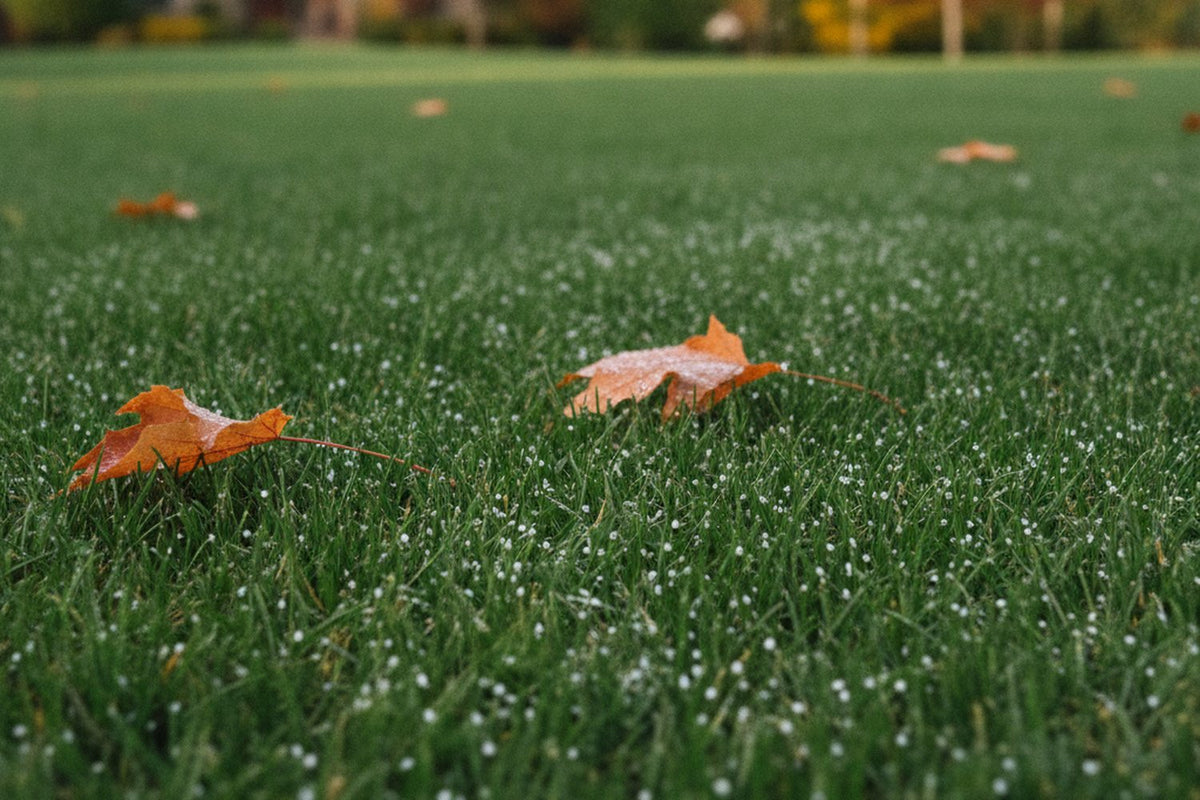
Pelletized lime is the same ground limestone, calcitic or dolomitic, stuck together into granules with a binder that dissolves when wet (Penn State, Michigan State). Penn State says pellets spread easily with drop or spinner spreaders, while finely ground powder tends to bridge over drop spreader outlets and should go down only when the air is calm. Michigan State says there is nothing special about pelletized lime's effectiveness: use the same rate as agricultural lime.
On speed the sources split: Ohio State rates pelletized limestone fast and ground slow, while the Fairfax County Master Gardeners say pellets work slightly more slowly. Virginia Tech found pellets as effective at maintaining pH but less effective at raising very acid soils.
Dolomitic vs calcitic lime
Calcitic lime is mostly calcium carbonate; dolomitic lime is calcium and magnesium carbonate. Virginia Tech says calcitic reacts slightly faster, a difference it calls negligible in the field, and that the choice comes down to magnesium: low magnesium gets dolomitic, and either works in all other situations. Penn State, Michigan State, Rutgers and NC State give the same magnesium rule. The Fairfax County Master Gardeners describe a competing view that too much magnesium relative to calcium makes soil prone to compaction, and settle it by following the lab; Michigan State finds no evidence that dolomitic lime does harm.
Gypsum is not lime at all: it is calcium sulfate and does not raise pH (Penn State, Ohio State, Alabama), and our clay soil guide covers when it helps. And two limes do not belong on a lawn: hydrated and burned lime raise pH fast (Ohio State rates both fast), but Penn State says never to use them on turf, because both can burn it.
Fast-acting, "calcium" and liquid lime
Fast-acting pellets are very finely ground limestone, often with an additive, pelletized for spreading. Finer particles do react sooner: in a University of Kentucky table that Virginia Tech reprints, 50 to 100 mesh particles are 100 percent reacted after one year, against 20 percent for 8 to 20 mesh. What does not hold is the promise of using less (see the CCE section). A Lawn Forum member puts it plainly: if the lab says you need 100 pounds per 1,000 square feet, you need 100 pounds, fast-acting or not. The counterpoint, from another member: fast-acting lime responds in months and, in small doses, lowers the risk of overshooting on a test that read too low.
"Calcium" products. Alabama Extension warns that calcium chloride, gypsum and Epsom salt cannot raise pH, and to be wary of products that claim to improve fertility with much smaller amounts of calcium.
Liquid lime is very fine limestone suspended in water:
- NC State: the most costly form, easy to use and fast acting, but its effects are short lived and it must be reapplied every year.
- Purdue: pH rises faster for the first few months, but within a year the change is equal for liquid and dry applied at equal rates.
- Alabama: real liquid lime is about half lime and half water, so it takes about two tons of liquid to do the work of one ton of lime; be wary of products that claim to fix pH with 1 to 5 gallons per acre.
When to apply lime to your lawn
Fall is the most-named window: Penn State says lime is most effective applied in fall, because rain, snow and winter heaving work it into the soil, and Rutgers says fall and early winter. The sources differ at the edges. NC State's Carolina Lawns guide says any time, with winter usually best; Scotts says never on a dormant lawn, so not in summer or winter; the Fairfax County Master Gardeners say any time the ground is not frozen, but summer and winter are not optimum; UMass limes twice a year, spring and fall. UMass also says lime can take 4 to 6 months to raise pH, and Michigan State that it reacts completely over two to three years.
How to spread lime
- Aerate first if you can. Purdue says lime applied right after aerification changes pH faster; Ohio State and UMass agree that coring helps.
- Use a spreader, set from the bag. NC State spreads lime with a rotary or drop spreader, and Scotts applies half in one direction and half at right angles. Solu-Cal's data sheet says to calibrate your spreader before use. Our spreader picks cover both kinds.
- Spread on a dry, growing lawn, then water it in. Scotts says never on dormant, wilted or stressed grass; UMass says not on very wet or frozen soil; Ohio State irrigates afterward to wash lime off the blades. Penn State keeps limestone away from azaleas, rhododendrons and blueberries.
Lime and fertilizer: together or apart?
Pick 1's label says it may go down at the same time as fertilizer, and none of the extension pages we read tells lawn owners to separate them. The Grass Factor warns that lime with urea can lose nitrogen, and Lawn Love, citing a Mississippi State Extension researcher, says the same of ammonium-based fertilizers. So if your fertilizer contains urea, keep the two a couple of weeks apart, as one Houzz forum reply suggests; UMass times most lawn fertilizer for September and November, so it is easy. Our fall lawn fertilizer picks cover the other half of the job.
Is lime safe for pets and kids?
Garden lime, yes, once it is watered in. UMaine Extension, citing Virginia State University, says calcitic and dolomitic lime are nontoxic to humans, wildlife and pets, but that lime dust can irritate lungs, eyes and skin, so wait until the lime is in the soil; some people wait for a good rain. Hydrated and burned lime are different: Ohio State's table calls both hazardous, and Penn State warns they can burn turf and get tracked indoors on shoes. Some makers say sooner (Jonathan Green: right after Mag-I-Cal goes down); we would follow UMaine and water it in first.
A word from the people who wrote this
We are Spear Head Spade, and we make double-patented digging spades, not lime, so no product of ours is on this list. The one job a spade does here is the soil test itself: Rutgers collects its lawn cores with a garden trowel or a spade, though Clemson notes a soil probe is far less destructive to a lawn. If you are choosing a spade for that or for the beds, our spade finder matches one to your soil.
Frequently asked questions
How many bags of lime do I need?
Take the lime requirement on your lab report, convert it to pounds per 1,000 square feet, multiply by the multiplier for your bag if the report is written for pure calcium carbonate, multiply by your lawn's area in thousands of square feet, and divide by the bag weight. Then split it so no single application passes the cap your sources give, 50 pounds per 1,000 square feet for most of ours. The five steps and a worked example are in the box near the top of this page.
How long does lime take to work on a lawn?
Months, not days. UMass says limestone can take 4 to 6 months to raise soil pH, and Ohio State says to expect several months. Michigan State says lime reacts completely over two to three years, with some benefit in the first few months. Espoma claims its Lightning Lime works in as little as 6 to 8 weeks.
Can you put too much lime on a lawn?
Yes. Ohio State says too much lime can make soil alkaline, and above pH 8.0 nitrogen, phosphorus, iron and several other nutrients become less available. Rutgers says annual applications may be excessive and raising pH above 6.5 brings no benefit. That is why the extension sources here say to lime on a soil test, and UMass and Purdue say to retest.
Will lime get rid of moss?
Not on its own. Penn State says moss is more common on acid soils but that weeds cannot be controlled with lime; UMaine notes moss also grows in shady, moist, poorly drained areas. Lime helps only if a test shows the pH is low.
How often should you lime your lawn?
Only when a soil test says so. Rutgers says a correct application holds pH for 2 to 3 years on sandy soils and 3 to 4 years on finer soils, and NC State says to retest every two to three years. Sandy soils need liming more often, according to UMass.
See also our guides to the best dethatcher and the best lawn leveling rake for the rest of a fall lawn job.
Disclosure: Our commissions do not change what we recommend or what you pay. Availability was checked on Amazon on September 22, 2026 and can change; we do not print prices because they move, so every "Check price" link shows today's.