As an Amazon Associate we earn from qualifying purchases. Some brands also pay us when you click or buy, so those links are ads. Full disclosure below
The best soil test kit for most gardeners is a mail-in lab kit like MySoil (sold as a 2 pack), which measures 13 plant available nutrient levels, including nitrogen and pH, and returns fertilizer recommendations in six to eight days. For a lawn, Soil Savvy reports pH and 14 nutrients as a fertilizer recommendation. If pH is the only question, a capsule kit like the Luster Leaf Rapitest answers it cheaply.
Soil advice is worthless without a test. Lime, sulfur, gypsum, and balanced fertilizer are all corrections to problems you may not have, and applying them blind costs money and can push the soil further from where you want it. Test first, amend second. It is why our clay soil guide says to get a soil test before buying gypsum: most garden clay is not sodic, and only a test tells you whether yours is the exception.
Best soil test kits at a glance
| Kit | Best for | Why it wins | Where to buy |
|---|---|---|---|
| MySoil Soil Test Kit, 2 pack (best overall) | One accurate answer for a whole garden | A mail-in lab measures 13 plant available nutrient levels, including nitrogen and pH, and sends back what to apply | Check price on Amazon |
| Luster Leaf Rapitest | Spot checking several beds cheaply | Twenty capsule tests, five each for pH, nitrogen, phosphorus and potash | Check price on Amazon |
| Bluelab Soil pH Pen | Gardeners who check pH often | Two point calibration, automatic temperature compensation and a probe cover that doubles as a dibber | Check price on Amazon |
| Soil Savvy | Lawns and a fertilizer plan | A lab report covering pH and 14 nutrients, written as a fertilizer recommendation | Check price on Amazon |
| Luster Leaf Rapitest Digital | Repeat testing without color guessing | An LED reader scores the same capsule chemistry across 25 tests | Check price on Amazon |
What is the best soil test kit?
The best soil test kit is MySoil, a mail-in kit that sends your sample to a lab that measures 13 plant available nutrient levels, including nitrogen and pH. Results come back in six to eight days with organic and non-organic recommendations. Home kits estimate nutrients; a lab measures them.
Anyone can read pH well enough with a capsule kit, and pH is the most useful number in the report. Nitrogen, phosphorus, and potassium are harder, because the amount available to a plant depends on extraction chemistry a color card cannot replicate. If you run one test on a new garden, make it a lab test.
What each type of soil test actually measures
Three kinds of soil test are sold to home gardeners, and they are not interchangeable.
- Mail-in lab kits. You collect a sample, mail it in a prepaid envelope, and a lab returns pH plus a full nutrient panel and a recommendation. This is the only type that measures nutrients in a way you can act on with confidence.
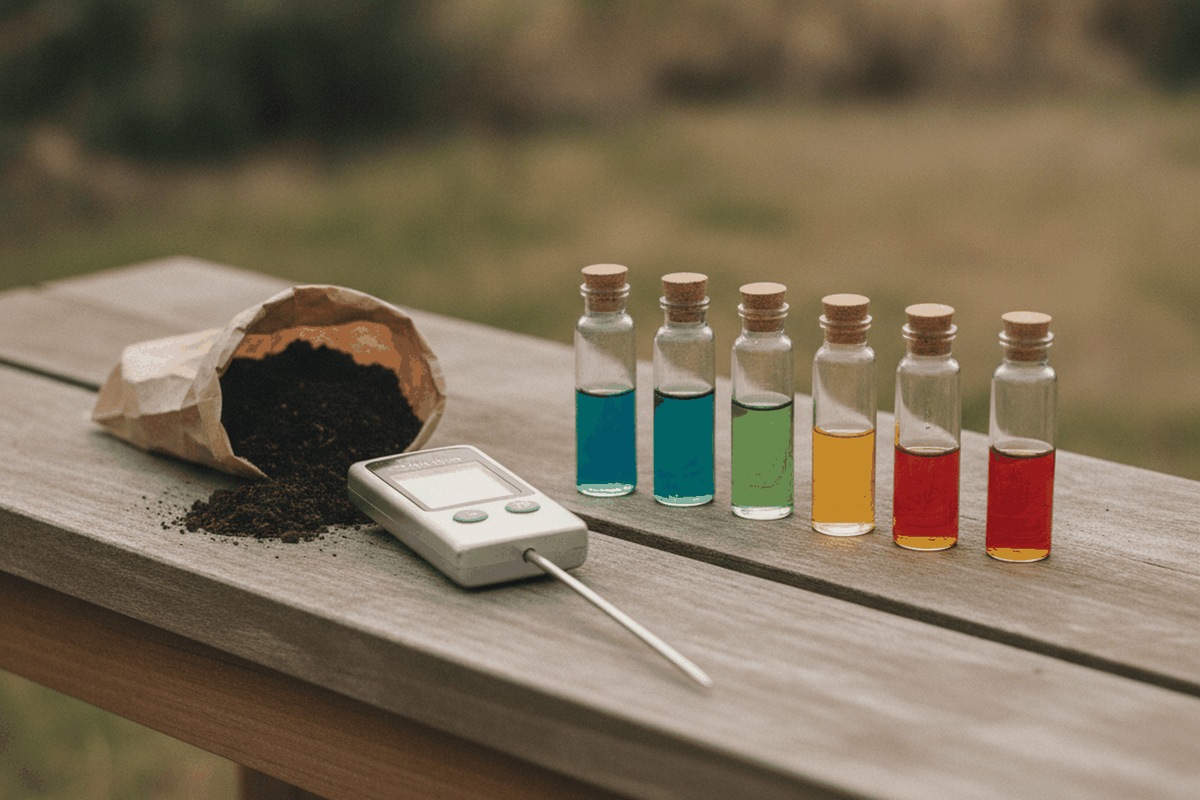
- Chemical capsule kits. You mix soil with water, add a reagent capsule, and match the color that develops against a printed comparator. Good for pH, honest as a rough sort for nitrogen, phosphorus and potash, and cheap enough to run in every bed.
- Probe meters. A metal probe pushed into moist soil reads pH, and some also claim moisture, light, or fertility. The pH reading on a lab grade meter is genuinely useful, but every probe reads badly in dry soil, so water the spot and let it sit before testing. The nutrient readings on inexpensive multi-function probes are not measuring nutrients at all.
Check what the test includes. A full nutrient panel means different things at different labs, so read what a kit or lab covers before you buy it. A routine fertility test, an add-on nutrient or salt test, and a contaminant test are separate requests. At the University of Minnesota Soil Testing Laboratory, for example, the regular lawn and garden test reports phosphorus, potassium, pH with a lime requirement when one is needed, organic matter and an estimated texture, while nitrate, lead and soluble salts are each ordered separately. On this page, the MySoil listing counts 13 plant available nutrients with nitrogen and pH among them, and the Soil Savvy listing says its report covers soil pH and 14 nutrients, nitrogen, phosphorus and potassium included. Check the panel for the kit or lab you choose rather than assuming it matches another one.
A fertility report is not a contaminant screen either. The University of Minnesota lab states that its soil test report will not tell you about diseases, microbes, herbicide or pesticide residues, or chemicals, and neither lab kit listing on this page mentions a lead or contaminant test. If lead or another contaminant is the worry, ask a lab for that test by name.
How to take a soil sample
The sample decides the answer. One scoop from one hole describes that hole, not the bed, so every kit asks for a composite.
Your kit's own instructions come first. Kits and labs set their own depth, number of spots, amount of soil and drying step, and they do not all match the general method below, which is written for a lab that asks for a dried composite. Where your kit gives its own spot count, depth or drying step, use it in place of the 10 to 12 spots and the drying step below. MySoil's instructions are one example: its How it works page says to collect from 5 to 7 spots, from the surface down to 6 inches (shallower if the ground is too hard), mix the soil, add one level scoop to the jar in the kit without pouring out the water or capsule already inside, and mail it within one day of adding the soil. Whatever the kit asks, keep the tools and bucket clean, and keep each area you want a separate answer for in its own sample.
- Take small cores or slices from 10 to 12 spots spread across the area, avoiding the edges, the compost pile, and any spot you recently fertilized.
- Go 4 to 6 inches deep for beds and vegetable ground, and 3 to 4 inches for an established lawn, where the roots are.
- Drop everything into a clean plastic bucket and pull out roots, stones, and mulch. Galvanized tools can skew micronutrient readings.
- Mix thoroughly, spread the soil on newspaper, and let it air dry. Do not use an oven or a radiator.
- Take the kit sample from that mixed, dried soil, and test beds with different histories separately. A lawn, a vegetable bed, and a shrub border are three samples.
When to test your soil
Fall is the best time to test, because the corrections a report calls for take months to work. Lime raises pH slowly and sulfur lowers it slowly, and both need rain, soil biology, and time. A test in September gives amendments the whole winter to act before spring planting, which is the same reason cover crops go in during fall.
Timing matters for lawns too: a fall test tells you what to apply before winter, which is what our fall lawn fertilizer guide works from. If you are filling a new raised bed, test the mix once it has settled rather than the day you fill it.
Reading your pH result, and what changes it
pH is the master variable. Below about 6.0 and above about 7.5, nutrients that are physically present in the soil become far less available to roots, which is why a garden can test adequate for phosphorus and still show deficiency. Most vegetables and lawn grasses want 6.0 to 7.0, and 6.5 is the safe target.
Raise pH with ground limestone and lower it with elemental sulfur, both at the rate your report gives, because the amount depends on soil texture as much as on the current reading. Clay needs far more than sand to move the same distance. Neither works fast: apply, water in, and retest the next season instead of adding more. Wood ash also raises pH and is easy to overdo. For a lawn, choose a lab test that reports a lime requirement or buffer pH; our guide to the best lime for lawns turns that number into bags.
One thing a pH result does not justify is gypsum. It has a real role in sodic soils where sodium has wrecked the structure, but most garden clay is not sodic, and there is no consensus that gypsum improves clay structure. Sand is worse: extension guidance is explicit that no amount of sand added to clay changes its texture, and sand gives clay particles a surface to cling to, leaving harder ground than you started with. Let the report rule out the fixes you were about to buy.
From soil test report to application
A soil test report carries two kinds of numbers. Measured levels describe what the test found in the soil. Recommended rates, in pounds of a nutrient or a product per area, describe what to apply. Read a report in this order before you buy anything:
- Confirm that the sample name and the crop or use printed on the report match the bed you sampled and what you grow there.
- Find the recommendation, not just the measured level. A measured level is a test result, not an amount to add.
- Check the area unit. A rate per 100 square feet and a rate per 1,000 square feet differ by a factor of ten, so confirm which one the report uses before you scale it to your bed.
- Check whether a rate is for a nutrient or for a product. A nutrient rate has to be converted using the analysis printed on the bag.
- Apply at the rate the report gives, and follow the product label.
Here is that conversion, using the worked example the University of Minnesota Soil Testing Laboratory publishes. It shows the arithmetic and is not a feeding recommendation for your soil. The report calls for 0.15 pounds of nitrogen per 100 square feet, and the bag is a 15-20-30 fertilizer, which is 15 percent nitrogen. Divide the nitrogen rate by the nitrogen share (0.15 divided by 0.15) and you need 1 pound of that fertilizer per 100 square feet, or 5 pounds to cover a 500 square foot garden.
The kits here do different amounts of that work for you. The MySoil listing says its report tells you what to apply, how much and when, in organic and non-organic forms, and the Soil Savvy listing describes an easy to understand fertilizer recommendation. The two Rapitest kits give pH, nitrogen, phosphorus and potash results by color, read by eye or by the Digital's LED reader, and the Digital's booklet turns its three nutrient results into fertilizer guidelines. Both Rapitest listings include pH preferences for over 450 plants. The Bluelab pH pen reads pH and temperature, not nutrients.
How to choose a soil test kit
- Decide whether you need nutrients or just pH. If pH is the question, a cheap capsule kit answers it. If the question is what fertilizer to buy, only a lab test is worth acting on.
- Count the beds. One lab kit tests one composite sample. Several beds with different histories need several kits, or a cheap capsule kit to sort them first and one lab test on the problem bed.
- Check what comes back. A raw number list is less useful than a report that says what to apply and how much. Both lab kits here return recommendations rather than only data.
- Be skeptical of multi-function probes. A cheap meter that claims pH, moisture, light, and fertility from one probe is measuring conductivity and calling it nutrition.
The best soil test kits, by job
These five cover the real cases, from one lab test to a kit you run in every bed.
1. MySoil Soil Test Kit: best soil test kit overall
MySoil is the kit to buy, and we link the 2 pack, two single-use kits with two prepaid envelopes, because the single kit was on backorder on Amazon when we checked on October 13, 2026. It is a mail-in lab test: you collect a sample, send it in the prepaid envelope, and get a report covering 13 plant available nutrient levels, including nitrogen and pH. Nitrogen is the number home kits handle worst and the one that decides most fertilizer purchases.
What makes it worth the money is the recommendation, not the data. The report says what to apply, how much, and when, in both organic and non-organic forms, which turns a page of numbers into a shopping list. It covers any growing situation: lawn and turf, vegetable garden, flowers, compost, trees, or house plants. Where it loses: one kit is one sample, so the 2 pack covers two beds, and a garden with more distinct beds than that gets expensive fast.
2. Luster Leaf Rapitest: chemical soil test kit
The Luster Leaf Rapitest is a kit that makes sense when you have several beds and one question. It is 20 cheap tests, five each for pH, nitrogen, phosphorus, and potash, using a capsule system and printed color comparators. Five pH tests will sort a whole yard.
Use it properly: trust the pH reading, treat the nutrient results as high, medium, or low rather than as numbers, and send a lab sample from whichever bed looks worst. The kit includes a pH preference list for over 450 plants. Where it loses: you are matching colors by eye, and the nutrient chemistry is a rough screen rather than a measurement.
3. Bluelab Soil pH Pen: soil pH tester
Probe meters are the category to be most careful with. The Bluelab Soil pH Pen is a pH pen you calibrate, not a multi-function probe. Its listing describes a digital pH meter for soil, coco, coir, potting mixes and rockwool that reads pH and temperature, set up with a two point calibration before first use and fitted with a calibration indicator on a backlit LCD.
The probe cover is the useful part in a garden: it doubles as a dibber, so you press the pen into the soil, pull the cover off and read in the hole it leaves, which the listing says cuts wear on the probe. It reads in 0.1 pH steps with automatic temperature compensation, the casing is waterproof, and the kit comes with one 20 ml sachet each of pH 7, pH 4 and KCl for the first hydration and calibration. Where it loses: it earns its place only if you check pH often, and it never reads nutrients. As with every probe meter, water dry soil and let it sit before you read it.
4. Soil Savvy: best soil test kit for lawns
Soil Savvy is a mail-in lab kit built around a fertilizer answer rather than a nutrient panel. The report covers soil pH and 14 nutrients including nitrogen, phosphorus, and potassium, and it lands as a recommendation rather than a table of numbers. For a lawn, where the practical question is which bag to buy in the fall, that framing beats extra decimal places.
It is the cheaper of the two lab kits here, which matters when a property needs a lawn sample and a garden sample. The maker says it uses the same soil testing technology as agricultural producers, turf managers, and landscapers. Where it loses: the report is built around one fertilizer answer rather than the organic and non-organic options MySoil lays out, and like any mail-in kit, one kit tests one composite sample.
5. Luster Leaf Rapitest Digital: NPK and pH combo kit
The Luster Leaf Rapitest Digital is the capsule kit with the color guessing removed. An LED reader scores the developed color and gives you a result in a few seconds, across 25 tests: 10 for pH and five each for nitrogen, phosphorus, and potash.
Ten pH tests make this a kit for someone tracking a correction across a season rather than testing once, and the booklet turns the nitrogen, phosphorus, and potash results into fertilizer guidelines. Where it loses: it is still capsule chemistry underneath, so a digital display makes the reading consistent, not more accurate than the reagent allows. It costs close to what a lab test costs.
Frequently asked questions
Are home soil test kits accurate?
Mail-in lab kits are accurate, because a laboratory runs standard extraction methods rather than matching a color card. Home capsule kits are reliable for pH and useful as a rough sort for nutrients. Cheap probe meters that promise nitrogen, phosphorus and potassium readings are the weak link, and their nutrient numbers are close to meaningless.
How often should you test garden soil?
Every three years is enough for an established bed that is growing well. Test yearly while you are correcting a known problem such as low pH, and test any new bed or new property before you buy a single amendment. Lawns under a regular fertilizer program benefit from a test every two years.
What is the ideal soil pH for vegetables?
Most vegetables do best between 6.0 and 7.0, with 6.5 as the usual target, because that band keeps the widest range of nutrients available to roots. Blueberries are the common exception and want 4.5 to 5.5. Potatoes tolerate more acid soil, and brassicas prefer the upper end of the range.
How do you lower soil pH?
Elemental sulfur is the standard way, and soil bacteria convert it to acid over months rather than days. Apply the rate your test recommends, water it in, and retest the following season before adding more. Peat moss and acidifying fertilizers help at the margins, and no amendment lowers pH quickly.
Can I get a free soil test?
Many state extension services test garden soil for a small fee, and some run free clinics at certain times of year. Fees, turnaround, and what the report covers vary by state, so check your own state extension office first. Their reports are usually calibrated to local soils and crops.
What is the best soil test kit for a lawn?
Soil Savvy (pick 4) is the lawn pick here. It is a mail-in lab kit whose report covers soil pH and 14 nutrients, including nitrogen, phosphorus and potassium, and it comes back as a fertilizer recommendation, which answers the question a lawn owner has before buying a bag. MySoil also lists lawn and turf among its uses and adds organic and non-organic options. Sample the lawn on its own rather than mixing it with garden beds.
What is the best soil test kit for a vegetable garden?
MySoil (pick 1). Its listing names vegetable gardening among the growing situations it tests, its lab measures nitrogen along with pH and the other nutrients, and the report gives organic and non-organic fertilizer options. With several beds, send the lab sample from the one that matters most and check pH in the rest with a capsule kit.
What is the best soil tester?
It depends on what you want to read. For nutrients, the better tester is a mail-in lab kit such as MySoil, whose lab measures them rather than estimating them by color. For pH alone, a calibrated pH pen beats a multi-function probe: the Bluelab Soil pH Pen (pick 3) reads pH and temperature in soil, coco or potting mix, calibrates at two points, and suits gardeners who check pH often. A probe that claims moisture, light and fertility from one spike is not reading nutrients.
The bottom line
Send one MySoil sample from the bed you care most about, and keep a Rapitest in the shed for pH spot checks everywhere else. Test in fall so lime or sulfur has the winter to work, sample 10 to 12 spots rather than one, and buy amendments only after the report names them. Many soil problems people try to fix with a product are a pH or structure problem underneath.
One note on who wrote this guide: Spear Head Spade is a family business in New Jersey. We sell double-patented digging spades, with over 600,000 sold. A test tells you what the bed is missing, and the tool that works the amendment in is the D-handle garden spade we sell.
Disclosure: some links in this guide are affiliate links to Amazon. This is at no extra cost to you, and it never changes our honest recommendations.
Product prices and availability are accurate as of the date/time indicated and are subject to change. Any price and availability information displayed on Amazon.com at the time of purchase will apply to the purchase of this product.