As an Amazon Associate we earn from qualifying purchases. Some brands also pay us when you click or buy, so those links are ads. Full disclosure below
The best gutter cleaning tools work from the ground. For most homes that means the Gutter Sense, tongs on a pole that lift debris out instead of pushing it along. The Orbit telescoping wand flushes the grit the tongs leave behind, and the Amerimax Getter Gutter Scoop is the pick for ladder work.
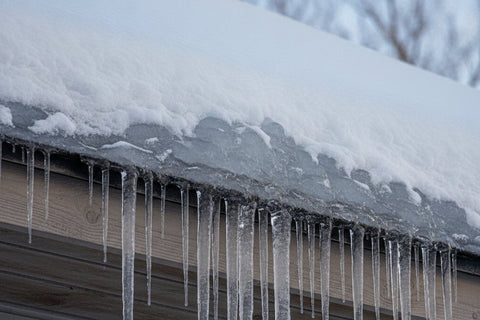
A gutter has one job: move a roof's worth of water past your siding and away from the foundation. A clogged one does the opposite. Water backs up over the front lip, soaks the fascia behind it, and in cold climates freezes at the eave into an ice dam that pushes meltwater under the shingles. It can also look clean from the ladder and still be useless if the downspout is packed. This page is one stop on our fall yard cleanup tools checklist, which puts every fall job in order.
The other half of the problem is the ladder. Almost every serious injury from this job comes from the climb, not the debris, so the tools worth owning are the ones that let you stand on the ground. We make digging tools, not gutter tools, so nothing here is ours. Each pick is judged on the reach its own listing states, on what it removes, and on whether it keeps you off the ladder.
Best gutter cleaning tools at a glance
| Tool | Reach, as listed | Best for | Where to buy |
|---|---|---|---|
| Gutter Sense Gutter Cleaning Tool (best overall) | Listed as usable to two stories | Lifting leaves out from the ground | Check price on Amazon |
| DOCAZOO Extension Telescoping Pole | 6 to 24 ft | Building a kit around one pole | Check price on Amazon |
| Orbit Telescoping Gutter Cleaning Wand 58543 | 40 to 70 in | Flushing the grit a scoop leaves | Check price on Amazon |
| Amerimax 8300 Getter Gutter Scoop, 2 pack | Arm's length, from a ladder | Fastest cleanout on a ladder | Check price on Amazon |
| MC-Hotfire 13 ft Gutter Cleaning Kit | 13 ft | A single story house on a budget | Check price on Amazon |
| Buyplus 16 ft Telescopic Gutter Cleaning Tool (not linked) | 16 ft pole, listed as reaching 24 ft | Two story eaves | Not available on Amazon on October 26, 2026 |
| TONYINGO 18 ft Reach Telescopic Gutter Wand | 4 to 12 ft pole, listed as reaching 18 ft | A water wand for the gap between the Orbit and the Buyplus | Check price on Amazon |
What is the best gutter cleaning tool?
The Gutter Sense. Spring-loaded tongs mount on a pole, and pulling a cord closes them around a handful of leaves so you can lift the pile out and drop it on the lawn. Brushes and water push debris along the trough toward the downspout, which is where you least want it. Tongs remove it. If water still finds the basement after the gutters run clear, our best sump pumps guide compares pumps by flow at a stated head and by how long a battery backup really runs.
Its own listing is honest about the limit: dry or light leaves, not wet or muddy packs. So the order for most houses is tongs on a dry day, then a garden hose for what is left, the job the Orbit wand does.
How do you clean gutters from the ground, without a ladder?
With tongs and a hose wand, each on a telescoping pole: the tongs lift the leaves out, the wand rinses the grit, and a hose run into each downspout shows the water gets away. On a single story house, that covers most of the job. A telescoping pole with tongs or a hose-fed head reaches a one story eave from the lawn. What you give up is your eyes: you work by feel, so you will not spot a sagging hanger or a separated seam until it causes a problem.
On a two story house, ground tools are right for a different reason: that gutter is not a homeowner ladder job. It is where the Buyplus water-fed pole earns its place, and where hiring the job out is a good answer. The Buyplus pole was not available on Amazon when we checked on October 26, 2026.
No ground tool clears a packed downspout. That one you work from the bottom: run the hose up into the outlet at ground level, and feed a drain snake up the pipe if the water still will not pass. Nothing here tells you the gutter is pitched wrong either. If water stands in a clean trough after a hose test, the hangers need adjusting.
What gutter cleaning tools work on a two story house?
Tools you run from the driveway, sized to the height of your gutter: a water-fed pole, or a long pole carrying a head, and a hired crew for anything taller than any listed reach. A second story gutter is not a homeowner ladder job, so the only question is how far each pole gets you.
Measure before you buy. Run a tape from the ground to the gutter and compare that number with the length or reach each listing states. Two cautions apply to every figure in the table. A reach figure is not a pole length: the TONYINGO wand (pick 7) lists an 18 ft reach on a pole that stops at 12 ft. And every telescoping pole flexes as it extends, so the top few feet of any long pole suit a light head, not a hard push against a stuck clog.
| Gutter height you measured | Tools on this page whose listed length or reach covers it | Keep in mind |
|---|---|---|
| Up to 13 ft | MC-Hotfire 13 ft kit (pick 5), TONYINGO wand (pick 7), Buyplus pole (pick 6), DOCAZOO pole with a head (pick 2) | The MC-Hotfire figure is its assembled 10 section pole, with a brush or squeegee on the end |
| 13 to 18 ft | TONYINGO wand (pick 7), Buyplus pole (pick 6), DOCAZOO pole with a head (pick 2) | 18 ft is the TONYINGO's listed reach, and its pole stops at 12 ft |
| 18 to 24 ft | Buyplus pole (pick 6), DOCAZOO pole with a head (pick 2) | Both top out at 24 ft as listed: the Buyplus as the reach of a 16 ft pole, the DOCAZOO as its full pole length. The Buyplus pole was not available on Amazon when we checked on October 26, 2026. |
| Over 24 ft | None of the tools on this page | A hired crew |
The Gutter Sense tongs (pick 1) mount on an ordinary extension pole, so their reach is the pole's, and their listing calls them usable to two stories. The DOCAZOO (pick 2) is the pole itself: tongs or a brush go on top of it.
How do you clean gutters safely from a ladder?
Sometimes the ladder is unavoidable. Treat it as the dangerous part of the job.
- Never rest the ladder on the gutter. Aluminum dents under the rails and the ladder slides sideways along the trough. Use a standoff stabilizer that bears on the fascia or roof edge, which also holds your body clear of the wall.
- One foot out for every four feet of height. Too steep it tips backward, too shallow the base slides out.
- Firm, level ground only. Not soft lawn, not a deck rail. If the ground gives at all, use a leveler or move.
- Three points of contact, belt buckle inside the rails. When the next stretch is past your reach, climb down and move the ladder. Reaching is how people fall.
- Hang the bucket on a hook so both hands are free for the climb, wear gloves and eye protection because gutter debris hides torn metal and screw points, and work in dry, still weather with someone home who knows you are up there.
Two hard limits. Never step off the ladder onto the roof, and never do gutters above a second story from a ladder. A ground tool or a hired crew covers both.
How do you use a gutter scoop?
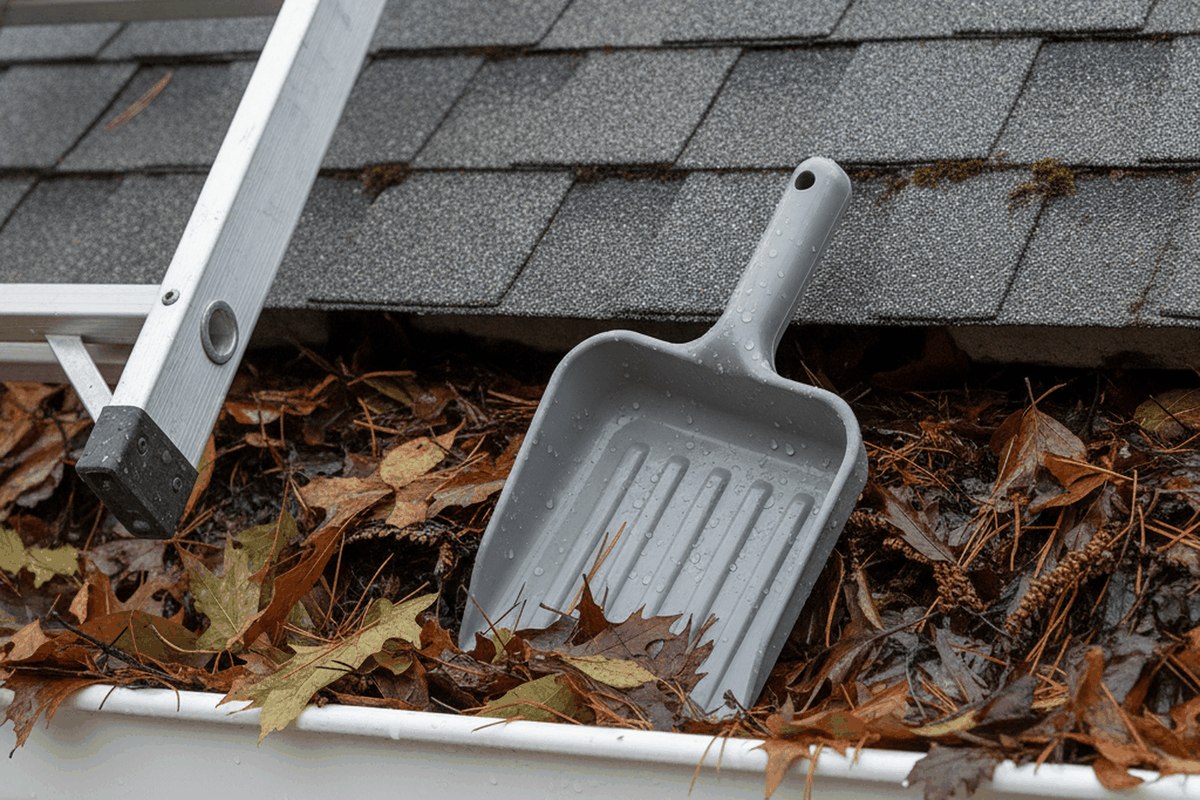
From a ladder, one arm's length at a time. A gutter scoop is the quickest way to empty a trough by hand, and it is a ladder tool, so the safety rules above apply every time you use one. The scoop on this page, the Amerimax 8300 (pick 4), is molded plastic and comes two to a pack, and plastic is the right material because a scoop that scrapes the trough should not cut through its finish.
- Hang the bucket first. Scoop into a bucket on a hook at the top of the ladder, so the muck lands somewhere other than the beds below.
- Work toward yourself. Draw the scoop along the trough toward the ladder, lift the pile out, and stop when the next stretch is past your reach. Climb down and move the ladder rather than leaning out.
- Finish with water. Run the hose along the trough and into each downspout before you put the ladder away: it clears the fine grit and shows the water gets past the elbow.
From the ground, the tool on this page that does a scoop's job is a set of tongs on a pole: like a scoop, it lifts debris out of the trough instead of pushing it toward the downspout.
How often should you clean your gutters, and when?
Twice a year: once after leaf drop finishes and before the first hard freeze, and once in late spring after maples drop seeds and oaks drop catkins. Overhanging pines change the math, because needles shed all year and knit into a mat water will not move, so plan on three or four passes under conifers. The fall pass matters most, and the mistake is doing it too early. Clean mid-drop and you will be back in three weeks.
If you would rather clean less often, our best gutter guards guide compares six DIY kits and says which ones handle pine needles.
| Region | Fall pass | Second pass |
|---|---|---|
| Northeast and Upper Midwest | Early to mid November, once hardwoods are bare | Late spring, for seeds and buds |
| Mid-Atlantic and transition zone | Mid to late November | Late spring |
| South and Gulf Coast | Late November into December | After spring pollen and needle drop |
| Pacific Northwest | November, then again midwinter | Rain does not pause, so check in January |
Gutters belong on the same list as draining hoses and shutting off the sill cocks. Our guide to winterizing the garden has that closeout sequence, and cutting overhanging branches back with a pole saw cuts next year's debris at the source.
What tools do you need to clean gutters?
The minimum kit for a single story house is three things: an extension pole, a head for it that either grabs or flushes, and a bucket with a hook. Add gloves and eye protection, because gutter muck is abrasive, unsanitary, and full of shingle grit that flicks back at you under water pressure. A garden hose does double duty here, as the flush and as the test that tells you the downspouts actually run. If any part of the job puts you on a ladder, a standoff stabilizer joins the list and is not optional.
Where can you buy gutter cleaning tools?
Home improvement chains (Home Depot and Lowe's in the US, Canadian Tire in Canada) and local hardware stores usually stock the basics: plastic gutter scoops, gutter brushes and hose-end wands. The specialist tools, such as tongs on a pole, long water-fed poles and leaf blower gutter kits, are worth comparing online, where each listing states its reach before you buy. Every pick in this guide except the Buyplus pole links to its Amazon listing, and the table above lists each pick's reach.
Tongs, wands, brushes, or blowers: which type clears what?
Gutter tools fall into a few families, and they are not interchangeable.
| Type | What it does | Where it falls short |
|---|---|---|
| Tongs on a pole | Lifts debris out of the trough | Struggles with wet, packed muck |
| Hose fed wand or pole | Flushes fine grit and shingle granules | Sprays debris down the siding |
| Brush on a pole | Sweeps loose dry material along | Moves debris toward the downspout, not out |
| Hand scoop | Fastest, most complete removal | Ladder only, with all the risk that carries |
| Leaf blower attachment | Blows dry leaves clear in seconds | Useless when wet, and it scatters debris |
| Pressure washer attachment | Breaks up packed, weathered debris | Enough force to dent a gutter or lift its coating |
| Wet or dry vacuum kit | Pulls wet debris out, contains it | Heavy, bulky, awkward at height |
If a blower attachment is where you are headed, the machine matters more than the tube. Our roundup of the best cordless leaf blowers covers which ones hold pressure down a long attachment.
Gutter attachments for a blower, wet/dry vac or pressure washer: which fits what?
If you already own one of these machines, a gutter attachment turns it into a gutter tool. None of the three below is a numbered pick on this page, and each one fits only the machines its own listing names, so the second column is the one to check against the machine in your garage.
| Attachment | Fits, as listed | In the box, as listed | What it does |
|---|---|---|---|
| CRAFTSMAN CMXZVBE38640 gutter kit, for a wet/dry vac | A wet/dry vac whose hose is 2-1/2 in. across, CRAFTSMAN or most other brands | A gutter nozzle, a blower nozzle and two extension wands | Cleans the trough with the vac's suction, or blows debris out when the hose goes on the vac's blowing port |
| M MINGLE PW32 gutter wand, for a pressure washer | A pressure washer gun, or most telescoping and extension wands, by a 1/4 in. quick connect | A 13 in. angled stainless steel wand and five nozzle tips, 0 to 65 degrees | Angles the spray into the trough once it rides on a telescoping wand; rated for up to 4000 PSI |
| A leaf blower gutter kit | Only the blowers its listing names: one kit we read lists a single brand's blowers, a minimum airflow and an outlet size limit, and another says most blowers | Extension pieces that make up the listed reach: 11 ft and 12 ft on the two blower kits we read | Blows dry leaves and debris up and out of the trough |
Of the three, the vac kit is the one that copes with a wet pack, because it pulls the debris out and holds it in the vac. The pressure washer wand breaks up packed, weathered debris, but it carries enough force to dent a gutter or lift its coating. A blower kit is for dry leaves only. Whichever you use, run a hose through afterward to check that the downspouts flow.
The best gutter cleaning tools, by job
None of these does the whole job. The realistic kit for most houses is a pole, a set of tongs, and a hose head.
1. Gutter Sense Gutter Cleaning Tool: best gutter cleaning tool overall
Gutter Sense is a pair of tongs that mount on the end of a pole and close on a cord pull. The listing states the tongs spread to a 14 inch grasp with paddles 2.5 inches wide, that they run flat in the gutter even when the pole is tilted, and that the tool is usable to two stories. It needs no water and no power, and it is the only pick here that removes debris rather than relocating it.
Where it loses: the tongs mount on an ordinary extension pole or standard handle, which the listing does not say is included, so budget for a pole. And the maker states that the tool works best with dry or lighter leaves and is less effective on heavy wet or muddy debris.
2. DOCAZOO Extension Telescoping Pole: best pole to build a kit around
Buy the pole once and hang everything else off it. The DOCAZOO extension pole is listed as extending from 6 feet to 24 feet with a quick-release thumb lever, and it ships with two tips: a straight metal tip and an attachable multi-angle tip that pivots through 180 degrees, which is the one that gets a head over a gutter lip. It takes the maker's own brushes, squeegees, and trimmers, and it collapses short enough to hang in a closet.
Where it loses: attachments are sold separately, so the pole alone cleans nothing. And 24 feet is a specification, not a working length. Any telescoping pole flexes as it extends, so treat the top few feet as reach for light heads, not for leaning into a stuck clog.
3. Orbit Telescoping Gutter Cleaning Wand 58543: best hose-powered flush
The Orbit 58543 is the second half of the job. The listing states it telescopes from 40 inches to 70 inches, that the zinc sweeper nozzle rotates through 180 degrees, and that the head locks in four positions, so you can aim the spray up into the trough or down at the lip. A padded foam grip keeps cold water off your hands. It is the simplest way to move the fine grit and shingle granules no scoop picks up.
Where it loses: 70 inches of wand is not a ground tool on its own. You hold it overhead at the eave, which on most houses means a ladder or a low roofline. Flush before you wash windows, not after.
4. Amerimax 8300 Getter Gutter Scoop: best scoop for ladder work
When you are already on the ladder, nothing beats a scoop for speed. The Amerimax 8300 Getter Gutter Scoop comes two to a pack. Plastic is also the right material: it will not gouge the gutter's coating or the seam sealant the way a metal trowel or a putty knife does.
Where it loses: the Amazon listing carries no specifications at all, no dimensions and no feature bullets, so judge it as what it is, a molded plastic scoop from a gutter manufacturer. It is also a ladder tool and inherits every risk in the safety section above. Buy it for the few feet a pole cannot solve, not as your primary method.
5. MC-Hotfire 13 ft Gutter Cleaning Kit: best budget all-in-one
The MC-Hotfire kit is a pole and heads in one box. The listing describes a 10 section extension pole assembling to 13 feet, a stiff nylon gutter brush head, and a dual-function squeegee with a cloth holder and two reusable pads. For a single story ranch that covers the gutter pass and the upper windows in one afternoon.
Where it loses: a brush sweeps rather than lifts, so material travels along the trough and can pack at the downspout or spill over the lip onto the siding. And a 10 section pole is nine joints, which is where flex lives. It will not feel like the DOCAZOO at full extension.
6. Buyplus 16 ft Telescopic Gutter Cleaning Tool: best reach for two story eaves
The Buyplus telescopic tool is the pick when the gutter is somewhere you have no business laddering. The listing states a 16 foot extendable aluminum pole reaching up to 24 feet, a 360 degree rotatable metal nozzle, zinc alloy threaded heads, and brass water valves, with gaskets and a hose attachment included. It is the longest-reaching water-fed pick, built for second story gutters from the driveway.
Where it loses: it needs a hose at decent pressure, and a fully extended aluminum pole with water in it is heavy to steer. Like every water tool it flushes debris outward, so expect wet leaves down the wall and grit in the beds below. Skip it if your gutters are single story, where tongs do a cleaner job.
When we checked on October 26, 2026, the Buyplus 16 ft Telescopic Gutter Cleaning Tool was not available on Amazon, so we do not link it for now.
7. TONYINGO 18 ft Reach Telescopic Gutter Wand: best mid-length water wand
If the Orbit is too short to use from the lawn and the Buyplus is more pole than your house needs, the TONYINGO wand sits between them. The listing states an aluminum pole that telescopes from 4 to 12 feet, a 21 inch flexible wand that swivels 360 degrees and bends into gutter corners and downspout openings, an 18 foot maximum reach, and four spray patterns from a gentle rinse to a jet. It connects to a garden hose by quick-connect or a standard 3/4 inch thread, and the kit includes a shut-off valve.
Where it loses: 18 feet is the listing's reach figure, not the pole length, and the pole itself stops at 12 feet, so measure a two story eave before you count on it. Like every water tool it flushes debris along and over the lip rather than lifting it out, so it is the rinse after the Gutter Sense tongs, not a replacement for them.
How to choose a gutter cleaning tool
- Count your stories first. One story means a ground pole tool is realistic. Two stories means a water-fed pole or a hired crew, not a longer ladder.
- Removal beats relocation. Tongs and scoops take debris out. Brushes and water move it toward the downspout, the part that clogs hardest.
- Check whether the pole is included. Several gutter heads are heads only, and you need a pole to use them.
- Match the tool to wet or dry. Tongs and blowers want dry leaves. Water and vacuums are the answer once the pack is soaked, and no pole tool clears a downspout elbow.
- Buy the safety gear with the tool. A standoff stabilizer and a bucket hook are small add-ons, and they are why it stays put.
What comes out of the trough is worth keeping. Gutter debris is mostly leaves and twigs, good brown material for a compost pile once the shingle grit settles out. Our guide to mulching leaves covers the mower pass that turns a pile into mulch, the best leaf rakes roundup covers gathering it, and the rest of the seasonal lineup lives in our garden guides.
Frequently asked questions
What is the best tool for cleaning gutters from the ground?
A telescoping pole fitted with tongs, such as the Gutter Sense, is the best ground-based option for most single story homes, because it lifts debris out of the trough instead of pushing it toward the downspout. A water-fed pole reaches a two story eave, though it flushes debris down the siding rather than removing it.
How often should gutters be cleaned?
Twice a year for most homes: once after the leaves have finished falling in November, and once in late spring after trees drop seeds and catkins. Houses with pines overhead need three or four passes, because needles shed continuously and mat into a layer water cannot move.
Can you clean gutters with a leaf blower?
Yes, with a gutter attachment kit and only on dry debris. A blower clears loose leaves in seconds and is the fastest method when conditions are right. It does nothing for wet, packed material, and you should still run water through afterward to check the downspouts are flowing.
Is it safe to clean gutters from a ladder?
It can be, with a standoff stabilizer so the ladder never rests on the gutter itself, firm level ground, a base set one foot out for every four feet of height, and three points of contact. Move the ladder rather than reaching. Do not step onto the roof, and do not attempt gutters above a second story from a ladder.
Do gutter cleaning tools work on wet leaves?
Most work poorly. Tongs and blowers are both specified for dry or light debris, and a stiff brush smears a wet pack rather than moving it. Water-fed tools and wet or dry vacuums are the honest answer for soaked material, or wait two or three dry days and let the pack lighten.
Do gutter cleaning tools really work?
Within limits. Tongs lift dry leaves out of a single story gutter reliably, and a hose-fed pole clears the grit that is left. What no pole tool handles well is wet packed debris, a blocked downspout, or spotting a failing hanger while you work.
What PSI do you need to clean gutters with a pressure washer?
There is no set number to aim for. The pressure washer gutter wands we read list a maximum, not a target: the M MINGLE PW32's listing rates it for up to 4000 PSI, which is what the fitting can take, not what a gutter needs. A pressure washer has enough force to dent a gutter or lift its coating, so start with the widest tip, keep the spray moving, and step up only if the debris will not shift. For most gutters, a hose-fed wand does the flush with no pressure washer at all.
How can you tell if your gutters are clogged?
Watch them in a steady rain. Water spilling over the front lip, a downspout that only trickles, and a wet stain on the fascia behind the gutter all point to a clog. On a dry day, run a hose into the far end of each run: if little or nothing comes out at the bottom, something in between is packed; if the trough runs clear, it is the downspout, and you clear that one from the ground up. Water standing in a trough you have just cleaned is a different problem, a gutter pitched wrong, and the hangers need adjusting.
When is the best time of year to clean gutters?
Late fall, once the leaves have finished dropping and before the first hard freeze, with a second pass in late spring. Pick a dry spell for the fall pass, since a soaked pack is easier after two or three dry days. Under pines, add passes through the year, because the needles keep falling.
Is there a trick to cleaning gutters from the ground?
Lift, then flush, then test. Take the leaves out with tongs on a pole on a dry day, rinse the grit that is left with a hose wand on a pole, and finish by running the hose into each downspout to prove the water gets away. In that order, most of the debris leaves the gutter before any water moves the rest toward the downspout, the part that clogs hardest.
The bottom line
Buy the Gutter Sense tongs and a DOCAZOO pole to carry them, and you can clear a single story gutter on a dry November afternoon without touching a ladder. Add the Orbit wand for the flush, the TONYINGO wand if the Orbit falls short from the lawn, or the Buyplus pole if your eaves are two stories up. The Buyplus pole was not available on Amazon when we checked on October 26, 2026. The rule underneath all of it: the gutter is worth cleaning, and it is never worth a fall.
A word on who wrote this: we are Spear Head Spade, a family business in New Jersey. We sell double-patented spades and one long-handled hoe, with over 600,000 sold. Gutters are not our department, but a downspout that still empties against the foundation ends in a trench, and our spade finder matches a spade to your height and your soil.
Disclosure: Our commissions do not change what we recommend or what you pay.
Product prices and availability are accurate as of the date/time indicated and are subject to change. Any price and availability information displayed on Amazon.com at the time of purchase will apply to the purchase of this product.