As an Amazon Associate we earn from qualifying purchases. Some links are paid. Disclosure
Our top picks
Best hose-powered flush
1. Orbit Telescoping Gutter Cleaning Wand 58543
Best for: Rinsing out the grit tongs leave
Lift-out kit for a shop vac
4. CRAFTSMAN CMXZVBE38640 Wet/Dry Vac Gutter Kit
Good for: Lifting leaves out with a shop vac
Blower kit for most blowers
5. BLACK+DECKER BZOBL50 Gutter Clean Attachment
Good for: Blowing leaves out from the lawn
The best gutter cleaning tools work from the ground. For most homes that means tongs on a pole that lift debris out instead of pushing it along. The Orbit telescoping wand flushes the grit the tongs leave behind, and the Amerimax Getter Gutter Scoop is the pick for ladder work.
1. Orbit Telescoping Gutter Cleaning Wand 58543: best hose-powered flush
Aims a hose spray into the trough.
| Pick | Reach, as listed | Lifts or flushes | Needs | Best for | Our verdict | Where to buy |
|---|---|---|---|---|---|---|
| 1. Orbit Telescoping Gutter Cleaning Wand 58543Best hose-powered flush | 40 to 70 in | Flushes | A garden hose | Rinsing out the grit tongs leave | Aims a hose spray into the trough. | Check price on Amazon |
| 2. Amerimax 8300 Getter Gutter ScoopBest scoop for ladder work | Arm's length, from a ladder | Lifts debris out | A ladder | Fastest cleanout on a ladder | A plastic hand scoop, two to a pack. | Check price on Amazon |
| 3. TONYINGO 18 ft Reach Telescopic Gutter WandMid-length water wand | 4 to 12 ft pole, listed as reaching 18 ft | Flushes | A garden hose | A hose rinse from the lawn | A hose wand on a 4 to 12 ft pole. | Check price on Amazon |
| 4. CRAFTSMAN CMXZVBE38640 Wet/Dry Vac Gutter KitLift-out kit for a shop vac | Not stated | Lifts debris out, or blows it out | A wet/dry vac with a 2-1/2 in. hose | Lifting leaves out with a shop vac | Two wands, a gutter nozzle and a blower nozzle. | Check price on Amazon |
| 5. BLACK+DECKER BZOBL50 Gutter Clean AttachmentBlower kit for most blowers | Up to 12 ft, for a 5 ft 11 in. user | Blows debris out | A leaf blower | Blowing leaves out from the lawn | Four extension tubes for a leaf blower. | Check price on Amazon |
When we checked on November 19, 2026, every pick we link was in stock as new; the TONYINGO wand (pick 3) was in short supply. How our guides are made sets out what we check.
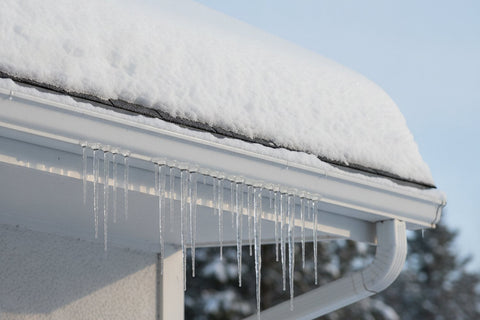
A gutter has one job: move a roof's worth of water past your siding and away from the foundation. When it backs up, water spills over the front lip, soaks the fascia behind it, and in cold climates freezes at the eave into an ice dam that pushes meltwater under the shingles. This page is one stop on our fall yard cleanup tools checklist, which puts every fall job in order.
What is the best gutter cleaning tool?
Tongs on a pole, for most homes. Spring-loaded tongs mount on a pole, and pulling a cord closes them around a handful of leaves so you can lift the pile out and drop it on the lawn. Brushes and water push debris along the trough toward the downspout, which is where you least want it. Tongs remove it. If water still finds the basement after the gutters run clear, our best sump pumps guide compares pumps by flow at a stated head and by how long a battery backup really runs.
The order for most houses is tongs on a dry day, then a garden hose for what is left, the job the Orbit wand does.
The Orbit 58543 is the second half of the job. The listing states it telescopes from 40 inches to 70 inches, that the zinc sweeper nozzle rotates through 180 degrees, and that the head locks in four positions, so you can aim the spray up into the trough or down at the lip. It moves the fine grit and shingle granules no scoop picks up. Bob Vila, which tested it, says its shut-off valve does a good job of controlling the pressure.
Good to know: you hold its 40 to 70 inches overhead at the eave, which on most houses means a ladder; from the ground, it suits a low roofline. Bob Vila likewise says it reaches lower gutters, like those on ranch or Cape-style homes, from the ground, rather than higher ones, and that how well it cleans depends on your home's water pressure. Flush before you wash windows, not after.
How we chose these gutter cleaning tools
We sell digging tools, not gutter tools, so nothing here is ours. Each pick is judged on the reach its own listing states, on whether it lifts debris out or flushes it along, and on how much of the job it leaves for a ladder. Where someone has used a pick on real gutters, we credit them: Bob Vila, whose testers used each of its picks to clean sections of gutter on their own homes. This Old House chooses from research rather than a test, so we count its picks as recommendations, not tests.
How do you clean gutters from the ground, without a ladder?
With tongs and a hose wand, each on a telescoping pole. On a single story house, that covers most of the job: a telescoping pole with tongs or a hose-fed head reaches a one story eave from the lawn. What you give up is your eyes: you work by feel, so you will not spot a sagging hanger or a separated seam until it causes a problem.
On a two story house, the job is a water-fed pole from the driveway or a hired crew, and the next section sizes a pole to your gutter.
No ground tool clears a packed downspout. That one you work from the bottom: run the hose up into the outlet at ground level, and feed a drain snake up the pipe if the water still will not pass. Nothing here tells you the gutter is pitched wrong either. If water stands in a clean trough after a hose test, the hangers need adjusting.
What gutter cleaning tools work on a two story house?
Tools you run from the driveway, sized to the height of your gutter: a water-fed pole, or a long pole carrying a head, and a hired crew for anything taller than any listed reach. A second story gutter is not a homeowner ladder job, so the only question is how far each pole gets you.
Measure before you buy. Run a tape from the ground to the gutter and compare that number with the length or reach each listing states. Two cautions apply to every figure in the table. A reach figure is not a pole length, so check both. And every telescoping pole flexes as it extends, so the top few feet of any long pole suit a light head, not a hard push against a stuck clog.
| Gutter height you measured | Tools on this page whose listed length or reach covers it | Keep in mind |
|---|---|---|
| Up to 12 ft | BLACK+DECKER kit (pick 5), TONYINGO wand (pick 3) | The BLACK+DECKER figure is its listed reach for a 5 ft 11 in. user holding the pole straight at chest level |
| 12 to 18 ft | TONYINGO wand (pick 3) | 18 ft is the TONYINGO's listed reach, and its pole stops at 12 ft |
| Over 18 ft | None of the tools on this page | A hired crew |
How do you clean gutters safely from a ladder?
Sometimes the ladder is unavoidable. Treat it as the dangerous part of the job.
- Never rest the ladder on the gutter. Aluminum dents under the rails and the ladder slides sideways along the trough. Use a standoff stabilizer that bears on the fascia or roof edge, which also holds your body clear of the wall.
- One foot out for every four feet of height. Too steep it tips backward, too shallow the base slides out.
- Firm, level ground only. Not soft lawn, not a deck rail. If the ground gives at all, use a leveler or move.
- Three points of contact, belt buckle inside the rails. When the next stretch is past your reach, climb down and move the ladder. Reaching is how people fall.
- Hang the bucket on a hook so both hands are free for the climb, wear gloves and eye protection because gutter debris hides torn metal and screw points, and work in dry, still weather with someone home who knows you are up there.
Two hard limits. Never step off the ladder onto the roof, and never do gutters above a second story from a ladder. A ground tool or a hired crew covers both.
What is the best gutter scoop?
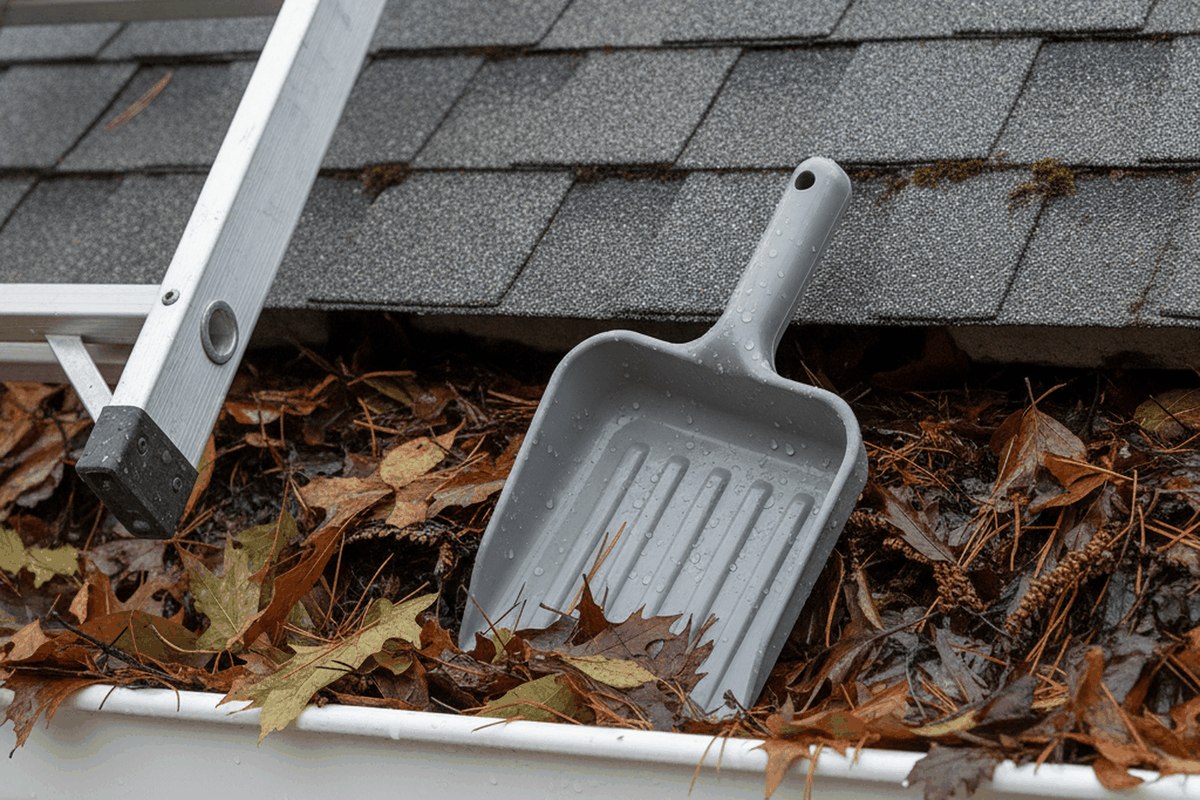
The Amerimax 8300 Getter Gutter Scoop (pick 2) is the best gutter scoop for ladder work. Bob Vila tested it among its picks, and This Old House, from research, names it its best gutter scoop. Plastic is the material to look for in any gutter cleaning scoop, because it will not gouge the gutter's coating or the seam sealant.
If you want a gutter scoop with a long handle so you can work from the ground, none of the picks here is a scoop on a pole. Whatever scoop you buy, check that it fits under your shingles: Bob Vila tested a wedge-shaped scoop 3.75 inches wide and dropped it, because the inch to 1.5 inches of shingle overhang most homes have made it impossible to fit into the gutters.
How do you use a gutter scoop?
From a ladder, one arm's length at a time. A gutter scoop is the quickest way to empty a trough by hand, and it is a ladder tool, so the safety rules above apply every time you use one.
- Hang the bucket first. Scoop into a bucket on a hook at the top of the ladder, so the muck lands somewhere other than the beds below.
- Work toward yourself. Draw the scoop along the trough toward the ladder, lift the pile out, and stop when the next stretch is past your reach. Climb down and move the ladder rather than leaning out.
- Finish with water. Run the hose along the trough and into each downspout before you put the ladder away: it clears the fine grit and shows the water gets past the elbow.
From the ground, the tool that does a scoop's job is a set of tongs on a pole: like a scoop, it lifts debris out of the trough instead of pushing it toward the downspout.
How often should you clean your gutters, and when?
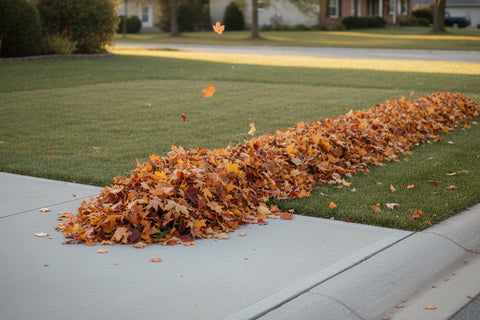
Twice a year: once after leaf drop finishes and before the first hard freeze, and once in late spring after maples drop seeds and oaks drop catkins. Overhanging pines change the math, because needles shed all year and knit into a mat water will not move, so plan on three or four passes under conifers. The fall pass matters most, and the mistake is doing it too early. Clean mid-drop and you will be back in three weeks.
If you would rather clean less often, our best gutter guards guide compares five DIY kits and says which ones handle pine needles.
| Region | Fall pass | Second pass |
|---|---|---|
| Northeast and Upper Midwest | Early to mid November, once hardwoods are bare | Late spring, for seeds and buds |
| Mid-Atlantic and transition zone | Mid to late November | Late spring |
| South and Gulf Coast | Late November into December | After spring pollen and needle drop |
| Pacific Northwest | November, then again midwinter | Rain does not pause, so check in January |
Gutters belong on the same list as draining hoses and shutting off the sill cocks. Our guide to winterizing the garden has that closeout sequence, and cutting overhanging branches back with a pole saw cuts next year's debris at the source.
What tools do you need to clean gutters?
The minimum kit for a single story house is three things: an extension pole, a head for it that either grabs or flushes, and a bucket with a hook. Add gloves and eye protection, because gutter muck is abrasive, unsanitary, and full of shingle grit that flicks back at you under water pressure. A garden hose does double duty here, as the flush and as the test that tells you the downspouts actually run. If any part of the job puts you on a ladder, a standoff stabilizer joins the list and is not optional.
Tongs, wands, brushes, or blowers: which type clears what?
Gutter tools fall into a few families, and they are not interchangeable.
| Type | What it does | Where it falls short |
|---|---|---|
| Tongs on a pole | Lifts debris out of the trough | Struggles with wet, packed muck |
| Hose fed wand or pole | Flushes fine grit and shingle granules | Sprays debris down the siding |
| Brush on a pole | Sweeps loose dry material along | Moves debris toward the downspout, not out |
| Hand scoop | Fastest, most complete removal | Ladder only, with all the risk that carries |
| Leaf blower attachment | Blows dry leaves clear in seconds | Wet leaves are harder to blow out, and it scatters debris |
| Pressure washer attachment | Breaks up packed, weathered debris | Enough force to dent a gutter or lift its coating |
| Wet or dry vacuum kit | Pulls debris out and holds it in the vac | Heavy, bulky, awkward at height |
If a blower attachment is where you are headed, the machine matters more than the tube. Our roundup of the best cordless leaf blowers covers which ones hold pressure down a long attachment.
Gutter attachments for a blower, wet/dry vac or pressure washer: which fits what?
If you already own one of these machines, a gutter attachment turns it into a gutter tool. Two of them are numbered picks on this page: the vac kit in the first row is pick 4, and the BLACK+DECKER kit, pick 5, is one of the two blower kits the last row describes. Each one fits only the machines its own listing names, so the second column is the one to check against the machine in your garage.
| Attachment | Fits, as listed | In the box, as listed | What it does |
|---|---|---|---|
| CRAFTSMAN CMXZVBE38640 gutter kit, for a wet/dry vac (pick 4) | A wet/dry vac whose hose is 2-1/2 in. across, CRAFTSMAN or most other brands | A gutter nozzle, a blower nozzle and two extension wands | Cleans the trough with the vac's suction, or blows debris out when the hose goes on the vac's blowing port |
| M MINGLE PW32 gutter wand, for a pressure washer | A pressure washer gun, or most telescoping and extension wands, by a 1/4 in. quick connect | A 13 in. angled stainless steel wand and five nozzle tips, 0 to 65 degrees | Angles the spray into the trough once it rides on a telescoping wand; listed for up to 4000 PSI |
| A leaf blower gutter kit | Only the blowers its listing names: one kit we read lists a single brand's blowers, a minimum airflow and an outlet size limit, and another says most blowers | Extension pieces that make up the listed reach: 11 ft and 12 ft on the two blower kits we read | Blows dry leaves and debris up and out of the trough |
Of the three, the vac kit is the one that can hold what it takes out: on the vac's suction side it pulls the leaves and debris into the vac instead of onto the lawn, and pick 4 below has what its testers found. A blower kit works best on dry leaves. Whichever you use, run a hose through afterward to check that the downspouts flow.
The other four picks, by job
None of these does the whole job. The realistic kit for most houses is a pole, a set of tongs, and a hose head.
2. Amerimax 8300 Getter Gutter Scoop: best scoop for ladder work
Best scoop for ladder work
Best for: Fastest cleanout on a ladder
Amerimax 8300 Getter Gutter Scoop
- Reach, as listed: Arm's length, from a ladder
- Lifts or flushes: Lifts debris out
- Needs: A ladder
A plastic hand scoop, two to a pack.
The Amerimax 8300 Getter Gutter Scoop is a molded plastic scoop from a gutter manufacturer, two to a pack. Bob Vila, which tested it, says its flexible tip improves its fit in the gutter, that it can hold a lot of debris at one time, and that pinching its sides together helped minimize spilling.
Good to know: its Amazon listing gives no dimensions and no feature bullets. Bob Vila notes that it is made from thin plastic and expects it to last no more than a few gutter cleanings, and This Old House says it fits standard 5 to 6 inch K-style gutters and may be too wide for smaller gutters or ones with a shingle overhang. It is a ladder tool, so the safety rules above apply, and it suits the few feet a pole cannot reach rather than the whole gutter.
3. TONYINGO 18 ft Reach Telescopic Gutter Wand: a mid-length water wand
Mid-length water wand
Good for: A hose rinse from the lawn
TONYINGO 18 ft Reach Telescopic Gutter Wand
- Reach, as listed: 4 to 12 ft pole, listed as reaching 18 ft
- Lifts or flushes: Flushes
- Needs: A garden hose
A hose wand on a 4 to 12 ft pole.
The TONYINGO wand puts a hose wand on a longer pole. The listing states an aluminum pole that telescopes from 4 to 12 feet, a 21 inch flexible wand that swivels 360 degrees and bends into gutter corners and downspout openings, an 18 foot maximum reach, and four spray patterns from a gentle rinse to a jet, with a shut-off valve in the kit.
Good to know: 18 feet is the listing's reach figure, not the pole length, and the pole itself stops at 12 feet, so measure a two story eave before you count on it. Like every water tool it flushes debris along and over the lip rather than lifting it out, so it is the rinse after tongs, not a replacement for them.
4. CRAFTSMAN CMXZVBE38640 Wet/Dry Vac Gutter Kit: a lift-out kit for a shop vac
Lift-out kit for a shop vac
Good for: Lifting leaves out with a shop vac
CRAFTSMAN CMXZVBE38640 Wet/Dry Vac Gutter Kit
- Reach, as listed: Not stated
- Lifts or flushes: Lifts debris out, or blows it out
- Needs: A wet/dry vac with a 2-1/2 in. hose
Two wands, a gutter nozzle and a blower nozzle.
The CRAFTSMAN CMXZVBE38640 turns a shop vac into a gutter tool. The listing states a gutter nozzle, a blower nozzle and two extension wands in the box, and a fit for CRAFTSMAN and most other wet/dry vacs with a 2-1/2 in. hose; with the hose on the vac's blowing port, the blower nozzle blows leaves out of the gutter. Bob Vila, which tested it and names it its best vacuum attachment, found it incredibly effective at blowing leaves and debris out with a wet/dry vac's exhaust. Its testers also ran it on the vac's suction port, where it sucks up the leaves and debris and keeps the mess down, and they found that the more practical use.
Good to know: the listing states no reach. Bob Vila gives the kit 47 inches of total reach and says most shop vac extensions fit it to reach a bit higher. It also says the kit takes some handling and might not suit a ladder, at least with a powerful vacuum, and that its sections can separate easily in use, far less often on the suction port. The vac itself is not in the box.
5. BLACK+DECKER BZOBL50 Gutter Clean Attachment: a blower kit for most blowers
Blower kit for most blowers
Good for: Blowing leaves out from the lawn
BLACK+DECKER BZOBL50 Gutter Clean Attachment
- Reach, as listed: Up to 12 ft, for a 5 ft 11 in. user
- Lifts or flushes: Blows debris out
- Needs: A leaf blower
Four extension tubes for a leaf blower.
The BLACK+DECKER BZOBL50 puts a leaf blower's air into the gutter while you stand on the ground. The listing states four quick-connect tubes for up to 12 feet of reach, measured on a 5 ft 11 in. user holding the pole straight at chest level, a flexible tube for steering, and a design that fits most blowers, with the blower sold separately. Bob Vila, which tested it on a handheld blower, found that it stayed firmly attached at full power, that the flexible tube let its tester hold the blower level instead of pointing it up, and that the extension did not bend or bow when held aloft.
Good to know: Bob Vila notes that its attachment band may not work well with some blowers, and that how much air reaches the gutter depends on the blower you attach. The blower is not in the box.
Also considered
- The Gutter Tool. Bob Vila's best overall after its test: a scoop that screws onto the end of an extension pole or a broomstick and drags debris to one spot for removal, with no pole in the box. This Old House, from research, notes that its angled design limits how well it works from the ground.
How to choose a gutter cleaning tool
Four checks, in this order:
- Count your stories first. One story means a ground pole tool is realistic. Two stories means a water-fed pole or a hired crew, not a longer ladder.
- Removal beats relocation. Tongs and scoops take debris out. Brushes and water move it toward the downspout, the part that clogs hardest.
- Check whether the pole is included. Several gutter heads are heads only, and you need a pole to use them.
- Match the tool to wet or dry. Tongs and blowers want dry leaves. Water is the answer once the pack is soaked, and no pole tool clears a downspout elbow.
What comes out of the trough is worth keeping. Gutter debris is mostly leaves and twigs, good brown material for a compost pile once the shingle grit settles out. Our guide to mulching leaves covers the mower pass that turns a pile into mulch, the best leaf rakes roundup covers gathering it, and the rest of the seasonal lineup lives in our garden guides.
Frequently asked questions
Is there a tool to clean gutters from the ground?
Yes. A telescoping pole fitted with tongs lifts debris out of the trough instead of pushing it toward the downspout, and it is the ground-based tool to start with for most single story homes. A water-fed pole reaches a two story eave, though it flushes debris down the siding rather than removing it.
Can you clean gutters with a leaf blower?
Yes, with a gutter attachment kit, and it works best on dry debris. A blower clears loose leaves in seconds and is the fastest method when conditions are right. It struggles with wet, packed material, and you should still run water through afterward to check the downspouts are flowing.
Is it safe to clean gutters from a ladder?
It can be, with a standoff stabilizer so the ladder never rests on the gutter itself, firm level ground, a base set one foot out for every four feet of height, and three points of contact. Move the ladder rather than reaching. Do not step onto the roof, and do not attempt gutters above a second story from a ladder.
Do gutter cleaning tools work on wet leaves?
Most work poorly. Tongs and blowers are both specified for dry or light debris, and a stiff brush smears a wet pack rather than moving it. Water-fed tools are the honest answer for soaked material, or wait two or three dry days and let the pack lighten.
Do gutter cleaning tools really work?
Within limits. Tongs lift dry leaves out of a single story gutter reliably, and a hose-fed pole clears the grit that is left. What no pole tool handles well is wet packed debris, a blocked downspout, or spotting a failing hanger while you work.
What PSI do you need to clean gutters with a pressure washer?
There is no set number to aim for. The pressure washer gutter wands we read list a maximum, not a target: the M MINGLE PW32's listing rates it for up to 4000 PSI, which is what the fitting can take, not what a gutter needs. Start with the widest tip, keep the spray moving, and step up only if the debris will not shift. For most gutters, a hose-fed wand does the flush with no pressure washer at all.
How can you tell if your gutters are clogged?
Watch them in a steady rain. Water spilling over the front lip, a downspout that only trickles, and a wet stain on the fascia behind the gutter all point to a clog. On a dry day, run a hose into the far end of each run: if little or nothing comes out at the bottom, something in between is packed; if the trough runs clear, it is the downspout, and you clear that one from the ground up. Water standing in a trough you have just cleaned is a different problem, a gutter pitched wrong, and the hangers need adjusting.
Is there a trick to cleaning gutters from the ground?
Lift, then flush, then test. Take the leaves out with tongs on a pole on a dry day, rinse the grit that is left with a hose wand on a pole, and finish by running the hose into each downspout to prove the water gets away. In that order, most of the debris leaves the gutter before any water moves the rest toward the downspout, the part that clogs hardest.
The bottom line
The rule underneath all of it: the gutter is worth cleaning, and it is never worth a fall.
A word on who wrote this: we are Spear Head Spade, a family business in New Jersey. We sell double-patented spades and one long-handled hoe, with over 600,000 sold. Gutters are not our department, but a downspout that still empties against the foundation ends in a trench, and our spade finder matches a spade to your height and your soil.
Disclosure: Some links pay us a commission when you click or buy, and on some pages brands pay us through Amazon's creator program on links to their products.
Product prices and availability are accurate as of the date/time indicated and are subject to change. Any price and availability information displayed on Amazon.com at the time of purchase will apply to the purchase of this product.