As an Amazon Associate we earn from qualifying purchases. Some brands also pay us when you click or buy, so those links are ads. Full disclosure below
The best fall lawn fertilizer for most cool-season lawns is Scotts Turf Builder WinterGuard Fall Lawn Food, a fall lawn food built to help grass recover from summer and put down deep roots before winter. For the late-season winterizer feeding, Jonathan Green Winter Survival 10-0-20 is the potassium-forward pick, and Jonathan Green Organic Lawn Food 10-0-1 is the organic choice for early fall. Spread the first feeding between Labor Day and late September, and the winterizer around your last mowing, from late October to mid-November. Missed September? In the transition zone the first feeding runs into mid-October, and the late fall winterizer is still ahead for every cool-season lawn.
Fall fertilizer is the one lawn feeding that pays twice. Cool-season grasses grow roots hardest when the air cools and the soil is still warm, so what you spread in September and again in November goes into deeper roots now and a faster green-up next spring. This page is one stop on our fall yard cleanup tools checklist, which puts every fall job in order.
One thing before the list: we make digging tools, not fertilizer, so nothing here is ours. Each pick is judged on the bag's analysis, cost per thousand square feet, and whether it does the job a fall feeding is for.
Best fall lawn fertilizers at a glance
| Pick | N-P-K | Bag size | One bag covers | Best for | Our verdict | Where to buy |
|---|---|---|---|---|---|---|
| 1. Scotts Turf Builder WinterGuard Fall Lawn FoodBest fall lawn fertilizer overall | Not listed | 10 lb | 4,000 sq ft | Early fall feeding on any cool-season lawn | Built for the early fall feeding, rebuilding roots after summer and preparing them for winter, and it goes on any grass type, wet or dry. | Check price on Amazon |
| 2. Jonathan Green Winter SurvivalWinterizer for the late fall feeding | 10-0-20 | 15 lb | Not listed | The late fall winterizer feeding | It carries twice as much potash as nitrogen, the ratio a lawn wants in late October and November; pair it with a September feeding of a nitrogen-forward pick. | Check price on Amazon |
| 3. Jonathan Green Organic Lawn FoodBest organic fertilizer for the early fall feeding | 10-0-1 | Not listed | 5,000 sq ft | Organic early fall feeding, no burn risk | An organic lawn food that feeds for 8 to 10 weeks, the length of the early fall growing window, and will not burn the yard. | Check price on Amazon |
| 4. Espoma Turf-Tone Fall WinterizerOrganic winterizer | 8-0-5 | 30 lb | Up to 5,000 sq ft | Organic winterizer, applied in October | An organic winterizer with extra potassium and no phosphorus, put down in October while the soil is warm enough for microbes to work on it. | Check price on Amazon |
| 5. The Andersons PGF CompleteBest for lawns you are overseeding this fall | 16-4-8 | 18 lb | 5,000 sq ft | Lawns being overseeded this fall | The middle number is the point: phosphorus helps seedlings build roots, so this is the bag for a lawn you are overseeding this fall. | Check price on Amazon |
What is the best fall lawn fertilizer?
Scotts Turf Builder WinterGuard Fall Lawn Food. It is built for this feeding, rebuilding roots after summer and preparing them for winter, and it goes on any grass type, wet or dry. The 32.3 pound bag, which covers 12,000 square feet, was unavailable on Amazon with no ship date when we checked on October 13, 2026, so we link the 10 pound bag. Buy one 10 pound bag for every 4,000 square feet per feeding, so a 10,000 square foot lawn takes three bags each time.
That is the early fall answer. A complete fall program is two feedings, though, and the second, the true winterizer in late October or November, wants more potassium than nitrogen. WinterGuard can do that job in a pinch; Jonathan Green Winter Survival, a 10-0-20, is the potassium-forward bag for it.
Why fall feeding matters for cool-season lawns
Cool-season grass has two growth peaks, spring and fall, and the fall peak builds the plant rather than the blades. As days shorten, top growth slows and the grass sends its energy down: roots keep growing until the soil drops to about 40 degrees, and the crown stores carbohydrates for winter. Nitrogen applied now feeds roots and storage instead of the mower.

The payoff is deeper roots going into winter, an earlier spring green-up without the soft surge a heavy spring feeding causes, and enough density to crowd out next year's crabgrass; the University of Minnesota Extension lawn fertilizing guide is a good plain-language reference on why.
What N-P-K to look for in a fall fertilizer
The three numbers on the bag are the percentages by weight of nitrogen, phosphate, and potash: a 10-0-20 is 10 percent nitrogen, no phosphorus, and 20 percent potassium.
- Nitrogen leads in early fall. The September feeding is about recovery and root growth, and nitrogen drives both; a nitrogen-forward bag with some potassium is right for it.
- Potassium leads on a winterizer label. Illinois Extension ties potassium to cold tolerance and disease resistance. A winterizer flips the ratio to more potash than nitrogen, like the 10-0-20 in Jonathan Green Winter Survival; a soil test says whether your lawn needs the extra.
- The middle number should usually be zero. Many states and towns restrict phosphorus on established lawns because it runs off into lakes and streams; the usual exceptions are seeding a new lawn and a soil test showing a deficiency. Unless one applies to you, buy a zero-in-the-middle bag, like the Jonathan Green and Espoma picks here.
- Iron is a bonus. A few percent deepens color without adding growth.
Fall fertilizer numbers: reading each pick's label
Every bag prints its analysis in the same order, and University of Minnesota Extension reads it the way the section above does: each number is a percent of the bag's weight, nitrogen first, then phosphate, then potash. For the ratio itself, Illinois Extension lists 3:0:2 and 4:0:2 among the N-P-K ratios it recommends for lawn fertilizers, and it describes winterizers on their own as typically high in nitrogen and potassium. How much of the last two numbers your lawn needs is a soil test question: Penn State Extension says a soil test is the only way to tell how much phosphate and potash a lawn needs.
Here is what the Amazon listings for four of the picks state. Scotts WinterGuard sits outside the table because its listing describes the bag by its job, a fall lawn food for any grass type that goes on a wet or dry lawn, rather than by analysis; its numbers are printed on the bag.
| Pick | Analysis on the label | What the listing says | Feeding on this page |
|---|---|---|---|
| 2. Jonathan Green Winter Survival | 10-0-20 | A winterizer lawn fertilizer that readies grass for colder months; granular | Late fall winterizer |
| 3. Jonathan Green Organic Lawn Food | 10-0-1 | Gradual release over 8 to 10 weeks; for newly seeded or sodded lawns as well as established ones; contains iron | Early fall, organic |
| 4. Espoma Turf-Tone Fall Winterizer | 8-0-5 | Natural and organic, with extra potassium; for fall use, ahead of winter dormancy | Late fall winterizer, organic, in October |
| 5. The Andersons PGF Complete | 16-4-8 | Quick and slow-release nitrogen, feeding for up to 8 weeks; iron, micronutrients and humic DG; not for sale in CA | Overseeding this fall |
Read the table as a label check, not a ranking. The last column is this page's own job for each bag; the rate printed on the bag and your soil test decide how much of it goes down.
When to apply fall fertilizer, by region
Cool-season lawns get two fall feedings, and the calendar shifts with latitude. Both of them go down more evenly from a broadcast spreader than from a hand toss, and our guide to the best fertilizer spreaders covers the sizes.

- Early fall. Labor Day to late September across the North and Midwest; mid-September to mid-October in the transition zone from Virginia through Kansas, once the grass is growing again after summer heat breaks.
- Late fall, the winterizer. Late October to mid-November in the North; through November in the transition zone. Put it down around your last mowing, while the grass is still green and before the ground freezes, since fertilizer on frozen soil runs off.
- Warm-season lawns. Across the South and Southwest, stop nitrogen well before your first expected frost (extension schedules for South Carolina and for Maryland zoysia end it in August, so check your state's schedule); a potassium product is worth adding later only if a soil test calls for it.
Winter fertilizer for grass: what a winterizer is and when it goes down
No feeding goes down in winter itself. A bag sold as a winter fertilizer or a winterizer is the last feeding of fall, timed to the end of the mowing season. Illinois Extension describes winterizers as generally high in nitrogen and potassium and schedules that late-season feeding about a week after the final mowing: in northern Illinois that is late October into early November, in central Illinois it is November, and in southern Illinois it is late November. Some states also set a firm end date; University of Maryland Extension notes that Maryland's lawn fertilizer law has a November 15 cutoff.
The potassium in a winterizer is the part to check against a soil test. Illinois Extension says grasses draw on potassium year round and ties it to disease resistance and to tolerance of heat, cold, and other stresses. UW-Madison Extension adds that the potassium sold in fall winterizers is not needed in any significant amount unless a soil test shows a deficiency, and University of Minnesota Extension notes that sandy soils often need added potassium and that a soil test tells you when to add it. So the soil test, not the front of the bag, decides whether the extra potash matters on your lawn.
Warm-season lawns run on a different calendar. University of Maryland Extension says a zoysia lawn's last feeding should come no later than mid-August, and that the grass needs no fertilizer once the season's first frost sends it dormant. Clemson Extension's Home and Garden Information Center schedules for South Carolina end the nitrogen feedings for Bermuda, zoysia, and St. Augustine in August, and list an extra potassium application of 1 pound per 1,000 square feet from late August through mid-September that they say may increase winter hardiness, while basing potassium rates on a soil sample.
Slow-release or quick-release, organic or synthetic
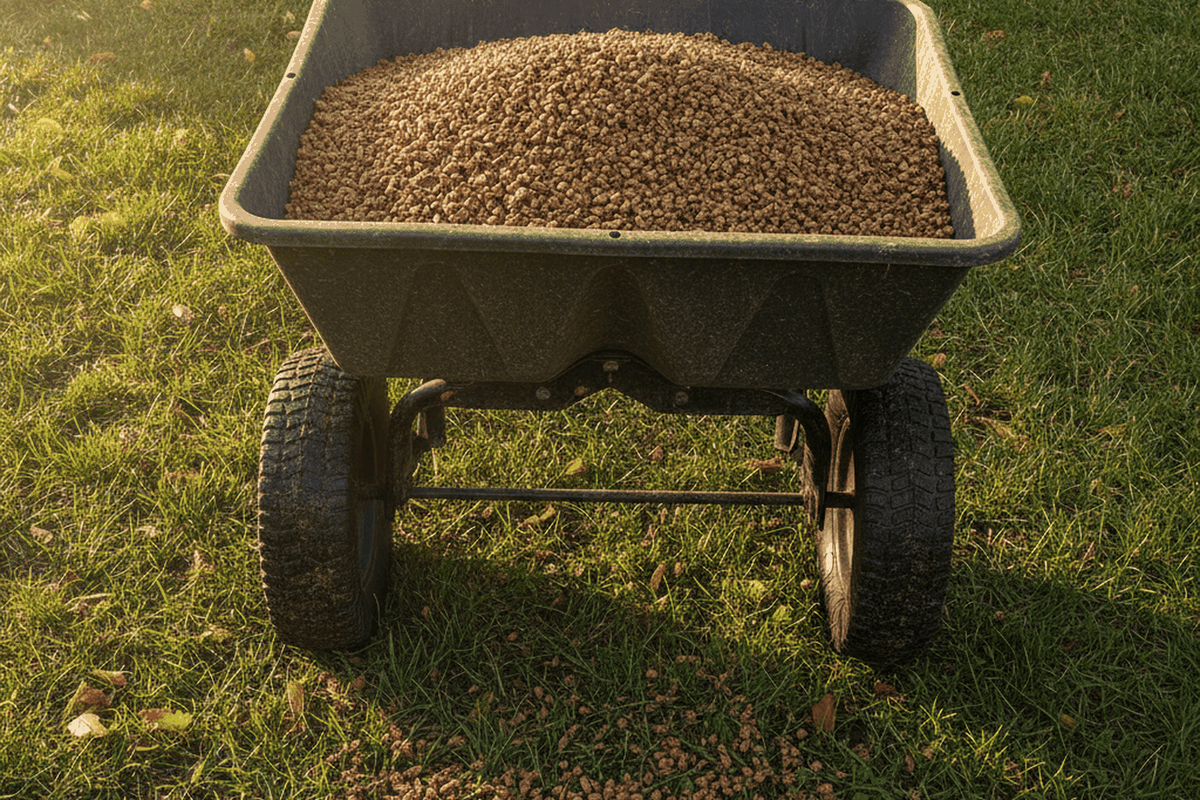
Quick-release nitrogen, usually urea or ammonium sulfate, reaches the grass within days, works in cold soil, and can burn if you overdo it. Slow-release nitrogen feeds steadily for six to eight weeks with far less burn risk and is the better form for early fall.
Organic fertilizers like Milorganite and Espoma rely on soil microbes to convert their nitrogen into a form grass can use, and those microbes go sluggish once the soil drops below about 50 degrees. That makes organics excellent in September and a poor choice in November, when a synthetic quick-release winterizer is the honest recommendation even for gardeners who go organic everywhere else.
How much fall fertilizer to put down
The standard target is about one pound of actual nitrogen per thousand square feet per feeding, a little less for the late one. To turn that into pounds of product, divide 100 by the first number on the bag: a bag with 20 percent nitrogen needs about five pounds per thousand square feet. When the bag's own rate is lighter, as with most winterizers, the bag wins, because that feeding is about the potassium.
Measure the lawn once, pacing off length and width and subtracting the house, driveway, and beds, then divide by the bag's coverage. Spread at half the printed rate in two passes at right angles, close the hopper before every turn, and sweep granules off pavement back onto the grass, since what stays on the driveway ends up in the storm drain. Clear the leaves off first, because granules that land on a leaf mat never reach the soil, and a lawn sweeper lifts them at mowing speed. If the ground is so hard that water beads and runs, fertilizer will not reach the roots either: aerate the lawn first, then feed it. A crisp bed edge also shows you exactly where to close the hopper. A sharp garden spade like our D-handle garden spade cuts that line and lifts the wedge out without a second tool; the technique is in our bed edging guide.
The best fall lawn fertilizers, by job
No single bag is right for both feedings on every lawn. These five cover the early feeding, the late one, the organic version of each, and the seeding case.
1. Scotts Turf Builder WinterGuard Fall Lawn Food: best fall lawn fertilizer overall
Best fall lawn fertilizer overall
Best for: Early fall feeding on any cool-season lawn
Scotts Turf Builder WinterGuard Fall Lawn Food
- Bag size: 10 lb
- One bag covers: 4,000 sq ft
- Feeding: Early fall
Built for the early fall feeding, rebuilding roots after summer and preparing them for winter, and it goes on any grass type, wet or dry.
Scotts Turf Builder WinterGuard Fall Lawn Food is a granular fall lawn food sold for exactly this job: helping grass recover from summer heat, drought, and foot traffic while it builds deep roots for winter. It goes on any grass type, wet or dry. Buy one 10 pound bag for every 4,000 square feet per feeding, so a 10,000 square foot lawn takes three bags each time. The 32.3 pound bag, which covers 12,000 square feet, was unavailable on Amazon with no ship date when we checked on October 13, 2026; take it if it is back, since one big bag feeds a larger lawn. Where it loses: it is a general fall food rather than a potassium-led winterizer, so the Jonathan Green bag below is the potassium-forward option for the late feeding.
2. Jonathan Green Winter Survival 10-0-20: winterizer for the late fall feeding
Winterizer for the late fall feeding
Best for: The late fall winterizer feeding
Jonathan Green Winter Survival
- N-P-K: 10-0-20
- Bag size: 15 lb
- Feeding: Late fall winterizer
It carries twice as much potash as nitrogen, the ratio a lawn wants in late October and November; pair it with a September feeding of a nitrogen-forward pick.
Jonathan Green Winter Survival is the potassium-forward bag for the late feeding. At 10-0-20 it carries twice as much potash as nitrogen, the ratio a lawn wants in late October and November when the job is cold tolerance and stored energy rather than growth. The Amazon listing for the 15 pound bag does not state coverage, so read the rate on the bag. Where it loses: it is a late-season feeding, so pair it with a September nitrogen feeding.
3. Jonathan Green Organic Lawn Food 10-0-1: best organic fertilizer for the early fall feeding
Best organic fertilizer for the early fall feeding
Best for: Organic early fall feeding, no burn risk
Jonathan Green Organic Lawn Food
- N-P-K: 10-0-1
- One bag covers: 5,000 sq ft
- Feeding: Early fall
An organic lawn food that feeds for 8 to 10 weeks, the length of the early fall growing window, and will not burn the yard.
Jonathan Green Organic Lawn Food is a 10-0-1 organic grass fertilizer that feeds for 8 to 10 weeks, which is the length of the early fall growing window on a cool-season lawn. It has no fast-release synthetic ingredients, so it will not burn the yard and kids and pets can use the lawn right after it goes down, and it contains no manures or sludge-based ingredients. It carries iron for deep greening, it is labeled for established lawns and for newly seeded or sodded ones, and its homogenous granules spread evenly through a rotary, drop, or hand-held spreader. The bag covers 5,000 square feet. Milorganite, the 6-4-0 classic, does the same early fall job, but Amazon stocks only the 5 pound bag, which covers 390 square feet, so buy it at a big box or garden center if you prefer it. Where it loses: like every organic it is for the early fall feeding only, since its nitrogen needs warm soil and active microbes, and its label lists 1 percent potassium; a soil test tells you whether the late feeding needs more.
4. Espoma Turf-Tone Fall Winterizer: organic, 8-0-5
Organic winterizer
Best for: Organic winterizer, applied in October
Espoma Turf-Tone Fall Winterizer
- N-P-K: 8-0-5
- Bag size: 30 lb
- One bag covers: Up to 5,000 sq ft
An organic winterizer with extra potassium and no phosphorus, put down in October while the soil is warm enough for microbes to work on it.
Espoma Turf-Tone Fall Winterizer is the organic answer to the late-season question, an 8-0-5 natural and organic lawn food with extra potassium and no phosphorus, labeled for fescues, bluegrass, ryegrass, St. Augustine, and zoysia. It will not burn or leach, it goes through a drop or broadcast spreader, and a 30 pound bag covers up to 5,000 square feet. The one adjustment: because it is organic, put it down at the early end of the winterizer window, in October while the soil is warm enough for microbes to work on it. Where it loses: 30 pounds cover up to 5,000 square feet where 10 pounds of WinterGuard cover 4,000, so a large lawn means hauling more weight.
5. The Andersons PGF Complete 16-4-8: best for lawns you are overseeding this fall
Best for lawns you are overseeding this fall
Best for: Lawns being overseeded this fall
The Andersons PGF Complete
- N-P-K: 16-4-8
- Bag size: 18 lb
- One bag covers: 5,000 sq ft
The middle number is the point: phosphorus helps seedlings build roots, so this is the bag for a lawn you are overseeding this fall.
The Andersons PGF Complete is a 16-4-8 with iron, micronutrients, and 7 percent humic acid, in fine particles that spread evenly. It blends quick and slow-release nitrogen for up to eight weeks of feeding, and an 18 pound bag covers 5,000 square feet. It is here for the middle number: phosphorus helps seedlings build roots, and seeding is the usual exception to phosphorus rules, so this is the bag for a lawn you are overseeding this fall. Where it loses: on an established lawn under phosphorus rules, choose a zero-middle-number bag, and it is not sold in California.
What fertilizer to use when overseeding in fall
Seeding changes the feeding. Penn State Extension says to put a starter fertilizer down just before or just after you seed, at 0.5 to 1 pound of nitrogen for each 1,000 square feet, and warns that more than 1.5 pounds can burn the young grass. Its examples of starter analyses include 10-10-10, 16-8-8 or 20-10-10, and it adds that a starter does not replace the phosphate and potash a soil test report calls for.
Phosphorus is why seeding gets different rules. University of Minnesota Extension says added phosphorus is often beneficial when establishing new turf, because it moves slowly through the soil, and that you should apply it only when a soil test shows a need. State law can draw the same line: UW-Madison Extension notes that Wisconsin limits phosphorus on lawns to newly established lawns and to lawns where a soil test shows a deficiency. Check your own state's rule before you buy a bag with a middle number.
The calendar matters as much as the bag. University of Maryland Extension says to sow tall fescue no later than mid-October, since the seed takes about two weeks to germinate and November frosts can damage the seedlings, and Penn State Extension does not suggest seeding later than mid-October for most of Pennsylvania.
On this page, The Andersons PGF Complete is the pick with phosphorus in its analysis, a 16-4-8 with quick and slow-release nitrogen for up to eight weeks. Jonathan Green Organic Lawn Food's listing says it can go on newly seeded or sodded lawns too, with a zero middle number in its 10-0-1. Whichever you use, keep weed control off the new grass until it has been mowed three or four times, as the next section explains.
Fall weed and feed: should you use one?
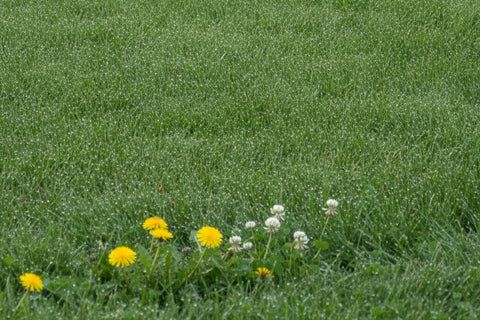
Fall is the best stretch of the year to kill broadleaf weeds like dandelion, clover, and ground ivy, because they are pulling sugars down into their roots and a leaf-applied herbicide rides down with them. That is why every store stacks weed and feed beside the fall fertilizer. The catch is that one granule is being asked to do two opposite things.
The herbicide half has to land on a damp weed leaf and sit there, unwatered, long enough to be absorbed. The fertilizer half wants the opposite: watered in within a day so the nitrogen reaches the roots instead of burning the blades. You cannot do both well in one pass, and you have spread weed killer across the whole lawn to treat the tenth of it that actually has weeds.
The cleaner sequence is to spread the straight fall fertilizer and water it in, then spot-treat the weeds a few days later on a calm morning above 50 degrees with no rain due for a day. A pump sprayer is the tool for that, and our garden sprayer guide covers the sizes. For a handful of weeds in a bed, a weeding tool pulls them and skips the chemistry entirely.
If you use a combination bag anyway, two rules. Put it down on the early fall feeding rather than the November winterizer, since a broadleaf herbicide needs weeds that are still actively growing and a frosted weed will not take one up. And keep it off any lawn you are overseeding: broadleaf herbicides damage new seedlings, and some fall lawn treatments carry a pre-emergent that stops your grass seed from germinating at all. Seed first, then wait until the new grass has been mowed three or four times before any weed control goes down.
How to choose a fall fertilizer
- Grass type first. Cool-season lawns get the two-feeding program above; warm-season lawns get their last nitrogen well before your first expected frost, so check your state's schedule.
- Which feeding is this? Early fall wants nitrogen-forward, slow-release or organic. Late fall wants a quick-release winterizer with more potassium than nitrogen.
- Check the middle number. Zero unless you are seeding or a soil test says otherwise.
Frequently asked questions
When should you apply fall fertilizer?
For cool-season lawns, twice: once in early fall, from Labor Day to late September, when the grass is growing again after summer, and once in late fall, from late October to mid-November, around your last mowing and before the ground freezes. Warm-season lawns get their last nitrogen well before the first expected frost, so check your state's schedule.
What lawn fertilizer should I use in September?
An early fall feeding: a nitrogen-forward lawn food, mostly slow-release, with a zero in the middle unless you are seeding, spread at about one pound of actual nitrogen per thousand square feet. Scotts Turf Builder WinterGuard is the straightforward choice and Jonathan Green Organic Lawn Food 10-0-1 is the organic one, since September soil is still warm enough for microbes to release it. Save the high-potassium winterizer for late October or November.
Can you fertilize your lawn in November?
Yes, if the grass is still green and the ground is not frozen. A November feeding on a cool-season lawn is the classic winterizer application, and it should use quick-release nitrogen with extra potassium, since organic and slow-release products need warm soil to work. Once the ground freezes or the lawn goes brown, wait for spring.
What is the difference between fall fertilizer and winterizer fertilizer?
Timing and the potassium number. A fall fertilizer is a nitrogen-forward feeding for early fall that rebuilds roots and thickens the lawn. A winterizer is the late fall feeding with more potassium and less nitrogen, which helps grass tolerate cold and store energy for spring. Many bags labeled fall lawn food cover both jobs if you apply them twice.
Can you use a weed and feed as your fall fertilizer?
You can, but the two halves work against each other: the herbicide needs to stay on damp weed leaves while the fertilizer needs watering in. Spreading a straight fall fertilizer and spot-treating the weeds a few days later does both jobs properly and puts far less herbicide on the lawn. If you do use a combination bag, use it on the early fall feeding rather than the winterizer, and never on a lawn you have just overseeded.
Do I need to water in fall fertilizer?
Yes for most granular products. A quarter to half an inch of water moves the granules off the blades and into the soil, which prevents burn and starts the release. Apply before a light rain or run the sprinklers afterward, but never before a downpour, which washes fertilizer into storm drains. Milorganite is the exception and needs no watering in.
Should I fertilize warm-season grass in the fall?
Not late in the season. Bermuda, zoysia, St. Augustine, and centipede slow down as nights cool, and late nitrogen pushes soft growth that winter damages. Give warm-season lawns their last nitrogen feeding well before your first expected frost (extension schedules for South Carolina and for Maryland zoysia end it in August, so check your state's schedule), and add a potassium product later only if a soil test calls for it.
What should you put on your lawn in the fall?
Nitrogen, mainly. UW-Madison Extension names nitrogen as the main nutrient a lawn feeding should supply, calls early September a key time to add it, and suggests about a pound of actual nitrogen for each 1,000 square feet. The rest is a soil test call: Penn State Extension says only a soil test can tell how much phosphate and potash a lawn needs, and that lime goes on by soil test recommendation, with fall the preferred time for it. If you are filling thin spots with seed, that seed takes a starter feeding of its own.
Is 32-0-10 a good fall fertilizer?
Read the numbers first: 32 percent nitrogen, no phosphate, and 10 percent potash by weight, the order University of Minnesota Extension describes for every bag. That is a nitrogen-led, zero-phosphorus analysis. UW-Madison Extension names nitrogen as the main nutrient to supply and notes that Wisconsin law limits phosphorus on lawns to new lawns and soil test deficiencies. Whether the 10 percent potash matters on your lawn is a soil test question. For the amount, Illinois Extension's method divides the nitrogen you want by the bag's nitrogen percentage, so a pound of nitrogen for each 1,000 square feet takes about 3.1 pounds of a 32-0-10; Penn State Extension says to apply nitrogen fertilizer at the rate on the manufacturer's label, so the bag's own rate comes first.
What fertilizer should you put down in October?
That depends on the grass. On a cool-season lawn, October sits between the two fall feedings: University of Minnesota Extension's schedule for its highest-maintenance lawns (watered, clippings removed) includes an early October feeding, and Illinois Extension's late-season winterizer starts in late October in northern Illinois. On a warm-season lawn, the extension schedules have already stopped: University of Maryland Extension puts a zoysia lawn's last feeding no later than mid-August, and Clemson Extension's South Carolina schedules end nitrogen for Bermuda, zoysia, and St. Augustine in August. If you are seeding in October, the starter feeding goes down with the seed, and University of Maryland Extension says to sow tall fescue no later than mid-October.
The bottom line
For a cool-season lawn, buy Scotts WinterGuard for the September feeding and Jonathan Green Winter Survival for the November one, or run WinterGuard twice, six to eight weeks apart, if you would rather buy a single product. Prefer organics? Jonathan Green Organic Lawn Food early and Espoma's winterizer in October. Seeding? The Andersons PGF Complete feeds the seedlings and the lawn together. Whichever you choose, aerate first if the ground is hard, water it in, keep it off the pavement, and let the roots do the rest over winter. Two checks make the plan sharper: a soil test tells you whether the middle number matters on your lawn, and the state of the thatch layer tells you whether a dethatcher belongs in front of the spreader. If the lawn also sits low or lumpy, our guides to leveling a yard and winterizing the garden cover the rest of the fall list. If the lawn is compacted, core it first with one of the best lawn aerators so the fertilizer reaches the root zone.
Disclosure: some links in this guide are affiliate links to Amazon. This is at no extra cost to you, and it never changes our honest recommendations.
Product prices and availability are accurate as of the date/time indicated and are subject to change. Any price and availability information displayed on Amazon.com at the time of purchase will apply to the purchase of this product.