As an Amazon Associate we earn from qualifying purchases. Some links are paid. Disclosure
Our top picks
Best overall
1. BioAdvanced Brush Killer Plus Concentrate
Best for: Fence lines, woods edges and around sheds, away from the lawn
Best ready-to-use spray
2. Roundup Poison Ivy Plus with Comfort Wand
Best for: A few plants by a path or foundation, with no mixing
Best for poison ivy in the lawn
3. Bonide BK-32 Poison Ivy and Brush Killer
Best for: Poison ivy growing in a lawn you want to keep
The best poison ivy killer for most yards is BioAdvanced Brush Killer Plus Concentrate, a triclopyr brush killer you mix with water and spray on poison ivy along fences, woods edges, sheds and paths. Its label lists poison ivy and poison oak among the woody plants and vines it kills, and says one 32 fl oz bottle is enough for up to 4,000 square feet. For a few plants and no mixing, Roundup Poison Ivy Plus with Comfort Wand comes ready to use in a 1 gallon jug with a battery-powered wand, and Roundup says it shows visible results in hours. Never burn poison ivy: University of Maryland Extension says the oil in the smoke can cause severe allergic reactions and breathing problems.
Poison ivy is a woody vine, so it takes a product that travels down to the roots. University of Maryland Extension names herbicides containing glyphosate or triclopyr, which it says usually carry poison ivy or tough brush killer names, and Clemson's extension adds three-way herbicides that combine 2,4-D, mecoprop and dicamba. Where the ivy grows decides which one: pick 1 is not for lawns by its label, pick 2 kills lawn grass, pick 3 is a lawn formula, and pick 4 is a small bottle with a brush-on applicator for the cut stems of vines on trees and shrubs. Every label here says to spray while the plants are actively growing, and the leaves are dropping now, so this guide also covers what to do until spring.
Jump to: Is it poison ivy? | Where it grows decides the product | The four labels side by side | When to spray | Vines on trees | How to spray it | Protect yourself | Brush killer or poison ivy killer?
Start here: which poison ivy killer for which spot
- Poison ivy along a fence, a woods edge or a shed, away from the lawn: BioAdvanced Brush Killer Plus Concentrate (pick 1), mixed in a tank or hose-end sprayer.
- A few plants by a path or foundation, with no mixing: Roundup Poison Ivy Plus with Comfort Wand (pick 2). It kills grass too, so keep it out of the lawn.
- Poison ivy growing in a lawn you want to keep: Bonide BK-32 Poison Ivy and Brush Killer (pick 3), on the lawn grasses its label lists.
- A vine climbing a tree, or tangled in shrubs you want to keep: Bonide Stump-Out Stump and Vine Killer (pick 4): cut the vine and brush the product onto the cut end.
Before you buy anything, make sure it is poison ivy (the look-alikes are below) and look at what grows around it. Each of these products can harm the plants you want if the spray lands on them. The labels of picks 1, 2 and 4 rule out use on or around food crops, and pick 3's label asks you to keep its drift off vegetables. For seedlings, University of Maryland Extension says digging, cutting and hand pulling small plants early in the season works, since the root system is not deep.
| Pick | Active | Form | Lawns | Rain | Best for | Our verdict | Where to buy |
|---|---|---|---|---|---|---|---|
| 1. BioAdvanced Brush Killer Plus ConcentrateBest overall | Triclopyr 8.8% | 32 fl oz concentrate | Not for lawns | 4 hours | Fence lines, woods edges and around sheds, away from the lawn | A 32 fl oz triclopyr concentrate you mix at 4 to 8 fl oz per gallon, whose label lists poison ivy and puts the bottle at up to 4,000 square feet; it is not for lawns. | Check price on Amazon |
| 2. Roundup Poison Ivy Plus with Comfort WandBest ready-to-use spray | Triclopyr, fluazifop-P-butyl, diquat | 1 gallon, ready to use | Kills lawn grass | 30 minutes | A few plants by a path or foundation, with no mixing | A 1 gallon ready-to-use jug with a battery-powered wand that Roundup says covers up to 300 square feet and shows visible results in hours; it kills lawn grass too. | Check price on Amazon |
| 3. Bonide BK-32 Poison Ivy and Brush KillerBest for poison ivy in the lawn | MCPA, triclopyr, dicamba | 16 fl oz concentrate | Listed lawn grasses | 1 hour | Poison ivy growing in a lawn you want to keep | A 16 fl oz lawn concentrate of MCPA, triclopyr and dicamba whose label lists poison ivy and names the lawn grasses it can go on, from bluegrass and fescue to Bermuda and zoysia. | Check price on Amazon |
| 4. Bonide Stump-Out Stump and Vine KillerBest for vines on trees and shrubs | Triclopyr 8.8% | 8 oz with applicator top | No lawn directions | 24 hours | Vines climbing trees or tangled in shrubs you want to keep | An 8 oz bottle of 8.8% triclopyr with an applicator top, for brushing onto the cut end of a poison ivy vine on a tree or shrub, as its label directs. | Check price on Amazon |
The best poison ivy killers, by job
1. BioAdvanced Brush Killer Plus Concentrate: best overall
Best overall
Best for: Fence lines, woods edges and around sheds, away from the lawn
BioAdvanced Brush Killer Plus Concentrate
- Active: Triclopyr 8.8%
- Form: 32 fl oz concentrate
- Lawns: Not for lawns
A 32 fl oz triclopyr concentrate you mix at 4 to 8 fl oz per gallon, whose label lists poison ivy and puts the bottle at up to 4,000 square feet; it is not for lawns.
A 32 fl oz concentrate of triclopyr (triethylamine salt, 8.8%), EPA Reg. No. 92564-6. Its label says to mix 4 to 8 fl oz per gallon of finished spray, with the top rate kept for older or hard-to-control plants, and gives up to 4,000 square feet for the 32 fl oz bottle. You can measure it into a pump-up tank sprayer for spot work, or pour it straight into a dial hose-end sprayer for large areas, as the label sets out. The label describes it as a selective systemic herbicide that gets in through the leaves, green or cut shoots and the roots, then moves through the whole plant.
Why it is the pick: it is triclopyr alone, with no grass killer added, in a concentrate that covers most poison ivy jobs. The same bottle is sprayed on the leaves, used full strength on a freshly cut stump with a paintbrush, and, for vines growing on plants you want, used on the cut vine as you would a stump, by its label. Triclopyr is one of the two actives University of Maryland Extension names for poison ivy, and Clemson's extension says triclopyr works best once the leaves have fully expanded in spring and before the fall color change. Rain or watering 4 hours after you spray will not wash away its effectiveness, by the label.
Good to know: the label says it is not for use on lawns and that certain warm-season grasses may yellow for a while when sprayed to excess, so keep it to fence lines and edges. Wilting and yellowing show up in 1 to 6 weeks, not hours, and the label sets a minimum of 28 days before you spray the same spot again. It also asks you to wear "a long-sleeved shirt, long pants, shoes, and socks" while you apply it, and says to keep people and pets off the treated area until the spray has dried. BioAdvanced also sells this same EPA registration as BioAdvanced Poison Ivy Killer Plus Concentrate, by EPA's list of its brand names.
2. Roundup Poison Ivy Plus with Comfort Wand: best ready-to-use spray
Best ready-to-use spray
Best for: A few plants by a path or foundation, with no mixing
Roundup Poison Ivy Plus with Comfort Wand
- Active: Triclopyr, fluazifop-P-butyl, diquat
- Form: 1 gallon, ready to use
- Lawns: Kills lawn grass
A 1 gallon ready-to-use jug with a battery-powered wand that Roundup says covers up to 300 square feet and shows visible results in hours; it kills lawn grass too.
Roundup's full name for it is "Roundup Poison Ivy Plus Tough Brush Killer2 with Comfort Wand," a 1 gallon ready-to-use jug, EPA Reg. No. 71995-65. It pairs three actives, by Roundup's page: 0.122% triclopyr (as the triethylamine salt), 0.097% fluazifop-P-butyl and 0.073% diquat dibromide. The wand runs on batteries: Roundup's instructions include removing a protective strip from the battery compartment to activate them. Roundup says one 1 gallon container covers up to 300 square feet, that rain will not wash it off after as little as 30 minutes, and that you can plant 1 to 30 days after you spray.
Why it is the pick: for a handful of plants by a path, a foundation or a fence post, there is nothing to measure or mix. Roundup says it kills poison ivy to the root and produces visible results in hours. For poison ivy, the label says to spray while the plants are actively growing, "but at least 4 weeks before the first killing frost in the fall," and to reapply if new growth appears. Roundup lists this product for vines climbing poles or mature trees, around trees and shrubs, and along fences and foundations.
Good to know: this one kills grass. The label calls it "not recommended for spot weed control in lawns" because it kills lawn grasses, and Roundup's list of what it kills includes Kentucky bluegrass, tall fescue, Bermudagrass and St. Augustinegrass. EPA lists the same registration under a second name, Roundup Weed and Grass Killer4, which explains why. The 2 at the end of the name matters: Roundup's older "Ready-To-Use Poison Ivy Plus Tough Brush Killer," EPA Reg. No. 71995-36, lists glyphosate and triclopyr, while this one lists no glyphosate. Its label says to keep people and pets away while you spray, lets them back in once the spray has dried, and rules out a backpack sprayer. The listing linked here gives model 5378405; Roundup's own page for the 1 gallon Comfort Wand version shows 5378404.
3. Bonide BK-32 Poison Ivy and Brush Killer: best for poison ivy in the lawn
Best for poison ivy in the lawn
Best for: Poison ivy growing in a lawn you want to keep
Bonide BK-32 Poison Ivy and Brush Killer
- Active: MCPA, triclopyr, dicamba
- Form: 16 fl oz concentrate
- Lawns: Listed lawn grasses
A 16 fl oz lawn concentrate of MCPA, triclopyr and dicamba whose label lists poison ivy and names the lawn grasses it can go on, from bluegrass and fescue to Bermuda and zoysia.
A 16 fl oz concentrate, EPA Reg. No. 228-334-4, with three actives by its label: 13.72% MCPA, 1.56% triclopyr and 1.35% dicamba, each as an amine salt. The label is for residential turf, on "Bluegrass, Fescues, Rye, Bent, Bermuda, Bahia and Zoysia Lawns." For brush and poison ivy around buildings and along fences it says to use 4 fl oz in a gallon of water to cover 1,000 square feet, so the 16 fl oz bottle makes 4 gallons of spray at that rate; in the lawn, its rate depends on the grass, below. It mixes with water in a tank or hose-end sprayer.
Why it is the pick: it is the one pick whose label lets you spray poison ivy where it creeps into the grass. Its label says that, used as directed, it kills broadleaf lawn weeds down to the root but not the grass, and its list of tough weeds includes kudzu, wild blackberries, poison oak and poison ivy. Clemson's extension says that in lawns you should read the label for use on each turfgrass species before you spray poison ivy, and this label names its grasses and the rate for each: 4 fl oz per gallon for each 1,000 square feet on fescue, Kentucky bluegrass, perennial rye and zoysia lawns, 2 fl oz on Bermuda, Bahia and bent. Rain or watering 1 hour after spraying will not wash away its effectiveness, by the label.
Good to know: the label says to avoid St. Augustine and centipede lawns unless you can accept injury, and its southern-lawn rate box says "Do not use on St. Augustine or centipede lawns"; the label also says not to spray carpet grass, dichondra or clovers you want, and that some Bermudagrass may yellow for a while. Spray below 90 degrees F, skip mowing for 1 to 2 days on either side of spraying, and wait at least 3 weeks before you reseed; new grass must be well established, mowed 3 times, before you spray it. Clemson's extension adds that after a triclopyr or 2,4-D product goes on a lawn, the clippings should not go on vegetable gardens or ornamental beds as mulch. Its label carries the signal word WARNING, where the other three picks say CAUTION, so read its precautions before you mix it.
4. Bonide Stump-Out Stump and Vine Killer: best for vines on trees and shrubs
Best for vines on trees and shrubs
Best for: Vines climbing trees or tangled in shrubs you want to keep
Bonide Stump-Out Stump and Vine Killer
- Active: Triclopyr 8.8%
- Form: 8 oz with applicator top
- Lawns: No lawn directions
An 8 oz bottle of 8.8% triclopyr with an applicator top, for brushing onto the cut end of a poison ivy vine on a tree or shrub, as its label directs.
An 8 oz bottle of triclopyr (triethylamine salt, 8.8%), EPA Reg. No. 53883-216-4, with an applicator top. For a stump, the label says to use it undiluted and cover the freshly cut surface with the applicator top. For poison ivy, poison oak and other vines that grow on or around plants you want, it says to cut the vine first and treat the cut end the same way, without letting the product touch the plants you want. It can also be mixed at 4 to 8 fl oz in a gallon of water and sprayed at one gallon per 500 square feet.
Why it is the pick: when poison ivy climbs a tree or weaves through a hedge, spraying the leaves means spraying the plant you want to keep. Clemson's extension says that where poison ivy grows among plants you want to save, "cut it back and spray or paint the herbicide only on the freshly cut stems or stump," and University of Maryland Extension says to cut a vine on a tree and apply the herbicide to the cut end right away. This bottle is built for that job: a small amount, the same triclopyr strength as pick 1, and an applicator top instead of a sprayer.
Good to know: its label says effectiveness may be reduced if rain falls within 24 hours, so pick a dry day. Symptoms such as wilting appear in 1 to 6 weeks, by the label. It is for outdoor residential use only, not on or around food crops, and the label asks you to keep people and pets away while you apply it and until sprays have dried. Its label asks you to wear "long-sleeved shirt, long pants, chemical resistant gloves made of any waterproof material, and shoes and socks" while you apply it. An 8 oz bottle is a cut-stem product: for a big patch on a fence line, pick 1 treats far more ground.
How we chose these
We looked at the poison ivy and brush killers that turned up in our Amazon searches and kept only products with an EPA registration number we could match to a label: the label the maker publishes, or the label EPA has on file in its Pesticide Product Label System. We read each pick's label through before writing what it kills, how much to use, where it can go and how long to wait, because, as EPA puts it, pesticide labels are legally enforceable: "the label is the law." For how and when to treat poison ivy, we used three land-grant extension services: University of Maryland Extension's Poison Ivy page, Clemson's Home and Garden Information Center fact sheet "How to Identify and Control Poison Ivy", and Penn State Extension's Poison-Ivy article, plus the FDA's consumer guide to poisonous plants for the oil and how it spreads.
Our rules: each pick was in stock on Amazon on November 11, 2026, with a new offer in the buy box, and carries an EPA registration number on its label. We picked by job, so the four do different things rather than four versions of the same spray. Every rate, wait, rainfast time and people-and-pets line on this page comes from the product's label or its maker's page; we make no safety promise of our own. Read the label on the bottle you buy, since a label can change between printings.
Also considered: products that missed the list and why
BioAdvanced Brush Killer Plus in the ready-to-use jug. The ready-to-use version of pick 1's triclopyr, at 0.8% under its own EPA registration, 92564-8, and its label says it is not for use on lawns either. Pick 2 holds the ready-to-use slot, and pick 1 is the same active as a concentrate.
Roundup's Poison Ivy Plus concentrate. The concentrate of pick 2's three actives, sold as "Roundup Poison Ivy Plus Tough Brush Killer2 Concentrate," EPA Reg. No. 71995-64. Roundup says a 32 fl oz bottle mixes into 5 gallons of spray for up to 1,500 square feet. It suits a larger area where killing the grass does not matter; pick 1 does the large-area job without the grass killer in it.
Ortho GroundClear Poison Ivy and Tough Brush Killer3. A ready-to-use wand spray of triclopyr with nonanoic acid, EPA Reg. No. 239-2773. Its label says weeds start browning within 1 hour, that rain or watering 2 hours after spraying will not reduce effectiveness, and that it is for non-garden areas and not recommended for lawns. It does the same ready-to-use job as pick 2, and we kept one wand spray on the list.
Bonide Poison Oak and Ivy Killer. A 32 oz ready-to-use trigger spray of 2,4-D, dicamba and mecoprop-p, EPA Reg. No. 2217-537-4, labeled for spot-treating weeds in the lawn, poison ivy among them. For a few plants in the grass it is the simpler bottle; pick 3 is a concentrate for more ground and gives a brush rate.
Southern Ag Brush Killer. A triclopyr brush killer that Clemson's extension lists for poison ivy. Its gallon listing gives 8.8% triclopyr, the same strength as pick 1, which is on the list as the triclopyr concentrate.
Is it poison ivy? How to tell it from the look-alikes
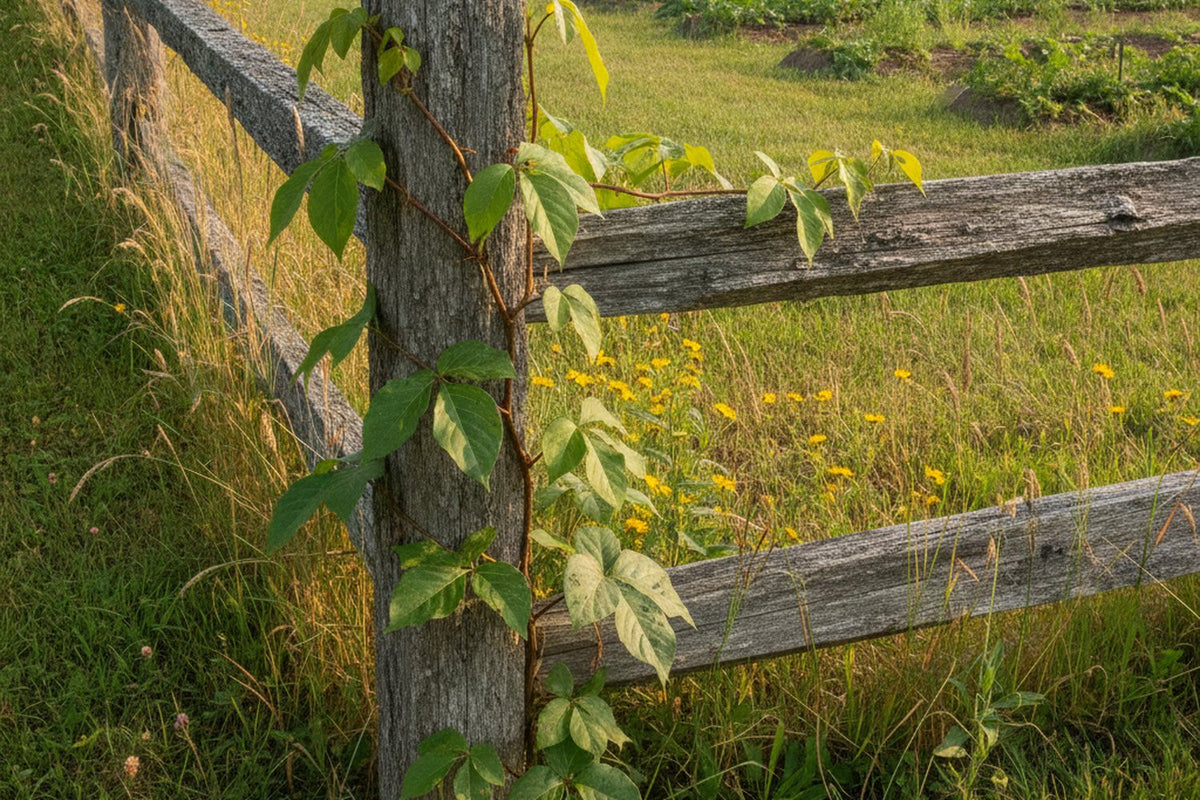
All parts of the plant, leaves, stems and roots, contain the oil urushiol, by University of Maryland Extension, so it is worth being sure before you start pulling or cutting. The leaf shape varies even on one plant, though each leaf is typically made of three leaflets, with edges that may be smooth, wavy, toothed or lobed. Here is what the sources say about the plants people mistake for it.
| Plant | How to tell | Whose word |
|---|---|---|
| Poison ivy | Compound leaves of three leaflets; climbs trees and posts with hairy aerial roots along the stem, or grows as a ground cover or small shrub; clusters of white, waxy fruit; leaves turn yellow or red in fall | Clemson; University of Maryland |
| Virginia creeper | Also climbs trees and covers the ground, but its leaves have five leaflets rather than three | Clemson; Penn State |
| Boxelder | A tree that University of Maryland Extension names among the plants with three leaflets that look very similar to poison ivy | University of Maryland |
| Atlantic poison oak | Looks like poison ivy but grows more upright, with hairs on both sides of the leaves; the FDA names poison oak among the plants whose urushiol oil causes the rash | Clemson; FDA |
| Poison sumac | A tall shrub or small tree of bogs and swamps, with 7 to 13 smooth-edged leaflets per leaf | FDA |
What it shows: "leaves of three" is the start, not the whole test. University of Maryland Extension notes that poison ivy leaves occasionally come in groups of five, seven or even nine, and the FDA says it grows throughout the country except in Alaska, Hawaii and some parts of the West Coast.
Where the poison ivy grows decides the product
Every pick here can hurt a plant you want if the spray reaches it. So the question is less which killer than where the ivy is. Here is what the labels and the extension services say, place by place.
| Where it grows | What to do | Whose word |
|---|---|---|
| Fence lines, woods edges, around sheds and buildings | Spray the leaves with a brush killer: pick 1, or pick 2 for a few plants | Pick 1 and pick 2 labels |
| Up a fence, pole or tree with mature bark | Spray the vine from the ground to 3 or 4 feet up; bark is mature if you scratch it with a finger and find no green tissue | Pick 3 label |
| On shrubs, or trees with green bark | Cut the vine at the base and treat the cut end as a stump: pick 4, or pick 1 or 3 full strength | Pick 1, 3 and 4 labels; Clemson |
| High in a tree | Sever the vine where it climbs the trunk, or "spot spray the foliage (but never direct the spray overhead)" | University of Maryland |
| In the lawn | A lawn-labeled product on the grasses its label names: pick 3; not picks 1 or 2 | Pick 3 label; pick 1 and pick 2 labels |
| In flower and shrub beds | Cut it back and paint the cut stems with pick 4; for spraying in existing beds Clemson prefers glyphosate, kept off other plants, because it is "much less apt to move through the soil" and injure shrubs | Clemson; pick 4 label |
| Near vegetables and fruit | None of these four: the labels of picks 1, 2 and 4 rule out use on or around food crops, and pick 3's says to keep drift off vegetables; dig small plants instead | Pick 1, 2, 3 and 4 labels; University of Maryland |
| Small seedlings anywhere | Dig or pull them early in the season, wearing gloves | University of Maryland; Clemson |
What it shows: two of the picks are tied to a place. Pick 3 is the only one made for the lawn, and pick 4 is the one for vines on plants you want. Picks 1 and 2 are for the edges, where nothing you care about grows under the spray. Clemson's extension also warns that many herbicides can move through thin bark into a plant, and says not to let them touch the leaves, stems or trunks of plants you want.
The four labels side by side
Here is what each pick's label or maker page says, line by line.
| Detail | Pick 1: BioAdvanced concentrate | Pick 2: Roundup with Comfort Wand | Pick 3: Bonide BK-32 | Pick 4: Bonide Stump and Vine Killer |
|---|---|---|---|---|
| Actives | Triclopyr 8.8% | 0.122% triclopyr, 0.097% fluazifop-P-butyl, 0.073% diquat dibromide | MCPA 13.72%, triclopyr 1.56%, dicamba 1.35% | Triclopyr 8.8% |
| EPA Reg. No. | 92564-6 | 71995-65 | 228-334-4 | 53883-216-4 |
| Form | 32 fl oz concentrate | 1 gallon, ready to use | 16 fl oz concentrate | 8 oz with applicator top |
| How much | 4 to 8 fl oz per gallon of spray | No mixing | Brush: 4 fl oz per gallon for each 1,000 square feet; lawns: 4 fl oz (fescue, Kentucky bluegrass, perennial rye, zoysia) or 2 fl oz (Bermuda, Bahia, bent) for the same area | Undiluted on cut stems; or 4 to 8 fl oz per gallon |
| Area per container | Up to 4,000 square feet | Up to 300 square feet | 4 gallons of spray at the brush rate | Cut stems; as a spray, one gallon per 500 square feet |
| In lawns | Not for use on lawns | Kills lawn grasses | Made for listed lawn grasses | Labeled for around homes, cabins, fences and walkways; no lawn directions |
| Rain | Rain 4 hours later will not wash it away | Rainproof in as little as 30 minutes (0.5 hour), by Roundup's page | Rain 1 hour later will not wash it away | Rain within 24 hours may reduce effectiveness |
| People and pets | Off until the spray has dried | Out during spraying; in after it has dried | Out during spraying; in after it has dried | Out during spraying and until sprays have dried |
| Cut vines and stumps | Full strength with a paintbrush | Listed for vines climbing poles or mature trees | Full strength with a paintbrush | Undiluted with the applicator top |
| Results show | 1 to 6 weeks | Within hours | No time given on the label | 1 to 6 weeks |
What it shows: the strength numbers are not comparable across forms. Pick 2's percentages are low because it is already mixed, and picks 1 and 4 share the same 8.8% triclopyr; the difference between them is the bottle, a sprayable concentrate against a small bottle with an applicator for cut stems. The honest split is by place: lawn or not, and spray or paint.
When to spray poison ivy, and what to do in fall and winter
Timing matters as much as the bottle. The extension services and labels line up on this: spray poison ivy while it is in full leaf and growing.
| When | What the sources say | Whose word |
|---|---|---|
| Spring | The vines come back into leaf, usually in May; triclopyr works best once the leaves have fully expanded | University of Maryland; Clemson |
| Early to mid-summer | Herbicides work best during active growth, when the plant absorbs and moves them most efficiently; 2,4-D and dicamba work best from late spring into early summer, while growth is fast | University of Maryland; Clemson |
| Fall | Spray triclopyr before the leaf color changes; spray pick 2 no later than 4 weeks ahead of the first killing frost | Clemson; pick 2 label |
| Late fall and winter | The vine is bare: poison ivy loses its leaves in fall, and the labels ask for leafed-out, actively growing plants | University of Maryland; pick 1 label |
| Any time of year | Contact with the plant can cause an allergic reaction; even dead plants may cause reactions for a couple of years | Pick 1, 2 and 3 labels; University of Maryland |
What it shows: if you are reading this in November, the leaves may already be turning or gone, and the labels' spray directions are written for leafed-out plants. Use the winter to find the vines and plan. University of Maryland Extension's first option for a vine on a tree is to sever it where it climbs the trunk, which cuts the flow of moisture from the roots, and Clemson's extension says to start cutting back plants early in the spring, about when the leaves unfold, then cut again whenever new growth appears. When the leaves are back, spray the regrowth or paint the cut stems as the label says. Clemson adds that it can take one to several weeks to see whether a plant has been killed, and that repeat applications may be needed.
How to kill poison ivy vines on trees without hurting the tree
University of Maryland Extension says the vines do no harm to the trees they climb, so you can take your time. The labels give two ways to deal with one, depending on the bark.
- Check the bark. Scratch it with a finger: no green tissue means mature bark, by pick 3's label.
- Mature bark: pick 3's label says to spray the vine thoroughly from the ground to 3 or 4 feet up, and its directions ask for particular care within the drip line of trees; for a vine on a tree, the labels of picks 1 and 4 give only the cut-vine method. Keep the spray off the tree's leaves, and never direct it overhead, as University of Maryland Extension warns.
- Green bark or a shrub: cut the vine at the base and treat the cut end as a stump, by the labels of picks 1, 3 and 4. University of Maryland Extension says to apply the herbicide right away, and pick 4's label says not to let the product touch the plants you want.
- Leave the top. Severing the vine cuts the flow of moisture from the roots, by University of Maryland Extension, and the labels treat the cut end, not the vine above it. That vine still carries the oil: the same source says even dead plants may cause reactions for a couple of years, and the labels say to handle dead plants with rubber gloves.
- Watch the stump. If new shoots come up, spray or paint them once they are leafed out; the labels of picks 1 and 2 set at least 28 days between treatments of the same spot.
How to spray poison ivy, step by step
Here is the order the labels and extension services set out:
- Dress for it. Long sleeves, long pants, gloves and boots, as University of Maryland Extension says; pick 1's label adds shoes and socks, and pick 4's label asks for chemical resistant gloves.
- Pick the day. Calm air, the plants in full leaf and growing, and no rain due for the time the label needs; the labels of picks 1, 3 and 4 note that calm weather with no rain forecast for 24 hours helps keep the spray where you put it.
- Shield what you want to keep. The labels of picks 1 and 3 suggest a sheet of cardboard or plastic between the spray and nearby plants.
- Mix only what the label says. Pick 1: 4 to 8 fl oz per gallon. Pick 3: 4 fl oz per gallon for each 1,000 square feet of brush, or of fescue, Kentucky bluegrass, perennial rye or zoysia lawn; 2 fl oz on Bermuda, Bahia and bent. Pick 2 comes mixed.
- Spray to wet, not to drip. Pick 1's label says to wet the weeds thoroughly but not to the point of dripping, with the nozzle set to a coarse spray; pick 3's says to wet the foliage, stems and trunk.
- Keep people and pets out while you spray and until it has dried, by every pick's label.
- Wait. Pick 2 shows results in hours; picks 1 and 4 take 1 to 6 weeks, by their labels.
- Handle the dead plants with care. The labels of picks 1, 2 and 3 say to wear rubber gloves to handle dead plants, then seal the plants and the gloves in garbage bags.
- Come back. Reapply if new growth appears, after the label's waiting time: at least 28 days for picks 1 and 2, and at least 21 days between broadcast lawn applications for pick 3.
Protect yourself while you work
The oil does the damage, and it travels. University of Maryland Extension says urushiol soaks into the skin in about ten minutes, that tools, clothing and pet fur can carry it, and that it can stay active on objects for months. The FDA says it lingers, sometimes for years, on almost any surface until water or rubbing alcohol washes it off.
- Cover up. Long-sleeved shirt, long pants, gloves and boots, with work clothes washed separately from the rest of the laundry (University of Maryland).
- Bag your hands if you have no gloves. Clemson's extension suggests long plastic bags over each hand, held with rubber bands, removed inside out and thrown away.
- Wash quickly. University of Maryland Extension recommends washing with running water, and warns that soaps with emollients or bath oils can spread the oil; Clemson's extension adds that rubbing alcohol removes the oil better than water does.
- Clean the tools and the dog. Wash anything that touched the plant with soap and water; University of Maryland Extension says alcohol also works for cleaning tools, and the FDA says to wash a pet that brushed against it while you wear rubber gloves.
- Never burn it. University of Maryland Extension says the oils in the smoke can cause severe allergic reactions and trouble breathing; Penn State Extension says the oil can be inhaled when poison ivy is burnt.
University of Maryland Extension says to contact your physician for severe swelling, blistering or itching, or a rash on a sensitive area such as the face, and the FDA lists difficulty breathing among the signs that call for a doctor.
Is a brush killer the same as a poison ivy killer?
Often it is the same registered formula under another name. Each pick's label carries an EPA registration number, and EPA's Pesticide Product Label System lists the brand names each registration is sold under. Three of the four picks show how much the names overlap.
| EPA Reg. No. | Some of the names EPA lists for it | What that tells you |
|---|---|---|
| 92564-6 (pick 1) | "BioAdvanced Brush Killer Plus Concentrate"; "BioAdvanced Poison Ivy Killer Plus Concentrate"; "BioAdvanced Science-Based Solutions Tree Stump Killer" | The brush killer, the poison ivy killer and the stump killer are one triclopyr formula |
| 71995-65 (pick 2) | "Roundup Poison Ivy Plus Tough Brush Killer2"; "Roundup Weed and Grass Killer4" | The poison ivy spray is registered with a weed and grass killer, which is why it kills lawn grass |
| 228-334 (pick 3's base registration) | Riverdale Horsepower Lawn Weed Killer; Bonide sells it as BK-32 Poison Ivy and Brush Killer | The poison ivy killer is registered as a lawn weed killer, which is why it suits a lawn |
What it shows: read the actives and the registration number, not the front of the bottle. A brush killer built on triclopyr alone, such as picks 1 and 4, targets woody plants, vines and broadleaf weeds, while a product that adds a grass killer, such as pick 2, takes the lawn with it. For brush beyond poison ivy, pick 4's label lists woody plants and vines from ash, maples and oaks to kudzu, wild grape and wild rose, and pick 1's names kudzu and blackberries.
Related guides
For weeds beyond poison ivy, our weed killer guide sets out the products by job, from driveway cracks to lawns, including a glyphosate concentrate for big areas. For pulling small poison ivy plants and other weeds by hand, our weeding tools guide compares hoes, hand weeders and pullers, and for a pump-up tank sprayer to mix pick 1 or pick 3 in, see our garden sprayer guide.
Frequently asked questions
What is the best poison ivy killer?
For most yards, BioAdvanced Brush Killer Plus Concentrate, a triclopyr brush killer whose label lists poison ivy and puts one 32 fl oz bottle at up to 4,000 square feet. For a few plants with no mixing, Roundup Poison Ivy Plus with Comfort Wand, which kills grass too. For poison ivy in the lawn, Bonide BK-32 on the grasses its label names, and for vines on trees and shrubs, Bonide Stump-Out Stump and Vine Killer brushed onto the cut stems.
What kills poison ivy down to the root?
A systemic herbicide that moves through the plant. University of Maryland Extension names products containing glyphosate or triclopyr, and Clemson's extension says glyphosate, triclopyr, dicamba, mecoprop and 2,4-D amine all move through the plant from the leaves and cut stems, in time killing both the shoots and the roots. Repeat applications may be needed, by Clemson, and the labels set a waiting time before you treat the same spot again.
Can you kill poison ivy in the fall or winter?
Not well with a spray once the leaves are gone. The labels ask for actively growing, leafed-out plants, Clemson's extension says triclopyr works best before the leaves change color in fall, and Roundup's label for pick 2 says to spray no later than 4 weeks ahead of the first killing frost. In winter you can cut vines where they climb trees, as University of Maryland Extension describes, then treat the regrowth in spring. The labels of picks 1, 2 and 3 say contact with poison ivy any time of year can cause an allergic reaction, so wear long sleeves and gloves to cut it, as Clemson's extension advises.
How do you kill poison ivy without killing the grass?
Use a product labeled for your lawn grass. Pick 3's label lists bluegrass, fescue, ryegrass, bentgrass, Bermuda, Bahia and zoysia lawns and says to avoid St. Augustine and centipede unless injury can be tolerated; its southern-lawn rate box says "Do not use on St. Augustine or centipede lawns." Pick 1's label says it is not for lawns, and pick 2 kills lawn grasses.
How do you kill poison ivy growing up a tree?
Cut it, or spray only its lowest few feet. On mature bark, pick 3's label says to spray the vine thoroughly up to 3 to 4 feet and to take particular care within the drip line of trees; on green bark or a shrub, cut the vine at the base and treat the cut end as a stump, as the labels of picks 1, 3 and 4 say. University of Maryland Extension says never to direct the spray overhead and notes that the vines do no harm to the trees they climb.
Can you burn poison ivy?
No. University of Maryland Extension says to never burn the plant, because the oils in the smoke can cause severe allergic reactions and trouble breathing, and Penn State Extension says the oil can be inhaled when poison ivy is burnt.
When can pets and kids go back out after spraying poison ivy?
After the spray has dried, by each pick's label, and keep them out of the area while you spray. The FDA notes that most pets do not react to poison ivy, but the oil on their fur can give a rash to the person who pets them.
Disclosure: Some links pay us a commission when you click or buy, and on some pages brands pay us through Amazon's creator program on links to their products. Availability was checked on Amazon on November 11, 2026 and can change.
Product prices and availability are accurate as of the date/time indicated and are subject to change. Any price and availability information displayed on Amazon.com at the time of purchase will apply to the purchase of this product.