As an Amazon Associate we earn from qualifying purchases. Some brands also pay us when you click or buy, so those links are ads. Full disclosure below
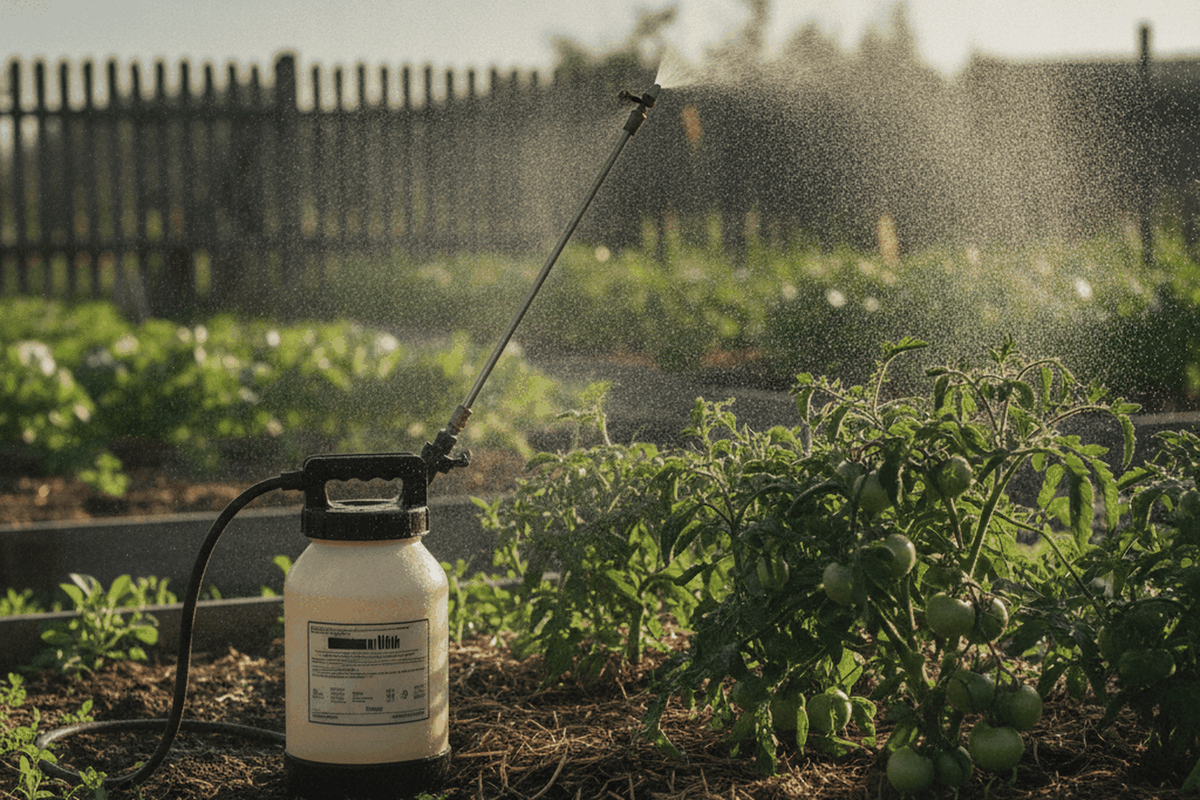
The best garden sprayer for most yards is a 2 gallon pump sprayer: light enough to carry full, and big enough to finish a typical job of weed killer or fertilizer on one fill. Big properties graduate to a 4 gallon backpack sprayer, long jobs suit a battery sprayer that holds pressure for you, and the rule that outranks every pick is one sprayer per chemical, labeled.
Sprayers are bought for a product, a weed killer, a fertilizer, a soap spray, and judged by whether they still hold pressure the following spring. The differences that matter are seals, wands, and honest capacity math, because water weighs more than marketing admits. These are the best garden sprayers by job, hand pumped and battery powered, with the safety plumbing every guide should include.
Best garden sprayers at a glance
| Sprayer | Best for | Type | Where to buy |
|---|---|---|---|
| Chapin 2 gallon (best overall) | Most yards, most jobs | Pump sprayer with anti-clog filtration | Check price on Amazon |
| Field King backpack | Big yards and long jobs | 4 gallon backpack, no-leak internal pump, up to 150 PSI | Check price on Amazon |
| Chapin SureSpray 1 gallon | Spot treatments and small gardens | 1 gallon pump sprayer | Check price on Amazon |
| PetraTools HD201 | Long-hose reach and second-sprayer duty | 2 gallon pump, 52 inch hose, 2 nozzles | Check price on Amazon |
| Chapin 28324 battery sprayer | Long jobs without pumping | 2 gallon battery tank sprayer, up to 24 gallons per charge | Check price on Amazon |
| PetraTools HD4000 | Acre-scale spraying | 4 gallon battery backpack, 40 to 90 PSI, 6 nozzles | Check price on Amazon |
What is the best garden sprayer?
The Chapin 2 gallon pump sprayer is our best overall because it attacks the way sprayers actually die: clogging and leaking. Its anti-clog design keeps the spray consistent instead of sputtering the moment anything but pure water goes in the tank, and Chapin's seals have a century of unglamorous reputation behind them. Two gallons is the right default: enough mix to finish a typical yard's job, at a carried weight that will not ruin the errand.
Backpack sprayer vs handheld
A handheld pump sprayer is right up to about 2 gallons and a job you finish on one fill. A backpack sprayer carries 4 gallons on both shoulders, keeps one hand free, and ends the refill trips that make big properties miserable. Buy the backpack the first season you refill the handheld twice to finish one job.
The deciding number is weight, not capacity. Water runs 8.3 lb per gallon, so a full 2 gallon tank is close to 20 lb hanging off one arm, while a full 4 gallon backpack is over 33 lb that both shoulders and your hips share. A handheld also softens as you spray and wants pumping every minute or two; a backpack lever pumps while you walk. If you spray beds, the handheld is less to store and less to rinse. If you spray fence lines, driveways, or an acre of anything, the backpack pays for itself the first afternoon you do not walk back to the spigot.
What is the best backpack sprayer, pump or battery?
For most big yards, the best backpack sprayer is a 4 gallon hand-pumped model with Viton seals, and on this page that is the Field King 190328 (pick 2). For long days of spraying with no pumping at all, the best battery backpack sprayer here is the PetraTools HD4000 (pick 6). The Roundup 190314 is a third 4 gallon manual backpack to know.
All three carry 4 gallons, so capacity does not separate them; the pump and the harness do. The table sets out what each maker lists.
| Backpack sprayer | Pump, as the maker lists it | Also listed by the maker |
|---|---|---|
| Field King 190328 (pick 2) | Internal piston pump, up to 150 PSI | Viton seals; 6 nozzles; pump seals change in minutes with no tools |
| PetraTools HD4000 (pick 6) | 12V battery-powered pump, adjustable from 40 to 90 PSI | 6 nozzles; 34.5 inch extendable wand; double-padded straps and back pad |
| Roundup 190314 | Manual pump | Viton seals and gaskets in the pump and the shut-off; padded straps, a waist belt and lumbar support |
Choose by how long you spray. A manual piston backpack such as the Field King covers most home jobs: one hand works the lever as you walk and the other aims the wand. A battery backpack takes the pumping away, which matters most on long fence lines and big lawns, and it asks for a charged battery before each job. For comfort and steady output on a long driveway or fence line, look for padded straps, a waist belt that lets your hips share the load, a shut-off that locks on and, on a battery model, a pressure you can set once.
Whatever goes in the tank, follow the product label: as US EPA puts it, the label is the law. Keep a backpack that has carried weed killer for weed killer only, the same one-sprayer-per-chemical rule that applies to handhelds below.
Battery sprayers: worth it?
Yes, if you spray for more than about twenty minutes at a stretch. A battery sprayer holds steady pressure with no pumping, so the pattern stays even from the first pass to the last and your forearm stays out of the job. For a few spot treatments a season, a manual pump sprayer is still the smarter buy.
The real gain is consistency. A hand-pumped tank starts at full pressure and fades until you stop and pump again, which means the first pass lays down more product than the last one, while the mixing rate on the label assumes something steady. A pump holds the pressure the nozzle was designed for. The costs are the ones you would expect: more money up front, a battery to keep charged, and a motor that can fail in a way a hand pump cannot. Buy battery when the job runs long, and keep a cheap manual sprayer for the ten-second jobs.
The best garden sprayers, by job
1. Chapin 2 gallon: best garden sprayer overall
For feeding roses, spraying insecticidal soap, and the general mix-and-apply work of a home garden, the Chapin 2 gallon is the sensible center of the market. Pump it up, spray until the pressure softens, pump again; the anti-clog filtration is what keeps that rhythm from degrading into nozzle surgery. Its limit is the arithmetic of arm-carried tanks: at two gallons plus the sprayer you are carrying nearly 20 lb, and jobs that need refills start arguing for the backpack.
2. Field King backpack: best backpack sprayer for big yards
When the job is measured in fence lines instead of flower beds, put the tank on your back. The Field King 190328 carries 4 gallons on both shoulders and pumps from a lever at your side, with an internal no-leak pump design that fixes the classic backpack failure of chemical seeping down your spine, and pressure up to 150 PSI for reaching into trees and driving fine mist. The honest math: 4 gallons of mix is over 33 lb of liquid before hardware, so fill to the job, not to the brim.
3. Chapin SureSpray 1 gallon: best small sprayer for spot jobs
Most gardens do not need a tank; they need a liter of soap spray on the aphids by the gate. The Chapin SureSpray 1 gallon mixes small batches honestly, carries anywhere, and stores on a shelf instead of a floor. It is also the right size for the second-sprayer rule below, the cheap way to give a chemical its own dedicated tank.
4. PetraTools HD201: best sprayer for reach
The PetraTools HD201 brings a 52 inch hose and two nozzles to the 2 gallon class, which converts to reach: under shrubs, into the back of deep beds, up into fruit trees, without contorting the tank. It is the strong pick when your spraying is more coverage than spot work, and a worthy dedicated-herbicide sprayer if the Chapin already owns fertilizer duty.
5. Chapin 28324 battery powered sprayer: best battery powered sprayer
Spraying a whole yard by hand is mostly pumping, and the Chapin 28324 deletes that half of the job. A rechargeable battery lives inside the 2 gallon tank and sprays up to 24 gallons on a single charge, which covers a lawn treatment, a round of feeding on the beds, and the fence line, without a single stroke of a pump handle.
The details that matter over an afternoon are the small ones. The 12 inch palm actuated wand has a built-in lock for continuous spray, so you are not squeezing a trigger for an hour, and an anti-clog filter keeps tank grit away from the sprayer parts when you mix something other than clear water. The pump motor is quiet, the charger is USB-C, and a single port pressure relief valve means one place to depressurize and one fewer seam to leak. It costs far more than a manual 2 gallon sprayer.
Where it loses: it is still a 2 gallon hand-carried tank, so a big property refills as often as ever, and a battery and a motor are two more things that can quit where a manual pump only has seals.
6. PetraTools HD4000: best battery backpack sprayer
When the job is an acre and the mix is counted in tanks, the PetraTools HD4000 ends both complaints at once: 4 gallons ride on your back and a 12V pump does the pressurizing. The battery runs 6 to 8 hours and moves over 200 gallons on a charge, which in home terms means it outlasts any day you would want to spend spraying.
Pressure adjusts from 40 to 90 PSI across six nozzles, and that range is the point. Low pressure and a fan tip for a feeding pass over beds, high pressure and a stream for driving product into a hedge or up a trunk. The wand extends to 34.5 inches, the straps and back pad are doubled, and the squeeze handle locks so a long pass does not become a grip exercise.
Where it loses: it is the most expensive sprayer here by a wide margin, and 4 gallons of mix is over 33 lb before hardware, so fill it to the job rather than to the brim.
How to choose a garden sprayer
- Do the water math first. Water weighs 8.3 lb per gallon. A 2 gallon tank carries; a 4 gallon tank is wearable only, which is why backpacks exist.
- Seals and wands are the product. Tanks rarely fail; O-rings, triggers, and cheap wands do. Brands with replaceable seal kits turn a leak into a part instead of a purchase.
- One sprayer per chemical, labeled with a marker. Herbicide residue in a shared tank has killed more tomatoes than any pest. A dedicated, clearly labeled sprayer for weed killer is not optional; rinsing is not enough.
- Read the product label and dress for it: gloves and eye protection whenever you spray anything, and follow the label's mixing rates exactly, because the label is the law of the product.
- Winterize in one minute: rinse, pump clean water through the wand, release pressure, store open and dry. Trapped liquid is how spring finds a cracked pump.
Frequently asked questions
What is the best garden sprayer for home use?
A 2 gallon pump sprayer with anti-clog filtration covers most home yards: big enough to finish a job, light enough to carry full, and simple enough to maintain with an occasional seal kit. Go backpack only when your jobs regularly outlast a 2 gallon tank.
Should I get a pump sprayer or a backpack sprayer?
Pump for gardens, backpack for properties. A hand-carried pump sprayer suits jobs under a few hundred square feet and stores easily. A backpack carries double the mix on your shoulders instead of one arm and keeps a hand free, which wins the moment your spraying is measured in fence lines or orchard rows.
Can I use the same sprayer for herbicide and fertilizer?
No. Herbicide residue clings to tanks, hoses, and seals, and even careful rinsing leaves enough behind to damage the next thing you spray with fertilizer or fungicide. The universal practice is one sprayer per chemical class, labeled in permanent marker, with the herbicide sprayer never lending its tank to anything.
Why did my sprayer lose pressure?
Almost always a seal or a clog. Dry O-rings leak pressure at the pump shaft, and dried residue blocks the nozzle or the filter. Pull the pump, grease or replace the O-ring, and soak the nozzle; five minutes of parts work revives most sprayers that seem dead.
The bottom line
Start with the Chapin 2 gallon, add a dedicated labeled sprayer the day a herbicide enters the shed, graduate to the backpack when the property demands it, and let a battery do the pumping once your jobs run past twenty minutes. Around here we reach for steel before spray where weeds are concerned, which is what our weeding tools guide is about, the watering side lives in the garden hose guide, and the whole shed is ranked in the essential garden tools list.
For context on who is recommending this gear: Spear Head Spade is a family business in New Jersey, and we sell the Spear Head Spade digging tools, with over 600,000 sold. Where weeds are the reason you are shopping, the cheaper answer is usually steel, and our guide to garden hoe types and uses explains which blade suits which bed. Ours is the Spear Head Hoe, on a 60 inch handle.
Disclosure: some links in this guide are affiliate links to Amazon. This is at no extra cost to you, and it never changes our honest recommendations.
Product prices and availability are accurate as of the date/time indicated and are subject to change. Any price and availability information displayed on Amazon.com at the time of purchase will apply to the purchase of this product.