As an Amazon Associate we earn from qualifying purchases. Some brands also pay us when you click or buy, so those links are ads. Full disclosure below
The best mini greenhouse for most people is the Ohuhu Mini Greenhouse 4-Tier: four shelves the maker rates at 22 lb each, and one standard 1020 seed flat on each of them. We checked every listing on Amazon on 2026-09-19.
Before the list, the number the category never prints. Three university extension services answer it for a cold frame: two of them put the inside of one at 5 to 10 degrees warmer than the air outside, and the third puts the gain at two to four weeks of season at each end of the year. Nobody has published a figure for a plastic shelf rack, so treat that as the category's ceiling. A mini greenhouse is a head start and a windbreak, not a heated room, and any listing that promises more than that is selling you the other thing.
One more thing first: we make digging spades, not greenhouses, so nothing here is ours. Each pick is judged on published dimensions, shelf sizes and panel material, and on how many seed flats those hold, traced to the brand's own page or its own Amazon listing, pulled on 2026-09-19.
The best mini greenhouses at a glance
| Model | Best for | Price | Seed flats it holds (computed) | Type | Named by |
|---|---|---|---|---|---|
| Ohuhu Mini Greenhouse 4-Tier (best overall) | A first mini greenhouse, on a patio or balcony | Check price | 4 flats | 4-tier PE rack, 27.2 x 18.9 x 62.2 in | Popular Mechanics |
| Pure Garden 3 Tier Mini | Spending as little as sensibly possible | Check price | 3 flats | 3-tier PVC rack, 27.5 x 19 x 50 in | Popular Mechanics |
| Koksry Portable Walk-in | Standing inside it to work | Check price | 6 flats | Walk-in PE tent, 56 x 30 x 76 in | Popular Mechanics |
| Ohuhu Indoor Greenhouse with Grow Light | Starting seeds in a room, in February | Check price | 4 flats | 4-tier PVC rack with lights, 27.2 x 19.9 x 61.8 in | Nobody |
| Giantex Wood Cold Frame 37 in | A bed you already have, if it is open bottomed | Check price | 3 flats | Fir cold frame, clear plastic, 37 x 25 x 16 in | Nobody |
| Outsunny Raised Bed Cold Frame | Bed and cold frame in one, starting from bare ground | Check price | 4 flats | Steel raised bed and polycarbonate cold frame, 48 x 24 x 32.25 in | Nobody |
| Backyard Discovery Aggie | Not being home at noon to open it | Check price | 4 flats | Cedar planter and self venting lid, 48 x 28.75 x 32 in | Nobody |
The flats column is the more comparable of the two numbers we compute, because a flat either fits or it does not, but every row except the Pure Garden is still measured on an outer dimension, so read it as a ceiling. The growing area further down is useful for scale and is not a like-for-like ranking at all.
How we chose these
We did not put a single one of these in a garden. We checked every Amazon listing against the maker's specification page where one exists, then against the roundups covering this category: Popular Mechanics, Bob Vila and the Telegraph, the only one of the three who set units up and left them out for weeks. Her picks are UK-only, so she is cited for the category and never for a model. Better Homes and Gardens tests here too and is this search's only editorial result, but we could not open it, so all we take is its search listing: its best overall is an Eagle Peak greenhouse.
The sourcing rule, because it decides several arguments below. A number appears only if the brand publishes it, on its product page or its Amazon listing, and we say which. Where the two disagree we use the maker's page, which happens on the Aggie. Reviewer figures are attributed in the same sentence.
Two rules. Four of the seven picks have no reviewer behind the exact model we link, and each says so rather than borrowing a sibling's credit. And the Aggie breaks the price ceiling we set, because it is the only unit we found at any price with a self opening lid built in; pick 7 weighs it against a cheap frame plus a bolt-on opener, which is only cheaper if that opener fits your lid, and no maker here publishes the figures to check.
The best mini greenhouses, by job
1. Ohuhu Mini Greenhouse 4-Tier: the best mini greenhouse overall
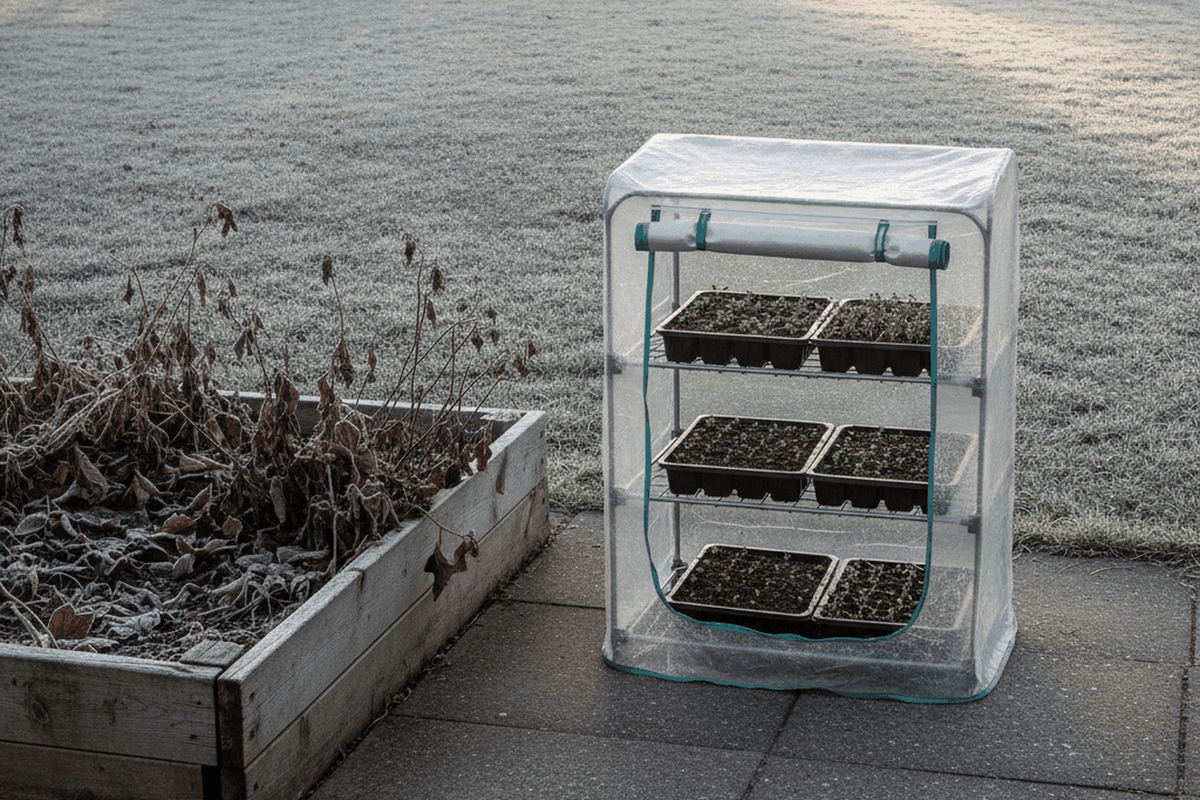
The Ohuhu Mini Greenhouse 4-Tier (ASIN B07S1LRTRK) is the one to buy if you are buying your first one. The listing gives 62.2 in by 27.2 in by 18.9 in, a reinforced steel frame, four shelves each holding up to 22 lb, and a push-fit system that sets up without tools and lets you move the shelves for taller plants. The cover is high density PE that Ohuhu says passes 50 to 60 percent of the light, and the listing states a 1 year warranty with free replacement connectors and covers, which is the part that matters on a product whose cover is the thing that fails. Popular Mechanics names it Best Tall and Narrow and prints a 23 lb shelf capacity where Ohuhu says 22; we use Ohuhu's. Four shelves take four 1020 flats. The walk-in below beats that at six, and this is still the pick, because the Ohuhu wins the thing a balcony has least of: it stands on 3.6 sq ft of floor against the Koksry's 11.7. Where it loses: Ohuhu never publishes a shelf dimension, only the outside footprint, so its square footage below is computed from the outside of the frame and is generous, and it cannot be ranked against the one row on the page that publishes a real shelf size. And its own first bullet promises you will "Start 4-6 Weeks Earlier", which is more than any extension service will say for a structure like this.
2. Pure Garden 3 Tier Mini: the cheapest one worth buying
The Pure Garden 3 Tier Mini (ASIN B01MSAR2YK) is the cheapest of the seven picks and Popular Mechanics' Best Value. It is 27.5 in by 19 in by 50 in on powder coated iron tubing with a PVC cover and a zippered roll-up door. It is also the single most useful listing on this page, because it is the only one publishing a full shelf size, 24.25 in by 18.5 in, next to its footprint; the Koksry below gives a shelf depth and nothing else. That one disclosure is what puts an error bar on every other row here, because it shows a shelf is 14 percent smaller than the footprint it sits in. Where it loses: the same listing contradicts itself, saying in one bullet that the shelves are 27.5 in long and in another that they are 24.25 in, and claiming the tiers "provide ample space to start multiple flats of seedlings". On either of its own numbers, exactly one standard 1020 flat fits. At 50 in it is also the shortest rack here, with three tiers where the two Ohuhus have four.
3. Koksry Portable Walk-in: the smallest one you can stand inside
The Koksry Portable Walk-in (ASIN B082FXTYSN) is Popular Mechanics' Best Small Walk-In and the answer if bending over a rack is the thing you hate. It is 56 in long, 30 in wide and 76 in high with a door 5.25 ft tall, which its listing says an adult walks through, on three tiers. The listing says "Floor 1 and 2 are 16.5 inch high and 11.5 inch wide", and since the unit is only 30 in deep we read that 11.5 in as shelf depth. Note what it does not say: it never publishes a shelf length, so we use the 56 in outside length, which makes its square footage generous in the same way the racks' is. What survives that is the flat count, because two flats end to end need 42 in and even a much-shortened 56 in shelf clears it: six flats, the most of the seven picks. Popular Mechanics adds that the shelves hold up to 50 lb, which is the tester's figure and not the listing's, and that the cover has ground flaps you weigh down with bricks, which is her observation and not something the listing mentions. Where it loses: at 11.5 in deep those shelves leave most of the 30 in of depth as standing room, and the cover is translucent green PE rather than clear. Koksry calls that a feature, saying it "lets in a lot of heat but doesn't burn the seedlings as the clear covers have done", which is the seller's opinion and not a measurement.
4. Ohuhu Indoor Greenhouse with Grow Light: the best for starting seeds indoors
The Ohuhu Indoor Greenhouse with Grow Light (ASIN B0FP1R5L7G) exists for the person whose February problem is light, not frost. It is 27.2 in by 19.9 in by 61.8 in in 95 percent light transmitting PVC on a steel frame, with a full spectrum light Ohuhu says covers 400 to 750 nm, a 4, 8 or 12 hour timer and eleven brightness steps from 10 to 100 percent. Its built in timer stops at 12 hours, short of the 16 hours a day that sits inside every extension range in our grow lights for seedlings guide, and its listing does not say whether the light comes back on by itself when power returns, so check that before you rely on an outlet timer. It is also one of only three listings in the 61 we pulled that answers the question this category is bought to answer, which is whether a standard seed tray fits: its four shelves "perfectly fit 10 inch by 20 inch seed trays, each holding up to 22 lbs". All three are grow light cabinets; every maker selling a plain rack leaves you to work it out. No reviewer names it, and we will not pretend otherwise. Where it loses: it costs far more per flat than the Koksry, and the lights are the whole reason. If you already own a lamp, the plain Ohuhu rack above is an inch shallower for less.
5. Giantex Wood Cold Frame 37 in: the best budget cold frame
The Giantex Wood Cold Frame (ASIN B0G7GRBX9B) is where this page stops being about plastic racks. It is a solid fir box 37 in by 25 in by 16 in, weighing 6.5 lb, with a clear lid held open on bolts. Set over a bed it covers 6.42 square feet of ground, measured on the outside of the box because Giantex publishes no interior dimension, and that takes three flats. It is one of two of our three frames that could go over ground you already have, with the Outsunny's cover used on its own, which matters because the heat a cold frame gives back at night comes from the soil under it. One honest gap: its title calls it "Portable Raised Planter Bed Protection" and none of its five bullets says whether the box has a floor, so setting it over a bed is our reading, not a quoted claim. No reviewer names this model. Bob Vila's Best Wood is a Giantex cold frame and it is currently unavailable, and the Suburban Hobby Farmer writer who bought a Giantex and used it over a year was writing about a different one, so both credits are brand level and we will not dress them up as more. Where it loses: 16 in of height means short crops only, lettuce and spinach and hardening off, not a tomato. And Giantex never says what the panels are made of, only "crystal-clear panels" over a detail block that says plastic, so we do not call it polycarbonate as we do on the two cold frames below.
6. Outsunny Raised Bed Cold Frame: the best cold frame that brings its own bed
The Outsunny Raised Bed Cold Frame (ASIN B09QCL99DD) is the one to buy if you are starting from bare ground and want the bed and the cold frame in one box. Its listing gives a galvanized steel raised bed under a stained solid fir frame with polycarbonate boards, 48 in long, 24 in wide and 32.25 in high overall, and an openable pointed roof for ventilation. It is also two products in one: the listing says you can use the greenhouse cover alone or combined with the bed, so the cover can go over a bed you already have as well. Four flats fit on its 48 in by 24 in footprint, computed on the outside because Outsunny publishes no interior dimension, so treat that as a ceiling. No reviewer names it. Our first pick for this slot, the Exaco Juwel Kombi, was out of stock on Amazon when we rechecked on 2026-09-28; it is in the also-considered section below. Where it loses: it is not the insulated option the Exaco was. Its listing states no panel thickness and says nothing of twin wall or sealing strips, and it describes the cover as protecting plants "from cold, light wind and rain", a modest claim, so do not buy it for a hard winter. No maker or tester publishes a temperature figure for it either.
7. Backyard Discovery Aggie: the cold frame that vents itself
The Backyard Discovery Aggie (ASIN B0CWLSXF9T) is the most expensive thing on this page and the only one with the fix for the venting problem built in. Backyard Discovery's own page and the Amazon listing say the same thing word for word: a hinge with heat sensitive wax "automatically opens lid when temperatures exceed 70℉ and closes as it cools with no electricity needed". The rest is built to match, which is what the price buys: 100 percent cedar, powder coated steel legs and hardware, double wall polycarbonate lid panels, wide bottom slats and a mesh liner for drainage, and a 5 year warranty, the longest term any brand states here. The maker's table gives 48 in wide by 28.75 in deep by 32 in high and 94.79 lb, where the Amazon title rounds it to 4 ft by 2 ft. We use the maker's. No reviewer names it. Where it loses, and read this before spending the money: the mechanism is not exclusive. A bolt-on wax opener, further down, gives the same mechanism, so the honest comparison is this against a Giantex plus an opener, a pair that costs far less. What that gap buys is the rest of the product: cedar rather than fir, a double wall polycarbonate lid, the 5 year warranty, drainage slats and a mesh liner, and one thing to assemble instead of two. If none of that moves you, the pair is the cheaper route, provided your lid comes in under the opener's 15 lb lift and 17.7 in of travel, which no maker here publishes, so measure before you buy. Its cost per flat is the highest here, and it is a planter on steel legs holding its own soil, so it is not somewhere to stand pots and it does not sit on your ground. And no interior dimension is published, so its flat count is computed on the outside of the box and is generous.
How much growing area does a mini greenhouse give you?
Between 1.43 and 48.00 sq ft across the fourteen of the fifteen models below that publish enough to work it out. The growing area column is computed by us.
Read the last column first, because this is not a like-for-like ranking and we will not pretend it is. Only the Pure Garden publishes a full shelf size, and its shelves are 14 percent smaller than its own footprint. Every other row rests on an outer dimension, so those are generous by roughly that much and cannot be ranked precisely. Use this table for scale and the flats table for the decision. One row has no figure at all, which is a finding in itself.
| Model | Tier | Growing area (computed) | Area from |
|---|---|---|---|
| Ohuhu Mini Greenhouse 4-Tier | Pick | 14.28 sq ft | Footprint x 4 tiers |
| Koksry Portable Walk-in | Pick | 13.42 sq ft | Outer length x stated shelf depth x 3 |
| Pure Garden 3 Tier Mini | Pick | 9.35 sq ft | Stated shelf x 3 |
| Ohuhu Indoor with Grow Light | Pick | 15.04 sq ft | Footprint x 4 tiers |
| Giantex Wood Cold Frame 37 in | Pick | 6.42 sq ft | Outer footprint |
| Outsunny Raised Bed Cold Frame | Pick | 8.00 sq ft | Outer footprint |
| Backyard Discovery Aggie | Pick | 9.58 sq ft | Maker outer footprint |
| Eagle Peak 8x6 Pop Up | Considered | 48.00 sq ft | Footprint, which is floor |
| Miracle-Gro 4-Tier | Considered | 11.12 sq ft | Footprint x 4 tiers |
| AHOME Mini Pop Up | Considered | 5.06 sq ft | Outer footprint |
| ShelterLogic GrowIT 4x4 | Considered | 16.00 sq ft | Footprint, which is floor |
| Bstrip 6-Tier Indoor | Considered | 16.96 sq ft | Footprint x 6 tiers |
| Exaco Juwel Kombi | Considered | 8.50 sq ft | Maker outer footprint |
| Garland Super 7 Propagator | Considered | 1.43 sq ft | Outer footprint |
| Nova Microdermabrasion Walk-in | Considered | Not published | Shelf size not published |
One thing falls out of it once you set it against the prices, and it is not a close call: area gets cheaper the bigger and flimsier you go, so a walk-in tent, a four tier rack and a plastic cloche buy the most area for the money, while the cold frames cost more per square foot than almost every shelf rack. Two rows also include full spectrum grow lights, the Ohuhu indoor pick and the Bstrip, so their price is buying light as well as space and does not compare with the rest at all.
How many seed trays does a mini greenhouse actually hold?
Fewer than you think, and for most of them the answer is one per shelf. The standard is a 1020 flat, which despite the name measures about 21 in by 10.75 in on the outside: that is the outer size Bootstrap Farmer gives for its shallow 1020, and its deep tray is 21.06 by 10.81, which changes no count below. Against the shelf and floor sizes the makers publish, here is what fits, laid flat with no overhang.
| Model | Surface we measured | Flats per level | Levels | Flats in total (computed) |
|---|---|---|---|---|
| Ohuhu Mini Greenhouse 4-Tier | 27.2 x 18.9 in outer footprint | 1 | 4 | 4 |
| Pure Garden 3 Tier Mini | 24.25 x 18.5 in stated shelf | 1 | 3 | 3 |
| Koksry Portable Walk-in | 56 in outer length x 11.5 in stated shelf depth | 2 | 3 | 6 |
| Ohuhu Indoor with Grow Light | 27.2 x 19.9 in outer footprint | 1 | 4 | 4 |
| Giantex Wood Cold Frame 37 in | 37 x 25 in outer footprint | 3 | 1 | 3 |
| Outsunny Raised Bed Cold Frame | 48 x 24 in outer footprint | 4 | 1 | 4 |
| Backyard Discovery Aggie | 48 x 28.75 in maker outer footprint | 4 | 1 | 4 |
Read that table against the area table, because they disagree on purpose. The reason is packing: a flat is 1.57 sq ft, so four flats use 6.3 sq ft of the Ohuhu's 14.28, under half of what you paid for. The Ohuhu is 18.9 in deep and two flats side by side need 21.5, so it misses a second flat by 2.6 inches; the Koksry's shelf runs 56 in and two flats end to end need 42. If you start seeds in trays, the flat count is the number to shop on. The Telegraph gives a tray figure for some of the units she tested, which is more than any US roundup does, but no roundup on this search prices it.
One caveat beyond the outer-dimension warning above: all three cold frame rows are computed on the outside of the box, because none of Giantex, Outsunny or Backyard Discovery publishes an interior dimension, so treat those counts as ceilings rather than capacities.
Also considered: models that missed the list and why
Eight more worth knowing about, three of them carrying a reviewer's name for the exact model we link. None is in the ranked list above, and every listing here comes from the same Amazon pull on 2026-09-19, with stock rechecked on 2026-09-28.
- Eagle Peak 8x6 Easy Setup Pop Up Greenhouse. Popular Mechanics' Best for Large Pots, with a patented center lock that pops the pre-assembled frame up in seconds and a 1 year limited after sale protection on frames and tops. It has the lowest cost per square foot of anything here, and that is why it is not a pick: 48 sq ft of floor makes it a walk-in tent, the size class our best greenhouse guide covers.
- Miracle-Gro 4-Tier Greenhouse. The cheapest four tier rack here, in 4.4 oz clear PVC on a 5/8 in tubular steel frame with removable wire mesh shelves. Its title carries the same 23 by 17 by 57 in that Bob Vila's Best Small is sold at, the ShelterLogic GrowIT 4-Tier Mini, which is currently unavailable. It misses on shelf size: at the 17.4 in depth its own bullets give, it still takes one flat.
- AHOME Mini Pop Up Greenhouse. Bob Vila's Best Mini, and the cheapest thing on this page by a distance. Its listing describes a 27 in by 27 in by 31 in clear PVC cover with four steel ground tacks and no shelving, which is why it is not a pick: it covers a pot or a corner of a bed, it does not start a season.
- Nova Microdermabrasion Walk-in Greenhouse. Bob Vila's Best Bang for the Buck, 57 in by 57 in by 77 in with eight wired shelves on three tiers, plus ropes and anchors. It is the one row here with no computed area, because its listing never states a shelf dimension and on a walk-in the footprint is mostly the part you stand in. There is no honest way to say what its price buys.
- ShelterLogic GrowIT 4x4 Raised Bed Greenhouse. A 4 ft by 4 ft triple layer heat bonded ripstop cover on a 1 in steel frame that rolls up for airflow. Popular Mechanics gives a ShelterLogic GrowIT its Best Roll Top, but the model it names and pictures is the 4 ft by 3 ft at Wayfair; this 4 ft by 4 ft is only the Amazon alternative listed beneath it. Read the end of its own title before ordering: "Wood Frame Not Included". If you already have a 4 ft raised bed, this is the one product here built to go over it, and it is sized for a 4 ft square rather than a long bed.
- Exaco Juwel Kombi. Currently unavailable on Amazon: its listing showed out of stock when we rechecked on 2026-09-28, so it is not linked. It was our pick for a cold winter, a raised bed with a 4 mm twin wall polycarbonate cold frame on top, insulation sealing strips and staged vent props, 51 in by 24 in on Exaco's own page. If it comes back, it is the insulated option the Outsunny pick is not.
- Bstrip 6-Tier Indoor Greenhouse with Grow Light. Six tiers and five full spectrum lights on a 29.5 in by 13.8 in footprint, on eight wheels with four locks, rated by its listing to 270 lb, and it states the same 10 in by 20 in tray fit as our indoor pick. It holds six flats against four, but costs more per flat, on a shelf only 13.8 in deep.
- Garland Super 7 Self Watering Propagator. The windowsill answer, 29.92 in by 6.89 in by 6.49 in with a 3.4 litre reservoir. At 6.89 in wide it is narrower than a 1020 flat, so it runs its own trays, and per square foot it is among the most expensive models here.
How much frost does a mini greenhouse actually stop?
About 5 to 10 degrees Fahrenheit, and about two to four weeks at each end of the season. That is not our figure and it is not a manufacturer's. The University of Vermont Extension says gardeners "can anticipate the temperature inside a cold frame to be 5 to 10 degrees warmer than the outside air". University of Missouri Extension says the same thing in almost the same words, that the temperature inside "generally is not more than 5 to 10 degrees above the outside temperature", and adds that a mat or blanket over the frame on a cold night "increases temperature by only a few degrees". Iowa State University Extension says cold frames "are used to extend the growing season by two to four weeks in both the fall and the spring".
Two things follow. The listings oversell: our own top pick's first bullet says "Start 4-6 Weeks Earlier" and promises "a near-100% survival rate", where Iowa State's number for a cold frame, the sturdier thing, is two to four. And scope cuts the other way: all three figures are for cold frames, and we found no extension service or tester who has measured a single skin plastic shelf tent, so read it by type. Picks 1 to 3 are plastic on a steel frame and nobody has measured one, so treat 5 to 10 degrees as a ceiling they are unlikely to reach. Pick 4 is an indoor cabinet with no frost job at all; it is a light box. Pick 5 sits over ground, which is where the extension services measured, and so does pick 6's cover if you use it without its bed. As sold, picks 6 and 7 hold their own soil in an elevated box, a galvanized steel bed and a planter on steel legs, so they have soil mass but not the ground coupling Iowa State describes, and nobody has measured that arrangement either.
What that buys is real. Iowa State describes planting cool season crops like lettuce, spinach or radishes two to four weeks early, and hardening off tomato and pepper seedlings without carrying them in and out: "all you have to do is close it up at night". None of it keeps a tender plant alive through a hard freeze. To keep seedlings or a small greenhouse above freezing, our guide to the best greenhouse heater covers heaters and seedling heat mats. For one bad night on plants already in the ground, our guide to protecting plants from frost is the cheaper answer, and it is usually a sheet. The Telegraph's tester, answering her own readers on how to insulate a cheap greenhouse, puts the ceiling plainly: "Even with insulation, no greenhouse will be completely frost free unless you install a heater with a thermostat to keep it from getting too cold."
Do you have to open a mini greenhouse every day?
On a sunny day, yes, and this is how these things kill plants. Iowa State is blunt: "Check cold frames frequently, even on cloudy days, to prevent temperatures from getting too warm and killing the plants inside." Its rule is a thermometer and a number. "The sash should be raised when the air temperature inside the cold frame rises above 85 degrees Fahrenheit. It should be closed before sunset to retain heat." Missouri adds one for a windy site: raise the lid "on the side opposite that from which the wind is blowing", so you are not wind burning seedlings or losing the lid.
The same source names the fix. Iowa State: "Automatic openers are also available. The simplest types consist of wax-filled cylinders that expand and push open the cover as temperatures rise and then contract and close the cover when it cools off." That is exactly the mechanism in the Backyard Discovery Aggie, whose hinge opens the lid above 70 F, fifteen degrees below the point Iowa State tells you to be standing there with your hands on the sash. It is the only unit we found at any price with one built in.
You do not have to buy the box to get the mechanism. A bolt-on automatic vent opener comes in an aluminum body rated to lift 15 lb, and its listing says it holds open above 25 C, which is 77 F, and closes again between 15 and 18 C. Check its limits against your own lid: 17.7 in of maximum opening, a 15 lb maximum lift, and a listing that says only that it "can be clamped onto or screwed onto your greenhouse frame". No source we saved says it fits any frame on this page, and none of those makers publishes a lid weight, so fit is a question for your frame's dimensions, not a recommendation from us. It is not a pick; it is here because an extension service named the category and this is an example of it.
What is the best portable or pop up greenhouse?
The Eagle Peak 8x6 Easy Setup Pop Up, if you want one you can walk into. It is Popular Mechanics' Best for Large Pots, its patented center lock raises a pre-assembled frame without tools, and it has the lowest cost per square foot of floor of anything here. Eagle Peak is also the brand behind Better Homes and Gardens' best overall small greenhouse, though we could not open that page to learn which model. If that is bigger than you meant, the AHOME Mini Pop Up is Bob Vila's Best Mini and covers a single pot.
Go in knowing that a pop-up is the product most likely to leave, which is why this is the one category where the listing's own hardware matters. Of everything on this page, only the Eagle Peak, the Nova and the AHOME state ropes, stakes, anchors or ground tacks in their listings, and all three are second tier; not one of the seven picks does.
What is the best indoor greenhouse?
The Ohuhu Indoor Greenhouse with Grow Light, because indoors the constraint is light and not heat, and it is the pick here that brings its own. Four shelves that fit a 10 in by 20 in tray each, 400 to 750 nm full spectrum, a 4, 8 or 12 hour timer and brightness from 10 to 100 percent. If you want more shelves in less floor, the Bstrip 6-Tier gives six tiers and five lights on a footprint 29.5 in by 13.8 in.
A windowsill propagator like the Garland Super 7 is a different product rather than a small version of these: it buys humidity and unattended watering, not area. If the grower you are shopping for keeps houseplants rather than seed trays, our guide to gifts for plant lovers covers the indoor side.
Is a cold frame better than a mini greenhouse?
For growing, usually yes. For starting, usually no. The classic cold frame is a box over soil, and Iowa State describes why that matters: "The ground and frame of the cold frame are heated by the sun during the day and radiate that heat during the night, keeping the inside warmer." A plastic rack has no such mass. It has shelves, which a cold frame does not, and it holds pots at working height, which a cold frame does not.
Then split it by what you already have, because our three cold frames are not interchangeable. Bare ground and nothing else: the Outsunny or the Aggie, both of which bring their own raised soil container. A bed you already own: the ShelterLogic GrowIT 4x4 cover in the second tier is the one product here unambiguously built for that, sized for a 4 ft square; the 6.5 lb Giantex covers a 37 by 25 in patch of one, if it is open bottomed, which Giantex nowhere states; and the Outsunny's cover, by its listing, works without its bed. Trays of seedlings, pots you move about, a balcony with no soil: buy a rack instead. And say the season out loud: the sourced ceiling on this page is two to four weeks at each end and cool season crops into November, so greens in December is a question about your zone, not about the box. If you want the step up from all of it, a walk-in kit with a published snow rating is a different purchase, and our best greenhouse guide covers that size.
Are 4 tier mini greenhouses any good?
Yes, for what they are, which is a plant rack with a zip-up cover: cheap growing space, tool-free, stores flat, four shelves on a footprint smaller than a doormat, and four flats rather than more.
The limit worth knowing is the cover, because that ages before the frame does. The Telegraph's tester finds pop-ups rarely last more than a few years before showing serious wear, and ours are the same fabric over a steel frame, which is why the overall pick's 1 year warranty with free replacement covers is the spec to look for when two racks are otherwise the same box.
How do you choose a mini greenhouse?
- Count flats, not tiers. Measure your trays, then check the shelf. All five shelf racks here take one flat per shelf, and one of their listings still says "multiple flats".
- Decide between shelves and soil first. A rack starts seeds at waist height; a cold frame grows crops in soil that gives heat back at night. They are not the same purchase, and only two of our three frames could go over ground you already have: the Giantex, if it is open bottomed, and the Outsunny's cover without its bed.
- Budget for the venting, whether it is your time or a bolt-on opener. Above 85 F you have to open it, and closed again before sunset.
- Weight it down, because none of the seven picks ships with a tie-down. We checked every listing: ropes, stakes and anchors appear only on second-tier models. The Telegraph's tester, whose racks survived storms, does it by hand, putting "bricks, paving slabs or even simply some rocks on the bottom shelf to weigh it down" and, where there is something to tie to, "tie it to a fence or railing". On a balcony that weight is the whole of your anchoring.
- Read the title to the end. One model here is a cover with no frame, and one is sold in a size its own maker's page contradicts.
Where the plastic stops and the ground starts
Everything above is a lid. What is underneath it is soil, and that is where the season is actually won: a cold frame wants level, turned ground under it before it goes down, and the seedlings that come out of a rack in May have to go into a hole somebody digs.
Our how to build a raised garden bed guide covers the box a cold frame sits on, our best soil test kits guide the thing worth knowing before you fill it, our best garden trowels guide the tool that moves a tray of starts into a bed, and our how to winterize your garden guide the jobs on either side of the first frost. When it is the ground itself, that is our end of it: we make double patented digging spades in three sizes, and the D-handle garden spade is the one we would take to leveling a cold frame pad or cutting the edge of a new bed.
Frequently asked questions
Are mini greenhouses any good?
For starting seeds early and hardening off, yes. Two extension services put a cold frame at 5 to 10 degrees warmer than outside air, and a third puts the gain at two to four weeks of season at each end, which is enough for lettuce, spinach and radishes in April and for tomato seedlings adjusting to outdoors in May. They are not a heated room and they will not carry a tender plant through a hard freeze.
Do mini greenhouses work in winter?
They extend autumn and start spring rather than covering the middle. Iowa State University Extension describes closing a cold frame overnight as temperatures cool and harvesting cool season crops well into November most seasons. With no added heat, a cold frame gives you 5 to 10 degrees over outside and nobody has published a figure for a plastic shelf rack, so a run of nights in the teens beats any of these.
What is the best small, inexpensive greenhouse?
The Pure Garden 3 Tier Mini, which is Popular Mechanics' Best Value and the lowest price of the seven picks. It gives three shelves it actually publishes the size of, 24.25 in by 18.5 in, on a powder coated iron frame under PVC. Below that, the Miracle-Gro 4-Tier adds a shelf on a slightly smaller footprint, and the AHOME Mini Pop Up is a cloche for one pot rather than a greenhouse.
What is the best brand of mini greenhouse to buy?
No single model on this page is named by two of the reviewers we read, which is the honest answer. One brand does recur: Eagle Peak. Popular Mechanics picks two of its models, Bob Vila picks a third, and Better Homes and Gardens makes an Eagle Peak greenhouse its best overall, though we could not read which one. For cold frames, Exaco and Backyard Discovery are the two brands here that publish a real specification page you can check a listing against.
How long does a mini greenhouse last?
The cover goes first. The Telegraph's tester, who set seven of them up in her garden, writes that pop-up greenhouses are typically a short-term solution and rarely last more than a few years before showing serious wear, and that in a windy spot, untethered, they can last less than 24 hours. She puts metal and glass at a decade, and says polycarbonate degrades over time and gets replaced sooner. So weight it down on day one, and read the warranty: the longest any brand here states is the Aggie's 5 years.
Where should you put a mini greenhouse?
Facing south, on level ground, out of the wind. University of Vermont Extension says to position a cold frame so the angled top faces south, and University of Missouri Extension says cold frames should have a southern exposure for maximum sunlight and suggests a north or northwest windbreak, which can be a building, a fence or a hedge. A rack on a balcony follows the same logic: the sunniest wall, with the back of it against something solid.
The bottom line
Buy the Ohuhu Mini Greenhouse 4-Tier if you want one thing that starts seeds on a patio and packs away. Buy the Koksry Portable Walk-in if you would rather stand up while you work and want the most seed flats of the seven picks. Buy the Giantex Wood Cold Frame if the plants are going in the ground. Buy the Backyard Discovery Aggie only if nobody is home at noon to open the lid. And whatever you buy, weight it down and buy a thermometer, because 85 degrees inside on a bright March afternoon is what actually kills the seedlings.
Disclosure: Our commissions do not change what we recommend or what you pay. Prices and availability were checked on 2026-09-19 and can change.