As an Amazon Associate we earn from qualifying purchases. Some links are paid. Disclosure
Our top picks
Broadcast spreader for the whole lawn
1. Scotts EdgeGuard DLX Broadcast Spreader
Best for: Spreading a whole lawn at the setting on the bag
Handheld spreader for smaller areas
2. WORX WG869 Cordless Spreader
Best for: Up to 4,600 sq ft a load, by its listing
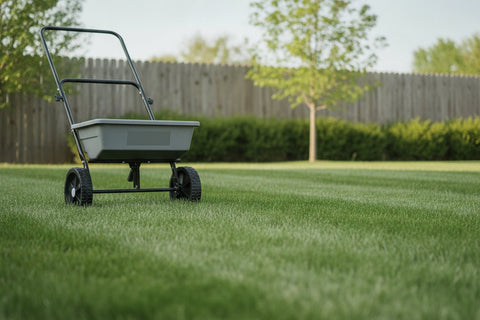
The best time to fertilize lawn grass depends on whether it is a cool-season or a warm-season grass: NC State Extension's Carolina Lawns guide (2021) says cool-season grasses grow best in the spring and fall and warm-season grasses grow best in the summer, and each extension calendar below times its feedings for its own state. On when to feed, the Maryland Department of Agriculture's lawn fertilizer guide (an undated page we read in November 2026) says to fertilize warm season grasses (Bermudagrass and Zoysiagrass) in late spring or summer and cool season grasses (fescues, bluegrass) in fall, based on soil test results; the section on late fall and winter sets out where the calendars stop. For spreading at the rate on the bag, our pick is the Scotts EdgeGuard DLX broadcast spreader. Good to know: University of Wisconsin-Extension's lawn fertilization guide (A2303, revised in 2011) says that following the spreader setting listed on the back of the fertilizer bag will eliminate the need for calibrating your fertilizer spreader.
Skip to the fertilizing calendars
The tools for the job
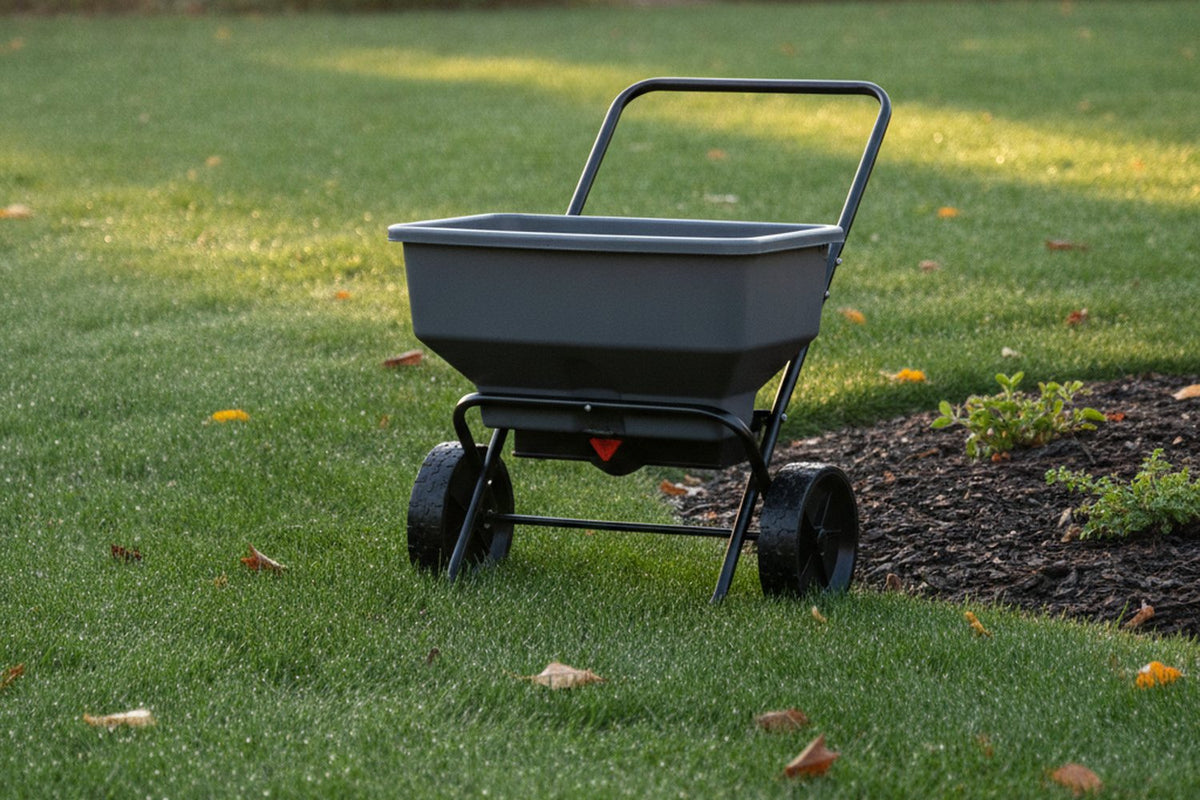
1. Scotts EdgeGuard DLX broadcast spreader
A pre-calibrated broadcast spreader with an edge guard, by its listing.
| Pick | What it is | Size | Job | Best for | Our verdict | Where to buy |
|---|---|---|---|---|---|---|
| 1. Scotts EdgeGuard DLX Broadcast SpreaderBroadcast spreader for the whole lawn | Broadcast spreader, EdgeGuard | Up to 15,000 sq ft of Scotts products | Step 5, spreading | Spreading a whole lawn at the setting on the bag | A pre-calibrated broadcast spreader that holds up to 15,000 sq ft of Scotts lawn products, by its listing. | Check price on Amazon |
| 2. WORX WG869 Cordless SpreaderHandheld spreader for smaller areas | Cordless handheld spreader | Up to 4,600 sq ft a load | Step 5, spreading | Up to 4,600 sq ft a load, by its listing | A cordless handheld spreader, up to 4,600 sq ft a load, with an 8 setting flow baffle, by its listing. | Check price on Amazon |
| 3. Luster Leaf Rapitest 1601 Soil Test KitHome soil test before you feed | Home soil test kit | 40 tests, 10 each of pH, N, P, K | Step 4, soil test | pH, N, P and K at home, 10 tests of each | A home soil test kit with 40 tests, 10 each of pH, N, P and K, by its listing. | No in-stock new offer sold by Amazon on November 22, 2026 |
When we checked on November 22, 2026, every tool we link was in stock as new and sold by Amazon. How our guides are made sets out what we check.
By its listing, the Scotts EdgeGuard DLX comes pre-calibrated and ready to use, holds up to 15,000 square feet of Scotts lawn products, and its EdgeGuard Technology keeps lawn product off landscaping, driveways and sidewalks. It is the kind of rotary spreader the Maryland guide and NC State name for spreading fertilizer evenly. Good to know: its listing gives the 15,000 square foot figure for Scotts lawn products, and the calculated table below works out loads from it.
2. WORX WG869 cordless spreader: handheld spreader for smaller areas
Best for: Up to 4,600 sq ft a load, by its listing
A cordless handheld spreader, up to 4,600 sq ft a load, with an 8 setting flow baffle, by its listing.
The WORX WG869 cordless spreader is a handheld spreader that weighs 3 lbs and covers up to 4,600 square feet a load, with a 5 foot maximum spread, by its listing, which says it also works as a fertilizer spreader for lawns and gives flow settings 3 to 4 for light fertilizer and 5 to 6 for heavy fertilizer on its 8 setting baffle. It runs on a WORX Power Share battery, by its listing; check the listing for whether one comes in the box. Good to know: the sources differ on spreading by hand. The Maryland guide says never apply fertilizer by hand and to use a drop or rotary spreader, and does not say whether a handheld spreader counts; Carolina Lawns, on renovating a lawn, says hand application is fine for small areas, but a rotary or drop-type spreader should be used on large areas to ensure uniform application.
3. Luster Leaf Rapitest 1601 soil test kit: home soil test before you feed
Good for: pH, N, P and K at home, 10 tests of each
A home soil test kit with 40 tests, 10 each of pH, N, P and K, by its listing.
No in-stock new offer sold by Amazon on November 22, 2026
When we checked on November 22, 2026, the Luster Leaf Rapitest 1601 soil test kit (pick 3) had no main offer on Amazon showing it in stock as new and sold by Amazon, so we do not link it for now.
The Luster Leaf Rapitest 1601 soil test kit gives at home results for soil pH, nitrogen, phosphorus and potash, with the components for 40 tests, 10 for each of pH, N, P and K, by its listing. Good to know: it is a home test, not a lab test. Clemson's soil testing fact sheet (HGIC 1652, revised Jan 20, 2016) says nitrogen testing is not recommended, because the levels of available nitrogen are variable due to its mobility in the soil, and the NC State calendars point to a soil test through your local Extension center. Step 4 covers when to sample.
When to fertilize lawn grass: the extension calendars, month by month
Each calendar below is one extension service's or agency's, for its own state, dated as its page dates it; where they differ, the step says so. This page links no fertilizer: for the bags, our best lawn fertilizer guide compares them by grass type, soil test and season.
Step 1: Tell whether your grass is cool-season or warm-season
Carolina Lawns (AG-69, July 2, 2021) says cool-season grasses grow best in the spring and fall and less actively in the summer and stay reasonably green in the winter, and names tall fescue, Kentucky bluegrass, fine fescue and perennial ryegrass as common types. It says warm-season grasses are slow to green up in the spring, grow best in the summer and go dormant after the first heavy frost, and it classes bermudagrass, zoysiagrass, centipedegrass, St. Augustinegrass, carpetgrass and bahiagrass as warm-season perennial grasses. The Maryland guide puts fescues and bluegrass on the cool-season side and Bermudagrass and Zoysiagrass on the warm-season side.
Step 2: Cool-season lawns, calendar by calendar
- Minnesota. University of Minnesota Extension's Fertilizing lawns page (reviewed in 2024) times the feedings by upkeep: four a year (Aug, Sept, early Oct and May to June) for a high maintenance lawn that is watered with the clippings removed; three (Aug, Sept and May to June) for a watered lawn with the clippings returned, or some watering with the clippings removed; two (Sept and May to June) for some watering with the clippings returned; and one (Sept) for a low maintenance lawn with no watering and the clippings returned. Its table assumes each application does not exceed 1 lb N per 1,000 sq ft.
- Wisconsin. The Wisconsin guide (2011) says you will achieve the best results with mulch-mowed lawns by fertilizing in late May (Memorial Day), early July (Independence Day) and early September (Labor Day), that an extra application in early October may be necessary where the clippings are removed, and that lawns consistently fertilized for 10 to 15 years can consider fertilizing in May and September only. It says to always follow the application instructions on the bag.
- North Carolina, tall fescue. NC State's tall fescue lawn maintenance calendar (July 8, 2021) says to fertilize as needed from March through August to promote color and recovery from damage, generally at one fifth to one half pound of nitrogen per 1,000 square feet, with lower amounts generally applied after March 15; from September through November, to have your soil tested and, for a basic level of fertility, fertilize with 1 pound of N per 1,000 square feet in mid-September and again in November, about the time the grass is green but not actively growing (the section on late fall and winter sets out where the Maryland guide differs); and 1 pound of N per 1,000 square feet in February.
- Maryland. The Maryland guide says to fertilize cool season grasses (fescues, bluegrass) in fall, based on soil test results.
Step 3: Warm-season lawns, calendar by calendar
- North Carolina, bermudagrass. NC State's bermudagrass lawn maintenance calendar (AG-431, July 30, 2021) says to apply nutrients based on soil testing and, in the absence of a soil test, to apply 1/2 to 1 pound of nitrogen per 1,000 square feet several weeks after the lawn turns fully green (typically between early April and May); from June through August, 1 pound of N per 1,000 square feet every four to six weeks; to minimize spring dead spot, no more than 1/2 pound N per 1,000 square feet in September, or four weeks before the first expected frost; and from December through February, not to fertilize.
- North Carolina, centipedegrass. NC State's centipedegrass lawn maintenance calendar (Aug. 4, 2021) says not to apply nitrogen before mid-May, to fertilize with 1 pound of N per 1,000 square feet in mid-May for a basic fertilizer program, to apply 1 pound in mid-August if fertilization beyond a basic program is needed, and not to fertilize centipedegrass from December through February.
- South Carolina. Clemson's Fertilizing Lawns fact sheet (HGIC 1201, revised Oct 7, 2019) says the first N fertilizer application for the year should be made once the grass has greened up and is growing in the spring, and that for the northern, cooler part of each zone, dates may be 1 to 2 weeks later in spring and 1 to 2 weeks earlier in fall, and the reverse for the southern, warmer part. It says fertilizing centipedegrass in excess of 2 lbs N per 1,000 square feet per year is not normally recommended, and that its recommendations are for South Carolina conditions and may not apply to other areas.
- Maryland. The Maryland guide says to fertilize warm season grasses (Bermudagrass and Zoysiagrass) in late spring or summer.
Step 4: Sample the soil a couple of months ahead
Clemson's soil testing fact sheet says soil samples can be taken at any time of the year, but it is best to sample the soil a couple months before the optimum time for fertilizing lawns, to allow ample time for the lime to react with the soil. The sources differ on how often: Clemson recommends soil sampling every year, while Carolina Lawns says a soil test should be made at least every two to three years for an established lawn.
On phosphorus, Minnesota Extension says only apply phosphorus if a soil test indicates a need; the Maryland guide says phosphorus may only be applied when a soil test indicates that it is needed or when a lawn is being established, patched or renovated; and the Wisconsin guide says Wisconsin law prohibits applying phosphorus to your lawn unless your soil test indicates a need for phosphorus or you are establishing a new lawn, and that local ordinances may not permit any phosphorus. Pick 3 is a home test for this step, and our best soil test kit guide compares soil test kits, what each type measures and how to take a sample.
Step 5: Set the rate from the bag, and spread it evenly
The Wisconsin guide says that if directions don't appear on the bag, consider selecting a brand that provides this information, and the Maryland guide says to always check the fertilizer product for recommended spreader settings and always read and follow label instructions. Clemson says never exceed the recommended rate, or the lawn may be damaged. The Maryland guide also says a single fertilizer application may not exceed 0.9 pound total N per 1,000 sq ft, which can include no more than 0.7 pound of soluble N per 1,000 sq ft.
To turn a nitrogen rate into pounds of product, the NC State tall fescue calendar says to divide 100 by the first number on the fertilizer bag for 1 pound of N per 1,000 square feet: with a 10-10-10 fertilizer, 100 / 10 = 10 pounds of fertilizer for every 1,000 square feet of lawn.
For spreading, Carolina Lawns says to apply fertilizers uniformly with a centrifugal (rotary) or drop-type spreader, half the fertilizer in one direction and the other half moving at right angles to the first pass; the Maryland guide says to spread half in a north-south direction and the other half in an east-west direction, and to overlap wheel tracks of the drop spreader to prevent striping. Picks 1 and 2 are a rotary spreader and a handheld one for this step, and our best fertilizer spreader guide compares broadcast and drop spreaders and how to set and calibrate one.
Step 6: Rain, watering in and runoff
The Maryland guide says do not fertilize lawns if heavy rain is predicted or the ground is frozen, keep fertilizer 10 to 15 feet from waterways, clean up fertilizer spills and don't use fertilizer to de-ice walkways and driveways. Minnesota Extension says to prevent burning of the lawn, always water after applying any fertilizer, unless the label recommends otherwise, and not to leave fertilizer and organic matter (lawn clippings, leaves) on sidewalks, driveways and gutters, since these contribute substantially to nutrient runoff into lakes and streams. Clemson says to always apply fertilizers when temperatures are cooler and the grass leaves are dry and water thoroughly after application.
Late fall and winter: is it too late to fertilize?
It depends on the calendar and, in Maryland, on the law. The Maryland guide says everyone is required to observe fertilizer blackout dates, and says do not apply lawn fertilizer between November 16 and March 1, and says fertilizer should only be applied to lawns when the grass is actively growing, to prevent runoff. NC State's tall fescue calendar differs: its second fall feeding goes down in November, about the time the grass is green but not actively growing, and its next in February. Minnesota's table has no feeding after early October, and the Wisconsin guide names early October only for lawns with the clippings removed.
For warm-season lawns, the NC State bermudagrass and centipedegrass calendars say not to fertilize from December through February, and Carolina Lawns says to avoid late fall or winter applications of nitrogen to reduce winter injury. Clemson's soil testing sheet says samples can be taken at any time of the year, so a sample sent in winter fits Step 4. For a cool-season lawn in fall, our best fall lawn fertilizer guide compares fall and winterizer fertilizers and when each goes down, by region.
How many spreader loads for your lawn?
The table works out how many loads each spreader takes for two example lawn sizes. Loads = lawn area / area one load covers, rounded up. Scotts lists the DLX at up to 15,000 square feet of Scotts lawn products, so 5,000 / 15,000 and 10,000 / 15,000 both round up to 1 load; WORX lists the WG869 at up to 4,600 square feet a load, so 5,000 / 4,600 = 1.09 rounds up to 2 loads and 10,000 / 4,600 = 2.17 rounds up to 3. Both are the listings' maximums, and the Maryland guide says the amount of area covered by the product is listed on the fertilizer label. The soil test kit spreads nothing, so its columns read Does not apply. To find your lawn's square footage, the Maryland guide says to multiply your lawn's length by its width, then subtract the areas not to be fertilized such as the house, deck, driveway and garden.
| Pick | Loads for a 5,000 sq ft lawn (computed) | Loads for a 10,000 sq ft lawn (computed) | Inputs (source) |
|---|---|---|---|
| Scotts EdgeGuard DLX (pick 1) | 1 | 1 | Up to 15,000 sq ft of Scotts lawn products (listing) |
| WORX WG869 (pick 2) | 2 | 3 | Up to 4,600 sq ft a load (listing) |
| Luster Leaf Rapitest 1601 (pick 3) | Does not apply | Does not apply | 40 tests, 10 each of pH, N, P and K (listing) |
How we picked these tools
We built the tool list from the lawn fertilizing pages of NC State Extension, University of Minnesota Extension, University of Wisconsin-Extension and Clemson's Home and Garden Information Center and the Maryland Department of Agriculture's guide, and linked a product only for a job one of them names: spreading fertilizer evenly, which pick 1 does as a broadcast spreader and pick 2 as a handheld spreader, by their listings, and a soil test, which the sources send to a lab and which pick 3 does at home. We also searched the US Consumer Product Safety Commission's recall database on November 21, 2026 for each brand and model we link and found no recall listed for any of these products. We make digging spades, not spreaders, soil tests or fertilizer, so nothing on this page is ours. How our guides are made sets out the full process.
Also considered
Each was checked on November 21, 2026.
- Amazon Basics JC894 broadcast spreader. In stock and sold by Amazon; its listing gives up to 5,000 square feet in one load, and this page links one broadcast spreader.
- CRAFTSMAN CMCOE300B and VEVOR TC2135 spreaders. In stock and sold by Amazon; this page links one broadcast spreader and one handheld.
- Scotts Whirl hand-powered spreader. In stock and sold by Amazon; our fertilizer spreader guide carries it, and this page links a different handheld.
- A drop spreader. Carolina Lawns and the Maryland guide name drop spreaders alongside rotary ones; the drop spreaders in our search results were in short supply or not sold by Amazon, so we do not link one.
- A soil thermometer. None of the calendars we read times a feeding by a thermometer reading, and the soil thermometers in our search results were in short supply, not in stock or not sold by Amazon, so we do not link one.
Frequently asked questions
What is the best time of year to fertilize a lawn?
It depends on the grass and the calendar. For cool-season grasses, Minnesota Extension's table (reviewed in 2024) puts the one feeding of a low maintenance lawn in September, NC State's tall fescue calendar (2021) puts its basic feedings in mid-September, November and February, and the Maryland guide (undated) says fall. For warm-season grasses, NC State's bermudagrass calendar (2021) starts several weeks after the lawn turns fully green, its centipedegrass calendar (2021) in mid-May, and the Maryland guide says late spring or summer.
Should you fertilize your lawn before or after rain?
The Maryland guide (undated) says do not fertilize lawns if heavy rain is predicted or the ground is frozen. On watering in, Minnesota Extension (reviewed in 2024) says always water after applying any fertilizer, unless the label recommends otherwise, and Clemson (2019) says water thoroughly after application.
How do you tell cool-season grass from warm-season grass?
By NC State's Carolina Lawns (2021): cool-season grasses grow best in the spring and fall and stay reasonably green in the winter, and include tall fescue, Kentucky bluegrass, fine fescue and perennial ryegrass; warm-season grasses are slow to green up in the spring, grow best in the summer and go dormant after the first heavy frost, and include bermudagrass, zoysiagrass, centipedegrass and St. Augustinegrass.
When do you fertilize bermudagrass and centipedegrass?
By NC State's 2021 calendars: bermudagrass several weeks after the lawn turns fully green (typically between early April and May), then every four to six weeks from June through August, and no more than 1/2 pound N per 1,000 square feet in September or four weeks before the first expected frost; centipedegrass in mid-May, with mid-August if fertilization beyond a basic program is needed. Both calendars say not to fertilize from December through February.
Do you need a soil test before you fertilize?
NC State's tall fescue calendar (2021) says to have your soil tested before its fall feedings, and its bermudagrass calendar says to apply nutrients based on soil testing. For phosphorus, Minnesota Extension (reviewed in 2024) says only apply it if a soil test indicates a need, the Maryland guide (undated) allows it only on a soil test or for a lawn being established, patched or renovated, and the Wisconsin guide (2011) says Wisconsin law prohibits it unless a soil test indicates a need or you are establishing a new lawn.
Disclosure: Some links pay us a commission when you click or buy, and on some pages brands pay us through Amazon's creator program on links to their products.
Product prices and availability are accurate as of the date/time indicated and are subject to change. Any price and availability information displayed on Amazon.com at the time of purchase will apply to the purchase of this product.