As an Amazon Associate we earn from qualifying purchases. Some links are paid. Disclosure
Our top picks
Best pruning shears overall
1. Felco F-2
Best for: Cuts to 3/4 inch, large hands
Loppers for thick canes
2. Fiskars 18 inch PowerGear2
Best for: Canes past 3/4 inch
Folding saw for old canes
3. Corona RazorTOOTH 7 inch
Best for: Old canes at the base
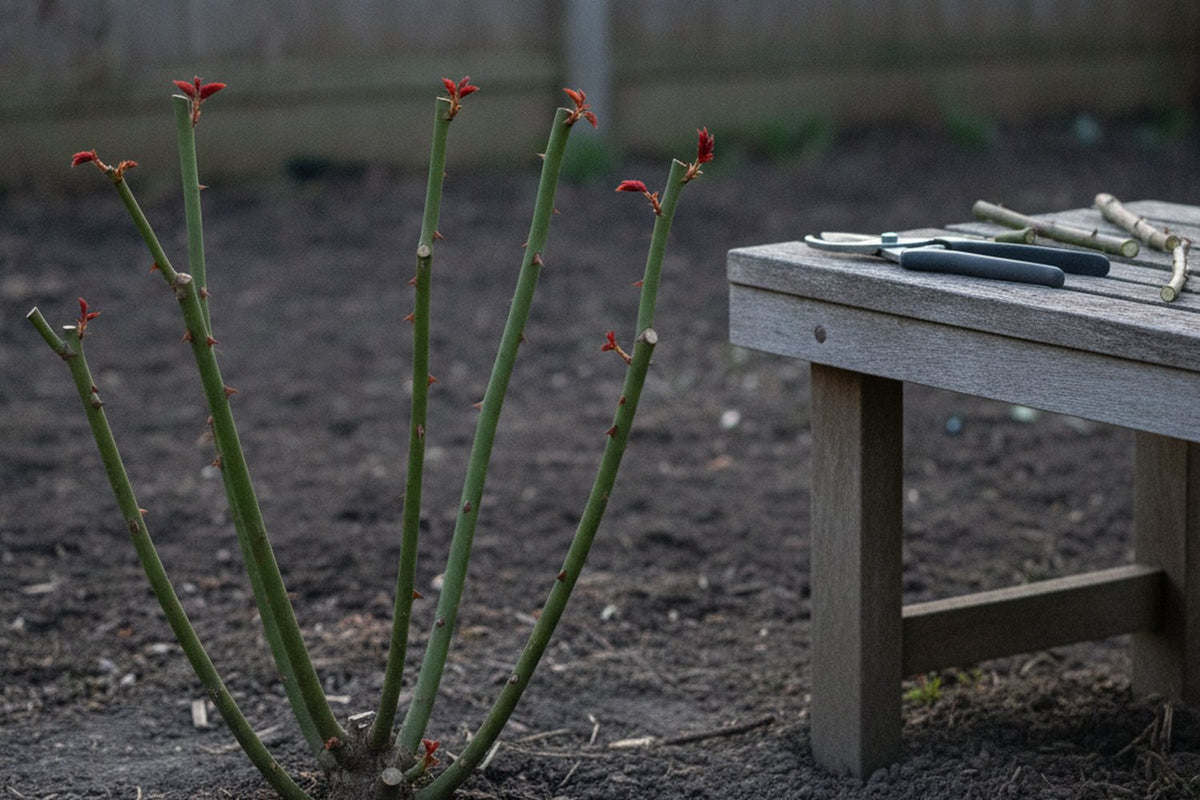
Here is how to prune roses, from the American Rose Society and university extension guides: cut out dead, diseased and damaged wood, open the center, then cut each cane at about 45 degrees, 1/4 inch above an outward-facing bud. Clemson Extension prunes repeat bloomers in spring, as the buds break dormancy, and once-bloomers right after flowering. The Society calls for scissor-type shears, not anvil; our pick is the Felco F-2.
The tools for the job
1. Felco F-2 pruning shears
Bypass pruners with a 0.98 inch stated cut and replaceable parts.
| Pick | Max cut | Weight | Best for | Our verdict | Where to buy |
|---|---|---|---|---|---|
| 1. Felco F-2Best pruning shears overall | 0.98 in | 0.55 lb | Cuts to 3/4 inch, large hands | Bypass pruners sized for large hands, with a 0.98 inch stated cut and replaceable parts. | Check price on Amazon |
| 2. Fiskars 18 inch PowerGear2Loppers for thick canes | 1.5 in | 2.25 lb | Canes past 3/4 inch | Bypass loppers in the 18 inch size, listed for branches up to 1.5 inches thick, with a leverage gear. | Check price on Amazon |
| 3. Corona RazorTOOTH 7 inchFolding saw for old canes | 3 in | 0.5 lb | Old canes at the base | A folding saw with a 7 inch curved blade that Corona says cuts branches up to 3 inches across. | Check price on Amazon |
| 4. Wells Lamont RosetenderRose gloves with a long cuff | No blade | Not stated | Thorny canes | Women's grain leather rose gloves with a long gauntlet cuff. | Check price on Amazon |
| 5. Felco F-6Pruning shears for medium hands | 0.79 in | 0.48 lb | Cuts to 3/4 inch, medium hands | The medium-hand Felco, with a 0.79 inch stated cut. | Check price on Amazon |
When we checked on November 21, 2026, every tool we link was in stock as new and sold by Amazon. How our guides are made sets out what we check.
Use the Felco F-2 for every cut up to about 3/4 inch: Oregon State Extension says bypass pruners will cut a woody stem up to three-quarters of an inch thick, and not to try to exceed their capability, as you may damage both the tool and the plant. Felco's page gives the F-2 a 0.98 inch cutting diameter, sizes it for large hands and lists replaceable components. Reviewed names it its best overall of the 10 pruning shears it tested, and Bob Vila, which calls it the best bypass pruning shear it has tested, says it weighs just half a pound yet slices through branches almost an inch thick. Our best pruning shears guide also names it best overall. Good to know: Reviewed says its 1 inch capacity depends on your hand strength; in its dowel round, only one of the 10 pairs, another brand's, got through the one-inch hardwood dowel, and that after repeated attempts, and the half-inch dowel was a several-cut job with severe pressure for every pair. Reviewed also found the F-2's action can feel a little sticky on soft canes, and its lock easy to close with your thumb but hard to reopen one-handed.
2. Fiskars 18 inch PowerGear2: loppers for thick canes
Best for: Canes past 3/4 inch
Bypass loppers in the 18 inch size, listed for branches up to 1.5 inches thick, with a leverage gear.
Reach for the Fiskars 18 inch PowerGear2 when a cane is past the pruners. Iowa State Extension uses hand shears on canes up to 3/4 inch in diameter and lopping shears on larger canes and difficult-to-reach places, and the American Rose Society says lopping shears with 18 inch handles cut large diameter canes without placing too much pressure on your hands. This is Fiskars' 18 inch size: its listing gives a bypass lopper for branches up to 1.5 inches thick and PowerGear2 gearing it says multiplies leverage, at 2.25 pounds. Our best loppers guide calls it its best compact loppers for tight shrubs. Good to know: Fiskars' listing states no blade length for it, and the PowerGear2 that Outdoor Life names its best for big branches is the 32 inch size, whose arms, Outdoor Life says, open nearly 180 degrees, which makes it hard to get into tight spaces near its maximum cut.
3. Corona RazorTOOTH 7 inch: folding saw for old canes
Best for: Old canes at the base
A folding saw with a 7 inch curved blade that Corona says cuts branches up to 3 inches across.
Use the Corona RazorTOOTH 7 inch for old, woody canes at the base. The American Rose Society says a pruning saw from Corona allows flush removal of large woody canes at the bud union (it names the brand, not a model), and that attempts to use pruning shears for these jobs usually result in damage to the bud union. This is Corona's 7 inch folding saw: Corona's page gives a curved blade that cuts branches up to 3 inches in diameter and a handle that covers the teeth when folded. Our best pruning saw guide covers it among five saws. Good to know: Corona calls it ideal for light tree trimming and landscaping, and its page states no weight, so the 0.5 pounds in the table is the listing's.
4. Wells Lamont Rosetender: rose gloves with a long cuff
Best for: Thorny canes
Women's grain leather rose gloves with a long gauntlet cuff.
The Wells Lamont Rosetender gauntlets are the long rose gloves the sources describe. The American Rose Society calls for a good strong pair of thick leather gloves that are puncture proof, and Iowa State Extension says rose gloves are longer, covering the forearm and providing additional protection from thorns. Wells Lamont's page gives these a puncture-resistant grain leather palm, a reinforced palm, fingers and fingertips, stretch-fit spandex and a long gauntlet cuff for forearm protection against thorns and brush. Good to know: Wells Lamont makes them as women's gloves in small, medium and large, and the link is the medium. Our best gardening gloves guide covers gloves by job, rose gauntlets among them.
5. Felco F-6: pruning shears for medium hands
Best for: Cuts to 3/4 inch, medium hands
The medium-hand Felco, with a 0.79 inch stated cut.
The Felco F-6 is the same idea for smaller hands. Felco's page designs it for medium-sized hands, where the F-2 is sized for large ones, and gives it a 0.79 inch cutting diameter, a 7.68 inch length and 0.48 pounds. Reviewed says Felco pruners come in a variety of sizes, so if you have big hands or tiny fingers you can find a pair that feels natural, and Oregon State says cutting tools should fit your hand and not be too heavy. Good to know: its 0.79 inch is just over Oregon State's 3/4 inch line, and Iowa State uses lopping shears on larger canes; its listing gives 0.46 pounds in its features and 0.1 in its item weight, so the table uses Felco's 0.48.
Which tool for which cane?
Iowa State Extension's line is 3/4 inch: hand shears below it, lopping shears above it, and the American Rose Society saws old woody canes off at the bud union. The table sets each cutting tool's stated maximum cut against that 3/4 inch line, and its blade length against its weight.
| Tool | Max cut vs 3/4 in | Blade in per oz | Max cut (in) | Blade (in) | Weight (lb) |
|---|---|---|---|---|---|
| Felco F-2 | 1.31 times | 0.25 | 0.98 (maker) | 2.17 (maker) | 0.55 (maker) |
| Fiskars 18 inch PowerGear2 | 2.00 times | Not stated | 1.5 (listing) | Not stated | 2.25 (listing) |
| Corona RazorTOOTH 7 inch | 4.00 times | 0.88 | 3 (maker) | 7 (maker) | 0.5 (listing) |
| Felco F-6 | 1.05 times | 0.21 | 0.79 (maker) | 1.65 (maker) | 0.48 (maker) |
Max cut vs 3/4 in is the stated maximum cut divided by 0.75; blade inches per ounce is the blade length divided by the weight in ounces (pounds times 16). So the saw reaches 4 times the hand-shear line and carries the most blade for its weight, 0.88 inch per ounce, while the F-2's 0.98 inch is 1.31 times the line, which Reviewed's note above puts in context. Fiskars' listing states no blade length for the loppers, so that cell says not stated. The gloves have no cutting figures, so they are not in this table.
What the sources say about clean, sharp blades
Oregon State Extension says to sanitize your pruners by dipping the blades into rubbing alcohol (70% isopropyl alcohol) or using a disinfectant spray before working on each plant, to help prevent the spread of plant disease, and Clemson Extension says to dip your pruning shears periodically in a 70 percent alcohol solution to avoid spreading diseases. Iowa State says dull tools tend to crush the canes, and that clean, sterile tools help prevent the unintentional transfer of disease pathogens like viruses. The RHS says cuts must be clean, so keep your secateurs sharp, and for larger stems, use loppers or a pruning saw.
When to prune roses
It depends on how the rose blooms. Clemson Extension says repeat bloomers such as floribunda and hybrid tea roses need a heavy annual pruning in spring, and that old-fashioned roses and climbers that bloom only once a year should be pruned immediately after flowering, since they bloom on wood from the previous year's growth. Dead, diseased or damaged wood on any rose, it says, should be removed as soon as it is seen.
| Rose type | When | Source |
|---|---|---|
| Hybrid tea, floribunda, grandiflora | Early spring, as the buds swell | Clemson |
| Shrub and landscape roses | Spring, just as buds begin to break | Iowa State |
| Repeat-blooming climbers | Early spring | Illinois |
| Ramblers | Right after flowering, early summer | Illinois |
| Once-blooming old garden roses | After flowering | Illinois |
| Miniature roses | Very hard in early spring (Illinois), or lightly, several times a year (Clemson) | Illinois, Clemson |
When to prune roses by climate
The spring date moves with your winter. Clemson Extension gives mid to late February near the South Carolina coast to mid-April in the mountains, and says the best way to judge is to look at the buds: when they begin to swell, go ahead and prune. Oregon State prunes from mid-February to early March in the Willamette Valley, and says pruning before the last hard frost may cause die-back that needs repruning, and that the later you prune, the later your first bloom flush. Iowa State prunes out dead wood on modern roses after the winter protection comes off, in late March to mid-April. In Marin County, California, UC Marin Master Gardeners prune between mid-January and mid-February. Illinois Extension says many rose growers wait until the forsythias start to bloom as the signal to begin.
How to prune roses, step by step
- Gloves and sleeves. The American Rose Society calls for a good strong pair of thick leather gloves that are puncture proof. UC Marin Master Gardeners say to wear long protective sleeves and gloves with gauntlets to cover your forearms, then to sit or get down on your knees to look at the bud union and the canes that come from it.
- Take out dead, diseased and damaged wood. Cut back to healthy tissue, which the American Rose Society says shows green bark outside and a white pith core once cut. Iowa State says to cut at least 1 inch below the dead, brown areas, and to remove the entire cane if there is no sign of life.
- Remove crossing canes and open the center. Oregon State says crossing or rubbing canes promote damage that encourages disease. The American Rose Society aims for canes that come from the bud union like the spokes of a wheel, for air circulation that helps prevent powdery mildew.
- Thin out weak growth. Illinois Extension removes all thin, weak canes smaller than a pencil in diameter; the American Rose Society says hybrid tea blooms need a stem about pencil thickness or greater.
- Choose the canes to keep, then cut them back. For hybrid teas, grandifloras and floribundas, Illinois Extension leaves 3 to 5 healthy, stout canes evenly spaced around the plant, each cut back to leave 3 to 5 outward-facing buds. The other types are below.
- Make each cut above a bud. Illinois Extension cuts at a 45 degree angle about 1/4 inch above an outward-facing bud, slanting away from the bud (more on the cut below).
- Remove suckers. On grafted roses, Illinois Extension says to dig down to the root where the sucker starts and tear it off, because cutting suckers off only encourages several to regrow where there was one; the RHS likewise says to trace suckers back to the roots and pull them away.
- Clean up. The American Rose Society removes any foliage left on the canes after pruning and cleans up around the bush, discarding all foliage as trash; UC Marin Master Gardeners say fungal spores like blackspot can overwinter on old leaves left on the bush. Oregon State sanitizes the blades before each plant (above).
How to prune each type of rose
Hybrid tea, floribunda and grandiflora roses
These take the hardest pruning. Illinois Extension says they produce the best flowers on new wood, so they are pruned very hard in early spring, usually removing about one-half to two-thirds of the plant's height. Oregon State keeps three to six strong canes from the previous year's growth and cuts them to 12 to 18 inches for hybrid teas and grandifloras and 24 to 26 inches for floribundas (its summary of floribundas says 24 to 36). Clemson Extension keeps three to five canes at 15 to 18 inches, and says pruning hard gives large blooms suitable for cut flowers but fewer of them. Iowa State says hybrid teas, grandifloras and floribundas often suffer heavy winter damage in Iowa, so the primary objective in the upper Midwest is to remove all dead wood and save as much of the live tissue as possible; after a mild winter with minor damage, it cuts the canes back to within 8 to 12 inches of the ground.
Shrub roses, including Knock Out roses
Illinois Extension says repeat-flowering shrub roses can be left unpruned for their first two or three seasons, then pruned by the one-third method: each spring, remove one-third of the very oldest canes. Purdue says heavy pruning may destroy their natural beauty and limits it to dead or damaged wood and thinning. For Knock Out roses, the Knock Out roses pruning page says to cut them back once a year to 12 inches high, in late winter or early spring when new shoots start growing from the canes, to keep a size of 3 to 4 feet wide and tall, and lists gloves, hedge shears and hand pruners.
Climbing roses
Illinois Extension says climbers may need a few seasons in the garden before pruning is necessary, that repeat-blooming climbers are pruned in early spring, and that shortening the side shoots, or laterals, to 3 to 6 inches stimulates flower production. Oregon State trims each lateral to three to five buds, then reties the main cane as horizontally as possible to encourage flowers on the laterals. Clemson Extension says that on large, tangled climbers, it is easier to remove most stems in sections, and to be careful not to damage healthy stems.
Ramblers and once-blooming old garden roses
Illinois Extension says ramblers are pruned right after flowering in early summer, and that old once-blooming roses such as Alba, Gallica, Centifolia, Damask and Moss roses produce flowers on old wood, so all pruning waits until after flowering. Clemson Extension removes no more than one-third of an old garden rose, generally only the oldest stems, and leaves some hips for fall and winter color; on once-blooming climbers it keeps five to seven strong canes untouched, since the stems you leave bear next year's flowers.
Miniature roses
The sources split. Illinois Extension groups miniatures with hybrid teas, grandifloras and floribundas, which it prunes very hard in early spring; Clemson Extension says everblooming miniatures can be lightly trimmed or tip-pruned several times a year, as they flower on new growth, and the American Rose Society says there are smaller versions of pruning shears, with a smaller blade surface, for miniature roses.
Where to cut and how much to remove
The American Rose Society's cut is about 45 degrees, about 1/4 inch above a dormant eye, sloping down and away from it, so the sap that rises to seal the cut runs down the far side of the cane and not over the developing eye. Where no leaves remain to guide you, it says to find the eye where a leaf was once attached: a slight swelling on the cane. Clemson Extension cuts above a bud facing out from the center, since new growth comes from the bud just below a cut; Oregon State says cutting to an outward bud keeps the middle open for air, which can help reduce disease. The RHS adds that on roses with a spreading habit, some stems can go to inward-facing buds for more upright growth, and UC Marin Master Gardeners say roses are very forgiving: a cut a little too low, too high or to an inward bud is ultimately not going to make a big difference.
How much to take depends on the type: about one-half to two-thirds of the height on hybrid teas (Illinois), about one-third to one-half of the volume (UC Marin), one-third of the oldest canes on shrub roses (Illinois) and no more than one-third of an old garden rose (Clemson). On canes thicker than a pencil, Clemson Extension seals the cuts with nail polish or wood glue to keep cane borers out; Illinois Extension suggests sealing only if cane borers are a problem.
On newly planted roses, the sources split: UC Marin Master Gardeners say not to prune newly planted roses, Clemson Extension prunes first-year plants lightly, and the RHS prunes newly planted roses hard, except climbing and shrub roses.
Deadheading vs pruning
Deadheading is the summer cut: Illinois Extension calls it removing faded flowers before they can develop seed, a form of summer or day-to-day pruning, and says the standard recommendation is to cut the flower stem back to an outward-facing bud above a five-leaflet or seven-leaflet leaf. Iowa State keeps at least two 5-leaflet leaves on each shoot and cuts about 1/4 inch above the leaf. Both set a stop date: Iowa State stops deadheading hybrid teas, grandifloras and floribundas in late August or September, and Illinois says not to cut flowers after October 1, so the plant can begin hardening off for winter. On rugosa and other shrub roses grown for their hips, Illinois says to clean the spent blooms away by hand and leave the hips.
Rose pruning mistakes to avoid
- Pruning too little. Oregon State calls underpruning the most common cause of an unproductive rose, and says neglected roses can easily be rejuvenated by pruning.
- Pruning once-bloomers in winter. UC Marin Master Gardeners say not to prune roses that bloom only once during winter, or you will be cutting off next spring's flowers.
- Pruning too early. Oregon State says pruning before the last hard frost may cause die-back that needs repruning.
- Anvil pruners. Clemson Extension says anvil pruners tend to crush the stems, and bypass pruners, which cut like a pair of scissors, are much better for roses.
- Forcing the shears. Oregon State says not to try to exceed bypass pruners' capability, as you may damage both the tool and the plant, and the American Rose Society says pruning shears on large woody canes at the bud union usually damage the bud union.
How we picked these tools
We built the tool list from the American Rose Society's equipment list and the pruning guides of Clemson, Illinois, Iowa State, Oregon State and Purdue extension, UC Marin Master Gardeners, the RHS and the Knock Out roses pruning page, compared each cutting tool's maker page or listing for its maximum cut, blade length and weight, took the testers' findings from Reviewed, Bob Vila and Outdoor Life, checked every pick against its Amazon listing and the CPSC recall database (none of the five models was listed when we checked on November 20, 2026), and worked out each cutting tool's maximum cut against the 3/4 inch hand-pruner line, and its blade length per ounce where both figures are stated, from the makers' and listings' own figures. We make digging spades, not pruning tools, so nothing on this page is ours. How our guides are made sets out the full process.
Also considered
Each was checked on November 20, 2026.
- Fiskars PowerGear2 32 inch loppers. In stock and sold by Amazon, and Outdoor Life's best for big branches, with arms that open nearly 180 degrees; the American Rose Society's loppers for rose canes have 18 inch handles, so the 18 inch size is the pick here.
- Corona FL 3470 telescoping loppers. In short supply on Amazon when we checked.
- Silky PocketBoy 170 folding saw. Not yet shipping on Amazon, and its offer was from a third-party seller, not Amazon.
- Fiskars bypass pruning shears and Fiskars Micro-Tip pruning snips. Both in stock and sold by Amazon; our best pruning shears guide covers both.
- Other rose gloves in our search. The other eight rose glove listings our search returned, from HANDLANDY, SLARMOR, WOHEER, GLOSAV, Craft911 and SAWIDIER, were each sold by a third-party seller, not by Amazon, when we checked.
Frequently asked questions
When is the best time to prune roses?
For repeat bloomers, spring as the buds begin to swell, by Clemson Extension; for roses that bloom once a year, right after they flower. The spring date runs from mid-January to mid-February in Marin County, California (UC Marin Master Gardeners), through mid to late February on the South Carolina coast (Clemson), to late March to mid-April in Iowa (Iowa State).
How far back do you cut roses?
It depends on the type. Illinois Extension removes about one-half to two-thirds of a hybrid tea's height, and Oregon State cuts the canes it keeps to 12 to 18 inches; the Knock Out roses pruning page says to cut Knock Out roses to 12 inches once a year; Clemson Extension takes no more than one-third of an old garden rose.
Should you cut roses back in the fall?
The sources split. Iowa State says not to prune roses in the fall, because pruning stimulates new growth that will not be able to properly harden off before winter. Clemson Extension, in South Carolina, cuts roses back by about one-third of their height in late fall to help prevent canes breaking in winter winds, and Oregon State takes several inches off hybrid teas, floribundas and grandifloras to reduce winter wind damage.
Where do you cut a rose after it blooms?
Illinois Extension cuts the flower stem back to an outward-facing bud above a five-leaflet or seven-leaflet leaf, and Iowa State cuts about 1/4 inch above the leaf, keeping at least two 5-leaflet leaves on each shoot.
What happens if you don't prune roses?
Oregon State Extension says underpruning is the most common cause of an unproductive rose, and that if pruned improperly, plants will have weak canes, poor form and little air circulation; neglected roses, it adds, can easily be rejuvenated by pruning.
What tools do you need to prune roses?
Clemson Extension lists sharp pruning shears, long-handled lopping shears and a pruning saw for any large, heavy, old stems, says bypass pruners are much better for roses than anvil pruners, and says leather gloves will help protect your hands. Our pick for the shears is the Felco F-2.
Disclosure: Some links pay us a commission when you click or buy, and on some pages brands pay us through Amazon's creator program on links to their products.
Product prices and availability are accurate as of the date/time indicated and are subject to change. Any price and availability information displayed on Amazon.com at the time of purchase will apply to the purchase of this product.