As an Amazon Associate we earn from qualifying purchases. Some brands also pay us when you click or buy, so those links are ads. Full disclosure below
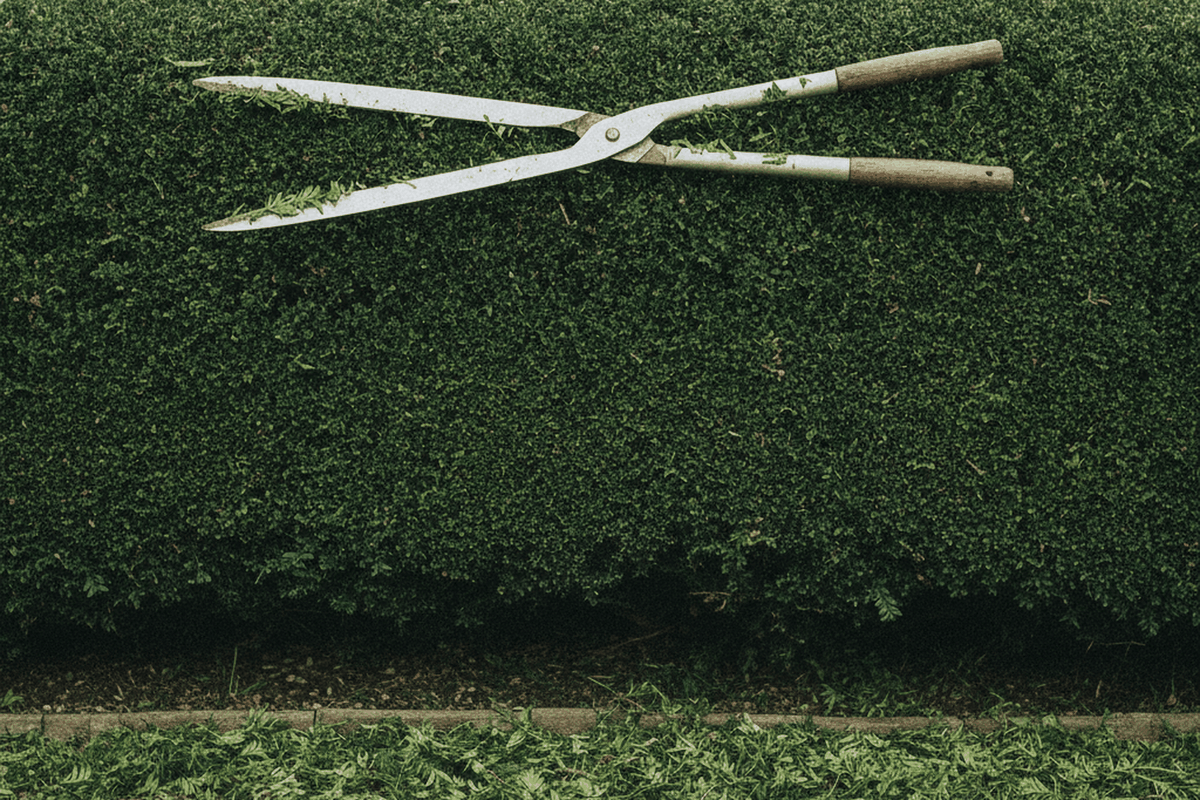
The best hedge shears for most gardeners are a 21 to 23 inch manual pair with sharp carbon steel blades and shock absorbing bumpers: quiet, precise, and fast enough for any hedge you can walk along. Tall hedges call for an extendable pair, topiary calls for short blades, and only long formal runs justify going electric.
Manual hedge shears are the tool electric trimmer ads want you to forget: no cord, no battery on a charger, no roar, and a cleaner cut on the green growth hedges are actually trimmed for. The differences between pairs come down to blade length, leverage, and how the shears treat your wrists at the end of a wall of boxwood. These are the seven best hedge shears, compared on their published specs and chosen by job. For long runs where shears stop making sense, our hedge trimmer picks cover cordless, corded and gas. Hedge shears are a two-handed tool for the green growth on a hedge, not a hand pruner for woody stems, so if that is the tool you are after, read our best pruning shears guide instead.
Our top picks
Best hedge shears overall
1. Fiskars 23" Power-Lever
Best for: Most hedges, most gardeners
Best hedge shears for tall hedges
2. Fiskars extendable
Best for: Tall hedges and deep reach
Best shears for topiary and shaping
3. Garden Guru
Best for: Topiary, boxwood, and shaping
Best hedge shears at a glance
| Shears | Best for | Blades | Where to buy |
|---|---|---|---|
| Fiskars 23" Power-Lever (best overall) | Most hedges, most gardeners | Self-sharpening steel, lever pivot | Check price on Amazon |
| Fiskars 25" to 33" extendable | Tall hedges and deep reach | 10 inch blades, telescoping handles | Check price on Amazon |
| Garden Guru shears | Topiary, boxwood, and shaping | Shaping-oriented shears for borders and shrubs | Check price on Amazon |
| Bahco BAHP51H-SL professional | Long runs and thicker stems | Hardened steel, partly serrated | On backorder on Amazon on October 18, 2026 |
| GARTOL 23" wavy blade | Twiggy, brushy growth | Forged high carbon steel, 9 inch wavy | Check price on Amazon |
| Miracle-Gro 21" shears | Small hedges on a budget | Carbon steel, comfort grips | Check price on Amazon |
| ARS HS-KR1000 | Frequent trimming, blades you can renew | Treated steel, replaceable blades | Check price on Amazon |
Hedge shears compared: length, blade type, capacity, and replaceable parts
| Shears | Blade length | Blade type | Cutting capacity (listing) | Replaceable parts (listing) | Weight class | Best for |
|---|---|---|---|---|---|---|
| 1. Fiskars 23" Power-Lever | 23 in overall | Self-sharpening steel, lever pivot | not stated | not stated | Medium | Most hedges, most gardeners |
| 2. Fiskars 25" to 33" extendable | 10 in blades, 25 to 33 in reach | Self-sharpening steel, low friction coating | not stated | not stated | Medium, heavier when extended | Tall and wide hedges |
| 3. Garden Guru shears | 15 in tool | Shaping blades for borders and shrubs | not stated | not stated | Light | Topiary, boxwood, shaping |
| 4. Bahco BAHP51H-SL | 28.7 in overall | Hardened steel, partly serrated | 3/8 in | not stated | Light for its size, aluminum handles | Long runs and thicker stems |
| 5. GARTOL 23" wavy blade | 9 in blades, 23 in tool | Forged high carbon steel, wavy | not stated | not stated | Medium | Twiggy, brushy growth |
| 6. Miracle-Gro 21" shears | 21 in overall | Carbon steel, comfort grips | not stated | not stated | Light | Small hedges on a budget |
| 7. ARS HS-KR1000 | not stated | Treated steel, adjustable pivot bolt | not stated | Replaceable blades | not stated | Frequent trimming, renewable blades |
Weight class is relative within this list and follows handle material and length, not a scale reading. Blade length is the cutting edge where the maker publishes it and the overall tool length where it does not. Cutting capacity and replaceable parts come from each Amazon listing, and "not stated" means the listing is silent, not that the shears lack it: only the Bahco listing gives a capacity, and only the ARS listing names replaceable blades.
How we chose
We compared these seven pairs on their published specs and chose them by job: blade length, blade type, the pivot and the handles, plus the cutting capacity and replaceable parts each Amazon listing states. Where a listing is silent, the table above says "not stated" rather than guessing. The when to trim table and the advice on which hedges want pruners instead of shears follow University of Maryland Extension guidance.
What are the best hedge shears?
The Fiskars 23 inch Power-Lever hedge shears are our best overall because they solve the two things that make people quit manual shears: effort and upkeep. The lever pivot multiplies your squeeze where the cut is thickest, and the self-sharpening blade design maintains the edge as you work, so the tool stays a pleasure past its first season. At 23 inches they are long enough to cut flat planes and short enough to control.
Are hedge clippers and manual hedge trimmers the same as hedge shears?
Yes. Hedge clippers and manual hedge trimmers are other names for hedge shears: two long blades on two handles, squeezed with both hands to cut soft green growth across the face of a hedge. Two of the listings here use both names, the Garden Guru and the GARTOL, so the best hedge clippers are the same pairs as the best hedge shears, led by the Fiskars 23 inch Power-Lever. A hedge trimmer without the word manual is the powered tool, a bar of reciprocating teeth, compared further down this page.
The best hedge shears, by job
1. Fiskars 23" Power-Lever: best hedge shears overall
For the standard case, a walkable hedge trimmed a few times a season, the Power-Lever pair gets the mechanics right: leverage at the pivot so the hundredth cut costs what the first did, blades that keep their own edge, and a length that balances plane-flattening reach against wrist control. Where they lose: above shoulder height and deep into wide hedges, which is exactly what the extendable pair below is for.
2. Fiskars extendable: best hedge shears for tall hedges
The Fiskars extendable shears telescope from 25 to 33 inches with 10 inch blades, which converts into the two kinds of reach a hedge demands: height without a ladder for the top of a six footer, and depth across a wide hedge to keep the plane flat instead of scalloped. Extended, physics collects its fee, since the same cut takes more effort at arm's length. Set the length to the job and they replace both a step stool and a second pair.
3. Garden Guru: best shears for topiary and shaping
Shaping is a different discipline from flattening. The Garden Guru shears are built for exactly the trimming-and-shaping duty their design targets: borders, boxwood, and decorative shrubs, where you sculpt curves and tight forms rather than mow a wall. Shorter, more controllable cutting suits detail work the way a long blade never can. If your hedge trimming is really shrub sculpting, start here.
4. Bahco BAHP51H-SL: best hedge shears for long runs and thicker stems
A hedge you trim every few weeks is a different job from a hedge you trim twice a year. The Bahco BAHP51H-SL professional hedge shears are built for the first case. They run 28.7 inches overall on tubular aluminum handles, the blades are fully hardened and precision ground, and the rated cut capacity is 3/8 inch, which is the top of what any hedge shear should be asked to take.
The length is the quiet advantage. Fixed handles that long give you the reach of a short extendable pair with none of the flex a telescoping joint adds, so the plane you cut across the top of a hedge stays flat instead of wandering. A partly serrated section on the blade grips stems rather than pushing them along the edge, which is what you want on the thicker growth at the base of an old hedge. Rubber buffers between the handles take the closing jolt out of every cut, and the aluminum keeps the whole tool light enough to hold at chest height for an hour.
Where it loses: price and specialization. It costs far more than the budget pair below, and a gardener with two porch boxwoods will never feel the difference. The handles are also fixed, so a genuinely tall hedge still belongs to the extendable pair at number two.
The Bahco was on backorder on Amazon when we checked on October 18, 2026, and no other Amazon listing we found matches the pair described above, so we do not link it for now. Until it is back, the ARS HS-KR1000 at number seven is the professional pair here for a hedge you trim often.
5. GARTOL 23" wavy blade: best hedge shears for twiggy, brushy growth
Wavy blades solve one specific problem: thin, whippy stems slide along a straight edge instead of getting cut. The GARTOL 23 inch wavy blade shears put a 9 inch wavy grind on forged high carbon steel, and the waves trap twigs at the point of the cut so brushy privet and overgrown boxwood stop sliding out of the blades. That is a cheap fix for a job the straight edged pairs above handle less cleanly.
The rest of the build is more considered than the price suggests. The blades carry a low friction, rust resistant coating that keeps sap from gumming the edge, shock absorbing bumpers sit between the handles, and a flower shaped pivot bolt lets you tighten the blades for thin, delicate growth or loosen them for dense hedge branches. The grips are anti-slip, which matters more than it sounds when your hands are damp with sap.
Where it loses: wavy edges are harder to sharpen than straight ones, because you are chasing a curve instead of running a file down a flat bevel. On a dense formal hedge a straight edge also leaves the cleaner face. If your hedge is a tight wall of yew rather than a loose tangle, pick number one instead.
6. Miracle-Gro 21": best budget hedge shears
A small hedge does not need a premium tool; it needs a sharp one. The Miracle-Gro 21 inch shears bring sharp carbon steel blades and comfort grips at the entry price, enough shear for a pair of porch boxwoods and a short run of privet. What the budget buys out: no leverage-multiplying pivot, so a long session works your forearms harder, and carbon steel wants a wipe of oil to keep rust off.
7. ARS HS-KR1000: best hedge shears with replaceable blades
Of the seven pairs here, the ARS HS-KR1000 professional hedge shears are the only ones whose listing names replaceable blades, so worn blades can be swapped instead of buying a whole new tool. This is ARS's professional hedge shear, which the listing describes as built for continued professional use, with treated steel and long lasting sharpness, a pivot bolt for blade adjustments, and a shape and balance the listing says is built for continued use.
Choose them when you trim often: a formal hedge sheared two or three times a season, or a yard of shaped shrubs. That is the owner who wears out blades, and the one who gains most from renewing them.
Where it loses: the listing publishes no blade length, weight or cutting capacity, so size it against the pairs above by what it does state, and treat it as a shear for soft growth like any other here. An adjustable pivot is also one you have to keep adjusted, so check the bolt before each season.
What are the best shears for bushes and shrubs?
For shaping bushes and shrubs, start with the Garden Guru: a 15 inch tool built for borders, boxwood and decorative shrubs, where you sculpt curves and tight forms rather than flatten a wall. For a couple of small bushes by the door, the Miracle-Gro 21 inch pair is enough shear. A long, flat run of shrubs trimmed as a hedge goes back to the Fiskars 23 inch Power-Lever, and a tall one to the Fiskars extendable. The exception is a shrub with large leaves, such as cherry laurel or a large-leaved holly: prune it with hand pruners, because shears damage big leaves, which then brown.
How to choose hedge shears
- Blade length trades flatness for control. Longer blades cut flatter planes on big hedges; shorter blades steer better on shapes and small shrubs.
- Leverage features earn their price. A geared or lever pivot at the joint is the difference between finishing a long hedge and finishing half of it.
- Wavy versus straight edges: a wavy, serrated grind holds stems in place mid-cut so they cannot slide out along the blade; straight edges are simpler to sharpen. Neither is wrong; wavy favors twiggy hedges.
- Bumpers matter at cut five hundred. Shock absorbing stops between the handles save your wrists from the closing jolt of every cut.
- Manual beats electric for small and medium hedges, precision shaping, quiet, and zero maintenance; electric earns its noise only on long formal runs cut on a schedule.
- Care is five minutes: wipe off sap, oil the blades, and sharpen the existing factory bevel only. Sticky blades ruin more shears than dull ones.
When to trim, by hedge
The right month depends on the hedge, and so does the right tool. This table follows University of Maryland Extension guidance on pruning shrubs and hedges, plus its boxwood, cherry laurel and privet pages. Its dates are written for a mid-Atlantic garden, so shift them for your climate. One rule covers every hedge in it: do not prune in fall, generally August to late October, because the new growth it forces will not harden off before winter.
| Hedge | When to trim | Shears or pruners | What UMD Extension notes |
|---|---|---|---|
| Boxwood | Thin in winter, December through February | Shears for topiary and tight shapes only; thinning cuts otherwise | Thinning is its preferred method; regular shearing makes foliage dense enough to encourage Macrophoma leaf spot and Volutella canker |
| Privet | During the growing season, finished before the August cutoff; a formal hedge is sheared one or more times a year | Hedge shears | Lists every privet species found in Maryland as invasive and advises against planting it |
| Yew | Spring or summer | Shears for the faces; pruners or loppers to cut back | One of the few evergreens that can be headed back into older wood |
| Laurel (cherry laurel) | Early spring, around March; new growth after flowering around June | Hand pruners, not shears | Advises against shearing it, which leaves dense outer foliage over bare branches; shears also damage large leaves, which then brown |
| Holly | Hard cuts in early spring; a winter trim is fine if you want the branches for holiday greens | Pruners on large-leaved hollies; shears only on small-leaved types | Severe pruning of evergreens belongs in early spring |
Read down the tool column and a pattern shows: hedge shears are the right tool on small-leaved, formal hedges, and hand pruners are the right tool on large-leaved ones. UMD Extension's own rule is that small-leaved plants such as boxwood can be clipped with shears, while large leaves should be pruned with pruners. Buy shears for the hedge you actually have.
Hedge shears vs pruning shears vs loppers
Three cutting tools, three jobs, and the split is by what you are cutting rather than by the plant.
- Hedge shears are two long blades worked with both hands, for shearing soft green growth across a surface: the top and faces of a formal hedge, or a topiary shape. Capacity is small; the one pair here with a published figure, the Bahco, is rated to 3/8 inch.
- Pruning shears are one-handed and make single cuts on individual stems: the thinning cuts boxwood wants, and the hand pruning laurel wants instead of shearing. Our best pruning shears guide ranks them.
- Loppers are long-handled, two-handed cutters for branches too thick for pruners, including the old stems you take out at the base of an overgrown hedge. See our best loppers for bypass, anvil and ratchet picks.
- A pruning saw takes over where loppers stop, on old, thick wood; our best pruning saws guide covers folding and fixed blades.
Most hedges need more than one of them over a year. UMD Extension recommends cutting out a third to a quarter of the oldest branches near the ground each year, before new growth starts in spring, with hand pruners, loppers or a pruning saw, and keeping the shears for the shape. For limbs above the hedge that you cannot reach from the ground, our best pole saws guide picks a pole saw or a pole pruner by job.
Hedge shears vs hedge trimmer
Hedge shears are manual, two handed blades you squeeze; a hedge trimmer is a powered bar of reciprocating teeth. Shears win on precision, quiet, and clean cuts on small and medium hedges. Trimmers win on speed across long formal runs. Most home gardens are shear jobs, and plenty of gardeners own both.

Reach for shears when the work is shaping. A manual pair cuts one squeeze at a time, so you can stop at a leaf, follow a curve, and see the plane you are cutting before you commit to it. Green growth up to about a quarter to half an inch comes off cleanly, there is no cord to route around a shrub, no battery on a charger, and nothing to hear but the blades. Shears also go in the shed dirty and come out working.
Reach for a trimmer when the work is footage. A hundred feet of formal privet cut three or four times a season punishes wrists, and a powered bar gets through it in a fraction of the time. The trade is a rougher cut, torn leaf edges that brown at the tips, real weight to hold at shoulder height, and a machine to maintain. Gardeners with long hedges often rough the faces in with a trimmer and finish the corners and the top edge with shears.
How to sharpen hedge shears
Sharpen hedge shears on the beveled side only, following the angle already on the blade. Clean the sap off, brace one blade, and draw a mill file or diamond stone along the bevel in one direction until a light burr forms along the edge. Wipe the burr off the flat back, oil the pivot, and stop there.
- Clean before you file. Dried sap reads as dullness far more often than a worn edge does. Mineral spirits or a scouring pad takes it off in a minute.
- Match the existing angle. Copy the bevel the maker ground rather than picking a new one; changing the angle is how a good edge gets ruined.
- File in one direction. Push from the pivot toward the tip along the bevel. Working back and forth rolls the edge over instead of cutting it.
- Leave the flat back alone except for a couple of light passes to knock the burr off once it forms.
- Wavy blades need a round file or a slim rod that fits the curve, worked wave by wave rather than in one long stroke.
- Finish with oil on the blades and a drop on the pivot bolt, then check the pivot tension before the shears go back on the hook.
Frequently asked questions
What is the difference between garden shears and hedge shears?
Garden shears is a loose name that most often means one-handed pruning shears, which make single cuts on individual stems. Hedge shears are two-handed, with long blades that cut many soft stems at once across the face of a hedge. Use pruning shears for thinning and for large-leaved shrubs, and hedge shears for shaping small-leaved, formal hedges.
What are hedge shears used for?
Hedge shears cut soft green growth across the surface of a hedge or shrub: flattening the top and faces of a formal hedge such as privet or yew, shaping boxwood and topiary, and tidying other small-leaved shrubs. They are not for branches, which belong to loppers or a pruning saw, and large-leaved shrubs such as laurel are better pruned by hand, since shears damage big leaves.
Which hedge shears are best?
For most hedges, the Fiskars 23 inch Power-Lever: its compound lever pivot and self-sharpening blades suit a hedge trimmed a few times a season. Pick the Fiskars 25 to 33 inch extendable pair for tall hedges, the 15 inch Garden Guru for topiary, the GARTOL wavy blade for twiggy growth, the Bahco for long runs and thicker stems, and the ARS HS-KR1000 if you want blades you can replace.
Should I buy manual hedge shears or an electric trimmer?
Manual for small and medium hedges, shaping work, and anyone who values quiet: no battery, no cord, cleaner cuts, and better control. Electric earns its purchase on long formal runs trimmed several times a season, where the sheer footage justifies the noise, weight, and upkeep. Many gardeners with big hedges own both and reach for the manual pair more than they expected.
How thick a branch can hedge shears cut?
Soft green growth up to roughly a quarter to half an inch, which is what hedge trimming actually consists of. Anything thicker belongs to loppers or a pruning saw; forcing shears through a real branch is how blades bend and pivots loosen. Our best pruning shears guide covers the hand tools for woody stems.
Are wavy or straight hedge shear blades better?
Wavy edges grip stems mid-cut so twiggy growth cannot slide out along the blade, which makes them slightly faster on loose, brushy hedges. Straight edges are easier to sharpen and feel cleaner on dense formal hedges. It is a preference, not a verdict; blade sharpness matters far more than blade shape.
How do I keep hedge shears sharp?
Wipe the sap off after every session, oil the blades lightly, and touch up the factory bevel with a file or sharpener a couple of times a season, sharpening only the beveled side. Most shears that feel dull are actually gummed with dried sap, so clean first and you may not need the file at all.
What size hedge shears should I buy?
Match the blade to the hedge. A 21 to 23 inch pair suits most home hedges and stays controllable in one hand at the end of a run. Go longer, or extendable, only when you are cutting above shoulder height or reaching across a wide hedge. Short 15 inch shears are for shaping boxwood and topiary, not for flattening a wall of privet.
How often should hedges be trimmed?
Most formal hedges want two cuts a season, the first in early summer after the first flush of growth, with fast growers like privet asking for a third. Informal and flowering hedges get cut once, right after they bloom. University of Maryland Extension advises against pruning from August to late October, since the new growth it forces will not harden off before winter.
The bottom line
One pair of lever-pivot 23 inch shears handles most hedges most gardeners will ever trim. Add reach, a wavy blade, or a professional pair only when the hedge in front of you asks for it, and buy the budget pair without guilt if the hedge is two boxwoods by the door. For the branches shears cannot touch, our pruning shears and loppers guide takes over, and the whole shed is ranked in the essential garden tools list.
A word on who wrote this: we are Spear Head Spade, a family business in New Jersey. We sell double-patented spades and one long-handled hoe, with over 600,000 sold. Shears are not part of our own line, but keeping an edge is a shared problem, and our guide to cleaning, sharpening and storing garden tools is the one to read next. Our own spades are on the spade finder, five questions that match a spade to your height and your ground.
Disclosure: some links in this guide are affiliate links to Amazon. This is at no extra cost to you, and it never changes our honest recommendations.
Product prices and availability are accurate as of the date/time indicated and are subject to change. Any price and availability information displayed on Amazon.com at the time of purchase will apply to the purchase of this product.