As an Amazon Associate we earn from qualifying purchases. Some links are paid. Disclosure
Our top picks
Best for most cool-season lawns
1. Jonathan Green Black Beauty Ultra
Best for: New lawns and bare spots in full sun to partial shade
Best for sun and part shade
2. Scotts Turf Builder Sun and Shade Mix
Best for: A lawn with a sunny side and a shadier side
Best low-maintenance
3. Scotts Turf Builder Tall Fescue Mix
Best for: Less upkeep through heat and drought
The best grass seed for most cool-season lawns, the tall fescue, bluegrass and ryegrass lawns that do their growing in spring and fall, is Jonathan Green Black Beauty Ultra, linked here as two 7 pound bags. It is mostly tall fescue with Kentucky bluegrass and perennial ryegrass, and in Bob Vila's month-long test of eight grass seeds it was the second to sprout and was named the best cool-season seed. For a lawn with a sunny side and a shadier side, the pick is Scotts Turf Builder Sun and Shade Mix, which Bob Vila's roundup for the Northeast names its best overall. For less upkeep through heat and drought, Scotts Turf Builder Tall Fescue Mix was the best low-maintenance seed in Bob Vila's test. For a yard that kids and dogs wear down, Scotts Turf Builder High Traffic Mix was Bob Vila's pick for high traffic. And for a lawn in full sun, Scotts Turf Builder Sunny Mix is a bluegrass and ryegrass mix that was one of the quickest to come up in the same test.
This guide has five picks, all for cool-season lawns, with the figures worked out for seeding a new lawn. Warm-season lawns such as bermuda, zoysia and centipede get no pick here, and the warm-season section says what to do instead. Shady lawns have their own guide, best grass seed for shade, and thickening a lawn you already have is the job of best grass seed for overseeding. Below the picks, one table sets out what Bob Vila's test found, a second compares the lawn grasses on extension service figures, and a third works out how many bags a new lawn takes from each maker's own coverage.
Jump to: Test results | Cool-season or warm-season | How much seed | When to plant | Warm-season lawns | Shade, thin lawns and bare spots | Seeding a new lawn
Start here: which grass seed for your lawn
- Most cool-season lawns, new or patchy, in full sun to part shade: Jonathan Green Black Beauty Ultra (pick 1).
- A sunny side and a shadier side: Scotts Turf Builder Sun and Shade Mix (pick 2).
- Less upkeep through heat and drought: Scotts Turf Builder Tall Fescue Mix (pick 3).
- Kids, dogs and worn paths: Scotts Turf Builder High Traffic Mix (pick 4).
- A small lawn or patch in full sun all day: Scotts Turf Builder Sunny Mix (pick 5).
- Thickening a thin lawn you already have: our overseeding guide, whose picks include Scotts Thick'R Lawn, the overall winner of Bob Vila's test.
- Mostly shade, under trees: our shade guide, which sorts seed by hours of sun.
- Bermuda, zoysia or centipede: no pick here; see warm-season lawns.
Not sure which kind of grass you grow? NC State Extension's rule of thumb is that cool-season grasses stay green through most of the winter, while warm-season grasses go dormant at the first heavy frost and turn brown until spring (more in the grass table).
| Pick | Grasses | Sun | Fertilizer in bag | New lawn per bag | Best for | Our verdict | Where to buy |
|---|---|---|---|---|---|---|---|
| 1. Jonathan Green Black Beauty UltraBest for most cool-season lawns | Tall fescue, bluegrass, ryegrass | Full sun to partial shade | None | 1,400 sq ft | New lawns and bare spots in full sun to partial shade | Mostly tall fescue with bluegrass and ryegrass, the second of eight seeds to sprout in Bob Vila's test, and seed only, with no fertilizer in the bag. | Check price on Amazon |
| 2. Scotts Turf Builder Sun and Shade MixBest for sun and part shade | Three fine fescues, bluegrass, perennial ryegrass | Full sun and moderate shade | Yes, with soil improver | 745 sq ft | A lawn with a sunny side and a shadier side | Three fine fescues with Kentucky bluegrass and perennial ryegrass plus fertilizer, for full sun and moderate shade, which Bob Vila's Northeast roundup names its best overall. | Check price on Amazon |
| 3. Scotts Turf Builder Tall Fescue MixBest low-maintenance | Tall fescue | Sun or moderate shade | Yes, with soil improver | 1,330 sq ft | Less upkeep through heat and drought | Tall fescue with fertilizer and soil improver, Bob Vila's best low-maintenance seed, though one of the last in its test to come up. | Check price on Amazon |
| 4. Scotts Turf Builder High Traffic MixBest for kids and dogs | Kentucky bluegrass, perennial ryegrass | Full sun and light shade | Yes, with soil improver | 930 sq ft | Yards with play areas and worn paths | Bluegrass and ryegrass that Scotts sells as self-repairing and Bob Vila's pick for high traffic, though one of the last seeds in its test to come up. | Check price on Amazon |
| 5. Scotts Turf Builder Sunny MixBest for full sun | Kentucky bluegrass, perennial ryegrass | Full sun and light shade | Yes, with soil improver | 360 sq ft | Sunny lawns and sunny patches | Kentucky bluegrass and perennial ryegrass with fertilizer, one of the quickest seeds to come up in Bob Vila's test, in a 2.4 pound bag for 360 sq ft of new lawn. | Check price on Amazon |
The best grass seed, by lawn
1. Jonathan Green Black Beauty Ultra: best for most cool-season lawns
Best for most cool-season lawns
Best for: New lawns and bare spots in full sun to partial shade
Jonathan Green Black Beauty Ultra
- Grasses: Tall fescue, bluegrass, ryegrass
- Sun: Full sun to partial shade
- Fertilizer in bag: None
Mostly tall fescue with bluegrass and ryegrass, the second of eight seeds to sprout in Bob Vila's test, and seed only, with no fertilizer in the bag.
Jonathan Green calls Black Beauty Ultra its most popular grass seed mixture, and it is linked here as two 7 pound bags. The maker names three grasses in it, tall fescue, Kentucky bluegrass and ryegrass, and Bob Vila gives the split as eight parts in ten tall fescue, with one part each of bluegrass and ryegrass. By its listing each 7 pound bag seeds up to 1,400 sq ft of new lawn or 2,800 sq ft of overseeding, so the pack starts up to 2,800 sq ft of new lawn, and Jonathan Green puts germination at 7 to 14 days. The listing says it needs full sun to partial shade; the maker's own spec line asks for 6 or more hours of sun a day.
Why it is the pick: it handles both jobs most cool-season lawns need, starting new grass and filling bare spots, and it did both well in Bob Vila's multi-seed lawn test. Bob Vila grew eight seeds side by side for a month. Black Beauty Ultra came up second, in roughly ten days to two weeks, then filled in the bare spots and left the existing grass thicker and greener. It grew evenly across the whole test plot, even though one part of the plot gets a lot more sun than the other and the watering was not adjusted for it, and Bob Vila named it the best cool-season seed of the eight. Jonathan Green says the perennial ryegrass in the mix is there for quick germination and wear tolerance, and that the blend is close to the mixtures sod growers buy from it.
Good to know: it is seed only. Bob Vila lists the lack of fertilizer as a drawback, so plan on a starter fertilizer at seeding, as Purdue University's turf program advises for new seedings. The seed has a waxy coating that, by Bob Vila's account, guards against disease and holds moisture. Jonathan Green's spec sheet rates it for moderate traffic, while its Amazon listing says it withstands heavy traffic; for a yard that gets run on every day, the High Traffic Mix is the traffic seed. The maker says to water the seeded area twice a day for 5 to 10 minutes, to start mowing once the new grass is 3 to 4 inches tall, and that seed kept cool, dry and off the ground lasts at least two years.
2. Scotts Turf Builder Sun and Shade Mix: best for sun and part shade
Best for sun and part shade
Best for: A lawn with a sunny side and a shadier side
Scotts Turf Builder Sun and Shade Mix
- Grasses: Three fine fescues, bluegrass, perennial ryegrass
- Sun: Full sun and moderate shade
- Fertilizer in bag: Yes, with soil improver
Three fine fescues with Kentucky bluegrass and perennial ryegrass plus fertilizer, for full sun and moderate shade, which Bob Vila's Northeast roundup names its best overall.
Sold in full as "Scotts Turf Builder Grass Seed Sun & Shade Mix": three fine fescues (creeping red, Chewings and hard fescue) with Kentucky bluegrass and perennial ryegrass, plus the fertilizer and soil improver Scotts markets as Root-Building Nutrition. Amazon's listing rates it for full sun and moderate shade, medium on drought resistance and medium to high on durability. It is linked here in the 5.6 pound bag, which Scotts says covers 745 sq ft of new lawn. Sow it in spring or fall, Scotts says, once the average soil temperature for the day sits between 55 and 70 degrees F, or air temperatures between 60 and 80 degrees F.
Why it is the pick: plenty of lawns are not all one thing, and this mix is made for one with a sunny side and a shadier side. Scotts writes it for a lawn started from scratch as well as an existing one, above all where sunny and shady areas share the yard. Bob Vila's roundup of seed for the Northeast names this same Amazon listing its best overall and calls it ideal for northern lawns. The grasses explain the fit: NC State notes that fine fescues stand shade better than the other cool-season grasses, and it pairs ryegrass with bluegrass because the ryegrass establishes sooner and the bluegrass can later spread into damaged areas. Our shade guide carries the same bag for a lawn split between sun and shade.
Good to know: for a new lawn, Scotts says to rake the seed in lightly and water daily, or as needed, until the new grass stands 2 inches or taller, then give it its first mowing. Scotts says the seed is treated with a fungicide and is "not meant for food, feed, or oil." This is also the first pick in our overseeding guide, which has its rate and dates for thickening an existing lawn; the figures here are for a new one.
3. Scotts Turf Builder Tall Fescue Mix: best low-maintenance
Best low-maintenance
Best for: Less upkeep through heat and drought
Scotts Turf Builder Tall Fescue Mix
- Grasses: Tall fescue
- Sun: Sun or moderate shade
- Fertilizer in bag: Yes, with soil improver
Tall fescue with fertilizer and soil improver, Bob Vila's best low-maintenance seed, though one of the last in its test to come up.
Sold in full as "Scotts Turf Builder Grass Seed Tall Fescue Mix": tall fescue seed with the fertilizer and soil improver Scotts markets as Root-Building Nutrition. Scotts sells it as a durable, low-maintenance lawn that resists heat and drought, in sun or moderate shade. It is linked here in the 16 pound bag, the largest bag on this page, which the listing says covers 1,330 sq ft of new lawn. Scotts' window is spring or fall, with air temperatures steady between 65 and 85 degrees F.
Why it is the pick: Bob Vila's test named it best low-maintenance, on the strength of drought resistance through hot summers, and the write-up calls it suitable for "most regions (other than the extreme north or deep south)." NC State calls tall fescue a reliable grass that is easy to start from seed, and, in North Carolina, the grass to plant for a lawn that stays green all year. For a buyer who would rather not nurse a lawn through August, that is the case for it, and it comes with fertilizer in the bag, where Black Beauty Ultra does not.
Good to know: the easy part comes later. The listing says the soil has to stay moist for 3 weeks or more, until the seedlings reach 2 inches, and in Bob Vila's test the seed came up among the last and grew slowly until the tester went to three waterings a day, by which time a few weeds had appeared and a second round of seed was needed. NC State notes that tall fescue grows in bunches, so bare areas have to be reseeded rather than filling in. Scotts says the seed is treated with a fungicide and is "not meant for food, feed, or oil." To thicken a tall fescue lawn you already have, our overseeding guide covers this mix at that rate.
4. Scotts Turf Builder High Traffic Mix: best for kids and dogs
Best for kids and dogs
Best for: Yards with play areas and worn paths
Scotts Turf Builder High Traffic Mix
- Grasses: Kentucky bluegrass, perennial ryegrass
- Sun: Full sun and light shade
- Fertilizer in bag: Yes, with soil improver
Bluegrass and ryegrass that Scotts sells as self-repairing and Bob Vila's pick for high traffic, though one of the last seeds in its test to come up.
Sold in full as "Scotts Turf Builder Grass Seed High Traffic Mix": Scotts' blend for lawns that take a beating, Kentucky bluegrass and perennial ryegrass with the fertilizer and soil improver Scotts markets as Root-Building Nutrition, sold as a seed that self-repairs to stand up to wear and tear. Scotts makes it for sun with some light shade and rates it low on drought resistance but high on durability. It is linked here in the 5.6 pound bag, which the listing says covers up to 930 sq ft of new lawn or 2,800 sq ft of overseeding; the listing's sowing window is spring or fall, with soil between 55 and 70 degrees F.
Why it is the pick: Bob Vila named it its seed for high traffic, and it is built on the grass NC State credits with recovering from wear. In Bob Vila's test it ended up as a durable stretch of turf on the route the tester and the dogs take most, up and down a deck. NC State says Kentucky bluegrass spreads by rhizomes, underground stems, and that most varieties recover from moderate traffic, while the ryegrass gets the stand going quickly. Our overseeding guide carries this mix too, for thickening a worn lawn rather than starting one.
Good to know: it was one of the last seeds in Bob Vila's test to come up and show real growth. The tester puts that partly down to watering: like any full-sun seed, it has to be watered two or three times daily before it sprouts, and once the sprinkler ran on a steadier schedule the patch grew in. Scotts rates its drought resistance low, so expect to water the lawn through dry spells once it is established. Scotts says the seed is treated with mefenoxam and carries the caution "Do not use for food, feed, or oil purposes."
5. Scotts Turf Builder Sunny Mix: best for full sun
Best for full sun
Best for: Sunny lawns and sunny patches
Scotts Turf Builder Sunny Mix
- Grasses: Kentucky bluegrass, perennial ryegrass
- Sun: Full sun and light shade
- Fertilizer in bag: Yes, with soil improver
Kentucky bluegrass and perennial ryegrass with fertilizer, one of the quickest seeds to come up in Bob Vila's test, in a 2.4 pound bag for 360 sq ft of new lawn.
Sold in full as "Scotts Turf Builder Grass Seed Sunny Mix": Scotts' blend for lawns in direct sun, of Kentucky bluegrass and perennial ryegrass, with a fertilizer and a soil improver in the bag that Scotts markets as Root-Building Nutrition. Scotts makes it for sun with some light shade and rates it medium to high on both drought resistance and durability. It is linked here in the 2.4 pound bag, which Scotts says covers 360 sq ft of new lawn or 1,080 sq ft of overseeding. Sow it in spring or fall, Scotts says, once the average soil temperature for the day sits between 55 and 70 degrees F.
Why it is the pick: it is built for sun, and it came up fast in a test. In Bob Vila's test it was one of the quickest seeds to germinate, and it did two jobs in one small plot of about 15 square feet: it thickened a few thin clumps of grass and seeded the bare dirt between them. NC State Extension explains why bluegrass and ryegrass are sown together: the ryegrass gets established sooner, and the bluegrass can later spread into damaged areas.
Good to know: Bob Vila found that starting it in direct sun and high heat took steady watering, about three times a day at first and twice a day once the grass was up, and the tester had to spread a second round of seed on the barest patches, which may have come from too little water early on. The 2.4 pound bag is small for a whole lawn: a new 1,000 sq ft lawn takes three bags (see how much seed), so it suits sunny patches and small lawns best. Kentucky bluegrass is also the slow starter of the cool-season grasses; by NC State's count it needs 7 to 14 more days than the others to sprout, so keep watering until it shows. Scotts notes the seed is treated with mefenoxam and prints the caution "Do not use for food, feed, or oil purposes."
How we chose these
We compared the lawn seed in Amazon's catalog by what the makers say is in the bag: which grasses, in what share, whether fertilizer comes with it, how much new lawn a bag covers and how much sun it needs. For each pick we read the maker's product page and the Amazon listing. Then we looked for side by side tests and used one that grew a range of lawn seeds the same way: Bob Vila's test of eight grass seeds, grown for a month in late spring and early summer and judged on how well each germinated, how tall it grew and how thick its blades were. Four of the five picks were among the eight. The Sun and Shade Mix was not; for it we read Bob Vila's roundup of seed for the Northeast beside Scotts' own figures. Bob Vila also ran a two-month bermuda seed test in 15 square foot beds. The Spruce and Better Homes and Gardens publish grass seed roundups too; neither is a source here. Grass facts, seeding rates, germination times and planting dates come from NC State Extension, Purdue University's turf program, the University of Tennessee Extension and the University of Minnesota Extension, each named where it appears.
The order is a judgment, not a score. Black Beauty Ultra leads because it has the strongest test result for a general cool-season lawn. The other four run by how many lawns we think each job fits: a sunny side and a shadier side first, then low upkeep, then worn yards, then full sun all day. A test win does not set the order among them.
Our floor for the picks: in stock on Amazon and sold new, when we checked on November 2, 2026. Each pick met it.
Also considered: seed that missed the list and why
Pennington Smart Seed Dense Shade. Ryegrass, bluegrass and tall fescue with fertilizer in the bag, which its listing rates for spots with 2 to 6 hours of sun a day. In Bob Vila's test it sprouted in just over a week and filled a full-shade patch beside a deck. For lawns under trees, our shade guide compares shade seed by hours of sun.
Scotts Turf Builder Bermudagrass. A bermudagrass seed with fertilizer and soil improver in the bag, made for full sun and sown in late spring or early summer, by its listing. In Bob Vila's bermuda seed test it came up in under a week, needed mowing four weeks in, and let a few weeds through. It is not a pick here because this guide's picks are all cool-season seed.
Pennington Smart Patch Sun and Shade. A bare-spot repair mix of American rye, perennial rye and Kentucky bluegrass with mulch, fertilizer and a tackifier to keep the seed from washing away, by its listing. No test we read covered it.
What Bob Vila's grass seed test found
Bob Vila's tester readied a set of test areas around the yard, spread each seed with a Scotts hand-powered spreader on the small areas or a Scotts Elite Spreader on the larger ones, fenced the dogs out, and kept the seed watered for a month before scoring how it germinated, how tall it grew and how thick the blades came in. The table pulls out how each of the eight seeds started, in the write-up's own terms, and shows where each one sits in our guides.
| Seed | Season (Bob Vila) | How it started in the test | In our guides |
|---|---|---|---|
| Jonathan Green Black Beauty Ultra | Cool | Second of eight to sprout, in about 1.5 to 2 weeks | Pick 1 here |
| Scotts Turf Builder Sunny Mix | Cool | One of the quickest; bare patches took a second round of seed | Pick 5 here |
| Scotts Turf Builder High Traffic Mix | Cool | One of the last to come up; grew in once watering was steadier | Pick 4 here; overseeding guide |
| Scotts Thick'R Lawn | Cool | Up just over 2 weeks in; one of the best end results, on a bare patch | Overseeding guide, for thin lawns |
| Scotts Turf Builder Tall Fescue | Cool | Among the last to germinate; slow at first, reseeded once | Pick 3 here; overseeding guide |
| Pennington Smart Seed Dense Shade | Cool or warm | Sprouted in just over a week | Also considered here |
| Scotts Turf Builder Bermudagrass | Warm | Up in under a week in Bob Vila's bermuda test; ready to mow at four weeks | Also considered here |
| Everwilde Farms Buffalo Grass | Warm | Kept lightly moist through a 14 to 21 day germination period | Not covered |
What it shows: speed out of the bag is not the whole story. Thick'R took just over two weeks to show and finished with one of the best results, and Bob Vila puts the slow starts of the High Traffic and Tall Fescue mixes partly down to its own watering in sunny plots. Purdue's turf program gives the usual order for cool-season seed: perennial ryegrass comes up first, then tall fescue, then Kentucky bluegrass. And it is one test, in one yard, over one month, so treat it as a field report rather than a trial.
Cool-season or warm-season? The lawn grasses compared
Every lawn seed falls into one of two groups, and the group decides almost everything else: when you sow, how much seed you spread and which bag you buy. NC State Extension describes the cool-season group (tall fescue, bluegrass, ryegrass and the fine fescues) as at their best in spring and fall, showing stress in summer and staying green through most of the winter. The warm-season grasses (bermuda, zoysia, centipede, St. Augustine, carpetgrass and bahia) grow best in summer, go dormant at the first heavy frost and green up slowly the next spring. Bob Vila's test write-up puts it in regional terms: the warm-season group copes far better with hot southern summers.
| Grass | Season | Sun and shade (NC State) | Wear (NC State) | Days to germinate (Tennessee) | Seed per 1,000 sq ft, new lawn |
|---|---|---|---|---|---|
| Tall fescue | Cool | Sun or medium shade | Moderate traffic; bunch type, so bare spots need reseeding | 6 to 12 | 6 lb (NC State); 5 to 8 lb (Tennessee) |
| Kentucky bluegrass | Cool | Sun or moderate shade | Moderate traffic; spreads to fill damage | 14 to 21 | 1 to 2 lb (NC State) |
| Perennial ryegrass | Cool | Mixed with bluegrass, it can stand in for fine fescue in shady sites | Bunch type; cannot spread | 3 to 7 | 4 to 6 lb (Tennessee); 2.5 lb as a bluegrass mix (NC State) |
| Fine fescues | Cool | Shade tolerant; may not last in hot, sunny spots | May not persist under heavy traffic | 6 to 14 | 1.5 lb in a mix (NC State) |
| Bermudagrass | Warm | Full sun; most varieties will not tolerate shade | Withstands wear and recovers fast | 10 to 20 (hulled seed) | 1 to 2 lb (NC State) |
| Zoysiagrass | Warm | Full sun and light shade | Very dense and wear tolerant | 10 to 14 | 1 to 2 lb (NC State); only two varieties can be seeded |
| Centipedegrass | Warm | Full sun to partial shade, not heavy shade | Does not tolerate traffic | 10 to 20 | 0.25 to 0.5 lb (NC State); two to three years to establish from seed |
| St. Augustinegrass | Warm | Very shade tolerant | Not rated here | No seed sold | Planted as sod, sprigs or plugs (NC State) |
How the picks fit the table: Black Beauty Ultra is mostly tall fescue, with some bluegrass and ryegrass mixed in, and the Tall Fescue Mix is that grass alone. The High Traffic and Sunny mixes are bluegrass and ryegrass, a pairing NC State describes as complementary: the ryegrass gives quick cover and the bluegrass spreads. The Sun and Shade Mix adds three fine fescues to the same pair. If you are adding seed to a lawn that is already growing, NC State's advice is to choose a blend or mixture that suits the existing lawn; our overseeding guide sorts its picks by the grass you already grow. NC State and the University of Tennessee both warn against piling on extra seed: too much gives a dense stand of weak, thin seedlings that disease finds easily.
How much grass seed does a new lawn take?
Each maker prints a new-lawn coverage on its bag, and a new lawn takes far more seed than thickening an old one: two to three times as much by these makers' own figures. Measure first, as Jonathan Green suggests: multiply the length of the lawn by its width, then take off the area of beds, patios and other ground that will not be grass. The table turns each maker's figure into a rate in pounds for each 1,000 sq ft, plus the number of bags for three lawn sizes, rounded up to whole bags. Black Beauty Ultra's figures are for each 7 pound bag, and its link is a pack of two.
| Pick | Linked bag | New lawn per bag (maker) | Pounds per 1,000 sq ft (computed) | Bags for 1,000 / 2,500 / 5,000 sq ft |
|---|---|---|---|---|
| 1. Jonathan Green Black Beauty Ultra | 2 x 7 lb (each bag) | 1,400 sq ft | 5.0 | 1 / 2 / 4 |
| 2. Scotts Sun and Shade Mix | 5.6 lb | 745 sq ft | About 7.5 | 2 / 4 / 7 |
| 3. Scotts Tall Fescue Mix | 16 lb | 1,330 sq ft | About 12 | 1 / 2 / 4 |
| 4. Scotts High Traffic Mix | 5.6 lb | 930 sq ft | About 6.0 | 2 / 3 / 6 |
| 5. Scotts Sunny Mix | 2.4 lb | 360 sq ft | About 6.7 | 3 / 7 / 14 |
How those rates compare with the extension figures: Purdue's table for Indiana lawns gives a tall fescue and bluegrass mix 5 to 7 pounds for each 1,000 sq ft, 3 to 6 pounds for bluegrass with ryegrass, and 8 to 10 pounds for tall fescue alone. Black Beauty Ultra's 5 pounds sits at the low end of its tall fescue and bluegrass range. The Tall Fescue and Sunny bags read high against the matching figures, and the High Traffic bag sits at the top of its range, because a pound from those bags is not a pound of seed alone: Scotts lists seed, fertilizer and soil improver in the formula, and NC State makes the same point about coated seed, which takes a higher rate to make up for the added weight. The Sun and Shade Mix counts the same three things in its weight, and Purdue's table has no row for its blend of five grasses. Follow the maker's rate for the bag in your hand.
Patching a lawn rather than starting one? NC State says a seeding rate 25 to 50 percent lower may be right when you sow into existing grass, and our overseeding guide works out the bags for that job.
When to plant grass seed
Cool-season seed: early fall first, early spring second. NC State says cool-season grass does best sown in early fall, and early spring can give fair results. Jonathan Green puts the best window for Black Beauty Ultra at mid-August to mid-October and the next best at mid-March to mid-May, and says the soil must be at least 55 degrees F for the seed to germinate, with seedling roots failing to establish once soil reaches 75 degrees or more. Scotts gives its Sun and Shade, High Traffic and Sunny mixes a soil range of 55 to 70 degrees F, and its Tall Fescue Mix an air range of 65 to 85 degrees F. The University of Tennessee Extension says cool-season seed germinates fastest when air temperatures cycle between about 59 and 82 degrees F.
Spring seeding favors the fast starters. Purdue advises sowing as early in spring as you can, and says spring sowings work better with tall fescue and ryegrass than with bluegrass, which is slow to sprout and has to fight crabgrass. If you want bluegrass in spring, Purdue suggests sowing it in a mix: 90 parts tall fescue to 10 parts bluegrass, or 80 parts bluegrass to 20 parts ryegrass, by weight.
Reading this in November? By November the early fall window the extension services prefer has passed. The University of Minnesota Extension describes the alternative it uses there, dormant seeding: seed spread once soil temperatures drop below 40 degrees F, usually early November through mid-March in Minnesota, so the freeze and thaw work it into the soil and it sprouts as the ground warms. Our overseeding guide covers when that works in other states.
Warm-season seed: late spring and early summer. NC State puts the best planting time for warm-season grass in late spring and early summer, and lists bermuda seeding from April to July. Scotts asks for daily average soil temperatures of 65 to 80 degrees F for its bermuda seed, and the University of Tennessee Extension says warm-season seed usually germinates well with air temperatures from 68 to 95 degrees F.
Warm-season lawns: no pick here
The plain answer first: this guide has no pick for a bermuda, zoysia, centipede or bahia lawn. Its picks are cool-season seed, sown in early fall or early spring, while warm-season seed goes in during late spring and early summer (see when to plant). Here is what the extension services say about growing these lawns from seed:
- Not every warm-season grass grows from seed. NC State says St. Augustinegrass seed is not available, so it goes in as sod, sprigs or plugs; that only two zoysia varieties, Compadre and Zenith, can be seeded; and that centipede sown from seed can take two to three years to establish.
- Bermuda needs sun. NC State says most bermuda varieties will not tolerate shade, and that the high-quality fine-textured types are mostly planted as sod, sprigs or plugs, while common bermuda and some newer varieties can go in from seed, at 1 to 2 pounds for every 1,000 sq ft.
- Hulled seed is quicker. The University of Tennessee Extension gives hulled common bermuda 10 to 20 days to germinate, says unhulled seed often takes 14 to 21 days or longer, and says to double the seeding rate when the seed is unhulled.
- Winter color is a separate job. A warm-season lawn is brown and dormant from the first heavy frost, so a November buyer is not seeding bermuda but, at most, sowing ryegrass over it for winter green. NC State notes that some homeowners use annual ryegrass that way on bermuda and that it is never recommended over other warm-season grasses. Our overseeding guide covers ryegrass over a bermuda lawn, with dates and picks.
Shade, thin lawns and bare spots: where our other guides fit
Shade. Grass grows on sunlight, and the grasses differ in how little they can live with. NC State notes that fine fescues tolerate shade better than the other cool-season grasses and that in moderate shade bluegrass outgrows tall fescue, while most bermuda will not tolerate shade at all. For a lawn with a sunny side and a shadier side, the Sun and Shade Mix is the pick here, by its listing for full sun and moderate shade, and Scotts also gives the Tall Fescue Mix moderate shade. Jonathan Green asks for 6 or more hours of sun for Black Beauty Ultra, and Scotts designs the High Traffic and Sunny mixes for full sun and light shade. For lawns under trees or on the north side of a house, our best grass seed for shade guide sorts seed by hours of sun.
Thin lawns. Thickening a lawn you already have is overseeding, and our best grass seed for overseeding guide matches the seed to the grass you grow, with timing by region and the seed math for that job. Its picks include Scotts Thick'R Lawn, in its sun and shade version, which Bob Vila's test named best overall after it filled a bare patch that sits half in sun and half in shade. The Sun and Shade, Tall Fescue and High Traffic mixes here are picks there too, at their overseeding rates.
Bare spots. NC State says bare spots wider than 4 inches should be reseeded, while smaller ones fill in on their own if the grass is the spreading kind; tall fescue and perennial ryegrass grow in bunches and cannot spread. For a patch, NC State's method is to loosen the soil 4 to 6 inches down, break clods down smaller than marbles, seed, rake the seed into the top eighth of an inch, and mulch the bare area. Jonathan Green says Black Beauty Ultra fills in bare spots quickly, and Scotts sells the High Traffic Mix as a seed that self-repairs, so either can go on a patch in the same lawn.
How to seed a new lawn, step by step
- Test the soil. NC State recommends a soil test for pH and nutrients before a new lawn, then mixing the lime and fertilizer the report calls for into the soil, 6 to 8 inches deep. Our soil test kit guide compares mail-in lab kits with home kits.
- Grade and smooth. Rake to a smooth, level grade with soil crumbs no bigger than marbles, let rain or watering settle it, roll it lightly, then rake again to break the crust, as NC State describes.
- Spread in two directions. NC State says to use a rotary or drop spreader and spread half the seed walking one way and the rest walking crosswise to that. Our fertilizer spreader guide compares broadcast and drop spreaders, which handle seed as well as fertilizer.
- Cover lightly and firm. Rake or drag the seed in so it sits just under the surface, then roll lightly for good contact between seed and soil (NC State; Scotts gives the same raking step on its bags).
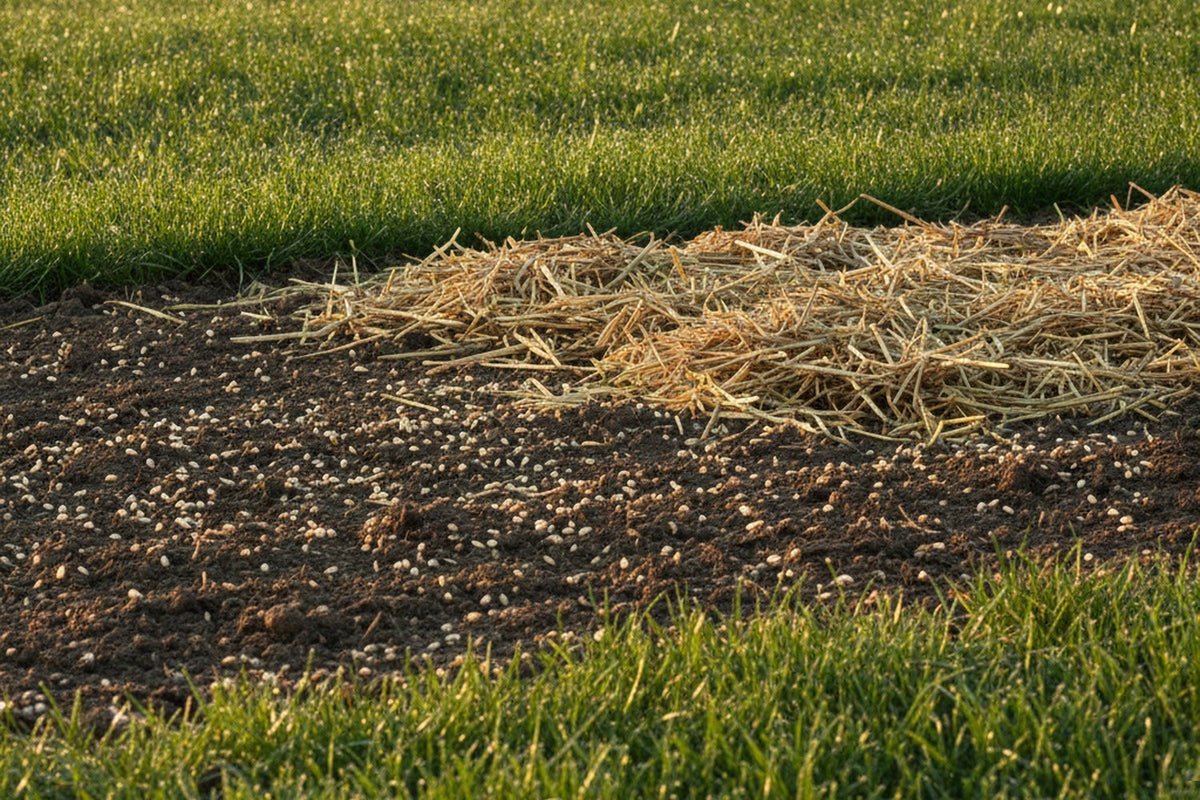
- Mulch if the ground may wash. NC State suggests weed-free straw, one to two bales per 1,000 sq ft for cool-season seed, and the University of Tennessee Extension says the straw should cover half to three quarters of the bare soil.
- Keep it damp. NC State says to keep the top 1.5 inches of soil moist, which can mean a light watering two or three times daily for 7 to 21 days, and not to cut back once the first seedlings show if the mix contains bluegrass. Our lawn sprinkler guide answers which sprinkler suits new seed.
- Feed the seedlings. Purdue recommends a starter fertilizer, one high in phosphorus, at seeding, and the University of Tennessee Extension suggests half a pound of nitrogen for each 1,000 sq ft three to five weeks after the seedlings come up. The Scotts mixes here carry fertilizer in the bag; Black Beauty Ultra does not.
- Mow at the right moment. NC State says to start mowing once the grass is half again taller than the height you want, so tall fescue meant to stand at 3 inches gets its first cut at 4.5, and never to take off more than a third of the leaf at once.
- Hold off on weed killers. NC State says to wait until a new lawn has been mowed three times before treating broadleaf weeds, and then to use the lowest rate on the product label. Jonathan Green says to wait at least 30 days after a weed control before seeding.
Related guides
For compacted ground, our lawn aerator guide covers core and spike aerators, including one shaped for slicing open a seedbed. If a layer of thatch sits on top of the soil, our dethatcher guide compares thatch rakes and machines and says to reseed the thinned spots afterward. And for the overseeding and shade jobs this page hands off, see best grass seed for overseeding and best grass seed for shade.
Frequently asked questions
What is the best grass seed?
For most cool-season lawns, Jonathan Green Black Beauty Ultra: a tall fescue, bluegrass and ryegrass mix that was the second of eight seeds to sprout in Bob Vila's test and its best cool-season seed. For a sunny side and a shadier side, Scotts Turf Builder Sun and Shade Mix; for less upkeep, Scotts Turf Builder Tall Fescue Mix; for kids and dogs, Scotts Turf Builder High Traffic Mix; for full sun, Scotts Turf Builder Sunny Mix. This guide has no warm-season pick, and shady lawns have their own guide.
What grass seed grows the fastest?
Perennial ryegrass. Purdue's turf program says it comes up first, followed by tall fescue and then Kentucky bluegrass, and the University of Tennessee Extension gives perennial ryegrass 3 to 7 days to germinate against 14 to 21 days for Kentucky bluegrass. That is why fast-starting mixes pair ryegrass with slower grasses.
How long does grass seed take to germinate?
From about 3 days to 3 weeks for cool-season seed, depending on the grass: the University of Tennessee Extension lists 3 to 7 days for perennial ryegrass, 6 to 12 for tall fescue, 6 to 14 for the fine fescues and 14 to 21 for Kentucky bluegrass. Jonathan Green puts Black Beauty Ultra at 7 to 14 days. Warm-season seed is slower and needs warm soil; Tennessee gives hulled bermuda 10 to 20 days.
When is the best time to plant grass seed?
For cool-season grasses, early fall, with early spring as the second choice, by NC State Extension's advice; makers ask for soil of at least 55 degrees F. For warm-season grasses such as bermuda, late spring and early summer, once the soil is warm; Scotts asks for 65 to 80 degrees F for its bermuda seed.
How much grass seed do I need for a new lawn?
Go by the bag's new-lawn coverage. By the makers' figures, a new 1,000 sq ft lawn takes one 7 pound bag of Jonathan Green Black Beauty Ultra, two 5.6 pound bags of Scotts Sun and Shade Mix, one 16 pound bag of Scotts Tall Fescue Mix, two 5.6 pound bags of Scotts High Traffic Mix or three 2.4 pound bags of Scotts Sunny Mix. Thickening an existing lawn takes much less seed per square foot.
Should I buy grass seed with fertilizer in it?
Either works if the seedlings get fed. The Scotts mixes here carry fertilizer and a soil improver in the bag, while Black Beauty Ultra is seed only. Purdue recommends a starter fertilizer high in phosphorus at seeding for any new lawn, so with a seed-only bag, plan to spread one.
What is the difference between cool-season and warm-season grass?
Cool-season grasses, among them tall fescue, Kentucky bluegrass and the ryegrasses, grow best in spring and fall and stay green through most of the winter, NC State Extension says. Warm-season grasses such as bermuda, zoysia and centipede grow best in summer, go dormant at the first heavy frost and turn brown until spring.
Disclosure: Some links pay us a commission when you click or buy, and on some pages brands pay us through Amazon's creator program on links to their products. Availability was checked on Amazon on November 2, 2026 and can change.
Product prices and availability are accurate as of the date/time indicated and are subject to change. Any price and availability information displayed on Amazon.com at the time of purchase will apply to the purchase of this product.