As an Amazon Associate we earn from qualifying purchases. Some brands also pay us when you click or buy, so those links are ads. Full disclosure below
The best lawn aerator for most home lawns is a core aerator that pulls plugs of soil out instead of pushing spikes in, wide enough for the lawn and weighted enough to keep its tines at depth. We checked every pick on Amazon on October 23, 2026.
One thing before the list: we make digging spades, not lawn aerators, so nothing here is ours. Every pick is judged on aerator type, the depth and width the listing states and weight tray capacity, all verified against its Amazon listing, most recently on October 23, 2026. This page is one stop on our fall yard cleanup tools checklist, which puts every fall job in order.
First on the list
Tow behind plug
1. Agri-Fab 48 in tow behind lawn plug aerator
One thing decides this list before anything else does. Extension turf specialists, Iowa State University Extension and Penn State among them, tell homeowners to core rather than spike. Five of our six picks pull cores.
Lawn aerators at a glance
| Aerator | Type | Width | Stated depth | Weight tray | Suits | Where to buy |
|---|---|---|---|---|---|---|
| Agri-Fab 48 in tow behind lawn plug aerator | Tow behind plug | 48 in | Plugs up to 3 in | Up to 175 lb | Lifting from the seat | Check price on Amazon |
| Brinly PA-42BH-A 42 in tow behind plug aerator | Tow behind plug | 42 in | Plugs up to 3 in | Up to 175 lb | Small shed storage | Check price on Amazon |
| Vlaeng 48 in tow behind plug aerator | Tow behind plug | 48 in | Plugs up to 3 in | Up to 230 lb | Most tray weight | Check price on Amazon |
| K.D STONEDGE rolling core lawn aerator | Push rolling core | Not listed | Not listed | Not listed | No tractor | Check price on Amazon |
| Brinly SAT2-40BH-P 40 in tow behind spike aerator | Tow behind spike | 40 in | Up to 2 in | Up to 150 lb | Slicing a seedbed | Check price on Amazon |
| LawnVigor manual lawn core aerator | Manual core, three plugs | Not listed | Not listed | None | Spot work, thatch check | Check price on Amazon |
How we picked
We picked from Amazon listings only, verifying the title, features, price and stock of every ASIN below on 2026-09-14. Pick 4 was replaced on October 19, 2026, and its listing title, features and stock were checked that day. Pick 6 was replaced on October 23, 2026, and its listing title, features and stock were checked that day. We rejected anything out of stock, backordered, or any tow behind without a stated working width. Where a listing is silent we write Not listed rather than guess. The cool season window runs to early October, so order with time to use it.
What is the best lawn aerator?
The best lawn aerator is a core aerator matched to your lawn and to what you can pull it with. With a lawn tractor, that is a tow behind plug aerator carrying as much weight on its tray as your soil needs; picks 1 to 3 differ on tray capacity, width and storage. With nothing to tow, it is a push roller that pulls cores, pick 4. For the spots a machine misses, it is a hand corer, pick 6.
Lawn aerators, by job
1. Agri-Fab 48 in tow behind lawn plug aerator: lifts from the tractor seat
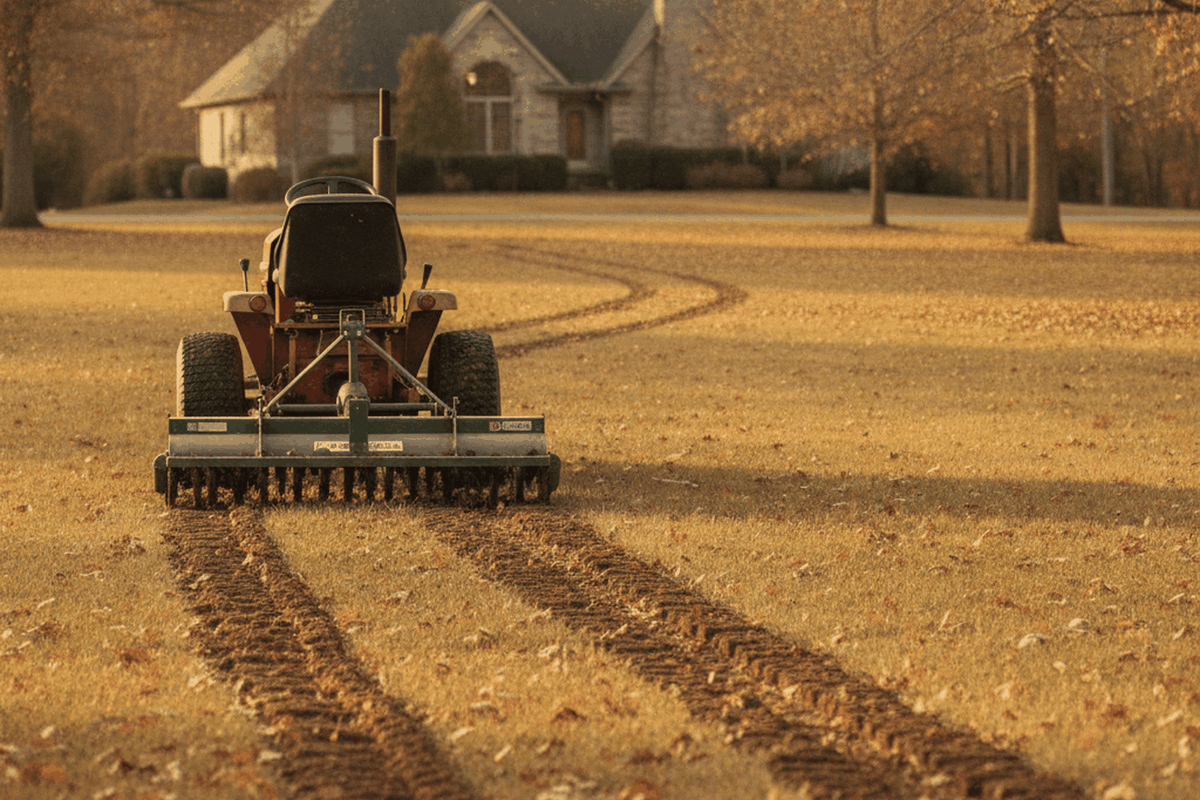
The Agri-Fab 48 in plug aerator is a tow behind plug aerator for any lawn big enough to justify a tractor. The listing states 32 galvanized self sharpening knives, plugs pulled up to 3 in deep, and a weight tray supporting up to 175 lb so the knives keep reaching depth as soil hardens. A cantilever handle lifts and drops the knives without leaving the seat. Where it fits: lawns you already mow with a riding mower or lawn tractor; in hard soil, load the tray toward its 175 lb.
2. Brinly PA-42BH-A 42 in tow behind plug aerator: folds for a small shed
The Brinly PA-42BH-A is the plug aerator for a shed where storage is the problem, because its tow bar folds out of the way when the job is done. The listing is the most specific here about the part that does the work: 16 gauge heat treated steel plugging spoons, narrower with sharpened ends so they need less weight, removing plugs up to 3 in, on a 175 lb enclosed tray. Where it loses: it is 6 in narrower than the Agri-Fab, and the listing never says how many spoons the 42 in model carries.
3. Vlaeng 48 in tow behind plug aerator: largest listed weight tray
The Vlaeng 48 in plug aerator is the other 48 in tow behind on this list. The listing states 32 rust resistant knives on an alloy steel frame, 3 in plugs, an adjustable handle that raises the knives to cross a driveway, and a weight platform rated to 230 lb, the highest here and the spec that matters most in hard clay. It is also honest that plug depth varies with soil moisture. Where it fits: heavy soil that needs more weight on the tray than 175 lb.
4. K.D STONEDGE rolling core lawn aerator: best with no tractor
The K.D STONEDGE rolling core aerator answers the lawn that needs coring with nothing to tow. It is a push roller, and its features, not just its title, say its rotary coring design extracts soil plugs, which is the test we set below. It has transport wheels and a reinforced dual push rod, and the listing aims it at small to medium lawns. Where it loses: the listing states no working width, tine count or tine depth, the numbers we most wanted, and it names no weight tray or sand fill, so on hard soil the moisture rule below matters even more.
Pick 4 changed on October 19, 2026. Until then it was the LawnVigor rolling core aerator, a push roller with six hollow tines and a sand filled drum. When we checked that day, the Amazon listing we linked for it showed as currently unavailable, so we no longer link it, and the K.D STONEDGE took the slot as the same kind of tool, a push roller that pulls cores.
5. Brinly SAT2-40BH-P 40 in tow behind spike aerator: best spike, for a job that is not compaction
The Brinly SAT2-40BH-P is the best built spike aerator we found, and we want to be plain about what it is for. The listing states 11 tine stars of 8 in diameter, each carrying 12 spike tips, penetrating up to 2 in, plus a 150 lb tray. It is the right shape for slicing a seedbed open before overseeding. Where it loses: it removes no cores, and the Iowa State, North Dakota State and Illinois extension services all warn that solid tines press soil together around each hole.
6. LawnVigor manual lawn core aerator: best manual core aerator
The LawnVigor manual core aerator is not the tool for a whole lawn, and it is the tool almost every lawn owner should keep anyway. Its listing states three heat treated hollow tines that remove soil plugs and can be replaced, a wide foot pedal and a bend resistant steel frame, and it asks you to water dry soil first and never rock or twist the tool in the ground. Use it on the strip where the mower turns, the dog path and the corner that stays wet. Where it loses: three cores a step still makes a few hundred square feet a real morning, and the listing states no tine depth or core diameter.
Pick 6 changed on October 23, 2026. Until then it was the Yard Butler ID-6C, a step-on corer that pulls two plugs at a time. When we checked on October 23, 2026, its Amazon listing showed it running low on stock, so the LawnVigor took the slot as the same kind of tool, a hand corer that pulls plugs.
Which is better, a spike aerator or a plug aerator?
A plug aerator is better. It lifts cores of soil out and leaves room for the surrounding soil to relax into, while a spike aerator drives a solid point in and pushes that soil sideways. Iowa State University Extension puts it simply: aerate with a core aerator, and avoid spike type devices that punch holes and compact the soil.
The rest of the field agrees. The University of Illinois Extension writes that spike aerators can cause more compaction by pressing soil together around the holes. North Dakota State calls hollow tine or core aerators best and says to avoid solid tine devices.
Worth knowing: much of the equipment sold as a plug aerator is not one. Several tow behind listings we checked use plug and core in the title, then describe star shaped tines that penetrate 2 in and never mention removing anything. Read the features, not the title, and look for plug or core attached to a verb like removes or pulls.
What is the best month to aerate your lawn?
For cool season grass, aerate in fall. Iowa State University Extension names September and April as the best times for Kentucky bluegrass and other cool season lawns, and the University of Minnesota Extension gives late August to early October depending on how far north you are. Penn State frames it by weather instead of date. In fall, clear the leaves first so the tines reach soil rather than leaf litter; our best lawn sweeper guide compares tow-behind and push sweepers.
Warm season grass runs the opposite calendar. Clemson Cooperative Extension says zoysiagrass, centipedegrass, St. Augustinegrass and bermudagrass are best aerified in late spring and summer while actively growing. Either way you want several weeks of growing weather after the machine leaves, so the holes close and the turf knits. North Dakota State adds the rule that catches people out in a dry year: wait until the lawn has broken out of summer dormancy.
| Grass type | Aerate | Source |
|---|---|---|
| Kentucky bluegrass, fescue, ryegrass | Late August to early October, or April | Iowa State, Minnesota |
| Zoysia, bermuda, centipede, St. Augustine | Late spring into summer, during active growth | Clemson |
How many passes should you make, and how many holes is enough?
Aim for 20 to 40 holes per square foot, the standard Iowa State University Extension publishes, and expect several passes to get there. Iowa State says most machines will not remove the proper number of holes in one pass. Clemson recommends going over the lawn twice at right angles.
Penn State gives six to eight passes ahead of an overseeding, Clemson six to 10 when seeding behind the machine, and Colorado State warns that a single pass leaves holes several inches apart and does little for the turf. Iowa State describes a proper core as about three quarters of an inch across and 3 in long, and Clemson recommends tine spacing of 2 to 3 in, closer spacing removing more soil. The first pass never looks like enough, because it is not. Our guide to aerating a lawn walks the whole job through.
Is it better to aerate before or after seeding and feeding?
Aerate first, then seed. The reason is simple: the holes give seed better contact with soil, which is what germination needs. Penn State puts overseeding straight after the aerator, and Iowa State suggests fertilizing about a week beforehand so the lawn recovers faster. For the shady parts of the lawn, our best grass seed for shade guide matches the bag to how many hours of sun the spot gets.
There is one credible dissent. Clemson advises letting the holes heal for about a month first, to avoid an uneven, speckled result. Clemson also carries the rule nobody else mentions, which costs a season when missed: apply pre emergent herbicide after aerating, never before, because coring opens the herbicide layer and lets weeds through.
Feeding follows the same logic. Aeration is the best day of the year to feed, because granular fertilizer reaches the root zone instead of sitting on thatch, so pair it with our best fall lawn fertilizer picks and the best fertilizer spreader to lay them down evenly. If a soil test calls for lime, the holes help it as well, and our best lime for lawns guide covers which kind to buy.
Should you aerate or dethatch?
Measure the thatch first, because they fix different problems. The University of Minnesota Extension sets the threshold: half an inch or less is usually fine, and beyond half an inch needs a thatch management program. Penn State sets a higher bar for mechanical dethatching specifically, at one inch or more.
The two are neighbors rather than alternatives. Coring pulls plugs of soil onto the thatch, and that soil carries the microbes that break it down, so aeration is slow thatch management as well as compaction relief. A dethatcher rips the layer out and is the faster answer past an inch. Our best dethatcher guide covers those machines.
Should you buy a lawn aerator or rent one?
Buy if you have a tractor and a lawn you will core every year or two, because a tow behind pays for itself against a few rentals or service visits. Rent a walk behind power core aerator if you have no tractor, a big lawn and one day a year to give it. If you are still choosing the tractor, our lawn mower guide covers when a riding mower is worth it and picks one for lawns of more than half an acre.
We have deliberately not printed a rental rate: we could not verify one against a rental company's own published price on 2026-09-14, and rates vary by store. A rented power unit is also heavy, awkward in a truck bed and hard work on a slope.
What to look for in a lawn aerator
- Type first, always. Hollow tines or coring spoons that lift plugs out, or nothing. The word plug in a title is not evidence. Find it in the features, attached to removes or pulls.
- Weight tray capacity. This decides whether tines reach depth in clay: 150 lb on the Brinly SAT2-40BH-P, 175 lb on the Agri-Fab and the Brinly PA-42BH-A, 230 lb on the Vlaeng. Concrete blocks, sandbags or paving slabs all work.
- Width against your lawn. A 48 in swath covers ground fast but needs room to turn; 40 to 42 in suits a yard cut into beds and paths. You are making two passes at right angles, so double your estimate.
- Storage. A 48 in tow behind is a large object for ten months of the year, which is why the Brinly tow bar folds.
Four things owners learn the hard way. Leave the cores where they fall, because raking them up throws away half the benefit. Run the machine when the ground is moist, since the aerator that pulls a 3 in plug on Tuesday will skate across baked ground on Sunday. Mark the irrigation heads and the shallow cable to the shed light first, because a coring spoon finds both. And put the machine away empty: unload the weight tray before you push a tow behind into the shed, and clear debris off the knives after each use, which the Vlaeng listing asks for by name.
What is the best lawn aerator for clay soil?
For clay, choose on weight tray capacity rather than width. The Vlaeng 48 in takes up to 230 lb, the most here, and the Agri-Fab and the Brinly PA-42BH-A take 175 lb each. Clay also demands the moisture rule be followed exactly, because dry clay stops tines cold and wet clay smears and compacts.
Clay lawns also earn coring twice a year rather than once, per Iowa State.
What is the best manual lawn aerator?
The LawnVigor manual core aerator (pick 6) is the best manual lawn aerator for spot work: three hollow tines that pull plugs and a wide foot pedal for leverage. For a whole lawn by hand, the K.D STONEDGE rolling core aerator (pick 4) is the push option, a roller that pulls cores as you push it.
Do aerator shoes work?
No, not for compaction. Aerator sandals are solid spikes strapped to a boot, the purest version of the tool the extension services above tell you to avoid. They push soil sideways rather than removing it, and nobody walks a lawn densely enough to land 20 to 40 holes in every square foot.
The LawnVigor corer above does what they cannot: it pulls cores.
How do you know your lawn needs aerating?
Start with a measurement, not a machine. The University of Minnesota Extension describes the test precisely: remove a two inch deep, pie shaped wedge from the lawn and measure the thatch between the soil surface and the green growth. Under half an inch is healthy, over half an inch needs managing.
Roots that stop in the top inch are the clearest compaction signal there is, and cutting that wedge cleanly is a spade job rather than a shovel job. You want a sharp blade that goes in vertically and takes a wedge you can drop straight back so the turf knits. That is what our D-handle garden spade was built for: a double patented blade, curved to carry soil and pointed to cut, on the 40 inch D handle that gives control at ground level, with over 600,000 sold.
One thing the wedge will not show: if the turf feels soft and raised in lines or ridges you can trace across the yard, that is moles tunneling under it, not compaction, and aerating will not stop it. Our guide to the best mole repellent covers how to tell moles from voles and what moves them on.
Frequently asked questions
How often should you aerate your lawn?
Once a year on well drained soil with little traffic, twice a year on heavy clay or heavy foot and pet traffic, per Iowa State University Extension. North Dakota State gives a wider range of once every one to five years. Measure thatch and root depth rather than working to a calendar.
Should you mow before or after aerating?
Mow before. Cutting slightly shorter than usual the day before lets the tines reach soil cleanly and makes the cores easy to see, so you can judge whether another pass is needed. Leave the cores where they fall and mow again a week or two later.
Is it better to aerate wet or dry?
Neither. Aerate when the soil is moist. Iowa State University Extension says to aerate when soil is moist and to avoid dry and wet soils, and North Dakota State explains that tines cannot dig deeply in dry soil and clog in wet soil. Colorado State suggests watering two days ahead.
Does aerating a lawn help with drainage?
Core aeration helps water move into compacted soil, because it removes soil rather than pressing it aside. It is not a cure for a drainage fault such as a high water table, a buried hardpan or a low spot with nowhere to drain. Fix grading first.
Do you rake up the plugs after aerating?
No. Leave them. The cores break down under rain and mowing within a week or two, and the soil they return carries microbes that help break down thatch. Raking them up throws that away and adds an hour of work. Only clear cores off paths and driveways.
Can you aerate and overseed on the same day?
Yes, and most extension guidance recommends it. Penn State Extension puts overseeding directly after six to eight passes with a core aerator. The exception is Clemson, which suggests waiting about a month so seed in the holes does not outgrow seed between them and leave a speckled lawn.
The bottom line
Core, do not spike. With a lawn tractor, a tow behind plug aerator covers the most ground, and picks 1 to 3 differ on tray weight, width and storage; with nothing to tow, the K.D STONEDGE rolling core aerator pulls cores as you push it. Water two days ahead, pass at right angles until you see 20 to 40 holes in a square foot, then seed and feed into the holes. If the lawn is bumpy too, topdress while the holes are open, and our best lawn leveling rake guide covers the rake that spreads the sand or soil into the low spots.
Disclosure: Our commissions do not change what we recommend or what you pay. Listings were last checked on October 23, 2026 and can change.
Product prices and availability are accurate as of the date/time indicated and are subject to change. Any price and availability information displayed on Amazon.com at the time of purchase will apply to the purchase of this product.