As an Amazon Associate we earn from qualifying purchases. Some brands also pay us when you click or buy, so those links are ads. Full disclosure below
The best dethatcher for most lawns is a corded electric machine like the Greenworks 13 amp 14 inch, which pulls a matted layer out of a normal suburban lawn in an afternoon and swaps to a scarifying reel when moss is the real problem. On a small lawn, a manual dethatching rake does the same work.
The harder question is whether your lawn needs dethatching in the first place. Most do not, and running steel tines through healthy turf in the wrong month sets it back for a season. Thatch only becomes a problem when the layer passes about half an inch, and there is a two minute test that settles it. This guide covers the test, the timing, and the five machines worth owning at each lawn size. This page is one stop on our fall yard cleanup tools checklist, which puts every fall job in order.
Best dethatchers at a glance
| Dethatcher | Best for | Why it wins | Where to buy |
|---|---|---|---|
| Greenworks 13 Amp 14 in. corded (best overall) | Normal suburban lawns | Quick-release swap between the included dethatching and scarifying reels, three depth positions | Check price on Amazon |
| Walensee 15 inch thatch rake | Small lawns, moss patches, touch-up work | A dual-sided head of 19 curved steel tines, and a handle that sets to about 40, 55 or 70 inches | Check price on Amazon |
| WEN 20716 15 in. cordless | Yards with no outlet in reach | Two 4.0 amp hour batteries and a charger in the box, 24 steel tines, five depth positions, collection bag | Check price on Amazon |
| Agri-Fab 40 in. tow-behind | Large lawns, behind a tractor | A 40 inch swath and 20 spring steel tines on a steel deck, pulled by a lawn tractor | Check price on Amazon |
| WEN DT1516 16 in. 15 amp | Mossy lawns that need real scarifying | Both heads included, a 24 tine dethatcher and a 20 blade scarifier, on a 16 inch path | Check price on Amazon |
What is the best dethatcher?
The best dethatcher for most homeowners is a corded electric dethatcher and scarifier, such as the Greenworks 13 amp 14 inch. It handles a normal suburban lawn in an afternoon, adjusts to three depths, and swaps to a scarifying reel when moss is the real problem. Under about 3,000 square feet, a manual thatch rake is enough.
Above that, the decision is mostly about how far the lawn is from an outlet. A corded machine never runs out of charge, and the cord sets how far from the house you can work. A cordless machine trades the cord for batteries, so the charge sets how long you can work. A tow-behind covers the most ground per pass, but only if you own something to pull it.
What is thatch, and do you actually have it?
Thatch is the layer of dead stems, roots, and runners that sits between the green blades and the soil surface. A thin layer, up to about half an inch, is good for a lawn. It cushions traffic, insulates the crowns, and holds moisture. Past half an inch it turns into a problem.
A thick mat blocks water and fertilizer from reaching the soil, and the grass starts rooting into the thatch instead of the ground. That is why a thatchy lawn goes brown in the first dry week of summer.
To measure it, cut a wedge of turf about 3 inches deep with a garden spade, lift it out, and look at the cut face of the plug. The spongy brown band between green growth and soil is the thatch, and you can hold a ruler against it. Under half an inch, put the machine back. The screwdriver version is rougher: push a long screwdriver into the lawn by hand. If it slides in, the soil is fine. If it stops in a springy layer, you have thatch, compaction, or both, and the plug tells you which.
One lookalike to rule out: if the lawn feels soft underfoot only along raised lines or ridges, not across the whole lawn, you are walking on mole tunnels rather than thatch, and no dethatcher fixes that. Our guide to the best mole repellent covers what does.
The best time to dethatch, by grass type
Dethatch when the grass is growing strongly enough to recover, which rules out summer heat and full dormancy. For cool-season grasses such as tall fescue, ryegrass, and Kentucky bluegrass, that means early fall, roughly late August through September across most of the north, with early spring as the fallback. For warm-season grasses such as Bermuda and zoysia, wait for late spring or early summer, after the lawn has fully greened up and been mowed a couple of times.
Timing matters more than which machine you buy. Dethatching tears out living material along with the dead, so the lawn needs four to six weeks of growing weather afterward to knit back together. In the right window it is followed by thickening. In July it is followed by weeds.
The same rule answers the October question for a cool-season lawn. If your lawn has fewer than four to six weeks of growing weather left before the first hard frost, a pass now leaves torn turf to sit through winter, so save the machine for spring. If the weather still has that long to run, go now, and keep the tines shallow. Warm-season lawns wait for late spring either way.
Dethatching vs aerating
They fix different problems. Dethatching removes the organic layer above the soil. Aerating pulls plugs out of the soil itself to relieve compaction. A lawn on heavy clay that puddles after rain needs aeration. A spongy brown mat under the blades needs dethatching. Plenty of lawns need both, and the order is dethatch first, aerate second, so the aerator's tines pull clean cores instead of punching through matted thatch. When the thatch layer is under half an inch, aeration is the better fix, and our best lawn aerators guide covers those machines.
If the ground is hard and the thatch layer is thin, skip this category and read our guide to aerating a lawn instead. Core aeration does more for a compacted lawn than any amount of raking will.
How to dethatch a lawn by hand
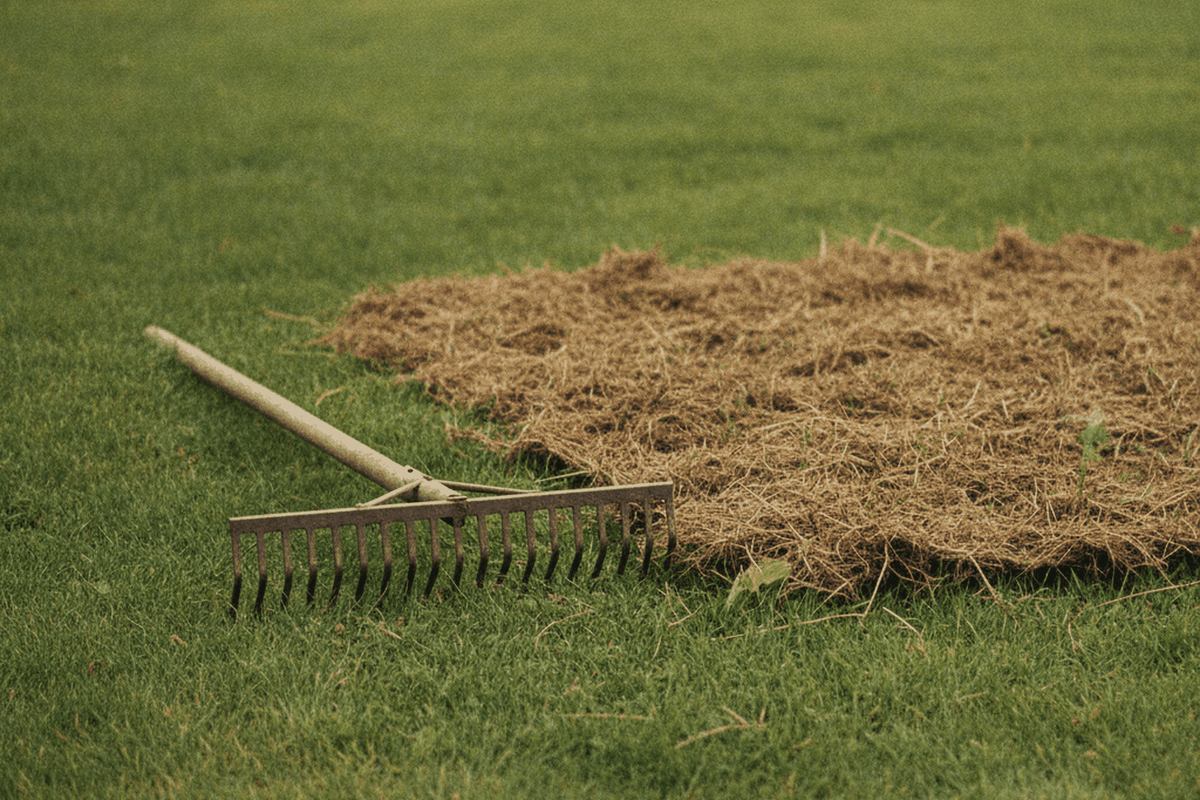
A manual dethatcher is a thatch rake: a rake with stiff, curved steel tines that bite down into the thatch instead of gliding over the grass the way a leaf rake does. The University of California Statewide IPM Program names the thatching rake as the method for small lawns and sends large lawns to a powered vertical mower, and this guide draws that line at about 3,000 square feet.
- Measure first. Cut the plug described above, and rake only if the thatch is thicker than about half an inch. The University of Minnesota Extension uses the same half inch line.
- Prep the lawn. Mow a little lower than usual and dampen the soil surface lightly beforehand, the prep UC IPM gives before dethatching.
- Pull the rake. Draw it across the lawn so the tines lift the thatch up to the surface, and work in sections, as the Walensee listing advises, because it is hard work.
- Take a thick mat in stages. Penn State Extension advises taking only a small amount of thatch on the first pass with a machine, then judging what is left and how thin the turf looks before a second pass, and the same caution suits a rake. Where the layer is severe, University of Missouri Extension suggests spreading the work over two to three years rather than removing it all at once.
- Clear the debris. Rake up what comes loose. The University of Minnesota Extension notes that it can go in a home compost bin or to a county compost site.
- Reseed the thin spots. Removing thatch also removes live grass plants, Penn State Extension notes, so seed the thinned areas, as covered under what to do after you dethatch below.
Hand raking has a ceiling. Past about 3,000 square feet it becomes the weekend job described under pick 1 below, and Iowa State University Extension says rental agencies often carry dethatching machines if you would rather not own one.
How to choose a dethatcher
Four decisions cover it.
- Lawn size sets the machine. Under about 3,000 square feet, a manual dethatching rake is genuinely enough. From there to about 10,000 square feet, a corded electric dethatcher is the sweet spot. Past that, or anywhere the cord will not reach, a cordless machine or a tow-behind saves a whole day.
- Path width is speed. A 13 to 16 inch electric path means a lot of passes on a big lawn, which is why 40 and 48 inch tow-behinds exist. Wider also means heavier and harder to steer around beds.
- Depth adjustment is the safety feature. Every machine here sets tine depth. Start at the shallowest setting that pulls material and go one notch deeper only if it does not. On thin or patchy turf a deep pass takes out more living grass than thatch, so stay shallow and plan to overseed.
- Dethatcher, scarifier, or both. Flexible dethatching tines comb thatch out of the canopy. A scarifier's fixed blades cut vertically into the soil surface, which is what breaks up moss and stimulates new rooting. Machines that include both reels handle both jobs with one motor, and mossy lawns want the scarifier.
Dethatching produces a lot of debris, several bags from even a small lawn. Have a leaf rake and a tarp ready, and check whether the machine includes a collection bag.
Dethatcher vs scarifier: which one do you need?
The two heads do different jobs. Spring or wire tines comb loose thatch up out of the grass, and blades slice down through the mat into the top of the soil. For routine thatch the dethatching head is enough, and the scarifier head is for moss and a deeper mat.
| Tool | What does the work | What it is for | On this page |
|---|---|---|---|
| Thatch rake | Curved steel tines, pulled by hand | Small lawns, edges and moss patches | Pick 1 |
| Dethatcher | Spinning spring or wire tines | Combing thatch out of a normal lawn | The dethatching head on picks 2, 3 and 5 |
| Tow-behind dethatcher | Spring steel tines dragged behind a tractor | Large lawns | Pick 4 |
| Scarifier | Fixed blades that cut into the thatch and the soil surface | Moss and a deeper mat | The scarifier head on picks 2, 3 and 5 |
| Core aerator | Hollow tines or knives that pull soil plugs | Compacted soil, not thatch | The Agri-Fab aerator in the combo section below |
Names vary between sources. Penn State Extension calls the spinning wire-tine machine a power rake and says it suits smaller jobs, and it describes vertical mowers as blades set perpendicular to the turf, with a depth setting that controls how much thatch comes out. The University of Minnesota Extension notes that a vertical mower is sometimes called a power rake too, which is why the FAQ below says the two names overlap. A homeowner scarifier head sits on the blade side of that line: the WEN DT1516 lists a 20-blade scarifying head next to its 24-tine dethatching head.
Should you dethatch and then scarify? On a two-head machine, start with the dethatching head on its shallowest setting, look at what came out and how thin the turf looks, and switch to the scarifier head only where moss or a deep mat remains. That order follows the Penn State advice above: a small amount on the first pass, then judge the turf before a second. Both heads tear out some live grass, so plan to overseed.
The best dethatchers, by lawn
Five machines cover every lawn from a city yard to an acre.
1. Walensee 15 inch thatch rake: best manual dethatcher
The Walensee 15 inch thatch rake has a dual-sided head of 19 curved steel tines in hardened manganese steel: one side lifts dead grass and thatch, and the head flips over to loosen the topsoil. Its sectional steel handle sets to about 40, 55 or 70 inches, so you can work standing up, and it comes apart for storage. We link it because the Bully Tools 24 tine thatching rake that held this spot was out of stock on Amazon when we checked on October 13, 2026.
A thatch rake works differently from a leaf rake. The tines cut down into the thatch layer and drag it up as you pull, which is hard work and why powered machines exist. For a small lawn, a moss patch on the north side of the house, or the edges a machine cannot reach, it is the right tool.
Where it loses: raking a large lawn by hand is a weekend and a set of blisters, not an afternoon, and the twist-lock handle sections need a recheck during a long session, as the listing itself advises.
2. Greenworks 13 Amp 14 in. corded: best electric dethatcher
The Greenworks 13 amp 14 inch is the machine most lawns should get. Its no-load speed is 3,200 rpm through a 14 inch path, tine depth sets in three positions, and a quick release swaps the included dethatching and scarifying reels, so one purchase covers both jobs.
Corded is the right compromise at this size. Nothing runs flat halfway across the lawn, the machine stays light enough to steer around beds, and the extension cord is a minor annoyance rather than the defining experience of the day.
Where it loses: three depth positions is coarser control than the five-position machines, and the cord caps how far from the house you can work.
3. WEN 20716 15 in. cordless: best cordless dethatcher
The WEN 20716 runs on two 20 volt max 4.0 amp hour batteries through a 650 watt brushless motor, and it is the pick for a yard the cord cannot reach. We link it because the Sun Joe 24V-X2-DTS15 that held this spot showed a used offer in the buy box on Amazon when we checked on October 18, 2026.
It comes with two heads, a dethatching head with 24 steel tines and a scarifying head, sets through five height positions from plus 1/4 to minus 1/2 inch, and clears a 15 inch path at up to 3,000 rpm. The listing puts both batteries, a dual-port charger and a detachable thatch collection bag in the box, and the bag saves the raking step, though the listing does not give its capacity.
Where it loses: runtime rather than daylight decides when you stop, and the listing does not give a runtime per charge.
4. Agri-Fab 40 in. tow-behind: best tow-behind dethatcher for a tractor lawn
Once a lawn is too big for a walk-behind, the Agri-Fab 40 inch tow-behind is the pick for that job. It hitches behind a lawn and garden tractor and combs a 40 inch swath with 20 spring steel tines, mounted on a heavy gauge steel deck and drawbar.
It rolls on 7 inch semi-pneumatic tires, arrives needing some assembly, and carries a 3-year limited warranty, according to the listing. The listing does not give a weight tray capacity or say how the tines raise for transport, so confirm both before you order. Like any tow-behind, it only makes sense if you own something to pull it.
Where it loses: the listing names no collection bag, so plan to sweep or rake up the thatch it lifts, and a 40 inch swath means more passes on a big lawn, so allow extra time.
5. WEN DT1516 16 in. 15 amp: best dethatcher and scarifier combo
The WEN DT1516 is a corded two-in-one: a 15 amp motor turning up to 3,300 rpm across a 16 inch path, with both heads in the box, a 24 tine dethatching head and a 20 blade scarifying head.
The five position height adjustment runs from plus 1/4 inch down to minus 1/2 inch, which is finer control than a three position machine when a lawn has healthy turf in some places and moss in others. It also includes a detachable collection bag and an automatic overload shutdown. If moss is the reason you are shopping, buy this one for the scarifying head.
Where it loses: it is heavier and bulkier than the 14 inch machines, and a 15 amp draw wants a short, heavy-gauge extension cord.
The five dethatchers compared
Every figure below comes from the product's Amazon listing as read on October 19, 2026. Where a listing gives no figure, the cell says not listed rather than guessing.
| Pick | Power | Working width | Tines or heads | Depth settings | Collection bag |
|---|---|---|---|---|---|
| 1. Walensee thatch rake | Manual | 15 in. | 19 curved steel tines on a dual-sided head | Not applicable | No |
| 2. Greenworks 13 Amp | Corded, 13 amp | 14 in. | Dethatcher and scarifier attachments | 3 positions | Not listed |
| 3. WEN 20716 | Cordless, 20V Max, two 4.0 Ah batteries | 15 in. | 24-tine dethatching head and a scarifying head | 5 positions, +1/4 to -1/2 in. | Yes, detachable |
| 4. Agri-Fab 45-0294 | Tow-behind, for lawn and garden tractors | 40 in. | 20 spring steel tines | Not listed | Not listed |
| 5. WEN DT1516 | Corded, 15 amp | 16 in. | 24-tine dethatching head and 20-blade scarifying head | 5 positions, +1/4 to -1/2 in. | Yes, detachable |
Dethatcher and aerator combos: what is actually in the box
Search for a dethatcher and aerator combo and much of what comes back is a two-head electric machine like the WEN DT1516 above: a steel-tine dethatching reel plus a bladed scarifier reel. Some listings call that second reel an aerator. It is not one in the sense that matters. Both reels work the thatch and the top of the soil, and neither pulls a core out, so neither relieves compaction the way a plug aerator does.
The true combo is a pair of tow-behinds for a lawn tractor, and it runs the job in the right order: dethatch first, then aerate through the cleared surface. Agri-Fab's version of that pair is the 40 inch tow-behind dethatcher above followed by its 48 inch tow plug aerator, model 45-0299, a separate listing. The aerator carries 32 galvanized knives that pull plugs up to 3 inches deep, according to the listing. On a walk-behind lawn, the same pairing is a dethatcher from the list above plus a core aerator, and our best lawn aerators guide covers those.
What to do after you dethatch
Dethatching opens the canopy and exposes bare soil, the best seedbed you will get without renting a slit seeder. Rake or bag the debris, overseed the thin areas the same day, topdress with a quarter inch of compost, and water lightly until the seed germinates. Seed and fertilizer both go down at a rate rather than a guess, so a spreader is the tool that makes the pass worth doing, and our fertilizer spreader picks cover the models that hold a setting across a whole lawn. Feed after the pass rather than before, and our guide to the best fall lawn fertilizer covers what to put down and when. If the pass exposed dips you had not noticed, that is the moment to fix them, and leveling a yard walks through how, with the leveling rakes that make it quick.
Frequently asked questions
When should you dethatch a lawn?
Dethatch when the grass is actively growing and has weeks of good weather ahead. For cool-season lawns that is early fall, with early spring as a second choice. For warm-season lawns it is late spring or early summer after full green-up. Never dethatch in summer heat or when the lawn is dormant.
Should you dethatch or aerate first?
Dethatch first, then aerate. Removing the thatch layer lets the aerator's hollow tines pull clean soil cores instead of punching through a spongy mat. If you only have time for one and the soil is hard and compacted, aerate, because compaction limits more lawns than thatch does.
How often should you dethatch a lawn?
Only when the thatch layer measures more than half an inch, which for most lawns is every three to five years, and for some lawns never. Lawns that build thatch fastest are heavily fertilized, warm-season, or growing on compacted soil. Check with a plug each fall rather than dethatching on a schedule.
Can dethatching damage a lawn?
Yes. Tines set too deep tear out living crowns and runners along with the thatch, and a thin or stressed lawn has little left to recover with. Start at the shallowest depth setting, work when the grass is growing strongly, and overseed the thin spots afterward.
Is a power rake the same as a dethatcher?
They overlap. Both use rotating tines to pull thatch, and homeowner machines are sold under either name. In trade use, a power rake is the more aggressive tool, with fixed flails that cut into the soil surface, while a dethatcher uses flexible spring tines that comb the thatch out more gently.
Do manual dethatchers work?
Yes, on a small lawn. The University of California Statewide IPM Program lists a thatching rake as the method for small lawns: pull it across the turf to lift the thatch, then rake up the debris. Past about 3,000 square feet the effort adds up, and a powered dethatcher or a rented machine makes more sense.
Is it worth buying a dethatcher?
Only if the plug test shows more than half an inch of thatch and you expect to do the job again. Most lawns need it every three to five years, and some never, so for a single pass renting is reasonable: Iowa State University Extension says rental agencies often carry dethatching machines, and the University of Minnesota Extension lists rental dealers, garden centers and hardware stores for vertical mowers. A thatch rake is worth owning either way for edges and small patches.
What size lawn needs a tow-behind dethatcher?
A lawn past about 10,000 square feet, where this guide's sizing moves beyond a corded walk-behind, and only if you own a lawn and garden tractor to pull it. A half acre is about 21,780 square feet, more than twice that line. The Agri-Fab 40 inch pick combs a 40 inch swath, about two and a half to three times the path of the 14 to 16 inch walk-behind machines on this list. Without a tractor, the WEN 20716 cordless is the walk-behind for a yard the cord cannot reach.
The bottom line
Test before you buy. If the plug shows less than half an inch of thatch, spend the money on aeration or fertilizer instead. If it shows more, get the Greenworks for a normal lawn, the WEN 20716 if no outlet is within reach, the Agri-Fab if you own a tractor, and the WEN DT1516 if moss is the real enemy. A thatch rake like the Walensee is worth owning regardless, because every powered pass leaves edges it cannot reach.
Disclosure: some links in this guide are affiliate links to Amazon. This is at no extra cost to you, and it never changes our honest recommendations.
Product prices and availability are accurate as of the date/time indicated and are subject to change. Any price and availability information displayed on Amazon.com at the time of purchase will apply to the purchase of this product.