As an Amazon Associate we earn from qualifying purchases. Some brands also pay us when you click or buy, so those links are ads. Full disclosure below
The best greenhouse heater for most backyard growers is the Bio Green Palma with its digital thermostat, Bob Vila's best overall after hands-on testing: a 1,500 watt fan heater, splash-proof to IPX4, with a separate thermostat whose sensor hangs at plant height. For a simpler heater, or while the Palma is unavailable (it was out of stock on Amazon on October 12, 2026), Bob Vila's best electric pick is the Dr. Infrared DR-218. Plan on one 1,500 watt heater holding 20 to 30F above the outside air, the range Bob Vila's tester gives for the Palma, so at 40F inside it covers nights down to about 10F to 20F. By the University of Arkansas heat-loss method, a small twin-wall greenhouse can do better on paper and a 10 x 12 ft kit does worse, about 18F above outside in twin-wall polycarbonate and 10F under plastic film; our sizing table covers the common kit sizes.
We make digging spades, not heaters, so nothing on this list is ours. Every pick is judged on heat output, the thermostat, how it copes with water, the safety rules in its own manual, and what an independent tester found when it heated a real greenhouse.
Jump to: How much heater your greenhouse needs | Which heater for which greenhouse | Thermostats | Propane heaters | Solar heat | Electrical safety
The best greenhouse heaters at a glance
| Heater | Best for | Heat output | Thermostat | Water rating | Who tested it | Where to buy |
|---|---|---|---|---|---|---|
| 1. Bio Green Palma with Digital Thermostat | Best overall | 1,500 W or 750 W; 5,120 BTU per hour (Bio Green) | Separate digital thermostat with a remote sensor | IPX4 splash-proof | Bob Vila (this listing); Garden Tool Box (UK sibling) | Out of stock on Amazon on October 12, 2026 |
| 2. Dr. Infrared Heater DR-218 1500W | A simple electric heater | 1,500 W | Dial, no temperature readout | IPX4 splash-proof | Bob Vila (this listing) | Check price on Amazon |
| 3. Dr. Infrared Heater DR-975 7500W | A large greenhouse, wired in | 7,500 W at 240 V; 25,597 BTU per hour (Dr. Infrared) | Remote control, 50F to 85F | Not stated; mounts on a wall or ceiling | Bob Vila (this listing) | Check price on Amazon |
| 4. Bio Green Thermo 2 Digital Greenhouse Thermostat | A digital thermostat for a Bio Green heater | Switches a heater up to 1,500 W (Bio Green) | Digital, sensor on a long lead | Not stated | None; it is the thermostat Bio Green packs with pick 1 | Check price on Amazon |
| 5. VIVOSUN Seedling Heat Mat and Digital Thermostat | Seed trays and cuttings | 105 W mat (listing) | Digital, with a soil probe | IP67 mat surface (listing) | Bob Vila (this listing) | Check price on Amazon |
| 6. Govee WiFi Thermometer Hygrometer H5179 | An alarm if the heat fails | None: it watches, it does not heat | Phone alerts outside a range you set | Not stated | None | Check price on Amazon |
Before you buy: check the power at your greenhouse. The CPSC says to plug electric space heaters directly into a wall outlet, never an extension cord or power strip, and Dr. Infrared's manual says the same, so each plug-in heater here needs an outlet within reach of its cord. The Royal Horticultural Society says the electrical connection to a greenhouse should be installed professionally.
How we chose
We did not test these heaters ourselves. We compared each pick's Amazon listing, and the maker's product page and owner's manual where we could read them (Bio Green's Palma page, which also describes the Thermo 2, Dr. Infrared's pages and manuals for the DR-218 and DR-975, and the VIVOSUN and Govee product pages), against what independent testers found in a real greenhouse. The main test is Bob Vila's: nine heaters, each timed raising a greenhouse 30F and holding it for three hours, plus the same tester's four-week review of the Palma. Garden Tool Box, a UK site, reviewed the Palma Basic 2000W, the UK sibling of pick 1, not the listing we link. No other tested roundup of greenhouse heaters sold in the US turned up in our search.
Our rules: a full pick had to be in stock on Amazon on September 28, 2026. Picks 1, 2, 3 and 5 are the exact Amazon listings Bob Vila tested. Picks 4 and 6 have no tester; we included them because a heater on its own cannot catch two failures: a thermostat that reads the wrong spot, which the Royal Horticultural Society warns about, and a heater that stops in the night. Each pick's section says why. Bob Vila's three gas picks (a propane cabinet heater, a propane convection heater and a vent-free gas wall heater) are named in the propane section but not linked, for the reasons given there. For sizing we used the heat-loss method the University of Arkansas greenhouse course teaches; for safety, the heater manuals, the U.S. Consumer Product Safety Commission, UMass Extension, Michigan State University Extension and the Royal Horticultural Society.
The best greenhouse heaters, by job
1. Bio Green Palma Greenhouse Heater with Digital Thermostat: best overall
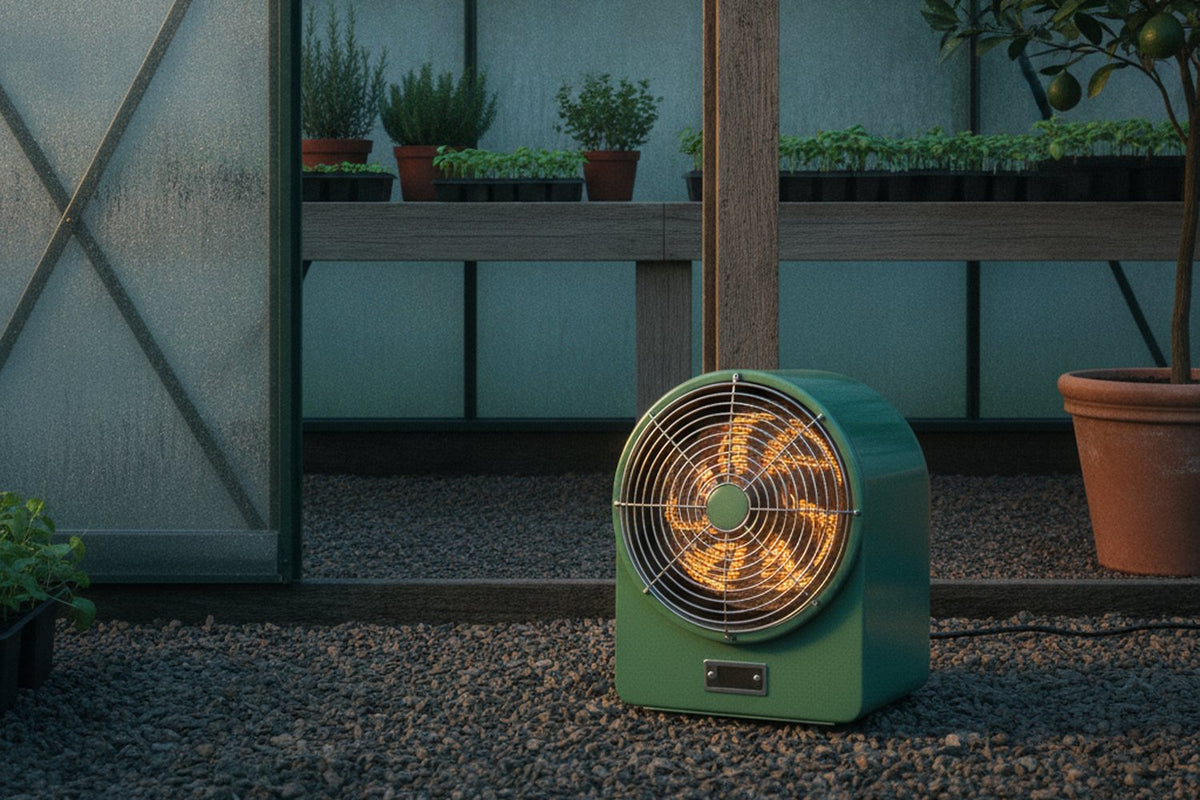
Bob Vila's best overall, and the heater its tester also ran for four weeks in his own backyard greenhouse. It is a 1,500 watt fan heater with two heating levels, 750 or 1,500 watts, in a stainless steel housing, and Bio Green rates it splash-proof to IPX4 and able to withstand irrigation water. The part that makes it a greenhouse heater rather than a space heater is the separate digital thermostat: you plug the thermostat into the wall, the heater into the thermostat, and the sensor sits on a long lead (Bob Vila's tester had 10 feet of it) wherever your plants are. Bob Vila's tester called that thermostat arguably the best feature and found that mounting it at plant height made temperature control much more accurate than his previous system.
In testing it took 14 minutes to warm the space 20F, then cycled on for no more than 2 minutes at a time, and it held 20F above the outside air for the three hours he monitored it. Bob Vila lists an auto shutoff if it overheats, and the review adds a tip-over shutoff. An air circulation mode turns it into a fan, which Bio Green's listing says prevents heat buildup around plants. It weighs 4.5 pounds, per Bio Green.
Where it loses: the cord. Bob Vila's one con is the relatively short 6 foot power cord (Bio Green says 1.9 m, about 6.2 ft), and the CPSC says never to plug a space heater into an extension cord (see the safety section). Output is the other limit: Bio Green rates it for rooms up to 130 square feet (the Amazon listing says 120), but Bob Vila's tester thinks it is probably best for about 96 square feet under a well-sealed cover, and warns that in a deep-cold climate one Palma may not be enough; he found it can only sustain 20 to 30F above the outdoor temperature. Garden Tool Box's one con on the UK Palma Basic was that the fan runs all the time. It also costs more than the DR-218 (pick 2).
The Palma was out of stock on Amazon when we checked on October 12, 2026, and so was its dial-only sibling, so we do not link either for now. Until one is back, pick 2, the Dr. Infrared DR-218, Bob Vila's best electric pick, is the heater to order.
2. Dr. Infrared Heater DR-218 1500W: best simple electric heater
Check price. Bob Vila's best electric greenhouse heater. It is a fan-forced 1,500 watt heater with a steel housing that Dr. Infrared rates IPX4 against splashing water, a cool-touch cabinet and a built-in overheat shutoff, and the listing puts its coverage at 150 square feet. Bob Vila liked the built-in fan for circulating air and eliminating cold pockets, and its numerous safety features. It weighs 13 pounds, per Dr. Infrared.
You choose heat or fan-only, then set the dial thermostat, which Dr. Infrared's manual gives a range of 32F to 104F. The manual's method is to let the greenhouse warm up, then turn the knob back just until the heater clicks off; from then on it cycles to hold that point. Bob Vila found it consistently kicked on within 5F of its set point.
Where it loses: the thermostat. The dial does not show the greenhouse temperature, so Bob Vila had to calibrate it against a digital thermometer, and the Royal Horticultural Society warns that thermostat dials may be off by a few degrees because they sit right next to the heater. The alternative is a heater that comes with a separate thermostat, like the Palma (pick 1). Dr. Infrared's manual says to plug the DR-218 directly into a wall receptacle, so check with Dr. Infrared before running it through a plug-in thermostat. Heat output is the same 1,500 watts as the Palma, so the same limits apply.
3. Dr. Infrared Heater DR-975 7500W: best for a large greenhouse
Check price. Bob Vila's best for large areas, and the pick for a big greenhouse or a cold zone where the sizing table below says one plug-in heater will not keep up. It is a 7,500 watt, 240 volt heater that mounts on a wall or ceiling, and Dr. Infrared's manual rates it at 25,597 BTU per hour, five times a 1,500 watt heater. It comes with a remote-controlled thermostat, a timer of 1 to 12 hours, and five adjustable louvers to aim the air, and the listing says it is UL and cUL listed.
Bob Vila's test greenhouse was about 200 square feet, and the heater exceeded its needs: it heated the cold space, spread the heat around and held a consistent temperature, though it cycled on and off more often than the other heaters, which the tester put down to its mounting spot near an outside corner and to its better-than-average temperature sensitivity. Mounted up high, it is also out of the plant-watering splash zone, a point Bob Vila makes for wall and ceiling heaters.
Where it loses: installation. It is hardwired with no power cord, Dr. Infrared's manual says it must be installed by a certified or licensed electrician on its own circuit with a 40 amp breaker, and Bob Vila lists the hardwiring and mounting as its con. Its built-in thermostat, set from the remote, only goes down to 50F (Dr. Infrared). The manual also allows a separate wall thermostat (Dr. Infrared's DR-001, not included), wired in by the electrician, in place of the built-in one; check that thermostat's range if you want to hold 40F. Dr. Infrared's manual says to mount it at least 6 feet off the floor and 1 foot from adjacent walls and surfaces, so check your greenhouse's height first, and not to use it outdoors. Our garage heater guide covers the same heater for a garage.
4. Bio Green Thermo 2 Digital Greenhouse Thermostat: best thermostat for a Bio Green heater
Check price. This is the digital thermostat Bio Green packs with pick 1, sold on its own. Bio Green describes it as the controller for the electric heater or heating cable in your plant nursery, providing heating in the cold and ventilation in the heat, so in summer it can switch a fan instead. In the Palma setup Bob Vila used, it plugs into the wall, the heater plugs into it, and the sensor hangs on a long lead where your plants are. The listing gives an adjustment range of minus 58F to 210F.
No tester reviewed the Thermo 2 on its own. We include it because Bob Vila's review of the Palma found the external digital thermostat that comes with it more accurate at plant height than the heater's own dial, and it gives a Palma you already own with only a dial (the dial-only version is in Also considered) the same control. If you are buying new, pick 1 already includes it, and the dial-only Palma plus a Thermo 2 costs more than pick 1.
Both Palma versions were out of stock on Amazon when we checked on October 12, 2026, so for now this is for a Bio Green heater you already own. It is not a way to add a thermostat to the DR-218: Dr. Infrared's manual says to plug the DR-218 straight into a wall receptacle.
Where it loses: its rating and its reach. Bio Green's own page says it handles up to 1,500 watts, while the Amazon listing says 3,000; we go by the lower figure, which is the full draw of the Palma it ships with, not two heaters at once or the 3,000 watt DR-218 (see Also considered). Bio Green describes it with its own heaters; for any other heater, follow that heater's manual, and Dr. Infrared's says to plug the DR-218 directly into a wall receptacle. More on thermostats in the thermostat section.
5. VIVOSUN Seedling Heat Mat and Digital Thermostat, 48 x 20.75 in: best for seed trays
Check price. Bob Vila's best seed tray heater. If what you need in late winter is warm soil for seedlings rather than a warm greenhouse, a mat on the bench does it on a fraction of the power: this one runs on 105 watts, per the listing, against 1,500 or more for the heaters above. VIVOSUN says the mat holds soil 10F to 20F above the air around it, and its thermostat and probe control the mat between 68F and 108F. The listing gives the mat an IP67 waterproof surface you can scrub, and says to use it indoors and never immerse it.
Laid flat on a greenhouse bench, it took up to four 1020 seed trays side by side, or pots up to about 6 inches, and Bob Vila measured soil within 3F of the set temperature throughout its test.
Where it loses: it is not a greenhouse heater. Bob Vila found it did almost nothing to raise the air temperature in its small greenhouse, and lists as its con that it is less effective in deep cold and will not prevent frosted foliage. Pair it with an air heater, or use it on its own only where the air stays above freezing, such as a heated room or a mini greenhouse indoors. For the light side of seed starting, see our guide to the best grow lights for seedlings.
6. Govee WiFi Thermometer Hygrometer H5179: best alarm if the heat fails
Check price. Every electric heater on this page stops if the power goes out, the breaker trips or its own overheat cutout fires, and you find out in the morning. This sensor sends an alert to your phone when the temperature falls out of the range you set, and Govee names greenhouses among the places to use it. Govee rates it accurate to plus or minus 0.54F, it keeps 20 days of readings online, and you can export up to two years of data, which is a simple way to see how cold your greenhouse really gets on the worst night.
No tester reviewed it for greenhouses. We include it because the Royal Horticultural Society advises a separate thermometer in the middle of the greenhouse, near the plants, rather than trusting a heater's dial; this one adds the alarm.
Where it loses: it reports over your home WiFi, and Govee says it does not support 5G WiFi, so the greenhouse has to be in range of your router, and Govee says the alert settings are made over Bluetooth, so you set them standing near it. It does not control anything: it tells you, and you act.
Also considered: models that missed the list and why
Vornado TAVH10 Space Heater. Bob Vila's best for small areas: a 750 or 1,500 watt heater with a digital display, a remote and a shutoff if it overheats or is knocked over, which held consistent heat in its test. It missed because it is not splash-proof, Bob Vila's one con, since it is not built for greenhouses; its tester calls IPX4 a matter of personal safety in a greenhouse. We do not link it, and Amazon showed it out of stock on September 28, 2026.
Comfort Zone 5000-Watt Ceiling Mount Heater. Bob Vila's best ceiling-mounted heater, hardwired, with plenty of warmth in testing. It missed because of what Bob Vila found mounted on a ceiling: the thermostat sat in a pocket of heat above the plants, so the plants were always 5F or more cooler than the heater, and its fan only runs while the heating elements do. The DR-975 (pick 3) can take a separate wall thermostat, per its manual.
Dr. Infrared Heater DR-218 3000W. The 240 volt version of pick 2, twice the output, with the same IPX4 rating. It plugs in rather than being hardwired, but Dr. Infrared says it needs a 240 volt, 20 amp circuit and a NEMA 6-20 outlet, which few greenhouses have. No tester reviewed this version, and Amazon showed limited stock on September 28, 2026.
Bio Green Palma with Manual Thermostat. The same heater as pick 1 without the separate digital thermostat, controlled by a steplessly adjustable dial on the heater. It missed because the separate thermostat is what Bob Vila's tester called arguably the best feature, and a dial next to the heater is exactly what the Royal Horticultural Society warns can read a few degrees off. It was out of stock on Amazon on October 12, 2026, so we do not link it.
Joylight Greenhouse Heater with Thermostat. On paper it matches the Palma: a 1,500 watt heater with an independent digital thermostat, overheat protection and an IPX5 water rating, which is higher than IPX4. It missed because no tester we found has reviewed it and our search turned up no maker page or manual to check the listing against.
VEVOR 1500W Greenhouse Heater with IPX4 Protection. VEVOR sells several 1,500 watt greenhouse heaters; this is the one whose listing claims IPX4, with overheat shutoff and two heat settings. Its listing does not describe a thermostat, and no tester has reviewed it.
BN-LINK 48 x 20.75 in Seedling Heat Mat with Thermostat. The same size as pick 5, with an IP67 mat, an ETL-listed controller and a 40F to 108F range. It missed only because Bob Vila tested the VIVOSUN and nobody we read tested this one.
DEWENWILS 15A Temperature Controller Outlet. A plug-in thermostat the listing rates for heaters up to 1,800 watts, with heating and cooling modes and a minus 40F to 210F range. It costs less than the Thermo 2. It missed because its listing does not describe a sensor on a lead that you can hang at plant height, the feature Bob Vila's tester valued in the Palma's thermostat, and no tester has reviewed it.
How big a greenhouse heater do you need?
Heater boxes give a coverage area in square feet, but a greenhouse loses heat through every square foot of wall and roof, and how fast depends on the glazing and on how cold it is outside. So we ran common kit sizes through the heat-loss method the University of Arkansas greenhouse course teaches: heat lost through the glazing (surface area x U-value x the temperature difference) plus heat lost to air leaking in (0.02 x the temperature difference x the volume x air changes per hour). A 1,500 watt heater makes 5,118 BTU per hour, using the US Energy Information Administration's conversion of 1 kilowatt hour to 3,412 BTU; Bio Green rounds this to 5,120.
Our assumptions, so you can check them against your own: a gable-roofed greenhouse with walls 5 ft high at the eaves and 7 ft at the ridge for the three smaller sizes, 6 ft and 8.5 ft for the 10 x 12; the University of Arkansas table's U-values of 0.65 for twin-wall (bi-wall) polycarbonate and 1.15 for a single layer of plastic film; one air change per hour, the table's figure for a metal greenhouse with a single poly layer; wind at 15 mph or less; and a steady night with no sun and no heat lost through the floor. Each cell is how many degrees above the outside air the heater can hold (computed).
| Heater, or heat figure | 4 x 6 ft, twin-wall | 6 x 8 ft, twin-wall | 8 x 10 ft, twin-wall | 10 x 12 ft, twin-wall | 6 x 8 ft, plastic film | 10 x 12 ft, plastic film |
|---|---|---|---|---|---|---|
| Heat loss per degree, BTU per hour (computed) | 95 | 142 | 195 | 293 | 247 | 504 |
| Heat needed for 40F inside on a 0F night, BTU per hour (computed) | 3,806 | 5,682 | 7,806 | 11,698 | 9,876 | 20,162 |
| 1. Palma or 2. DR-218 at 1,500 W (plan on 30F at most) | 54F above outside (40F inside down to minus 14F) | 36F (down to 4F) | 26F (down to 14F) | 18F (down to 22F) | 21F (down to 19F) | 10F (down to 30F) |
| 1. Palma on its 750 W setting | 27F (down to 13F) | 18F (down to 22F) | 13F (down to 27F) | 9F (down to 31F) | 10F (down to 30F) | 5F (down to 35F) |
| Two 1,500 W heaters on separate circuits | Over 100F: far more than this size needs | 72F (down to minus 32F) | 52F (down to minus 12F) | 35F (down to 5F) | 41F (down to minus 1F) | 20F (down to 20F) |
| 3. DR-975 at 7,500 W (built-in thermostat from 50F) | Over 100F: far more than this size needs | Over 100F: far more than this size needs | Over 100F: far more than this size needs | 88F (50F inside down to minus 38F) | Over 100F: far more than this size needs | 51F (50F inside down to minus 1F) |
| 5. VIVOSUN mat | Does not heat the air: Bob Vila found it did almost nothing to the air temperature | |||||
What the table says: one 1,500 watt heater keeps a small twin-wall greenhouse at 40F on a night well below freezing, but its reach shrinks fast as the greenhouse grows or the cover gets thinner. By the method, the same heater that holds a 6 x 8 ft twin-wall greenhouse at 40F down to about 4F only manages down to about 19F under a single layer of plastic film. The real-world check is Bob Vila's: its tester held 20F above the outside air for three hours in his 80 square foot greenhouse, and thought 30F possible, but without wind and with a greenhouse full of plants; our 8 x 10 ft column, the same 80 square feet in twin-wall, computes 26F. The method leaves out wind above 15 mph, gaps in the panels and heat lost into the ground, and the University of Arkansas course notes that it is common to install somewhat more heating capacity than the calculation requires.
So here is how to use it. In the 1,500 W row, where a cell shows more than 30F, plan on 30F, the most Bob Vila's tester gives for one heater; where it shows less, go by the cell. The two-heater and DR-975 rows have no tester measurement behind them, so leave a margin below those cells. To check any heater against your own size, divide its BTU per hour by the heat loss per degree: that is the rise it can hold, for example 5,118 / 142 = 36F for a 1,500 watt heater in a 6 x 8 ft twin-wall greenhouse.
Two more ways to read it. If your greenhouse needs more than one heater, Dr. Infrared's manual says you can run more than one at a time as long as they are not on the same circuit. And if you are still choosing a greenhouse, our best greenhouses guide compares twin-wall polycarbonate kits with plastic-covered ones, a choice that moves these numbers a long way.
Which greenhouse heater for which greenhouse
| Your greenhouse | Our pick | Why, from the testers, makers and the table |
|---|---|---|
| Seed trays in a mini greenhouse or on a bench | 5. VIVOSUN mat | Warms the soil 10F to 20F above the air on 105 watts; it will not keep frost off leaves (Bob Vila). |
| A small 4 x 6 to 6 x 8 ft twin-wall kit, kept frost-free | 1. Palma | Plan on 20 to 30F above outside, the range Bob Vila's tester gives for the Palma: at 40F inside, nights down to about 10F to 20F. Its digital thermostat reads the air at plant height. |
| A Bio Green heater with only a dial, or a vent fan for summer | 4. Thermo 2 | Bio Green's own digital thermostat, rated by Bio Green for up to 1,500 watts; it can switch a fan when it is hot. For any other heater, follow that heater's manual: Dr. Infrared's says to plug the DR-218 directly into a wall receptacle. |
| An 8 x 10 ft twin-wall kit, or a 6 x 8 under plastic film, in a cold winter | Two Palmas, or 1. Palma plus 2. DR-218, on separate circuits | By the table, one 1,500 watt heater stops at about 14F outside in an 8 x 10 twin-wall and about 19F in a 6 x 8 under film; two double the temperature rise. Each keeps its own control: every Palma comes with its thermostat and the DR-218 has its own dial. |
| A 10 x 12 ft twin-wall kit, kept frost-free at 40F | Two Palmas, or 1. Palma plus 2. DR-218, on separate circuits | By the table, two 1,500 watt heaters hold 40F down to about 5F outside, where one stops at about 22F. The Royal Horticultural Society says a greenhouse's electrical connection should be installed professionally. |
| Larger than 10 x 12 ft, or tropical plants kept at 50F | 3. DR-975 | 25,597 BTU per hour; its built-in thermostat runs from 50F to 85F, and its manual allows a separate wall thermostat. It needs an electrician and its own 40 amp breaker. |
| Any heated greenhouse | 6. Govee H5179 | A phone alert when the temperature drops out of range, so a tripped breaker or power cut is caught the same night. |
| No electricity at the greenhouse | No heater pick | See the propane and solar sections below; for a night or two of frost, covering plants may be enough, as our guide to protecting plants from frost explains. |
Do you need a greenhouse heater with a thermostat?
Yes, if you want to sleep. Bob Vila says heaters without temperature control have to be switched on and off by hand, so you check the greenhouse often to avoid under- or overheating, while a thermostat switches the heater on only when needed, which also saves energy. The better question is where the thermostat reads. The Royal Horticultural Society warns that thermostat dials may be inaccurate by a few degrees because they sit close to the heater, and Bob Vila's tester found that mounting the Palma's separate sensor at plant height made temperature control much more accurate than his previous system, and that setting the heater's own thermostat against a thermometer was less accurate at plant height. He also found placement matters: if the sensor sits in the direct path of the warm air, it switches the heater off too early. He had good results with the heater facing the door and the sensor hung at bench height at the opposite end.
A plug-in thermostat carries a rated load, and it is printed on the listing. The Inkbird ITC-308 is sold for greenhouse heaters, but its own listing title says 110V 1200W, less than the 1,500 watts the Palma and the DR-218 draw, so we do not link it. Bio Green rates the Thermo 2 (pick 4) for 1,500 watts, the draw of the Palma it ships with, and the DEWENWILS in Also considered lists 1,800. Dr. Infrared's manual says to plug the DR-218 directly into a wall receptacle, so follow your own heater's manual before adding any controller.
Are propane greenhouse heaters safe for plants?
An unvented propane or kerosene heater sends everything it burns into the greenhouse, and the extension services that advise commercial growers explain why that is a problem for plants as well as people. John Bartok, a University of Connecticut agricultural engineer who wrote UMass Extension's fact sheet on unvented greenhouse heaters, lists what ends up in the air: water vapor that condenses on the cold glazing and drips on plants and raises disease, sulfur dioxide, which can injure some plants at levels as low as half a part per million, and ethylene, which can cause malformed leaves and flowers, stunted growth and bud drop at levels as low as 0.01 parts per million. A Michigan State University Extension article adds that its author has seen ethylene injury more often in plastic greenhouses than glass because they are more airtight, and that carbon monoxide from a faulty heater can make people sick or kill them. The Royal Horticultural Society also notes that burning gas or paraffin produces water and ethylene.
For that reason we do not recommend an unvented propane or kerosene heater as the regular heat for a closed hobby greenhouse, and we do not link one. If you want a kerosene heater for a garage, a workshop or a room of the house during a power outage, our kerosene heater guide covers those jobs and the ventilation and carbon monoxide alarm rules that come with them.
The alternative the UMass fact sheet points to is a vented heater. It defines an unvented heater as one designed without a flue connection, and notes that if the heaters were vented, the moisture would have been exhausted outside along with the flue gases.
The unvented heaters we do not link include Bob Vila's three gas picks, the Mr. Heater 18,000 BTU propane cabinet heater, the Dyna-Glo 25,000 BTU convection heater and the vent-free HearthSense wall heater, the first two of which Bob Vila liked for working without electricity, and the Mr. Heater Buddy family. Bob Vila itself notes that with any gas heater it is crucial to ensure adequate venting, and it suggested the Dyna-Glo as a backup in a power outage or for mild climates. If you use one that way, the extension advice is fresh air: UMass calls for a free air inlet of at least 1 square inch per 1,000 BTU per hour of heater input, MSU recommends 1 square inch of vent per 2,500 BTU, UMass suggests indicator plants near heaters, and MSU names a young potted tomato, which shows ethylene injury within 24 hours. Bob Vila adds that some gas heaters include an oxygen depletion sensor that shuts the heater off when oxygen runs low, and MSU notes that carbon monoxide detectors are available from local hardware stores. Follow the heater's own manual as well.
Is there a solar greenhouse heater?
A few, but the one Family Handyman names makes its solar heat only while the sun shines; Family Handyman says it switches between solar and electrical energy. Family Handyman found a few stand-alone products that could realistically be called solar greenhouse heaters, but says most combine solar panels with electric space heaters, and that stand-alone products work best in small spaces. Its example is the Nakoair Solar Air Collector, which on a sunny day can pump air into the greenhouse 40 to 85 degrees warmer than the outdoor air, and starts and stops with the intensity of sunlight. For heat at night, the panel route needs storage: Bob Vila says to add a battery so the system can run when the sun is not out, when heating is needed most. Size the panels and battery for the heater's watts and the length of the night: a 1,500 watt heater running for one hour uses 1.5 kilowatt hours.
The other solar route is the building itself. University of Georgia Extension describes passive solar greenhouses that store the day's heat in a thermal mass, such as a sand-filled wall or water-filled barrels, and release it at night, and reports a study where such a structure stayed above 32F on a night as cold as minus 22F. That is a purpose-built greenhouse, though. In an ordinary one, the Royal Horticultural Society says the lift from containers of water is negligible and that a heater with a thermostat is still the best option. Bob Vila suggests water barrels as thermal mass and, for a bit more heat, moving a well-tended compost pile into the greenhouse for the winter.
Is an electric heater safe in a wet greenhouse?
It can be, if the heater is built for it and the power supply is right. None of this is wiring advice; it is what the heater makers and safety agencies say.
- Splash rating. Bob Vila says electric greenhouse heaters should ideally be water-resistant and to check for an IPX4 splash-proof rating; picks 1 and 2 have it, and its tester called IPX4 a matter of personal safety in a greenhouse.
- Wall outlet only. The CPSC says to plug electric space heaters directly into a wall outlet, never an extension cord or power strip, and Dr. Infrared's DR-218 manual says the same.
- GFCI protection. The CPSC's fact sheet explains that a ground fault circuit interrupter protects against severe electric shocks, especially where electrical equipment is near water, that the electrical code has required it outdoors since 1973, and that portable GFCIs are also available. The Royal Horticultural Society says the electrical connection to a greenhouse should be installed professionally.
- Clearance. The CPSC says to keep portable heaters at least 3 feet from anything that can burn; Dr. Infrared's manual says 3 feet from the front of the heater, and away from the sides and rear.
- One heater per circuit. Dr. Infrared's manual says more than one heater can run at a time as long as they are not on the same circuit.
- Hardwired heaters. Dr. Infrared says the DR-975 must be installed by a certified or licensed electrician.
How to keep a greenhouse warm in winter for less
Every degree you keep in is a degree the heater does not have to make. Bob Vila recommends sealing air leaks and lining the walls and roof with bubble wrap. The Royal Horticultural Society agrees, and adds the trade-off: a layer of plastic cuts out about ten percent of the light, and plants that need all the light they can get, such as winter lettuce, may do better without it. In a large greenhouse with few plants, it suggests moving them to one end and screening that end off with bubble wrap to heat a smaller space; heavier grades of fleece over plants on the coldest nights give about 2C more protection. Set the thermostat no higher than your plants need: the Royal Horticultural Society's frost-free greenhouse is 4C, about 39F, and Bob Vila's tester keeps his at 40F for marginally hardy plants, noting that tropical plants need to stay above 50F. On a 20F night, holding 50F instead of 40F takes half as much heat again, because the heater has to hold a 30F rise instead of 20F.
A word from the people who wrote this
We are Spear Head Spade, and we make a double patented digging spade, not greenhouse heaters. If you are planning the greenhouse itself, our best greenhouses and best mini greenhouses guides cover the structures these heaters go in, and our guide to protecting plants from frost covers the beds outside it. And when spring comes and the beds need digging again, our spade finder matches a spade to your soil.
Frequently asked questions
What temperature should a greenhouse be in winter?
For overwintering hardy and half-hardy plants, frost-free is enough: the Royal Horticultural Society's frost-free greenhouse is 4C, about 39F, and Bob Vila's tester keeps his at 40F. Tropical plants need more, above 50F by the same tester's account, and on a 20F night that takes half as much heat again as holding 40F.
What is the best heater for a small greenhouse?
The Bio Green Palma (pick 1) with its digital thermostat. Bob Vila's tester found it works for a small greenhouse, probably best for about 96 square feet under a well-sealed cover, and gives its limit as 20 to 30F above the outdoor temperature. Our sizing table computes more than 30F for a 4 x 6 or 6 x 8 ft twin-wall kit, so plan on the tester's 20 to 30F: at 40F inside, nights down to about 10F to 20F.
What type of heater is best for a greenhouse?
Where there is power, an electric fan heater sold for greenhouses, with a thermostat. The Royal Horticultural Society says electric heaters are easily controlled, that fan heaters provide more heat and improve air circulation to avoid cold corners, and to buy one specifically sold for greenhouses to ensure safety; tube heaters are a lower-energy source of background heat. For why we do not recommend unvented gas, see the propane section.
How many BTUs do I need to heat a greenhouse?
It depends on the greenhouse's surface area, its glazing and how cold it gets. By the University of Arkansas method, holding 40F inside on a 0F night takes about 5,682 BTU per hour for a 6 x 8 ft twin-wall polycarbonate greenhouse and about 11,698 for a 10 x 12 ft one. A 1,500 watt electric heater makes 5,118 BTU per hour.
Can you use a regular space heater in a greenhouse?
You can, but a greenhouse is wet. Bob Vila's con on the Vornado, a space heater it otherwise liked, is that it is not splash-proof, and its tester calls an IPX4 rating a matter of personal safety in a greenhouse. Whatever you use, the CPSC says to plug it straight into a wall outlet, never an extension cord or power strip.
How can I heat my greenhouse for less?
Keep the heat you have first: seal air leaks and line the greenhouse with bubble wrap, as Bob Vila and the Royal Horticultural Society both suggest, heat only the part of the greenhouse your plants are in, and set a thermostat to the lowest temperature your plants need, since a thermostat only runs the heater when it is needed.
How do you heat a greenhouse without electricity?
The Royal Horticultural Society says gas or paraffin heaters can be useful where there is no electrical supply, but burning them produces water and ethylene, which UMass and Michigan State University Extension link to plant injury, so they need fresh air. A passive solar greenhouse built around a thermal mass is the other route; see the solar section.
Should I put a heater in my greenhouse?
If you want to keep tender plants alive through a cold winter, yes. Bob Vila calls the heater the most glaring difference between a greenhouse and a cold frame or high tunnel, and the Royal Horticultural Society says keeping a greenhouse frost-free lets you grow more tender plants through the winter and start warm-season plants early in spring.
Disclosure: Our commissions do not change what we recommend or what you pay. Availability was checked on Amazon on September 28, 2026 and can change; we do not print prices because they move, so every "Check price" link shows today's.