As an Amazon Associate we earn from qualifying purchases. Some brands also pay us when you click or buy, so those links are ads. Full disclosure below
The best greenhouse overall is the Palram Canopia Hybrid 6 ft by 4 ft, Bob Vila's best overall pick and the only pick here whose maker publishes its snow rating, wind rating, warranty and full dimensions on its own product page. We checked every pick on Amazon on 2026-09-19 and rechecked stock on 2026-09-28.
Every greenhouse roundup we read sorts kits by size or by looks. Almost none prints the two numbers that decide whether your greenhouse is still standing in March: how much snow the frame carries and how much wind it takes. So we put those first, and we say where each number came from.
One thing before the list: we make digging spades, not greenhouses, so nothing here is ours. Each pick is judged on published dimensions, panel material, snow and wind ratings and cost per square foot, traced to the brand's own product page or to its Amazon listing, pulled on 2026-09-19.
Best greenhouses at a glance
| Greenhouse | Best for | Snow and wind rating | Type | Named by | Where to buy |
|---|---|---|---|---|---|
| Palram Canopia Hybrid 6 ft by 4 ft | Best overall | 15.4 psf, 56 mph | Twin-wall polycarbonate roof, clear walls | Bob Vila | amazon |
| Quictent 20 ft by 10 ft tunnel | Most covered ground per dollar | Not published | 150 GSM PE film on steel hoops | Popular Mechanics | amazon |
| GAOMON 6 ft by 7 ft | A small greenhouse for one bench | 18 psf, 50 mph | 4 mm twin-wall polycarbonate | Nobody | amazon |
| Showellgard lean-to 6 ft by 2 ft | Fitting against a wall | Not published | 4 mm twin-wall polycarbonate | Nobody | amazon |
| CDCASA 12 ft by 10 ft | Walking in, and a hard winter | 20 psf, 56 mph | 4 mm twin-wall polycarbonate | Nobody | amazon |
| Palram Canopia Oasis Hex 8 ft (41.97 sq ft of hexagon) | Looks, as a garden feature | 15.4 psf, 55 mph | Clear polycarbonate, over 90 percent light | Nobody | amazon |
How we chose
We did not put a single one of these in a backyard. Nothing here was hand tested. What we did was compare each brand's published specifications against what independent reviewers reported, then verify prices and stock on Amazon on 2026-09-19.
The roundups we read are Bob Vila, Popular Mechanics, Good Housekeeping and GreenhouseReview, the only one of those four that describes setting the greenhouses up itself, though it publishes no prices, no dimensions and no weather figures. The Spruce names the Backyard Discovery Willow its overall pick, and since its page would not load for us, that is all we take from it.
Our rule on numbers: we print a snow or wind figure only where the brand publishes it, on its own product page or on its own Amazon listing, and we say which. Figures that appear only on third-party blogs are refused. Palram is the only brand here publishing a full specification page, and even then only for the two Hybrids: its Oasis page gives dimensions but sends you to a photo gallery for the load figures. Every other number below comes from the brand's own Amazon listing, except where we say otherwise: the GAOMON's light transmission is from its Lowe's page, the Oasis's snow load from Palram's own video, and the Mythos's ratings from a retailer's Palram comparison sheet. Where we lean on a retailer we say so, and we do not let a retailer overrule a brand.
Half the models these reviewers name were unavailable on Amazon when we checked, including Popular Mechanics' overall pick. Where a reviewer's exact model is out of stock and a sibling is not, we take the sibling and say so. Four of the six picks have no reviewer behind them at all, and each says so in its own section.
The best greenhouses, by job
1. Palram Canopia Hybrid 6 ft by 4 ft: the best greenhouse overall
The Palram Canopia Hybrid 6 ft by 4 ft (ASIN B00P0REDYC) is the kit to buy if you want one greenhouse and no research project. Palram's own product page for model 701651 states 56 mph, 75 kg per sq m of snow (15.4 lbs per sq ft), a 5 year limited warranty and the full dimensions: 4 ft 2 in by 6 ft 1 in, 6 ft 10 in to the peak.
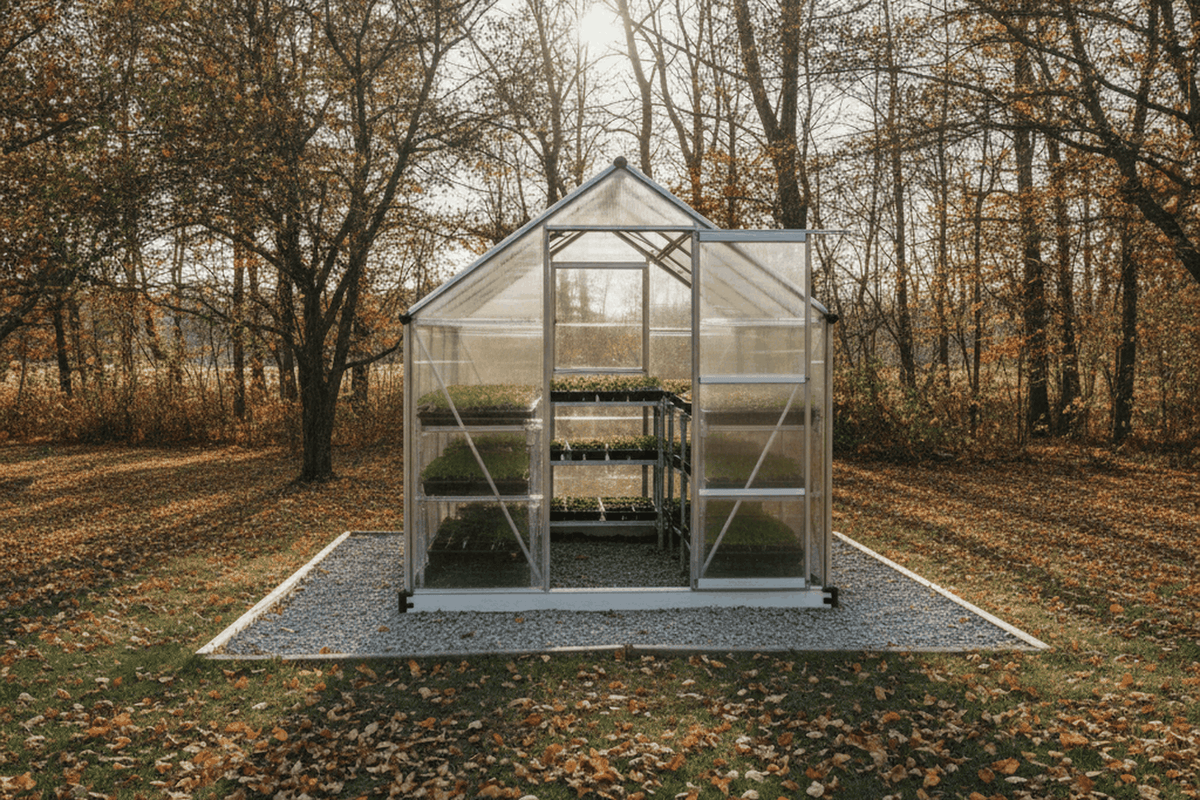
That combination is rarer than it sounds. This is the only pick here whose maker publishes a warranty term on the model's own product page. The roof is 4 mm twin-wall polycarbonate for diffused light and the walls are crystal clear at over 90 percent light transmission, which is the split the "hybrid" name refers to. The listing adds a galvanized steel base with pre-drilled anchor holes, a gutter, an adjustable vent window and a door you can hang either way, though anchors are not supplied.
Bob Vila makes this exact size its overall pick, and Popular Mechanics picks the same Hybrid line as its best hard-panel kit. The green one Bob Vila links is unavailable, so we take the silver. Our first choice was the 6 ft by 8 ft version of the same greenhouse, but every listing of it was out of stock on Amazon when we rechecked on 2026-09-28; it is in the also-considered section below.
Where it loses. At 73 in wide it holds one bench, not two, and at 4 ft 2 in long that bench is short. You are buying about 25 sq ft of floor and about 8 sq ft of growing surface, and no listing in this category tells you that.
2. Quictent 20 ft by 10 ft tunnel: the cheapest covered ground here
The Quictent 20x10x6.6 ft tunnel (ASIN B0GG9YL4DG) covers 193.9 sq ft at the lowest cost per square foot in either tier of the table below, and far less per foot of ground than the overall pick. If what you want is room for rows rather than a structure that outlives you, nothing else here is close.
It is better built than most tunnels. The frame is 0.7 mm galvanized steel, the cover a 150 GSM reinforced PE mesh with a UV inhibitor passing 85 percent of light, and the doors are rigid hinged frames rather than zips. Popular Mechanics makes the 20 by 10 Quictent Premium its tunnel pick, and Bob Vila names the brand for a smaller shelf model.
Where it loses. A PE cover is a consumable, not a roof. Quictent publishes no snow or wind figure, describing only a reinforced top with 4 to 5 extra crossbars, and its own instructions tell you to bury the flap and drive spiral stakes.
3. GAOMON 6 ft by 7 ft: the best small greenhouse for a single bench
The GAOMON 6 ft by 7 ft (ASIN B0GYCMCDH3) is the small hard-panel pick, with a one-bench footprint. Its listing states 50 mph of wind and 18 psf of snow on 4 mm twin-wall polycarbonate with 99.9 percent UV protection, and its Lowe's page, a retailer listing rather than a maker's page, repeats the 50 mph and the 4 mm and adds 75 percent light transmission.
No reviewer names it, and we will not pretend otherwise. It is here because the one small hard-panel kit the reviewers name that is still on Amazon is the Palram Hybrid 6 ft by 4 ft, our overall pick, and the GAOMON gives you 42 sq ft of floor against the Palram's 25. We are comfortable with its 18 psf because it sits in the same band as Palram's 15.4 and the CDCASA's 20; the 110 psf claim we throw out further down is seven times that band, which is a different kind of number.
You get an adjustable roof vent, a lockable door and a slide-in panel system. If you want a bigger footprint, read the Kingdura entry in the also-considered section below: it is 60 sq ft against the GAOMON's 42, with a credible snow figure of its own.
Where it loses. At 72 in wide it is a one-bench greenhouse, about 14 sq ft of surface. Neither Amazon nor Lowe's publishes a height or a warranty term, so you are buying on the two numbers it does state.
4. Showellgard lean-to 6 ft by 2 ft: the one that fits against a wall
The Showellgard lean-to 6 ft by 2 ft (ASIN B0H6LNLVS3) is for the yard where nothing freestanding fits: a fence line, or the side return between a house and a boundary. It uses the same construction as the bigger kits, with a 4 mm twin-wall translucent roof, clear polycarbonate walls, an aluminum frame on a steel base, a vent window, a gutter and a sliding door.
Lean-tos are the one shape where borrowing a wall genuinely helps, because a heated house wall on the cold side is free warmth at night. No reviewer stands behind this specific model.
Where it loses. Two feet deep is a reach-in cabinet, not a walk-in, and per square foot it is the worst value of the six picks bar the Oasis. Showellgard publishes no snow or wind figure. Third-party blogs quote 56 mph and 15 psf, and because neither traces to Showellgard, this page does not use them.
5. CDCASA 12 ft by 10 ft: the best walk-in for a hard winter
The CDCASA 12 ft by 10 ft (ASIN B0FVSG8849) is the one to buy if you want to walk in, turn around and work. Its listing states an overall footprint of 148.3 in by 122 in, which is 125.6 sq ft, and 122 in of width fits two 24 in benches with a six foot aisle between them. It also states the highest snow and wind pair of the six picks, 20 psf and 56 mph.
Panels are 4 mm twin-wall polycarbonate passing 70 percent of light and blocking over 99.9 percent of UV, on a rust-resistant aluminum frame the listing says two people assemble in 4 to 6 hours. There are rain gutters on both sides, a swing door with snap-on handles, and window vents with 5 adjustable angles.
Credit where it is due: this is the only listing on the page that tells you where its own rating stops. It says to keep doors and windows shut in strong winds, to add reinforcement in hurricane-prone areas, and that storm damage is not covered.
Where it loses. No reviewer names it, and CDCASA has no manufacturer site we could find, so unlike the Palram figures its 20 psf and 56 mph are the Amazon listing's own and we could not corroborate them anywhere else. Stock showed only 16 units when we checked. Its vents are in the walls rather than the roof, which purges heat less well than the roof vents on the AMERLIFE in the section below.
6. Palram Canopia Oasis Hex 8 ft: the one you buy for the shape
The Palram Canopia Oasis Hex 8 ft (ASIN B01MUCRQ52) is the best finished kit in this price band and the one we would put where people can see it. Crystal clear panels pass over 90 percent of the light with 100 percent UV protection, the frame is powder coated galvanized steel and aluminum, and the double door is 3 ft 8 in wide.
Palram's own page for model 704053 gives the dimensions, 245 cm across the corners and 8 ft 9 in to the peak, but points to a photo gallery for the load figures rather than printing them. So the numbers here come from Palram's own Amazon listing, which states 55 mph, and from Palram's own video for the model, which gives 75 kg per sq m. A Home Depot snippet quotes 56 mph for the same model number and we do not use it, because a retailer is not the maker.
No reviewer names it either. It is in this list because an ornamental hexagon is a real thing to want, and because Palram rates it for the same snow load as the overall pick.
Where it loses. It is the worst value of any model on this page. Per real square foot it costs far more than the overall pick, its snow rating is the same as the Hybrid, and a 24 in bench ring leaves a standing area about 3 ft across. Buy it for the hexagon, not the growing.
What does a greenhouse actually cost per square foot?
Price tags in this category tell you almost nothing, because a budget tunnel covers more than four times the ground of a premium hexagon. Dividing price by each brand's stated floor dimensions spreads these fourteen models across a wide range, and it is the most useful comparison on this page. The table below lists them from the lowest cost per square foot to the highest.
| Greenhouse | Tier | Floor area (computed) |
|---|---|---|
| Quictent 20 ft by 10 ft tunnel | Pick | 193.88 sq ft |
| Kingdura 6 ft by 10 ft | Also considered | 60.00 sq ft |
| Eagle Peak 9 ft by 4 ft lean-to | Also considered | 36.00 sq ft |
| GAOMON 6 ft by 7 ft | Pick | 42.00 sq ft |
| Garvee 8 ft by 10 ft | Also considered | 80.00 sq ft |
| ShelterLogic GrowIT 4 ft by 4 ft | Also considered | 16.00 sq ft |
| CDCASA 12 ft by 10 ft | Pick | 125.64 sq ft |
| AMERLIFE 12 ft by 10 ft Hybrid | Also considered | 120.00 sq ft |
| Palram Canopia Mythos 6 ft by 8 ft | Also considered | 49.17 sq ft |
| Palram Canopia Hybrid 6 ft by 8 ft | Also considered | 49.17 sq ft |
| Palram Canopia Hybrid 6 ft by 4 ft | Pick | 25.35 sq ft |
| Showellgard lean-to 6 ft by 2 ft | Pick | 12.00 sq ft |
| Backyard Discovery Willow 9 ft by 6 ft | Also considered | 54.00 sq ft |
| Palram Canopia Oasis Hex 8 ft | Pick | 41.97 sq ft |
How the computed column works. Floor area is the brand's stated length times width, taken from Canopia's own dimension table for the two Palram Hybrids, from that same frame's dimensions for the Mythos, and from the listing's stated size for every other row. The Oasis is computed as a hexagon, which the note below explains.
We wanted to give you cost per cubic foot as well, and could not. Only four of the fourteen give us enough to work it out: the Quictent, where a tunnel's arch lets us take two thirds of its peak height; the Hybrid 6 ft by 8 ft and the Mythos, where Canopia's frame publishes both an eave and a peak height and we average the two; and the AMERLIFE, which publishes no usable height but does state its own interior volume. Everyone else gives a peak height with no sidewall height, or no height at all. That silence is itself worth knowing about the category.
The hexagon needs its own note. Some retailers quote the Oasis at roughly 5.3 square metres, which is its bounding rectangle. Palram's own dimensions, 245 cm across the corners and 212 cm across the flats, describe a regular hexagon, and a regular hexagon is always exactly three quarters of the rectangle it sits in. That is 41.97 sq ft against 55.96, exactly 25 percent less floor, and it raises the Oasis's cost per square foot accordingly.
One volume claim is worth ignoring. The AMERLIFE cubic figure is its own stated 435 cubic feet of usable space, because no eave height is published. The same brand states 1,108 cubic feet for its 10 ft by 12 ft model, which has the same footprint, so the two cannot both be right.
What size greenhouse do you need?
Ask the question in bench feet, not floor feet. Floor area counts the aisle you walk in, and the aisle grows nothing. What actually limits you is the surface you can set trays and pots on, and that follows from width in a way almost no listing explains.
Assume a bench 24 in deep along a wall and a 30 in aisle to stand and work in. Two benches and an aisle need 78 in of width. One bench and an aisle need 54 in. That single threshold sorts this whole category, and it is why a greenhouse sold as "6 by 8" holds one bench: a Palram Hybrid is 73 in wide, five inches short.
| Greenhouse | Width | Benches that fit | Bench area (computed) | Standard 1020 flats | 6 in pots |
|---|---|---|---|---|---|
| Palram Canopia Hybrid 6 ft by 4 ft | 73 in | One | 8.3 sq ft | 5 | 16 |
| Showellgard lean-to 6 ft by 2 ft | 24 in | Reach-in, no aisle | 12.0 sq ft | 7 | 24 |
| GAOMON 6 ft by 7 ft | 72 in | One | 14.0 sq ft | 8 | 28 |
| Palram Canopia Oasis Hex 8 ft | 83 in across flats | Perimeter ring | 34.4 sq ft | 21 | 68 |
| CDCASA 12 ft by 10 ft | 122 in | Two | 49.4 sq ft | 30 | 98 |
| Quictent 20 ft by 10 ft tunnel | 118 in | Two, under sloping hoops | 78.7 sq ft | 49 | 157 |
The flat and pot columns come from two stated assumptions: a standard 1020 nursery flat is about 21 in by 11 in, or 1.6 sq ft, and a 6 in pot takes about half a square foot with room to lift it out. The tunnel row carries one more: its walls are arched hoops rather than vertical, so that 78.7 sq ft assumes ground beds or low benches, not full-height staging at the edges.
Read it this way. If you start seeds each spring and overwinter a few tender pots, one bench is enough. If you want tomatoes in the ground through a season, you need width for two benches or an aisle down the middle of a bed, which starts at the 10 ft kits.
How much snow can a greenhouse hold?
A snow rating is given in pounds per square foot, which is useless until you turn it into inches. The University of Minnesota Extension puts snow density between 3 pounds per cubic foot for light fluffy snow and 21 for wet heavy snow, and those two figures convert any rating into a depth.
| Greenhouse | Stated snow rating | Light fluffy snow at 3 lb per cu ft (computed) | Wet heavy snow at 21 lb per cu ft (computed) |
|---|---|---|---|
| CDCASA 12 ft by 10 ft | 20 psf | 80 in | 11 in |
| GAOMON 6 ft by 7 ft | 18 psf | 72 in | 10 in |
| Palram Canopia Hybrid 6 ft by 4 ft | 15.4 psf (75 kg per sq m) | 62 in | 9 in |
| Palram Canopia Oasis Hex 8 ft | 15.4 psf (75 kg per sq m) | 62 in | 9 in |
| Quictent 20 ft by 10 ft tunnel | Not published | Not applicable | Not applicable |
| Showellgard lean-to 6 ft by 2 ft | Not published | Not applicable | Not applicable |
Palram states 75 kg per sq m and rounds it to 15 on its own product page and 15.4 elsewhere; it is one figure, printed here as 15.4. The Extension page says a building designed for 20 psf "would be expected to handle six feet of dry, fluffy snow or one foot of wet, heavy snow"; dividing 20 by 3 and by 21 gives 80 inches and 11, so the Extension is rounding its own example to the nearest foot.
So the honest headline is that nine to eleven inches of wet snow is the practical ceiling on the four rated picks above, and the gap between a 15.4 psf and a 20 psf rating is under three inches. If you get lake-effect snow, the answer is not a better kit. It is a broom, used before bed.
Treat outlying claims with suspicion. Two listings here state 110 lbs per sq ft, including a Garvee 6 ft by 10 ft, which is seven times what Palram publishes for a heavier kit and higher than the design snow load for houses in northern Minnesota. Whatever that figure measures, it is not the same thing. Check your county's ground snow load with your building department before trusting any of them.
Is a polycarbonate greenhouse better than a plastic cover?
Yes, for anything meant to stay up all year. Twin-wall polycarbonate is a rigid panel with an insulating air gap between two skins. A PE cover is a sheet stretched over hoops. One is a roof and the other is a tarp, and they fail in completely different ways.
The polycarbonate kits here run 4 mm twin-wall with UV coatings and carry published wind and snow ratings. The Quictent's 150 GSM PE cover passes more light, 85 percent against the 75 percent quoted for GAOMON's panels, but holds far less heat, and covers abrade at the hoop contact points and need replacing.
So the split is by purpose. To extend a season by a few weeks at either end, buy the film and accept it as a consumable. To overwinter plants under something still standing in five years, buy the panels and pay far more per square foot.
What is the best small greenhouse?
The best small greenhouse is the GAOMON 6 ft by 7 ft, one of very few budget kits publishing both a wind and a snow figure. At 42 sq ft it holds one 24 in bench of about 14 sq ft.
If you have room for a bigger footprint, the Kingdura 6 ft by 10 ft gives you 60 sq ft against the GAOMON's 42, and its snow figure holds up. It is covered in the also-considered section below.
What is the best walk in greenhouse?
For a true walk-in, the CDCASA 12 ft by 10 ft is the pick. Ten feet of width is the threshold: at 122 in it fits two 24 in benches and still leaves a six foot aisle, where every six-foot-wide kit leaves you sidling past a single bench.
The AMERLIFE in the section below is the same nominal size for more money, and the one thing it buys you is two roof vents instead of wall vents, which purge heat better on a hot afternoon.
What is the best lean to greenhouse?
The Showellgard 6 ft by 2 ft is the best rigid lean-to in this band, with twin-wall panels, a gutter and a sliding door. Be clear about what a lean-to is, though. At 24 in deep you reach in from outside rather than stepping in, so it is a growing cabinet against a wall.
What about Grandio, Juliana and Riga?
Grandio and Juliana are the brands a long-standing specialist review site ranks first and second, with Riga fifth, and they are missing here for one reason: Amazon does not sell them. They are direct-order kits in a different market from everything above, and worth knowing about before you assume the kits above set the ceiling.
We cannot tell you how they compare on the numbers this page runs on, because that site publishes no prices, no dimensions and no snow or wind figures, and we did not fetch the makers' own pages. What it does say about its top pick, the Grandio Elite, is that it has 10 mm twin wall panels, which is thicker than the 4 mm panels on the rigid kits above.
Also considered: models that missed the list and why
These are the greenhouses a shopper is most likely to be weighing against the six above: the ones the major reviewers name, the brands that dominate the search results, and the models we pulled prices for and then set aside. Each one is here with the specific reason it did not make the list.
AMERLIFE 12 x 10 x 8 ft Hybrid. A genuinely good kit and the near miss of this list: 56 mph and 18 psf, a mix of clear and translucent panels, two adjustable roof vents and an integrated gutter. Those roof vents purge heat better than the CDCASA's wall vents. It lost the walk-in slot on arithmetic: the CDCASA states a higher snow rating, 20 psf against 18, at the same nominal size for less money.
Backyard Discovery Willow 9 ft by 6 ft, white cedar. The Spruce's overall pick, and the strongest published pair on this page: its listing states it withstands up to 2,800 pounds or 30 inches of snow and winds up to 100 mph, the only 100 mph figure anywhere here. It missed on two counts. It is above the price ceiling this list works to, and it showed only one unit in stock when we checked.
Palram Canopia Mythos 6 ft by 8 ft. The Hybrid 6 ft by 8 ft's cheaper sibling, on the same frame with the same 75 kg per sq m and 56 mph, per a retailer's Palram comparison sheet, but with translucent twin-wall panels all round at over 70 percent light transmission instead of clear walls. It is not really a rival so much as a fork: take it over the Hybrid if you want diffused light, and save money.
Palram Canopia Hybrid 6 ft by 8 ft. Currently unavailable on Amazon: every listing of it, in green, gray and silver, was out of stock when we rechecked on 2026-09-28, so it is not linked. It was our overall pick until then, the same greenhouse on a longer frame: Canopia's page for model 701572 gives 8 ft 1 in by 6 ft 1 in and the same 56 mph, 75 kg per sq m and 5 year warranty. If it comes back, take it over the 6 ft by 4 ft: 49 sq ft of floor instead of 25, and a bench twice as long.
Garvee 8 ft by 10 ft. Good Housekeeping picks this one, and at 80 sq ft it is the largest mid-priced rigid-panel kit in the table above. It missed on a spec that does not survive scrutiny: the listing claims support for over 110 lbs per sq ft of snow load, seven times what Palram publishes for a heavier greenhouse. Everything else about it is fine, and we would rather recommend a kit whose numbers we can stand behind.
Kingdura 6 ft by 10 ft. The only other budget kit in our whole search that publishes both a wind and a snow figure, and at 60 sq ft it is 43 percent more ground than the GAOMON. Its stated 160 pounds per square metre works out at 14.9 psf, just under what Palram publishes, and its 50 mph matches the GAOMON. It is the closest thing here to a straight upgrade on the small pick, and the only reason it is not one is that a 6 by 10 footprint is not what someone searching for a small greenhouse is asking for.
Eagle Peak 9 ft by 4 ft pop-up lean-to. Popular Mechanics' lean-to pick, a PE cover on a powder-coated steel frame, and the listing states a 1 year limited after-sale protection covering frames and tops. It is below the band and it is a soft cover, so it lost the lean-to slot to a rigid-panel kit.
ShelterLogic GrowIT 4 ft by 4 ft raised bed greenhouse. In stock, cheap, and a closable translucent cover over a raised bed rather than a structure you walk into, so it belongs with cold frames. Bob Vila's actual small pick is a different ShelterLogic, the 4-Tier Mini, which is unavailable. For seed starting and a single bed, our best mini greenhouses and cold frames guide covers the smaller and cheaper end.
And the ones you cannot buy today. If you have been reading other roundups you will be looking for these. Every one returned "currently unavailable" with no price when we checked Amazon on 2026-09-19, which is why none is linked: the SV Scool PE walk-in, which is Popular Mechanics' overall pick; the ShelterLogic GrowIT 4-Tier Mini, the Home-Complete lean-to and the Giantex wooden cold frame, which are Bob Vila's small, lean-to and wood picks; and the Backyard Discovery Bellerose XL and Poppy, both named by Good Housekeeping.
One more Palram colour is out: the 6 ft by 4 ft in green, which is the one Bob Vila links. It is sold in silver, and that is our overall pick above. Greenhouse stock thins out from September onwards, so some of these will come back in spring.
How do you choose a greenhouse?
- Start with width, not area. Under 78 in you get one bench. That single fact rules out or rules in more kits than any other.
- Then the cover. Panels for a permanent structure, film for a seasonal one. Do not buy film expecting a building.
- Then the published ratings. Prefer a brand that prints a psf and an mph figure. Two picks here print neither, and both are chosen for something else entirely: ground per dollar, and fitting against a wall.
- Then the site. Level ground, out of the prevailing wind, and away from the north side of the house. Every kit here anchors down, and anchors are usually sold separately.
- Then ventilation. One roof vent is a minimum and two is better. A sealed greenhouse in April cooks plants faster than a cold night kills them.
Buy in late summer or early autumn if you can. Stock thins as winter approaches, and half the models the major reviewers recommend were already unavailable when we checked in September.
What has to happen before the kit arrives?
Site work, and more of it than the box suggests. Every greenhouse on this page anchors to the ground and every one assumes that ground is level. Palram's own buying advice stresses a level site, and a frame assembled out of true is the usual reason panels will not seat and doors will not close.
That means cutting a level pad, and often a shallow trench for a timber or paver footing that the base bolts to. Our how to level a yard guide covers getting a pad flat, and once the frame is up, how to build a raised garden bed and how to improve clay soil cover the beds that go inside it.
That first job is a spade job, not a shovel job: slicing a clean vertical edge for a footing trench and lifting turf off a pad is what a digging spade is shaped for. We make double patented digging spades, and the D-handle garden spade is the one we would take to a footing trench.
Where does a greenhouse stop and a cold frame start?
A greenhouse is a building you walk into and heat as a volume. A cold frame or a cloche is a lid over a bed or a plant, holding a few degrees for one cold night. They solve different problems, and the cheaper one solves the more common problem. If you do heat a greenhouse, our guide to the best greenhouse heater covers how much greenhouse one heater can hold.
If you only need to get tender plants through a frost or two, you do not need any kit on this page. Our how to protect plants from frost guide covers cloches, hoops and frost cloth, and how to winterize your garden puts the rest of the autumn jobs in order.
Frequently asked questions
What is the best brand of greenhouse to buy?
Palram, sold as Canopia, is the brand Bob Vila ranks best overall and Popular Mechanics picks as its best hard-panel kit. It is the only one here publishing a snow rating, a wind rating and a warranty term on its own site. Grandio and Juliana rank higher on specialist sites but Amazon does not sell them.
What type of greenhouse is best?
For a permanent structure, a twin-wall polycarbonate kit on an aluminum frame, because it holds heat, carries a published snow rating and does not need a new cover every few years. Bob Vila rates glass tougher and more scratch resistant, but no glass kit turned up in our search within this list's price ceiling.
Is it cheaper to build your own greenhouse or buy one?
Against a tunnel, the lowest cost per square foot here, no. Nobody buys hoops, film and timber for that. Against the hard-panel kits, building can win on money, because polycarbonate sheet and framing lumber cost less than a kit. You pay for it in weekends.
Do you need a foundation for a greenhouse?
You need level ground and an anchor, which is not the same as a concrete slab. Most kits here include a galvanized steel base with pre-drilled holes, and most do not include the anchors themselves. A timber or paver perimeter set level and bolted to is the common answer in a garden.
Can you use a greenhouse in winter without heat?
An unheated greenhouse holds a few degrees over outside, which is enough to overwinter hardy and half-hardy plants and to start seeds weeks early. It is not enough to keep tender plants alive through a hard freeze. Twin-wall panels hold that margin better than a single-skin film cover does.
How long does a greenhouse take to assemble?
Plan a weekend with a second pair of hands. The CDCASA listing states two people assemble it in 4 to 6 hours, and the AMERLIFE states about 6 hours with three. Palram supplies step by step instructions and a sliding panel system. Level the base first; that is what costs the day.
The bottom line
Buy the Palram Canopia Hybrid 6 ft by 4 ft if you want one greenhouse that comes with real numbers behind it. Buy the Quictent tunnel if you want the most growing ground per dollar and you accept the cover as a consumable.
And measure your width before you spend anything. Under 78 inches you are buying one bench, whatever the box says.
Disclosure: Our commissions do not change what we recommend or what you pay. Prices and availability were checked on 2026-09-19 and can change.