As an Amazon Associate we earn from qualifying purchases. Some brands also pay us when you click or buy, so those links are ads. Full disclosure below
The best inverter generator for most homes is the WEN DF480iX, a dual fuel machine listed at 4,000 running watts on gasoline, with electric start, a carbon monoxide shutdown and a maker's rating of 62 dB at quarter load. We checked every pick on Amazon on 2026-09-19 and again on 2026-09-28. It is one stop on our fall yard cleanup tools checklist.
Starting watts is the number every listing shouts. Running watts decides whether your fridge and your furnace stay on together, and it is the smaller number on every machine here. Read it first.
One thing before the list: we make digging spades, not generators, so nothing here is ours. Each pick is judged on rated running watts, fuel, noise, run time and carbon monoxide shutdown, taken from the maker's own spec sheet wherever it differs from the Amazon listing.
Best inverter generators at a glance
| Product | Best for | Running / starting watts | 240V outlet | Weight | Noise, per the maker | Tested by |
|---|---|---|---|---|---|---|
| WEN DF480iX (best overall) | Outages first, camping if 62 dB suits your site | 4,000 / 4,800 gas; 3,600 / 4,320 propane | No, 120V only | Not stated | 62 dB at quarter load | None. Popular Mechanics named its DF360iX sibling best budget |
| Westinghouse ecoGen10000 | Hardwired circuits through a transfer switch | 7,600 / 10,000 | Yes, L14-30R and 14-50R | 147.7 lb dry | 79 dBA | Pro Tool Reviews |
| Champion 8500 tri fuel | A house with an outdoor gas outlet | 6,500 / 8,500 gas; 5,850 propane; 5,265 natural gas | Yes, 14-50R | 132.3 lb | 64 dB(A) | None in our set |
| Honda EU2200i | Campgrounds and quiet hours | 1,800 / 2,200 | No, 120V only | 47.4 lb dry | 48 dB(A) at quarter load; Popular Mechanics measured 59.9 dB at 25 ft | Popular Mechanics, Bob Vila, Pro Tool Reviews |
| PowerSmart HB5040DC | The cheapest real running watts | 3,300 / 3,800 gas; 3,100 / 3,500 propane | No, 120V only | 50.7 lb | 70 dB at 23 feet | None in our set |
| Westinghouse iGen2550c | A camper, or essentials on cords | 1,900 / 2,550 | No, 120V only | 40 lb dry | As quiet as 52 dBA | None in our set |
How we chose these
We did not hands-on test any of these generators, and no page that has not run them for a season should say otherwise. What we did instead: pulled every spec from the makers' own product pages, checked those against the Amazon listings, verified price and stock on 2026-09-19, and read what the people who do test them concluded.
Those testers are Pro Tool Reviews, Popular Mechanics, Bob Vila, Field and Stream and Consumer Reports. Consumer Reports' ranked models sit behind its membership wall, so the count that follows is over the four open lists, and we use Consumer Reports only for its size classes and its placement rule. Two machines carry more than one list, both 2,200 watt models: the Honda EU2200i with three, and the Yamaha EF2200iS with two. The Honda is pick 4. Where a tester's exact model sits in our also considered section and a sibling is a pick, it is because the sibling is the same machine in a size that suits more houses.
The more useful finding is what happens when you take those lists shopping. Three of the tester picks we priced could not be bought the day we checked. Pro Tool Reviews' 30 amp RV choice, the Westinghouse iGen4500DFc, is out of stock, as are Popular Mechanics' Pulsar 7250W and Field and Stream's Champion 8750W. Every generator below was in stock with a live price.
What is the best inverter generator?
The WEN DF480iX, for outage essentials you can reach with cords. If a hardwired furnace or well pump is on your list, skip to the Westinghouse ecoGen10000 instead: the WEN has no 240V outlet, and without one it cannot feed a transfer switch whatever its watts say.
The best inverter generators, by job
1. WEN DF480iX 4800 watt dual fuel inverter generator: best overall
The WEN DF480iX (ASIN B0D3WW1CSQ) is the machine we would buy first. WEN's own page gives a 224cc engine at 4,000 rated watts on gasoline and 3,600 on propane, 62 decibels at quarter load, keyless electric start, the WEN Watchdog CO shutdown and a three year warranty.
What you get for the money is 4,000 running watts of cord-reachable power on gasoline, five times the 800 watts Honda's worked example needs for a fridge, five lights and a TV, and 3,600 on propane, which is still four and a half times it. What you do not get is 240 volts. WEN's own outlet list is four 120V 5-20R receptacles, a 12V DC socket, a TT-30R RV receptacle and two USB ports, with no 240V receptacle at all, and per Consumer Reports a machine without a 220 volt connection cannot be hooked to a breaker panel through a transfer switch. Watts and connection are separate questions: this machine has the watts for a furnace fan and no way to reach a hardwired one. Where it loses: the propane rating drops 400 watts, which Amazon does not tell you, and 62 dB is audible where the Honda is not.
2. Westinghouse ecoGen10000 open frame inverter generator: best for home backup
The Westinghouse ecoGen10000 (ASIN B0CFW189Q9) is the pick when the job is hardwired circuits rather than extension cords, and the only machine here a tester named for exactly that role: Pro Tool Reviews chose it as its best inverter generator for emergency power. Westinghouse lists 7,600 running watts at 3% THD or less, a 420cc engine with a cast iron sleeve, and an L14-30R 30A and 14-50R 50A outlet alongside four GFCI household outlets.
That is the most running watts here by 1,100 and one of only two picks with a 240V receptacle, which is what a transfer switch needs. It sits inside Pro Tool Reviews' 5,000 to 8,000 watt range, though above Bob Vila's narrower one. Where it loses: 147.7 pounds rolls rather than lifts, it is gasoline only, and it is loud. Westinghouse's own bullet says as low as 72 dBA while its spec table says 79; Pro Tool Reviews independently lists 79, so treat 79 as the number.
3. Champion 8500 watt tri fuel inverter generator: best multi fuel
The Champion 8500 watt tri fuel inverter (ASIN B0GP9NLLXY) is the only pick that runs on a household natural gas line. Champion's spec sheet gives running watts of 6,500 on gasoline, 5,850 on propane and 5,265 on natural gas, 8,500 starting watts on all three, 13 hours at quarter load on gasoline, and a 120/240V 14-50R alongside a TT-30R. Both hoses are in the box.
On natural gas it never needs refueling, and it is the second of the two picks that can feed a transfer switch. One constraint the marketing skips: the 25 foot gas hose needs an existing exterior gas outlet, and against Consumer Reports' rule of at least 20 feet from any dwelling it leaves about five feet of siting freedom, so where that outlet sits decides whether this machine works at your house at all. Where it loses: it gives up nearly a fifth of its gasoline output on natural gas, it weighs 132.3 pounds, and Champion lists it as not parallel capable.
4. Honda EU2200i inverter generator: best for quiet hours and camping
The Honda EU2200i (ASIN B08YJVDGS1) is the most agreed-on generator in this category: Popular Mechanics and Bob Vila both call it their best overall portable, and Pro Tool Reviews the best for camping and tailgating. Honda's spec sheet gives a 121cc GXR120 engine at 48 dB(A) at quarter load and 57 at rated, 47.4 pounds dry, CO-MINDER shutdown and a three year residential warranty.
Buy it if quiet is a requirement rather than a preference, and read the noise section before treating 48 dB as a prediction. Two things to know: it is not available in California, and Honda sells this model code, EU2200ITAN, under three Amazon listings. This is the cheapest and has the fullest bullets. Where it loses: 1,800 running watts is the least of the six picks, it is 120V only, Honda leaves a furnace fan off this model's application list while putting it on the 2,800 watt EU3000iS, and per running watt it is the dearest power among the picks.
5. PowerSmart HB5040DC 3800 watt dual fuel inverter generator: best value
The PowerSmart HB5040DC (ASIN B0FSD2SJJP) is the cheapest way to real running watts we found: 3,300 on gasoline and 3,100 on propane, with CO Protect shutdown and certification against ANSI/PGMA G300 and ANSI/UL2201. Per running watt it is the best value here, and Amazon sells it for less than PowerSmart's own site.
Where it loses, and this one matters: the Amazon listing claims 59 dBA in Eco Mode, while PowerSmart's own page rates it at 70 dB at 23 feet. We use the maker's figure, which makes this the loudest small machine here. The warranty is two years where all five of the others are three, and it is 120V only.
6. Westinghouse iGen2550c inverter generator: best small inverter
The Westinghouse iGen2550c (ASIN B0C1PPYTLW) is the quiet one you can actually afford, at 1,900 running watts, 3% THD or less, as quiet as 52 dBA, with a CO sensor and a TT-30R 30A outlet. Westinghouse names the load it is for: a refrigerator, a sump pump and electronics.
At 10 hours per gallon at a quarter load it goes furthest on a gallon of anything here, and needs under five gallons to cover a two day outage. Where it loses: the Amazon listing states no warranty though Westinghouse's own page gives three years, and Westinghouse publishes three weights for it, 40 pounds dry, 42.4 shipping and 46 in a bullet. We use 40, the same dry basis as Honda's 47.4.
Also considered: models that missed the list and why
Eight machines we costed and did not slot, including every tester pick that is an inverter generator in this price band.
Yamaha EF2200iS. The only machine besides pick 4 that two testers named, and Bob Vila rates it as offering similar output and performance to the Honda at a more affordable price. That was not true at the prices we found: it costs more than the Honda. On Yamaha's own numbers it is also 57 to 65 dBA against the Honda's 48 to 57, and 7.8 pounds heavier at 55.2 dry.
WEN DF360iX. Popular Mechanics' best budget pick, at 2,900 rated watts. It missed because pick 1 is the same machine one size up: a little more money for 1,100 more rated watts and electric start.
Champion 4500 watt dual fuel. Popular Mechanics' RV camping pick, at 3,500 running watts and 61 dBA. It missed on stock alone: Amazon flagged it scarce.
Westinghouse iGen4500DFc, no price. Pro Tool Reviews' choice for 30 amp RVs and the one we most wanted to include. Amazon returned it out of stock with no price, so it has no row in the cost table and no place on the list.
Generac GP3300i. The big brand default, at 2,500 running watts with COsense shutdown. It missed on value: pick 1 gives 1,500 more running watts for less.
Firman WH03041. Firman rates it 3,000 running watts at 58 dB at quarter load. It missed on cost per watt, where pick 5 does far better, and it is recoil start only at that price.
Champion 2500 watt Ultralight. The lightest machine on this page at 39.7 pounds, though Champion does not say whether that is a dry weight as Westinghouse's 40 pounds is. It is also one of only two machines here publishing a decibel figure with a distance attached, 53 dBA from 23 feet. It missed because pick 6 costs less and makes 50 more running watts.
Honda EU3000iS. Field and Stream called it the quietest generator it tested, and Honda rates it 2,800 running watts at 50 to 57 dB(A). It missed on price: per running watt it is the most expensive power in this comparison.
Champion 6500 watt tri fuel. Currently unavailable on Amazon. It held pick 3 until 2026-09-28: the same Champion tri fuel design one size down, at 5,250 running watts on gasoline and 4,253 on natural gas, with the same 25 foot natural gas hose in the box.
Predator is not here for a simple reason: our Amazon searches returned no Predator generator at all, so no price or stock could be checked and no row could be built. It is not an untested brand: Consumer Reports rates Predator generators on the very page we read for this guide. They are just not buyable on the retailer this page prices.
What two days of outage takes
Two columns are computed by us from the figures beside them: run time divided by tank size; and a 48 hour outage, where tanks are 48 divided by the stated run time, refuels are whole tanks after the first, and gallons are the part-tanks that implies. Generatorbible publishes rated watts and price for hundreds of models; the refuelling arithmetic is what is missing. It covers the six picks and seven of the eight machines above; the iGen4500DFc has no price, so it has no row.
Read the load column before comparing. Four of the six picks publish a quarter load figure and two publish a half load figure, which is twice the work. A half load row is not beatable by a quarter load row, so we have not ranked or bolded across them.
| Generator | Running watts | Run time per tank | Hours per gallon (computed) | At what load | 48 hour outage: refuels / gallons (computed) |
|---|---|---|---|---|---|
| PowerSmart HB5040DC | 3,300 | 4.5 h on 1.3 gal | 3.5 | 50% | 10 refuels / 14 gal |
| Westinghouse ecoGen10000 | 7,600 | 12 h on 5.28 gal | 2.3 | 25% | 3 refuels / 21 gal |
| WEN DF480iX | 4,000 | 7 h on 1.9 gal | 3.7 | 50% | 6 refuels / 13 gal |
| Champion 8500 tri fuel | 6,500 | 13 h on 4.5 gal | 2.9 | 25% | 3 refuels / 17 gal |
| Westinghouse iGen2550c | 1,900 | 11 h on 1.1 gal | 10.0 | 25% | 4 refuels / 4.8 gal |
| Honda EU2200i | 1,800 | 8.1 h on 0.95 gal | 8.5 | 25% | 5 refuels / 5.6 gal |
| Also considered, same arithmetic | |||||
| WEN DF360iX | 2,900 | 1.5 gal tank, per Popular Mechanics; no run time published | Not stated | n/a | Not stated |
| Champion 2500 Ultralight | 1,850 | 11.5 h, tank not stated | Not stated | Load not stated | Not comparable |
| Champion 4500 dual fuel | 3,500 | 14 h, tank not stated | Not stated | Load not stated | Not comparable |
| Generac GP3300i | 2,500 | 7 h on 1.06 gal | 6.6 | 25% | 6 refuels / 7.3 gal |
| Firman WH03041 | 3,000 | 9 h on 1.8 gal | 5.0 | 25% | 5 refuels / 9.6 gal |
| Yamaha EF2200iS | 1,800 | 10.5 h on 1.24 gal | 8.5 | 25% | 4 refuels / 5.7 gal |
| Honda EU3000iS | 2,800 | 19.6 h on 3.4 gal | 5.8 | 25% | 2 refuels / 8.3 gal |
Two things fall out of it. The premium tracks brand and noise engineering, not size: the two Hondas and the Yamaha are the three dearest watts on the page, while the cheapest watt of all belongs to a 3,300 watt machine.
The refuelling column reorders everything for a long outage, but read it at the output each row represents, because a quarter load on a big machine is more power than a half load on a small one. At about 1,625 watts the Champion asks you outside three times in two days; at about 1,650 watts the PowerSmart asks ten times, in the storm, at night. The ecoGen10000's 21 gallons buy about 1,900 watts against the iGen2550c's under five gallons for about 475, so the honest comparison there is four times the fuel for four times the output. On propane the same sum is four 20 pound tanks for two days on the WEN, at 12 hours a tank.
Where the Amazon listing and the manufacturer disagree
We checked every pick's Amazon bullets against the maker's own spec sheet. Four of the six contradict their maker outright, and a fifth contradicts itself, which is the best reason to distrust a roundup built from listings alone.
| Machine | What Amazon says | What the manufacturer says | Which we used |
|---|---|---|---|
| WEN DF480iX | 4,000 rated watts on propane | 3,600 rated watts on propane | Manufacturer |
| PowerSmart HB5040DC | 59 dBA at 25% load in Eco Mode | 70 dB at 23 feet | Manufacturer |
| Champion 8500 tri fuel | No mention of carbon monoxide | CO Shield automatic shutoff | Manufacturer |
| Westinghouse iGen2550c | No warranty stated | Three year limited warranty | Manufacturer |
| Westinghouse ecoGen10000 | Two outlets are transfer switch ready; has a fuel gauge | Body copy agrees; its own spec table says no to both | Neither. We state the contradiction |
Two change a buying decision. Champion's carbon monoxide shutdown exists and Amazon simply omits it, so all six picks have one. And the PowerSmart is 11 decibels louder than its listing claims.
What size inverter generator do you need for home backup?
The testers we link disagree with us here, so take their numbers first. Bob Vila puts many homeowners in a 5,000 to 7,000 watt range for outages and major appliances. Pro Tool Reviews likes 5,000 to 8,000 continuous watts for emergency power, and is explicit about what that buys: not a whole house, but the most important appliances plus lights, fans, TVs, modems and routers, picking your battles on the water heater and the washer. Two of our picks land inside Pro Tool Reviews' range, the Champion 8500 at 6,500 and the ecoGen10000 at 7,600; only the Champion also fits Bob Vila's narrower one. Neither tester is sizing for a panel in that passage. They are sizing to run more of the house at once than we are. If that is your job, our best portable generator guide compares six conventional open frame generators for home backup, five of them with a 240 volt outlet for a transfer switch.
Our narrower case is the far more common job: essentials on extension cords. Honda's own worked example totals a fridge, a furnace fan, five lights and a TV at 1,400 running watts, with 1,600 watts needed for the biggest single start, and concludes a 3,000 watt generator runs all of it easily. That is a wattage exercise, not a connection one. A hardwired furnace needs a transfer switch and therefore a 240V machine whatever the watts say, and most gas furnaces are wired in rather than plugged in, so check yours. On cords the honest total is the 800 watts of fridge, lights and TV. Cords need roughly 800 to 2,000 running watts plus headroom; a panel needs 5,000 and up plus a 240V outlet. That is the split between our top two picks. The WEN is the cord machine and the ecoGen10000 is the panel machine, and they are different jobs, not first and second place.
Our six picks against real draws. Figures are Honda's published wattages, except the heater (Bob Vila) and the air conditioner (LIFAN's rating for that load). Honda and Bob Vila disagree about a fridge, 200 running watts against about 600; we use Honda's, which is a reminder that any wattage chart is an estimate. The furnace column is the hard one: 800 watts are already running when the fan's 1,600 watt start lands, so the machine needs 2,400 starting watts unless you stagger, which Honda's page says you may.
| Pick | Running / starting watts | Fridge, 5 lights and a TV (Honda: 800 W running) | Add the furnace fan (Honda: 1,400 W running; 2,400 W starting, computed) | A 1,500 W space heater or water heater (Bob Vila) | 13,500 BTU RV air conditioner (LIFAN rates this load at 3,800 W running) | Hardwired circuits via transfer switch |
|---|---|---|---|---|---|---|
| WEN DF480iX | 4,000 / 4,800 | Yes | Yes, with headroom | Yes | Yes | Will not run: no 240V outlet |
| Westinghouse ecoGen10000 | 7,600 / 10,000 | Yes | Yes, with headroom | Yes | Yes | Yes, L14-30R and 14-50R |
| Champion 8500 tri fuel | 6,500 / 8,500 | Yes | Yes, with headroom | Yes | Yes | Yes, 14-50R |
| Honda EU2200i | 1,800 / 2,200 | Yes | Only if you stagger the starts: 2,400 W is above its 2,200 W starting, and Honda's page allows 1,600 W staggered. Honda also leaves a furnace fan off this model's application list | Yes, on its own | Will not run | Will not run: no 240V outlet |
| PowerSmart HB5040DC | 3,300 / 3,800 | Yes | Yes, with headroom | Yes | Will not run: 3,300 W is below the 3,800 W LIFAN rates for this load | Will not run: no 240V outlet |
| Westinghouse iGen2550c | 1,900 / 2,550 | Yes | Yes, just: 2,550 W starting covers the 2,400 W. None of the makers here lists a furnace fan below 2,800 W | Yes, on its own | Will not run: Westinghouse says to parallel a second unit for the full 30 amps | Will not run: no 240V outlet |
Two safety points that are not optional. A transfer switch or interlock device is the proper way to feed your home circuits from a portable generator, per Consumer Reports, and installing one is a licensed electrician's job; a listing that says transfer switch ready describes the outlet, nothing more. And never plug a generator into a wall outlet to power the house: it endangers you and the crews on the line.
What is the best dual fuel inverter generator?
The best dual fuel inverter generator is the WEN DF480iX, on 4,000 running watts on gasoline. Every dual fuel machine gives up output on propane, and the honest question is how much: the WEN drops 400 watts to 3,600, the PowerSmart 200 to 3,100.
Propane earns its place anyway. It stores far longer than gasoline, so the tank in the garage is still good next winter, and the run times favor it: WEN rates the DF480iX at 7 hours at half load on 1.9 gallons of gasoline against 12 hours on a 20 pound propane tank. The same 20 pound tank runs a patio fire too, and our best propane fire pits guide works out how many hours each fire pit gets from one.
Which inverter generator is actually the quietest?
The Honda EU2200i, on every figure we have, but with a caveat the rest of this category will not give you. Honda rates it at 48 dB(A) at quarter load and 57 at rated load. Popular Mechanics, who actually measured it, got 59.9 dB at 25 feet, about 12 dB above the rated quarter load figure. Rated decibels are a ranking device, not a prediction of what you will hear, and that applies to every number in this section including ours.
Lined up on their makers' figures the indicative order is the iGen2550c as quiet as 52 dBA, the WEN 62 dB at quarter load, the Champion 64 dB(A), the PowerSmart 70 dB at 23 feet, and the open frame ecoGen10000 at 79, where Pro Tool Reviews' independent figure settles Westinghouse's own 72-versus-79 contradiction. Even the Yamaha two testers prefer is 57 to 65 dBA. These are not measured the same way, so treat the ordering as indicative rather than a ranking. Pro Tool Reviews describes the convention the category should use and rarely does: 23 feet, with the load stated.
What is the best inverter generator for camping and RV use?
For campgrounds and quiet hours the Honda EU2200i is the answer, on 48 dB(A) at quarter load, 47.4 pounds dry and CO-MINDER. For a smaller outlay, the iGen2550c is lighter still at 40 pounds dry, carries a TT-30R 30A outlet and runs 11 hours at 25% load.
Air conditioning catches people out: the sizing table above rules out three of the six picks on it. If a 13,500 BTU unit is why you are buying, the makers who name that load are LIFAN, of its 4800W, and Honda, of the EU3000iS.
Should you buy a battery power station instead?
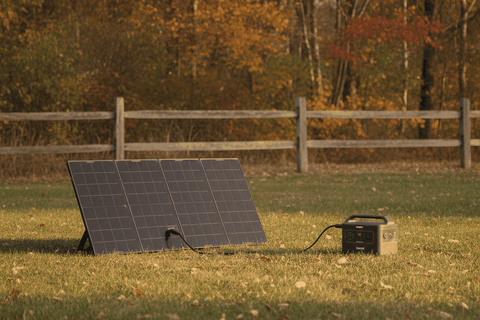
For a lot of people, yes. A battery power station makes no noise and produces no exhaust, which removes the largest risk attached to everything on this page. What it cannot do is run for three days on a tank you refill in two minutes. Our best portable power stations guide covers that choice: battery for silent, short duration power, engine for long outages and big motors. For a no-fuel option that recharges from the sun, see our best solar generators guide.
How do you choose an inverter generator?
Choose by running watts, 240V and fuel, in that order. Add up what you need on at once, leave headroom for the surge when a motor starts, then buy the smallest machine that clears it.
- Read the second watt number, from the maker. Amazon leads with the bigger one.
- Decide whether anything you need is hardwired. That rules out four of our six picks before price enters the argument.
- Decide about propane before brand. It is a modest step up in price from WEN's 56477i to the dual fuel DF480iX, and the feature most likely to matter in a long outage.
- Treat a bare decibel number as unknown, not as quiet. Three of our own six picks give one with no load and no distance, which is why noise is the least reliable line here, ours included.
- Budget for what comes after. Cords or a transfer switch and the electrician, fuel cans and stabiliser or propane tanks, and a carbon monoxide alarm. None of it is in the sticker price.
What about reliability?
The Reddit thread that ranks on page one for this search is titled "Most Reliable Inverter Generator?", and nobody can test durability in a season. What you can compare is what each maker stands behind: WEN, Westinghouse, Champion and Honda all publish three year warranties, and PowerSmart two. WEN names a nationwide network of skilled service technicians, Westinghouse a nationwide customer service network, and Champion a network of service centers across the country. Honda's own product page sells through a dealer locator rather than pointing at retailers.
What does an inverter generator need to stay safe and keep running?
Carbon monoxide is the hazard that actually kills people with these machines. Consumer Reports puts the rule at a distance: place a gasoline generator at least 20 feet from your house or any dwelling, including a garage, exhaust pointed away from windows and doors. Champion says CO Shield is not a substitute for an indoor CO alarm. Keep one in the house whatever the generator has. If a kerosene heater is part of the outage plan too, our best kerosene heaters guide covers the ventilation each heater needs and where to put that alarm.
Maintenance is light. Gasoline goes stale, so treat or drain it before storage; propane does not, which is half the argument for dual fuel. Our guide to the best fuel stabilizer covers when to stabilize generator gas and when to drain it. Change the oil on the manual's schedule, keep the machine dry, and run it under load twice a year so the carburetor does not gum up. Our how to winterize your garden guide covers the rest.
A generator gets you through the outage; the yard is usually what caused it. Storm cleanup starts with a saw, which our best chainsaws guide covers, and if the power is out in January the heat may come from the woodpile, which our best log splitters and best snow blowers guides cover. The rest of the year the work goes back underground, and that is where we live. Spear Head Spade makes one double patented digging spade, and the spade finder says which size fits your soil.
Frequently asked questions
Is an inverter generator quieter than a regular generator?
Usually, and the mechanism is real: Westinghouse explains that Eco Mode matches engine speed to demand instead of running flat out. But the range here runs from 48 dB(A) to 79, and the loudest machine on the page is an inverter. The enclosure matters as much.
Can an inverter generator run a whole house?
Not the portable ones here. The largest makes 7,600 running watts, a large inverter in Consumer Reports' classes, enough for circuits rather than a house. Westinghouse's iGen12000TFc lists 9,000 running watts and is transfer switch ready, the next rung up. Whole house equipment is a permanently installed standby.
Do inverter generators need a transfer switch?
Only if you want to power your home's own circuits rather than extension cords, and then a transfer switch or interlock device is not optional. Installing one is a licensed electrician's job. Only two picks here can feed one, the ecoGen10000 and the Champion 8500; the other four have no 240V outlet. Never plug a generator into a wall outlet.
How much propane does a dual fuel inverter generator use?
A standard 20 pound exchange tank is the unit to plan in: about four of them for a two day outage on the WEN. Propane does not go stale the way gasoline does, so a spare is worth keeping, and you lose rated output on it.
Is it safe to leave an inverter generator running overnight?
Our testers disagree. Bob Vila says running a portable generator unattended is not recommended, and that includes overnight. Pro Tool Reviews sizes for 8 to 10 hours so you are not refuelling at night. Either way, Consumer Reports' rule holds: at least 20 feet from any dwelling, exhaust pointed away, and never refuel a hot engine.
Are the decibel numbers on Amazon reliable?
Not always. One of our six carries a noise figure its own maker contradicts by 11 decibels. Even a maker's rating undersells reality: Popular Mechanics measured our quietest pick at 59.9 dB at 25 feet against a rated 48 dB(A). Treat rated decibels as a ranking device, not a prediction.
The bottom line
Buy the WEN DF480iX for outage essentials on extension cords, the Westinghouse ecoGen10000 if a hardwired furnace or well pump is on the list and you are having a transfer switch fitted, and the Honda EU2200i if quiet is a requirement rather than a preference. Size it by running watts, and run it 20 feet from the house.
Disclosure: Our commissions do not change what we recommend or what you pay. Prices and availability were checked on 2026-09-19 and can change.