As an Amazon Associate we earn from qualifying purchases. Some links are paid. Disclosure
Our top picks
Best bypass pruners
1. Felco F-2
Best for: Most hydrangea cuts
Pruners for green stems
2. Fiskars Bypass Pruner
Best for: Green stems to 5/8 in
Lopper for old stems
3. Fiskars 18 inch PowerGear2
Best for: Old stems at the base
How to prune hydrangeas depends on the type. University of Maryland Extension says bigleaf, mountain and oakleaf hydrangeas bloom on old wood and are pruned just after the flowers fade, smooth and panicle hydrangeas bloom on new wood and are pruned in late winter or early spring, and reblooming types are pruned in early spring or after the first flush of flowers has faded, removing as little wood as possible. For the cuts, Clemson Extension says to use clean, sharp bypass pruners; Bob Vila and Reviewed both name the Felco F-2 their best overall, and Reviewed says its one-inch capacity depends on your hand strength.
Which hydrangea do you have?
Proven Winners, a plant brand, says to identify your hydrangea type before you prune, or risk cutting off a season of blooms, and UMD says many hydrangeas cannot replace flower buds that were accidentally removed. What matters is the age of the wood that carries the buds: UMD says old wood is branch growth at least one year old, and new wood is branch growth produced in the current growing season.
- Bigleaf (mophead and lacecap), old wood. UMD says bigleaf hydrangea can have rounded, petal-dense mophead blooms or flattened, petal-ringed lacecap blooms, and that the only commonly-grown species that can produce blue or purple flowers are bigleaf and mountain hydrangea. The New York Botanical Garden's library says their leaves are thick, crisp, shiny, and coarsely toothed, and Illinois Extension says alkaline soils cause pink flowers and acid soils blue. UGA Extension's Fulton County guide says they set their flower buds in late summer or early fall for the following year's blooms.
- Mountain, old wood. UMD says mountain hydrangea looks nearly identical to bigleaf and has lacecap-style flowers; Illinois Extension says it is more compact and does not require as much pruning.
- Reblooming bigleaf and mountain, old and new wood. UMD says these remontant types produce flower buds on both old and new wood: the old wood buds open first, followed by new wood flowers that keep forming well into the summer. UGA Extension in Forsyth County says these remontant hydrangeas were trademarked Endless Summer and brought to market in 2004.
- Oakleaf, old wood. UMD says oakleaf hydrangea has characteristic oak-shaped leaves; UGA's Forsyth County agent says the leaves turn deep red in the fall, and Clemson Extension says it blooms in June.
- Smooth, new wood. UMD names 'Annabelle' as the popular mophead variety; NYBG says smooth hydrangea leaves are thinner and floppier than mopheads and lacecaps, and UGA's Forsyth County agent says the big pompom bloom is naturally white.
- Panicle, new wood. Illinois Extension says panicle hydrangeas have large cone-shaped flower panicles that are white or green and gradually turn pink; NYBG says their leaves are smaller, thinner and rougher, with 3 leaves growing from a node in a whorl, and UMD says it is the final species to flower and includes the peegee.
- Climbing, old wood. UMD says climbing hydrangea clings to a wooden, bark, or stone support, or sprawls along the ground; Illinois Extension says it is a climbing vine that can reach up to 40 feet high and that its flowers form on old wood.
When to prune hydrangeas
Old-wood types (bigleaf, mountain and oakleaf): after flowering, and before August. UMD says to prune just after the flowers fade; UGA's Fulton County guide says to prune bigleaf and oakleaf immediately after flowering, typically in late spring or early summer; NYBG says mopheads and lacecaps should be pruned in the summer when the flowers have started to fade but before August, because pruning after this time removes the buds that will produce flowers next spring; and Clemson's hydrangea fact sheet says to avoid pruning after August 1 to prevent removing next year's buds. Proven Winners differs: it says hydrangeas that bloom on old wood finish flowering so late in the season that pruning them after they bloom doesn't leave enough time for them to regrow and form flower buds for next year, and suggests pruning them only to remove completely dead branches in the spring once the plant starts to leaf out.
New-wood types (smooth and panicle): late winter or early spring. UMD, Illinois Extension and Clemson all give late winter or early spring, and Illinois and Clemson add before new growth begins. NYBG says these types can be pruned at any time except in the spring (or summer, for peegee) after the new growth has started, and that late winter is best. Proven Winners adds late fall or early winter, once the plants have gone dormant, since next year's flower buds won't be formed until mid- to late spring.
Reblooming types: early spring or after the first flush. UMD says to prune either in early spring or after the first flush of flowers has faded: early-season pruning will delay the start of flowering, and mid-season pruning might interrupt or shorten the overall reblooming window, so the timing is a personal preference. UGA's Forsyth County agent says reblooming hydrangeas can be pruned immediately after blooms fade, but if a hard freeze kills the buds, they can be pruned in late winter and will still bloom. NYBG advises clipping back individual Endless Summer flowers right after they bloom and not pruning after August 1st, and Proven Winners says to prune rebloomers the same way as hydrangeas that bloom on old wood.
Climbing hydrangea: lightly, if at all. UMD says climbing hydrangeas are not routinely pruned; Illinois Extension says to prune after the flowers have faded; and NYBG says they can be lightly pruned for shape in late summer, and if more drastic pruning is needed, early spring is best.
How to prune each type
UGA's Fulton County guide says to begin by cutting out any dead, diseased or damaged branches and to make clean cuts just above a healthy bud or lateral branch; Proven Winners says to make your cut just above a set of large, healthy leaves, and that a broken or dead branch can be removed completely.
Bigleaf and mountain. UMD says thinning, which removes entire stems, suits bigleaf and mountain types best, and that thinning dense plants can improve air circulation through the foliage, which lowers the risk of a disease outbreak like leaf spot. NYBG says a bush can be trimmed by cutting back stems close to a node, and if the plant is overgrown, to prune back about 1/3 of the older stems almost to the ground each summer; Clemson says to remove only a third of the total growth of the plant. UMD says bigleaf and mountain hydrangeas can be trimmed to about 12 inches off the ground. In spring, UMD says, you will be able to see if any stems have dead tips from winter damage, and after their removal you can determine how far back to trim the remaining growth.
Oakleaf. UGA's Forsyth County agent says to prune lightly, removing spent blooms and leaving plenty of stem length to enjoy the exfoliating bark throughout the winter. NYBG says oakleaf hydrangeas rarely need pruning and, if they need it for shape or size, to prune them as it advises for mophead hydrangeas; UMD says oakleaf can be pruned to about 12 inches or left taller, especially for large-maturing varieties.
Rebloomers. UMD says pruning height can vary but should remove as little wood as possible to avoid delaying new blooms. For an Endless Summer that needs reshaping, NYBG says it is typically done by cutting back just a third of the branches at a time over a period of three years, so that the plant stays strong and flowering, and that after winter dieback a gentle clipping of branches back to a pair of healthy buds can be done, but if you need to do heavy clipping you will lose flowers.
Smooth. UGA's Forsyth County agent says pruning smooth hydrangea to 6-12 inches above the ground stimulates vigorous regrowth; UMD gives about 12 inches off the ground. UMD says that in some cases pruning might increase the size of flower clusters, even if the number of flower clusters is reduced overall, and its trial garden photo shows a smooth hydrangea cut back and thinned in late winter with fewer but larger clusters. Illinois Extension's hydrangea sheet says smooth hydrangeas respond well to rejuvenation pruning, and to remove the outer canes in late winter.
Panicle. UGA's Forsyth County agent says to prune lightly to remove old flowers and dead branches and to improve plant form, but to resist cutting it back hard; UMD says panicle can be pruned to about 12 inches or left taller. Illinois Extension's sheet says larger flowers can be produced by an annual thinning of the plant to five to 10 primary canes, and that panicles can be rejuvenated by cutting all the way to the ground every few years. For a tree-form panicle, UMD says the trunks should not be cut down unless you want to convert it back into a shrubby shape, and NYBG says the main trunk and the top branches should not be removed.
How much to take off. For new-wood types, Illinois Extension says you can remove as much as one-third to one-half of the total mass of the shrub; Proven Winners says to never remove more than one-third, for example as much as two feet off the top and sides of a six-foot plant, because pruning further removes too much of the sturdy framework that keeps the plant standing upright and the plant needs to retain enough foliage to make an adequate amount of food to support the root system. Illinois Extension's sheet describes two methods: renewal pruning, often called thinning, the ideal method for multi-stemmed shrubs, removes one third to half of the older stems and all dead stems every year (cut the old, leave the young); rejuvenation pruning, recommended for overgrown or neglected shrubs, removes all stems on the shrub to a few inches above the ground during late winter to early spring. UMD, which calls a cut that removes most of the old wood renewal pruning, says the plant might not flower well (if at all) for a year or longer while it recovers.
Climbing. NYBG says climbing hydrangeas also need little pruning and can be lightly pruned for shape in late summer.
Deadheading hydrangeas
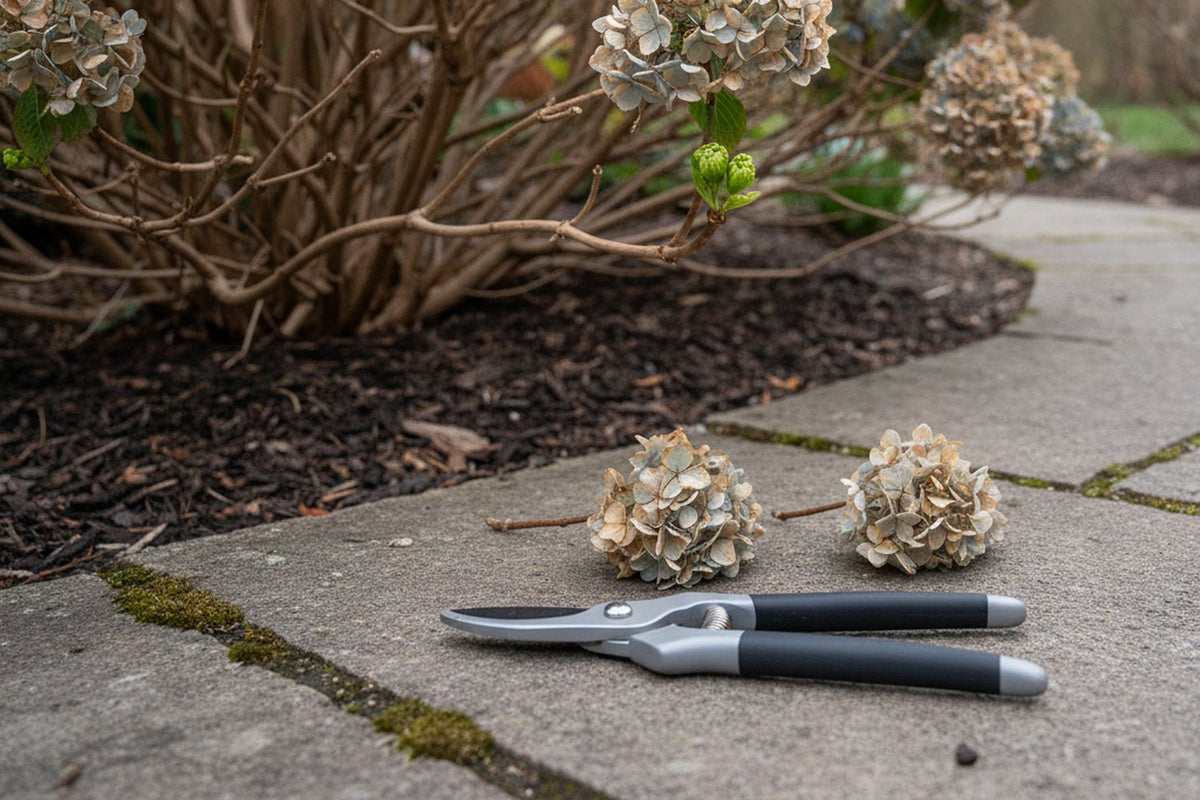
Deadheading is optional. UMD says dead-heading removes only spent flowers at the branch tips (no further down the branch), can be performed any time after flowers fade for any hydrangea type, and is not necessary for plant health, though it might encourage faster reblooming for hydrangea varieties capable of repeat flowering. UGA's Fulton County guide says to cut the flower stalks back to a pair of healthy buds or lateral branches. Illinois Extension's sheet says smooth hydrangea flowers appear in June, and a second floral display comes in August if spent flowers are removed. Leaving them is fine too: NYBG says many gardeners enjoy having the spent flower heads in the garden over the winter for a bit of structure and interest, and Proven Winners, writing about new-wood types, says that if you like the look of dried flower heads in winter, leave them on and prune them in spring, or prune in late fall to early winter where there is a heavy snow load or if you prefer a tidier look. For the cut itself, NC State Extension says scissor shears suit deadheading, the job of the Felco 322 snips (pick 4 in the tools below).
Decision chart: which hydrangea, and when to cut
- Does it climb a wall, tree or fence, or sprawl along the ground? Yes: climbing hydrangea. Prune lightly for shape after the flowers fade or in late summer (Illinois Extension, NYBG); UMD says it is not routinely pruned. No: go to 2.
- Are the leaves shaped like an oak's? Yes: oakleaf, old wood. Prune lightly, right after flowering (UGA Extension, Clemson; Proven Winners differs on old-wood timing). No: go to 3.
- Are the flowers cone-shaped, with 3 leaves at a node? Yes: panicle, new wood. Prune in late winter or early spring (UMD, NYBG). No: go to 4.
- Are the flowers blue or purple, or the leaves thick, shiny and coarsely toothed? Yes: bigleaf or mountain; go to 5 (UMD, NYBG). No: go to 6.
- Is it a reblooming variety, such as Endless Summer? Yes: prune in early spring or after the first flush, removing as little wood as possible (UMD). No: prune just after the flowers fade and before August (UMD, NYBG, Clemson); Proven Winners differs: it suggests pruning old-wood types only to remove completely dead branches in the spring.
- Big round white or pink flowers, such as 'Annabelle', on thin, floppy leaves? Yes: smooth, new wood. Prune in late winter or early spring (UMD, UGA Extension). No, or not sure: Proven Winners says if in doubt, don't prune, and that no hydrangea requires pruning to grow and bloom well.
Mistakes that cost a year of flowers
- Cutting an old-wood type late in the year. Clemson says to avoid pruning after August 1 to prevent removing next year's buds, and Proven Winners says that next summer's buds are already present on the branches in fall and winter, so you could inadvertently cut off flower buds and remove all of the blooms for the season; it says that doesn't harm the plant, but it's definitely disappointing.
- Cutting an old-wood shrub to the ground. UMD says a cut that removes most of the old wood means the plant might not flower well (if at all) for a year or longer.
- Pruning to keep it small. Proven Winners says pruning hydrangeas to reduce their height isn't effective because they will grow right back to their original size, or even larger, and says to transplant a too-large, still-dormant hydrangea to a new spot in early spring and replace it with a variety that naturally stays shorter; UMD gives the same two options.
- Cutting a tree-form panicle's trunk. UMD says the trunks should not be cut down, unless you want a shrub again.
- Blaming the pruning for every bloomless year. Illinois Extension says that if hydrangeas don't bloom for a season, it is likely due to not enough sun, an early frost, or incorrect pruning; Clemson says the most common reason hydrangeas fail to bloom is winter injury, with too much shade, poor soil fertility and excess nitrogen fertilizer among the other possible causes, and UGA's Fulton County guide says to avoid high-nitrogen fertilizers, as these can encourage excessive foliage growth at the expense of flowers.
The tools for the job
1. Felco F-2
Bob Vila's and Reviewed's best overall pruners.
| Pick | Job | Cuts up to | Fit | Best for | Our verdict | Where to buy |
|---|---|---|---|---|---|---|
| 1. Felco F-2Best bypass pruners | Most cuts | 0.98 in | Right hand, large | Most hydrangea cuts | Felco lists a 0.98 inch cutting diameter and a fully repairable design. | Check price on Amazon |
| 2. Fiskars Bypass PrunerPruners for green stems | Green stems | 5/8 in | Not listed | Green stems to 5/8 in | Bypass pruners for flower stems and green growth, up to 5/8 inch by its listing. | Check price on Amazon |
| 3. Fiskars 18 inch PowerGear2Lopper for old stems | Old stems | 1.5 in | 18 in long | Old stems at the base | An 18 inch geared bypass lopper for branches up to 1.5 inches thick, by its listing. | Check price on Amazon |
| 4. Felco 322 SnipsSnips for deadheading | Deadheading | 0.39 in | Either hand | Spent flowers | Bypass snips for young stems and flowers, 0.39 inch and 0.25 pounds by Felco's page. | Check price on Amazon |
| 5. Wells Lamont GlovesGloves for the job | Your hands | Not a cutter | Women, Medium | Grip and dirt | A 3-pack of PU-coated gloves for women in size Medium, with a ribbed elastic wrist. | Check price on Amazon |
When we checked on November 21, 2026, every tool we link was in stock as new and sold by Amazon. How our guides are made sets out what we check.
The Felco F-2 is for most of the cuts on this page: dead stems, spent flowers and stems cut back to a bud. Bob Vila names the Felco 2 its best overall pruner and says it is very strong and capable of cutting branches nearly 1 inch thick; Reviewed names it best overall too and says Felco pruners cut cleanly through every plant you're likely to encounter in your garden, from delicate flower stems to half-inch diameter branches; and Your Best Digs says it easily cuts through thick and thin stems up to 1/2 inch. Felco's page gives a cutting diameter of 0.98 inch and a fully repairable design with replaceable components, and Reviewed says it comes with a limited lifetime warranty and 22 different replacement parts. Good to know: Felco's page lists it for the right hand and a large hand size. Reviewed says its one-inch capacity depends on your hand strength, that the action can feel a little sticky on softer plant materials like raspberry canes, and that the lock can be hard to re-open one-handed; Your Best Digs says anything larger than 1/2 inch took a lot of grip strength.
2. Fiskars Bypass Pruner: for green stems
Best for: Green stems to 5/8 in
Bypass pruners for flower stems and green growth, up to 5/8 inch by its listing.
The Fiskars Bypass Pruner is a lighter second pair for green stems. Its listing calls it ideal for pruning delicate flower stems and green growth, gives cutting stems and small branches up to 5/8 inch in diameter, and lists a sap groove that keeps the blades from sticking and a lock. Bob Vila says it worked great for green wood and fairly well for drywood cuts up to its 5/8 inch listed threshold. Good to know: Bob Vila says its thin profile made it less comfortable, especially for hardwood cuts, that the slide lock felt light-duty and that it still doubts its long-term durability, though it performed better than expected; it also lists it as slightly heavier than comparable options.
3. Fiskars 18 inch PowerGear2 Lopper: for old stems at the base
Best for: Old stems at the base
An 18 inch geared bypass lopper for branches up to 1.5 inches thick, by its listing.
The Fiskars 18 inch PowerGear2 is for old stems cut low, the size NC State Extension gives to loppers: 1/2 inch to about 1 1/2 inches. Its listing gives an 18 inch bypass lopper that glides through up to 1.5 inch thick branches, with gears and a cam mechanism that it says power through the middle of branches, the toughest part to cut, and fully hardened bypass steel blades. It is also the compact pick in our best loppers guide. Good to know: NC State says extra mechanisms such as gears add weight that can make the tool cumbersome if working for long hours. None of the testers this page cites reviews this lopper, and Fiskars' own pages did not load for us, so its figures are the listing's; one of Bob Vila's lopper picks is a 28 inch Fiskars with the same stated 1.5 inch capacity (see Also considered).
4. Felco 322 Snips: for deadheading
Best for: Spent flowers
Bypass snips for young stems and flowers, 0.39 inch and 0.25 pounds by Felco's page.
The Felco 322 snips are for deadheading: NC State says you can use scissor shears for deadheading, cutting flowers, or pruning herbaceous plants. Felco's page lists them as picking and trimming snips with a 0.39 inch cutting diameter, a weight of 0.25 pounds and the longest reach in its range, for right-handed and left-handed users alike. Good to know: Felco gives their tool type as bypass for young branches, and 0.39 inch is under the 1/2 inch NC State gives for pruning shears; none of the testers this page cites reviews them.
5. Wells Lamont Coated Grip Gloves: for your hands
Best for: Grip and dirt
A 3-pack of PU-coated gloves for women in size Medium, with a ribbed elastic wrist.
The Wells Lamont gloves cover your hands. Virginia Cooperative Extension's publication on hand tools says to use personal protective equipment (PPE) such as goggles, gloves, appropriate clothing, and steel-toed shoes during the use of hand tools to minimize the number of injuries. Wells Lamont's page for style 413F gives a PU coating for grip, a breathable polyester shell and an elastic, ribbed wrist that keeps out dirt and debris, and the listing names pruning among their jobs. They are also the overall pick in our best gardening gloves guide. Good to know: Wells Lamont's page and the listing sell them as women's gloves, in a 3-pack of size Medium, and none of the testers this page cites reviews them.
Which tool for which stem?
NC State says to use pruning shears for small limbs, typically less than 1/2 inch in diameter, and loppers for branches 1/2 inch to about 1 1/2 inches; Clemson Extension's tree pruning sheet gives the same two bands and a pruning saw for branches larger than 1 1/2 inches. Other extension pages draw the lines differently: University of Maryland Extension's tools page gives hand pruners up to one inch and loppers up to three inches, and Virginia Cooperative Extension's table gives a bypass pruner 5/8 inch or less. NC State says that no matter the type of hand pruners you choose, never cut a stem too big for your tools: you will know this is happening if you have to squeeze too tightly to make the cut, and not only will you damage the tissue of the plant, but you may damage your pruners. UMD adds to cut by moving the blade side of the pruner up and through or across the branch, since moving the blade down through the branch can cause tearing.
To set each tool's stated maximum cut beside those sizes, the table works out max cut / NC State size = the tool's stated maximum cutting diameter / NC State's top stem size for that tool (1/2 inch for pruning shears, 1 1/2 inches for loppers), and, where the maker states both, blade length per ounce = blade length in inches / tool weight in ounces (pounds x 16).
| Tool | Max cut / NC State size | Blade in per oz | Max cut (in) | Blade length (in) | Weight (lb) |
|---|---|---|---|---|---|
| Felco F-2 (pick 1) | 1.96 | 0.25 | 0.98 (maker) | 2.17 (maker) | 0.55 (maker) |
| Fiskars Bypass Pruner (pick 2) | 1.25 | Not stated | 5/8 (listing) | Not stated | Not stated |
| Fiskars 18 inch PowerGear2 (pick 3) | 1.00 | Not stated | 1.5 (listing) | Not stated | Not stated |
| Felco 322 (pick 4) | No size given | 0.45 | 0.39 (maker) | 1.81 (maker) | 0.25 (maker) |
So the Felco F-2 opens to 1.96 times NC State's top size for pruning shears and the Fiskars Bypass Pruner to 1.25 times, while the 18 inch PowerGear2's 1.5 inches matches the top of NC State's lopper band, at 1.00; NC State gives no size for scissor shears, so the Felco 322 has none to compare. That headroom is not a target: Reviewed and Your Best Digs both say the top of the F-2's range takes grip strength. The Felco 322 carries 0.45 inch of blade per ounce against the F-2's 0.25, about 1.8 times as much. Bob Vila's spec box gives the F-2 8.5 ounces; the table uses Felco's 0.55 pounds. Fiskars' own pages did not load for us, so the Fiskars rows carry the listings' cutting sizes and no maker blade length or weight. The gloves cut nothing, so they are not in the table. For stems over 1 1/2 inches, our best pruning saw guide covers folding and fixed blade saws; our best pruning shears guide covers bypass, anvil, ratchet and cordless pruners, and our best loppers guide bypass, anvil, ratchet and telescoping loppers.
Clean, sharp tools
Clemson's hydrangea fact sheet says to use clean, sharp bypass pruners to reduce disease spread and to disinfect pruners between cuts to prevent disease transmission. UGA's Fulton County guide says to sterilize your pruning tools with rubbing alcohol or a bleach solution before pruning to prevent the spread of disease. UMD's tools page says to disinfect pruning tools if there is a danger of spreading infection from one diseased plant to another, cleaning them between pruning cuts with 70 percent alcohol, or bleach diluted one to nine with water, and to be sure to rinse bleach from tools, because it is corrosive to metal. Clemson's tree pruning sheet, on pruning out fire blight, says to sterilize pruning tools between cuts by dipping the blades in isopropyl rubbing alcohol or a solution prepared from one part household bleach to nine parts water, and that once all the pruning is completed, to be sure to lightly oil the pruners to prevent them rusting from the alcohol or bleach solution; for all pruning tools, it says to sharpen and oil their blades at the end of each season.
Virginia Cooperative Extension says to make sure the pruners are in good working condition and the blades are sharp, and that dull, sticky tools may cause slipping, which, in turn, can lead to cuts and other injuries. After each day's work, it says to wipe the blade clean with a dry cloth and lubricate the movable handle shaft and spring, to sharpen blades whenever extra effort is needed to make the cut, and to adjust the blade or replace worn out parts when the cut is not clean. Pick 2's listing gives its own care line: wipe pruners clean after each use to prevent sap build-up and lightly oil the blade for longer product life. Our how to clean, sharpen and store garden tools guide covers cleaning, rust, sharpening pruner blades and oiling. When we checked the CPSC's recall database on November 20, 2026, none of the five picks had a recall listed.
How we picked these tools
We compared each tool's maker page or listing for its stated cutting size, blade length, weight, hand fit and warranty, checked every pick against its Amazon listing and the CPSC recall database, took the tool advice from Bob Vila, Reviewed, Your Best Digs, NC State Extension, Clemson Extension, the University of Maryland Extension and Virginia Cooperative Extension, took the pruning advice from the University of Maryland, UGA, Illinois and Clemson extension services, the New York Botanical Garden and Proven Winners, and worked out each cutting tool's stated maximum cut against NC State's sizes, and its blade length per ounce where the maker states both, from the makers' and listings' own figures. We make digging spades, not pruning tools, so nothing on this page is ours. How our guides are made sets out the full process.
Also considered
Each was checked on November 20, 2026.
- Corona ClassicCUT bypass pruner (BP 3180D). In stock and sold by Amazon. Your Best Digs recommends it as another durable option, though it found it less balanced than the Felco F-2, which made pruning a little more awkward and might tire your hands over longer periods; Reviewed says it lacked finesse: it didn't slice cleanly through half-inch cottonwood branches, leaving strings and fibers dangling that had to be re-cut.
- Fiskars 28 inch bypass lopper. One of Bob Vila's lopper picks, for living green growth with a cutting capacity of branches up to 1.5 inches thick, which it lists as having no lock; it showed as in stock and sold by Amazon when we searched. It is 10 inches longer than pick 3 for the same stated capacity.
- Fiskars 32 inch PowerGear2 lopper. In stock and sold by Amazon; the longer version of pick 3 and the overall pick in our best loppers guide.
- Fiskars Micro-Tip pruning snips. Bob Vila's pick for flowers; the listing it links was sold by a third-party seller, not by Amazon.
- Silky PocketBoy folding saw. For stems larger than 1 1/2 inches, where Clemson points to a pruning saw; the listing we read was not yet shipping and was sold by a third-party seller, not by Amazon.
- Atlas NT370 gloves. Sold on Amazon by a third-party seller, not by Amazon.
Frequently asked questions
How do you prune hydrangeas?
It depends on the type. UMD says old-wood types (bigleaf, mountain, oakleaf) are pruned just after the flowers fade and new-wood types (smooth, panicle) in late winter or early spring; UGA's Fulton County guide says to cut out dead, diseased or damaged branches first and make clean cuts just above a healthy bud or lateral branch.
When should you prune hydrangeas?
The sources give seasons rather than one month: after flowering and before August for bigleaf and other old-wood types (NYBG, Clemson, which says to avoid pruning after August 1), and late winter or early spring for smooth and panicle types (UMD, Illinois Extension, Clemson). Proven Winners adds late fall or early winter for new-wood types once they have gone dormant.
What is the 1/3 rule for hydrangeas?
The sources give different limits. Proven Winners says never to remove more than one-third of a new-wood bloomer; Clemson says to remove only a third of a bigleaf's total growth; and NYBG says to prune back about 1/3 of an overgrown mophead's older stems almost to the ground each summer. Illinois Extension allows one-third to one-half of a new-wood shrub's total mass.
Do you cut off dead hydrangea blooms?
You can, but you don't have to. UMD says dead-heading is not necessary for plant health, though it might encourage faster reblooming for varieties capable of repeat flowering, and that it removes only spent flowers at the branch tips; NYBG says many gardeners enjoy the spent flower heads over the winter for structure and interest.
What happens if you don't cut back hydrangeas?
UMD says hydrangeas do not require extensive or regular pruning and that most pruning is done for aesthetic reasons, and Proven Winners says no hydrangea requires pruning to grow and bloom well.
What is the biggest mistake when pruning hydrangeas?
The sources name two. Cutting off next year's flower buds: UMD says many hydrangeas cannot replace flower buds that were accidentally removed, and Clemson says to avoid pruning bigleaf hydrangeas after August 1 to prevent removing next year's buds. And pruning to keep a hydrangea smaller, which Proven Winners calls a common misconception, since they grow right back to their original size, or even larger.
What tools do you need to prune hydrangeas?
Clemson says to use clean, sharp bypass pruners. NC State gives pruning shears to stems typically less than 1/2 inch, loppers to 1/2 inch to about 1 1/2 inches and scissor shears to deadheading. Our pick for the pruners is the Felco F-2, which Bob Vila and Reviewed both name their best overall.
Disclosure: Some links pay us a commission when you click or buy, and on some pages brands pay us through Amazon's creator program on links to their products.
Product prices and availability are accurate as of the date/time indicated and are subject to change. Any price and availability information displayed on Amazon.com at the time of purchase will apply to the purchase of this product.