As an Amazon Associate we earn from qualifying purchases. Some brands also pay us when you click or buy, so those links are ads. Full disclosure below
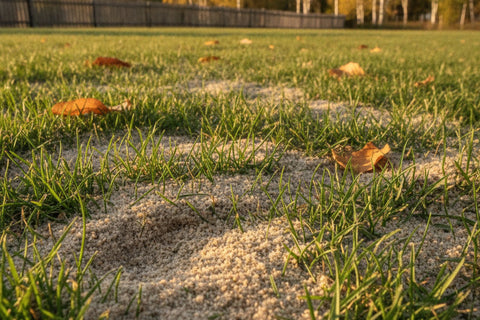
To level a yard by hand, mow low, spread a topdressing mix of sand and compost over the low spots, no more than half an inch per pass, and work it in with a leveling rake. Water it and repeat in a few weeks. Holes deeper than an inch need the sod cut, lifted, filled underneath, and laid back.
A bumpy lawn is annoying in three separate ways. It scalps when you mow, because the mower deck rides the high spots and shaves them, it holds water in the dips, and it catches a foot when you walk across it in the dark. A reel mower suffers most, because it needs a relatively smooth surface for a clean cut. How to level a yard and how to level a lawn are the same job, and one number decides the method: how deep the low spot is. Under about an inch you topdress and let the grass grow through it. Deeper than that you lift the sod and work underneath. Neither method fixes a grading problem, and telling that apart from a low spot is most of the job. Bare dirt with no grass on it is simpler still, and it has its own section below.
Which repair does your yard need?
Match what you see to the fix before you buy anything. Each repair has its own section further down this page.
- Shallow dips or general bumpiness, under about an inch, with live grass: topdress in thin passes and let the grass grow up through each one. See "How to level a lawn: low spots up to about an inch."
- A hole deeper than about an inch: cut the sod, fill underneath with soil that matches yours, and lay the sod back. See "Deeper holes."
- A raised bump or high spot: lift the sod and take soil out from underneath it. See "Bumps and high spots."
- Bare dirt with no grass: move soil from the highs to the lows, let it settle, then rake it smooth. See "How to level bare ground or a dirt yard by hand."
- A low area that stays wet for days after rain, or water running toward the house: that is grading or drainage rather than leveling, and often a job for a pro. See "Slopes, drainage, and when to call a pro."
Whichever fits, the lawn repairs work best while the grass is actively growing, so check "When to level a lawn" before you start.
Why yards go uneven
Lawns rarely settle unevenly for no reason, and the reason usually tells you whether topdressing will hold.
- Settling over disturbed soil. Backfill above utility trenches, an old stump hole, a filled pool, or the trench a builder left along a foundation keeps compacting for years. Those dips come back until the soil below stops settling.
- Freeze and thaw. In cold climates the surface heaves through winter and does not come back down flat. This is the most common source of general bumpiness.
- Animals and roots. Moles and voles push up ridges, grubs loosen turf that then sinks under foot traffic, and tree roots swell into visible humps.
- Wear and runoff. Foot paths pack down, and downspout outfalls and mower turns scour soil away.
- Bad topsoil to begin with. Thin topsoil spread over rubble or compacted subsoil never settles evenly. If a long screwdriver stops after two or three inches a day after rain, everywhere you try it, compaction is the real problem, and our lawn aeration guide is the place to start.
Fix the cause where you can. Redirect a downspout, deal with grubs, reroute a path with a stepping stone. Otherwise you will be topdressing the same dip every year.
Tools and materials
- Topdressing mix. Roughly equal parts sand and compost, or screened topsoil that resembles your existing soil. Sand alone is for sandy soils and thin passes only. A layer of pure sand over clay creates a boundary that water and roots both struggle to cross.
- A leveling rake, sometimes called a lute. A wide flat steel plate on a long handle. It is the tool that makes this job go quickly, because it spreads and levels in one pass without gouging the turf. Our guide to the best lawn leveling rakes matches head width to lawn size. Its best value pick is the VASALAID 36 by 12 inch stainless leveling rake.
- A landscape rake. A wide toothed head for grading bare soil, pulling out stones, and breaking clods before you smooth them. Our pick: the VEVOR 36 inch aluminum landscape rake.
- A wheelbarrow. Mixing sand and compost in the barrow beats mixing it on the lawn. Our wheelbarrow guide covers what to buy.
- A spade. For cutting and lifting sod over the deeper holes, and for the odd root you have to get under.
- A hose or sprinkler. Watering settles the topdressing into the canopy and keeps the grass growing through it. Start with a good garden hose; a sprinkler helps on bigger areas.
Sand, topsoil, or compost: what to use to level a lawn
The right fill depends on the soil you already have, because a layer that drains differently from the soil under it causes trouble. University of Minnesota Turfgrass Science explains that a topdressing whose particle size differs from the lawn's soil can change how water moves through it, and in extreme cases can create a perched water table, where the layer has to saturate before water drains any deeper. For that reason the Minnesota newsletter generally advises against sand or topsoil topdressing and prefers compost.
- Sandy soil: the one place sand belongs. Clemson Cooperative Extension's fact sheet on topdressing a home lawn (HGIC 1227) says sand should only be used to topdress lawns where the native soil is sandy, so the sand and compost mix in the steps below fits here.
- Clay or loam: use screened topsoil that closely matches the soil already there, or compost, rather than a sand-heavy mix. The same Clemson sheet says topsoil used for topdressing should closely mirror the native soil.
- Compost: Clemson says it can be used on every soil type, and the Minnesota newsletter calls it generally the preferred topdressing for lawns. Its October 2026 issue recommends no more than a quarter inch of compost at a time, lightly raked through the grass afterward, with a watering to help it settle.
- Holes under lifted sod: fill with soil that matches what surrounds the hole, as in the deeper holes section, so the roots grow back into the same kind of soil.
On depth, Clemson's sheet says to keep each application light, with no more than half an inch of material at a time, which is the limit this guide uses for a pass of sand, compost, or topsoil over grass. Compost on its own stays thinner, at the quarter inch the Minnesota newsletter recommends. The two sources differ on sand and topsoil and come from different regions, Minnesota and South Carolina, so your local extension office is the place to check advice for your own soil and grass.
The weeks between passes in the steps below are a typical gap in good growing weather, not a fixed schedule. Wait until the grass has grown up through the last layer before you add the next one.
How much topdressing or soil do you need?
Measure only the patches you are treating, not the whole yard. For each patch, multiply its length by its width in feet to get square feet, then work it out like this: square feet times the depth in inches, divided by 12, gives cubic feet. Divide cubic feet by 27 for cubic yards.
- A 10 by 10 foot patch is 100 square feet. At a quarter inch, 100 times 0.25 divided by 12 is about 2.1 cubic feet. At half an inch, 100 times 0.5 divided by 12 is about 4.2 cubic feet.
- Scattered dips that add up to 1,000 square feet need about 41.7 cubic feet at half an inch, which is roughly 1.5 cubic yards.
Half an inch is the most a pass should carry, and a dip is rarely that deep across its whole width, so a figure worked at full depth leaves some to spare. Bagged soil and compost labels give either a volume or a weight; where the label gives cubic feet, divide your total by it for the number of bags. Bulk soil is usually sold by the cubic yard. For scale, the Best Choice Products wheelbarrow in the tools below lists a 5 cubic foot capacity, so a half inch pass over a 100 square foot patch is a little under one full load. For whole lawn passes, our leveling rake guide, linked under Tools and materials, has a quantity table by lawn size.
How to level a lawn: low spots up to about an inch
This is the routine for general bumpiness and shallow dips, where the grass is still alive and you want to keep it. Nothing here needs a machine.
1. Mow a notch lower and clear the surface
Mow one or two notches lower than usual the day you start, and rake off clippings, leaves, and thatch. Short grass lets the topdressing fall to the soil surface instead of hanging in the canopy, and it lets you see the actual shape of the ground, which taller grass hides. If the lawn is compacted, core aerate first and leave the plugs to break down. If the rakings come up as thick mats of thatch, deal with that first, and our dethatcher picks cover the hand rakes and the powered machines.
2. Mark the low spots
Walk the lawn and put a flag or a stone at each dip in the morning or evening, when low light exaggerates them. Once you start spreading soil, every dip looks the same. Flag the sprinkler heads and any shallow lighting cable while you are out there, and call 811 before you open the ground over an old trench line.
3. Mix the topdressing
Mix roughly equal parts sand and compost in the wheelbarrow, or use screened topsoil that matches your soil. Break up any clumps: a clod sitting in a low spot becomes a new high spot. On a very sandy lawn, compost alone is fine.
4. Spread no more than half an inch at a time
Shovel small piles onto the low areas and spread them out. Half an inch is the working limit for a pass over living grass, and it is less material than it sounds. Grass smothers under a thick layer, and a lawn you buried is a reseeding job, not a leveling job. Deep dips get several thin passes across the season rather than one deep fill.
5. Work it in with the leveling rake
Drag the lute back and forth across each patch, then across the whole area at an angle to the first direction. You are pushing the mix down into the grass and off the high points, so the blades stand back up through it. When you are done, you should see grass through the topdressing everywhere. Anywhere it looks like bare soil, pull material off with the rake.
6. Water it in and let the grass grow through
Water enough to settle the mix into the canopy, then keep the area damp for a week or two. Do not mow until the grass has grown a good inch above the new surface, and take no more than a third off when you do. If any patch does end up thin, overseed it and keep it moist. Fall feeding helps the lawn knit back over the topdressing, and our fall lawn fertilizer picks cover what to put down.
7. Repeat in a few weeks
Give it three to four weeks of growing weather, look at the lawn again in low light, and do another half inch pass on whatever is still low. Two or three light passes across one season fix most bumpy lawns, and the result lasts because the grass grew through each layer instead of being buried under one.
Deeper holes: cut the sod, fill, and lay it back
Anything more than about an inch deep is not a topdressing job. Burying that much grass kills it, and adding half an inch at a time to a four inch hole takes years. Lift the turf instead and work underneath it.

Cut a square or an H shape around the hole with a spade, blade held vertical, about two inches deep. Then drop the handle low so the blade runs almost level, slide it under the root layer an inch or two down, and peel the sod back in one piece. Our D-handle garden spade suits this part of the job. It is double-patented, with the blade curved like a shovel to carry material while the edge is pointed and sharpened like a spade, pre-sharpened at the factory to a 35 degree bevel along the entire edge, tip to tail. The same tool cuts the vertical line, undercuts the roots, and moves soil in and out of the hole. Keep the sod in the shade and damp while it is off, and put it back the same day if you can.
Fill the hole with soil that matches what is around it, in layers, firming each layer with your foot or the back of the rake so it does not resettle into a dip a month later. Bring the fill up to an inch or two below the surrounding grade, matching the thickness of the sod you lifted. Lay the sod back, press it down, check that it sits flush by laying a board across it, and water it heavily. Keep it damp for two to three weeks while the roots reconnect, and stay off it. If the sod is too broken to reuse, fill and firm the hole, then seed or lay new sod, and our guide to removing sod covers cutting and lifting turf cleanly.
Bumps and high spots: lift, remove soil, relay
Bumps are the same operation in reverse, and most people try to fix them the wrong way, by mowing them shorter. That just scalps the grass off the top and leaves a brown patch on a bump you still have. Once the bump is gone, mow at the height your grass wants; our best lawn mowers guide lists the extension services' mowing heights by grass type and which mowers reach them.
Cut the sod around the high spot and peel it back the same way. Then dig soil out from underneath until the surface sits level with the ground around it, checking with a board or a string line rather than by eye, since a bump you are standing over always looks smaller than it is. Firm the base, lay the sod back, press it flush, and water it in.
Two exceptions. Ridges from moles or voles are tunnel collapse, so treat the animals first or you will be relaying sod all season; our guide to the best mole repellent covers telling the two apart and what to do about each. A hump over a tree root is the root growing, and you should leave it: cutting a structural root can destabilize the tree, and a mulched bed around the base is the better answer.
How to level bare ground or a dirt yard by hand
With no grass to protect, the half inch rule no longer applies and the job goes faster: you move soil from the high spots into the low ones and firm it so it stays put. This is the routine for a dirt yard before seed or sod, or ground a project left torn up. When the bare ground is ready for seed, our lawn spreader guide matches a spreader to the size of the area, from a handheld to a tow behind.
- Clear and loosen. Pull out rocks, roots, and debris. If the surface is packed or crusted, loosen the top two to four inches with a spade or garden fork so soil moves under a rake instead of skating over it, and break up clods as you go.
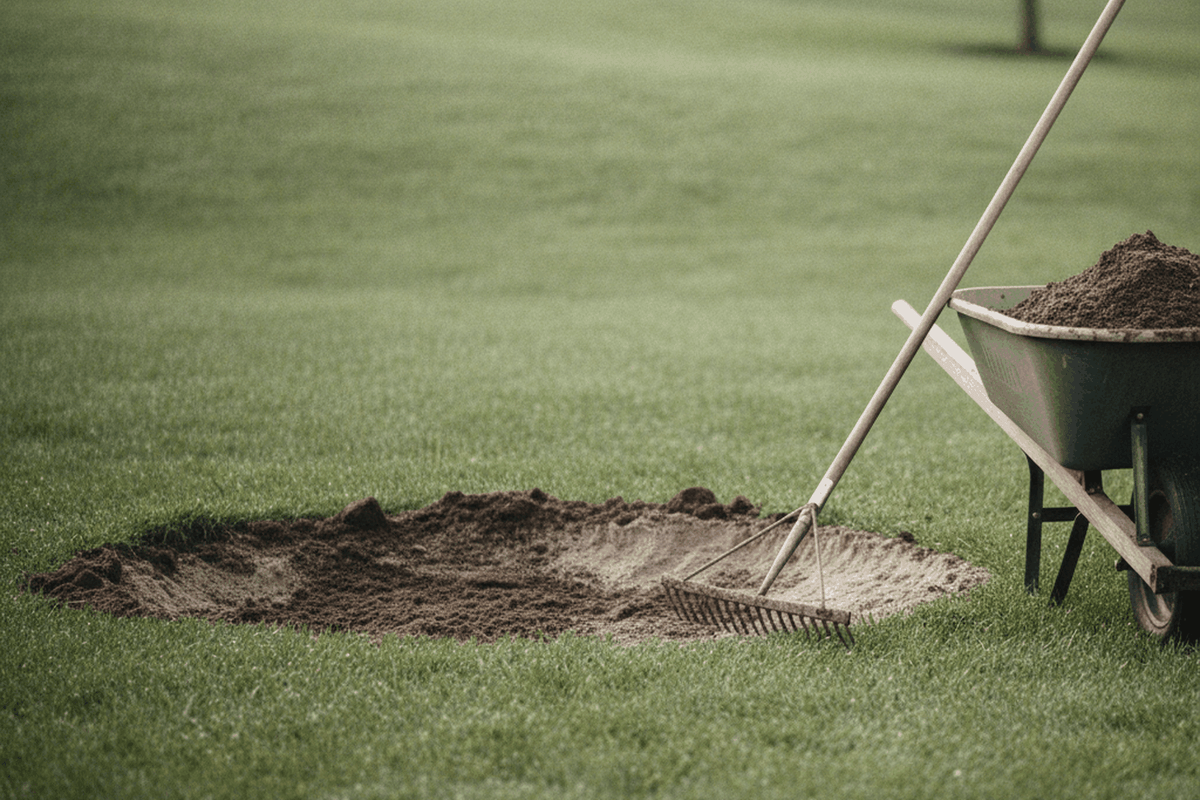
- Cut the highs and fill the lows. Move soil from the high spots into the low ones with a spade and the wheelbarrow, then spread it with the toothed side of a landscape rake. If you are short of soil, fill with screened topsoil that matches what is there, not pure sand over clay.
- Check it with a board or a string line. A straight 2x4 laid across the ground shows the highs and lows your eye misses. Over a larger area, set stakes and pull a string line to the finished height. Keep the ground falling away from the house, as covered below.
- Settle it before you finish. Loose fill settles, and settling is how a level yard turns lumpy again. Water the area thoroughly or walk it in with short, flat-footed steps, let it dry, then fill the dips that show up. A lawn roller does the same job on bare soil. On an established lawn, rolling to flatten bumps mostly compacts the soil, so keep the roller for seedbeds.
- Finish with the leveling rake. Drag the lute across the firmed surface in two directions for the final grade, then seed or lay sod.
Slopes, drainage, and when to call a pro
Leveling is not the same as grading. Leveling smooths the surface of a lawn that already drains. Grading changes where water goes, and that is a different job with real consequences.
A sloping yard does not have to be flat to be level in the sense that matters. A smooth, even fall mows cleanly and sheds water, so on a gentle slope the routines above still work: fill the dips and take down the bumps until the surface follows one even plane, checked with a string line pulled taut between stakes rather than with a level. Making part of a slope genuinely flat, for a play area or a patio pad, means cutting soil from the uphill side and moving it to the downhill side. By hand that is only realistic for a small patch: lift the sod first and set the topsoil aside, place the fill in thin layers and firm each one, spread the topsoil back before the sod, and expect the filled edge to settle for a season. Once the downhill edge would be steeper than a bank you can mow, roughly one foot of drop in three feet of run, it needs a retaining wall, and that is usually a machine and a pro job.
The rule that matters: never regrade so that water runs toward the house. Ground next to a foundation should fall away from it, and the standard recommendation is about six inches of drop over the first ten feet. If you are filling a low spot beside the house, check that you are not building a shelf that traps water against the wall instead of letting it run off.
Bring in a professional when the low area stays wet for days after rain, when water collects near the foundation or a basement window, or when the change would mean moving enough soil to need a machine. Topdressing a swamp just gives you a soft swamp. Persistent surface water usually needs a French drain, a dry well, or a regraded swale, sized by someone who does it for a living.
When to level a lawn
Level during the growing season, when the grass can knit back over new soil quickly. For cool season lawns such as bluegrass, fescue, and ryegrass, early fall is the best window, with spring second. For warm season lawns such as Bermuda, zoysia, and St. Augustine, late spring into early summer, once they are fully greened up and growing hard.
Do not topdress a dormant, drought stressed, or frozen lawn. Grass that is not growing cannot push up through the mix, and the layer just sits there and smothers it. Give the lawn at least six weeks of active growing weather after the last pass before it goes dormant.
Can you level a yard without equipment?
Yes. Every leveling method on this page is hand work, and none of it needs a machine. The minimum kit is a rake, a spade or shovel, something to carry soil in, and a straight board to check the surface. A machine only earns its place once the job turns into grading, moving enough soil to change a slope, as covered in the slopes section above.
A leveling rake makes topdressing quicker, but it is not the only way. On a small patch, the back of a bow rake can push topdressing down into the grass, and a straight 2x4 dragged across the surface knocks the high points into the low ones. Both take longer than a wide leveling plate.
Here is how the Amazon tools linked in this guide compare, from what each product's own listing states:
| Tool | Job in this guide | Size (per listing) | Build (per listing) |
|---|---|---|---|
| VASALAID lawn leveling rake | Spreads and levels topdressing over grass | 36 x 12 inch plate; 78 inch handle in three parts, adjustable | Stainless steel with a powder coat finish, fully welded |
| VEVOR landscape rake | Pulls stones and clods off bare soil | 36 inch head with 37 tines; 75 inch handle with two length settings | Aluminum alloy, spring-lock assembly |
| Best Choice Products wheelbarrow | Mixes and moves the topdressing | Holds up to 5 cubic feet; 330 lb weight capacity | Plastic bin on a powder-coated steel frame, two 14 inch inflatable wheels, padded handlebar that doubles as a stand |
Tools for this job
What leveling by hand actually calls for, from the topdressing mix to the rake that spreads it.

Spear Head Spade 40 inch D-Handle Garden Spade
Cuts the clean vertical line around a deep hole, slices under the sod so it peels back in one piece, then moves soil in and out of the hole.
VASALAID Lawn Leveling Rake, 36 by 12 inch stainless head
The lute is what makes this job quick: it spreads and levels topdressing in one pass without gouging the turf, on a 78 inch handle so you are not bent over.
Check price on AmazonVEVOR Landscape Rake, 36 inch aluminum head
The toothed head pulls stones, clods, and debris off the bare soil in a filled hole before you smooth it. Aluminum on a 75 inch handle, so it is light to swing and light duty: surface work, not moving heavy soil.
Check price on AmazonBest Choice Products dual-wheel wheelbarrow, poly tray, built-in stand
Mixing the sand and compost in the barrow beats mixing it on the lawn, and you will move more material than you expect. Two front wheels keep a full load of wet mix from tipping onto the turf, which is why it is the top pick in our wheelbarrow guide.
Check price on AmazonBagged topdressing sand and topsoil blend
Bagged sand and topsoil blends vary by region and shipping weight, so buy on what is local rather than on a brand, and skip pure sand over clay.
Check price on AmazonCommon questions
What is the best material to level a yard?
A mix of roughly equal parts sand and compost, or screened topsoil similar to your existing soil. The sand keeps the mix loose enough to spread and settle, and the compost feeds the grass growing through it. Avoid a thick layer of pure sand over clay, which creates a boundary that water and roots both struggle to cross.
Can you level a lawn without removing the grass?
Yes, for dips up to about an inch. Mow low, spread no more than half an inch of topdressing at a time, rake it into the canopy so the blades still show, water it, and repeat after a few weeks of growth. Anything deeper than an inch needs the sod cut and lifted, because that much material smothers the grass.
How much topdressing can you apply at once?
Half an inch over living grass, and no more. That is the limit the grass can grow up through in a couple of weeks. Two or three light passes across a season fix a dip that one deep fill would only trade for a dead patch. Deep holes are a cut and lift job instead.
When is the best time to level a lawn?
During active growth. Early fall is ideal for cool season grasses such as fescue, bluegrass, and ryegrass, with spring as the second choice. Late spring to early summer suits warm season grasses such as Bermuda and zoysia, after full green up. Never topdress a dormant, frozen, or drought stressed lawn.
How do you level a bumpy lawn?
Work out whether the bumps are high or the ground between them is low. Fill shallow dips with half inch passes of sand and compost worked in with a leveling rake. For raised bumps, cut and peel the sod, remove soil underneath until it sits flush, then lay it back and water. Mowing bumps only scalps them.
How do you level dirt by hand?
Loosen the top two to four inches, move soil from the high spots to the low ones with a spade and a wheelbarrow, and spread it with a landscape rake. Check it with a straight board or a string line, water it or walk it in so it settles, and fill the dips that appear. Finish with a leveling rake before you seed or lay sod.
How much soil do you need to level a yard?
Measure only the low patches, then multiply their square feet by the depth in inches and divide by 12 for cubic feet. A 100 square foot patch at half an inch takes about 4.2 cubic feet, and at a quarter inch about 2.1. Divide cubic feet by 27 for cubic yards.
Can you level a lawn with topsoil?
Yes, if the topsoil closely matches the soil already in your yard. Clemson Cooperative Extension in South Carolina advises topsoil rather than sand where the native soil is not sandy, applied no more than half an inch at a time, while the University of Minnesota generally prefers compost. A topsoil that drains differently from yours can form a layer that holds water, so screened topsoil similar to your own, or compost, is the safer fill.
Can you level a yard without a leveling rake?
Yes, on a small patch. Push the topdressing into the grass with the back of a bow rake, or drag a straight 2x4 across it. A leveling rake is faster, because its wide flat plate spreads and smooths the mix in one pass.
The bottom line
Most uneven lawns are a sand and compost job, half an inch at a time, in the growing season, with a leveling rake and a couple of passes a few weeks apart. Holes deeper than about an inch get the sod cut, lifted, filled underneath, and laid back. Anything that involves where water goes is grading, not leveling, and the one line never to cross is sending water toward the house.
Disclosure: some links in this guide are affiliate links to Amazon. This is at no extra cost to you, and it never changes our honest recommendations.
Product prices and availability are accurate as of the date/time indicated and are subject to change. Any price and availability information displayed on Amazon.com at the time of purchase will apply to the purchase of this product.