As an Amazon Associate we earn from qualifying purchases. Some brands also pay us when you click or buy, so those links are ads. Full disclosure below
To aerate a lawn by hand, water it the day before, then push a manual core aerator into the soil every four to six inches and leave the plugs to break down. Aerate in early fall for cool-season grass, late spring for warm-season grass, and overseed and fertilize while the holes are open.
Aeration is the lawn chore people skip for years and then wonder why the grass thins no matter how much they feed it. On clay, or on any lawn that gets walked, played, and parked on, the top few inches pack down until water beads, roots stall, and fertilizer sits on the surface. If the lawn is bumpy as well as compacted, our guide to leveling a yard covers the topdressing that follows aeration, and our best lawn leveling rake guide picks the rake that spreads it flat. This page is one stop on our fall yard cleanup tools checklist, which puts every fall job in order.
What aeration actually does
Healthy soil is about half pore space, the gaps that hold air and water and give roots somewhere to go. Foot traffic, mower wheels, and clay's own tendency to pack squeeze that space out of the top few inches. Roots stay shallow, the lawn dries out fast in July and puddles in April, and thatch, the layer of dead stems between the blades and the soil, builds up because the microbes that would digest it have no air. If the plug shows more than about half an inch of thatch, dethatch first; our dethatcher picks cover manual, electric and tow-behind.
Core aeration pulls plugs of soil, roughly half an inch across and two to three inches deep, out of the lawn at close spacing. Each hole is a channel for air, water, and fertilizer to reach the root zone, and the soil around it can expand into the space. The plugs left on the surface crumble and carry soil microbes into the thatch, which starts breaking it down.
Core aeration vs spike aeration: which is better?
Core aeration is better by a wide margin. A core aerator removes soil, which relieves compaction and leaves open channels that stay open. A spike aerator drives solid tines into the ground and pushes soil sideways, so each hole closes quickly and its walls are packed harder than before. Spikes suit a light pass before overseeding. Cores fix the problem.
When to aerate your lawn
Aerate when the grass is growing fast enough to heal, which depends on the kind of grass.
- Cool-season lawns: early fall. Bluegrass, fescue, and ryegrass, which is most lawns from the Mid-Atlantic and Ohio Valley north, grow hardest in fall. Aerate from late August through early October, at least six weeks before the first hard frost, so roots fill the holes before winter. Spring is the second choice, but it opens the lawn to crabgrass seed just as it germinates.
- Warm-season lawns: late spring to early summer. Bermuda, zoysia, St. Augustine, and centipede should be fully greened up and growing, which usually means May or June. Fall aeration opens holes they cannot close before dormancy.
- Soil moist, not wet, and grass green. Aerate a day after an inch of rain or irrigation. Dry clay will not let a tine in, saturated soil smears instead of releasing a plug, and a brown, dormant lawn cannot heal the holes.
The screwdriver test: does your lawn need aerating?
Push a long screwdriver into the lawn a day after watering. If it slides in six inches under hand pressure, the soil is open enough and you can skip this year. If it stops after two or three inches, or you have to lean on it, the lawn is compacted and will benefit from aeration.
Test several spots, because the strip along the driveway will fail while the back corner passes. Other signs are water pooling after rain, grass that thins in the same places every year, and thatch thicker than half an inch. To see it, cut a slice of turf with a sharp garden spade like our D-handle garden spade and lift it. A compacted lawn shows shallow roots stopping at a dense, pale layer an inch or two down.
How to aerate your lawn by hand, step by step
This is the method for a manual core aerator, the two-tine tool you drive with your foot, on lawns up to a couple of thousand square feet or the compacted strips of a bigger one.
1. Water the lawn the day before
Put down about an inch of water, or wait for a soaking rain, and aerate the next day. The soil should be moist through the full depth of the tines: soft enough to let them in, firm enough that a plug holds together. If you cannot push the tool in with your foot on the bar, the ground is too dry, and forcing it bends tines.
2. Mow a notch lower and mark the hazards
Mow a notch lower and rake off debris so the tines reach soil. Then flag every sprinkler head, shallow drip line, invisible fence wire, and low-voltage lighting cable. A core aerator only goes three inches or so, too shallow for most buried utilities but exactly deep enough to crush a sprinkler head.
3. Set the tool, step on the bar, pull straight up
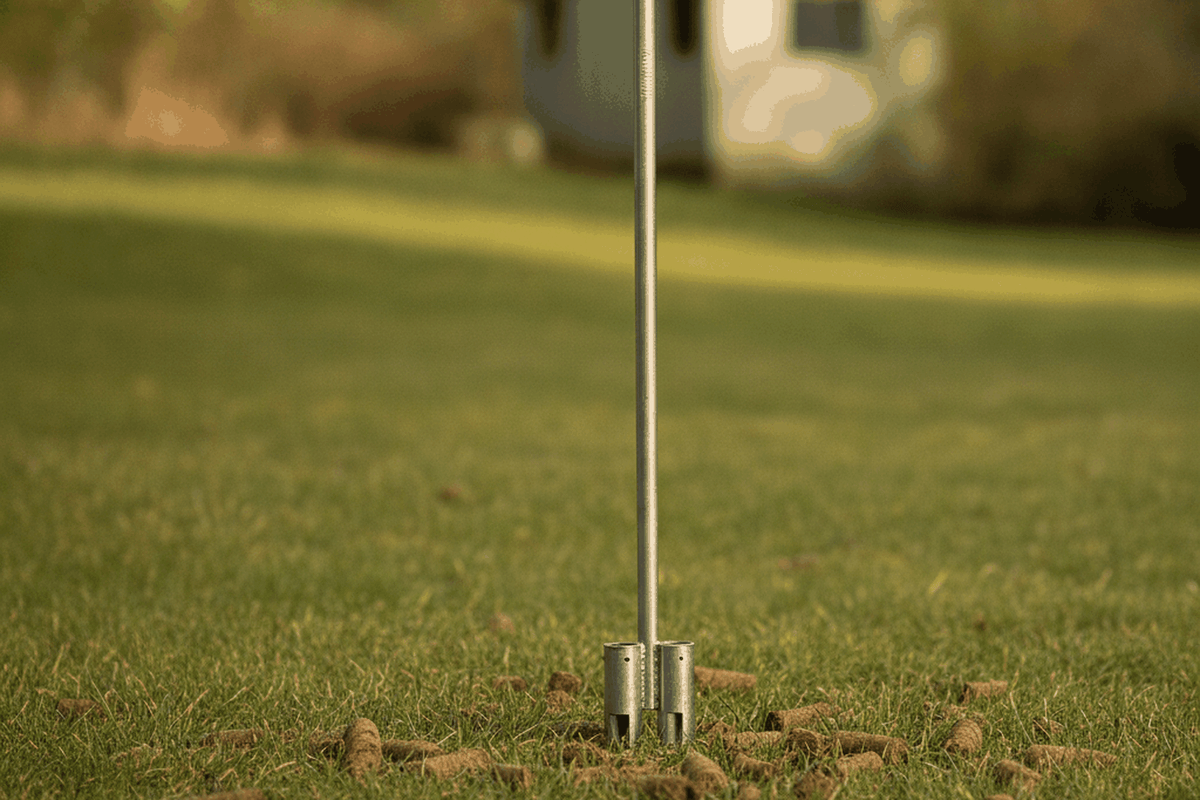
Start along one edge. Stand the aerator on the turf, put your weight on the foot bar until the tines are fully in, rock the handle slightly, and pull straight up. The plugs ride in the hollow tines and are pushed out by the next pair on the following stroke. Keep your back straight and let your leg do the pushing.
4. Work a grid, four to six inches apart
Move four to six inches between pulls and keep rows the same distance apart. Spacing matters more than depth. A manual tool pulls two plugs per push, so figure on two to four pushes per square foot.
5. Make a second pass at right angles
If the screwdriver stopped short across most of the lawn, run a second pass over the whole lawn at right angles to the first. If it only failed in places, second-pass just those: the traffic paths, the play area, the strip beside the driveway. They are packed hardest and need twice the holes.
6. Leave the plugs where they fall
Do not rake them up. They dry in a few days and break apart under the mower, and the soil and microbes in them go back into the thatch and help digest it. If the look bothers you, drag a landscape rake across the lawn once they are dry.
7. Overseed and topdress while the holes are open
The hour after aerating is the best seeding window the lawn will offer all year. Spread seed matched to your lawn at the overseeding rate on the bag, and if you have compost, rake a quarter inch across the surface so it falls into the holes with the seed, where it stays moist and hidden from birds. For a cool-season lawn, Scotts Turf Builder Rapid Grass Sun and Shade Mix blends Kentucky bluegrass, perennial ryegrass and fine fescue seed with fertilizer, and Scotts rates a 10 lb bag at up to 5,000 square feet when overseeding; because the feed is already in the bag, count it as the same-day feeding in step 8 and give the next lawn food about 8 weeks later, as Scotts advises. Hitting the rate on the bag is the part hand scattering gets wrong, since it doubles up in some strips and leaves others bare, and our fertilizer spreader picks cover the broadcast and drop models that meter seed and feed evenly.
8. Fertilize, water lightly, and stay off it
Feed the lawn the same day. For a cool-season lawn in early fall that means a nitrogen-led fertilizer, or a blend with some phosphorus if you overseeded, and our guide to the best fall lawn fertilizers covers what to buy and how much to put down. If you have never tested the soil, one of the soil test kits we recommend tells you whether the lawn needs lime or phosphorus before you spend on either. Then water lightly and often, enough to keep the top inch damp for two weeks if you seeded, and keep feet, dogs, and mowers off until the new grass is tall enough to cut.
What to do after aerating
Seed, then fertilizer, then water, in that order, while the holes are open. If part of the lawn sits under trees, our best grass seed for shade guide sorts the seed by how many hours of sun that spot gets. Mow when the new grass reaches three inches, taking no more than a third off, and hold off on weed control until you have mowed the new grass two or three times, since most pre-emergent and broadleaf products stop new grass too. Expect the lawn to look slightly worse for a week and noticeably better after a month.
Tools for this job
Match the tool to the square footage: a manual corer for a small lawn and the bad spots on a medium one, a rolling tool for more ground with less benefit, a tow-behind plug aerator for a large lawn if you already own a riding mower. And for a lawn over about 5,000 square feet with no tractor, renting a gas-powered core aerator for a half day beats every product here. For a full comparison of tow behind, push and manual machines, see our guide to the best lawn aerators.
1. Yard Butler Manual Lawn Coring Aerator: best manual core aerator
The Yard Butler Manual Lawn Coring Aerator is the standard hand tool for this job, and the one the steps above assume. Two hollow powder-coated steel tines pull a pair of plugs on every push, a foot bar gives you leverage, and the long handle lets you work standing with your leg doing the pushing rather than your back. Where it loses: at two plugs per push it is a couple of hours per thousand square feet, so it suits small lawns and spot compaction, and wet clay can pack inside the tines, which you clear with a screwdriver.
2. Agri-Fab 16 inch Push Spike Aerator: best rolling aerator for mid-size lawns
The Agri-Fab 16 inch Push Spike Aerator is a spike tool, not a core tool, and it does not remove soil. Five spiked steel wheels across a 16 inch width punch holes up to two and a half inches deep as you push it like a mower, and a steel weight tray takes a concrete block, which you supply, to drive the spikes into hard ground. It is the practical choice for a light pass before overseeding on a lawn too big to hand-core and too small to justify a tow-behind. For a wider, sturdier rolling tool, the Brinly 20 inch Premium Push Spike Aerator has galvanized star tines, a 35 pound weight tray, and transport wheels, and is rated for lawns up to half an acre.
3. Ohuhu Lawn Aerator Shoes: the cheapest option, and the weakest
Ohuhu Lawn Aerator Shoes are strap-on spiked soles that you walk the lawn in, and they are here mainly as a warning. Your body weight drives short spikes into the turf, which removes no soil and packs the walls of each hole tighter. On a tiny patch before overseeding they open the surface a little. As a fix for compaction they do nothing, and if that is your problem the Yard Butler above costs a little more and works.
4. Brinly 40 inch Tow Behind Plug Aerator: best for large lawns with a riding mower
For a large lawn with a lawn tractor or zero-turn mower, the Brinly 40 inch Tow Behind Plug Aerator pulls real plugs behind the mower on your own schedule. Twenty-four heat-treated steel plugging spoons pull plugs up to three inches deep across a 40 inch swath, an enclosed tray holds up to 150 pounds of weight for penetration in hard ground, and a transport lever lifts the spoons onto the tires for crossing the driveway. For lots over an acre, the Agri-Fab 48 inch plug aerator pulls plugs up to 3 inches deep with 32 galvanized knives, and its weight tray takes up to 175 pounds. Where it loses: it needs a tractor and storage, and for a once-a-year job on a lawn under an acre, a half-day rental each fall costs less for the first few seasons.
Common questions
When is the best time to aerate your lawn?
Early fall for cool-season lawns such as bluegrass, fescue, and ryegrass, roughly late August through early October, when the grass is growing strongly and has six weeks to recover before frost. Late spring to early summer for warm-season lawns such as Bermuda, zoysia, and St. Augustine, after they have fully greened up. Never aerate dormant or drought-stressed grass.
Is it better to aerate with a core aerator or a spike aerator?
A core aerator, every time. Hollow tines remove plugs of soil, which leaves open channels for air, water, and roots and loosens the soil around each hole. Spikes push soil aside, so the walls of each hole are packed tighter than before. Spike tools are fine for a light pass before overseeding, but they do not fix compaction.
How often should you aerate a lawn?
Once a year for most lawns on clay soil or with regular foot traffic, and every two to three years for lawns on sandy or loamy soil that drain well. Aerate whenever the screwdriver test fails: if a screwdriver will not slide six inches into moist soil with hand pressure, the lawn is compacted enough to benefit.
Should you aerate before or after overseeding?
Before. Aerate first, then spread seed the same day so it falls into the open holes, where it stays moist and in contact with soil instead of sitting on top of thatch. Follow the seed with a fall lawn fertilizer and light, frequent watering. Seeding first and aerating afterward buries some seed too deep and crushes the rest.
Do lawn aerator shoes actually work?
Barely. Aerator shoes push short spikes into the ground under your body weight, which compacts the soil around each hole rather than removing any. They can help seed settle on a tiny patch, but they do not relieve compaction. A manual core aerator costs a little more and does the real job.
The bottom line
Aerate with cores, not spikes, in early fall for cool-season grass and late spring for warm-season grass. For a small lawn or the compacted strips of a bigger one, the Yard Butler coring aerator and an afternoon are all it takes. Over about 5,000 square feet, rent a machine or, with a tractor, buy the Brinly. Then seed, feed with a good fall lawn fertilizer, water lightly, and let the plugs lie. If your soil test calls for lime, coring helps it work too, and our best lime for lawns guide covers which kind to buy and how to time it around feeding.
Disclosure: some links in this guide are affiliate links to Amazon. This is at no extra cost to you, and it never changes our honest, use-based recommendations.
Product prices and availability are accurate as of the date/time indicated and are subject to change. Any price and availability information displayed on Amazon.com at the time of purchase will apply to the purchase of this product.