As an Amazon Associate we earn from qualifying purchases. Some brands also pay us when you click or buy, so those links are ads. Full disclosure below
Improve clay soil by adding organic matter, not sand. Spread two to three inches of compost on the surface every year, or work two to four inches into the top six to eight inches when you open a new bed. Fall is the best time. Expect real change in three to five seasons.
Clay soil is not a defect to be corrected. It is a texture, and texture is permanent. What you can change is structure: how those particles clump, how water moves through them, and how hard the ground is to work. That distinction matters, because most popular clay remedies try to change texture, and they do not work.
Below: how to confirm you have clay, what to add and at what rate, the two fixes the evidence does not support plus two quieter mistakes, and when to dig or stay off.
How do you know if you have clay soil?
Two field tests settle it and neither costs anything. Wet a lump and squeeze it into a ribbon: clay ribbons past two inches before it snaps. For numbers, shake soil and water in a jar and read the settled layers, because above about 40 percent clay you have a clay soil.
The ribbon test. Wet a walnut-sized lump to the consistency of putty, then squeeze it upward between thumb and forefinger into a flat ribbon. Sand feels gritty and will not ribbon, silt feels floury and breaks within an inch, and clay feels slightly sticky, takes a shine when rubbed, and ribbons past two inches before it snaps.
The jar test gives numbers. Fill a straight-sided jar one third with soil, top with water and a drop of dish soap, shake hard, then leave it to settle and read the layers.
- After one minute, mark the top of the sand layer at the bottom.
- After two hours, mark the top of the silt layer above it.
- After two days, mark the top of the clay layer, the last to settle. The water above may still be cloudy.
Measure each band and divide by the total. Above about 40 percent clay you have a clay soil, and 27 to 40 percent is a clay loam, which behaves the same way in a wet spring. Below that, the hardness is compaction rather than texture, and the fix is different.

What is clay soil actually good for?
Clay holds water and nutrients far better than sandy soil does, so a clay garden survives a dry August much better and needs less feeding. That is the trade you get for the stickiness. The goal is not to turn clay into something else, it is to make what you have workable.
The reason for both halves is particle size. Oregon State Extension puts it in scale: the largest clay particle is more than a thousand times smaller than the smallest sand particle. Packed that tightly, the soil drains slowly and turns sticky when wet and brick-hard when dry, and the same fine pores are what hold the water and nutrients in place.
What should you not add to clay soil?
Do not add sand, and do not buy gypsum without a soil test. Four amendments get recommended constantly for clay and only one has a defensible case. Sand is the outright mistake, gypsum treats sodium rather than clay, peat holds more water in ground that already holds too much, and lime is a pH decision, not a structure one.
| What people add | The claim | What the evidence says | Do this instead |
|---|---|---|---|
| Sand | It loosens clay and improves drainage | Oregon State Extension: no amount of sand added to clay will change its texture, and the large particles give clay a surface to cling to | Put the money and effort into compost |
| Gypsum | It breaks up heavy clay | Works on sodic soils, where sodium has destroyed structure. LSU AgCenter says it will not loosen ordinary clay, and Washington State University reports effects that are often a matter of months | Soil test first, and buy only if sodium or calcium says so |
| Peat moss | It lightens heavy soil | Acidic, holds still more water in ground that already holds too much, and gone in a few seasons | Compost, leaf mold or composted bark |
| Lime | It sweetens and loosens clay | Raises pH and adds calcium. That is a pH decision, not a structure decision | Lime only when a test shows the pH is genuinely low |
Sand is the one to avoid outright
This is the most common clay advice and it is wrong. Extension guidance is direct: no amount of sand added to clay soil will change its texture, and the large sand particles give clay a surface to cling to, creating harder conditions than you started with. The result gets described as concrete-like for a reason.
It fails on volume. LSU AgCenter puts the threshold at roughly half the soil, so changing the top six inches means six inches of sand tilled in over two passes. Anything less fills the gaps between the grains with clay, which is closer to mortar than to soil.
Gypsum treats sodium, not clay
Gypsum is calcium sulfate, and the theory is reasonable: free calcium ions carry a positive charge, clay particles carry a negative one, and the calcium encourages clay to clump into larger aggregates with pore space between them. Where that chemistry has real work to do is sodic soil, in which excess sodium has destroyed the structure and calcium displaces it.
Most garden clay is not sodic, and that is the whole question. LSU AgCenter's soil scientists put it plainly: outside the arid western United States and some coastal areas where clay can be high in sodium, gypsum is not generally beneficial as a soil-softening amendment and will not loosen the soil. Washington State University's review reaches the same place from the other direction. It grants that gypsum changes the structure of heavy clay under intensive agriculture, then adds two limits for everyone else: the effects are short lived, often a matter of months, and gypsum works poorly on the layered, compacted profiles typical of urban lots.
How to tell whether your clay is actually sodic
A lab test is the only way, and it is the same standard test that answers the lime question. Sodic is a defined threshold, not a judgment call: an exchangeable sodium percentage above about 15, or a sodium adsorption ratio of 13 or more. Ask for sodium and calcium on the report. If you come back under those numbers, gypsum has nothing to fix on your ground, and if you come back over them the lab sets the rate, which is the honest answer to how much gypsum to add.
Peat and lime are the quieter mistakes
Peat moss reads like a soil conditioner and behaves like a sponge: in ground that already holds too much water, a material prized for water retention is the wrong direction, and it is gone in a few seasons. Lime has a real job, raising pH and supplying calcium, and it is not a structure treatment. Add it because a test says your pH is low, never because the ground is hard. Our guide to the best lime for lawns covers choosing and spreading it from a soil test.
What should you add to clay soil, and how much?
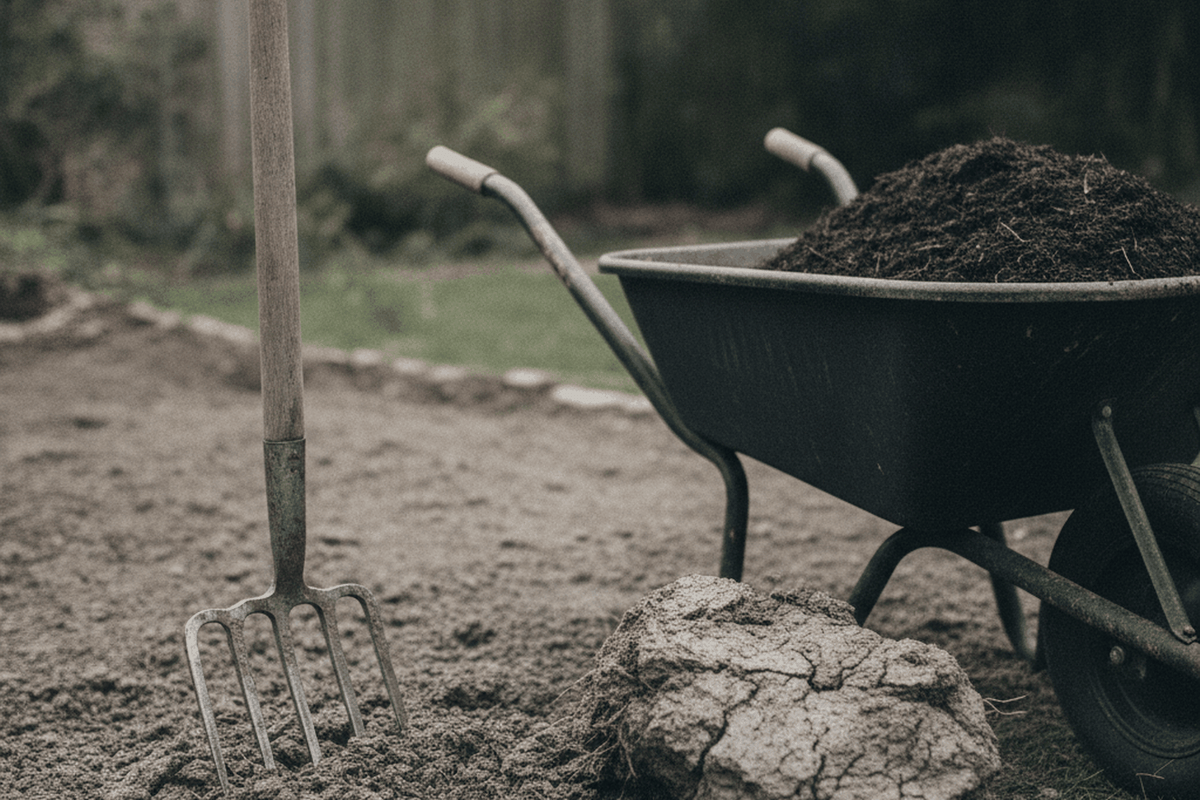
Compost, leaf mold, aged manure and bark all improve clay by feeding the biology that builds soil structure. Aggregates form, pore space opens, water infiltrates instead of ponding, and the ground works across a wider moisture range. The rate is two to three inches a year on the surface, which is 17 to 25 cubic feet per 100 square feet.

Rates below are per 100 square feet, a bed about 10 by 10. Extension guidance is written as depths, so the volumes are the arithmetic: one inch over 100 square feet is 8.3 cubic feet.
| Amendment | Rate per 100 sq ft | What it does | How long it takes |
|---|---|---|---|
| Compost or leaf mold, surface applied | 2 to 3 inches, 17 to 25 cubic feet, or 9 to 13 two-cubic-foot bags | Feeds the organisms whose secretions glue particles into aggregates | Top few inches in one season |
| Compost, dug in for a new bed | 2 to 4 inches worked into the top 6 to 8 inches, 17 to 33 cubic feet | Builds a workable rooting zone at once | Immediate, once only |
| Aged manure | 1 to 2 inches, applied when roots are growing | Organic matter plus nitrogen | One season, and it leaches on bare winter ground |
| Composted bark or wood chips | 2 to 3 inches on the surface, not dug in | Slows evaporation, stops the surface hardening | Two or more seasons, and ties up nitrogen if mixed in |
| Gypsum | Only the rate your soil test specifies | Displaces sodium in genuinely sodic soil | Often only months |
The part most advice leaves out is that this is not a one-time fix. Oregon State's Linda Brewer puts it plainly: repeated additions do change clay soils, but they must be at least annual, and the soil will remain clay forever.
One caution: microorganisms breaking down wood chips use the same nitrogen your plants want, so spread fresh chips on the surface in fall rather than mixing them in. Our compost bin picks cover the bins that finish a batch, and our guide to the best compost tumblers covers the drums that finish one fastest.
How do you improve clay soil, step by step?
Seven steps in order, though the season matters more than the sequence. Fall is the best time to start in most of the country: the ground is workable, a cover crop has all winter to work, and anywhere the ground freezes hard, a winter of freeze and thaw breaks clods better than any tool you own.
1. Test the soil before you buy anything
A test costs about what one bag of amendment costs and settles two of the questions above: it reports pH, so you know whether lime has a role, and sodium and calcium, the only thing that makes gypsum worth buying. Our soil test kit picks cover which kits tell you something.
2. Wait for the soil to crumble, not smear
Squeeze a handful. A sticky ball that smears means stay off, one that crumbles under a poke means you can work, and in most of the country that window opens in early fall and again in late spring.
3. Spread two to three inches of compost on the surface
Oregon State Extension recommends two to three inches of bark, manure, leaf mold or compost spread on top of beds rather than dug in, which over 100 square feet is 17 to 25 cubic feet. Worms and roots pull it down, and the layer slows evaporation and surface hardening.
4. Dig it in only when you are opening new ground
When the bed does not exist yet, incorporation is worth doing once: two to four inches of compost into the top six to eight inches, which is where LSU AgCenter places the feeder roots of shrubs, vegetables and flowers. On raw builder clay, UGA Extension goes a little heavier for a new planting site, working in a three to four inch layer of organic amendment. After that, go back to layering on top.
5. Mulch the surface and keep it mulched
Bare clay bakes into a crust that sheds water, and shredded bark or wood chips stop that. Rutgers caps total mulch depth at three inches, and at two on compacted or poorly drained soils, which describes most clay. Keep it off stems and trunks.
6. Put a cover crop on any bed you are not using
Roots do the loosening you would otherwise do with a fork. Winter rye, crimson clover, hairy vetch and daikon radish all push through heavy ground, and the radish drills channels that stay open after it rots. Our cover crop guide has what to sow and when.
7. Repeat every year, and stay off the beds
One heavy amendment followed by nothing drifts back toward where it started, so repeat the surface application at least annually. Keep permanent paths, keep beds narrow enough to reach across, and never walk on wet clay: compaction undoes a season of work in an afternoon. If those paths are gravel, a woven fabric under the stone keeps it from sinking into the clay, and our guide to weed barrier fabric picks one for the job.
When should you dig clay soil, and when should you never?
Working clay wet does more damage than any missing amendment. Water acts as a lubricant, letting particles slide together and squeezing out the large pores that hold air and let water through, so digging, walking on or rototilling wet clay destroys structure you may have spent seasons building.
The test is simple. Squeeze a handful: a sticky ball that holds its shape and smears when you rub it means stay off, and one that crumbles apart when you poke it means you can work.
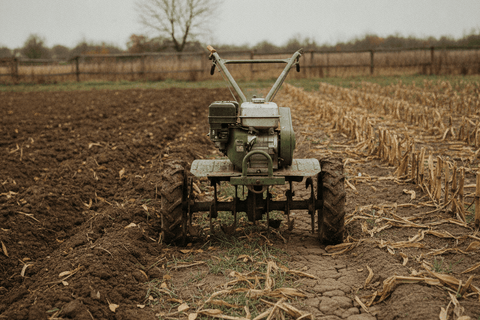
Never run a tiller through wet clay. It is the classic mistake, and worse than digging, because the tines pulverize the aggregates you are trying to build and can smear a compacted pan at the depth they reach. A tiller has one real use here, the single incorporation pass when you break new ground and the soil is dry enough to crumble. Our garden tiller guide covers which machines suit that job.
Compacted clay under a lawn is a different problem with a different tool. Pulling cores rather than poking holes relieves it without inverting anything, and our lawn aeration guide covers timing and core spacing. If the lawn over that clay is bumpy too, our guide on how to level a lawn covers what to topdress with so you do not build a sand layer on top of it.
Are raised beds the shortcut?
Yes, and they are the honest answer for anyone who wants vegetables this year rather than in three seasons. A raised bed lets you garden above the clay while the clay improves underneath, and our raised bed guide covers sizing them so you never have to step in.
Two rules separate a raised bed that works on clay from one that drowns. Loosen the clay underneath before you fill, with a fork rather than a tiller, so roots and water pass the boundary instead of stopping at it. And never dig a deep hole in clay and backfill it with light potting mix. LSU AgCenter calls the result a bathtub: water runs through the loose mix, hits the clay walls and bottom, and sits there until roots drown. Their fix is to go up instead, building about 12 inches of bed on top of the existing soil, which drains and still gives roots room.
What tools actually help in clay?
A sharpened, pointed spade and a digging fork, and a tiller only for the one incorporation pass on new ground. Take smaller bites than you would in loam, because a full blade of wet clay is heavy and will not release cleanly, so cutting a narrow slice and lifting it beats wrestling a large one. Our best shovels for digging guide sorts the spade and shovel shapes by the ground each one suits, clay included.
Tool geometry matters more in clay than in easy ground, because a blade has to cut in rather than bounce off a dry surface. Our D handle garden spade is double patented, with a blade curved like a shovel to carry material and an edge pointed and sharpened like a spade to cut, and the profile finds the path of least resistance around obstructions rather than stopping dead against them. Your weight goes onto the foot rest and the point enters at one spot rather than the whole width at once, which is why it takes up to 80% less effort than a standard shovel in hard, clay or rocky ground. For root-matted clay, our guide on digging through roots has the technique.
A digging fork is the other tool worth owning here, because it loosens and lifts without inverting, and it breaks the clods a spade turns up.
What plants thrive in clay soil?
Plenty, and choosing well buys you years while the soil improves. Clay's water and nutrient holding suits deep-rooted perennials, most shrubs and nearly all trees that tolerate wet feet. It suits nothing that needs sharp drainage or a long straight root run.
| Category | Thrives in heavy clay | Skip, or grow in a raised bed |
|---|---|---|
| Perennials | Daylily, coneflower, black-eyed Susan, aster, bee balm, Siberian iris, hosta in shade | Lavender, Mediterranean herbs, alpines, anything needing sharp drainage |
| Shrubs | Viburnum, ninebark, red twig dogwood, panicle hydrangea, spirea, and roses, which do particularly well on clay | Blueberries, which want acid and drainage, and dryland shrubs |
| Trees | River birch, swamp white oak, bald cypress, red maple, honeylocust | Anything native to sandy ground, and most stone fruit on a wet site |
| Vegetables | Brassicas, beans, squash and pumpkins, and late crops that want moisture in August | Carrots, parsnips and other long roots, which fork in dense ground |
Regional note. In the humid East and Midwest the problem is a wet spring, so plant early in fall and choose species that tolerate saturation. In the arid West and on some coasts, clay is often alkaline and salty as well as heavy, and those are the settings where a test may genuinely point at gypsum. Washington State University adds the heavy clays of the Southeast to that short list.
How long does it take to improve clay soil?
Clay improves gradually. The first season of added organic matter makes the top few inches noticeably easier to work, and three to five years of annual applications turns builder clay into ground that digs and drains like decent loam. It is still clay underneath, and per Oregon State it always will be.
That is the part worth making peace with. In the meantime, a clay garden that is mulched, undisturbed and planted well outperforms one that is repeatedly dug in the wrong conditions in pursuit of a texture it will never have.
Tools for this job
What actually helps with clay, and nothing the guide tells you to skip.

Clay needs a blade that cuts in rather than bounces off, and taking a narrower slice with a sharpened spade is faster than wrestling a full blade of heavy clay.
Spear & Jackson Neverbend Professional Digging Fork
A digging fork breaks clods and works two to four inches of compost into the top six to eight inches when you are establishing a bed.
Check price on AmazonBlack Kow Composted Cow Manure, 35 lb bag
Composted manure is the organic matter that opens tight clay and feeds the soil life that keeps it open, dug in when you first make a bed and spread on top every year after.
Check price on AmazonThe guide says to test before you buy gypsum, and a mail-in test gives you pH and nutrient numbers rather than a guess.
Check price on AmazonCountryMax Natural Shredded Hardwood Mulch, 2 cu ft
Mulching the surface stops clay baking hard between rains and slows the evaporation that makes it so unpleasant to work.
Check price on AmazonCommon questions
Does adding sand improve clay soil?
No. Extension guidance is explicit that no amount of sand added to clay will change its texture, and that sand gives clay particles a surface to cling to, producing harder conditions than before. Organic matter is what works.
Does gypsum work on clay soil?
Only on sodic clay, where excess sodium has damaged the structure and calcium displaces it. LSU AgCenter says that outside the arid West and some coastal areas, gypsum will not loosen ordinary clay soil. Most garden clay is not sodic, so get a soil test before you buy any.
How much gypsum should I add to clay soil?
Only the amount a soil test tells you to add, and on most garden clay that amount is none. It is worth buying when a lab reports an exchangeable sodium percentage above about 15 or a sodium adsorption ratio of 13 or more, and the lab sets the rate. Washington State University notes the effects are often a matter of months.
How do you improve clay soil quickly?
There is no quick fix, and treating it as one is why people end up adding sand. The fastest legitimate route is two to four inches of compost worked into the top six to eight inches when establishing a bed, then annual surface additions.
When should you dig clay soil?
When it crumbles rather than smears. Squeeze a handful: if it forms a sticky ball that holds together, the soil is too wet and working it will compact the structure, because water lets the particles slide together and closes the pore space.
What is the best tool to break up hard clay soil?
A digging fork for loosening and a sharpened, pointed spade for cutting and lifting, because both work with the soil rather than pulverizing it. A rotary tiller is most likely to make things worse: it shatters the aggregates you are building and can smear a hard pan at the depth the tines reach.
Do coffee grounds help clay soil?
Only as part of a compost pile. Spent grounds are a nitrogen source, not a soil conditioner, and a layer on the surface can cake and shed water. Compost them first.
Is clay soil bad for gardening?
No. Clay holds water and nutrients better than sandy soil, so clay gardens are more drought-resilient and need less feeding. The difficulty is workability and drainage, and both improve with organic matter and by staying off the soil when it is wet.
The bottom line
Organic matter is the only amendment that reliably improves clay, sand is the one to avoid outright, and gypsum is worth buying only when a soil test says sodium or calcium is the problem. Spread compost every year, stay off the ground when it smears, and let raised beds carry the vegetables while the clay catches up.
Disclosure: some links in this guide are affiliate links to Amazon. This is at no extra cost to you, and it never changes our honest, use-based recommendations.
Product prices and availability are accurate as of the date/time indicated and are subject to change. Any price and availability information displayed on Amazon.com at the time of purchase will apply to the purchase of this product.