As an Amazon Associate we earn from qualifying purchases. Some brands also pay us when you click or buy, so those links are ads. Full disclosure below
To remove sod, cut the turf into strips about a foot wide, undercut each strip one to two inches deep with the blade held almost level, then roll it up and lift it. For anything over two hundred square feet, rent a sod cutter. To skip digging, smother the grass under cardboard and mulch for two to four months.
Removing sod is the least glamorous hour in the whole business of making a new bed, and it is the part that decides whether the bed works. Skip it and the lawn walks straight back in. How to remove sod and how to remove grass from a yard are the same job, and there are four honest ways to do it. The strips you lift off even a small patch add up to several hundred pounds, so pick the method before you start rather than halfway through.
This guide covers all four methods, what each one costs you in time, and where each one fails. If the new bed is going to sit against lawn, our garden edging guide covers cutting the line that keeps grass out afterward, and our raised bed guide covers the same site prep from the frame side, including the cardboard that goes on the base. For paths and gravel where fabric does belong, our weed barrier picks cover it. If the lawn is staying and it is only the spongy mat under the grass you want gone, that is thatch rather than sod, and our dethatcher guide covers removing it. If the lawn left beside the new bed needs reseeding, our seed and fertilizer spreader guide picks a spreader for patches, slopes and whole lawns.
The four ways to remove sod, ranked by effort
Every method here works. They differ in how much of the work is yours, how long you wait before planting, and what kind of grass defeats them.
| Method | Best for | Ready to plant | Where it fails |
|---|---|---|---|
| Dig it out with a spade | Beds up to about 200 square feet | Same day | Large areas, and soaking wet clay that smears instead of cutting |
| Rent a sod cutter | Whole lawns and long borders | Same day | Slopes, rocky or root filled ground, tight curves, small spaces |
| Smother with cardboard and mulch | Anywhere you can wait a season | Two to four months | Running grasses that creep back in from the edges |
| Solarize under clear plastic | Hot, sunny, open ground in midsummer | Four to eight weeks | Cool or cloudy summers and any shade on the sheet |
Hand digging wins on small beds because it is finished the same afternoon. Machines win once the area gets big enough that your back becomes the bottleneck. Smothering wins whenever the calendar is on your side, and most gardens end up using two of the four.
How to remove sod by hand with a spade
The whole technique is one idea: cut the turf into pieces small enough to lift, then slide the blade underneath at a steady depth. People who find this job brutal are almost always trying to lever up sheets that are still attached on three sides.
1. Mark the shape and water the day before
Lay a hose or a string line to set the bed outline, and look at it from wherever you will actually see the bed rather than from directly overhead. Then water the area the day before if there has been no rain. Damp soil releases the roots and cuts cleanly. Bone dry ground shatters and doubles the effort, and saturated ground smears and rides up on the blade.
2. Cut the outline, then a grid of strips
Cut around your marked line first with the blade held vertical, about two inches deep. Then cut across the area to divide it into parallel strips roughly a foot wide. A foot is the width that rolls up without tearing and still lifts comfortably. Cut the strips into lengths of two or three feet if the turf is thick or wet, because weight climbs fast.
3. Undercut each strip with the blade almost level
This is the step that matters. Drop the handle low so the blade runs almost parallel to the ground, and push it in under the strip one to two inches below the surface. You are slicing the root layer horizontally, not digging a hole. Hold that same depth the whole way, working from one end of the strip in short bites rather than trying to run the length in one push.
4. Roll each strip as you free it
Roll each strip up like a rug as the blade releases it. Rolling as you go keeps the piece together, stops it tearing in the middle, and means you are never lifting a floppy sheet of wet turf. Any roots that hold on get one more pass with the blade rather than a pull.
5. Shake the soil back into the bed
Give each roll a firm shake or two over the open ground before it leaves the bed. The soil clinging to the underside is real topsoil, and most of it comes back off with very little work. It is the difference between stripping a bed and robbing it.
6. Stack or compost the sod grass side down
Stack the sod somewhere out of the way with the grass side down, so no living grass face is left on top where it can root back into the ground. Keep the stack damp and covered and it turns into loam. Then fork over the exposed bed, work in compost, and plant.
Which Spear Head Spade to use
This job asks a spade to do two different things, and most spades are only good at one of them. Cutting the turf line wants a point that starts through the root mat without a run up. Undercutting wants a blade you can lay over almost level and drive along under the strip. The Spear Head Spade is double patented, and the blade is curved like a shovel to carry material while the edge is pointed and sharpened like a spade, so the same tool cuts the outline and then slides underneath. Each blade is pre-sharpened at the factory to a 35 degree bevel along the entire edge, tip to tail, so the sides cut the strips as readily as the point does. Put your weight on the foot rest rather than stamping, and the cut stays at one depth. The 40 inch D handle garden spade is the one most people want here, since the short handle gives the control the undercutting pass needs. The 58 inch long handle version suits anyone who would rather work upright across a bigger area. Our spade versus shovel guide covers the difference.
Renting a sod cutter for large areas
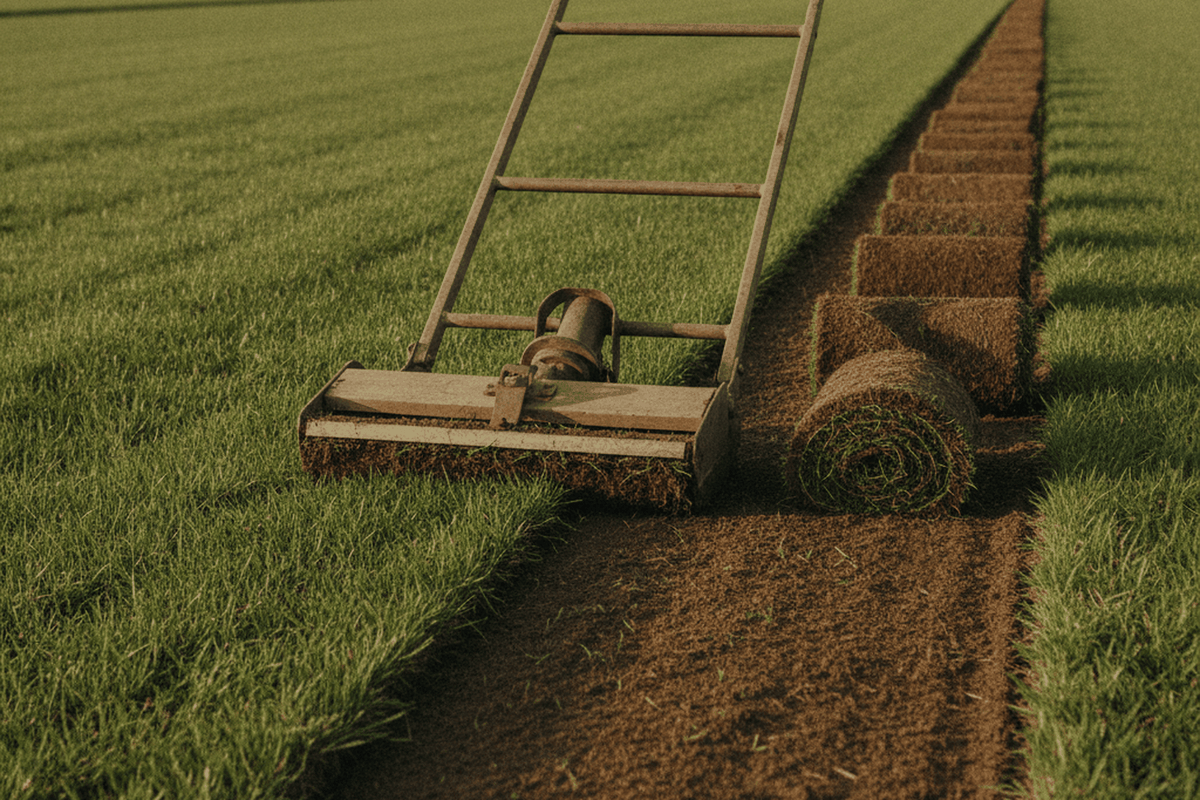
A walk behind sod cutter is a small engine driving a blade that reciprocates just under the surface while the machine crawls forward. It cuts a strip twelve to eighteen inches wide at a depth you set, usually between one and two and a half inches, and leaves the turf lying in continuous ribbons for you to roll and carry. The cutting is fast. The carrying is not, and that is the part people forget when they book the machine.
Rental yards and the big home centers rent them by the half day or the day, commonly about $80 to $120. The machine weighs a few hundred pounds, so check that you have a trailer or that the yard delivers, and that you can get it in without lifting it over a step.
The trip starts paying for itself somewhere between two hundred and five hundred square feet, and above that it is not close, especially when a whole lawn is coming out for a renovation. It loses on slopes, in ground full of rocks or tree roots, and around tight curves and narrow side yards where you spend the day turning the machine around. For a single bed the size of a car, the rental trip alone takes longer than doing the job by hand.
How to remove grass without digging: smothering and solarizing
Both of these kill the grass in place and leave the root mass to break down into the soil, which is genuinely better for soil structure than stripping it off. Both cost you time instead of labor.
Sheet mulching with cardboard
Mow the grass short, then cover it with plain corrugated cardboard, overlapping every seam by six to eight inches so no light gets through the joints. Pull off packing tape, labels and staples first, and skip anything glossy. Soak the cardboard thoroughly, then put four to six inches of mulch or compost on top to hold it down and keep it dark. Fall leaves work here if you shred them first, since whole leaves mat into a shell that sheds water.
Ordinary cool season lawn grass is dead in two to four months, so cardboard laid in fall gives you a bed to plant in spring, and the cardboard itself is usually gone by then. Where it fails is running grasses such as Bermuda and quackgrass, which travel underground and simply come up outside the covered area, so extend your sheet a foot beyond the bed line and expect to pull escapees. If you need to plant sooner, you can plant into pockets of compost on top of the cardboard the same day and let the grass die underneath.
Solarizing under clear plastic
Solarizing cooks the top few inches of soil rather than starving it of light. Mow low, water the ground until it is wet several inches down, then lay clear plastic, not black, directly on the soil and bury or weight every edge so the heat cannot escape. Leave it through the hottest four to eight weeks of summer.
Done in full sun in a hot region it kills the grass, a good share of weed seeds near the surface and some soil borne disease with it. Done in a cool, cloudy or coastal summer it mostly grows a greenhouse. The heat is also indiscriminate, so the beneficial soil life in that top layer goes with everything else. In cooler climates use an opaque tarp instead and give it a full season. It works by darkness rather than heat, so it is slower but far less weather dependent.
What to do with the sod you remove
Do not send it to the curb if you have anywhere to put it. Stacked upside down in a hidden corner, kept damp and covered, sod rots down into some of the best soil on the property in six to twelve months. Use it to fill a low spot, build up a berm, or top off beds next season. For a low spot under live grass, our guide on how to level a yard covers topdressing a shallow dip and lifting the sod over a deeper one.
It also patches. Lift a few good pieces before you start and keep them aside to repair bare spots elsewhere in the lawn. Sod keeps about a day rolled up in warm weather, longer if you unroll it in the shade and water it.
Two cautions before you find a home for it.
- Do not bury sod deep under a new lawn or path. It decomposes, and the ground settles unevenly a year later.
- Do not compost turf that has been treated with a persistent broadleaf herbicide. Those products survive composting and will damage tomatoes and beans in whatever you spread it on.
If the bed you are opening is heavy ground, our clay soil guide covers what to do with it once the grass is off.
Tools for this job
What this job actually calls for, whether you are cutting the sod out today or covering it until spring.

Spear Head Spade 40 inch D-Handle Garden Spade
Cuts the turf outline with the point, then lays over almost level to undercut each strip, so one tool does both halves of the job.
Colwelt Saw-Tooth Half Moon Edger
Its crescent blade is the specialist for long, formal bed lines, and it makes the outline cut and the cross cuts quickly. It will not undercut, so you still need a spade or a lifter.
Check price on AmazonBully Tools Heavy Duty Sod Lifter
A dedicated flat head for the undercutting pass, worth owning if you strip sod often enough to want a purpose built lifter.
Check price on AmazonDeWitt Natural Paper Mulch Weed Barrier, 4 feet by 300 feet
For sheet mulching a big area when you cannot collect enough clean boxes, it rolls out in one pass with no tape or staples to strip.
Check price on AmazonCARTMAN 10 by 12 foot Waterproof Poly Tarp, 8 mil
Drags the stripped rolls off the lawn in one trip, and doubles as the opaque cover for smothering grass in climates too cool to solarize.
Check price on AmazonCommon questions
How deep do you cut sod?
One to two inches is right for most lawns. That is deep enough to take the grass crowns and the bulk of the root mat, and shallow enough that you are not hauling away good topsoil. Go deeper only where the turf is old and the root layer is genuinely thicker than two inches.
Can you put sod in the compost?
Yes, but stack it separately rather than adding strips to an active pile. Pile the pieces grass side down, keep the stack damp and covered, and leave it six to twelve months. It breaks down into good loam. The exception is turf treated with a persistent broadleaf herbicide, which can survive composting and damage what you feed with it.
How long does cardboard take to kill grass?
Two to four months for ordinary cool season lawn grass under wet cardboard and four to six inches of mulch. Start in fall and the bed is ready by spring. Running grasses such as Bermuda and quackgrass take longer and often creep out at the edges, so extend the covered area a foot past the bed line.
Do you need to remove grass before a raised bed?
For a bed twelve inches or deeper, no. Mow low, lay overlapping cardboard on the grass, wet it, and fill on top. The grass dies in the dark. Strip the sod first for shallow beds around six inches, and wherever an aggressive running grass such as Bermuda is already in the area.
The bottom line
For a bed you can pace out in a few strides, cut it into foot wide strips, undercut with the blade almost level, roll, shake the soil back and plant the same day. For a lawn sized area, rent the machine. If you can hand the job to the calendar instead, cardboard and mulch through the fall costs you almost nothing and leaves better soil behind than any of the others.
Disclosure: some links in this guide are affiliate links to Amazon. This is at no extra cost to you, and it never changes our honest, use-based recommendations.