
As an Amazon Associate we earn from qualifying purchases. Some brands also pay us when you click or buy, so those links are ads. Full disclosure below
The best wheelbarrow for home use is a two-wheel poly model: the second wheel removes the balancing act that tips a single-wheel load, and the poly tray never rusts and shrugs off concrete and fertilizer. A one-wheel barrow still wins on narrow paths and planks, a heavy-duty cart wins on volume, and a dump cart wins when you tow more than you push.
A wheelbarrow is the tool you buy once a decade, which is exactly why so many people buy the wrong one. The barrow that suits a mason pouring concrete is a miserable partner for a gardener moving mulch, and the light stamped-steel special at the big box store rusts through before the tires wear out. This guide picks the best wheelbarrows and garden carts by the job you actually do, and it is honest about which style belongs in which yard. This page is one stop on our fall yard cleanup tools checklist, which puts every fall job in order.
Best wheelbarrows at a glance
| Wheelbarrow | Best for | Why it wins | Where to buy |
|---|---|---|---|
| Best Choice Products dual-wheel barrow (best overall for home use) | Everyday garden hauling: mulch, soil, plants | Two front wheels end the tipping problem; built-in stand keeps it level while you load | Check price on Amazon |
| Classic single-wheel barrow | Narrow paths, planks, and tight corners | One wheel pivots in place and tracks a board; the traditional choice for a reason | Amazon, hardware stores |
| VEVOR heavy-duty cart | Big loads: firewood, stone, full-bed cleanups | 7 cubic feet and a 1,200 lb rating move in one trip what a barrow moves in three | Check price on Amazon |
| Gorilla Carts poly dump cart | Yards where you tow more than you push | Four wheels, a pull handle, and a quick-release bed that dumps where you point it | Check price on Amazon |
| WORX Aerocart 8-in-1 | Small properties that need one tool for everything | Converts from barrow to dolly to bag holder; replaces a shed corner of single-use gear | Check price on Amazon |
What is the best wheelbarrow for home use?
For most gardens, a two-wheel poly wheelbarrow like the Best Choice Products dual-wheel barrow. The reasoning is simple: the single most common wheelbarrow complaint is tipping, and a second wheel removes the balancing act entirely. You steer it with one hand, park it on a slope without drama, and the poly tray never rusts. Two wheels take the balancing off your arms, though no barrow makes a slope safe: on a grade, load lighter than you would on the flat. Purists will tell you a single wheel is more maneuverable, and they are right, but maneuverability only matters on the day you thread a plank or a narrow gate. Stability matters every single load.
How to choose a wheelbarrow
Five decisions separate the barrow you keep for twenty years from the one that ends up rusting behind the shed.

- Poly or steel tray. Poly (heavy plastic) is lighter, never rusts, and shrugs off fertilizer and concrete residue; it is the right call for nearly all garden work. Steel takes more abuse from sharp rock and hot loads but rusts the moment the paint chips, and it adds real weight before you have loaded anything.
- One wheel or two. One wheel pivots on the spot, runs a plank, and dumps with precision. Two wheels (a 2 wheel wheelbarrow) remove most of the tipping risk and cut the strength needed to keep a heavy load level. If loads regularly go over rough ground on a narrow path, take one wheel; everywhere else, take two.
- Pneumatic or flat-free tires. Air-filled tires ride softer over roots and steps but go flat, always on the day you need them. Flat-free (solid or foam-filled) tires never quit and cost you only a slightly harder ride. On carts with four small wheels, flat-free is the easy call.
- Capacity. Home barrows run about 4 to 6 cubic feet; contractor barrows and big carts run 7 and up. A cubic foot of damp soil weighs around 75 to 100 lb, so the limit is usually your back, not the tray. Buy for the bulky loads (mulch, leaves, brush), not the dense ones.
- Handles. Traditional twin handles give the most dumping control. A loop handle lets you pull with one hand and works better for smaller-framed gardeners. Cart-style pull handles take the lifting out of hauling, since the wheels carry the load, but Penn State Extension's lifting advice is to push rather than pull if possible, so a cart is not automatically easier on your back.
How many wheelbarrow loads are in a cubic yard?
Bulk mulch, soil and gravel are sold by the cubic yard, and one cubic yard is 27 cubic feet. Divide 27 by the tray's capacity and round up: a 6 cubic foot tray needs at least 5 trips per yard (27 divided by 6 is 4.5), and a 4 cubic foot cart needs at least 7. Treat that as a volume-only floor, not a load plan. Real hauling usually takes more trips, because a tray is seldom filled to its rated capacity, wet soil and gravel get heavy long before the tray is full, and the load you can move comfortably sets the count. To count bags rather than cubic feet, our garden cart guide works out, cart by cart, how many bags of mulch or topsoil fit by volume and by weight.
Here is the same arithmetic for the picks on this page, from the capacity each listing states. Pick 2 is a style rather than one listing, and the WORX Aerocart's listing gives no tray volume, so both are left out.
| Pick | Capacity (per listing) | Trips per cubic yard, by volume alone | Overall size and storage (per listing) |
|---|---|---|---|
| 1. Best Choice Products dual-wheel barrow | 5 cu. ft. | At least 6 | 58 x 27.5 x 26 in. (length x width x height); can be stored upright |
| 3. VEVOR heavy-duty cart | 7 cu. ft. in its title; 6.48 cu. ft. in its feature list | At least 4 at 7 cu. ft.; at least 5 at 6.48 cu. ft. | Not stated |
| 4. Gorilla Carts poly dump cart | 4 cu. ft. | At least 7 | Bed 36 x 20 in.; overall size not stated |
Tray volume is not a safe payload. A listing's load rating is the maker's stated ceiling, and your own strength is usually the lower limit (see "Capacity" above). Penn State Extension's advice on gardening with fewer aches and pains covers the loading itself: test the weight of a load before you lift it, lift the handles to elbow height with your legs rather than your back, and open big bags of soil or mulch and move them in smaller loads. If a load feels heavy at the first lift, take some out and make it two trips.
Check the route and the storage spot before you buy
A barrow that suits the job can still be the wrong size for the yard. Four checks before you order:
- The narrowest gap. Measure the tightest gate, side path or doorway on the route, and compare it with the overall width the maker lists for the barrow, handles and wheels included, not the tray alone.
- Room to turn and tip. Leave space at the far end to swing the barrow around and dump it. A single wheel pivots in a tight space; a four-wheel cart needs a wider circle.
- Rough and sloping stretches. Walk the route before you load, and clear hoses, tools and branches off it. Where it crosses roots, steps or a slope, plan a lighter load or an extra trip.
- The storage spot. Measure where the barrow will live against its overall length and width, and check whether the listing says it can be stored upright, which takes less floor.
Compare wheelbarrows and garden carts: capacity, load and tires
This table lines up what each pick's own Amazon listing states, so you can compare the barrows and carts on this page side by side. Pick 2 is left out because it is a style of barrow rather than one listing, and where a cell says a figure is not stated, the listing gives none.
| Pick | Type (per listing) | Tray and frame (per listing) | Capacity (per listing) | Load rating (per listing) | Tires (per listing) |
|---|---|---|---|---|---|
| 1. Best Choice Products dual-wheel barrow | Two-wheel barrow | Plastic bin on a powder-coated steel frame | 5 cu. ft. | 330 lb | Two 14 in. inflatable rubber wheels |
| 3. VEVOR heavy-duty cart | Four-wheel cart; pull it by hand or tow it behind an ATV, UTV, tractor or lawn mower | Metal frame with a coated finish; sold as a poly dump cart | 7 cu. ft. in its title; 6.48 cu. ft. in its feature list | 1,200 lb | 13 in. rubber tires |
| 4. Gorilla Carts poly dump cart | Four-wheel pull cart with a quick-release dump bed; made for hand use, not towing | Poly bed, 36 x 20 in., on a powder-coated metal frame | 4 cu. ft. | 600 lb | 10 in. pneumatic tires |
| 5. WORX Aerocart 8-in-1 | Two-wheel convertible: barrow, dolly and hand cart | All-metal frame | Not stated | Loads up to 300 lb; lifts up to 200 lb as a dolly | Flat-free tires |
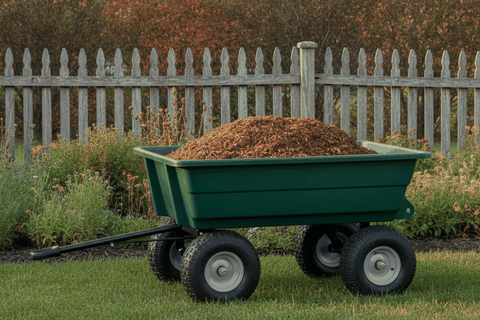
The four-wheel carts carry the largest load ratings here because the frame and wheels hold the whole weight, not your arms. The two-wheel barrows are the ones to reach for when you want to steer a load through the beds and tip it right where it goes.
The best wheelbarrows, by job
The best wheelbarrow depends on what you haul, how far, and over what ground. These five cover the realistic cases.
1. Best Choice Products dual-wheel barrow: best overall for home use
This is the barrow for the gardener who wants to load mulch without a wrestling match. The two front wheels carry the balance for you, so a full tray of soil stays level even for someone who has no interest in forearm workouts, and the built-in stand holds the tray steady while you shovel into it. The poly tray keeps the weight civilized and the rust away. Its limits are inherited from the two-wheel layout: it will not thread a plank, and on a badly rutted path the twin wheels find both ruts at once. For flat-to-normal yards, that trade is easy to accept.
2. Classic single-wheel barrow: best for narrow paths and tight corners
The traditional barrow earns its keep the day the load has to go somewhere awkward: down a 30 inch side path, across a plank onto a raised bed, between fence posts. One wheel means the whole load pivots around a single point, which is why masons never gave it up. It also demands the most from you, since your arms are the outriggers. Look for a 6 cubic foot poly tray on a steel undercarriage and a pneumatic tire, from the established names on Amazon or any hardware store. Skip the sub-4-cubic-foot stamped steel versions; they are toys with handles.
3. VEVOR heavy-duty cart: best for big loads
When the job is measured in yards of material rather than trays, volume beats finesse. The VEVOR heavy-duty cart holds 7 cubic feet and is rated to 1,200 lb, which is firewood, wet soil, and stone territory. Loads like that belong on four wheels, and the cart layout obliges. It is overkill for deadheading season, and it wants storage space, but for property owners with real hauling on the calendar it collapses three trips into one.
4. Gorilla Carts poly dump cart: best garden cart alternative
Half the yards in America do not actually need a wheelbarrow; they need a wagon. The Gorilla Carts 4 cubic foot poly dump cart rolls on four wheels, so nothing balances on your arms at all, and the quick-release dump bed tips the load out where you stop. Penn State Extension's advice is still to push rather than pull if possible, so keep each load light enough to pull comfortably, and the low bed height makes loading easier for anyone with shoulder or knee complaints. The trade-off is agility: four wheels need a wider turning circle, and dumping is less precise than a barrow's controlled tip. For mulch runs from driveway to beds, it is the comfortable answer.
5. WORX Aerocart 8-in-1: best do-it-all for small properties
The WORX Aerocart is the Swiss Army answer: a compact two-wheel barrow that converts into a hand dolly, a bag holder, a rock lifter, and a plant mover. The design puts the load over the wheels, so its effective lifting feel is far lighter than its tray size suggests. No single mode beats a dedicated tool, and the smaller tray means more trips on big mulch days, but if your storage is one garage corner and your jobs change weekly, one convertible beats four specialists.
What is the best heavy duty wheelbarrow?
For the heaviest loads on this page, the VEVOR heavy-duty cart (pick 3). Its listing gives a 1,200 lb load rating on a metal frame with 13 inch rubber tires, and you can pull it by hand or hitch it behind an ATV, UTV, tractor or lawn mower, which suits firewood, stone and wet soil. For concrete, masonry and rock work, the traditional heavy duty tool is a single-wheel contractor barrow with a steel tray: one wheel lets you tip a heavy load exactly where it has to go, and steel stands up to sharp stone and hot loads (see "Poly or steel tray" above).
Three things make a barrow or cart heavy duty. The frame: a steel or powder-coated metal frame carries the weight, whatever the tray is made of. The wheels: larger tires roll over ruts and gravel with less effort, and four wheels spread the load so none of it rests on your arms. The rating: a stated load rating lets you compare two listings, and the ratings on this page are 330 lb for the Best Choice Products barrow, 600 lb for the Gorilla Carts dump cart, 1,200 lb for the VEVOR cart, and loads up to 300 lb for the WORX Aerocart.
For most home yards, a heavy duty rating is not the limit. Damp soil runs 75 to 100 lb per cubic foot, so your own strength usually gives out before the frame does. Buy heavy duty for stone, firewood, wet soil and concrete, and a lighter barrow for mulch, leaves and plants.
What is the best small or lightweight wheelbarrow?
For small yards and narrow paths, two shapes work best. The classic single-wheel barrow (pick 2) is the narrow one: a single wheel tracks a board or a 30 inch side path and turns in its own length. The WORX Aerocart (pick 5) is the compact two-wheel choice for a small property. Its listing describes an all-metal frame on flat-free tires that also works as a dolly and a hand cart, and it says lifting 200 lb with it feels like lifting 17 lb, because the load sits over the wheels.
Lightweight is about empty weight and balance as much as tray size. A poly tray weighs less than steel before you load anything, and a second wheel takes the balancing off your arms. That is why the Best Choice Products dual-wheel barrow (pick 1), with its plastic bin and padded handlebar, is a steady everyday barrow to handle. Pick by the narrowest gap you have to get through and by the loads you move most, not by the biggest tray.
What about electric wheelbarrows?
Power-assist barrows put a battery and hub motor under the tray, and they make sense in two situations: slopes that make a loaded barrow genuinely unsafe, and gardeners who have the will but no longer the back. They cost several times what a manual barrow does, add charging to your chore list, and add weight you feel the day the battery is flat. Try the manual options first; if your ground argues, the electric category on Amazon is maturing fast.
One more pairing worth naming: a wheelbarrow moves what a spade digs, and the two tools set each other's pace. If the digging half of your day needs an upgrade too, our guide to the best shovels for digging covers that side.
Frequently asked questions
Is a one-wheel or two-wheel wheelbarrow better?
Two wheels are better for most home gardeners because the barrow balances itself: heavy loads stay level with one hand and are far less likely to tip on a slope. One wheel is better on narrow paths, planks, and tight turns, where the single pivot point lets you steer precisely. Choose based on your paths, not tradition.
Is a poly or steel wheelbarrow better?
Poly is better for garden use: it is lighter, never rusts, and is immune to fertilizer, concrete residue, and rain. Steel tolerates sharp rock and rough treatment better and suits masonry work, but it rusts wherever the finish chips and adds noticeable empty weight. Most gardeners who switch to poly do not go back. Either tub rinses clean under a hose, and our best garden hoses guide picks a hose by job.
What size wheelbarrow do I need?
A 4 to 6 cubic foot tray covers nearly all home gardening. Damp soil runs 75 to 100 lb per cubic foot, so bigger trays hit your lifting limit long before they are full of anything dense. Size up to 7 cubic feet or more only for bulky, light loads like leaves and brush, or move to a towed cart instead.
Should I buy a wheelbarrow or a garden cart?
Buy a wheelbarrow if you dump with precision, work in tight spaces, or cross rough ground on narrow paths. Buy a garden cart if you mostly move material from point A to point B over open ground: four wheels carry all the weight, so there is nothing to lift or balance, and the low bed loads easily. Penn State Extension's lifting advice is to push rather than pull if possible, so keep each load to what you can pull comfortably. Big properties often justify one of each.
What is the best two wheel wheelbarrow?
For most home gardens, the Best Choice Products dual-wheel barrow (pick 1). Its two 14 inch inflatable rubber wheels carry the balance, its plastic bin sits on a powder-coated steel frame, and the padded handlebar doubles as a stand while you load. If you want one tool that also works as a dolly and a hand cart, the WORX Aerocart (pick 5) is a two-wheel convertible on flat-free tires.
What is the best wheelbarrow for seniors?
One that balances itself and loads low. A two-wheel barrow like the Best Choice Products model keeps a load level without you balancing it, and a four-wheel cart like the Gorilla Carts dump cart takes the weight off your arms altogether: you pull it by its handle, and its low bed is easy to load. Whatever you choose, fill it only as far as you can move it comfortably.
What is a good alternative to a wheelbarrow?
A garden cart. A four-wheel cart such as the Gorilla Carts dump cart or the VEVOR heavy-duty cart carries the load on its own wheels, so there is nothing to lift, and a dump bed tips the load out where you stop. For a small property, the WORX Aerocart works as a barrow, a dolly and a hand cart in one. For bulky, light material like leaves, a tarp dragged across the lawn is the simplest alternative of all.
The bottom line
Match the barrow to the yard. Flat suburban lot and regular mulch runs: the two-wheel Best Choice barrow is the calm, stable default. Narrow paths and precise dumping: stay classic with a single wheel. Serious volume: the VEVOR cart. More towing than pushing: the Gorilla Carts dump cart. One corner of storage for every job: the WORX Aerocart. Whichever carries your loads, our essential garden tools list covers the rest of the shed. What goes in the barrow usually comes from three jobs: improving clay soil, leveling a yard, and hauling finished compost out of whichever bin you pick in our compost bin guide.
A quick word on us: Spear Head Spade is a family business in New Jersey. We sell the double-patented digging spade the site is named for, with over 600,000 sold. What fills the barrow is usually soil, and our tool for moving it is the D-handle garden spade.
Disclosure: some links in this guide are affiliate links to Amazon. This is at no extra cost to you, and it never changes our honest recommendations.
Product prices and availability are accurate as of the date/time indicated and are subject to change. Any price and availability information displayed on Amazon.com at the time of purchase will apply to the purchase of this product.