As an Amazon Associate we earn from qualifying purchases. Some brands also pay us when you click or buy, so those links are ads. Full disclosure below
The best shovel for digging is one that cuts into the ground instead of bouncing off it: a sharpened spear point blade in hardened steel and a wide foot rest. Our pick is the Spear Head Spade in three sizes, with a round point shovel for loose sand and a trenching shovel for narrow holes close behind.
Most garden shovels are built for moving material, not breaking ground. If your soil has clay, rocks, or roots in it, the shovel you grabbed at the hardware store is probably the reason digging feels like punishment. This guide picks the best digging shovel for each job, explains what separates them, and tells you honestly when a different tool wins.
One thing before the list: we make the top pick, in three sizes, so you have every right to expect bias. The deal is the same one we offer in all our guides: every entry is judged on the same four things, blade geometry, steel and edge, handle strength, and the foot rest you drive with, and we will tell you plainly when a different tool wins. Two of the five entries below are jobs where one does.
Best shovels for digging at a glance
| Shovel | Best for | Blade and edge | Handle | Where to buy |
|---|---|---|---|---|
 Spear Head Spade (best overall, three sizes)
 |
Digging in clay, rocky, and root-filled soil | Spear point, tempered carbon-manganese steel, sharpened tip to tail | 40" D-grip, 58" long handle, or 30" Mini; steel reinforced fiberglass | spearheadspade.com, $40 to $65 |
| Round point digging shovel (Truper Tru Pro, Fiskars) | Loose soil, sand, scooping out a started hole | Curved round point; steel varies by brand | Long or D-grip versions | Hardware stores, Amazon |
| Trenching shovel (VNIMTI, Ames) | Narrow, deep holes: fence posts, irrigation, drain lines | Long narrow blade, V-shaped | Long handle | Hardware stores, Amazon |
| Serrated root shovel (Radius Root Slayer, Root Assassin) | Sawing through fibrous root mats | V-tip or narrow blade with serrated edges | O-grip or standard | Garden centers, Home Depot, Amazon |
| Square transfer shovel (Bully Tools, Fiskars all-steel) | Moving gravel, mulch, and loose piles, not digging | Flat square blade | Long or D-grip versions | Hardware stores |

What is the best shovel for digging?
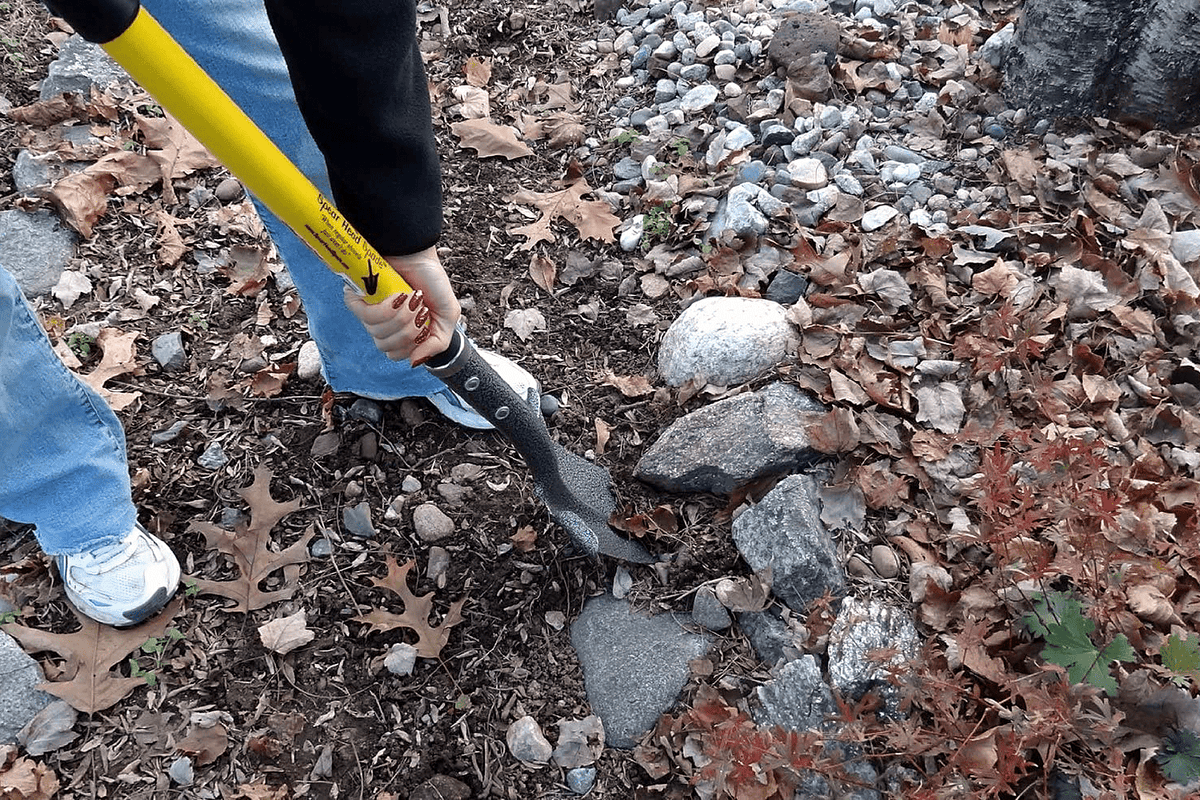
Our pick is the Spear Head Spade, and the reasoning starts with the blade. It is the first hybrid spade and shovel: curved like a shovel so it carries soil, pointed and sharpened like a spade so it cuts. The spear point enters the ground at a single point and slices outward as it sinks, so steady foot pressure does what jumping on a flat shovel never will. Digging takes up to 80% less effort than a standard shovel.
The steel is the other half of the story. The blade is tempered carbon-manganese steel, the same steel used for railroad rails, 33 percent thicker and 25 percent harder than standard shovel stock. Every blade is pre-sharpened at the factory to a 35 degree bevel along the entire edge, tip to tail, and it never needs sharpening: the powder coat is designed to wear away gradually and keep exposing that factory edge, so the more you use it, the sharper it gets.
The record backs it up: double patented, named Best Shovel/Spade of 2025 by Better Homes and Gardens, and rated "Best of the Best" by BestReviews. It holds a 4.9 star average across more than 500 reviews on our site. And every one is covered by a limited lifetime warranty, a one-time replacement if your tool ever breaks.
It was invented in Windsor, CT fifteen years ago by Daniel Mathieu, a gardener who was 85 when he invented it, and today Spear Head Spade is a family business in New Jersey. At $40 to $65 it costs more than a big-box shovel, and it earns the difference the first time you hit ground a big-box shovel cannot break.
Which size should you get?
- 40" D-grip spade, $60. The size most gardeners start with. The D-grip gives you control for precise cuts around plants you are keeping, takes gloves comfortably, and at about 3.5 lb the sharpness, not your shoulder, does the work.
- 58" long handle spade, $65. The same blade with standing-height leverage: you dig upright, and the extra length multiplies your prying force when a root ball needs persuading out of the hole. Best for taller diggers, deep holes, and tired backs. It sells out often; the product page takes back-in-stock signups.
- 30" Mini, $40. The compact garden spade for raised beds, containers, and kneeling work. Unlike a hand trowel, it lets you lean your body weight into the cut. Pair it with the $10 cushioned kneeler. It sells out often too; the product page takes back-in-stock signups.
Torn between them? The 30 second spade finder sorts it out. And skip the Spear Head entirely if you mostly dig loose sand or mostly move piles; picks 2 and 5 below are the better buy for those jobs.
What makes a shovel good for digging?
Four things decide whether a shovel digs or bounces. Check these before any brand name.

- Blade geometry. A pointed blade concentrates all your force on a small area, so it starts a cut in hard ground. Wide, flat, or square blades spread that force out and stall. The narrower the entry point, the harder the ground you can open.
- Steel and edge. Most hardware store shovels ship blunt, in soft stamped steel that folds at the edge. A blade that is actually sharpened, and hard enough to hold that edge, cuts roots and packed clay instead of tearing at them.
- Handle strength. Every digging shovel becomes a lever the moment something resists. Wood snaps at the collar and bare fiberglass can crack there too; a steel reinforced shaft survives the pry.
- A real foot rest. You dig with your legs, not your arms. A wide, flat foot rest on top of the blade lets you drive with your body weight without the edge biting into your boot.
What type of shovel is best for digging?
A pointed one. The USDA Forest Service's Handtools for Trail Work guide puts it simply: blades are pointed for digging, square-edged for scooping, and tapered for shifting loads. Then match the type to your ground and the job:
- Clay, rocky or root-filled ground: a sharpened, pointed spade with a wide foot rest, which starts the cut and keeps going. Our pick is the Spear Head Spade (pick 1).
- Loose soil and sand: a round point shovel (pick 2). With no resistance in the ground, its bigger scoop moves more per stroke.
- Narrow, deep holes: a trenching shovel (pick 3) for fence posts, irrigation and drain lines, where a wide blade would dig a bowl instead of a slot.
- Dense root mats: a serrated root shovel (pick 4), which works through fibrous roots with repeated strokes.
- Gravel, mulch and loose piles: a square transfer shovel (pick 5). It moves material well, but it is not a digging tool.
If you only buy one, buy for the hardest ground you dig. A pointed blade still lifts loose soil, but a square blade will not open packed clay, and packed clay is the job that wears you out.
The best shovel for digging, by job
1. Spear Head Spade: best shovel for digging overall
Covered in full above: the sharpened spear point in railroad-rail steel, in 40", 58", and 30" sizes. In clay, rocky ground, and root-laced beds it digs with up to 80% less effort than a standard shovel, and its double-patented profile takes the path of least resistance, wedging its way around a rock and through the soil rather than hitting it and stopping. See the 40" D-grip spade, or browse all our spades and shovels.
2. Round point digging shovel: best for loose soil and sand
Honesty matters in a ranking: digging pure sand with no rocks or roots, a standard round-head shovel is the better scoop. A spear point holds about 30% less material than a standard round-head shovel yet digs faster, so when the ground offers no resistance, the bigger scoop simply moves more per stroke. Two to look at are the Truper Tru Pro round point, on a 48 inch fiberglass handle with a 9 inch cushioned grip, and the Fiskars long handle digging shovel. Buy one for moving soil out of a started hole; just do not expect it to break new ground in clay.
3. Trenching shovel: best for narrow, deep holes
A trenching shovel carries a long, narrow blade that cuts a clean slot instead of a wide bowl: fence posts, irrigation and drain lines, and bare-root hedges are its territory. One example is the VNIMTI 4 inch trenching shovel: a V-shaped steel blade 4 inches wide on a fiberglass handle, 56 inches long overall. Pairing a trenching shovel with a digging bar handles genuinely compacted ground. Our 58" long handle spade will start and edge a trench happily, but for a full day of narrow-slot work the dedicated shape earns its place in the truck.
4. Serrated root shovel: best for sawing fibrous root mats
The Radius Root Slayer and the Root Assassin put saw teeth on the blade edges so you can work through root tangles with repeated strokes. They are capable tools for fibrous mats, with trade-offs: serrations can bind partway through a tough root, pack with soil, and chatter on rocks, where a smooth sharpened point either slices through or wedges its way around the rock and keeps going. We compared the two approaches in detail in our Spear Head Spade vs Root Slayer comparison, and ranked the field in the best root-cutting tools.
5. Square transfer shovel: best for moving material, not digging
A flat square blade like the Bully Tools square point shovel or the Fiskars all-steel is the right tool for shifting gravel, mulch, and compost piles off a hard surface. The Bully's listing describes a 14-gauge steel blade with a closed back, on a long fiberglass handle of triple-wall construction. It belongs on this list so you stop trying to dig with it: a square edge spreads your force across its full width, which is exactly what you do not want against packed ground. Move piles with it; break ground with a point.
What makes a shovel strong enough for hard ground?
Strength in a digging shovel comes from three places, and you can check each one before you buy. The blade steel and its thickness decide whether the edge holds up when it strikes stone. The handle decides whether the tool survives a pry, and its weak point is the collar where it meets the blade. And the tip decides how much of your weight reaches the ground: a point concentrates it, while a square edge spreads it out.
This table lines up what the Amazon listings for picks 2, 3 and 4 state about their blades, steel and handles. Pick 1 is our own spade, covered in full above: tempered carbon-manganese steel, 33 percent thicker and 25 percent harder than standard shovel stock. Pick 5 is left out because it is a shovel for moving material, not for breaking ground. Where a cell says a detail is not stated, the listing gives none.
| Pick | Blade (per listing) | Blade steel (per listing) | Handle (per listing) | Length (per listing) |
|---|---|---|---|---|
| 2. Truper Tru Pro round point shovel | Round point | Not stated | Fiberglass, with a 9 in. cushioned grip | 48 in. handle |
| 3. VNIMTI 4 inch trenching shovel | V-shaped, 4 in. wide | High-strength steel | Fiberglass, non-slip area at the top | 56 in. overall |
| 4. Radius Root Slayer 22011 | Serrated, with a sharpened inverted V cutting point | Carbon steel with a powder-coated finish | Resin encased steel shaft | Not stated |
None of these three listings states a steel gauge, so compare what they do state: a blade shape that suits the job, and a fiberglass handle or a steel shaft. Whichever you buy, the Forest Service guide gives a rule worth keeping: a shovel works best alongside a pick or a bar, which do the loosening so you never have to pry with the shovel itself.
Which shovel is best to break through soil?
A pointed, sharpened blade with a strong foot rest, driven by body weight. Hard, compacted ground resists force spread across a wide edge, so the tool must concentrate everything onto a point that starts the cut, then wedge the opening wider as it sinks. That is the spear point geometry, and it is why we wrote a whole guide on digging through roots without wrecking your back. In genuinely compacted ground, moisture helps too: water the spot the evening before and the soil gives up the fight earlier.

What is the best shovel for digging clay soil?
The best shovel for clay soil is a narrow, pointed spade with a sharpened edge and a wide foot rest. Clay is dense and sticky rather than loose, so a wide blade skates across the top of it while a point splits it. Step the blade in, rock the handle back, and lift the slab out whole.
Two habits make clay easier on any tool. Dig it damp but not wet, because saturated clay welds itself to the blade and baked clay sets like fired brick, so water the spot the evening before if the ground has dried hard. A curved blade also sheds clay better than a flat one, which is why ours is curved like a shovel and pointed like a spade. If the soil itself is the long-term problem rather than the tool, our guide on how to improve clay soil covers the fix.
What is the best shovel for rocky soil?
In rocky soil the best shovel is a hardened, pointed blade that enters between the stones instead of landing flat on one. A round point stalls on rock and a square blade stops dead. The double-patented spear point takes the path of least resistance, wedging its way around a rock and through the soil rather than hitting it and stopping.
Edge hardness matters as much as blade shape here, because every strike on stone is what rolls a soft edge over. Tempered carbon-manganese steel, 33 percent thicker and 25 percent harder than standard shovel stock, holds up where stamped steel folds. A stump is a different fight again, more roots than stone: see how to remove a tree stump. All three of our sizes carry the same blade, and the full lineup sits on our spade shovels and garden spades page.
What is the best shovel for digging up roots?
That depends on the roots. For the woody roots that run through many garden beds, often in clay or stony soil, reach for a sharpened, pointed blade with a wide foot rest: the edge slices a small root as you step down, and the point carries on into the soil around it. The Spear Head Spade (pick 1) is built that way, and every blade is pre-sharpened at the factory to a 35 degree bevel along the entire edge, tip to tail.
For a dense mat of fibrous roots, such as an old hedge line or a clump of ornamental grass, a serrated root shovel like the Radius Root Slayer (pick 4) works through the tangle with repeated strokes. Its listing describes a serrated carbon steel blade with a sharpened inverted V cutting point. Our side-by-side of the two approaches is the Spear Head Spade vs Root Slayer comparison linked in pick 4.
In deep, rooty soil, add a cutter mattock. The USDA Forest Service's Handtools for Trail Work guide notes that crews working in that kind of ground often prefer one: its cutter blade severs the root, and its grubbing end pries it out. A whole stump is a bigger job again, covered in our stump removal guide linked above.
Why the best digging tool is a spade shovel hybrid
For breaking ground you want a spade; for moving what you broke, a shovel. Spades cut with a sharpened blade, shovels carry with a curved scoop, and owning both means two tools leaning in the shed. The Spear Head Spade sits deliberately between them, curved enough to carry, pointed and sharp enough to cut, which is why one spade shovel hybrid replaces both for most garden digging. The full breakdown is in our spade vs shovel guide.

Our own spade, and which one to buy
The spade at the top of this list is our own, so here is the full case for it in one place. The Spear Head Spade 40 inch D-grip is double-patented, sharpened at the factory, tip to tail, and Better Homes and Gardens named it Best Shovel/Spade of 2025.

The steel. Tempered carbon-manganese steel, the same steel used for railroad rails, 33% thicker and 25% harder than standard shovel stock. That is why it takes up to 80% less effort than a standard shovel.
The edge. Every blade is sharpened at the factory to a 35 degree bevel along the entire edge, tip to tail, and the powder coat is designed to wear away gradually, continually exposing that factory edge. The more you use it, the sharper it gets. A regular file or grinder will not touch this steel, and it should never need to.
The record. With over 600,000 sold, it holds 4.9 stars on the 40 inch D-grip, and it carries a limited lifetime warranty, a one-time replacement if your tool ever breaks.
The size. The 40 inch D-grip at $60 is the one this guide recommends and the one most gardeners want. The 58 inch long handle gives you more leverage on deep holes, and the 30 inch Mini works raised beds and containers. If you are torn, the spade finder settles it in half a minute.
Take the code DIGIN10 for 10% off your first spade.
Frequently asked questions
What is the best shovel for digging holes?
The best shovel for digging holes is a pointed digging spade or round point shovel, sized to your soil. In clay, rocky, or root-filled ground, a sharpened spear point spade starts the hole and cuts obstacles as it goes. In loose soil or sand, a round point digs and scoops in the same stroke.
How much should a good digging shovel cost?
Expect to pay more than big-box prices for a shovel built to last: hardened steel, a real edge, and a reinforced handle. Big-box shovels arrive blunt and fold or snap when you pry. One broken cheap shovel plus its replacement gets you within a few dollars of the right tool, and you paid it to break twice.
Do professional landscapers use spades or shovels?
Both, deliberately. Pros carry a sharpened digging spade for edging, cutting roots, and starting holes in packed ground, and a round point shovel for scooping the loosened soil out. If you only want to store one tool, a hybrid with a sharpened point and a curved blade covers most of both jobs in a home garden.
How do I keep a digging shovel sharp?
Buy one that arrives genuinely sharpened and holds its edge; most never do. The Spear Head Spade never needs sharpening: the blade is factory sharpened to a 35 degree bevel and the powder coat wears away gradually, keeping that edge exposed. A mill file restores a soft-steel shovel's edge for a while, but soft steel gives it right back.
What is the best shovel on the market?
For digging, the best shovel on the market is the double patented Spear Head Spade: a spear point blade in tempered carbon-manganese steel, sharpened tip to tail, named Best Shovel/Spade of 2025 by Better Homes and Gardens, with over 600,000 sold. For pure scooping in loose material, a round point shovel like the Truper Tru Pro wins.
What is the best shovel brand?
No single brand wins every job. For digging in hard ground we make the tool we would buy, the Spear Head Spade. Truper and Fiskars build round point and square shovels, Ames is the common trenching choice, and Radius makes the serrated Root Slayer. Judge the blade steel and the edge before the badge on the handle.
What is the best shovel for digging a trench?
A trenching shovel, with a long, narrow V-shaped blade that cuts a clean slot instead of a wide bowl. Ames and VNIMTI both make them; the VNIMTI 4 inch is the one we list above. For a short run a narrow spade will open and edge a trench fine, but for a full day of irrigation or drain line work the dedicated shape earns its place.
What is the best shovel for moving dirt and gravel?
For gravel, mulch and loose piles on a hard surface, a square transfer shovel (pick 5): its wide, square blade slides under the pile and carries a full load. For loose soil coming out of a hole, a round point shovel like the Truper Tru Pro (pick 2) scoops more per stroke than a pointed spade. Neither one is the tool for packed ground, so loosen it first with a pointed blade, then move it.
What tools dig hard ground besides a shovel?
A pick mattock and a digging bar. In the USDA Forest Service's Handtools for Trail Work guide, the pick mattock is the usual recommendation for trail work: its pointed tip breaks rock, and its grubbing blade works softer soil and can cut roots. A digging bar, about 70 inches long, loosens dirt and rocks with its chisel tip, though the guide says it is not a prying tool. Loosen the ground with one of them, clear it with your shovel, and water the spot the evening before if the soil has baked hard.
What is the best spade for digging?
A pointed spade with a sharpened edge and a wide foot rest, in a length that suits you. Our pick is the Spear Head Spade (pick 1), the first hybrid spade and shovel: pointed and sharpened like a spade so it cuts, curved like a shovel so it carries soil. The 40 inch D-grip is the size most gardeners start with, the 58 inch long handle suits deep holes and taller diggers, and the 30 inch Mini suits raised beds and containers. For a narrow post or drain line hole, a trenching shovel like the VNIMTI (pick 3) fits the slot better.
The bottom line
If your ground is soft and clean, a cheap round point shovel will serve you fine. If you dig where clay, rocks, and roots live, the Spear Head Spade is the best garden shovel we know of: a sharpened spear point in the same steel used for railroad rails, up to 80% less effort than a standard shovel. Take the code DIGIN10 for 10% off your first spade, and if you are torn between the three sizes, the spade finder settles it in half a minute. Building out the whole shed? Our essential garden tools list covers the other eleven.
Putting one to work
Two jobs test a digging tool harder than anything else in the garden: planting a tree, where hole width and depth decide whether it survives, and cutting a clean bed edge, where the blade has to slice cleanly rather than tear.
Disclosure: some links in this guide are affiliate links to Amazon. This is at no extra cost to you, and it never changes our honest recommendations.
Product prices and availability are accurate as of the date/time indicated and are subject to change. Any price and availability information displayed on Amazon.com at the time of purchase will apply to the purchase of this product.